#precalculus
1 messages · Page 104 of 1
 viscid thistle
 willow bear
thank you
 willow bear
that makes sense to do yes
 tawny stag
then you make the demoniator the sane
willow bear
...you don't even need to do that
willow bear
=tex 2\cos(t)\cdot 4\sin(t) - 2\cos(t) \cdot 3\frac{\sin(t)}{\cos(t)}
 granite stirrupBOT
tawny stag
granite stirrupBOT
tawny stag
ohh okay i see it now
i have a question why is it -2cos*3 sin/cos
mostly on why -2cos
willow bear
uhh
because before the simplification, you had 2cos(t) multiplied by the parenthetical? i'm surprised you're asking that
tawny stag
i got it im sorry i confused myself sometimes
viscid thistle
^^ damn i am not that far in math yet
never seen that before, but i like it
that what i meant
 still yew
I have a random question, does anyone but me know the answer of $$i^i$$ and did the work?
granite stirrupBOT
 patent beacon
Ya
still yew
K
 mental wedge
hey
did i do this correctly ?
"Find all 8th roots of 1 and graph them on the complex plane. Be sure to show all work."
 red swan
it seems good to me
willow bear
yup :+1:
mental wedge
thanks
 willow bear
vertical lines with x-coordinates equal to the zeroes of the denominator
 timid jacinth
so if I factor the denominator and find the zeros, I've found the vertical asymptote?
timid jacinth
what
willow bear
in order for x = a to be a vertical asymptote, a has to be a root of the denominator but not the numerator if the fraction is reduced to lowest terms
otherwise, you can make something like (x^2 + 3x)/(x+3), which has a hole at -3 rather than a VA
timid jacinth
why does it have a hole?
willow bear
because f(-3) itself is not defined, but the limit of f(x) as x approaches -3 exists (and is equal to -3)
(where f is my example function ofc)
and like, f(x) = x whenever x != -3
so it's like you've taken the graph of y = x and removed the point at x = -3, leaving a hole
timid jacinth
Ah I see
I kind of get it
I think I'm about to be introduced to what you're talking about
timid jacinth
This is a dumb question, and I can do it normally, but for some reason I'm having trouble factoring 2x^2+7x-4
how should I go about this
red swan
use the discriminant
timid jacinth
that seems a bit lengthy though
the discriminant is
-b sqrt(b^2-4ac) right?
I'd like to just look at it and be able to figure it out in like 10 seconds
red swan
that is one of the solutions, not the discriminant
timid jacinth
what's the discriminant
timid jacinth
so the discrim is just this b²-4ac
red swan
yes
red swan
nop thats wrong
timid jacinth
where'd I go wrong
red swan
a sign
willow bear
well i mean, the lazy way would be to just plug everything into the quadratic formula
get the roots
rewrite original expression as 2(x-a)(x-b), where a and b are your roots
willow bear
the 2, of course, is taken from the original leading coefficient
81 > 0 so you know your thing is factorable in the first place
timid jacinth
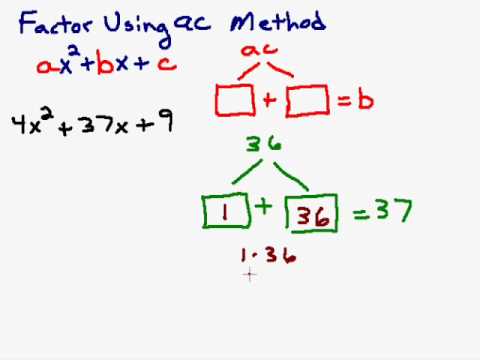
here's how I normally factor stuff, it's called the ac method
willow bear
it's also a perfect square, meaning the factors will be "nice"
 willow bear
(2x-1)(x+4), surely?
timid jacinth
yeah
I'm trying to figure out
why my method isn't working
a*c = -8
then you figure out what multiplies to ac and gives you the b term when added together
-1+8=7
willow bear
i feel like that may not really work for a != 1 but i'm too asleep to try and come up with an Algorithm™
willow bear
like, there's nothing wrong with simply finding the roots using the QF
timid jacinth

yeah but that always takes me forever
I'd like to be able to just look at it and figure it out in like 10 seconds like I normally do using the ac method
do you see why I'm confused now?
nvm
I'm really dumb
forgot a whole step
you have to group if a != 1
so 2x^2+7x-4 = 2x^2-1x+8x-4
(2x^2-1x) (+8x-4)
x(2x-1)4(2x-1)
(x+4)(2x-1)
timid jacinth
so let's say I get really stuck with factoring and I want to use the quadratic formula
to figure out the roots
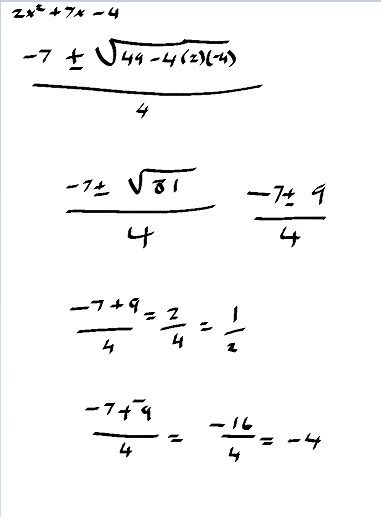
where did I go wrong?
oh wait
hmm
@clever inlet
by using the quadratic formula on the same polynomial, and I want to find out it's factored form, what do I do?
what is the 1/2 and -4 telling me?
 clever inlet
your roots
timid jacinth
so how do I use these numbers to find the factors
timid jacinth
ah
ok
so
when I got x = -4
from the quadratic formula
and I want to know the factor
what's my next step
x = -4
x + 4 = 0
this is the factor
but
I'm not sure how you're just coming up with it
once I find the -4, should I be telling myself, what will make this into a 0?
timid jacinth
sounds familiar
timid jacinth
ok
so I'm right in saying once I find the -4, should I be telling myself, what will make this into a 0?
willow bear
(x-(-4))(x-b) = 0
willow bear
well, yes
timid jacinth
so I have (x+4)(x-1/2)=0
willow bear
and you'll also need to put your leading coefficient in front afterwards
willow bear
and you'll also need to put your leading coefficient in front afterwards
clever inlet
Expand it out
And while the roots are the same as the original quadratic
Its a different quadratic
timid jacinth
I'm a bit lost

I'm not understanding where that lead coefficient of 2 is coming from
clever inlet
What's a in your original quadratic?
timid jacinth
2
timid jacinth
so I just have to go back to my original quadratic 2x^2+7x-4
and pull the 2 from the front?
that seems so arbitrary
clever inlet
You're basically taking the 2 in the denominator and putting it in front of x
timid jacinth
the denominator of the quadratic formula? The 2(a) or the 2(2) in this case?
timid jacinth
Wow I'm really lost
again, that seems arbitrary
we're talking the 2 from (x-1/2) and just sticking it at the front?
what's the concept or math behind that?
clever inlet
Its the same as multiplying through by 2
timid jacinth
we're literally just multiplying the x-1/2 by 2
to get rid of the fraction?
Why is my question I guess?
because it's literally the exact same
2x-1 = x-1/2
right?
clever inlet
Yes
timid jacinth
so what's the point
clever inlet
well looks at the example of say
y = x^2 + 2x +1
and
y = 2x^2 + 4x + 2
same root right?
but different curves
actually that's a meh example
hmm
clever inlet
Yes
timid jacinth
how do I even factor the 2nd one lmao
the ac method doesn't work on it
I'd have to use the quadratic formula on it
clever inlet
2(x+1)(x+1)
clever inlet
Factor out 2
timid jacinth
because for me, it's either the ac method of I'm doing the quadratic formula
clever inlet
2(x^2 + 2x + 1)
timid jacinth
that's factoring out a GCF though right?
clever inlet
Yeah
clever inlet
Yeah
timid jacinth
alright
so we have (x+1)(x+1)
so I see that if we don't stick that 2 from the original quadratic up front, then when we multiply the factors our we'd have a different quadratic than what we started with
clever inlet
Yeah
timid jacinth

Where are they getting these additional values from
cause when I plug in -1 to the r(x) = 2x^2+7x-4 / x^2 + x - 2
I'm getting something completely different
ah nvm
clever inlet
are you doing your substitution correctly?
timid jacinth
I missed a sign
or a few
why did they pick those x values though
they seem a little obscure
timid jacinth
https://gyazo.com/d4c5ab25cb84a7f92ab2efc924dc4d34 why do they pick these numbers for additional vlaues?

@willow bear Are you available?
willow bear
these look arbitrary
timid jacinth
is it because they're inbetween the two verical asymptotes?
because if they didn't pick -0.5, I never would have known how far the graph of inbetween the two asymptotes goes down
willow bear
seems so
timid jacinth
or how deep the U is so to speak
willow bear
if you wanted to figure out exactly how deep it is you'd need calculus
willow bear
p much
timid jacinth
Ok great, and for this one could you clear up the domain for me
they've got the domain as x | x is < 1/2 or x > 7.5
first, shouldn't it be y, not x?
sorry
I'm talking about range!
timid jacinth
Anyone around?
willow bear
first, shouldn't it be y, not x?
formally, it doesn't matter
{ x | x < 1/2 or x > 7.5 } and { y | y < 1/2 or y > 7.5 } describe the exact same set
timid jacinth
So I did my exam, I got a 97/100 but the questions I struggled with was finding x-intercepts
E.g finding the x intercepts of a polynomial likef(x)= 6x^2-3x+7
willow bear
"x-intercept" here is a synonym for "zero"
timid jacinth
So I should have just factored?
 burnt vigil
When it crosses the x axis the function equals 0
So you want to find the values of x that make the function equal 0
willow bear
@timid jacinth you should've used any method you wanted for finding the roots of that polynomial
be it factoring or using the QF
timid jacinth
Ah, so simple. So if a function is presented in standard form, should I rewrite it in ax^2+bx+c form before factoring?
willow bear
define standard form?
timid jacinth
@willow bear for example, if I'm given a polynomial on ax^2+bx+c form and told to put it in a(x-h)^2+k form
And later, I'm told to find the intercepts of a polynomial in the form a(x-h)^2+k, would I want to convert it back to the original ax^2+bx+c form?
willow bear
not necessarily?
i mean there's no Formal Requirement™ on which form you Have™ to use
it's possible in both
i'd wager it's even easier in vertex form since that's basically a completed square
timid jacinth
How do I do it in vertex form?
willow bear
a(x-h)^2 + k = 0
a(x-h)^2 = -k
(x-h)^2 = -k/a
x-h = ± sqrt(-k/a)
x = h ± sqrt(-k/a)
nothing complicated honestly
 unique scarab
Why is the square ±
willow bear
because (-t)^2 = t^2
so an equation like t^2 = s necessarily has two solutions if s is positive
 hallow ember
Does anyone know how to find the range of this
hallow ember
Yes
willow bear
well, what does the graph of this function look like?
hallow ember
it's a small u shape with x intercepts at 2 and -2 and y intercept at -2
hallow ember
o yeah
willow bear
so it should now be obvious what y values it spans
willow bear
=tex -2 \leq y \leq 0
granite stirrupBOT
hallow ember
yes that's the one I came up with at first
willow bear
and that's correct
viscid thistle
I forgot something i think
Is this correct ? $$ (a -bi)^2 = (a^2 - 2abi -b^2) $$ or this $$ (a -bi)^2 = (a^2 - 2abi +b^2) $$
granite stirrupBOT
willow bear
the first one
granite stirrupBOT
-292
granite stirrupBOT
(-1)+0i
willow bear
== (2+3i)^2
granite stirrupBOT
(-5)+12i
viscid thistle
is this correct ?
=tex z^2 - (5 -14i)z - 2(12 + 5i) = z^2 + (-5 +14i)z + (-24 - 10i) = 0
granite stirrupBOT
Failed to parse equation: Invalid token at position 4
tex \begin{equation}     z^2 - (5 ...
    ^
Support the bot on Patreon: https://www.patreon.com/dxsmiley
 signal fable
The equation logbx = logbx has two solutions in x whose sum is 10. What is the value of b?
HELP PLEASE @everyone
viscid thistle
log like natural log right?
 signal fable
yeah
I mixed up
You think you can solve it?
I want extra credit so bad
This is a extra credit question
viscid thistle
i will try
signal fable
thanks habibi
 quartz garnet
uh
=tex \log_b \sqrt{x}=\sqrt{\log_b x}. \
\Leftrightarrow \frac{1}{2}\log_b x=\sqrt{\log_b x}~\rightarrow~\sqrt{\log_b x}=t.\
\Leftrightarrow \frac{1}{2}t^2=t. \
\Leftrightarrow t=0,~2. \
\Leftrightarrow \sqrt{\log_b x}=0,~2. \
\Leftrightarrow \log_b x = 0,~4. \
\Leftrightarrow x=b^0,~b^4. \
b^0+b^4=10~\Leftrightarrow~b^4=9~\Leftrightarrow~b=\sqrt{3}.~(\because b>0)
salutes
viscid thistle
Why did you draw a conclusion in the end, im talking about the therefore
quartz garnet
what
viscid thistle
You wrote therefore b>0
quartz garnet
no, because b>0
viscid thistle
Oh did I mix up
quartz garnet
$$\therefore$$ = therefore, $$\because$$ = because
granite stirrupBOT
viscid thistle
soz
granite stirrupBOT
quartz garnet
@signal fable
viscid thistle
Physics is lucky tonight
@quartz garnet what is your main source for learning math?
 calm whale
will he finally reveal his secret :?
quartz garnet
uh
by myself
viscid thistle
Tell that to ramanujan
quartz garnet
My dad and my math academy, mainly
viscid thistle
says myself then says my dad
viscid thistle
oh
calm whale
a mooc (massive open online course)
viscid thistle
Do u use it
viscid thistle
It does give knowledge
but it doesn't go complex
You can use khanacademy to learn the basics because you will need to learn the basics anyway khan just explains good
quartz garnet
uhm
I meant cram school lol
calm whale
cram school afaik are intense courses on a certain subject
or aimed at a certain test
SAT/ AP etc
quartz garnet
"Although the South Korean educational system has been criticized internationally for its rigorousness, it remains common for South Korean schoolchildren to attend one or more cram schools after their elementary school-day is finished. Some types of institutes include math, science, art, and English. English-language institutes are particularly popular."
🤔
quartz garnet
yeap
quartz garnet
ehw
viscid thistle
Says myself then lists 2 sources in which he interacts with other people
quartz garnet
get that away
calm whale
eww > ehw
viscid thistle
Is number theory hard?
quartz garnet
sure
viscid thistle
did u do it
quartz garnet
a little bit maybe
calm whale
why are you asking 🤔 ?
viscid thistle
because I am going to start learning it soon
calm whale
what are you doing?
viscid thistle
?
calm whale
high-school ?
viscid thistle
basically HS
calm whale
khan academy really is great
signal fable
thank you habibi @quartz garnet
signal fable
thank you too
quartz garnet
no problem physicsc
viscid thistle
Khanacademy is made for people to think they are good at math while it is just teaching basic stuff
 ocean cove
could you justify your first claim
calm whale
I must disagree D
ocean cove
i dont think anyone's going on khanacademy to boost their ego. rather, they're willing to learn new things
calm whale
exactly
viscid thistle
i agree
calm whale
also some of the things on khanacademy are far from basic
viscid thistle
If you learn it step by step it is not complicated really
ocean cove
does the difficulty of the lessons matter? if you're learning more advanced stuff, it's not a bad thing to have it explained simply
calm whale
number theory: a branch of pure mathematics devoted to the study of integers
I'm confused cuz im studying divisibility theorem under discrete mathematics
🤔
along with induction and some other methods of math proof
soo number theory I guess would be
pythagorean triplets
quartz garnet
Cus that helps solving some problems of discrete mathematics
calm whale
along with fermat's last theorem
quartz garnet
Not only that lol
calm whale
all the sequences
quartz garnet
Things like calculating the remainder when \
$$\Large 2004^{2003^{2002^{2001^{2000^{1999^{\cdots}}}}}}$$ \
is divided by 1000 and stuff
granite stirrupBOT
calm whale
might run into diophantine equations
quartz garnet
that's also a huge part of number theory
calm whale
how old are you?
calm whale
18
viscid thistle
my bd today
viscid thistle
ty
calm whale
h birthday
for middleschool you would look at divisibility
dunno
@quartz garnet what's calc I?
is it just normal calc?
quartz garnet
Calc I is uhm
learning how to take derivatives, identifying continuity and differentiability, learning how to take the definite/indefinite integral, and applying it to various situations
in korean standard, calc I only deals with polynomials
quartz garnet
Parametric equations are also dealt with
However polar coordinates is not in the high school curriculum over here
signal fable
Boi are you in highschool?
quartz garnet
Hehe take a guess
quartz garnet
Okey then I'll stay with that =w=
calm whale
In vector calculus, the Jacobian matrix (, ) is the matrix of all first-order partial derivatives of a vector-valued function. When the matrix is a square matrix, both the matrix and its determinant are referred to as the Jacobian in literature.
...
quartz garnet
n o
signal fable
oh okay then xD
calm whale
gnight
ocean cove
o/
quartz garnet
G'night!
viscid thistle
Bye bye
granite stirrupBOT
granite stirrupBOT
quartz garnet
🤔 where are those from
 main flume
willow bear
main flume
willow bear
damn you and your fancy Unicode symbols
willow bear
👀
quartz garnet
Lol
viscid thistle
now, they do have a point however, its undefined but its a good idea to think about, its like the same idea as 0/0 equals 1
quartz garnet
0^0 = 1 conveniences many things, but that doesn't mean it must be defined
To be f o r m a l to the nth degree
For $$f(0)=g(0)=0,$$ the limit $$\lim_{x\to0}f(x)^{g(x)}$$ doesn't tend to any specific value
granite stirrupBOT
quartz garnet
Even though $$\lim_{h\to0}(1+h)^{\frac{1}{h}}=e,$$ we don't say $$1^{\infty}=e,$$ right?
granite stirrupBOT
quartz garnet
The same thing
viscid thistle
You are correct, I would believe so
however, I do find it funny how desmos does try to "define" it as one
not saying its correct but its funny
 frigid hearth
I need help on a question
" Write the equation of the tangent function with a period of 3pi, phase shift of -pi/4, and a vertical shift of 2 "
I don't think it's possible because the " b " part for phase shift and the period is different :\
but I'm not sure
frigid hearth
is 3pi the amplitude?
 floral rose
err no
f(x) = tan [ 3π(x-(π/4))] + 2
can't really recall for sure
the amplitude would be multiplied to the tangent function, so it would have to be on the outside
floral rose
well i know for sure that d is vertical shift, a is amplitude
i thought c was simply phase shift, and i always think of b as "how curvy the function is"
floral rose
ah ok
b is factored out of the function
atan(bx - c) + d
see that b? it's factored to the outside to get
ab tan(x - c/b) + d
the resulting c/b that you have after you factor out is your phase shift
the period in this case, since its tangent, is pi/b
@frigid hearth
frigid hearth
wait factored to the outside??
frigid hearth
wait how do u factor to the outside .-.
granite stirrupBOT
 leaden karma
Does anyone know much about professor leonard's courses
should I take his calc courses or TTP videos
if I want to get better at prcalc
floral rose
yeah the "original equation" would be in the form a * tan(bx-c)
and if you just factor out that b (but still within the function itself) it's easy to see what the phase shift is
and then the period of your function divided by that b is the new period
" Write the equation of the tangent function with a period of 3pi, phase shift of -pi/4, and a vertical shift of 2 "
since the new period is pi/b, im assuming you're supposed to find b by equating it to 3pi
willow bear
y = 2 + tan([x-pi/4]/3)
floral rose
if thats not how, im lost 😛
frigid hearth
yeah so b should be 1/3 right?
frigid hearth
yeah its +2, not 2tan
frigid hearth
yeah so b is 1/3 and phase shift is c/b
lmaoo XD okay
that means phase shift is like c/4 .-.
which doesn't make any sense because the b for period is 1/3 and the b for phase shift is c/4
c would be positive pi
willow bear
frigid hearth
ohh okayy
ty!!!
Lol i originally thought that -pi/4 is c/b XDDD
ahhhhhhhhhhhhhhhhhhhhhhhh
i realized my mistake now ty XD
floral rose
oh, haha 😛
 obtuse salmon
wait whats the difference between precalculus and calculus
 mental maple
Generally the transition from precalc to calc is when limits are introduced
But it differs per country
calm whale
https://www.khanacademy.org/math/precalculus
check out calc I, II, III for the differences

Khan Academy
Learn for free about math, art, computer programming, economics, physics, chemistry, biology, medicine, finance, history, and more. Khan Academy is a nonprofit with the mission of providing a free, world-class education for anyone, anywhere.
granite stirrupBOT
 gleaming schooner
I have to find the center and radius for the circle represented by that equation
So, I complete the square and get:
=tex (x^2 + 2x + 1) + (y^2 - 6y + 9) = 3
granite stirrupBOT
gleaming schooner
Is this correct?
granite stirrupBOT
clever inlet
(x^2 + 2x + 1) factors to (x+1)^2
@gleaming schooner
Basically it's a perfect square since you made it to be
Then the 1 comes from half of b
gleaming schooner
So what would the radius of that circle be?
Would it be sqrt(3)?
@clever inlet
clever inlet
Yep
 languid wind
i need to prove that cos(x + y)cos(x - y) = cos^2(x) + cos^2(y) -1
calm whale
=tex cos(x + y)cos(x - y) = cos^2(x) + cos^2(y) -1
granite stirrupBOT
languid wind
yes that
 languid wind
i know the pythagorean identities, quotient, reciprocal identities
calm whale
are you aware of this one?
calm whale
=tex cos (a+b) = cos(a) cos(b) - sin(a) sin(b)
languid wind
yes
granite stirrupBOT
calm whale
yeah just do that
languid wind
alright
calm whale
and I'd assume you'd get it
viscid thistle
Can anyone explain to me how log5 = 1 - log2?
 sour hemlock
log2 = log(10/5)
log(10/5) = log10 - log5
log10 = 1; log10 - log5 = 1 - log5
so log 1og5 = 1 - log2
viscid thistle
thank youu
languid wind
A circle with centre at (0,2), radius 2, rolls along the positive x-axis. The centre
moves to the point (5,2). Point P, initially at the origin will roll along the
circumference, as the circle turns, to the point Q(x,y). What are the co-ordinates
of Q, accurate to two decimal places?
calm whale
how the fuck does a point at the origin roll along the circumference what
calm whale
to two dec places
sour hemlock
nvm I can tell you my method so you can try this too
so
our wheel makes 5 / (2xpix2) revolutions
sour hemlock
which is equal to 0.398 in terms of distance traveled by point P on circumference
now you need to find the angle it forms to cover this much distance
So, (angle/ 360) x (2 x pi x radius) = 0.398
this will give angle = 11.408
Now you need to use geometric manipulation
You will have a sector with 11.408 angle
Find the length of the straight line from (5, 0) to (x, y)
aaaarrrrghhh it's so hard to explain here and my writing and calculation is messed up
You basically have to use simultaneous equations
Like the length from (5, 0) to (x, y) is one equation and the distance from (5, 2) to (x, y) will form another equation (This is where I made a mistake because I took 0,0 instead, dumb me). Solve these two equations to get x, y
gleaming schooner
@willow bear
willow bear
mhm
okay so
there's a template that all exponential graphs' equations follow
y = a * b^x
and in your graph, increasing x by 1 made y increase by a factor of 3/2
so b = 3/2
and from there it's kinda trivial that a = 1
gleaming schooner
By looking at it, how do I quickly identify that y increased by a factor of 3/2
willow bear
@gleaming schooner (27/8)/(9/4)
willow bear
yes
=tex \frac{27}{8} \cdot \frac{4}{9} = \frac{3 \cdot 9 \cdot 4}{2 \cdot 4 \cdot 9}
granite stirrupBOT
granite stirrupBOT
Query made by @gleaming schooner
Data sourced from Wolfram|Alpha: http://www.wolframalpha.com/input/?i=108%2F72
Do more with Wolfram|Alpha Pro: http://www.wolframalpha.com/pro/
willow bear
i mean if you insist
gleaming schooner
Ah
willow bear
but ya know, starting from what i had you could've canceled out the 4 and 9 multipliers
gleaming schooner
Ohhhh
Wow
@willow bear That makes sense
Thank you
Wish I were as good at math as you are 😛
willow bear
i mean, in my head i did it more like
=tex \frac{27}{8} \Bigg/ \frac{9}{4} = \frac{27/9}{8/4}
granite stirrupBOT
gleaming schooner
(3/2)^-3
willow bear
yes
gleaming schooner
Wouldn't that be (2/3^3)?
willow bear
(2/3)^3
gleaming schooner
Interesting, alright
So it's B
8/27
I'm actually preparing for a precalc test, but I'm taking practice exams on the individual topics online.
My professor refuses to give review sheets.
gleaming schooner
Kind of, but she does so in a convoluted way
She gives us a chapter range in the text book
But it's such a large range
So I'm just taking a practice exam on each chapter topic
Exponential functions, logarithmic functions, trig functions, inverse trig functions
Solving inequalities
I have today and tomorrow to study :<
 lost pawn
You guys learn inequalities at the same time as exponential functions?
Or what Anto said
Is it proving inequalities?
willow bear
so things like prove that x^2 + y^2 ≥ 2xy for all real x and y?
gleaming schooner
Solving polynomial and rational inequalities
willow bear
right
that's what i thought
honestly, it's a bit algorithmic, if anything
the hardest part is factorization
i don't think it follows any country's curriculum
it's supposed to be international
and comprehensive
 deft kettle
So
viscid thistle
the way id use sth like that is just look up topics themselves
ie if i am shaky on polynomial long division, i look up a vid on that
curriculums may vary depending on your institution i guess
willow bear
grade numbers are also anything but constant
:p
and countries have different amounts of grades in schools
US has 12, Russia has 11
deft kettle
Oh gee
willow bear
definitely
willow bear
- an exponential function never has any vertical asymptotes
- it always has a horizontal asymptote, which is the value that y approaches as the actual exponential term goes to zero
gleaming schooner
Well this function has a vertical shift 2 units down
So there would be a horizontal asymptote at y = -2
willow bear
yes
willow bear
that's
not
how you do that
at all
okay so it looks like k = -3 @gleaming schooner
if the drawing is to be trusted, that is
argh!
viscid thistle
Drawing in american?
calm whale
laughs in british
viscid thistle
Yes, I forgot, the rotation of our flat earth angles the Western sector of the flat earth so that tons of radiation causes American drawings to not be trustable at all
Einstein was right
 blazing raven
 willow bear
get everything to one side
=tex \frac{1}{x-2} - \frac{1}{x+3} \geq 0 \ \frac{x+3-(x-2)}{(x-2)(x+3)} \geq 0
granite stirrupBOT
willow bear
=tex \frac{5}{(x-2)(x+3)} \geq 0
granite stirrupBOT
calm whale
this can't be = 0 🤔
gleaming schooner
What would be the common denominator between 1/(x-2) - 1/(x+3)?
calm whale
(x-2)*(x+3)
gleaming schooner
I don't get how 😮
gleaming schooner
1
willow bear
seriously?! this is algebra II stuff at best?!
gleaming schooner
My algebra isn't very good =[
gleaming schooner
Don't you find the lowest common multiple
gleaming schooner
Let me write it out hold on
calm whale
🤔 🤔 🤔
willow bear
@gleaming schooner yes, and the lowest common multiple of (x+3) and (x-2) is precisely (x+3)(x-2)
it's often a lot easier to find it with polynomials since there's a lot of coprime elements in that ring
calm whale
I think he's still adding 1/3 + 1/2
gleaming schooner
Back, sorry about that lol
But yea, you would just find the lcm which is 6, divide the denominator into 6 and then multiply the numerator by the quotient
So 2/6 + 3/6
5/6
Hmm okay
I understand
Thanks @willow bear @calm whale
So once I have (x+3)-(x-2)/(x-2)(x+3)
What do I do
viscid thistle
nvm im retarded i read it wrong kek
gleaming schooner
Ahh alright
willow bear
i'm
gleaming schooner
Apologies
willow bear
to say i'm surprised you're asking this question would be an understatement
willow bear
take a break
gleaming schooner
Test in a few hours e.e
willow bear
seriously take a damn break
oh crap
well in that case
you should honestly still stop cramming
it's gonna do more harm than good
gleaming schooner
Yea
Very true
So for that proble, it would just be x >= 2, x >= -3
RIght?
problem*
calm whale
😄
willow bear
x > 2, x < -3, surely??
calm whale
how do you get the fat < ?
gleaming schooner
5/(x-2)(x+3)
willow bear
**bold**
floral rose
put two asterisks
calm whale
o thats bolded lo
gleaming schooner
Alright, feel better
willow bear
studying for a cs theory test is driving me crazy for no apparent reason
gleaming schooner
:3
@calm whale Would you be able to help me understand this inequality problem?
I'm up to:
gleaming schooner
=tex \frac{5}{(x-2)(x+3)} >= 0
calm whale
and then it goes like - + - + -+ etc
and you just look where your ineq satisfies the equations
granite stirrupBOT
calm whale
ugh what is a partial fraction 🤔
is that a partial fraction 😄
cause it is just a normal fraction
putting a fancy name infront of it does not make it complicated
 late haven
=tex \frac{5}{(x-2)(x+3)} = \frac{A}{x-2} + \frac{B}{x+3}
granite stirrupBOT
late haven
partial fractions
calm whale
very nice
late haven
intimidating stuff
calm whale
it does look pretty insane
late haven
It's just occured to me that A and B probably have units associated with them
calm whale
they do?
late haven
er, dimensions
calm whale
o
calm whale
🤔
late haven
Assuming that 5 was dimensionless
gleaming schooner
@calm whale What do you mean you draw a line and draw all roots?
Is there a video I can watch that explains this
calm whale
now you go from right to left
and well fuck 😄 not sure how to explain it
you write - + - + , change signs when you encounter a root
calm whale
nah fuck that
thats how I did them
anyway the mathsy way
is to do 2 simultaneous equations
gleaming schooner
Cause that's similar to what my professor showed us
I just didn't understand it fully
The - + - +
And test points
gleaming schooner
Yea
calm whale
what
uuh anyway
|x-2 > 0
|x+3 > 0
thats one
|x-2 < 0
|x+3 < 0
thats two
=tex \frac{5}{(x-2) \times (x+3)} >= 0
granite stirrupBOT
calm whale
it can't be equal to 0