#precalculus
1 messages · Page 103 of 1
 willow bear
 viscid thistle
🙏
willow bear
@timid jacinth the conceptual part is fairly easy: you subtract multiples of the divisor from the dividend until what remains of the dividend is of a lower degree than the divisor
i got my own hw to do so ping me if you need me
 patent beacon
Ufhvhg. Polynomial division. I do whatever I can to avoid.
willow bear
you don't... "fit" x+2 into -x^3
you find a monomial by which you multiply x+2 so that the leading term of (x+2) * M is -x^3, so that you can then subtract that from your dividend and it goes down one degree
see that (-1)x^3 + (-2)x^2 there? @timid jacinth
 timid jacinth
Ok
Yeah
I'll have to contact my teacher
Cause it just isn't coming naturally to me
Not it makes sense why I don't understand
willow bear
which part exactly are you having trouble with?
timid jacinth
I missed class when they did this section https://gyazo.com/90b3085a08fc4d41b04cb24d5ec4bf41

Basically all of it
But I think it's just because it's a brand new concept since I missed class when they introduced it and I picked back up at 3.4
viscid thistle
If you have an equation of a curve and an equation of a line. Why does solving simultaneously and finding a repeated root mean the line is a tangent to the curve?
willow bear
informally, it's because the curve looks (loosely speaking) like the graph a power function (x^2, x^3 etc depending on your root's multiplicity) close to your repeated root
viscid thistle
Sorry i'm not sure i get it
And a tangent thats y=2x-1
A curve thats y=x^2
And i solve simultaneously i get (x-1)^2=0
willow bear
i mean, yeah, my explanation was informal, i admit
viscid thistle
Can i intepret that as the tangent goes through x=1 twice?
willow bear
not really no
 tepid topaz
Whats the difference between a and b?
willow bear
well, cos(x+y) and cos(x) + cos(y) aren't the same thing
that's kind of the whole point
in general, f(a+b) need not equal f(a)+f(b)
tepid topaz
So you cant factor out functions due to their ( )'s?
willow bear
you
yes that'd be very very wrong in general
https://mathwithbaddrawings.com/2015/07/08/everything-is-linear-or-the-ballad-of-the-symbol-pushers/

When you see algebraic rules as merely about moving x’s and y’s around a page, it’s easy to fall prey to systematic errors.
 merry nimbus
@tepid topaz are you using special triangles to solve that
Evaluating without a calculator
tepid topaz
I don't believe so
willow bear
...ok no these are things you should definitely know the values of without a calculator
easy angles
easy acute angles at that
merry nimbus
Yap
viscid thistle
xD, 4th year applied math, still dont know them off top of my head 😄
Kinda makes me wonder, does any field in uni actually care after 2nd year for actual values/ simplifying as much as you can?
willow bear
well like, it sure as hell doesn't hurt to know them & be able to place them on a circle
like on your head
tepid topaz
How do you go about using double angle identities on sec x = 3; quad 1, needing to solve for sin 2x, cos 2x and tan 2x. Book only gave finding sin as an example
 quartz garnet
sec x = 3 <=> cos x = 1/3 is pretty obv, and now we need to use the double angle formula
sin 2x = sin (x + x) = 2sinxcosx
cos 2x = cos (x + x) = cos^2 x - sin^2 x = 2cos^2 x - 1 = 1 - 2sin^2 x
tan 2x = tan (x + x) = (2 tan x)/(1 - tan^2 x)
tepid topaz
Shouldnt sec 3 and cos 1/3 be equal then?
tepid topaz
Wat am i doing wrong here then?
quartz garnet

tepid topaz
I suppose
tepid topaz
Yea
willow bear
so sin(x) = +sqrt(8)/3, since you are told x is in Q1 and thus both its sin and cos are positive
is that clear?
tepid topaz
Yep
willow bear
so now you have sin(x) and cos(x)
you can figure out everything
sin(2x) = 2sin(x)cos(x)
cos(2x) = cos^2(x) - sin^2(x) = 2 cos^2(x) - 1 = 1 - 2 sin^2(x) (whichever you like best)
and tan(2x) is just sin(2x)/cos(2x)
 frank apex
Can anyone help me in solving no.18
 blazing raven
woot root(i)
 late haven
=calc sqrt( sqrt(-1) )
 granite stirrupBOT
Failed to parse equation: Invalid syntax at position 1
calc sqrt( sqrt(-1) )
 ^
=calc sqrt( sqrt(-1) )
granite stirrupBOT
0.70710678+0.70710678i
 burnt vigil
1/√2 + 1/√2 i
willow bear
👀
 ebon spoke
👀
viscid thistle
👁🗨
 tacit umbra
How do you write an equation for a graph for a rational function that has a removable discontinuity at x=2, cross the x axis at -3, has a vertical asyntote at x=3, an has a horizontal asymtote of y=2?
I got to ((2x(x-2))÷(x-3)(x-2)
viscid thistle
(x-3) should be in your numerator
since you want that to be there when u set the whole thing to 0
(to find the roots/x ints)
 signal mesa
can anyone help me find the equation of the line tangent to y=sin(sin(x)) at (4pi, 0)
the derivative is cos(sin(x))cos(x) so i think the slope would evaluate to 1
quartz garnet
That's it
signal mesa
so would it be y..= x lol
granite stirrupBOT
1
 main flume
oh
signal mesa
i got 95% on my first calc exam and i cant even find the equation of a fucking line
signal mesa
thank-you for the help lol
quartz garnet
np
viscid thistle
review of basics gets me all gitty inside, even still
viscid thistle
Hello can anyone help me with this question?
Find all real zeros of the polynomial p(x) = (2x^2 + 4)(x+3) - 2x(x+3)^2
 clever inlet
What have you tried so far?
clever inlet
Factoring?
 terse sequoia
take each unique factor and set it equal to zero
so you should have 3 of those
which three do you think those are @viscid thistle
terse sequoia
Close
We only want unique terms, so we can ignore (x+3)^2 entirely
Your 3 will be (2x^2 + 4) (x+3) and 2x
Now find your zeroes
viscid thistle
so im finding (2x^2 + 4) = 0 (x+3) = 0 and -2x = 0?
terse sequoia
Correct
viscid thistle
sfter i find those then what?
terse sequoia
Well you have to look at the nature of your zeroes
Since your question only asks for real zeroes, you shouldn't provide any imaginary ones
patent beacon
I'm not following this logic. The polynomial isn't factored
patent beacon
Hah. Yeah it happens to the best of us
terse sequoia
I may or may not be too tired for this
patent beacon
How late?
patent beacon
I took a nice 10 hours.
terse sequoia
Okay well let's start from scratch then excelont
You should multiply everything out and combine like terms
willow bear
well not everything
starting from (2x^2 + 4)(x+3) - 2x(x+3)^2, you can factor the (x+3) out
getting (x+3)[2x^2 + 4 - 2x(x+3)]
terse sequoia
^
viscid thistle
I'm sorry im lost haha
Was following what armstid said
but he was doing the wrong thing
patent beacon
Haha. Good night
willow bear
you want to rewrite your polynomial as one product
finding when a product is zero is piss easy
viscid thistle
Sorry just been awhile, not a fan of math tbh 😦
willow bear
...
idk how i'm supposed to respond to that
do you understand
- what your goal is in this problem
and 2. what i did?
viscid thistle
im supposed to find all X = ?
and i didnt understand what you did
you took out (x+3)
willow bear
i mean i didn't do all the steps
yes i did factor out (x+3)
didn't simplify what remained
anyway
your goal is to find all values of x such that (2x^2 + 4)(x+3) - 2x(x+3)^2 = 0
in order to do that, you want to rewrite your left hand side so that it's one product of several parentheticals
because finding when a product of things is zero is easy, compared to finding when a sum of things is zero
viscid thistle
ok i understand that
So i find (2x^2 + 4) = 0
(x+3) = 0
ans - 2x(x+3)^2 = 0
can i do it that way
then just get the x values?
patent beacon
@viscid thistle
So, let's say you have:
a * b = 0
This must mean that either a or b is zero right?
Same logic with
(x + 1)(x + 2) = 0
This means that
x + 1 = 0 or x + 2 = 0
and you can solve for x here easily.
viscid thistle
right i get that
patent beacon
In your equation, you have
(2x² + 4)(x + 3) - 2x(x + 3)² = 0
Factoring:
(x + 3)[(2x² + 4) - 2x(x + 3)] = 0
Cleaning up that second bracket:
(x + 3)[2x² + 4 - 2x² - 6x] = 0
(x + 3)[4 - 6x] = 0
And we can apply the above to say:
x + 3 = 0 or 4 - 6x = 0
viscid thistle
i think im just stuck on the algerbra of how to get to x = ?
willow bear
which is exactly what kay, arm and i have been talking about, albeit not completely
viscid thistle
s o is x + 3 = 0 or 4 - 6x = 0 the answer
shouldnt 4-6x = 0 be simplified for for x = ?
willow bear
s o is x + 3 = 0 or 4 - 6x = 0 the answer
not yet
gotta solve both of these for x
separately
willow bear
yes those are your solutions
viscid thistle
Ok i understand , thank you guys very much for your help
I
I'm sorry for bothering you guys
willow bear
nothing to apologize for
viscid thistle
@willow bear think you can help me with one more question
quartz garnet
;')
main flume
👻
quartz garnet
I wanna see o3o
viscid thistle
Find the intervals on which the polynomial is positive and the intervals on which it is negative. p(x) = (x+2)^2(x-5)(x-9)
main flume
=tex p(x)=\overset{A}{\boxed{(x+2)^2}}\overset{B}{\boxed{(x-5)}}\overset{C}{\boxed{(x-9)}}
willow bear
kao i'll let you handle this
granite stirrupBOT
main flume
@viscid thistle ya there?
viscid thistle
Hey Im sorry kaynex is helping me via pm , thank you all very much for your help ❤
main flume
Okie dokie 👌
 sacred eagle
whoever can help me with 20 questions DM me
 ocean cove
@sacred eagle just as a suggestion - post some of your questions (maybe 1-3) and see how others solve it
and see if you can apply that method to your other problems
sacred eagle
im trying to but it keeps changing the questions
to complex
and had some graphing too that i just did but yeah
also with that time limit idk why he did that this way lol
 hollow cobalt
in order to solve cos^2(3x)=1/2, would I take the sqrt of both sides, rationalize the radical on the right then solve for cos3x=sqrt2/2 ?
hollow cobalt
i dont follow
 fair valley
someone take over please I gotta leave the house
hollow cobalt
late haven
so I never advocate for memorizing sine/cosine values
but the first one that really sticks in the mind is cos(45°) = sin(45°) = 1/sqrt(2)
so..
cos(3x) = 1/sqrt(2)
3x = pi/4 (45 degrees, but in radians)
hollow cobalt
how do i find the other solution in Q4?
patent beacon
I advocate entirely for memorizing the simple values. They are endlessly helpful.
cos(3x) = sqrt(2)/2
3x = pi/4 + 2pik
x = pi/12 + 2pi/3 k
Where k is any integer
@hollow cobalt
willow bear
cos^2(3x) = 1/2
2cos^2(3x) - 1 = 0
cos(6x) = 0
6x = π/2 + πk
so x = π/12 + πk/6
this is how i'd do it
@hollow cobalt
so yeah, the solution set is $$\frac{\pi}{12} + \frac{\pi}{6}\bbZ$$
granite stirrupBOT
 fossil mango
i shouldn't study math when i'm tired...
but i'm trying to understand the euler equation, and I'm trying to make sense of what means take a number to an imaginary exponent
around internet i've read various explanations, they use the fact that e=(1+1/n)^n
and they say, what if instead of 1/n it is some complex number i/n ?
i don't understand why, and how do i link that with an exponent.
but i intuitively get that (1+i/n)^n is a multiplication of complex numbers and it rotate around
late haven
I could try explain it
fossil mango
i will try to understand it
i won't make many question, i'll need time to think about it 😛
late haven
the definition you're looking at there is
=tex e = \lim_{n \to \infty} \left( 1 + \frac{1}{n} \right)^{n}
granite stirrupBOT
fossil mango
yes
late haven
that's just a way to approximate e
you can put $$ \left( 1 + \frac{1}{100} \right)^{100} $$
granite stirrupBOT
fossil mango
i'm ok up to there
late haven
however this particular definition won't help you understand euler's equation
you'll want to look at this one,

In mathematics, a Taylor series is a representation of a function as an infinite sum of terms that are calculated from the values of the function's derivatives at a single point.
The concept of a Taylor series was formulated by the Scottish mathe...
fossil mango
i studied that yes
late haven
=tex e^x = 1 + x + \frac{x^2}{2!} + \frac{x^3}{3!} + ...
granite stirrupBOT
late haven
did you try substitute ix into x?
fossil mango
yes, there's a nice video on kahn academy on that
that shows that is cos(x)+i sin(x)
late haven
wait, so what's got you confused?
fossil mango
that e^(i pi) is like the arc length of the unit circle
i get that e^(ipi) can describe the same point on the unit circle as sin and cos
i understand how to use it
I'm trying to make sense of what means take a number to an imaginary exponent
graphically
late haven
if you are looking for an intuitive physical representation, then you won't find it
fossil mango
logical then
late haven
the proof cos(x) + i sin(x) is the logical representation
fossil mango
since e^(i theta) = cos(theta) +i sin(tetha)
i mean, it feels that e^(i theta) just means an angle theta on the complex plane.
late haven
that's not just what it means
that's what it is
this wasn't something people decided and agreed on - it was discovered
fossil mango
is the talyor series the only way to get to this ?
late haven
if aliens exist somewhere, out there, they too will have come to the same conclusion
there's a few ways to do it
there's a calculus one, and a diffeq. one
late haven
because it's a trivial way to calculate e
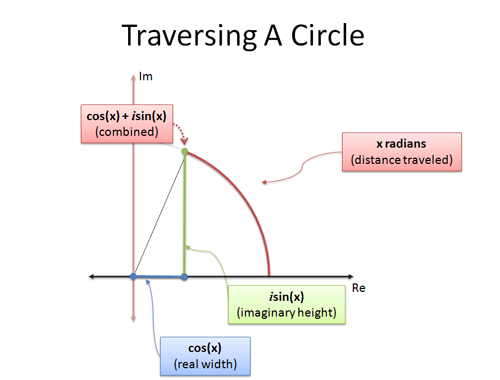 late haven
no, that's something different
fossil mango
like here
midpage
a quarter of the page sorry
The Nitty Gritty Details
and also on wiki, top right image
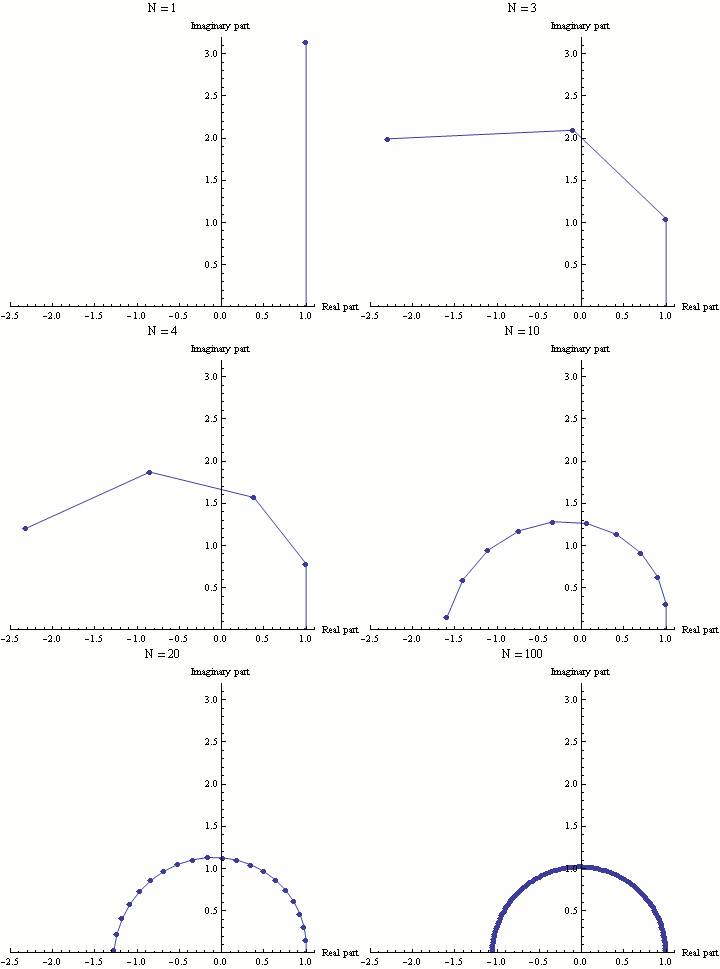
In mathematics, Euler's identity (also known as Euler's equation) is the equality
      e

        i
        π


    +
    1
    =
    0


{\displayst...
i get that... but that's not e^i
late haven
ah, I see
fossil mango
is .. taking the definition of e and changing something inside... and.. how does that becomes e^x ?
late haven
=tex e^z = \lim_{n \to \infty} \left( 1 + \frac{z}{n} \right)^n
granite stirrupBOT
late haven
the page you're on is missing the power on the e
fossil mango
and how does we go from the definition of e
to this one?
with some complex number scattered around?
late haven
idk. there's probably a proof for it somewhere
fossil mango
because this makes more sense to me
multiplying over and over a complex number i get a rotation
i'm going to bed now..
thank you very much for your patience
i'll keep thinking tomorrow
quartz garnet
Was ist das
 austere bramble
for $$z=x+iy\in\mathbb{C}, e^z=e^{x+iy}=e^xe^{iy}=e^x(\cos(y)+i\sin(y))$$
granite stirrupBOT
austere bramble
the lim(1+1/n)^n is how the number e gets defined
but not how the function f(z)=e^z is defined
@menoz#1299
fossil mango
@austere bramble yes, and i was wondering how do we get to e^z
i found a partial answer in this video

For this Christmas video the Mathologer sets out to explain Euler's identity e to the pi i = -1, the most beautiful identity in math to our clueless friend H...
austere bramble
we want to extend e^x into the complex plane
so that if we restrict it to the real axis, we get back e^x
and e^z should satisfy alot of properties that e^x does
well analagous properties
fossil mango
this accompain this video
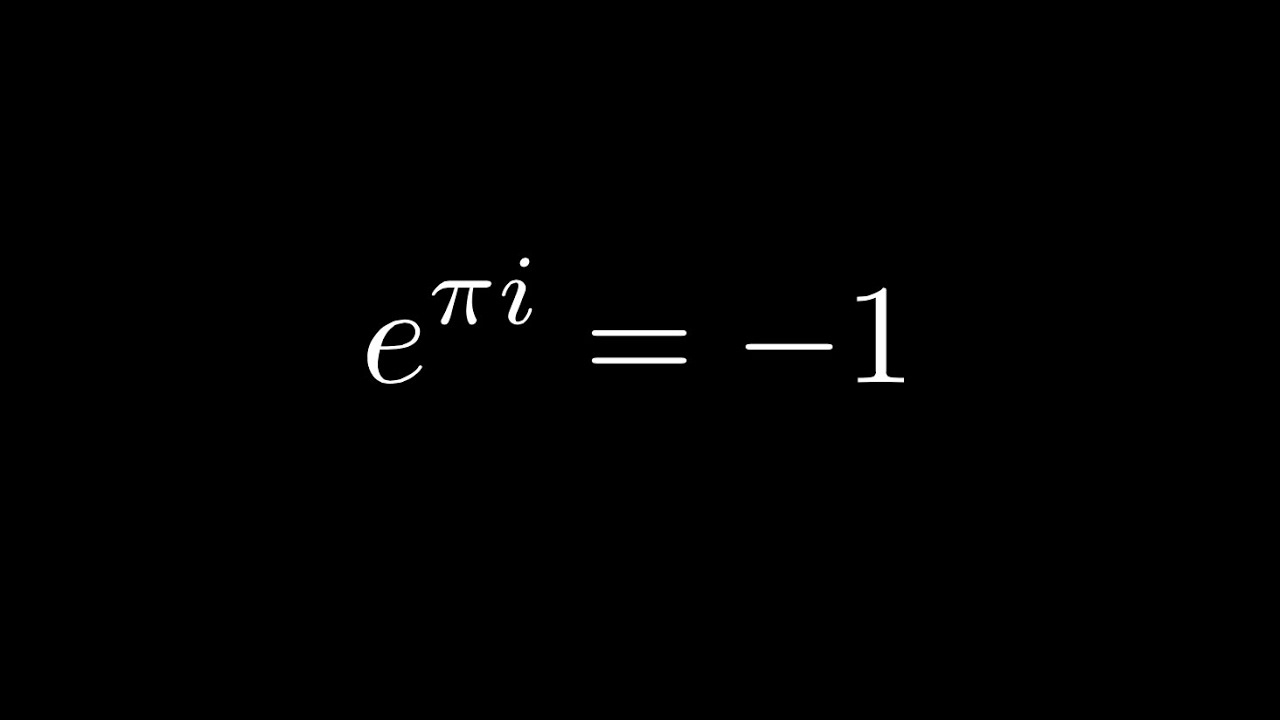
Improved version here: https://youtu.be/mvmuCPvRoWQ The enigmatic equation e^{pi i} = -1 is usually explained using Taylor's formula during a calculus class....
i think is more what i am looking for
in case anyone is interested ...
i'll try to wrap my head around that
austere bramble
around what?
fossil mango
How to Think About Exponentials
i need to make sense of exponents. i need to link it to something.. I need to be able to explain what they are to understand it
 rain totem
Hello
Can someone help me with the idea of recursion formulas. I understand explicit.
clever inlet
hi
granite stirrupBOT
Query made by @gleaming schooner
Data sourced from Wolfram|Alpha: http://www.wolframalpha.com/input/?i=2(0)(0-4)^2(0%2B8)^2
Do more with Wolfram|Alpha Pro: http://www.wolframalpha.com/pro/
 gleaming schooner
Alright, thanks
willow bear
aight so @timid jacinth that formula you posted is simply the general expression of a polynomial
rain totem
yep
willow bear
the a_i are all coefficients
numbers by which the powers of x are being multiplied
indexed in accordance with said powers, simply for convenience
so that, for example, a_10 would be the coefficient on x^10 under that naming scheme

reposting here for visibility
really, a_0, a_1, a_2, etc are all independent of each other, and they simply happen to be named in a systematic fashion for ease of reference
@timid jacinth
rain totem
recursive mmm
willow bear
not really
rain totem
yeah
willow bear
you can kind of think of it as an array
rain totem
tru
willow bear
=tex a_{10}
granite stirrupBOT
willow bear
and no, that's not the result of applying some operation to a and 10
that's simply a name
=tex x_1, x_2, x_3, x_4
granite stirrupBOT
willow bear
these are four separate variables
rain totem

I screwed this up on a test
Just curious to see how others would go about solving this
patent beacon
Bring everything up to Exponentials to get rid of the logs
patent beacon
I can't imagine doing it any other way. What did you have in mind?
rain totem
That's how I was supposed to solve it
patent beacon
So 5×3^(x - 1) = 2^3^4^0 = 8
 patent beacon
Yessir
 rain totem
Whats the problem?
rain totem
Square roots have 2 answers
timid jacinth
right
rain totem
Unless you want the principal square root
rain totem
yes
@timid jacinth Don't forget Descartes Rules of Signs
Such as
You know imaginary roots come in pairs
root and its conjugate
timid jacinth
hhmm
All I know about descartes rules of signs
is how to figure out
how many positive or negative zeros there are
from a polynomial
that's all I've been introduced to
tepid topaz
How to solve sin theta/2 if theta = 3/5
patent beacon
@timid jacinth Like he says, imaginary roots always come in pairs.
If a + bi is a root of your polynomial
a - bi must also be a root
IF the coefficients on the polynomial are real numbers, that is
rain totem
@tepid topaz say again?
timid jacinth
for now, I'll take your word for it 😄
patent beacon
@tepid topaz
So you want a closed value to sin(3/10)? I'm not sure anyone can do that for you
tepid topaz
33
rain totem
patent beacon
Could also use sin(2x) = 2sin(x)cos(x)
timid jacinth
https://gyazo.com/e4d7a0ddb4eb0e9d86deb2541e27e5fd homeslice and kayne, am I thinking about this correctly? Just want to make sure
 timid jacinth
where, I dotted them 😄
patent beacon
No, try
x² + 1 = 0
x² = -1
x = ±sqrt(-1)
x = ±i
patent beacon
x = sqrt(-1) isn't correct, then the ± kinda gets summoned in
rain totem
I guess
timid jacinth
so
tepid topaz
So to find cos for sin theta =3/5 i have to use sin^2 +cos^2 = 1?
timid jacinth
x = ±sqrt(-1), then I pull the - out of the radicand by pulling i out right?
so now I have x = ±i sqrt(1)
and the sqrt(1) = 1 so it's just x = ±i
patent beacon
That works, and it's definitely good to remember that pulling a negative out of a square root results in an i coming out.
Remember of course that sqrt(-1) = i by definition, so you could do that too
timid jacinth
yeah
alright
thanks guys
Kayne or Homeslice; https://gyazo.com/d088364413065f2ff5d2b9092baca238

Why do they chose to use -2 first?
it really urks me
I don't understand why they instantly go to -2
is there a logical reason, if so what is it?
patent beacon
They didn't do it first, they just skipped the guessing process
tepid topaz
Does this look right? Excuse bad handwriting
patent beacon
They found the zero by trying zeros, and then they show you the synthetic division
tepid topaz
Oh i thought i cropped the top portion out
timid jacinth
@patent beacon that makes me feel a lot better. Thanks.
Uh, Kayne, if you go back to that picture, why in the world is the new quotient (x^2-2x+2)? Shouldn't it be x^2-2x-2?
I'm so lost
@patent beacon did they fuck up the synthetic divison for -2?
cause surely the quotient should be x^2-2x+2?
patent beacon
It would appear they fucked up, yes.
timid jacinth
Alright, sorry for calling you for something so simple, just wanted to make sure that my understanding of synthetic divison wasn't completely wrong
patent beacon
No no it makes sense. Why did the book make such a simple mistake? Lol
timid jacinth
I'm not very robust in my mathetmatical approaches, if the one method that I know doesn't fit I panic, and who knows, it's an old book so it should've been caught and updated I think
patent beacon
In general, if you know something is true, then you know it's true. Be confident!
timid jacinth
I'm super behind in my trig class
haven't been able to go for a while and now there's a test on two chapters I haven't started
probably going to fail that class
think I can catch up with algebra II though
patent beacon
Well anything you wanna know? Let's do your homework
timid jacinth
I have to go walk my dog real quick and catch up on my notes for algebra II. I think the trig test is likely on Tuesday, so maybe there's a slight chance I can catch up.
Anyway, I'll be back in like 20 minutes Kayne if you're still around. Thanks for all your help so far! You're awesome!
patent beacon
Yaya np. You're obviously a student who cares to learn and that's what everybody around here wants to help.
rain totem
@patent beacon Are you a teacher off of discord?
patent beacon
Well thank you! I don't deserve such a compliment though, there's a lot of people here who are very helpful. There is a reason I stick around this discord and not... Other... math sites.
I would say from above you're very helpful yourself.
 jagged needle
 hollow iron
hey there. I am a junior in high school taking precalculus. i have like 3 tutors, as this stuff just doesnt click with me. we are currently reviewing conic sections for when finals come around, and i have completely blanked on it. any help would be appreciated. i just came around to understanding the unit circle, and we are now graphing sin cos tan, which i sortof understand.
timid jacinth
Kayne or homeslice, still around?
 plush pasture
ANYONE HAVE ANY IDEA WHAT THIS MEANS https://gyazo.com/31c041c8b2f54d559d0ea26c4eb7f57a
 willow bear
you're given a revenue function, R(x) = 1000x - 0.02x^2
and what you're asked to find is the value of x that corresponds to the largest revenue possible
and in the second question, the value of R(x) for that value of x
@plush pasture
plush pasture
yea but like im super confused
Wouldnt I just put in 12million cuz thats like the biggest answer I can put in for the largest revenue possible
willow bear
no, the biggest answer option is not necessarily the correct answer.
tell me, how much do you know about quadratics?
do the words "vertex form" ring any bells to you?
willow bear
yeah, so you know that if you graph a quadratic, the vertex corresponds to the largest (or smallest, depending on the sign of the leading coefficient) y-coordinate
and the vertex form is a way of writing the equation for your quadratic in a way that communicates the coordinates of the vertex
fossil mango
hello!
 pseudo valve
hi
granite stirrupBOT
(-1)+(1.2246468e-16)i
fossil mango
so i had to get a better intuition about them, yes
pseudo valve
=tex e^{z} = e^{a+i*b} = e^{a} * e^{ib} = r * e^{ib}
granite stirrupBOT
fossil mango
i was trying to follow that property as it is explained in https://www.youtube.com/watch?v=F_0yfvm0UoU
Improved version here: https://youtu.be/mvmuCPvRoWQ The enigmatic equation e^{pi i} = -1 is usually explained using Taylor's formula during a calculus class....
granite stirrupBOT
fossil mango
fossil mango
get an intuition
pseudo valve
?
fossil mango
i understand what it represent and how to use it
pseudo valve
=tex e^{ix} = cos(x) + i * sin(x)
granite stirrupBOT
pseudo valve
Does that help you?
fossil mango
no, my problem is with the exponential function, not the euler's identiy
pseudo valve
huh
fossil mango
i don't understand what does it means to have 3^x for example?
pseudo valve
what?
fossil mango
pseudo valve
I don't understand what you don't understand
fossil mango
in the paper it says that the repeated multiplication is a special case of a function that follow the power rule
pseudo valve
yes
You can define exponential as repeated multiplication of the constant e
But it's useless
So we don't do it
 calm whale
square root of 3
fossil mango
yes
pseudo valve
How is it related to exponential function?
calm whale
think of it as normal fractions I guess?
fossil mango
because it is an exponent
pseudo valve
exponent isn't exponential
calm whale
so like 3^1 wouldn't do anything to the value just like 3*1 doesn't
3^2 would increase it just like 3 * 2
3^(1/2) would decrease the value just like 3/(1/2)
and LOL
pseudo valve
=tex a^b \neq \exp{a}
granite stirrupBOT
calm whale
PackSciences got jebaited here
pseudo valve
?
calm whale
I think he's refering to
fossil mango
if i want to evaluate a number to an exponent, i should use a taylor series isnt it ?
fossil mango
why?
pseudo valve
because it is going to diverge
fossil mango
no i mean...
pseudo valve
i mean not diverging
fossil mango
i mean..
pseudo valve
I mean the terms are non neglectible
In the infinite part
the best way to evaluate a^b is to type it in the calculator
pseudo valve
tbh it's true
Unless it has a cool expression
3^(1/2) is cool because it's a square root
fossil mango
i think we are not getting the point
pseudo valve
"if i want to evaluate a number to an exponent, i should use a taylor series isnt it ?"
calm whale
menoz what are you trying to do?
pseudo valve
give an example?
fossil mango
trying to understand this video
Improved version here: https://youtu.be/mvmuCPvRoWQ The enigmatic equation e^{pi i} = -1 is usually explained using Taylor's formula during a calculus class....
i get that i can use e^i to represent an angle multiplying the i
i dont' get how did we get to that conclusion. what's the intuition.
pseudo valve
What timestamp?
fossil mango
0.59 seconds,
 calm thicket
Are you familiar with trig functions?
fossil mango
for example. from there onwards.
yes
i alraedy did the sin and cosine and taylor expansion on them
pseudo valve
Ok so what you need to understand
Is that repeted multiplication of a number
Makes sense only if the b in a^b is an integer
You can multiply by half a number
Like a^(3/2), you can't say that it's a*a/2, right?
So it's not how we define it
fossil mango
im good up to here
pseudo valve
So what's your question?
you said timestamp 59 sec and that's what he said
so ...
fossil mango
so from there, how we define it?
pseudo valve
complex power series or derived of the function is self
fossil mango
the video says, we define the exponential function as a functino that satisfies the power property f(a+b)=f(a)f(b)
pseudo valve
Huh, that's one of the exponential's properties
I have never seen if anyone did defined it that way, but he is allowed to define it as he wants
fossil mango
yes. I'm trying to understand the video
to make sense of the exponential function.
i mean, whait would represent 3^i ? where is the 3? what would change in my graph?
pseudo valve
what does it have to do with exponential?
fossil mango
i can represent e^x with the taylor series, what about 3^x ?
fossil mango
so e^x is used as a starting point, as a base for everything else basically.
i mean, we HAVE to know e^x
and use it to compute others exponentials
pseudo valve
great, I want to kill myself now
pseudo valve
"others exponentials" I read that and I immediately jumped out of the window
fossil mango
is like an operator that we use.
pseudo valve
exp is a function
fossil mango
well this is not helping me to understand
pseudo valve
your questions are too vague
you said "other exponentials"
there is only one exponential
fossil mango
when you don't know things you commit errors
pseudo valve
i am not blaming you to not know
pseudo valve
I am confused about what you are trying to ask
fossil mango
how to think about exponentialS ?
pseudo valve
Apparently, in english exponentials define the set of function a^x 🤔
Ok
So there are other exponentials
It's my bad
Sorry
So you can that you compute exponentials with exp.
Yes, you can do that
It works for a definition
fossil mango
@willow bear that helps a bit to make a bit more sense. is this the way you think about exponentials? you always use e^x as a "starting point", as a base function?
pseudo valve
it's a way to think of it
But the circle definition is more intuitive in my opinion
fossil mango
the explanatio made by the 3b1b sounds intriguing to me. and makes sense to me up to acertain point.
pseudo valve
which point?
fossil mango
reading the paper i linked before, he tries to find e by creating a function that respect the power property of above. f(a+b)=f(a)f(b)
fossil mango
and... at some point it says
I would like to stress one more time that we should think of exponentials purely in terms of the
property f(x + y) = f(x)f(y), not in terms of the infinite sum we use to define them explicitly.
pseudo valve
yes
fossil mango
i'm having hard time in thinking in that way.
pseudo valve
he just says "there is a property of exponential and you can use it to define exponentials and that's it"
he just wants to say that it's an important property
willow bear
to me, the two "important" exponential functions are e^x and 2^x
the former because of its being its own derivative, which is pretty damn useful in any setting even tangentially employing calculus, and the latter being computationally convenient when half-lives are involved
fossil mango
i mean, he started by creating a function for e^x , what if we wanted a functino for 3^x ?
pseudo valve
=tex 3^x = e^{x*ln(3)}
fossil mango
@willow bear but that wasn't exactly what i've asked 😛
granite stirrupBOT
fossil mango
@pseudo valve yes, this is what i mean, we have to know e ...
fossil mango
following the reassoning they made in the paper, what you are saying doesnt makes sense.
fossil mango
they say, at the beginning
Imagine you didn’t know the series defining e
x
e^x
and they build it.
and my question was
pseudo valve
he does define the exponentials not explicitely knowing e
He says that it exists
And thus, you can build a function without knowing a constant
pseudo valve
It's already opened
fossil mango
at second page, chapter 2, Constructing the series for e^x
pseudo valve
yes
fossil mango
this is where i am reading.
where are you reading? you said "He says that it exists"
fossil mango
so what do you mean by "He says that it exists" ?
fossil mango
where?
pseudo valve
In e^x
pseudo valve
=tex \exists e, e^x \text{has the property } f(x+y) = f(x)*f(y)
granite stirrupBOT
pseudo valve
I don't see what's putting you so much trouble?
It's literally how he defined e.
Everytimes he uses the ^ operator
fossil mango
i think there is a communication problem between us
pseudo valve
probably
Can you try rephrasing what you have problems with? At least one last time then I'll relay with someone else
pseudo valve
?
fossil mango
what if i make you a question, and you answer yes or no
pseudo valve
ok
fossil mango
can we have function like the power series defining e^x that defines a^x ? i mean a function written in the same form, as a power series.
willow bear
yes
fossil mango
but without knowing e^x in first hand
pseudo valve
Yes
fossil mango
so without knowing that there is the power series defining e^x in the first hand.
pseudo valve
power series of 1/n! * (xln(a))^n
fossil mango
can we build it following the same idea he used to do the power series of e^x ? using the same reasoning?
the natural log presumes that e is known. isn't it?
pseudo valve
I don't know, probably but it would be super boring
fossil mango
is like e^x with x=1
pseudo valve
e^(x=1) = e
fossil mango
the natural log presumes that e is known. isn't it?
granite stirrupBOT
pseudo valve
it matters
So the constant is zero
And in general, it's better to put the range
Because undefinite integrals
SUCKS
and I think they should be banned from this world
fossil mango
derivative of ln(x) is 1/x
if the integral is indefinite it would be ln(x) + C
and ln(1) = 0
so it would be just ln(x) - 0
why do we need it?
pseudo valve
huh
integral between 1 and x equals ln(x) - ln(1); ln(1) = 0. And ln(1) = 0 is super important here because you haven't defined it yet.
Without bounds, it would be ln(x) + C with no more info
You would need the extra ln(1) = 0
fossil mango
ah ok ok
makes sense
is there a way to get an intuition of what a^ix would would look like in the graph?
pseudo valve
huh, I don't
fossil mango
like, e^i means i go 1 radiant around the unit circle
pseudo valve
yes
fossil mango
e^1pi means i go pi aroudn the circle
pseudo valve
yes
pseudo valve
Hold on
fossil mango
maybe as e multiplied by some number?
like 3^i
how much do i turn around the circle?
pseudo valve
=tex a^{ib} = e^{a logc(ib)}
granite stirrupBOT
Support the bot on Patreon: https://www.patreon.com/dxsmiley
granite stirrupBOT
fossil mango
3^i depends on a lot of things?
pseudo valve
=wolf log(ix)
granite stirrupBOT
Assumptions
Assuming i is the imaginary unit. Use 🇦 i is a variable instead
Assuming "log" is the natural logarithm. Use 🇧 the base 10 logarithm instead
Query made by @pseudo valve
Data sourced from Wolfram|Alpha: http://www.wolframalpha.com/input/?i=log(ix)
Do more with Wolfram|Alpha Pro: http://www.wolframalpha.com/pro/
pseudo valve
the real part of log(ix) isn't linear
=tex a^{ib} = e^{a logc(ib)} = e^{a*log(b)*i \pi / 2 }
granite stirrupBOT
granite stirrupBOT
pseudo valve
Nah, there is something wrong :/
fossil mango
i dont' get what you're trying to say
granite stirrupBOT
Assumptions
Assuming i is the imaginary unit. Use 🇦 i is a variable instead
Timeouts
InterestingMultiDimensionalDefiniteIntegrals
Query made by @pseudo valve
Data sourced from Wolfram|Alpha: http://www.wolframalpha.com/input/?i=a^ib
Do more with Wolfram|Alpha Pro: http://www.wolframalpha.com/pro/
pseudo valve
=wolf 3^(ix)
granite stirrupBOT
Assumptions
Assuming i is the imaginary unit. Use 🇦 i is a variable instead
Timeouts
InterestingDefiniteIntegrals
Query made by @pseudo valve
Data sourced from Wolfram|Alpha: http://www.wolframalpha.com/input/?i=3^(ix)
Do more with Wolfram|Alpha Pro: http://www.wolframalpha.com/pro/
pseudo valve
wait I am stupid
=tex a^{ix} = cos(x * log(a)) + i* sin(x log(3)) = e^{ixln(a)}
@fossil mango it's like exp, but it's stretched
basically you multiply by ln(a) by changing from base e to base a
So the angles are stretched
granite stirrupBOT
fossil mango
my orig question was, how shold i map intuitively 3^i on the circle?
i should change it to cos() + i sin() form?
pseudo valve
if you shift a radian in b in a^ib, you have to shift ln(a) radians in the circle
fossil mango
i have to shift x*ln(a) radians
pseudo valve
Yes, I guess so
fossil mango
not just ln(a)
pseudo valve
well if you shift x radians, yes
fossil mango
so same as before, using e ^ln(x)
ok...
is difficult for me to get the whole picture of exponents , logarithms, e^x
i get piece by piece but i don't have yet an instantaneous clear vision of everything
pseudo valve
Also, it's very unlikely you would have to study 3^z
Because noone studies such objects seriously
Because it's not useful in physics
We prefer base 10, 2 or e
fossil mango
well but I want to understand and see things from different point of view when possible, to build an infrasctructure in my mind that can adapt to different views
and i'm not sure to be able to explain to someone how to think about exponents for example.
ah yes, another question
in the paper, i don't understand why are we building the e^x from scratch
fossil mango
but how does this links with the exponents in general
pseudo valve
just fun properties?
fossil mango
i mean why e^x ? what's then?
pseudo valve
I don't understand your question
fossil mango
page 2, at the point b)
One of these functions is in some sense the “most natural”, and we write it either as exp(x)
or e^x. Note, this just means the number e is, by definition, the value of this special function
at 1, not that e is some magic number which gives the function its specialness. It is defined
explicitly with the following infinite sum
not that e is some magic number which gives the function its specialness
no?
pseudo valve
it just gives the function in exp(1)
fossil mango
e^x is the only function that has the properties that he has?
like the derivative is still e^x
(and the integral)
is it the only function?
calm whale
is this still going on
fossil mango
mmm tomorrow maybe XD
i kept reasoning on it and then i got tored for today.. i'll keep thinking tomorrow 😃
thanks everyobody for the help!
viscid thistle
look up real analysis literature
it defines the map exp(x)
you will see how this function is proven to be e^x
@fossil mango if you dont find it tomorrow, I can show you the proof 😃
fossil mango
@viscid thistle i didn't understand what should i be looking for...
calm thicket
Let $$a$$ and $$b$$ be positive integers and $$k=\frac{a^2+b^2}{1+ab}$$. Show that if $$k$$ is an integer then $$k$$ is a perfect square.
granite stirrupBOT
calm thicket
Not necessarily asking for a solution, just putting it out there to whoever hasn't heard of it before :p
viscid thistle
@fossil mango The point is that exp is a map that arises at a certain point in the theory of real analysis
and in calculus/high school we just start to work with e^x knowing not much more than that its derivative is e^x as well
in real analysis we show that the exp map corresponds to the function e^x
and so you can see how this "magic number" as you guys were calling it arises 😃
fossil mango
Ah ok thanks for explanation
So i guesss it's not time yet
😄
I've never heard of real analysis
Would it be calculus 3 ? With differential equations?
 still yew
Are these good proofs?
still yew
@viscid thistle are these good?
willow bear
the handwriting 🤢
still yew
Ik
willow bear
also i the imaginary unit is never written capital
also ln(ab) = ln(a) + ln(b), not ln(a)ln(b) like you wrote
willow bear
what you wrote makes basically zero sense honestly
viscid thistle
plus im not really the person you should be checking proofs with 😛
sorry lol
@menoz no its beyond calculus. You will proof a lot of calculus theorems in it though
dont know why the mention doesnt work xd
@menoz
but ok
its more about building R from Q first and then metric spaces
differentiation and integration will really be proven analytically
you go deep into continuity and convergence
Cauchy sequence plays a large role
viscid thistle
I thought I saw a plus sign in some parts, I did read it quickly but I didnt see any mistakes now I see some ~_~
Im starting to get sloppy these days ~_~
viscid thistle
What is this?
 scenic kelp
Some guy advertising everywhere
calm whale
just banhammer him
burnt vigil
@viscid thistle ^
 naive hearth
Hey all! I'm having trouble finding the inverse of j(x):
I first replace j(x) with y.
Then I switch x & y.
Then, to solve for y I multiply each side by (y-1)
This gives me yx - 2y = x + 3
At this point I'm stuck trying to isolate the y term...
Oh, I think I figured it out on my own...
I can make (yx - 2y = x + 3) = (y(x - 2) = x + 3)
Then divide each side by x - 2 to isolate y!😁
So, the inverse in y-1 = x+3/x-2.
=tex j(x)=\frac{2x-3}{x+5}
granite stirrupBOT
naive hearth
Yay, thanks @granite stirrup. I'm going to do one more just to make sure I get how to do these.
calm thicket
I got $$\frac{-x-3}{-x+2}$$
granite stirrupBOT
naive hearth
Thanks @calm thicket Working on it now...
calm thicket
It looks like when you multiplied each by (y-1) you got the wrong result, it should be 2y-3 = xy-x, then when you factored it out and divided it seemed pretty okay (except you forgot to add 1 to both sides)
(sorry if I phrased the variables wrong, I learned solve for x then swap, not swap then solve for y)
(2x+3)/(x-1) = y
naive hearth
Ok, thanks. I'll look at the first one again.
calm thicket
2x = yx-y-3
2x-yx=-y-3
-x(y-2)/(-y+2)=-(y/(-y+2)-3/(-y+2))
x=(-y-3)/(-y+2), swap and you get y=(-x-3)/(-x+2)
I could be doing it wrong as well but just in case 😛
Quick check in desmos confirms
naive hearth
=tex x=\frac{2y+3}{y-1}
granite stirrupBOT
naive hearth
So, this is where I was at when I multiplied each side by(y-1)
From this I got x(y-1)=2y+3
naive hearth
Yes, I did that next, and then +x to each side, and -2y from each side.
calm thicket
Doesn't work, you still have xy on left
Better to subtract both 3 and xy
wait nvm I'm drunk, you're right
3+x = xy-2y
3+x = y(x-2)
y = (x+3)/(x-2)
except I'm still drunk and it's supposed to be negatives
one minute
naive hearth
hmm, I think you can just do, y-1 = (x+3)/(x-2), to indicate it's the inverse of a function.
calm thicket
=tex j^{-1}(x)
granite stirrupBOT
naive hearth
nice ^____^
calm thicket
But yeah, testing it confirms
(disclaimer: I'm also in precalc so I'm likely to be horribly wrong whenever trying to help here)
naive hearth
I didn't think of looking at the answer in desmos, good idea. Thanks again!
calm thicket
protip: learn tex, it's a useful skill 'round these parts
😛
and if you plan on learning math in college it's really helpful (and even required I hear) as well
 odd ice
I don't know latex, I've only gone through the calc series and linear algebra though
naive hearth
I've used tex for regular documents for a few years now, but I do need to work on my tex math skills. I'll try converting all my pre-calc notes to LaTex for practice.
I can't even imagine going back to Word or LibreOffice, tex is 👌
 faint narwhal
I need help simplifying an equation, im not sure if i simplified it long enough.
viscid thistle
shoot away
faint narwhal
(sin(2a))(sin(b-c))x + (sin(2b))(sin(c-a))y + sin(2c) +(sin(a-b))x =0
im not sure on how to further simplify it
viscid thistle
It dosent look like you can
faint narwhal
ok
is there a way i can solve it?
well get y on one side?
oh wait
that should be easy right
subtract (sin(2b))(sin(c-a))y from both sides
then divide both sides by (sin(2b))(sin(c-a))
viscid thistle
MB
faint narwhal
MB? My bad or maybe?
 ripe wren
y [cos(a + 2 b - c) - cos(a - 2 b - c)] = x [cos(2 a + b - c) - cos(2 a - b + c) - 2 sin(a - b)] - 2 sin(2 c)
viscid thistle
My bad.
faint narwhal
is it possible to subtitute c for some form of a and b?
 willow bear
9**(cos(t) - sin(t))**, surely?
 tawny stag

does anyone know how to do this problem
i know youre suppose to use trig identities
willow bear
you know cos^2(θ) = 1 - sin^2(θ), right?
once you apply that, your thing becomes a quadratic in sin(θ)
viscid thistle
2(1- sin^2(θ)) ye
tawny stag
ohhh okay thank guys
viscid thistle
=tex \sqrt{2} \notin \mathrm {Guys}
granite stirrupBOT
tawny stag
hahah