#precalculus
1 messages · Page 101 of 1
 timid jacinth
 tired nest
Yep, perfect.
timid jacinth
OH
MY
GOD.
that was like
a revelation
doesn't 1-(4/5)^2 become 1-(4/5) if I take the sqrt of the entire thing though?
timid jacinth
hhmm
tired nest
It's like... if you square (a+b) you don't get a^2 + b^2
timid jacinth
oh yeah
tired nest
Because the square of a number is the number times itself, so (a+b)(a+b)
tired nest
Yeah.
timid jacinth
okay
that makes sense now
so always evaluate to the simplest level before I take the sqrt of something?
timid jacinth
Alright
I have a similiar type of question; I'm going to try the other method here, can you guys interrupt me if I make a mistake?
Find exact values of remaining trig functions of theta.
Sin(theta)= -7/25, 180degrees < theta < 270degrees
From here, I can determine that theta must lie in quadrant 3, because sin = y, and sin is negative, therefore it must be in either quadrant 3 or 4, but I know theta is between 180 degrees and 270 degrees, therefore it must be in quadrant 3.
Now, by using the concept of a circle; I know through sin(theta) = opposite / hypotenuse, I can tell from sin(theta) = -7 / 25 that my radius of the circle will be 25.
From here I can apply pythagorean theorem to determine what cos(theta) is since cos(theta) = x on a circle.
sqrt(x^2+(-7)^2) = 25.
or x^2+(-7)^2 = 25^2.
x^2 +49 = 625.
x^2 = 576
sqrt(x^2) = sqrt(576)
x = + or - 24, since I know I'm in quadrant III, my cos(theta) must be negative, therefore x must be negative so I take x= -24, or cos(theta) = -24/25
@tired nest am I correct so far?
tired nest
Yeah, looks good so far.
timid jacinth
Awesome. So now, I just need to use my knowledge of the identities of the functions.
For example; tan(theta) = sin(theta)/cos(theta), so tan(theta) = (-7/25)/(-24/25), which is eqaul to -7/-24 = 7/24
tired nest
Yeah. 👌
timid jacinth
Can we go over even and odd trig functions? Why is it that only cos(theta) and sec(theta) are even functions and everything else is odd?
sorry
tired nest
They're not both even.
tired nest
Yes.
 clever inlet
You saw the interactive unit circle right?
tired nest
Ohh.
timid jacinth
my problem is, I haven't seen the graphs of the functions
so I just need to know how the unit circle explains them to be even / negative functions
clever inlet
so back to the unit circle
notice
cos(0) = 1
if you go up to like say cos(45)
you'll get 1/sqrt2
and if you go down to cos(-45)
you'll get the same thing
basically imo
just play with the interactive unit circle
tired nest
Pick an angle and look on the unit circle at the positive and negative of that angle.
An even trig function will give you the same value for both.
As kangaroux demonstrated.
timid jacinth
Ah
gotcha
so if I take
sin(30) for example
I see sin(30) = 1/2
if I look for sin(-30), I'll see that sin(-30) = -1/2
tired nest
Yeah.
tired nest
Exactly.
timid jacinth
if I take cos(30), cos(30) = sqrt(3)/2
cos(-30) = cos(330) = sqrt(3)/2, so since cos(x) = cos(-x), the function is even
tired nest
Yeah.
timid jacinth
okay
and that's going to be the case with all of the fuctions that aren't cos or the reciprocal of cos
It must be hilarious watching me on here, watching me learn step by step lmao
tired nest
And you can think of it a bit like this... the 0 point is on the x axis, so the x axis is like the line of symmetry for the unit circle. On one side is positive and one side is negative.
 willow bear
wouldn't describe it as hilarious
timid jacinth
just a couple of weeks ago I was asking about basic functions and now I'm on to basic trig
infuriating?
tired nest
You're actually doing really well, chief.
willow bear
yeah
clever inlet
^
willow bear
honestly tho, sin is odd, cos is even, and the parity of everything else can be built up from there
timid jacinth
yeah, I just understand mathematical concepts better when they're broken down into words
tired nest
Yeah. So to finish what I was describing just now, if you look at that line of symmetry, you can see how sin is all positive on one side and all negative on the other. The cos is actually symmetric though.
So it just comes out even that way.
timid jacinth
so if i'm asked "Use the even-odd properties of the trigonometric functions to find the exact value of the given expression. Do not use a calculator." for cot(-60)
I just need to find cot(60) and see if it's equal to cot(-60) to determine if it's even, if it isn't I just need to take cot(-60) and verify it's = to -cot(60)
willow bear
cot = cos/sin = even/odd = odd
so cot(-60°) = -cot(60°)
also, "even-odd properties"? seriously? til "parity" is a term too complicated for college
willow bear
do you know how function parity interacts with operations on functions? outside of the context of trig
willow bear
degrees, yes
timid jacinth
sin(300) = -sqrt(3/2)?
willow bear
yes
okay so
for addition (and subtraction):
even + even = even, odd + odd = odd
for multiplication (and division):
even * even = even, odd * odd = even, even * odd = odd
for composition:
even(even) = even, odd(even) = even, even(odd) = even, odd(odd) = odd
(these are all easy to verify using the definitions of even and odd functions)
timid jacinth
Okay
I wonder when I'll be introduced to this
or if it was skipped over
sin(-270) = sin(90), so 1?
 granite stirrupBOT
0.89399666
willow bear
:p
timid jacinth
I would if I knew how to make the degree symbol
or else I'm typing sin(-270degrees)
willow bear
deg is okay
timid jacinth
ok fair enough
So, I'm getting a little confused here.
if sin(-270deg) = 1, and I'm asked to use even-odd properties to find the value of the expression; am I doing -sin(-270deg) = -(1) = -1, which would mean that it isn't odd right?
but I know sin is an odd function
willow bear
18
timid jacinth
Wow
and you're already a math wizard
or
math witch
but that sounds
weird
and
an insult
tired nest
😄
tired nest
Why so?
timid jacinth
so cos(pi) = -1
timid jacinth
cos(-pi) = cos(0) right?
timid jacinth
okay
willow bear
pi and -pi are also the same point lel
timid jacinth
oh shit
yeah
let me draw that, and tell me if I'm correct in my understanding
https://gyazo.com/667dea6c6b22c6d5e7eede9124fb2482 based paint and gyazo
 willow bear
yup
timid jacinth
Do you practice math as a hobby?
or were you just ulta receptive to your classes when you were younger?
because, aren't you advanced for your age?
willow bear
i do indeed do math as a hobby
timid jacinth
@west furnace why
 west furnace
your name
 viscid thistle
Im "advanced" for my age as well, I mean, advanced is more of a how much time you put into it atleast for me that is, I do math as a hobby, a job and what not @timid jacinth point being, to get to an advanced level you need to study!
timid jacinth
yeah
the career I want will involve a lot of math
my problem is I haven't done math for 7 years
viscid thistle
Take this to general?
timid jacinth
Is my reasoning correct?
(sin47deg)(csc47deg) = (sin47deg)(1/sin47deg) = 1
willow bear
yes
timid jacinth
Thanks
tan(theta) = tan(theta + k(pi)) right?
or am I expressing it incorrectly?
willow bear
yeah, tan(θ) = tan(θ+πk) for all integers k
timid jacinth
I'm onto range questions now, and range is just a concept that messes me up even moreso when it comes to trig functions
I understand the range of sin and cos
How does the range of tan work?
timid jacinth
Nope, trying to avoid them until I'm introduced to them in class so just the unit circle
willow bear
ok
timid jacinth
which occurs at pi/2
 crimson gate
Yep
timid jacinth
and every odd interger multiple of pi/2
crimson gate
So as you approach pi/2, sin(number that's almost pi/2) will be infinitely close to one and cos(that number) will be infinitely close to zero
When you divide it by that number that's infinitely close to 0 you get an infinitely large number
And when you take the cos(number that's right after pi/2 but infinitely close) you'll be dividing by that same thing as before, but since its after pi/2 it's negative, which means you're dividing a positive by a negative, so you get a negative infinitely large number
That's why tan has a range of (-inf,inf) but the domain doesn't include odd multiples of pi/2
Because if theta were an odd multiple of pi/2 you'd be dividing by 0
timid jacinth
right, because tan = sin/cos, cos is 0 at odd integer multiples of pi/2
willow bear
that is a rather convoluted description
timid jacinth
Here is where I got lost a little
And when you take the cos(number that's right after pi/2 but infinitely close) you'll be dividing by that same thing as before, but since its after pi/2 it's negative, which means you're dividing a positive by a negative, so you get a negative infinitely large number
I understood everything up to that point
willow bear
i can explain geometrically why the range of tan is R
timid jacinth
for example, .9999 / 0.000001 will give me a massive number, and as sin gets closer to one and cos gets closer to 0, but both remaining below 1 and above 0 respectively, that number will only get larger so +inf
crimson gate
Yep
timid jacinth
so, are we now talking about getting closer to -pi/2?
crimson gate
So after you cross pi/2 on the unit circle, the y coord stays positive but x becomes negative, since pi/2 is on the y-axis. You'll have .9999/-.0000001
willow bear
mh
crimson gate
Sorry, hard to spellcheck on mobile :x
willow bear
i feel like this is a bit too informal for my taste
timid jacinth
couldn't you just say the same for -pi/2 though?
like, y is now negative, and x is still positive
willow bear
steel, you're explaining the asymptotes of tan, which is not quite what chief was looking for
timid jacinth
as y approches -pi/2 it's something like -.99999 / 0.0000001
because in that quadrant, x is still positive right?
so that'd give me an infinitely large negative number
crimson gate
It approaches infinity and negative infinity, would that not show that the range would be (-inf,inf) in this case?
timid jacinth
I'm not getting the concept of crossing pi/2 into the second quadrant
timid jacinth
Sure, understanding both can't hurt though
crimson gate
Maybe a geometric explanation would help, verbality in math can only go so far
timid jacinth
I tend to be a bit more receptive to verbal descriptions 😛
willow bear
okay, so i'll want you to draw a unit circle on the xy plane, and the line x = 1
which touches your circle at (1,0)
aight?
timid jacinth
what do you mean the line x = 1 that touches the circle at 1,0?
willow bear
one moment
timid jacinth
if you could draw it on paint or something, which is what I was going to do and then send you a screen shot, that'd help immensely
Steel, can you explain that second part of your description a little differently?
willow bear
timid jacinth
ok
willow bear
the point where it touches your circle is 0, and the units and direction are the same as on the y axis
timid jacinth
Ok
willow bear
now, this gives a nice visual representation of tan(θ)
to find the tan of an angle, draw a straight line through your angle's point and the center and look where that line crosses the tangent axis
that crossing point will be tan(θ)
 timid jacinth
Okay
willow bear
now, if cos(θ) = 0, then the line you draw will be vertical, and thus won't intersect the tan axis
make sense?
timid jacinth
you're talking about the terminal line right?
willow bear
the one i have in green
willow bear
yeah ok so
willow bear
imagine θ changing gradually from 0 to π/2, and its terminal line with it
timid jacinth
ok
willow bear
the point on the tan axis will sweep out its entire upper half
timid jacinth
the half above 0 right?
willow bear
yeah
timid jacinth
Ok
willow bear
and a similar thing will happen if you let θ go from 0 to -π/2 instead
so basically, the entire tan axis gets covered
timid jacinth
right
willow bear
so the range of tan is R
timid jacinth
wouldn't it eventually hit the tan axis though?
like let's say, it's right by 1, where cos is almost 0
wouldn't it hit it eventually, just really really high up?
because it still has a slight gradient
willow bear
yeah, but almost 0 and exactly 0 are different things
tired nest
Parallel lines never intersect.
timid jacinth
but it would only be parallel to the tan axis at pi/2 right? or where y = 1
willow bear
yep
timid jacinth
if it's just shy of y=1, wouldn't the line intersect eventually?
timid jacinth
So why can't we assign a value other than infinity for when that terminal line intersects with the tan axis?
let's say it's as close to 1 as possible, wouldn't the point of intersection just be a ridiculously high number rather than infinity?
tired nest
You can. You only have infinity when it's parallel.
timid jacinth
so why do we write the range as (-inf, inf) instead of [ridiculously large negative number, ridiculously large positive number]
willow bear
there is no such thing as as close as 1 to possible
whatever number you claim to be closest to 1, i can find one that's closer by taking (your number + 1)/2
willow bear
precisely
timid jacinth
.999 is going to infinitely reoccur
or whatever it's called
.999 is larger than .9999
etc
willow bear
also, for every number x, there is an angle such that tan(θ) = x
tired nest
That's why you have the curved brackets for the range. (-inf, inf) That means the actual values aren't included but everything possible in between is included.
timid jacinth
Ok
and the same applies for the opposite direction towards -1 or -pi/2
but the number is just going to be an infinitely negative number
which is expressed as -inf
tired nest
Yep.
timid jacinth
Thanks everyone

wouldn't they eventually touch?
or will it keep getting closer and closer
but never actually touch?
tired nest
Yeah they touch, cause they're not parallel.
timid jacinth
so if they touch, let's say at -1000000
why isn't the point at which they touch considered the limit to the range?
so like [-10000000, 10000000]
willow bear
because there is an angle with a bigger tan
tired nest
Because it will also touch at -10000001 and -10000002 and so on. All the way until -inf
willow bear
tan is unbounded
crimson gate
Because you can always get slightly closer to pi/2 without getting to pi/2
crimson gate
Trust me when you see the graphs it'll all click instantly
timid jacinth
both the verbal and the geometrical descriptions really helped me
yeah I'm actually excited to see them
I just don't want to look at them and base all of my knowledge off of them since I'm supposed to be understadning this stuff without them
tired nest
That's fine. Since you're going to be learning them soon anyway.
timid jacinth
How old are you when you typically learn this stuff? In England, where I was educated, we aren't introduced to this stuff at all in highschool
and we graduate at 16
you're only introduced to trig and calc etc if you elect to take math at the college and uni level
at least, that was the case when I was in school
crimson gate
Depends, usually senior year of high school in America I think, so about 17 or 18. Many people end up taking precalc before then so it could be from 15-18, depending on the math experience they went into high school with, if they take summer classes, etc
timid jacinth
ah ok
you go to college in the Uk between 16-18
and that's where you're introduced to this if you chose to continue with maths
obviously I didnt
crimson gate
I took precalc my sophmore year and then calc i and ii junior year, my high school didn't offer calc iii so I had to wait until now (first year of college) to take it
crimson gate
You also cover some simple trig before precalc I think
clever inlet
I was wondering why they don't teach trig in high school
timid jacinth
for us it goes highschool < college < Uni
clever inlet
That makes more sense then
timid jacinth
college does not = uni
you go to uni after graduating college
My issue is, I'm doing uni in the U.S, and I left highschool in the U.K at 16, I'm 22 now and the extent of my knowledge was basic algebra
so I was never introduced to trig or anything of that sort
crimson gate
From what I've heard, education is a lot more focused in the uk, where Americans have to take tons of general stuff in hs whereas you get much more freedom in the uk, but idk if that's true
timid jacinth
absolutely true
for example, gen ed's in Uni don't exist in the UK
for example, if I choose to major in English in the UK at Uni
all I'd be doing is English classes
no need for general ed's in math / sci / humanities
so if you don't choose to take math's at a higher level past high school in the UK, you simply don't do mathematics past basic algebra
clever inlet
Over here, they have 3 math courses
With more content in each
And they pick stuff they feel like is useful for further education
Like how they do calculus before a lot of Alg 2 topics
Or they teach differentiation before quadratics
timid jacinth
Well, I'm in an Alg 2 class at the same time as a trig class
and I'm findining, what was review for the trig class is the material I'm learning at the same time in the alg 2 class
is the range of tan the same for cot? If so, why?
crimson gate
It is, and it's for the same reasons, except for even multiples of pi/2 instead of odd (since even mults if pi/2 will make sin=0 and the sin is on the bottom in cot)
crimson gate
Mhm
crimson gate
Yeah
timid jacinth
as we approach 0 (y) but remain above 0, we'd still be dividing almost 1/0^+ or w/e the notation is
which would result in a massive positive number
alternatively, as we approach -1, but never actually hit -1, we'd be dividing almost -1 by a tiny number greater than 0
which would result in a massive negative number
crimson gate
Yes
crimson gate
Yeah and when theta = pi or 0, it's at -1 or 1 o n the x axis
timid jacinth
Okay, I'm going to try and draw the same thing
Anne(?) drew earlier
but for cot
fuck
I don't think I can
willow bear
the cot axis is the horizontal line touching your circle at y = 1
timid jacinth
would cot's axis be vertical like tan's?
ah
thought so
had it right the first time then but second guessed myself
https://gyazo.com/fd57bdffba4531b39bc006a8992ef0b8 something like this?
 willow bear
yup
willow bear
what?
crimson gate
Nah they're not
timid jacinth
Yeah, paint is no longer a thing so I'm told
or they're not making new versions for future operating systems
crimson gate
It's like when they "got rid of internet explorer" and now they have "edge"
crimson gate
Pretty sure it's something along those lines
timid jacinth
I can live with that I guess
Alright, I have my first trig test here with me, I got a 72% on it
I'm going to go over a few questions I got wrong
For example;
One question was; given f(x) = sqrt(x-1)
(a) state the domain and range of f(x) (use interval notation)
I put (1, inf) and got it wrong, my answer should have been [1, inf) right?
for domain at least
timid jacinth
fug
I have a problem with range
maybe I'm just foggy rn
how would I find the range of f(x)=sqrt(x-1)
willow bear
the range of sqrt is [0, inf)
timid jacinth
and that's because the outcome will always be greater than or equal to 0 since it's a square root?
willow bear
output, but yes
timid jacinth
that's what I meant, so the -1 doesn't effect anything?
willow bear
the -1 affects the domain
willow bear
sqrt(y-1) = x, solve for y
timid jacinth
y = x+1?
timid jacinth
let me go back at it
Uh
so I took the original function f(x)=sqrt(x-1),
substituted y for f(x), so y=sqrt(x-1)
substituted x for y, so x=sqrt(y-1)
squared both sides, so x^2 = y-1
yeah I have no fucking clue tbh
willow bear
y = x**^2** + 1, surely?
timid jacinth
yeah
looking back at it
for some reason when I did sqrt(y-1)^2
I took y^2 + 1
or somehting
y^2 - 1
added the 1, so I had x^2 + 1 = y^2, took the sqrt of both sides
so I got x + 1 = y
that's where I went wrong
no idea why I did that
so the inverse of f(x)=sqrt(x-1) is f(x)=x^2+1?
so if f(x)=sqrt(x-1) then f^-1(x) = x^2 + 1, I can verify this by doing f^-1(f(x))?
willow bear
indeed
timid jacinth
So that evaluates to x
willow bear
however, you do have to explicitly restrict the domain of your f^-1
to [0, +inf)
since that was the range of the original function
viscid thistle
I feel like one of the few people who uses set notation for domain and range,hahah
in Algebra that is
 gleaming schooner
Good morning
clever inlet
morning
gleaming schooner
I have a quadratic equation that I need to find the roots of.
clever inlet
?
gleaming schooner
It's f(x) = -1/5(x-1)² + 1
So I set 0 = -1/5(x-1)² + 1
And I get -1 = -1/5(x-1)²
gleaming schooner
x -1
Oops
Oh crap
I'm sorry
I messed up the equation entirely
I have to start over lol
I combined two different equations.
tired nest
No problem. 😄
clever inlet
If it was the right equation
tired nest
It happens.
clever inlet
Then you got really close
To the actual answers
Which is still good
Since you know what you're doing
clever inlet
solve for roots?
gleaming schooner
0 = -1/5(x + 4)² + 1
-1 = -1/5(x + 4)²
Divide both sides by -1/5
5 = (x+4)²
gleaming schooner
5 = x² + 8x + 16
clever inlet
ehh
gleaming schooner
Ah..
clever inlet
well
say you have
x^2 = 4
both (2)^2 and (-2)^2
= 4
you can also look at it in terms of the parabola graph
timid jacinth
If I'm told to find the exact value of all trig functions and I'm only given the fact that the point (3,-4) is on the terminal side of theta, do I assume cos(theta)=3 and sin(theta)=-4?
timid jacinth
Yeah
clever inlet
desmos
gleaming schooner
In Desmos
clever inlet
using your equation
gleaming schooner
Ohh
clever inlet
well
clever inlet
the simplified
 full elm
Desmos
gleaming schooner
@clever inlet So the final answer, for the roots would be x = ± sqrt(5) - 4?
clever inlet
yep
gleaming schooner
Alright, thanks! 😃
tired nest
Okay, @timid jacinth you basically want a triangle with the hypotenuse from (0,0) to (3,-4)
Right angle to the x axis, like in the unit circle.
That's what it's saying.
gleaming schooner
-1/5(0 + 4)^2 + 1 gives me -1/5(16) + 1
How do you get -11/5 from that ?
@clever inlet
clever inlet
?
=0 i assume?
actually nvm
not a quadratic
-1/5(16) + 1
-16/5 + 1
-16/5 + 5/5
-11/5
clever inlet
-1/5(16) = -16/5 right?
clever inlet
1 is the same as 1/1 ?
gleaming schooner
Yea
timid jacinth
I'm asked to find the exact value of all trig functions, where the point (3,-4) lies on the terminal side of theta,
Do I use x,y,r definitions here and the Pythagorean theorem to find the functions?
Like since so have the point (3,-4) I technically have x and y, so I can do x^2 + y^2 = r^2 to find cos and sin and from there the rest of the functions?
willow bear
i mean, you can draw a triangle with θ's terminal side as its hypotenuse
a "signed triangle" of sorts, in that its legs are allowed to be negative
the hypotenuse of that triangle will be 5, by the pythagorean theorem
and well yeah now that you have all three sides of it, all you need to do is take their ratios
timid jacinth
I can also consider it as (3)^2 + (-4)^2 = 25, so I have r=5, sin = -4/5, cos = 3/5 etc, or is this flawed reasoning?
willow bear
yeah, sin(θ) = -4/5 and cos(θ) = 3/5
and once you have those two, you have everything
timid jacinth
Right
I think that was the intended way I find it
These were questions on my test that I botched
I didn't even put an answer down for this one
But it's so simple looking back now
 signal mesa
hey can anyone help me prove lim x->0 of f(x)=x^4 cos(2/x)
since the limit of a product is the same as the product of the limits can i just say since x^4 = 0 then the limit of the function must be 0
as x approaches 0
 mental maple
that is only true if both limits separately exist
mental maple
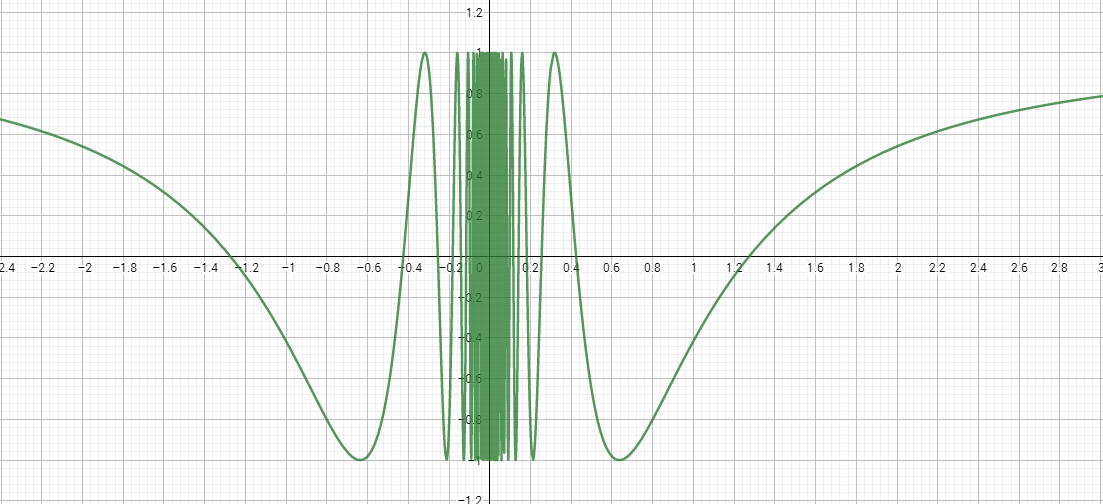
this is the graph of cos(2/x)
that limit does not exist as x -> 0
but you can use for example -1 < cos(2/x) < 1
signal mesa
ohh squeeze theorem
signal mesa
christ how did someone come up with this lmao
do i have to put down any assumptions before the proof i dont think theyre expecting a rigorous proof or anything
mental maple
did you learn the formal definition of the limit?
then probably not
just state that -x^4 <= x^4 sin(2/x) <= x^4
and that both x^4 and -x^4 go to 0 as x -> 0
signal mesa
epsilon delta you mean
mental maple
ye
gleaming schooner
How can I graph the following quadratic equation without using a calculator: f(x) = -1/5(x + 4)² + 1 The roots are (-4 + sqrt(5), 0) and (4 + sqrt(5), 0), the y-intercept is (0, -11/5)
How can I graph those roots? o,o
mental maple
uhm, i would just draw a parabola with vertex (-4,1)
all parabola are the same anyway
crimson gate
Yeah so you know the vertex is (-4,1) because it's in vertex form, and you know the roots, so you can just plot the three points and graph from there
signal mesa
we went over the epsilon delta definition but i dont remember the professor using it in conjunction with squeeze theorem
but i guess a formal definition of a limit when youre trying to prove a limit exists in a proof would be necessary lol
mental maple
ye, if you take the squeezew theorem for granted it's not needed
you can prove usingthe definition that limits preserve non-strict inequalities
the squeeze theorem follows from that
signal mesa
thank-you
signal mesa
if im trying to take the limit at 2 and i factor the numerator of this equation into (x+3)(x-2) im not able to cancel the denominator am i
gleaming schooner
Thanks
I'm having trouble taking a quadratic equation written in standard form, and converting it to vertex form
I have f(x) = 3x² - 42x - 91
mental maple
@signal mesa consider what happens when x > 2 and when x < 2 separately
signal mesa
it becomes negative when x is less than 2
mental maple
@gleaming schooner yes
gleaming schooner
So, I do that and I get:
y = 3(x² - 14x + 49) - 91
And I then have to take away 3 * 49 from the right side.
gleaming schooner
Alright
signal mesa
are we assigning x = -x
mental maple
that's not really a good way to say it
|x| is a piecwise defined function
it's x when x > 0
and -x when x < 0
signal mesa
so that applies even to the x which isnt in the absolute value notation
mental maple
basically, the absolute value makes your whole function piecewise defined
one part when x-2 > 0, and one part when x-2 < 0
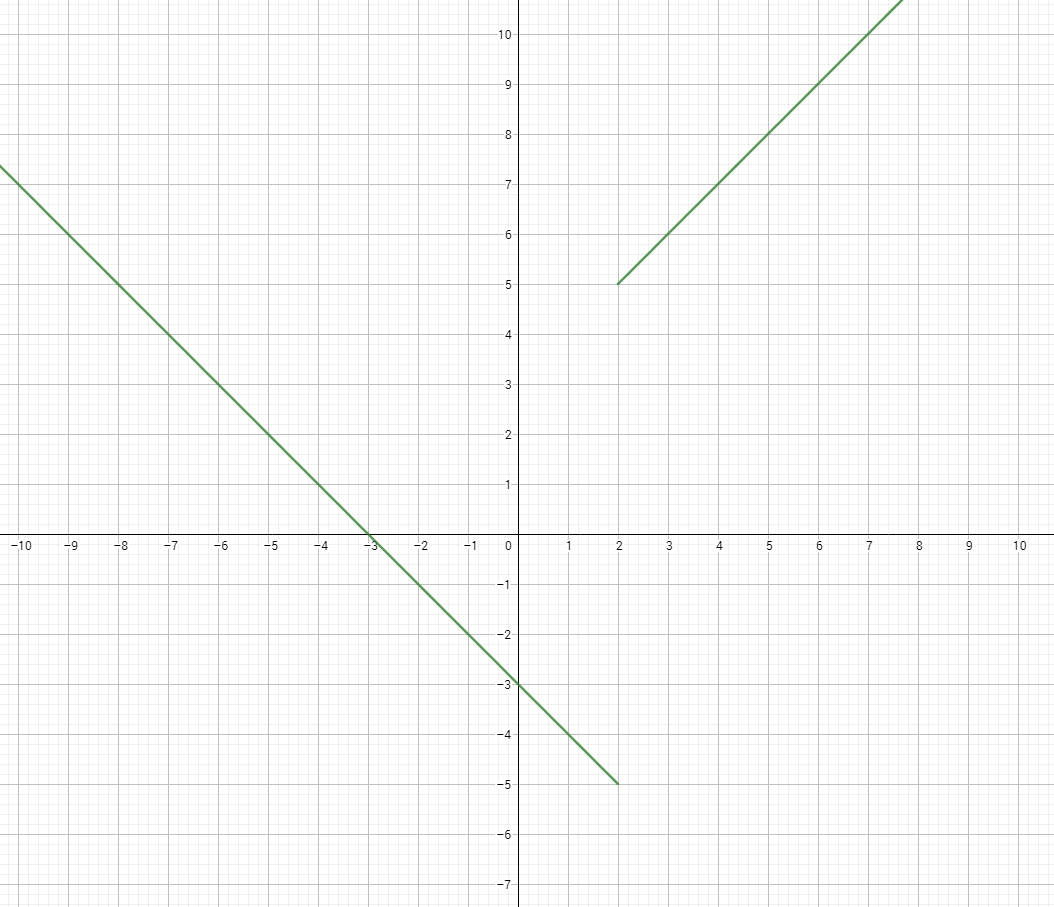
it looks like this
one part is x+3
one part is -x-3
signal mesa
thank you thats a big help


 blazing raven
yup
timid jacinth
how can b be greater than a though?
if a is a longer leg?
or is that just the result of poor drawing?
blazing raven
um?
oh I see. Yeah. If the problem didn't say b or a is longer then yeah. You are likely safe.
timid jacinth
Alright
tired nest
Always trust the maths over the drawing, unless explicitly told otherwise.
 velvet sparrow
U wot?
timid jacinth
my sin(45.6) = sqrt(51)/10 right?
timid jacinth
Alright
so for tan I got 7/sqrt(51)
why can't I leave it like that again?
in one class I'm being told to rewrite 7/sqrt(51) to 7(sqrt(51))/51
tired nest
You want to avoid leaving roots in the denominator.
timid jacinth
and in the other I'm being told to leave it alone
tired nest
It's not incorrect if there's a root in the denominator, but usually it's preferred without it.
 sonic heath
It's usually better to put roots in the numerator for the sake of doing sums with fractions
You don't want to be finding 'root 51' as a common denominator.
😛
timid jacinth
ah
sonic heath
If forced to add.
timid jacinth
gotcha
velvet sparrow
What wouls be wrong wuth that?
timid jacinth
Hmm
this is a weird one
One sec, I'll put it up on paint and show where I'm at
So, the red is my working out so far
I'm confused how to advance beyond this
given the restriction
 sonic heath
Okay
velvet sparrow
Use the definitioms of trig functions
sonic heath
Do you know your trigonometric identities when a right angle is involved?
timid jacinth
Yep
sonic heath
Okay, what are they?
timid jacinth
SOHCAHTOA
sonic heath
Right
So, in this case - We'll start with finding c
You already have the length of b
And the angle B = 41 degrees
So, what identity involves c, b and an angle?
(Considering the location of the angle, of course)
timid jacinth
cos(A)=b/c, so cos(49deg)=4/c
sonic heath
Slight mixup there - cos is not (opposite/hypotenuse)
sonic heath
Oh I see what you're doing
My bad
And yes - You're correct.
And yeah you can go about it that way
Taking that cos as 180 - theta
So, yeah - your working there is correct
timid jacinth
so now I need to solve for c?
sonic heath
Okay, so now we need side lengths
timid jacinth
Okay
sonic heath
So you mentioned trigonometric identities SOH CAH TOA
And you have internal angles
You gave me the relationship before cos(90-theta) = 4/c
Which is the same as
=tex \cos(49) = \dfrac{4}{c}
granite stirrupBOT
timid jacinth
c=4/cos(49)?
willow bear
=tex \cos(49^\circ)
timid jacinth
not sure
granite stirrupBOT
sonic heath
Ah, thank you
willow bear
yes, c = 4/cos(49°)
timid jacinth
Okay
sonic heath
Now repeat for the missing side, using the trigonometric identities again.
timid jacinth
so I just leave c = 4/cos(49deg) for now
willow bear
what's the problem y'all are doing?
timid jacinth
velvet sparrow
Trig
sonic heath
"so I just leave c = 4/cos(49deg) for now"
You can do, for simplicity sake
If you want
willow bear
they're asked to leave answers as exact values
49° isn't one of those angles with an easy sin or cos
sonic heath
You could always leave it like that until you find 'a' as well, and then do the calculation
But yeah - She's right
Looks like you've got to give a precise answer here.
willow bear
seriously though this is the point where
i feel like sharing the way i tend to view trig functions geometrically
not as ratios, but as multipliers
timid jacinth
so how do I express c=4/cos(49deg) as an exact value?
sonic heath
Calculator 😛
timid jacinth
we're not allowed to use calculators
timid jacinth
ok
sonic heath
Heh
velvet sparrow
Elaborate @willow bear
sonic heath
My bad Chiefqueef - apparently I'm still half asleep.
timid jacinth
so now I can move on to sin(49deg), which I think is sin(49deg)= a/(4/cos(49deg))
sonic heath
The reason why it is the exact value is because if you WERE to put it into a calculator
You would round off
And lose the 'exactness'
Hence why you must give that answer you just found.
willow bear
@timid jacinth you can figure out a from b directly
velvet sparrow
Not allowed
willow bear
what?
sonic heath
"so now I can move on to sin(49deg), which I think is sin(49deg)= a/(4/cos(49deg))"
Yes.
And re-arrange for a
timid jacinth
okay
willow bear
anyway
this is what i meant by thinking of trig functions as multipliers
it's also a nice explanation for why sec and csc are named the way they are
sonic heath
That's really quite cool
timid jacinth
a=(sin49deg)/(4/cos(49deg))
timid jacinth
I thought I was just rearranging for a?
willow bear
sin(49°) = a/(something)
a = (something) * sin(49°)
but once again holy shit chief you're making your own life harder here ;w;
timid jacinth
eh
sonic heath
=tex sin(49^{\circ})= \dfrac{a}{(\frac{4}{cos(49^{\circ})}}
timid jacinth
I'm a bit lost right now
I guess I'm supposed to figure this out with methods I'd have been taught up until this point
which, if I recall is complementary angles and x,y,r definitions
granite stirrupBOT
willow bear
you were given this, right?
timid jacinth
yea
timid jacinth
a is the leg between B and C right?
willow bear
yes
timid jacinth
yeah that makes sense
willow bear
for clarity
timid jacinth
becuase tan = O/A, 4/a
willow bear
yeah so even though you've figured out c, you really do not need it to find a
timid jacinth
so right now I've got tan(41deg)=4/a
willow bear
yeah, and now rearrange for a
willow bear
👍
timid jacinth
so I leave my a as that, now I need to solve for side c
timid jacinth
so, I'm done?
willow bear
yes
willow bear
the problem isn't really hard or long tbh
at some point, trigonometric manipulations like these are going to become automatic
timid jacinth
A boy can dream
sonic heath
Just a case of practice
Honestly, the 'multiplier' thing just shown is news to me, because I was taught SOH CAH TOA via rote memorisation in school
Rather than shown the reason and actual relationships.
timid jacinth
I have no fucking clue what the reason or relationships are
sonic heath
Of course sqrt{2}, but I'd prefer to have a more intuitive understanding of it
willow bear
i meant okay from a mathematical standpoint
sonic heath
Because I have no idea how secant etc are defined other than through calculating them each time or looking them up
willow bear
but yeah i feel like introducing them as multipliers, like in my picture, is better
sonic heath
Indeed.
It's better because you don't have to have the hypotenuse length to immediately get an answer
You can have any of the lengths
willow bear
oh yeah
willow bear
a thing you multiply by
in my picture, in the first triangle you can see that the hypotenuse, which i marked with r, gets multiplied by sin(θ) and cos(θ) to produce the legs
timid jacinth
so
lets say
sin(theta) = 1/2
and
r = 1
to find the leg I'd just do 1/1 * 2/1 = 2?
willow bear
why'd you divide 1 by sin(θ)?
willow bear
?
timid jacinth
I didn't make that connection
for whatever reason
So back to that earlier problem, a=4/tan(41deg), c=4/sin(41deg)
just wanting to make sure I've got it correct for note taking purposes
I found c with theta = 41deg intead of 49 this time
and by using sin
timid jacinth
not very fond of biology
viscid thistle
Biology is good for one thing, application of exponents and exponent functions
 calm thicket
^
willow bear
ayy
viscid thistle
lol
 smoky lance
anyone about?
clever inlet
?
 late haven
o/
willow bear
don't ask to ask
just post your damn problem
willow bear
rational root theorem
viscid thistle
^
willow bear
and hope that you can get it down to a quadratic
willow bear
then you're fucked
willow bear
all hail wolfram alpha, our robot overlord
viscid thistle
🙏
 subtle forum
Anyone here that can help me with how to write 5i as exponential?
or, in exponential form
 desert thistle

 viscid thistle
@GONNATAKEURBRAINS JOHNSON#9914 if you don't have access to wolfram or anything for degree 4 there is a formula, its disgusting though
 austere bramble
$$for z\in\mathbb{C}$$ we can think of $$z=re^{i\theta}$$ where r becomes the norm and theta is the angle. 5i has distance 5 from 0, and i is on pi/2, so you get $$5i=5e^{i\pi/2}$$
granite stirrupBOT
subtle forum
Thanks @desert thistle
viscid thistle
could someone help me with transformations of sin and cos functions
tired nest
What's the question, @kurry ?
tired nest
Okay, so, try this first: what happens when you sub pi/6 into #1?
 agile tendon
How do you prove Thurston's geometrization conjecture using Ricci flow with surgery to affirm as a corollary the Poincaré conjecture for 3-manifolds?
austere bramble
if you know how you'd be famous
signal mesa
 hollow cobalt
how would i write (1 + i sqrt3)^3 in the form a + bi?
willow bear
(x+y)^3 = x^3 + 3x^2y + 3xy^2 + y^3
(1 + sqrt(3)i)^3 = 1 + 3 * sqrt(3)i + 3 * (sqrt(3)i)^2 + (sqrt(3)i)^3
= 1 + 3 sqrt(3)i + 3 * (-3) + (sqrt(3))^3 * i^3
hollow cobalt
damn. . lost me on the last one
willow bear
what exactly are you confused about?
hollow cobalt
i understand the expansion and i see how the 2nd line is just the complex rendition of that
im not sure where its going from there
willow bear
i'm not done yet
hollow cobalt
ah ok
willow bear
do you understand how i got from the expansion to 1 + 3 sqrt(3)i + 3 * (-3) + (sqrt(3))^3 * i^3?
 dusk kettle
does anyone actually teach the set of outputs of a function as its codomain, or does everyone say range?
hollow cobalt
uhh
hold on let me rewrite it on paper and look at it. . getting confused by the format i think
also havent slept
dusk kettle
=tex 1 + 3\sqrt{3}i + 3 (-3) + \sqrt{3}^3 i^3
granite stirrupBOT
dusk kettle
=tex (1 + \sqrt{3}i)^3 = 1 + 3 \sqrt{3}i + 3 (\sqrt{3}i)^2 + (\sqrt{3}i)^3\ =1 + 3\sqrt{3}i + 3 (-3) + \sqrt{3}^3 i^3
granite stirrupBOT
hollow cobalt
thanks
ok yeah duh
now i see it
though ,
why distribute at the end
?
with the sqrt3^3 i^3
willow bear
i was about to show why
dusk kettle
I think the plan is to factor out the i
willow bear
this whole thing equals $$1 + 3\sqrt{3}i - 9 + 3\sqrt{3} \cdot (-i)$$
granite stirrupBOT
willow bear
=tex = -8 + 3\sqrt{3}i - 3\sqrt{3}i
granite stirrupBOT
willow bear
which is just -8
hollow cobalt
stuck on one last
how do i find f^-1 (inverse f) of f(x) = 1/1+e^-x
assuming that f is a one to one function
willow bear
=tex f(x) = \frac{1}{1 + e^{-x}}
granite stirrupBOT
hollow cobalt
yes
 naive hearth
Hello all, I'm having trouble finding the equation of the line that is perpendicular to 3x + 4y = 7.
I start by converting this to slope intercept form to get the slope.
So then I have =tex y = -3/4x +7/4
clever inlet
Yeah
And for perpendicular
m1 * m2 = -1
And for point
I guess the y int
Actually nvm
I'm dumb
The y int probably isn't on the perpendicular line
viscid thistle
hopefully this helps (the ' thingy is the derivative but you can think of it as the slope of that line)
naive hearth
ok, so would m2 be just 3/4? or for a fraction do you invert it to be 4/3?
clever inlet
Wait
viscid thistle
that is the thought process u need to have, to see that for a parallel line the slope will be exactly the same
perpendicular line = slope is opposite and reciprocal
clever inlet
Is there even enough info for a single line equation?
viscid thistle
(in basic words, flip the sign and the denominator/numerator)
the answer to that therefore would be any line with a slope of -4/3
clever inlet
Ah yeah true
viscid thistle
don't try to just memorize that though, take a look at the drawing (sorry for it being so shitty) and try to realize how the slopes are affected
ms paint masterrace
clever inlet
👍
naive hearth
@tan thanks! so you flip the denominator/numerator and change the sign of both? I'm having trouble conceptualizing that but I think I can get there with some work.
m1 = -3/4 and m2 = -4/3
viscid thistle
yes, my answer was incorrect on the sign
try to grasp the head around the concept though, let me see if i find some good explanations for it
http://www.algebralab.org/lessons/lesson.aspx?file=geometry_coordparallelperpendicular.xml this site is a bit ugly but it has nice examples displaying it
naive hearth
Thanks @tan and @clever inlet !
Now I need to find the the line with that slope(4/3) that passes through the points (-2/3, 7/8).
So I will use point-slope form, y- y1 = m(x - x1)
so now I have y - (7/8) = 4/3(x - (-2/3))
I need to get this in y = mx + b form, but I'm a bit lost...
viscid thistle
alright so you have this right now
=tex y - \frac{7}{8} = \frac{4}{3}(x-(\frac{-2}{3})
granite stirrupBOT
granite stirrupBOT
naive hearth
The book i'm using isn't very helpful, I don't understand why they multiply by 2.