#geometry-and-trigonometry
1 messages · Page 370 of 1

 dark sparrow
yes
 heavy snow
O = 5 + 4 + 5,38 + 2 = 16,38 A = 5*((2+4)/2) = 15
 heavy snow
mixed up the words there, sorry
 hearty rain
@forest drift ...
dark sparrow
you've been all promises and no delivery, anish bhat
you know this makes you look very suspicious at best, right?
 earnest basin
Help
 forest drift
dark sparrow
you've been all promises and no delivery, anish bhat
forest drift
dark sparrow
you've been all promises and no delivery, anish bhat
lol
heavy snow
if the task is to solve what coordinates say B has in the line AB if what is given to you is only A = (5,2) and the midpoint M = (-1, 1) how would you solve it?
dark sparrow
the midpoint, as in the midpoint of AB?
heavy snow
I assume the midpoint here is between A and B
my first thought is to find out the length of A and M and then double it to find B?
heavy snow
B is supposed to be (-5, 4)
dark sparrow
it's better to remember how you would find the midpoint given A and B
$M = \paren{\frac{x_A + x_B}{2}, \frac{y_A + y_B}{2}}$
 somber coyoteBOT
Kanga Gang Annihilator Ann
 heavy snow
right and that gives me an equation
heavy snow
the Y equation is quite difficult to solve
dark sparrow
is it?
it should not be any more difficult than the x equation
they have the exact same structure just with different numbers
heavy snow
2 * (3 + x) / 2 = -1 * 2
3 - 3 + x = -2 - 3
x = -5
dark sparrow
and you had difficulty going through the exact same motions with (y+2)/2 = 1?
heavy snow
actually I was doing something wrong
got it
2 * (-2 + y) / 2 = 1 * 2
-2 + y = 2
2 + -2 + y = 2 + 2
y = 4
heavy snow
sorry I was looking at the wrong task it should be A = (3, -2) B = (?,?) and M = (-1, 1)
dark sparrow
ah.
heavy snow
thats why I got Y wrong there
hearty rain
forest drift
lol
What do mean, 'lol'?
 upper karma
how do we visualize the graph by reflection of a function f(x) at a given line like y=x. Is there any way we could visualize this in a nice easier way rather than plotting all the points?
heavy snow
is the midpoint normal between a line AB just another name for a midpoint?
upper karma
upper karma
how do we visualize the graph by reflection of a function f(x) at a given line l...
Like how do we visualize the reflection of the graph of a function f(x) = cosx along y=x line. Please give me some idea on what exactly you do to know this?
heavy snow
visualize as in using your imagination or an actual graph tool?
upper karma
heavy snow
visualize as in using your imagination or an actual graph tool?
imagination and drawing it on copy
heavy snow
put in the function here and practice visualization?
would be my take on it
if you actually know what it looks like then you can approximate a similar function
upper karma
heavy snow
if you actually know what it looks like then you can approximate a similar funct...
actually I was tryin' to learn the graphs of inverse functions which is in fact graphs of a function reflected along y=x but I was having hard time understanding it . so
upper karma
heavy snow
if you actually know what it looks like then you can approximate a similar funct...
I mean how do you get to know that this part of line will be concave here , convex here, will point this side after reflection?
 upper karma
heavy snow
stuff like this?
upper karma
heavy snow
stuff like this?
yeah, exactly like this.
forest drift
hearty rain
What do mean, 'lol'?
ummmmmmmmmm I never proved ramanujan wrong.
heavy snow
no you didnt
forest drift
I just proved another case of ramanujan correct
forest drift
dark sparrow
okay so you misled us all
nope
heavy snow
stop spamming these boards with nonsense
dark sparrow
 upper karma
heavy snow
no you didnt
upper karma
heavy snow
no you didnt
suppose u're given a function and how do u know it's graph after reflection along y=x will be like you've drawn in the ss u've sent.. plz tell me. that's the thing i'm havin' dilemma over
heavy snow
well put in the function you have into that graph there and it'll draw it for you
upper karma
heavy snow
well put in the function you have into that graph there and it'll draw it for yo...
okay.. sounds cool... ty so much, king
heavy snow
what does the function you are trying to solve look like?
forest drift
dark sparrow
I just hope that you guys hate me
forest drift
you hate me right?
dark sparrow
no
 wise pawn
forest drift
you hate me right?
wise pawn
forest drift
you hate me right?
stop spamming about non math in here please
heavy snow
you can send it down the toilet
forest drift
heavy snow
you can send it down the toilet
ah
heavy snow
how do you find the midpoint normal of a line AB if A = (1,0) and B = (5,4) ?
erm the task is to write it as a linear equation, y=kx+m
 nocturne remnant
welp i think i have one way to do it
forest drift
heavy snow
how do you find the midpoint normal of a line AB if A = (1,0) and B = (5,4) ?
basically find the mid term using the formula and then just get the equation of a line passing through the point
heavy snow
(1 + 5) / 2, (0 + 4) / 2 = M(3, 2)
nocturne remnant
alternatively, any point T(m,n) lies on the desired line if TA = TB
so you might be able to just plug the distance formula or sth
nocturne remnant
heavy snow
y = 3x + 2
how did you get
heavy snow
 forest drift
heavy snow
forest drift
heavy snow
ooh geogebra is funn
heavy snow
how do you find it then without using the graph tool?
forest drift
heavy snow
how do you find it then without using the graph tool?
you cannot
or maybe
just find the locus
nocturne remnant
does the question tell you to use a graph?
heavy snow
no
nocturne remnant
well you cant use a graph in the exams
heavy snow
it gives you the A and B points and then you are supposed to determine the equation to the perpendicular bisector
nocturne remnant
was there a similar-type problem in the lesson / handouts / textbooks?
heavy snow
surprisingly nothing
and I looked it up and other people have being asking the same question when it comes to this problem
dark sparrow
well i would suggest writing out (x-1)^2 + y^2 = (x-5)^2 + (y-4)^2, expanding it out and letting the algebraic dust settle
but i'm almost certain that wouldn't go well
nocturne remnant
heavy snow
surprisingly nothing
(I'll assume that means you can approach the problem whichever way you like)
dark sparrow
this is just TA^2 = TB^2 in elon mask's notation
nocturne remnant
so yeah, either plug the distance formula
or find the mid-pt, and then the desired slope in order to construct the eqn
heavy snow
well I solved the mid-pt (1 + 5) / 2, (0 + 4) / 2 = M(3, 2)
dark sparrow
sure, that's going to be your midpoint
nocturne remnant
desired line should be perpendicular to the original line AB
dark sparrow
if you want to do it that way, the next step would be to find the slope of the line AB and take its negative reciprocal
heavy snow
so you inverse AB ?
nocturne remnant
find the slope of AB first
heavy snow
so rise/run = 4/5 = 0,8
heavy snow
not sure maybe (2, 1) ?
nocturne remnant
slope!
heavy snow
I don't know how you do that
nocturne remnant
a slope is a number
(Any two perpendicular lines have their slopes multiply to -1)
heavy snow
1 ?
nocturne remnant
well AB is 1
heavy snow
1 * -1 = -1
nocturne remnant
so the required slope is?
heavy snow
-1 I guess?
nocturne remnant
Yep!
So, we already have the slope, and that the line passes through (3,2)
now, you should be able to find the y=mx+c
heavy snow
what do you mean sub x = 3, y = 2, m = -1?. 3 - 2 + -1 ?
nocturne remnant
substitution
juse replace the letters in the equation with the corresponding numbers
heavy snow
2 = -3x + -1 ?
heavy snow
2 = 3 - 1 unless you count out the -x slope
I'm just guessing because I don't know how you'd approach this
heavy snow
weeeell that explains it
heavy snow
wouldn't have been easier just to show me that to begin with?
nocturne remnant
well i didnt think you'd get stuck on such a thing
since you know about midpoints and stuff

heavy snow
how am I supposed to know you are supposed to solve it this way?
its the reason I asked for help to begin with
nocturne remnant
nocturne remnant
y = mx + c
sub x = 3, y = 2, m = -1
i reckon this is quite clear already
but whatever
bye
heavy snow
for you it is, not me, okey, thanks, bye
its a common pattern I've noticed when you ask for help about a math problem. People just assume you know everything already and they are too lazy to imagine why the person who is asking for help is thinking in a particular way about a problem. If you can imagine what the person who is asking for help is thinking which leads to the wrong answer, you can also guide and show that person the correct way of thinking.
hearty rain
forest drift
ummmmmmmmmm I never proved ramanujan wrong.
I am not angry, I am disappointed
upper karma

 molten delta
upper karma
molten delta
upper karma
Do you still need help?
 abstract fog
upper karma
abstract fog
upper karma
We can see here this is supplementary angles
In the supplementry formula we use =180
So we will have
90 + 3x + 2x-20= 180
70 + 5x = 180 we combine like terms
5x= 110
x= 22
We know x is 22 but we are not done yet
It wants to know what angle c is
So we now go (2*22 - 20)
44-20
24
So we get our answer which is m<c is equal to 24
Hopefully I got it right and you understand
@hexed tiger
Did I do the work correctly
I’m not that good at geometry and idk if I am leading in wrong path
 loud vale
upper karma
loud vale
upper karma
What does x positive mean over here as highlighted in the blue text? Can x ever be considered negative? How could distance be negative? Plz tell

 humble pulsar
upper karma
What does x positive mean over here as highlighted in the blue text? Can x ever ...
humble pulsar
upper karma
What does x positive mean over here as highlighted in the blue text? Can x ever ...
x could be negative once you introduce the unit circle for trig
but distance is strictly non-negative, yes
Because you use right angle trig, you restrict yourself to only considering positive x
upper karma
humble pulsar
Because you use right angle trig, you restrict yourself to only considering posi...
what if we want to consider negative x in above example?
 lunar heart
excuse me can anyone help me with geometry
humble pulsar
Then the argument doesn't hold
Cause you wouldn't have a triangle
Or.. if you impose it on the unit circle then you'd just get the triangle the other way, so it should actually work in technicality?
upper karma
humble pulsar
Or.. if you impose it on the unit circle then you'd just get the triangle the ot...
ty so much, king
earnest basin
Circle M has a central angel of 100 degrees with radius 12 cm. Find the area of the segment.
54.75 sq. cm
4.56 sq. m
10.47 sq. cm
76.46 sq. cm
Helppppp
<@&286206848099549185>
 signal swallow

 sacred wyvern
I really don't understand trigonometry much could anyone help me what exactly it is I tried going through some websites for them but I still didn't understand it?
dark sparrow
somewhat loosely, trigonometry is the study of the relationship between lengths and angles in triangles (and in other shapes that can be built up from triangles)
 fallen sleet
how to prove that a circle has a finite perimeter?
dark sparrow
i guess you would need to work with the definition of a rectifiable curve
ie the definition of what it means for a curve to have a length in the first place
fallen sleet
does this mean changing the definition of a rectifiable curve [for example making it x2] would not cause any issues? [even if it is not useful]
dark sparrow
i think you misunderstand
the definition of a rectifiable curve concerns what curves have a length in the first place, not the assignment of lengths to curves
fallen sleet
oh my bad
 silk jacinth
I know this solution I saw is wrong, but my sleep- and glucose-deprived brain figure out why:
tan x = sin x
sin x / cos x = sin x
sin x / cos x = sin x / 1
cos x = 1
x = 2πn
oh wait now I get it, if sin x = 0, then cos x might not be 1
so yeah nevermind 😄
humble pulsar
tan(x)-sin(x)=0 then factor
silk jacinth
yeah that's how I did it
but someone gave that solution and I couldn't immediately find the error in their reasoning
 empty thicket
Hi anyone know how to do proofs
humble pulsar
empty thicket
Hi anyone know how to do proofs
nah, no one's ever done proofs here
 twin axle


 opaque mauve
Hello I need some help with geometry
My teacher gave me this and idk where to start

This is a example of what I need to do

 tribal tendon
@nocturne pebble
forest drift
empty thicket
Hi anyone know how to do proofs
yes I know
forest drift
opaque mauve
Hello I need some help with geometry
hey
can you come to DMs
I can help you out
for the first question
opaque mauve
It’s ok I finished it already
forest drift
okk
forest drift
opaque mauve
It’s ok I finished it already
it's very easy
 heady adder
Hello
@forest drift pranam ramanujan ji

I was playing with this simulation and i am unable to understand how 230° is found here.

 potent orbit
Anyone know about this?
 heavy snow
direction is the length of p2-p1
the line started at point p1(2.5) and ended at point p2(11,13)
you then take the origin or p1 * direction * force which is 2,8
potent orbit
heavy snow
direction is the length of p2-p1
Is it fine with you if I DM you about it?
heavy snow
sure

 dense badger
nvm got c can somone help with a
upper karma
dense badger
The first one
Sec=1/cos
And cot=cos/sin
So 1/cot= sin/cos
And sinsec= sin/cos
upper karma
upper karma
Sec=1/cos
This is a
upper karma
Sorry i wrote it wrong
upper karma
Yes
dense badger
how
upper karma
1-cos²x=sin²x
upper karma
Is your problem solved?
upper karma
Give every Point a letter first
potent orbit
I figured it out, sorta, but i do have a more complex one
Here's the one I'm talking about
 upper karma
potent orbit
Here's the one I'm talking about
upper karma
potent orbit
Here's the one I'm talking about
Draw the situation and it will be much easier
It doesnt matter if the picture is bad it is vetter than No picture
Better
potent orbit
Seriously? You don't know how to help if there isn't a picture involved?
 viscid ginkgo
https://i.imgur.com/FMB3cdQ.png am I crazy or does khan academy not explain how to get to a maximum point of (2.5pi, 6) here at all??
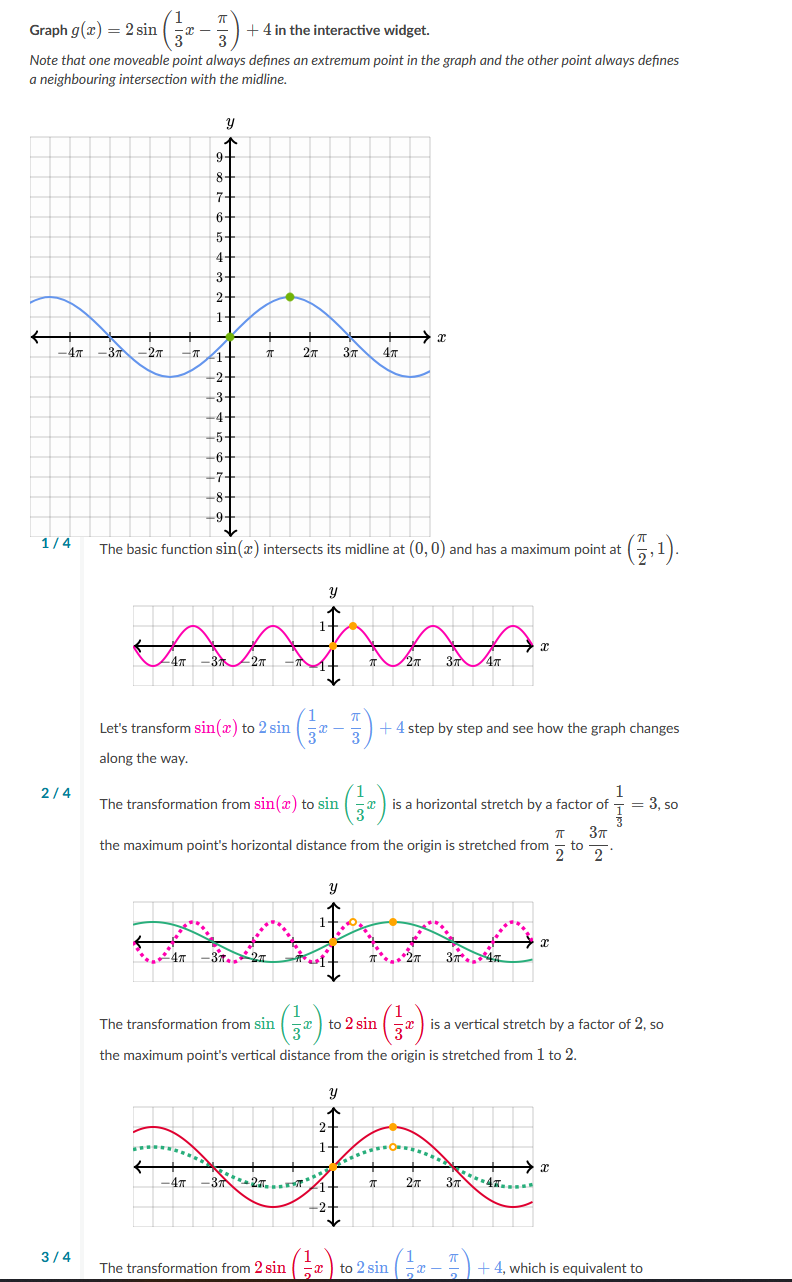
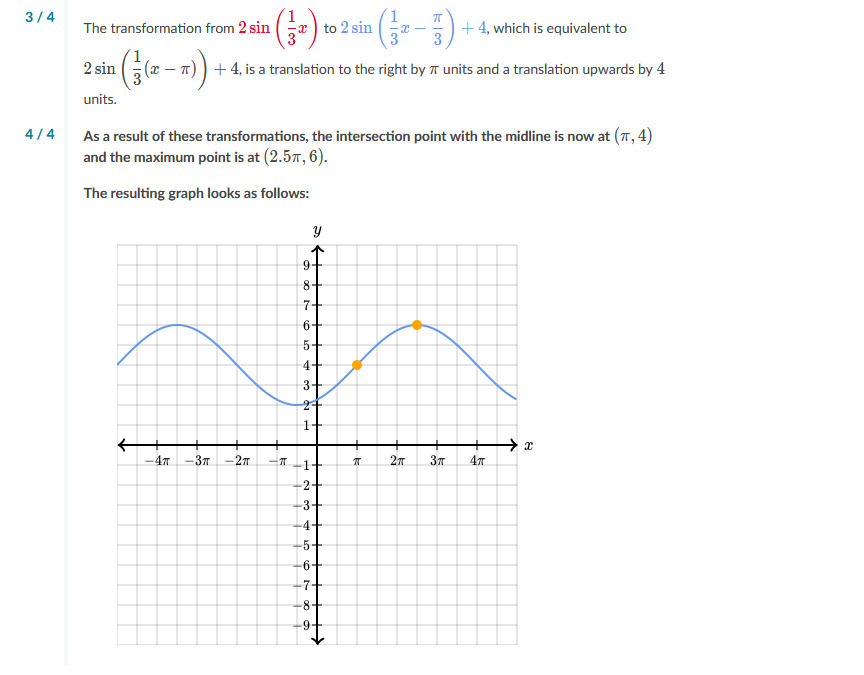
this is often my problem with my classes where I feel like people don't explain things properly
I look all over for the answer and spend so much time confused
upper karma
potent orbit
Seriously? You don't know how to help if there isn't a picture involved?
A picture make things simplier
You put 2.5π in your function
And 2.5π-π=1.5π
And than (1/3)•1.5π=(π/2)
π/2=90°
Sin 90°= 1
So (2•1)+4=6
upper karma
viscid ginkgo
this is often my problem with my classes where I feel like people don't explain ...
Thé answer is correct but you have to work with radian and degrees
 upper blaze
Guys I have a question
Does anyone know how much 3D geogebra calculations are precise?
 viscid ginkgo
upper karma
And 2.5π-π=1.5π
viscid ginkgo
upper karma
And 2.5π-π=1.5π
yes I finally understood this when someone explained ( [] - C) = + horizontal shift
thank you sir
upper blaze
 onyx mesa
i dont know how to prove the last part
onyx mesa
i dont know how to prove the last part
I dont know what you dont understand
You have all 3 angles and 1 common side
onyx mesa
upper blaze
I dont know what you dont understand
yeah i figured it out after a bit
you have to get the shortest proof possible so stating it's right triangles wouldnt count
onyx mesa
can someone help me
upper blaze
Hmmm but thats shortest? I dont see what shorter you want xD
forest drift
onyx mesa
im stuck
I learnt this in grade 4 lmao
dark sparrow
great, who cares
upper blaze
Anish, I think you should be more respectfull to others and if you cant help them dont comment. If you have something usefull to say please do otherwise dont say anything. You alredy trolled here before now please stop
forest drift
upper blaze
Anish, I think you should be more respectfull to others and if you cant help the...
I never trolled
forest drift
upper blaze
I have never saw your work
first of all correct your english
forest drift
upper blaze
About ramanujan proof?
I never trolled
I have done it but I am hesitant to show it to others cuz you guys might steal
dark sparrow
I have done it but I am hesitant to show it to others cuz you guys might steal
lmfao
wow
upper blaze
Fast Geogebra question. If I have a regular triangle in some plane in space how can I make tetraheadron over that triangle so that 4th point of tetraheadron is on wanted side of a plane?
wise pawn
you could use the cross product
 spiral gulch
hi i am confused in one of my mock exam questions i dont really get it can someone help me?
 upper karma
use the basic formula
sin²x+cos²x=1
1-cos²x=(4/7)²
1-cos²x= 16/49
1-16/49=cos²x
so cosx = 0.8206518066
cotx = (cosx/sinx)
dark sparrow
so cosx = 0.8206518066
ew
upper karma
yea i know
dark sparrow
there is no need whatsoever to shove these ugly decimals in
upper karma
it is squerooth of (33/49)
dark sparrow
please do not call me bro
dark sparrow
if you really care so much about a stranger's gender, then i'm a girl.
upper karma
ok tha i take my words bro and so back
sorry there is u shorter way
so we now secx= (1/cosx)
so secx= square root of (49/33)
but tha is cot > 0 and it has to be <0
upper karma
0<cosx>1 so the corner is in quadrant 1
and if -1<cosx>0 than is cotx<0

so secx have to be -square root (49/33)
upper karma
spiral gulch
so secx have to be -square root (49/33)
 lost gale
does Diagonal in a rectangle across an angle?
 radiant fractal
hey quick question, is it no triangle because angle c gets cancelled or what exactly?
 upper blaze
radiant fractal
hey quick question, is it no triangle because angle c gets cancelled or what exa...
upper blaze
radiant fractal
hey quick question, is it no triangle because angle c gets cancelled or what exa...
What is ssa?
 iron spoke
side side angle
 silent plank
There can be only one with ssa so 1 and 2 are false
bad reasoning
upper karma
you know something else
upper karma
silent plank
> There can be only one with ssa so 1 and 2 are false
bad reasoning
and if you know it so much better give than your opinion/answer ok
silent plank
i try not to give the whole answer away.
There can be only one with ssa
is false or incomplete
 vagrant quail
How do you motivate yourself to learn euclidean geometry at the Olympiad level? It just seems so unmotivated and dry
 silk patio
Motivation by beauty. What is the main motivation for you for any mathematics?
vagrant quail
Well exactly, beauty. But there is barely any beauty in Olympiad geometry, cause all the problems always seem contrived or too niche to be relevant
At least that is my impression of it
dark sparrow
you're not alone in having that impression, if it's any consolation
vagrant quail
Almost all the teachers that have taught me geometry just dump a load of theorems with no proof and then 2-3h of problems
But I still believe that if I just learn it in the right way, I can see something in it
Like Ceva's theorem
silk patio
I wouldn’t let uninspiring teachers trick you into thinking the results aren’t beautiful or have no conceptual motivations
vagrant quail
I do believe that the teachers are to blame in part for just lazily explaining the subject
But is there an approach to this that doesn't feel like directionless gruntwork?
wise pawn
what are you currently doing to learn euclidean geometry, what's your process?
 twilit pagoda
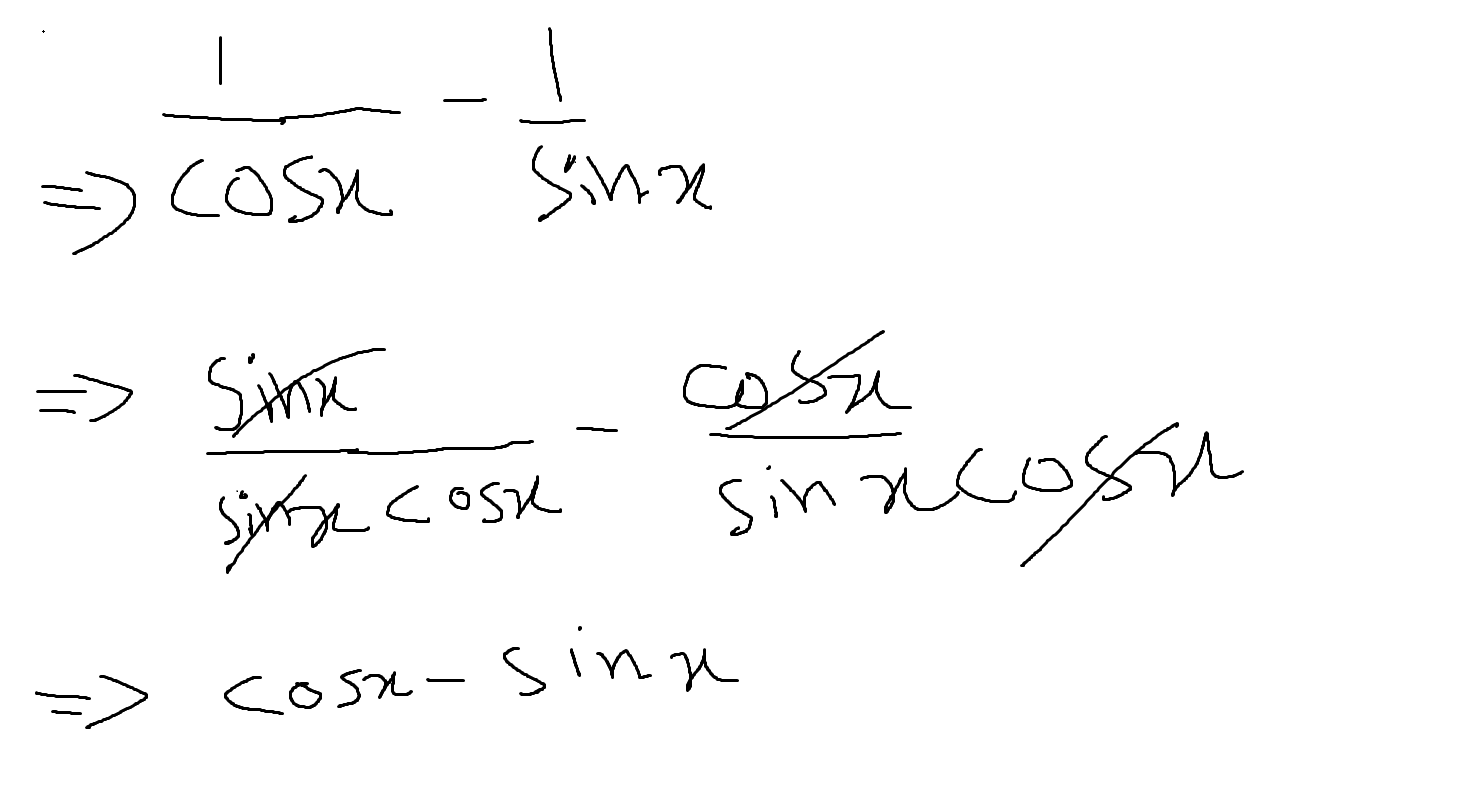
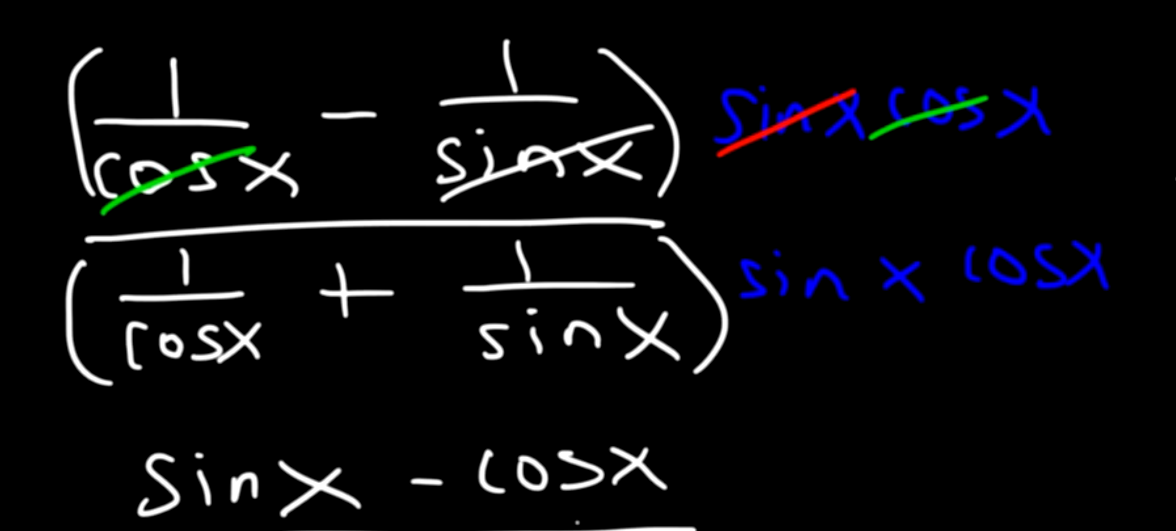
I started learning these trig functions a few days ago and I'm happy with my progression, I tried solving this problem myself but I'm getting a different answer than the lecturer I'm following.
So this is the question: https://snipboard.io/QCeA3g.jpg
And this is my solution: https://snipboard.io/KSB4tA.jpg
What wrong did I do there?
The lecturer used this cancelling technique which I'm not really aware of: https://snipboard.io/dcXQrW.jpg
And got this answer: sin x - cos x
However I'm getting cos x - sin x which is completely changing my final answer.
So whats wrong there?

Easy and free screenshot and image sharing - upload images online with print screen and paste, or drag and drop.
Easy and free screenshot and image sharing - upload images online with print screen and paste, or drag and drop.
Easy and free screenshot and image sharing - upload images online with print screen and paste, or drag and drop.
twilit pagoda
Edit: okay I've just crossed division and I got the same answer as my teacher: https://snipboard.io/ygc3Ax.jpg. Now my question is when do we do cross division? Or we also do cross division and thats something I've never noticed (i started learning math 1 month ago) so...
Easy and free screenshot and image sharing - upload images online with print screen and paste, or drag and drop.
upper karma
twilit pagoda
I started learning these trig functions a few days ago and I'm happy with my pro...
your fold is that (sinx/(sinx*cosx))= 1/cosx and not to cosx
 runic dock
@faint dagger
upper karma
Is cot(-x) = -cot X?
Or is that only in the case of sine?
But sin(-x) = -sin X everywhere?
And is that the case in any other trig fns

here you can change this a in your x
if you know the radials than you can use this

pi is the same as 180°
wise pawn
upper karma
Is cot(-x) = -cot X?
if you know cos(-x)=cos(x) and sin(-x)=-sin(x) and how to write cot in terms of sin and cos, then you can work it out
upper karma
wise pawn
if you know cos(-x)=cos(x) and sin(-x)=-sin(x) and how to write cot in terms of ...
So like
cot(-x) = [sin(-x)/cos(-x)]
= [-sin(x)/cos(x)]
= -cot(x)
Alright thanks 
silk patio
It’s cos/sin but doesn’t matter
 upper breach
can someone help me with t this

 late thistle

 cosmic smelt
trad: calculate the volume of a parallelepiped with a square base and a diagonal of 26 cm and make an angle with the base of 53 °
how do i graph that angle?
upper karma
What is it?
dark sparrow
based on it being spammed all over, probably a scam.
upper karma
I think it
humble pulsar
 smoky palm
Sin^2(x)+Cos^2(x)=cot^2(45)
smoky palm
Sin^2(x)+Cos^2(x)=cot^2(45)
that's incorrect
smoky palm
Eh
smoky palm
What is cot*2(45)
humble pulsar
1
humble pulsar
You're still wrong
humble pulsar
yeah, that's just pythagorean identity
smoky palm
That is
On an not unrelated
Which of the types of trig identities should be memorized?
humble pulsar
I mean... hard to say b/c idk what your teacher would give you on a formula sheet
humble pulsar
pythagorean identity, double angle
smoky palm
What about half angle
humble pulsar
derived from double angle.
humble pulsar
then idk
smoky palm
What about the sums and differences, or the ones derived from that
humble pulsar
compound angle you should know, to which double and subsequently half angle come from them
smoky palm
Thank you
humble pulsar
as well as the "definition identities"
like tan(x)=sin(x)/cos(x) and sec(x)=1/cos(x)
smoky palm
The basic ones
I didn’t know those were identities
But, it makes sense
Do I need to know how to use polar coordinates?
humble pulsar
I mean for multi-var yes, but I never used polar in 1st year.
humble pulsar
2nd year.
smoky palm
Do they do a review or something?
humble pulsar
no fucking clue what the university you will go to will do
 wintry tundra
@smoky palm the ones I use the most in derivatives is pythag and double angle
smoky palm
tyty
forest drift
guys
I proved ramanujan wrong again
and that too 2 days before Indian Mathematics Day
upper karma
forest drift
guys
How
upper karma
are you trying to prove his statements?
he is one of the biggest 'mathers' from the 20th century
good luck with proving
forest drift
upper karma
good luck with proving
I am done proving
silent plank
sum upto n natural numbers = n(n+1)/2
how does that prove anyone wrong about anything
 turbid star
forest drift
sum upto n natural numbers = n(n+1)/2
turbid star
forest drift
sum upto n natural numbers = n(n+1)/2
I suppose that is not from Ramanujan?
that was from Gauss as far as I can remember
upper karma
forest drift
sum upto n natural numbers = n(n+1)/2
Ig u mean sum upto infinity = -1/12 one? If so then yes i agree he was so wrong there
turbid star

forest drift
turbid star
that was from Gauss as far as I can remember
yeah gauss
forest drift
upper karma
Ig u mean sum upto infinity = -1/12 one? If so then yes i agree he was so wrong ...
sum upto infinity = -1/8
he told -1/12
turbid star
upper karma
Ig u mean sum upto infinity = -1/12 one? If so then yes i agree he was so wrong ...
Ramanujan wasn't wrong there, I think that's analytic continuation
forest drift
I proved it is -1/8
turbid star
also, why is this in geo and trig
upper karma
forest drift
sum upto infinity = -1/8
I dont think that still makes sense
upper karma
turbid star
Ramanujan wasn't wrong there, I think that's analytic continuation
Have you watched mathologer's video about that?
turbid star
I haven't actually
but I heard that Mathologer got a lot of "hate" from that video
or it was something like that, I dont remember if it was Mathologer
upper karma
turbid star
but I heard that Mathologer got a lot of "hate" from that video
He might have idk either
But he proved very efficiently every blunder ramanujan made
In sum upto inf = -1/12
wise pawn
forest drift
I proved ramanujan wrong again
this channel is for talking about math, not for bragging about math without showing it
you can only brag about it if you show it, otherwise you're trolling
forest drift
wise pawn
this channel is for talking about math, not for bragging about math without show...
honestly I never have received hate from people who have done more than me
wise pawn
are you trying to imply this is some form of hate?
I'm just telling you your messages are not math and off topic here
turbid star
^^^
upper karma
forest drift
honestly I never have received hate from people who have done more than me
Give proof now
Im 10 billion Percent sure sum of all natural numbers ≠ negative
forest drift
wise pawn
I'm just telling you your messages are not math and off topic here
i dont care
forest drift
upper karma
Im 10 billion Percent sure sum of all natural numbers ≠ negative
have you ever heard of mathematical marvels
upper karma
forest drift
have you ever heard of mathematical marvels
No
forest drift
upper karma
No
Then just don't comment on anything
 weary drift
@forest drift ur whole history is trolling w/ poor attitude toward others. pls stop or face a ban
upper karma
forest drift
Then just don't comment on anything
I might appreciate you to explain that to me rather than telling me to stop
forest drift
weary drift
<@!919513117296295967> ur whole history is trolling w/ poor attitude toward othe...
Ok I don't care
weary drift
bye
weary drift
yes
weary drift
i suggest not contacting him
turbid star
I dont think it would have been fruitful anyways
#geometry-and-trigonometry message
turbid star
upper karma
aw man he was an entertainer
xD yeah had a good laugh
weary drift
whole history was this. entertaining to some but in the end we dont want garbage contributors here
upper karma
weary drift
i suggest not contacting him
He's a 9th grader i was like that as well when i was in 9th
That was the exact time when i was the most excited to dive deep into the advanced maths
turbid star
then later the cringe strikes back
upper karma
He was insecure to show prove because he was afraid they might steal it so he will only send it to the indian maths society (im concluding that because of his earliest chat here)
Agony of 9th graders are cringe indeed
turbid star
upper karma
He was insecure to show prove because he was afraid they might steal it so he wi...
I'd be really surprised if they even accept it
ANYHOW
off topic chat
upper karma
turbid star
I'd be really surprised if they even accept it
Yep they didn't respond and he's expecting them to publish that in their annual journal which obviously aint gonna happen anyway yes off topic lets get back to trig
Oh btw are functions like sinh, cosh, considered trig?
weary drift
i think the enthusiasm for math is genuine. its just the approach to math & trash attitude
turbid star
yeah I agree
upper karma
Trigonometry
Measure of 3 sides (triangles)
Deals with circular function lol
And then we have hyperbolic function
turbid star
deals with hyperbola thingies
upper karma
Trig changed a lot haha
upper karma
We learnt it as triangles
Changed to circles
Evolved into have others
turbid star
im pretty sure they do
upper karma
turbid star
do sech cosech etc also exist?
Yes
turbid star
but how would they be defined
somber coyoteBOT


 Requested by Insert nerdy name#7892
upper karma
turbid star
but geometrically?
Requested by Insert nerdy name#7892
upper karma
turbid star
but geometrically?
Not sure tbh
I have yet to learn conic sections
Im not even sure how they have defined sinh geometrically
I just know it as an exponential function
turbid star
upper karma
Im not even sure how they have defined sinh geometrically
something to do with the area around hyperbola
like this
 silk patio
It depends on it, just not linearly
 bright cairn
A tangent to the ellipse x^2 + 4y^2 = 4 meets the ellipse x^2 + 2y^2 = 6 at P and Q. Prove that the tangents at P and Q will be at right angle
I tried using various method
lets there be a tangent at ellipse 1 - parametric
intersect it with e2
solve quadratic
but it got complicated
tried in reverse
and failed
oh
i am sorry
 dull harness
Is anyone here

 weak fjord
cause u love math
 gleaming nova
did i ask for you to ping me
weak fjord
my fault g 🚔 🚶♂️
aint know it was illegal
u dont gotta ask, its a feature for a reason, lmfao.
weary drift
@weak fjord pls dont ping randos
gleaming nova

dark sparrow
gleaming nova
i feel like that same thing has happened to you as well ann lol
gleaming nova
the burden of being way too active
smoky palm
When do you start to use hyperbolic trig functions?
earnest basin
Help
 wintry tundra
smoky palm
When do you start to use hyperbolic trig functions?
wintry tundra
smoky palm
When do you start to use hyperbolic trig functions?
Calc 2 sometimes
Bc the derivatives and integrals for the basic h-trig stuff are the same
So its weird
 silver willow
Should I talk about Analytic geometry here or in Pre-calculus?
smoky palm
For the half angle identities, are there third angle identities? Fourth angle? And if so, what are they?
dark sparrow
you can get something like a 1/4 angle identity by applying the half angle identity to itself
for 1/3 angles you would have to engage in cubic equation fuckery
smoky palm
dark sparrow
you can get something like a 1/4 angle identity by applying the half angle ident...
Ooh! Thank you
 dry basalt

They ask for the distance between the "source" (the red sun) passing through B to the "capteurs = sensors" (big blue arrow)
And they find this result:

I don't see how to get it, if a sympathetic soul can explain it to me. Thank you
dry basalt
humble pulsar
pythagorean theorem
I don't see how you get this result with the pythagorean theorem, can you expand a little more please? How long are the sides of the triangle?
humble pulsar
The horizontal side is x
So drop a perpendicular from the reflection point to the horizontal side, you'll form a right triangle with legs e and x/2
Hence the hypotenuse cones from pythagorean
 humble pulsar
dry basalt
humble pulsar
dry basalt
yes.
 vapid terrace
I need to find 16 different and even distance from each other points on a circumference of a circle it has a radius of 3 (Unity measurements) how do I go about doing this I'm pretty confused?


 woven copper
is there a way to add sinusoidal function without vectors?
 mortal zealot
woven copper
is there a way to add sinusoidal function without vectors?
mortal zealot
woven copper
is there a way to add sinusoidal function without vectors?
as in sin(x)+cos(x)?
then no
that's the simplest form
woven copper
mortal zealot
as in sin(x)+cos(x)?
like sin(x)+sin(y)=k sin(z)
 covert dew
??
mortal zealot
nope
You might be interested in this though

i hate this png
search up sum to product formulas
woven copper
like adding sin waves
upper karma
I wanna learn trigonometry
I have exam after two weeks
I need someone truely teach me
 tidal drum
I'm trying to make a triangular tube 9" long. I'm putting a cylinder inside of it with diameter 4.375". at minimum, what are the lengths of the sides of the equilateral triangle?
I should be able to figure this out, I'm just... failing.
nevermind... google is my friend: Also the radius of Incircle of an equilateral triangle = (side of the equilateral triangle)/ 3. so that gives me the answer I need.
dark sparrow
that's not correct, or you may have mis-copied it
the ratio between the side length of an equilateral triangle and the radius of its inscribed circle is not 3
it's 2*sqrt(3)
@tidal drum

 upper merlin
 crude zenith
there should be some more info to be told
in words
for example what is that point hanging near the center of the square?
crude zenith
it is centre of square
upper merlin
crude zenith
it is centre of square
coord bash 😅
tidal drum
dark sparrow
the ratio between the side length of an equilateral triangle and the radius of i...
Thank you for correcting me. The site must be wrong because there's nothing else there that might change the above statement to be more correct. I just copy/pasted it.
 shut finch
does anyone know how to work what is the distance from a to b
 humble pulsar
are the square and circle concentric?
shut finch
humble pulsar
are the square and circle concentric?
sorry do not understand what you are saying can you simplify
humble pulsar
do they share a center Y or N?
shut finch
yes
humble pulsar
so find the radius of the circle
shut finch
that is the point how
humble pulsar
Hint: diameter of the circle and diagonal of the square are the same
humble pulsar
then getting ab should be just line segment manipulation
 echo spear

 candid sonnet
cud anyone please help me with this
 upper karma
shut finch
does anyone know how to work what is the distance from a to b
upper karma
shut finch
does anyone know how to work what is the distance from a to b
is it a cirkle or an oval???
upper merlin
@upper karma he already got the solution
upper karma
ow i didnt see that
smoky palm
Are there any websites or anything that I can use to work on trig?
Like, the more advanced side to trig, with identities and whatnot, not just the right triangles
dark sparrow
<@&268886789983436800>
 silk charm
thx
 storm heath

What does produced to D mean?
Does it mean it is in the segment AB itself?
Or is that going away from the line?
nocturne remnant
I think D should be on the extended line AB but not segment AB
So from left to right the four points might look like A-C-B-D


 smoky palm
I’ve got
cos(12)cos(24)cos(48)cos(96)
And I have to simplify it, what I did Is I know cos(18)
So, cos(30-18)=Cos30Cos12+Sin18Sin30
Then, do I just do some stuff with double angle identities to find the rest?
 humble pulsar
 grave nova
How do I solve this?
grave nova
How do I solve this?
similar triangles.
grave nova
???
humble pulsar
???
grave nova
What do you mean by similar triangles?
gleaming nova
same side ratios
one triangle is just a scaled up / scaled down version of the other
grave nova
Oh ok
wise pawn
is sin(x^2) sort of like you want
 brave needle
Oh that’s good
But is it possible for the period to increase rather than decrease as x tends to inf
wise pawn
yeah, try to think in terms of what you're plugging in as hitting the multiples of pi less often
so like for instance y=x is not changing anything, but y=5ln(x) will be hitting them but less often because it's below y=x
so sin(5 ln(x)) will get something kind of like that
althought just a random choice of function that lies below y=x that's monotonically increasing
brave needle
wise pawn
so sin(5 ln(x)) will get something kind of like that
Ok that’s exactly what I was looking for thx!
upper blaze
Guys I found a claim on Wikipedia that there are 7 lines connected to tetraheadron that and concurent at its centroid. I know that one of them is generalization of Eulers line but does anyone have any idea what are other 6?
dark sparrow
can you link the wikipedia article that makes this claim?
 valid osprey
\
upper blaze
dark sparrow
can you link the wikipedia article that makes this claim?
https://en.wikipedia.org/wiki/Euler_line
Under section "Generalization"

In geometry, the Euler line, named after Leonhard Euler (), is a line determined from any triangle that is not equilateral. It is a central line of the triangle, and it
passes through several important points determined from the triangle, including the orthocenter, the circumcenter, the centroid, the Exeter point and the center of the nine-point...
I mean this claim make a lot of things different but Idk what lines are they talking about. Though I am not suprised to see this. I myself found few lines that pass through centroid in my research though their importance to me is unknown (For my research they were useless)
And plus they dont seem like something that would be associated to tetrahedron in sentance like this.
 grave pond
Seven lines that pass through the centroid of a tetrahedron would be the line from each vertex to the centroid of the opposite face, and the three lines that join centers of opposite edges.
(This is obviously the case in a regular tetrahedron, and any tetrahedron can be made regular by an affine transformation. Affine transformations preserve lines, planes, midpoints, centroids ...).
The Euler line analogue must be an eighth line.
upper blaze
grave pond
Seven lines that pass through the centroid of a tetrahedron would be the line fr...
I was hoping for 7 Euler like lines not those easy ones honestly xD
Becouse when you say associated you just cant mean that becouse it is very well known


 torn quail
torn quail
torn quail
im not sure what shape to consider this part. a trapezoid?¿
upper blaze
Honestly, why do you think that you can apply math to concrete problem hahahaaha?
torn quail
lmao i have to
i need the surface area of this pot for an experiment im doing. it's relative to the cooling of water with varying s.a
upper blaze
Can you use aprox or it has to be accurate?
torn quail
as accurate as possible, as long as i can justify what im doing
im in high school so the procedure doesnt need to be very extensive
upper blaze
project it onto a plane?
torn quail
how would i do that? loggerpro?
upper blaze
and assume all are straight lines?
Well projection will be close(if not accurate) circle so you can take paper and wrap around it to get diameter of bigger one
or radius whatever
radius of bottom part(small cirlce) you can measure when you find center using normal geometry
rest of it should be easy assuming all are lines and curvature you throw away and say its an error
torn quail
but isnt the curvature important tho

wait so basically what you're saying is to ignore the curvature in this part and consider it to be a large flat circle?
upper blaze
torn quail
wait so basically what you're saying is to ignore the curvature in this part and...
Yes, and when you find projection of that distance you are showing on picture then you can find that distance using pithagora 😄
assuming they are straight lines
torn quail
oh okay thanks
upper blaze
well you can use thee meter thats used for measuring cloaths?
to find exact measures
But again some aprox should be made
upper blaze
Hmmm I am not sure actualy maybe you can measure those 2 radis I told you and that height difference of those 2 circles and then
oh wait actually maybe you can do it precisly but it will take some work if its possible at all xD
I am thinking that you can find surface that contains that part in between the circles
I mean its equation
using geogebra or something
But hmmm
I dont know hahahah
really I dont know
 clever fable
Do vertical asymptotes of a function become a 'hole' when we take the function's reciprocal and graph them?
Or will that depend on the function that we are taking the reciprocal of?
humble pulsar
clever fable
Do vertical asymptotes of a function become a 'hole' when we take the function's...
they become roots
since you'd have the reciprocal of (not 0 number)/0 becomes 0/(not 0 number), which is 0
 pliant jasper
humble pulsar
since you'd have the reciprocal of (not 0 number)/0 becomes 0/(not 0 number), wh...
pliant jasper
humble pulsar
since you'd have the reciprocal of (not 0 number)/0 becomes 0/(not 0 number), wh...
Does it matter how you write it? For example the reciprocal of f(x) = 1/x is x, which has no holes. But if I write it as f(x) = $\frac{1}{\frac{1}{x}}$ does x=0 become a hole because it has division by 0
somber coyoteBOT
qas
 clever fable
^^^^
humble pulsar
In that case any function has a hole
which is absurd
cause it's not true
the reciprocal of 1/x is x
x is continuous on R.
pliant jasper
Ok 👍
clever fable
humble pulsar
since you'd have the reciprocal of (not 0 number)/0 becomes 0/(not 0 number), wh...
what if the function was a log for example, like log(x+1), when we take its reciprocal, it will be 1/log(x+1), but x=-1, so it would be a hole right?
clever fable
oh
humble pulsar
log(0) is undefined
clever fable
Ok I think I kind of understand, it will just be a root then right?
humble pulsar
no.
clever fable
how would the graph look like?
humble pulsar
x=-1 isn't in the domain of either log(x+1) or 1/log(x+1)
,w graph y=1/log_10(x+1)
somber coyoteBOT

 Requested by Omegabet_#9771
clever fable
Requested by Omegabet_#9771
clever fable
Wait so what's happening at x = -1, if it's not a root?
humble pulsar

not going into the in-depth analysis rn, cba
my guess is just approaching in the limit
clever fable
hmm I see, it's just in my teachers' solutions, there was a hole, and I was just confused because I thought all vertical asymptotes are going to have holes - which i have realised is now not the case
Thanks for bothering anyway XD!
humble pulsar
Yeah holes and asymptotes are completely different
it approaches the point (-1,0) from the bottom though
clever fable
Yea it makes a bit more sense now (I think). I'll probably just check the solutions with my teach, but it seems more clearer (in terms of what's happening when we take the reciprocal of the functions.)
 spiral mesa
Wdym
 hoary mango
i keep squaring at wrong sides
like
i could be trying to solve a right triangle
and my deadass would square the hypotenuse
to the a or b side
spiral mesa
Just beware the location of the right angle and that's it
I was about to type angel instead of angle lol
hoary mango
i've bewared a fuck ton of times
but i still get it wrong
turns out hypotenuses arent always diagonal
gleaming nova
the hypotenuse is the longest side of a right triangle
or just the side opposite to the right angle
upper karma
both
silent plank
how is a line being diagonal relevant
hoary mango
😐
have you not heard of the past messages i made
i said a fucking hypotenuse isn't always diagonal
silent plank
wdym by isn't always "diagonal"
silent plank
if your trying to identify the hyp by whether a line is "diagonal," then that's the source of your problem
the hyp is the side opposite the right angle of a right triangle
diagonal is also vague in this context and I have nfi what you actually mean by that
dark sparrow
it's something that depends on the orientation of the triangle as drawn on the page
silent plank
is the swearing necessary?
if as drawn on the page, no lines are vertical/horizontal meaning you'd consider all your lines to be "diagonal", then you're stuffed
 chilly whale
hoary mango
turns out hypotenuses arent always diagonal
chilly whale
hoary mango
turns out hypotenuses arent always diagonal
This comes as a surprise to you? That a triangle can be rotated?
hoary mango
why do people take this so personally
chilly whale
Who?
hoary mango
the fact i said diagonals arent always the longest
chilly whale
Not sure how that has any relevancy for why people should take it personal, which I'm pretty sure no one is doing.. It's more or less just surprising that you're defining diagonals that way.
silent plank
tbf i took it a little personally when swearing was involved and the implication that i was illiterate
chilly whale
^ that I can understand. People that ask for help are not even trying anymore
grave pond
Manners aside, in the diagram in Euclid's proof, the hypotenuse is horizontal.
 glacial dawn
He’s a mobile Roblox player
weary drift
@hoary mango curb ur attitude
 versed valve
Hey can you help me on how do i prove the reflective faculty of hyperbola and ellipse?
 opaque gull
glacial dawn
He’s a mobile Roblox player
opaque gull
glacial dawn
He’s a mobile Roblox player
LMAO
 vital moat
I've been struggling in advanced functions a lot and got a 53 and 58 on the first 2 unit tests, does anyone know how I could convince my teacher to assign me mark boosting work?
 viscid crag
 royal raptor
 humble pulsar
<@&268886789983436800>
 clear haven
band
 quasi matrix
hey
 flint wyvern
If I have a circle centered at (4,4) with radius 2, what are the functions of the two tangent lines to the circle passing through (0,0)?
Just playing around with this for a LaTeX illustration I'm making... can't seem to get it !!
dark sparrow
vital moat
I've been struggling in advanced functions a lot and got a 53 and 58 on the firs...
is 53/58 not a high enough grade for you or is your teacher so draconian in their grading that this works out to an F-?
flint wyvern
he means he got a 53% and a 58% as two separate grades
which in the states, if repeated on a sufficient number of exams, will force the student to retake the class
dark sparrow
...i could have sworn the message said "53/58" with a slash the forest time i read it lol
 silent plank
what did you discover in Q16
 empty kite
The thing is
I don't know
There was no q16
Teacher just posted this in teams
+bunch of other questions asked us to solve as review for finals
silent plank
you could start by drawing in the centre, radii to the points of tangency and denote the length as r
empty kite
Sorry I still don't get it
silent plank
which part of that don't you get
empty kite
I don't understand what's next...
silent plank
did you do what I recommended?
empty kite
Am I supposed to see something
silent plank
that doesn't answer my question
empty kite
Yes
silent plank
making those constructions might not lead you directly to the answer you seek, but they will most likely be helpful
empty kite
Hm
dark sparrow
can you show us what your diagram looks like after doing what ramonov instructed you to do?
silent plank
(note these initial steps are intended to help prove the implied result from Q16)
empty kite
Hold on
 graceful ginkgo
You can try drawing squares inside the circle to solve it


 dark sparrow
what is troubling you here?
@lusty abyss
is it ||that the problem presents an obviously impossible scenario||?
 lusty abyss
Yes
lusty abyss
dark sparrow
what is troubling you here?
Should I do Pythagoras?
silent plank
as shown, the scenario as shown is ||impossible|| and it is pointless to continue
lusty abyss
Why would someone give something like this to a grade 7 kid
dark sparrow
incompetent or inattentive teachers,
or perhaps incompetent board members who overlooked this glaring error
silk patio
What do you mean it’s impossible
grave pond
There are at least two ways.
silk patio
Calculate the area in two ways
grave pond
The altitude from P is supposed to be longer than either PQ or PR.
The altitude from Q is drawn inside triangle even through 5²+6²<8² so the angle at P must be obtuse.
grave pond
What stuck me first was that they say "QY = x; find the value of x" instead of simply "find QY", but that strange phrasing fades into the background once it turns out that the diagram is impossible anyway.
Even if it is hyperbolic geometry, both of my objections would still apply. (And the Euclidean area formula won't work there anyway).
dark sparrow
silk patio
This is megahyperbolic-geometry tho
even in hyperbolic geometry there are no right triangles with legs longer than the hypotenuse, so...
silk patio
Megahyperbolic-geometry
dark sparrow
what the fuck is that
silk patio
A joke that you took seriously
dark sparrow
this is no place for jokes
your objection appeared genuine. you cannot accuse me of taking your joke seriously when you present it as if it were serious.
silk patio
Don’t blame the fact you didn’t pick up on the social cue on me
silk patio
Exactly
dark sparrow
are you in all seriousness saying that i should have picked up on a social cue that wasn't there?
silk patio
It was there, you just missed it. It’s okay
grave pond
Just ignore him, he seems ot be a troll.
silk patio
Yeah you’re right, I’ll ignore them
 junior light
I request both of you to de-escalate.
dark sparrow
chilly whale

chilly whale
iron spoke
with 0 info
Not really, just a badly designed diagram or faulty value assigned to the segment PX
And what the people have mentioned above of course!
 pastel fog
I have a question, I stumbled upon an interesting post by Andy Sloane, the post is about Rendering a 3D ASCII donut on a 2D plane, his blog post Andy defines the math behind it. But I am quiet stuck somewhere.
The points (x, y, z) is defined by the expression (R2,0,0)+(R1cosθ,R1sinθ,0) I do not get how this was derived.
The blog post link is here: https://www.a1k0n.net/2011/07/20/donut-math.html

a1k0n.net
grave pond
(R2,0,0) is the center of the circle. The added term R1(cos theta,sin theta,0) is the standard parameterization of a circle in the xy-plane.
pastel fog
Thank you @grave pond 🙂
upper merlin
I found all the trivial angles but it just seems impossible to get to the solution
 hoary mango
bro how the fuck do i do unit circles
it literally never indicates any point at any time
hoary mango
how the fuck do you get 170 on this
 spiral mesa
Cancel out 180 with 18 and pi with pi, so you get 10*17
hoary mango
nah trigonometry is fucking mid
functions are literally like 100x better than this crappy ass course bro
spiral mesa
What's so terrible about it
hoary mango
the fact it has so much out of context equations
and then it just turns into an AP for no reason at the math part
i feel like precalculus should be a better choice than this since its functions and shit like that
while in trigonometry, you get stupid equations with stupid formulas
like literally
they dont give steps on how they got their first answer
they just skip it off, leaving questions to the fucking void
so overall, trigonometry sucks and it always will
once bad, always bad
iron spoke
nah bro they just taught you trig in the worst way possible
upper karma

 short arch
Hi everyone, I am at 11th grade, and I am learning the cross product, is this solution correct?
 short arch
I am still practicing this method, I am asking if I did it correct or not despite the problem, did I apply the right hand rule correctly or not?
dark sparrow
,rccw
somber coyoteBOT
 dark sparrow
ok so you're just calculating the cross product of A and B
the sketch looks... adequate i guess
the way you drew C it looks like it's pointing in roughly the right direction
short arch
So I did it correct?
dark sparrow
i guess so?
short arch
Thanks for your help
dark sparrow
but you haven't shown what the value of A×B is
and you've also omitted the length symbol in the last line
and also i guess you got this angle of 22° out of nowhere
short arch
dark sparrow
and also i guess you got this angle of 22° out of nowhere
I just assumed it
dark sparrow
oh, you assumed it? why not assume it's 42.069 degrees exactly?!
why not assume that 2+2=5 while you're at it?
short arch
dark sparrow
oh, you _assumed_ it? why not assume it's 42.069 degrees exactly?!
I wanted to give some hypothetic values so I can draw it, in fact I wanted to test if I am drawing it right or not
iron spoke
i think she was joking lol
 graceful halo
upper merlin
I found a pure geometry solution later tho
graceful halo
upper merlin
I found a pure geometry solution later tho
can you share it because i am also curious on how to solve it using pure geometry
upper merlin
graceful halo
can you share it because i am also curious on how to solve it using pure geometr...
draw a line from A to meet BC at F such that angle BAF=70 and join EF; you will be able to prove that triangle AEF is equilateral and CA is a perpendicular bisector of EF which suffices to show angle ECA is 40
I have no clue how I got this
 river marsh
Just posting this here even though I’ve got a help channel open, just because it’s been open for quite a while without a response. This is a year 1 university problem but none of the early uni channels seem to fit this question
Is the sum of the forces in each cable equal to the weight of the plate? And if so, how do I solve that algebraically? Preferably using Cartesian coordinates
 upper karma
hoary mango
while in trigonometry, you get stupid equations with stupid formulas
upper karma
hoary mango
while in trigonometry, you get stupid equations with stupid formulas
trig is interesting wdym
 mild birch
river marsh
Just posting this here even though I’ve got a help channel open, just because it...
mild birch
river marsh
Just posting this here even though I’ve got a help channel open, just because it...
yeah, resolve the Tension into on the plane and perpendicular to the plane T1,T2,T3
all the horizontal vectors/ ones on the plane cancel each other out
vertical ones add up to give the magnitude of weight
you’ve got T1x+T2x+T3x = 0
T1y+T2y+T3y=0
T1z+T2z+T3z = mg
it’s basic trig to see what T1x or wtv is
@river marsh
i hope that made sense
then it’s just simultaneous eqns
if you’ve got a calculator that does matrices, use it, it makes your life easier
river marsh
my calc can do simul. equations
mild birch
oh, that works too
river marsh
i think i may have thought about this too deeply
because i was resolving the forces into cartesian vectors i,j,k and then trying to figure out the tension
mild birch
ahh well, i remember doing 2d ones in school, wasn’t too hard to extend it to 3d
you could , but do you need to ?
river marsh
well i must have gone wrong there because i got dumb numbers
mild birch
t look like bunch of points