#geometry-and-trigonometry
1 messages · Page 369 of 1
 pliant cave
 dark sparrow
okay
so then afterward, you constructed a regular pentagram (red) with the black segment as one of its sides
do i understand this part correctly, yes or no
pliant cave
yes
 worthy igloo
CAS says you're wrong
 dark sparrow
and then you claim this angle is equal to 40°. do i understand this correctly?

 true slate
More or less
pliant cave
dark sparrow
and then you claim this angle is equal to 40°. do i understand this correctly?
yes
 fallow edge
dark sparrow
fallow edge
dark sparrow
not to mention you're only trying to trisect one particular angle (60°) which cannot on its own stand as proof that you can trisect a general angle
 dark sparrow
just do some complex number bashing 
worthy igloo
I meant tan(alpha) = algebraic number
pliant cave
I would've constructed a heptagon first, but the programs available to me weren't all too easy for me to see where the necessary points were.
dark sparrow
r3d4k73d, you do not have a regular 9-gon.
you have something that looks so close to a regular 9-gon you can't distinguish it from one on sight, but in fact you have not constructed an exact 20° or 40° angle.
pliant cave
and I am a little sad that that is the case, but It can be said that I was really close...
worthy igloo
as I said, we have proofs that this is impossible
 thorn oyster

 devout harbor
@thorn oyster Hint: Sin^2(theta) = 1 - cos^2(theta). You then have a quadratic in cos(theta)
 wide umbra
Hello everyone. I hope y'all are having a great day.
I'm currently calculating the altitudes of a triangle, and i have a problem.
I have to find the equation of altitudes, and i know how to do that but...
In one altitude, i'm getting this result:

Anyone knows how do i continue, considering that i should not get decimal numbers as a result
dark sparrow
can you show the original problem
wide umbra
Yeah.
I have a triangle: A(2,6), B(-3,-1), C)(6, -4).
I have to find the altitude from C. The length of AB is 3xsqrt(10), while the area is 39.
 silent plank
why does your equation have x and y in it
The length of AB is 3xsqrt(10), while the area is 39
those aren't correct
 silent plank
that's not what you typed out
wide umbra
uhw yeah, i missed a -
i need x, y because i have to find the equations of the altitude
silent plank
AB is still wrong though
silent plank
how are you getting sqrt(90)
wide umbra
sqrt((x2-x1)^2 + (y2-y1)^2) = d
wide umbra
I found the altitude by the equation h = 2A / a
and it resulted to be (13/5) x sqrt(10)
dark sparrow
dion you're not doing what you're asked to do
ramonov is asking you to show how you're getting sqrt(90)
wide umbra
oh
okay wait
I'm wrong because i was including the wrong side(BC), instead of (AB). The length of AB should be sqrt of 74
Sorry.
So, i need to take in consideration AB side length and C coordinates, right?
silent plank
given info about area and AB can be used to determine the altitude from C
(using area of a triangle)
wide umbra
So, the formula would be ha=2x39/sqrt(74)?
 silent plank
what's ha
 wide umbra
Alright, thank you very very much
 pure citrus

 smoky carbon
How can I solve this ?,$\displaystyle \frac{\cos{x} \times \sin{x}}{2} = 4(\displaystyle \frac{\sin{x}(1 - \cos{x})}{2}$
 somber coyoteBOT
mechap
 smoky carbon
$\displaystyle \frac{\cos{x} \times \sin{x}}{4} = \sin{x}(1 - \cos{x}) \Leftrightarrow \displaystyle \frac{\cos{x}}{4} = 1 - \cos{x} \Leftrightarrow \cos{x} = 4(1 - \cos{x}) \Leftrightarrow -5\cos{x} = 4$
somber coyoteBOT
mechap
 smoky carbon
Here is what I did
 noble heath
dark sparrow
not to mention you're only trying to trisect one particular angle (60°) which ca...
noble heath
dark sparrow
not to mention you're only trying to trisect one particular angle (60°) which ca...
Actually succeeding in trisecting 60 degrees would contradict the abstract algebra proof that you cannot trisect an angle, because in that proof they show that cos(20°) is an algebraic number of degree 3
 abstract fog

this shit hurts my brain
and its the how do the fucking problem helper
I don't know how the fuck I am going to remember this and the other fucking units
silent plank
arctan(-sqrt(3)) = 2pi/3
its not
 unique ridge
it kinda doe wehn you think about it hmm🧐
silent plank
arctan(-sqrt(3)) is -pi/3
unique ridge
 silent plank
that is dodgy
they're actually doing
arctan2(8sqrt(3),-8)
where the signs of the x and y coordinates (and quadrant is considered)
silent plank
arctan2 is a similar to arctan
however it accounts for the location of your point
unique ridge
i dont have it on my caclulator
silent plank
you can get the desired value from properties of the unit circle
and arctan
note that the range of arctan is (-pi/2,pi2)
which can't be used directly if your complex number in this case is in Q2
in which case
from properties of the unit circle
the angle you want is
pi + arctan(-sqrt(3))
arctan2
is just a fancy name/way to define all these shifts
unique ridge
ait i get it now
 upper karma
Do hyperbolic trig functions have anything to do with triangles?
dark sparrow
very little, if anything.
i mean, if you're dealing with triangles in hyperbolic geometry, you will see sinh, cosh and tanh pop up in many places.
upper karma
dark sparrow
i mean, if you're dealing with triangles _in hyperbolic geometry_, you will see ...
At least this
 dull pendant
I really don’t think I got part b here is supposed to be 10

 stray pollen

 twilit pagoda
Hey,
I'm sorry this is very basic and probably very dumb but could anybody please tell me what exactly is a vertical angles? I've googled and watched several vids but they're explaining it really hard i just dont understand.
Is it right that two angles are vertical angles if they share the same vertex but not the same line unlike adjacent angles where you need same vertex and one line has to be in both angles?
Sorry if it was hard to understand
abstract fog
no

it has not
5 hours of wasting and confusion
its really hard to learn math over text
upper karma
abstract fog
what exactly is your question. are you just asking someone to solve this for you? give you the answer? what units besides ft are on this question?
 drowsy geyser
Guys, need help
 upper karma
drowsy geyser
Guys, need help
upper karma
drowsy geyser
Guys, need help
Quadratic formula, or factor
upper karma
drowsy geyser
Guys, need help
Let x or any other variable substitute = cos(2x-10) and then solve
dark sparrow
upper karma
Let x or any other variable substitute = cos(2x-10) and then solve
except that your new variable absolutely should not be called x. anything else BUT x
upper karma
yep of course
 lethal yarrow
Why is a full circle 360 degrees?
Why not 100 degrees or 18 degrees?
How do you guys come up with these numbers?
On a clock, there's 60 minutes, so half way around the circle is demarcated by 30. And yet, with geometric circles, half way is demarcated with 180. Why?
These numbers seem arbitrary
 nocturne remnant
Not exactly sure but I think a circle has 360 degrees because people thought that there were 360 days in a year
dark sparrow
lethal yarrow
How do you guys come up with these numbers?
it's not "us" it's the babylonians
they are to blame for there being 360 degrees in a circle
there are reasons why the number 360 was chosen
lethal yarrow
nocturne remnant
Not exactly sure but I think a circle has 360 degrees because people thought tha...
But the arrow of time is a linear phenomenon. Unless... wait, did they think time was circular and not linear? Were they into retrocausality and closed time loops before even Einstein?
nocturne remnant
maybe... 
 restive bobcat
I just have a quick question for anyone that can answer it
How do trapeziums have a pair of parallel sides when they aren't equidistant, or are they and wouldn't this contradict the definition parallel and parallel sides in which they have to be equidistant

Or are they just not parallel sides at all, which is what I'm thinking tbh
 mystic karma
tey are parallel you can trust this one
 upper merlin
restive bobcat
How do trapeziums have a pair of parallel sides when they aren't equidistant, or...
upper merlin
restive bobcat
How do trapeziums have a pair of parallel sides when they aren't equidistant, or...
when you say equidistant it means that the perpendicular distance is the same
that's why the height of the trapezium is always constant
 iron spoke
dark sparrow
there are reasons why the number 360 was chosen
iron spoke
dark sparrow
there are reasons why the number 360 was chosen
radians are the way to go :P
literally the perfect measure
 fallen sleet
🤨
 fallen sleet
dark sparrow
there are reasons why the number 360 was chosen
fallen sleet
dark sparrow
there are reasons why the number 360 was chosen
nice factors i assume?
dark sparrow
yes, something to that effect.
 humble pulsar
No one just gives answers
But if you actually cared, you would've just... asked the question.
I mean... you can ask a question, but it'd take a while to go over like 5+ questions completely
#❓how-to-get-help if you never read it.
 iron hatch
quick question: given a sphere equation such as x^2 + y^2 +z^2 = 1, how do u find a point on outer surface of sphere?
 remote gale
do the variables "X^2" , "Y^2" ,"Z^2" represent surface areas of squares? (presuming that X^2 equals X-squared, etc.)
thus if X=Y=Z and the midpoints of squares X,Y,Z converge unto a focal centrepoint of sphere O,
then the corners of squares X,Y,Z (4 corners per square) would represent 12 points on the outer surface of sphere O.
those points on the surface of sphere O could be labeled: "X1,X2,X3,X4;Y1,Y2,Y3,Y4;Z1,Z2,Z3,Z4"
if XǂYǂZ then those variables cannot represent sidelengths of squares whose corners would represent surface points on a sphere, given that the midpoints of each square converge unto the central focus point of said sphere
humble pulsar
remote gale
do the variables "X^2" , "Y^2" ,"Z^2" represent surface areas of squares? (presu...
the fuck you on about
remote gale

 visual hare
Good evening I’m trying to solve this problem
I’m trying to solve x for Socahtoa

I know 18 is the adjacent and x is the opposite
visual hare
anyone there?
fallen sleet
visual hare
Does there exist multiple triangles with the given properties?
fallen sleet
come on, try streching the x side in your head, does the bottom side still maintain its length?
upper karma
visual hare
it can't get solve if you don't have 3 parts of the triangle
 hidden terrace
Can someone help me solve for all non permissible values
 humble pulsar
hidden terrace
Can someone help me solve for all non permissible values
humble pulsar
hidden terrace
Can someone help me solve for all non permissible values
does cos(t) have any problematic values of t?
upper karma
hidden terrace
Can someone help me solve for all non permissible values
$1-cos^2\theta=sen^2\theta$
somber coyoteBOT
Robin

 pine quartz
who's still up??? can anyone help me with trigonometry?
i don't really know what should i do T^T

 ionic bluff
-x/2 = -sqrt(1-x^2)
x/2 = sqrt(1-x^2)
x^2/4 = 1-x^2
x^2 = 4 - 4x^2
5x^2 = 4
x = 2/sqrt(5)
P = (2/sqrt5, -1/sqrt5)
somber coyoteBOT
EndTimes

 rich wolf
,w arccos(2/sqrt5)
somber coyoteBOT


 rich wolf
,w arcsin(-1/sqrt5
somber coyoteBOT

 olive cove
I like how the decimal 'approximation' still has like 30 digits
upper karma
Me
ionic bluff
olive cove
I like how the decimal 'approximation' still has like 30 digits
wolfram alpha has infinite precision!
 daring bolt
Could anyone plz help me

 fleet sentinel
for this question can someone explain to me how the plotted the point at 3.1 for the y axis

like i get why its at 3.1 but why is at 5 am?
 digital blaze
hey! can someone hop on call w me and help me through some trig concepts? im pretty lost haha
fallen sleet
How do you describe a triangle's angles unambiguously and clearly? I tried using "clockwise" or "counterclockwise" from a line but my teacher had the opposite interpretation [what i thought cw he thought was ccw and vice versa]
(My problem, which I should have prepared much earlier, failed hard, aisde from the problem stated above, some of the students couldn't understand the conversion of km/h to m/s)
 lyric relic
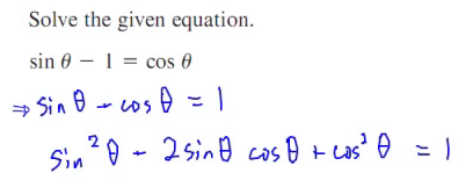
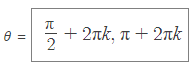
Can sombody explain the process between the first blue line and the second? He says he is squaring both sides of the equation, but then adds the double angle formula in there out of left field?
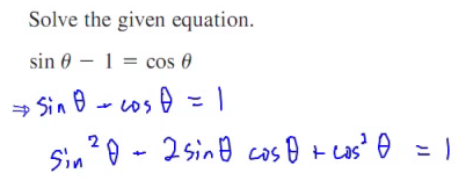 fallen sleet
wdym? its a valid implication, it doesn't use any trigonometric identities
fallen sleet
$(a+b)^{2}=a^{2}+2ab+b^{2}$
somber coyoteBOT
alshfik
 lyric relic
ahhh gotta foil my b
fallen sleet
yeah, dw about it $\(a+b)^{2}=a^{2}+b^{2}$ is a common mistake
somber coyoteBOT
alshfik
 silent plank
would also be interested in the rest of the worked solution as squaring like that creates extraneous solutions
 fallen sleet
what about ramonov's question?
lyric relic
Im not done with the equation yet, im stuck. somehow the next step is $/2sin theta cos theta = 0
well that command didnt work lol
fallen sleet
only one $
somber coyoteBOT
2003 Volkswagen Jetta
 lyric relic
lol
fallen sleet
no clue, don't know about trig, check the identities in the pins maybe?
fallen sleet
looks like it
lyric relic
well i got the answer but with a negative in front...
https://i.gyazo.com/2de75974cdb8eb15f8a5fcf5682b8f0e.png
I think I can just multiply both sides by - 1 that should be within bounds
 lyric relic
ik its double angle id
fallen sleet
no need to negative
lyric relic
but in the video example it comes out postive
I wonder if I did the math wrong or somthing
fallen sleet
wdym?
lyric relic
i should be getting https://i.gyazo.com/f4f8bfb0989d3e4b8fd7fa5fb1f49b15.png
 fallen sleet
ok? and what did you get?
fallen sleet
ohh alright
lyric relic
so thats why I multiplied by -1

 safe mantle
Hello!
lyric relic
on a calc can I do 2 theta by doing sin-1(0) * 2?
somber coyoteBOT
alshfik
 safe mantle
sorry im not trying to intrude but I would love some help if anyone else is free :(
lyric relic
ohh even odd ids
somber coyoteBOT
2003 Volkswagen Jetta
 lyric relic
I believe
fallen sleet
no my equation is valid [yours is as well]
just don't multiply by -1 at the beginning and use the double angle thingy
lyric relic
safe mantle
sorry im not trying to intrude but I would love some help if anyone else is free...
Ask your question im not the only one allowed to ask 😛
fallen sleet
idk how to find the intersections of two sine functions unfortunately :(
 fallen sleet
idk how to find the intersections of two sine functions unfortunately :(
fallen sleet
fallen sleet
idk how to find the intersections of two sine functions unfortunately :(
oh wait no we just know sin(2t)=0
lyric relic
okay so the period of sin(2t) is pi instead of 2 pi
right
yes
period if 2pi/k and k is 2 so 2pi/2 is pi
Therefor to find theta values for a sin function of period pi...
I finally got it, that was awful
https://i.gyazo.com/e1f14e243556c247f9f096d97aaa7d1b.png

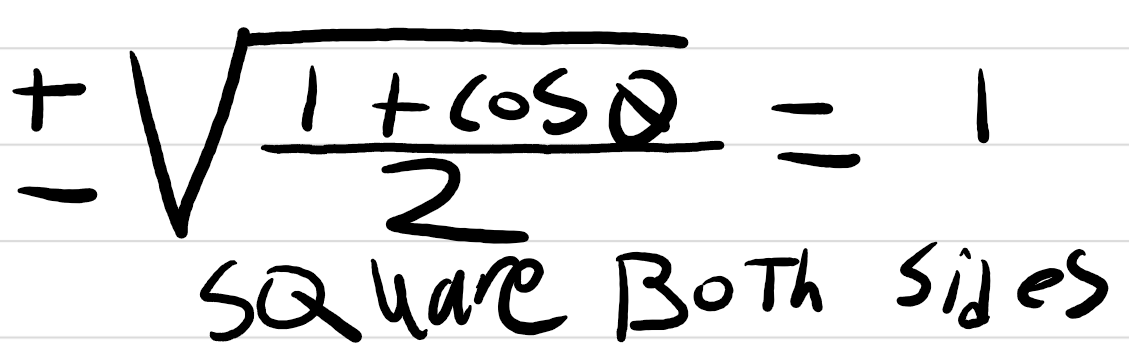
if a + or - is in front of a sqrt, does squaring that square root make the + or minus go away or do I still have two equations?
 fallen sleet
SMSG axioms don't state that a space exists?!?!!
olive cove
lyric relic
if a + or - is in front of a sqrt, does squaring that square root make the + or ...
If you square a positive number it becomes positive. If you square a negative number it also becomes positive. So only 1 answer remains
 earnest basin
Helpppppp

 olive cove
earnest basin
olive cove
earnest basin
Find what?
 heavy snow
can anyone explain to me how you find the sides (I assume length) of the right rectangle EFGH using the left rectangle ABCD as a reference?.

I know that 9/6 = 3 but I have no idea about the rest
 heady wave
Ratio of top sides is 9/6
which is 3/2
so any side you multiply on ABCD by 3/2 becomes the side length for EFGH
so 6 * $3/2$ = 9
somber coyoteBOT
Prime
 heavy snow
4 *1,5 etc
heady wave
yes exactly
heavy snow
ah got it so you take the fraction of one side and apply it to the rest
heady wave
yep
heavy snow
alright, thanks 😄
 quiet bramble
can someone help me with this?
 heavy snow
how do you find the length of X and Y in A) ?

I guess you'd use the intercept theorem
 north sun
safe mantle
north sun
safe mantle
remember, cos(θ) is the x-coordinate of a point on the unit circle and sin(θ) is the y-coordinate of a point on the unit circle
north sun
heavy snow
how do you find the length of X and Y in A) ?
ratio of the lengths I'm pretty sure
upper merlin
heavy snow
how do you find the length of X and Y in A) ?
similarity
heavy snow
so x / 4 = 8 / 2 ?
 shrewd ivy
thats not correct
safe mantle
anyone available rn 😅
upper merlin
Just post your question when someone is available he/she would answer
daring bolt
Plz 🥲


 nocturne pebble
Nvm I figured it out, I rounded 2.07 to 2
 desert ibex
can someone help me with proofs plz
I have a quiz tomorrow and my teacher does not teach
like fr
 steady belfry
i understand the terms and such for the "given" and "prove", but what is an flowchart proof?

 rare sierra

 storm portal
rare sierra
storm portal
rare sierra
Law of cosines
north sun
rare sierra
Rearrange the cosine law
heavy snow
this is a repost but how you go to about solving A) ?

you are supposed to find the length of X and Y
 heavy snow
yeah I just don't know what theorem to use here
dark sparrow
i suppose we are to assume DE and BC are parallel
and thus triangles ADE and ABC are similar
heavy snow
yes and you are pointing me towards the similar intercept theorem
 scarlet plaza
is studying trigonometry early a good idea?
this stuff seems really complicated, and i don't know if i can catch up in the future studying it in my class
heavy snow
@dark sparrow the task is to evaluate the unknowns which in this case is X and Y and you'd go about doing this using either the intercept theorem a/b = c/d or the other one which I don't know the english name for but its ΔDEC - ΔABC
@scarlet plaza don't you have levels of math courses?
looking at the facts x should be 5,3 and y 6,0
scarlet plaza
heavy snow
<@!469667735941545984> don't you have levels of math courses?
levels of math courses?
heavy snow
high school math, pre-college math, college math etc
scarlet plaza
sure
heavy snow
it only looks complicated when you don't know the basics from previous levels
usually school math classes you are talking about follows a certain level
it all depends on what level you are on
"is studying trigonometry early a good idea?" is a strange question to ask because unless you are not following any of the trigonometry classes in school then start from the very beginning or whatever level you are on
and advance from there up until you reach pre-uni math which is what this channel is for
dark sparrow
heavy snow
<@!183668144404037632> the task is to evaluate the unknowns which in this case i...
triangles ADE and ABC are similar
DEC and ABC are not similar at all
dark sparrow
heavy snow
looking at the facts x should be 5,3 and y 6,0
no, x is not 5.3
heavy snow
what makes you say that?
dark sparrow
i know what x should be and it's not 53/10
maybe if you tell us how you got x = 5.3 your mistake could become more apparent
heavy snow
alright so I solved it
first step is to solve Y because we need to know it in order to solve X
4/2 = y/3
2 = y/3
3 * 2 = 3 * y/3
2 * 3 = y
6 = y
y = 6
and then we solve X
x/8 = 6/9 <<< this is why we need to solve Y first
x = (6 * 8) / 9
x = 48/9
x = 16/3
x = 5,3
so if you go by the theorem X is solved using DE/AB = EC/BC which is in other words top parallel line / bottom parallel line = top hypotenuse / bottom hypotonus
and Y is solved by ΔDEC / ΔABC which is in other words the top triangle / bottom triangle
heavy snow
but how would you solve B ?
dark sparrow
heavy snow
first step is to solve Y because we need to know it in order to solve X
no, you don't need to know y to solve for x.
x = 16/3
x = 5,3
16/3 ≠ 53/10.
so no you cannot say x = 5.3
it's not 5.3
heavy snow
x = 16/3
= 5,33333333333333333333
dark sparrow
yeah 5.3333... with the threes going on forever is equal to 16/3
but you said it was 5.3
i.e. 5.30
5.300000000000000
not 5.33333333333333333...
heavy snow
rounded down
dark sparrow
if you want to round then you have to be explicit about rounding
nowhere in the problem does it say you should round
by the way
you keep talking about DEC
the "bottom triangle"

this?
dark sparrow
x/8 = 6/9 <<< this is why we need to solve Y first
you could have just donex/4 = 8/6
heavy snow
also one thing that 99% of math books does here is they round either up or down the answer by default
no idea why though because its not necessary
dark sparrow
so they just write shit like $x = \frac{16}{3} = 5.3$ without so much as clarifying that rounding is happening???
somber coyoteBOT
Kanga Gang Annihilator Ann

 dark sparrow
and how was i meant to know that you placed the letters exactly like that?
it's not like there is a set in stone rule that you must always name your vertices with these letters in this order, you know.
heavy snow
you'd use your imagination
dark sparrow
eternalgamesnan
you do realize
there's literally 120 ways with just the letters A-E alone to label the diagram
right?
right??????????
for all i know, you could have placed the letters like this

or like this

or like this

or in about a hundred other ways
heavy snow
well if you can read my calculations which shows you how I figured out the correct answer then you can interpolate how I did it
even if the labels are wrong
dark sparrow
yeah but i should never have to "interpolate" in the first place lmao
and if you use the same set of letters as me then naturally i will try to read your work as if it were referring to my labels
heavy snow
how tf were I supposed to know what letters you used
heavy snow
you spend more time arguing about crap than helping
dark sparrow
...
these things matter, you know
i mean if you saw my diagram then chose to ignore it and also chose not to inform me your letter choice differs from mine
that's on you
heavy snow
how would you solve this?
 dark sparrow
this is another triangle similarity problem
heavy snow
I think you'd start by doing 10 - x / 10 = ?? / ???
heavy snow
what made you choose 12 / 15?
dark sparrow
it's the one and only known ratio between the two triangles in the pic
heavy snow
aha I see
dark sparrow
i didn't have a choice really
fallen sleet
am i correct to say that hs geometry proof differs from later proof-based subjects in that proofs of existence are cut out in hs geometry?
dark sparrow
proofs of existence in HS geometry are typically just proofs by construction
fallen sleet
could you show an example? forgot to specify i was talking about two-column/flowchart proofs
 winter venture
Hey, can anyone help me in #help-9 please? It is trigonometry highschool/entry university level please :p
would really appreciate, thanks.
fallen sleet
dark sparrow
proofs of existence in HS geometry are typically just proofs by construction
hold on no i think you're right
this was the example i wanted to give, not sure if it counts

woops
wrong symbol

was never proven that line AB and line CD existed
if you want to include it you really only have three options:
-first-order logic [looks weird]
-assume an object written by itself means "this object exists" [possible, never seen it]
-words [long, looks bad]
heavy snow
is this an exercise in how you develop a proof?
fallen sleet
no i gave it as an example
fallen sleet
fallen sleet
am i correct to say that hs geometry proof differs from later proof-based subjec...
se this
i am inclined to believe this is the case also because if you look at the smsg axioms, existence postulates are given no names
heavy snow
@dark sparrow how would you solve for Y ?
dark sparrow
same problem as before?
heavy snow
yes
heavy snow
hmm I was thinking the same thing but I was unsure if you could do that if the unknown is on the outer angle
but you are correct
dark sparrow
why would you be unable to write down this equation?
heavy snow
and the main reason I was thinking that is because the triangles Y unknown is not the length of the parallel compared to the other problem
and you only do DEC / ABC if the task is to solve the parallel unknown
so the same method would apply to solving my next task C) but in this case I'm not sure how

I guess you'd do (2.2 - x) / 2.2 = ??? / ???
upper karma
Draw the projections of a hexagonal pyramid of base side 25 mm and axis height 60 mm resting on the edges of its
base on HP with its triangular face perpendicular to both HP and VP.
heavy snow
hmm so you always divide by the ratio there
I'm starting to see a pattern there
y/2.8 = 2/3
 reef talon
Hi
I have a question
But I have no clues in which channel to ask
So I’ll ask here


Can anyone please check
Ping me too
<@&286206848099549185>
heavy snow
I solved D) on my own
x) x/(x+3.6) = 2/5
y) y/(y+4.2) = 2/5
x = 2,4
y = 2,8
but I'm not sure about E)
but I can see its very similar to B)
heavy snow
you are supposed to find the length between BD and DC using the angle bisector theorem but this make no sense to me

I followed this example but whatever I do is giving me the wrong answear

so in my case it would be 1,63/4,32 = 0,37
amd 1,63/4,18 = 0,38
I assume you take BC which is given to you as 3,26 and divide it into 2 because of BD and DC
nocturne remnant
Hmm…how did you get 1.63 for both?
My calculator shows something a bit different
heavy snow
3,26/2
nocturne remnant
…
nocturne remnant
heavy snow
3,26/2
Well of course it wouldn’t be that easy
But, you know the ratio BD:DC because of angle bisector theorem
heavy snow
the answear should be bd = 1,66 dc = 1,60
nocturne remnant
Ye
heavy snow
how?
nocturne remnant
nocturne remnant
But, you know the ratio BD:DC because of angle bisector theorem
Can you answer this?
heavy snow
3,26/2 = 1,63
nocturne remnant
Stop using “1.63” ffs
heavy snow
tf should I be using then? magic?
nocturne remnant
Just say BD:DC bruv isn’t that what you’re trying to find?
heavy snow
BD:DC there
heavy snow
= magic?
 heavy snow
but the answear should be bd = 1,66 dc = 1,60
heavy snow
wtf is BD+DC=BC
heavy snow
and the length of these segments are?
heavy snow
the sum of BC is given to you as 3,26
nocturne remnant
And since you have BD:DC as well as BD+DC this turns into an algebra problem
That’s all I’m gonna say
heavy snow
you are making zero sense
if the length of BC is given to you as 3,26 and you are supposed to find the length between BD and DC then BC has to be / 2
that gives you the length of both BD and DC
 near root
I need help solving this puzzle. The circle is at the center of the rectangle. How do we get the area of the red triangle? Assumptions: all angles that look like right angles are right angles. All verticals/horizontals meet at 90 degrees. Also it is not drawn to scale.

 empty kite
no numbers are given
so
i assume you want us to find an expression or equation to define the area of the red triangle?
in which case, as no numbers are given, let a be the area of the triangle.
the area of the triangle is a :troll:
anyways, any numbers
 last cipher
Goodnight I'm trying to solve this problem and I'm have a hard time can some please help me

 oblique shore
last cipher
Goodnight I'm trying to solve this problem and I'm have a hard time can some ple...
oblique shore
last cipher
Goodnight I'm trying to solve this problem and I'm have a hard time can some ple...
hi there
last cipher
oblique shore
hi there
hi
oblique shore
can u show me the rest of the problem
there is text below that asks what you want to find
last cipher
oblique shore
can u show me the rest of the problem
It say round to the nearest 10
empty kite
cos(theta) = adjacent/hypo
oblique shore
last cipher
It say round to the nearest 10
ok
oblique shore
you gotta go nice and slow to help people
empty kite
ok
so
you know how the law of sines
states that cos(theta) is equal to the adjacent side over hypoten
last cipher
empty kite
you know how the law of sines
yes
empty kite
we can get the missing angle of the triangle
by adding the two angles
and subtracting it from 180
which gives us 30 degrees
the adjacent side's length is given to us
which is length of 12
so
cos(30) = 12/x
rest is easy
solve for x
✅
last cipher
@empty kite is it 13.8?
last cipher
?
empty kite
probably

 patent quarry
there really isnt explanation of what to do
"find the coordinates"?
whats the text to the left
nocturne pebble
Three vertices of parallelogram ABCD are given. Find the coordinates of the remaining vertex
my bad
patent quarry
oh
okay,
so
the definition of parallelograms is that each two sides are parallel with each the opposite side-- in which it must create a closed rectange shape. this means that the opposite sides are going to be equal to one another
just realised your diagram is wrong 😛
ill draw it out for you
ignore what i just said
well, the last sentense
nocturne pebble
Thats what I did but I found the slope of CD
But I got a completely difference answer idk how
patent quarry

it helps if you draw it out on a graph
in this case, which point would be best to create the parrellogram
?
of course, this can be shown mathematically in which i will get to afterwards
nocturne pebble
Wouldn't it be (-1,-3) - (1,2)
patent quarry
oh sorry, disregard what i said
basically

its much more simpler than you think
in this case, it would be (1, -1)
 nocturne pebble
What's the difference between my way and your way
You did AD I did CD but I got a completely different answer
patent quarry
nocturne pebble
You did AD I did CD but I got a completely different answer
?
wait holy shit, that is that sum of all of the coordnates
im going to test something out hang on
wait what grade are you in
nocturne pebble
patent quarry
the definition of parallelograms is that each two sides are *parallel* with each...
AB = CD So I found the slope of CD and applied it to A(-1,-3)
patent quarry
or year
nocturne pebble
9th
patent quarry
okay
i think i know what the problem is
your coordnates are labeled wrong

if you take a look at this

A and D have the same x-coordinate
-- yet they stray from eachother
they should vary in height, not width
 patent quarry
yes!
nocturne pebble
Lol I messed up bc I wrote it as 2/1 so I tried to add 1 to the x coordinate
Thank you very much
nocturne pebble
huh
 nocturne pebble
lol I feel like im missing something

 nocturne pebble
patent quarry
in this case, it would be (1, -1)
nocturne pebble
patent quarry
in this case, it would be (1, -1)
but I got the same answer as you
 nocturne pebble
is left to right
not up to down
like red dot goes with purple
blue dot goes with green
Nvm i don't get it either
patent quarry
ok
im dividing this
to explain it another way

you have a parrellogram with points, VXYZ

each coresponding side of the parrellogram is equal to each other

right?
patent quarry
 nocturne pebble
I have them all written on my notebook
patent quarry

(-1, 1) is the difference of Z towards Y
so if you take Z which is (1, -1) and take away the difference, you get point Y which is (0, 0)

so lets go back to this

 patent quarry
get one difference between two point to get the other difference to the other pair of points
 nocturne pebble
Lmao my bad the reason I didn't get the answer before was because I couldn't add correctly
patent quarry
oh
 lunar heart

 wise pawn
I'm pretty sure they're all the same thing, but I'd have to see the definitions to tell you for sure
in other contexts Affine space doesn't necessarily refer to a specific field
fallen sleet
i think euclidean spaces are spaces where the parallel postulate holds true?
nope
"fundamental space of classical geometry." according to the pedia
heavy snow
you are supposed to find the length between BD and DC
does anyone know how to solve this?

BC as one line is 3,26cm
according to the angle bisector theorem you should do a/b = x/y
which I assumed would translate into 4,32/4,18 = x/y
dark sparrow
that and x+y=3.26 should let you solve this problem
heavy snow
problem is I tried 3.26/2 = 1,63
dark sparrow
and where did this 3.26/2 come from?
heavy snow
1,63+1,63 = 3,26
heavy snow
between BD is X and DC is Y
dark sparrow
but you keep insisting BD and DC must be the same length
heavy snow
I assumed that because it tells you that BC as one side is 3,26
heavy snow
what is x and y?
dark sparrow
you have a system of two equations that you can use to solve for x and y...
x/y = 4.32/4.18
x + y = 3.26
i just do not understand why your mind jumps from "BC is split into two segments" to "BC is split precisely in half and in no other ratio"
when in fact that isn't true at all
if it were true that x = y, then x/y would be 1, which we're explicitly told it isn't!
heavy snow
I dont know how to solve these two equations
dark sparrow
do you know how to solve systems of linear equations?
(i know these equations aren't linear as written but bear with me here)
heavy snow
yes
dark sparrow
okay, then what if i told you it's possible to rewrite x/y = 4.32/4.18 as a linear equation?
if you can do that, the system of equations will become linear. and as you just confirmed to me, you know how to solve those.
heavy snow
how would you rewrite?
dark sparrow
multiply both sides by 4.18y to get 4.18x = 4.32y
heavy snow
so
4.18/4.18x = 4.32y/4.18
x = 1.033493y
dark sparrow
no reason to do that
unless you like dealing with stupidly long decimals
i personally would avoid division until it is necessary
heavy snow
do mind that the answer should be BD = 1,66 and DC = 1,60
 nocturne pebble
Nvm I got it
iron spoke
excuse me lmao

 silk patio
You can’t do it easily
humble pulsar
iirc the 4 circle case the guy did it all by hand
 signal condor
 opaque ibex
how to do this
opaque ibex
how to do this
IDK if I got all the possibilities, but I count at least 44 variations.

 shell lark
I need to know the angle phi in this ellipse, knowing the eccentricity and the angle theta. AB is a line passing through both focal points.
It feels like the eccentricity and theta should be enough to define phi.
 upper karma
anyone read euclids elements?
 wintry tundra
shell lark
I need to know the angle phi in this ellipse, knowing the eccentricity and the a...
wintry tundra
shell lark
I need to know the angle phi in this ellipse, knowing the eccentricity and the a...
You could use angle sum to express the angles in the triangle in terms of phi and theta
Nvm
signal condor
It almost seems like you would want a generalized Thale's Thm, written in terms of eccentricity and theta. This is super interesting to think about. I will definitely come back to this (hopefully later tonight) when I'm not busy.
 upper jacinth
Hi, If we have 6 points and we arrange them in ascending order of x and join first 3 and later 3 to form 2 different triangle(these points are given),
What's the best way to find the coordinates of lines that can be formed joining the vertices of both triangle such that no two lines should intersect the triangles (or the newly formed lines.)
The way we find the lines is by taking the second triangle's vertices and drawing line to vertices of first triangle and if it does not intersect the triangles then we consider it a line and next time we check for intersection we also consider this line as well
Green and Red are the two triangles given and the blue lines are the ones that we have to find

 ruby tendon
can someone help me in geogebra?
I want to make a plane go through this green shaded area

and I cant figure out how
when I say x+y>=3 it just makes a flat plane
 upper blaze
ruby tendon
I want to make a plane go through this green shaded area
upper blaze
ruby tendon
I want to make a plane go through this green shaded area
Hmm where is that green shaded area? You mean this small part there? What is it part of ?
Guys I have a question that is acutaly interesting. Does anyone know what Fermats point is and did anyone studyed it more then it is ussualy writen in books?
upper blaze
upper jacinth
Hi, If we have 6 points and we arrange them in ascending order of x and join fir...
Can you clerify what do you need a bit more? I mean what is problem you are faceing? Is it finding line equations or what?
ruby tendon
upper blaze
Hmm where is that green shaded area? You mean this small part there? What is it ...
it is a small part of the constraint which is in pink
upper blaze
ruby tendon
it is a small part of the constraint which is in pink
And you want plant that do what? Just goes through 3 random points or? Since to me it looks like this is some surface
 grave pond
upper blaze
Guys I have a question that is acutaly interesting. Does anyone know what Fermat...
grave pond
upper blaze
Guys I have a question that is acutaly interesting. Does anyone know what Fermat...
Fermat's point with what? He was pretty prolific.
upper blaze
grave pond
Fermat's point _with what_? He was pretty prolific.
Fermat- Toricelli point of triangle and tetraheadron
grave pond
Hmm, interesting.
upper blaze
Hahaha do you know anything about it?
grave pond
Only what Google and Wikipedia told me in the last 10 minutes.
upper blaze
ahhaha yea Fermats point for Tetraheadron still hasnt been geometricly constructed xD
Becouse no good properties can be transfered from 2D to 3D case
ruby tendon
upper blaze
And you want plant that do what? Just goes through 3 random points or? Since to ...
yea mathematically defining the plane
upper blaze
ruby tendon
yea mathematically defining the plane
Honestly I have no idea how would you find plane through random part of some surface. I mean can you describe general problem you are faceing maybe we can help on that instead of this small part
ruby tendon
upper blaze
Honestly I have no idea how would you find plane through random part of some sur...
well x+y >= 3
is the plane
but if I define it that way I get a flat plane
upper blaze
Flat plane? and you want what other kind of plane? 😮
I am sorry I am confused but wanna try to help hahaha
ruby tendon
I want the plane to go through the green shaded area
which has the constraint x+y >=3
upper blaze
Sorry 😦
 upper blaze
Ohhh you want 2 planes that will intersect your surface such that they form boundery of that area xD
Ok I got it
ruby tendon
I already got the boundary
I just want a plane to intersect that boundary so I can get the black line
the boundary is the green shaded area
upper blaze
Now honestly stupid solution
Cant you take 2 points from boundery and from a line and take any plane that containts that line ? xD
ruby tendon
yep already did that, it works fine, but yesterday I did it mathematically by defining it in the console but I dont remember how I did it, I was hoping someone here knew
upper blaze
No bloody idea xD
ruby tendon
np, I will just do it manually it just becomes annoying if you have multiple constraints
signal condor
ruby tendon
which has the constraint x+y >=3
A plane is usually given by ax+by+cz = D
Where (a,b,c) is a normal vector to the plane
You can use the gradient of a function to define the surface's normal and match a plane to it. (Assuming you want the plane to be tangent to the surface)
In this case, your normal vector would be a multiple of (2x, 4y, -1)
Naturally, you have to choose a point on the surface that you want the plane to be tangent to. In this case, I will assume that that point has x+y = 3, and for simplicity, I will also let y=x. Then the point is (3/2, 3/2, f(x,y)). f(3/2, 3/2) = (3/2)^2 + 2*(3/2)^2 = (3^3)/(2^2) = 27/4 = 6.75.
Now take N = (3, 6, -1). (x, y, z) = (3/2, 3/2, 27/4). The plane is given by 3x+6y-z = D, and D = 3*(3/2)+3*(3/2)-(27/4) = 9/4
Then again, I might have misunderstood you. Maybe you don't care about the plane being tangent to the surface. In that case, you wouldn't use the gradient.
Instead, you would generate the surface normal by the cross product of a vector on the line x+y = 3 and another vector connecting a point on the line to the point on the surface.
I.e. take the point on the line to be (3, 0, 0), the vector on x+y= 3 to be (-1, 1, 0), and then we could use a point P = (p1, p2, p3) on the surface of f(x,y) = x^2 + 2*y^2.
Then let V1 = P - (3,0,0) = (p1-3,p2,p3), and let V2 = (-1,1,0). Take N = V1 X V2. Complete the same procedure as before to find D and determine the plane. You can use any (x,y,z) that you know will lie on the plane


 lyric timber
How to solve trigo equations
dark sparrow
- learn how to solve equations of the form sin(x)=c, cos(x)=c and tan(x)=c
- reduce all other trig equations to those
upper jacinth
upper blaze
Can you clerify what do you need a bit more? I mean what is problem you are face...
I need to know the coordinates of each new line formed
upper blaze
What are coordinates of a line? You mean equation?
upper blaze
 near hound
how do i prove i cant use addition
near hound
how do i prove i cant use addition
On last picture there is reason "Congruent segments subtracted from congruent segments for congruent segments ?
 forest drift
hello
do you guys know about the interesting theorem , mass point theorem where we assign masses to each of the points?
upper blaze
forest drift
do you guys know about the interesting theorem , mass point theorem where we ass...
I wouldnt say that is a theorem. Its more like another way of doing geometry where you asign weight to each point and then work with functions mostly to conclude stuff. Its very good and I know few problems that are solved using weights but without them are still unsolved xD
I mean not unsolved, you take equal weights and you got that unweighted situation but not geometricly solved.
forest drift
upper blaze
I wouldnt say that is a theorem. Its more like another way of doing geometry whe...
yeah
upper blaze
it is very usefull but I havent been using it yet xD
forest drift
upper karma
no way it's Ramanujan
Fun Fact - I proved Ramanujan wrong
wise pawn
same
forest drift
and sent it to Indian Ramanujan math society
wise pawn
what'd you prove wrong and how'd they respond?
forest drift
wise pawn
what'd you prove wrong and how'd they respond?
they didn't respond
they might put it in their annual journal
fun fact - I am a 9th grader
upper blaze
....
forest drift
wise pawn
what'd you prove wrong and how'd they respond?
the sum to infinity = -1/12 one
silk patio
Sketch your proof @forest drift
upper blaze
I think that whatever he did he peobably doesnt understand enough math for it to be correct either he is a genious so which one is more probable
And this is not channel to type about it anyway
quiet bramble
I have a question, for a biconditional statement, does the inverse also have to be true?
 hearty rain
forest drift
Fun Fact - I proved Ramanujan wrong
hearty rain
forest drift
Fun Fact - I proved Ramanujan wrong
T
ell me how!
 clever fable
In terms of loci, can someone please explain why these define a circle??

I get that the moduli would refer to the distances between z1 and z2, but I don't understand how the "k" factor makes it a circle (except of course if it was 1)
And as for the one with the conjugate, I honestly have no clue
 solid juniper
quiet bramble
I have a question, for a biconditional statement, does the inverse also have to ...
solid juniper
quiet bramble
I have a question, for a biconditional statement, does the inverse also have to ...
There are three options for the sides of a biconditional.
- Both sides can be true.
- One side can be true and the other false.
- Both sides can be false.
If one side is true, the biconditional forces the other to be true, so that rules out option 2 where one side is true and the other false.
This means that if one side is false, the only option is that the other side is also false. This means that one side being false forces the other side to be false.
That's why the inverse biconditional is also true.
upper blaze
clever fable
I get that the moduli would refer to the distances between z1 and z2, but I don...
If i am not mistakeing the best way to see this is writr z=x+iy z_1=x_1+iy_1 z_2=x_2+iy_2
Then you will see that k2x2 and k2y2 will not vanish
And if there is no k then it will vanish
You can do same for last one
Does anyone know how would you define similarity in 3D space like between tetraheadrons?
 hybrid trellis
wise pawn
upper blaze
Does anyone know how would you define similarity in 3D space like between tetrah...
hybrid trellis
wise pawn
upper blaze
Does anyone know how would you define similarity in 3D space like between tetrah...
two shapes are similar if you can transform one into the other with translations and rotations
silk patio
And reflections
And dilations
What you said is called a direct isometry. I tried to do this before where I wanted to classify similarity in terms of a single preservation property. I.e a similarity transformation is one that maps dimension k affine subspaces to dimension k affine subspaces
upper blaze
Yea i know that but i was thinking more like some.similarity criterion
Like 2 tetraheadrons are similar iff something
There are few properties that i eant to try to generalize to 3d
And this might be crucial.step
silk patio
You can check similarity of the faces
Or check that it has the same ratio of sides in the right combinatorial configuration
wise pawn
yeah I wouldn't consider two triangles similar if they were the same including reflection and dilation, otherwise all triangles would be similar which kinda defeats the purpose
silk patio
Like shrunk sides
Dilation is conformal so you can’t go to anything
Just shrunk copies
You’re thinking about congruent
wise pawn
yeah
heavy snow
I don't know what this is called in English but in this task you are supposed to find the length between AB so you need to figure out what X is first. According to the theorem (whatever its called) ab = cd so x * 1 = 2 * 1,5 which when you solve it x = 3. So now you only have to add it together 3+1 = 4 which is the length

but it never explains to me the proof or logic of why you should add 3+1 to get the length of the diameter?
dark sparrow
you mean you don't understand why if x = 3 then AB = 3+1 = 4?
heavy snow
well yeah because in my book they never explained how you find the length of a diameter which I assume they also assume you already know from previous books
dark sparrow
the diameter is just a line segment...
it's a line segment broken into two parts
one of them has length x, the other has length 1
so the whole thing has length x+1
is this alien to you?
heavy snow
now its obvious so I was probably overthinking
dark sparrow
were you under the impression that this somehow doesn't apply because the segment also happens to be the diameter of a circle?
heavy snow
and I'm getting something else than what the answer should b
this one confuses me though because you are supposed to find the length between CP

AP * BP = CP * DP (8.0 + 3.7) * x = (10.4 + x) * 3.7 = 4.81 10.4 + 4.81 = 15.21
other theroms says it should be (A + D) * D = (C + B) * B or in otherwords (a + b) * b = (c + d) * d
forest drift
hearty rain
T
ell me how!
sure sure
forest drift
silk patio
Sketch your proof <@919513117296295967>
sure sure
I have sent it to the Indian Ramanujan Mathematical Journal
forest drift
upper blaze
I think that whatever he did he peobably doesnt understand enough math for it to...
I used basic math for the proof and I have completed university math
silk patio
Send it here @forest drift
dark sparrow
i suspect he actually has nothing to show
why else would he be so strangely avoidant
hearty rain
Valid or not, I am interested
forest drift
dark sparrow
why else would he be so strangely avoidant
i'm not
I am currently in piano class
so I will send it later
forest drift
I'm just writing it down
 weary jay
How long will it take for you to write it down?
hearty rain
How did you send it to them without writing it down/making a document? The proof cannot be that small
heavy snow
this is what I did which is wrong
p) 4.2 * 6.8 = x * 6.6 (4.2 * 6.8) / 6.6 = (x * 6.6) / 6.6 4.327 = x x = 4.327
p) 4.327 + 6.6 = 10.927 4.2 + 6.8 = 11 cos v = 11/10.927 = 0,089 a = 11 * 0.089 = 0.979cm
how would you solve 5067?. You are supposed to find the area of the triangle APB
 upper karma
hearty rain
How did you send it to them without writing it down/making a document? The proof...
upper karma
hearty rain
How did you send it to them without writing it down/making a document? The proof...
Since it has not been published yet he cannot send that or we will steal it
 timber tapir
yoyoyoyo
trig people
can u help me understand how to find inverse trig on unit circle?
if im not mistaken u just kinda work backwards right? so like
$sin^{-1}\left(\frac{\sqrt{3}}{2}\right):=:\frac{\pi}{3 }:and:sin\left(\frac{\pi}{3 }\right):=:\frac{\sqrt{3}}{2}$
somber coyoteBOT
ski

 timber rover
 dark sparrow
well no technically i do not
but i guess from context if you replace 3/pi with pi/3 everything becomes correct
poorly formatted because it's clearly symbolab nonsense
but correct
hearty rain
upper karma
Since it has not been published yet he cannot send that or we will steal it
makes sense
 native parcel
dark sparrow
poorly formatted because it's clearly symbolab nonsense
native parcel
dark sparrow
poorly formatted because it's clearly symbolab nonsense
yeah lol if someone actually types latex like that it would be quite depressing
heavy snow
if you have 3 points in a coordinate system, for example p1(2,5) p2(1,1) and p3(4,7) that forms a triangle
how do you figure out the circumference of the triangle?
do you find the length between each of the points first and then use Pythagorean theorem?
so length between p1 -> p2, p2 -> p3 and p3 -> p1 ?

what is the perimeter of the triangle with vertices A(-4, 2), B(0, -1) and C(3, 3) ?
yep
dark sparrow
the circumference? you meant the perimeter?
heavy snow
yeah, I didn't find the right word as circumference is used for circles
but in this video she does AB + BC + AC but is it the same as doing AB + BC + CA ?
dark sparrow
do you think they're the same or different?
is the distance from A to C any different than from C to A?
heavy snow
not in this triangle case, no
maybe they would make a difference if one side is not identical to another
dark sparrow
there is actually no difference whatsoever
distance is symmetric. the distance from here to there is the same as from there to here
heavy snow
does that apply to any triangle type?
dark sparrow
it applies regardless of whether or not you even have a triangle
it should make intuitive sense
when you're just measuring the straight line distance between two points it does not matter which point you start at
heavy snow
got it
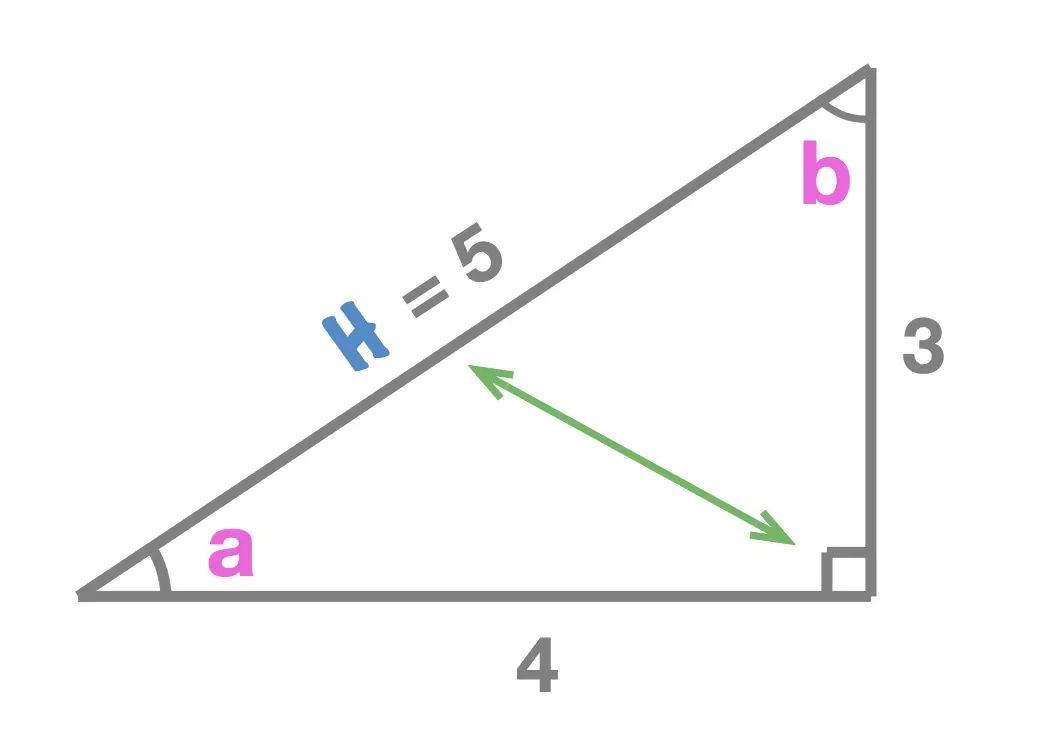
when you have a triangle who has numbers attached to each side like this example https://www.radfordmathematics.com/geometry-trigonometry/right-angle-trigonometry/images/sohcahtoa-sidelengths-hypotenuse.png

are 5, 4 and 3 there the length of each side?
dark sparrow
yes, the numbers mean lengths.
heavy snow
alright because it was never explained to me what those actually were but now when dealing with vertices and distances it makes sense
heavy snow
how do you find the area of 4 points?
dark sparrow
you don't
heavy snow
if the lengt of each side of this figure is 5 + 4 + 5,38 + 2
dark sparrow
unless you mean that in the literal sense, in which case the area of a shape consisting of just four points and nothing else (not even anything between them) is 0
heavy snow
it has to be rectangle
dark sparrow
oh, so you actually meant finding the area of a four-sided polygon?
oh, so you actually wanted the area of a rectangle?
heavy snow
yeah I dont know what shape it is
dark sparrow
maybe you could just send a picture
heavy snow
all that is given to you are the points of this 4 shaped figure
p1(5,0) p2(10,0) p3(10,4) p4(5,2)
dark sparrow
okay, let's take a look
heavy snow
it has to be a polygon I think?
dark sparrow

here it is
looks like a trapezoid to me
also i mean of course it's a polygon
the problem probably says as much
 unborn ether
heavy snow
all that is given to you are the points of this 4 shaped figure
unborn ether
heavy snow
all that is given to you are the points of this 4 shaped figure
what else does the question say?
dark sparrow
if you're given a list of points usually it means the points are vertices of a polygon
heavy snow
the question gives you these points and then the task is to figure out the area and bounds
dark sparrow
here's the diagram labeled with your point names
 unborn ether
heavy snow
the question gives you these points and then the task is to figure out the area ...
unborn ether
heavy snow
the question gives you these points and then the task is to figure out the area ...
oh the area?
dark sparrow
this is a trapezoid with bases P1P4 and P2P3, and height P1P2
unborn ether
Well you got the shape just use the formula
heavy snow
the bounds of it is 5 + 4 + 5,38 + 2 = 16,38
heavy snow
yes
unborn ether
dark sparrow
"bounds"
 heavy snow
but I have no idea about the area
b*h which would be the length of p1 and p2 * the length of p2 and p3 ?
dark sparrow
"length of p1 and p2"...
you should really learn how to say things properly. you're doing yourself a disservice otherwise.
anyway, no
if you don't know how to find the area of a trapezoid, you can find the area of this one by splitting it into two pieces
like this for example
 unborn ether
heavy snow
b*h which would be the length of p1 and p2 * the length of p2 and p3 ?
unborn ether
heavy snow
b*h which would be the length of p1 and p2 * the length of p2 and p3 ?
h*((a+b)/2)
or that works as well
dark sparrow
or you could have the formula handed to you by someone else 😒
unborn ether
dark sparrow
or you could have the formula handed to you by someone else 😒
cmon its just some formula

welp that guy dipped so will i
heavy snow
what would a + b be?
heavy snow
p1 * p4 + p2 * p3 ?
heavy snow
oh so the length
dark sparrow
in geometry when we put two point names next to each other it refers to the line segment joining them, or its length.
unborn ether
heavy snow
but that cannot be right
It can only be
Math isn't always beauty, my friend. Sad truth
heavy snow
because the perimeter should be 15
unborn ether
heavy snow
because the perimeter should be 15
How do you know that?
heavy snow
facts from my book?
unborn ether
w h a t
So your book gave you a trapezoid and its perimeter, then proceeded to give you false measurements for each side?
@dark sparrow
Out of my league here
heavy snow
ah there we go 5*((2+4)/2)
dark sparrow
i want to see for myself
where exactly the book claims that the perimeter should be 15
heavy snow
p1p4 = 2 and sqrt(2^2) = 2 and p2p3 = 4 and sqrt(4^2) = 4
unborn ether
I swear if he dips
heavy snow
wait
unborn ether
heavy snow
wait
cmon man hurry