#geometry-and-trigonometry
1 messages · Page 367 of 1
 wintry tundra
 slender mist
wintry tundra
do you see how the 5 is touching angle c?
slender mist
wintry tundra
do you see how the 5 is touching angle c?
yup
wintry tundra
the side with length 5 touches angle c
wintry tundra
that means they are adjacent
slender mist
wintry tundra
which would be?
12
wintry tundra
slender mist
12
yep
so 12 is on top because its opposite over adjacent
so opposite is on top
wintry tundra
and the adjacent side is 5
so the tangent is 12/5
alright tell me what you get next
so i can see if you did it right
slender mist
wintry tundra
so the tangent is 12/5
TanA = 5/12
TanC = 5/13
SinA = 12/5
CosA = 12/13
:pain:
wintry tundra
slender mist
TanA = 5/12
TanC = 5/13
SinA = 12/5
CosA = 12/13
yeah cos a is right
sin a you have to find the opposite side
so which side is opposite of angle a?
by the way the opposite side is the side that the angle doesnt touch
slender mist
wintry tundra
sin a you have to find the opposite side
5
slender mist
wintry tundra
and sine is opposite over hypotenuse
so 5/13
wintry tundra
yes
because 5 is opposite of a
since it doesnt touch it
and 12 is adjacent since its not the hypotenuse and it touches a
slender mist
12/5
wintry tundra
np
 quiet bramble


 ivory path
where's B?
 simple frigate
where does sine cossine , tangent etc comes from
wintry tundra
simple frigate
where does sine cossine , tangent etc comes from
What do you mean
wintry tundra
These are what the values happen to be
Sadly there's no actual way to explain why these values are the way they are besides Taylor series
 signal swallow
or you can just use the properties of a right triangle
the proportions for a 30-60-90 right triangle are always 1, sqrt(3), 2

 valid harbor
alternate mean is to go from the height of an equilateral triangle
wintry tundra
signal swallow
or you can just use the properties of a right triangle
for a random value tho like if the angle was 46.57543543 then you cant really specifically say besides just it is bc it is
 molten falcon
signal swallow
molten falcon
signal swallow
Aren't the sqrt(3) and 2 swapped?
 silent plank
yeh, it should be the other way around
 soft bridge
yo can anyone in alegbra 2 help me on this
for most of the questions you have to write sentences
but some of them require to write an equation, expression, or function
signal swallow
molten falcon
Aren't the sqrt(3) and 2 swapped?
yeah i'm tired lmao
molten falcon
ah i see
 dim pier
Hi, this might be a bit advanced but do the addition rules etc (e.g. sin(x + y) hold for the hyperbolic variants of these functions?
Imagine a vertical line through the middle of the rectangle and spin the rectangle about this vertical line as your axis. Can you see that the path swept out is a cylinder? Then which rectangle when swept out gives you the cylinder in the question?
Which part is confusing? We can break it down step by step to help you understand more
Alright, first do you know what an axis of rotation is?
And if not, do you know what an axis is?
Do you know the word rotation? (Sorry if this is rude, not sure if english is your first language)
Ehhh sort of
So have you ever eaten skewers? Like maybe cubes of meat or some veggies on a skewer and they're roasted over a fire of some sort
Or actually if you've seen a kebab machine, my analogy works too
The rod which the food is skewered on, is an axis
And when we flip the food over, or spin it around, we spin this food about or around this axis, and the axis becomes an axis of rotation
The difference between about and around is semantic and people might use them interchangably, so it's important to know what people mean with the word. More commonly you see about
Right, so now you get what an axis of rotation is?
Now imagine this rectangle skewered on your axis of rotation
If the rectangle were to represent a part of the x-y plane, the axis of rotation could be the y-axis
So your "skewer" goes from one edge to the opposite edge, instead of through the rectangle directly
So it's not like a normal vector to the plane, the axis lies in the plane
You following?
So now we need a bit of mental visualization, and maybe if you have paper around it would help
Can you see that if you fix this axis, and you spin the rectangle around, the path you trace is a cylinder?
Right!
Now the question is simply asking you, which rectangle do I spin, to get this cylinder?
Ah nope
More like flipping the rectangle over and over
Like imagine if you had a piece of paper on your table, and you flipped it over and over
Yeah
Yep!
So the axis of rotation would go from left to right now
Can you see that?
That is a axis of rotation, but the question asks for the other axis of rotation
Which is perpendicular to this one
Maybe I just misunderstood your drawing here
Imagine if you had a flat piece of paper, and you flipped it from right to left instead of up down
So now your axis of rotation would be up down
Can you see that?
Right, so now the question is asking which rectangle you have to spin (flip) about this up-down axis of rotation, to get the cylinder with dimensions described in the question
So you look at each rectangle, let me ask you - how does the height of the rectangle influence the height of the cylinder?
Perfect
Just took a bit of visualization
And so how does the radius relate to the width of the rectangle?
Hahahha
Okay so for simplicity's sake, we'll describe the rectangle as a width and a height, can you see that
Now, we spin the rectangle about our up-down axis of rotation. Where is this axis of rotation, relative to the width of the rectangle?
Hahahha
Alright, let me just say that the axis of rotation is in the middle of the width of the paper
Can you see that?
So you see how when you rotate this rectangle about this axis, you get a cylinder?
Right, so now knowing that the axis is in the middle of the rectangle, how does the width of the rectangle relate to the radius of the cylinder?
Nope, not quite
Hmmm, let me see if I can find a video to help visualize
It's not exactly your problem, but it's close to what I'm asking you to visualize
NP, let me know if you still need help
 unreal flax
Hi community help please!
I have a overdetermined system with full column rank of linear quations of the form Ax=b ( A is long matrix)
I have A_1x = b1 which is composed of rows of Ax=b but height is smaller than A.( A_1 is Wide matrix)
I want a least squares solution of Ax=b but such that A_1x = b1 strictly holds.
 verbal swallow
If tanA+cosA=2, what's tanA-cosA=?
 dark sparrow
@verbal swallow are you sure you copied the problem correctly
it looks to me like there would be two possible answers
verbal swallow
@dark sparrow yes. I checked and it's cosA
dark sparrow
and you're not told anything else?
verbal swallow
Nope. "If tanA+cosA=2, what's tanA-cosA=?" it's the ques 😦
 spare vector

 wanton prawn
Angle ACM = 25° I have to find the other green marked angles. I have no Idea where I can find my 2nd angle. Anyone that can help me out? 🙂

 upper merlin
wanton prawn
Angle ACM = 25° I have to find the other green marked angles. I have no Idea whe...
upper merlin
wanton prawn
Angle ACM = 25° I have to find the other green marked angles. I have no Idea whe...
is M the center?
of the circle
wanton prawn
yes
upper merlin
MA=MC cuz its the radius
can u find the others now?
and to find angle ABC you need to use a property of circles which you would have learnt
wanton prawn
the engle acm is the one that is already marked green on the top right?
angle*
thx for your help
 wanton prawn
if you want to write l = length in cm and w = width in cm
then yeah thats correct 😄
 marble lark
Can someone help me calculate the area of this compound solid please

 olive cove
Just calculate the 3 volumes of the 3 main shapes or 2 if you see how
marble lark
olive cove
Just calculate the 3 volumes of the 3 main shapes or 2 if you see how
Yeye I was able to achieve it, thank you very much :DDDDD
 past jungle
I have a question on asymptotes. Why is x=-1 not an asymptote in this case? I used the quadratic formula to get x=9 and -1 but only x=9 was the correct answer.

 short fable
Because for x=-1 it's undefined but it's not an asymptote
past jungle
but why is it not?
short fable
if you were to graph this function, it'd look like this
 past jungle
without the graph how would i know its not an asymptote?
short fable
you'd just find all x for which denominator is equal to 0
but
numerator has to be nonzero
which in case of x=-1 doesn't happen $x^2-1 = (-1)^2-1 = 0$
 somber coyoteBOT
Michał

 cerulean nest
short fable
if you were to graph this function, it'd look like this
cerulean nest
short fable
if you were to graph this function, it'd look like this
1/x 
 cerulean nest
Ah, now no one is gonna help you because you did not wait 15 minutes
short fable
So like, in 1. these statements are true cuz they r given. In 2. you can use corresponding angles (cuz HT || SF)
and for 3. you can use the fact that the sum of degrees in a triangle is 180°
 dreamy quest
cerulean nest
Ah, now no one is gonna help you because you did not wait 15 minutes
dreamy quest
cerulean nest
Ah, now no one is gonna help you because you did not wait 15 minutes
i didn’t notice it in the rules, mb
@short fable thank you sm :)
cerulean nest
dreamy quest
i didn’t notice it in the rules, mb
haha all good
 buoyant bison
wanton prawn
if you want to write l = length in cm and w = width in cm
buoyant bison
wanton prawn
if you want to write l = length in cm and w = width in cm
Thanks
 clever drum
dreamy quest
can someone pls help me with this?
clever drum
dreamy quest
can someone pls help me with this?
Proofs were a nightmare with me, I struggled with them back in 6th grade
dreamy quest
clever drum
Proofs were a nightmare with me, I struggled with them back in 6th grade
ESPECIALLY TWO COLUMN PROOFS OMG
clever drum
- Is always given no matter what
clever drum
dreamy quest
ESPECIALLY TWO COLUMN PROOFS OMG
I once had 8- at one point
8 column proofs were pure nightmares
dreamy quest
8????
dreamy quest
oh yea, someone helped me w it. but thank you though :)
 dark sparrow
yes
 winged hound
when i am trying to find the orthocenter, does it matter which two coordinates i pick to find the slope?
 leaden atlas
i need some help
calcule the radius of the circle

 upper karma
What is the value of the angle between the line that passes through points L1 A (-6,1) and B (2, -1) and another line L2 that passes through points C (-8, -4) and D (6.2)?
olive cove
Make vectors and use dotproduct
upper merlin
leaden atlas
i need some help
calcule the radius of the circle

Really hard to give hints in this cuz it requires constructions so take my beautiful diagram
olive cove
Beautiful it is but line paper for mathematics is questionable imo.
leaden atlas
upper merlin
dont worry,i did, but thanks anyway
wintry tundra
olive cove
Beautiful it is but line paper for mathematics is questionable imo.
I use line paper constantly
 formal tartan
yo that's a good one...

 mighty rune
 warm totem
set up a proportion
you get 60/40 = x/240 (I converted to inches)
so 40x=14400
x=360
and converting it back to feet gives you 30 feet
warm totem
mighty rune
you get 60/40 = x/240 (I converted to inches)
what does / mean
mighty rune
warm totem
what does / mean
a fraction or divison
warm totem
So you just do 60/40 =1.5 then to get rid of the 240 you just multiply so 360=x
mighty rune
$$\frac{60}{40}=\frac{x}{240}$$
somber coyoteBOT
Omega Warrior
 mighty rune
warm totem
So you just do 60/40 =1.5 then to get rid of the 240 you just multiply so 360=x
mighty rune
warm totem
So you just do 60/40 =1.5 then to get rid of the 240 you just multiply so 360=x
you could also do it in the cross method where you do 60 times 240 equals to 40x
and gives you the same answer
 mighty rune
warm totem
That one?
mighty rune
warm totem
That one?
for this one you get: $$/frac{x}{6}=/frac{x+1.8}{8.4}$$
somber coyoteBOT
Omega Warrior
 somber coyoteBOT
Omega Warrior
 warm totem
okay
warm totem
mighty rune
<@!710782855432765458>
I keep getting 4.5
mighty rune
hmm
oh wait
@warm totem x is the value of CF, to find CD, you need to add 1.8 to x
so then you will get 6.3
warm totem
ohhh okay
mighty rune
yeah
 daring bolt
I know this out out of topic but y’all think y’all can help me 😓
 weary drift
daring bolt
weary drift
daring bolt
Oh my bad I didn’t any thing to offended you or anyone else
daring bolt
Yea sorry
 grizzled ether
Hi! How do you do this type of question? KInda confused with it
 upper merlin
grizzled ether
Hi! How do you do this type of question? KInda confused with it
upper merlin
grizzled ether
Hi! How do you do this type of question? KInda confused with it
triangle AFD is similar to triangle EBA
sometimes marking the angles can solve questions which involve only side lengths
 vagrant bolt
 upper karma
<@&286206848099549185>

 sick sable

 ember heart
upper karma
<@&286206848099549185>
ember heart
upper karma
<@&286206848099549185>
Well a horizontal line would've 180° in total
So on one part you've got 90° so can get the other and find the value of p
 jagged ferry
Hey why would it be 2r in the parentheses instead of just r this is my math teachers work.

 jagged ferry
D=90 e =80 and f=100 they are supplementary angles
 west burrow

how would we find the back bearing
im really confused cuz i cant just minus 55 from 360
jagged ferry
west burrow
im really confused cuz i cant just minus 55 from 360
What angle are you looking for?
mighty rune
west burrow
im really confused cuz i cant just minus 55 from 360
what about 180-55?
mighty rune
oh
 dark sparrow
@wild lion do you still need help with this?
 wild lion
Yes
dark sparrow
have you made any progress on this or are you stuck not knowing where to begin?
wild lion
I'm stuck with the center of the circle haven't encounter a center that is monomial in form
dark sparrow
"a center that is monomial in form"

anyway, may i suggest graphing the line y = 4x and the points (0,0) and (2,8)?
something might jump out at you.
wild lion
I get it

 median perch
Hope this helps
dark sparrow
do not give out answers
median perch
Oh oops
So we have qr=wz/2 as qr is a midsegmemt
That means 2x-2.5 = (2x+7)/2
Just solve for x
And find wz and qr from the X we found
Hope this make sense idk
 austere jewel
yo guys is sin a . 2 cos a = 2 sin a . cos a
 graceful halo
austere jewel
yo guys is sin a . 2 cos a = 2 sin a . cos a
graceful halo
austere jewel
yo guys is sin a . 2 cos a = 2 sin a . cos a
assuming '.' is implying multiplication here yes
upper karma
Hi
dark sparrow
austere jewel
so then 2 cos a . sin a = 2 sin a . cos a
yes, this is just the commutative law of multiplication
 river marten

 kind bone
Hell
austere jewel
dark sparrow
yes, this is just the commutative law of multiplication
Ye ofc i know that but with this new trigonometry that im learning I just wanted to make sure
kind bone
Someone pls tell me how to get good at geometry and not fail and good resources and do good on tests
Im a freshman taking honors geo and need at least a B+ to not fail bc i got a d- first quarter
 clear turtle
can someone help

 fallow kiln
try drawing the triangle
A'B'C'
then draw lines from A to A' to C' to B' to B to C, since thats exactly what its asking about
then look at the shape, think and try firgire out how u could find the area of that shape
reflect means mirror
 hearty lantern
You can split the forces into their horizontal and vertical components
hearty lantern
So the acute angle between F1 and x axis is 180-124=56 degrees. Hence you. Have a triangle with the horizontal component adjacent to the 56 degree angle and 55N is the hypotenuse. Hence using trig the horizontal component for F1 = 55cos(56). Using a similar method the vertical component of F1 is 55sin(56). The same method can be used to resolve F2 into vertical and horizontal forces. A triangle can be constructed with angle 4 degrees, hypotenuse 90, horizontal component opposite 4 degree angle and vertical component adjacent to 4 degree angle. Thus, horizontal component of F2 = 90sin(4) and vertical component of F2 = 90cos(4). So the resultant force components are:
Horizontal: 55cos(56)+90sin(4)=37.034N (180 degrees to positive x axis) Vertical: 90cos(4)-55sin(56)=44.184N (270 degrees to positive x axis. Create a right angled triangle with hypotenuse being the resultant force, and other sides being horizontal and vertical components.By using pythagoras, the resultant force is sprt(37.034^2+44.184^2)=57.654N By using trig on the triangle, the acute angle between negative y axis and resultant force = arctan(37.034/44.184)=39.969 degrees. Hence the angle of the resultant force from the positive x axis is 270-39.969=230.031 degrees
daring bolt
I’m so sorry
daring bolt
Yea my bad tho
hearty lantern
Dw abt it
 urban bolt
sin2x < cos2x
upper karma
someone plz tell this.....
 upper merlin
upper karma
someone plz tell this.....
upper merlin
upper karma
someone plz tell this.....
 upper karma
upper merlin
upper karma
upper merlin
can u tell me with a rough diagram plz
upper merlin
upper karma
can u tell me with a rough diagram plz
also s = (a + b + c) / 2

that formula for r would be very helpful as one the angles in your case is 90 degrees
upper karma
upper merlin
what is the derivation of this?
upper merlin
i will have to google it up ig
upper merlin
upper karma
what is the derivation of this?
are you comfortable with hindi?
upper karma
upper merlin
are you comfortable with hindi?
yes
upper merlin
upper karma
yes
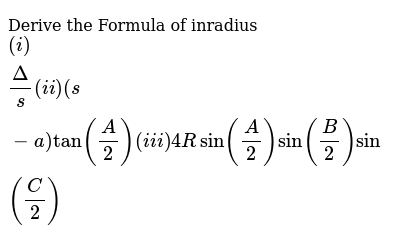
doubtnut
Derive the Formula of inradius (i) Delta / s (ii) (s-a) tan (A/2) (iii) 4R sin (A/2) sin (B/2 )sin (C/2)
upper merlin
no i ll be giving my first try this time
upper karma
upper merlin
no i ll be giving my first try this time
me too
upper karma
upper merlin
https://www.doubtnut.com/question-answer/derive-the-formula-of-inradius-i-delta-...
how tan(A/2) = sqrt((s-b)(s-c)/s(s-a))
upper merlin
upper karma
how tan(A/2) = sqrt((s-b)(s-c)/s(s-a))
no this is better ig: https://math.stackexchange.com/questions/1691711/how-to-prove-sin-fraca2-sqrt-fracs-bs-cbc-cos-fraca2-sqrt

Mathematics Stack Exchange
I have read these formulae in my book but i could not understand how these are proved.
$\sin\frac{A}{2}=\sqrt{\frac{(s-b)(s-c)}{bc}};\sin\frac{B}{2}=\sqrt{\frac{(s-c)(s-a)}{ca}};\sin\frac{C}{2}=\sq...
upper karma
upper merlin
https://www.quora.com/How-do-you-prove-Tan-A-2-s-b-s-c-s-S-a
thanks
tangent is such an inconvienient topic
function
sry
I meant function
 spring mauve
Problem 6. Assign to each side b of a convex polygon P the maximum area of a triangle
that has b as a side and is contained in P. Show that the sum of the areas assigned to
the sides of P is at least twice the area of P.
pls help with this 🙂
clear turtle
in my opinion i think b is pretty much like 75 degrees
upper merlin
spring mauve
Problem 6. Assign to each side b of a convex polygon P the maximum area of a tri...
There is very little chance that people are able to help you with IMO problems
spring mauve
our teacher gave us these stuff.....not understanding some parts of it
upper merlin
👀 your teacher gave you the 6th problem of IMO 2006?
upper merlin
no I can just read the solution online which is also pretty tough to understand
spring mauve
i can also read it online but then there is no fun in doing that way ig
upper merlin
yea you can just keep trying
 upper karma
dark sparrow
this looks like it might be insufficient data
upper karma
dark sparrow
this looks like it might be insufficient data
no
dark sparrow
also what's "circle concept" supposed to mean
upper karma
means theorems related to circle
dark sparrow
circle types?
are you sure the problem doesn't say anything else other than what you have marked? are you absolutely 100% certain there's nothing else?
can i see the text of the problem
dark sparrow
your teacher only gave you that diagram? nothing else?
honestly, i can't come up with a way to attack this problem right now
maybe it's possible to do it by coordinate-bashing but i'd like to avoid that if possible
upper karma
dark sparrow
honestly, i can't come up with a way to attack this problem right now
ok but if u will get any so. please tell
without using circles
dark sparrow
we are allowed to use trigonometry, right
upper karma
dark sparrow
we are allowed to use trigonometry, right
definitely
upper karma
dark sparrow
we are allowed to use trigonometry, right
ok i got the solution
i used angle bisector theorem
upper karma
ok wait

 dark sparrow
AD^2 = AE * AC - ED * DC
where did this come from?
 amber wraith
stewart theorem?
upper karma
now apply stewarts theorem and angle bisector theorem
upper karma
dark sparrow
> AD^2 = AE * AC - ED * DC
where did this come from?
there are 3 ways to prove this
u can also prove it by applying cosine rule in both triangle made by angle bisector
dark sparrow
hm
upper karma
and one by using a circumcircle
dark sparrow
i personally have never heard of stewart's theorem in particular
dark sparrow
everything else seems like just algebra


 gaunt iris
Help

 prisma briar
Hello? anyone need some help?
 dapper marlin
 dapper marlin
prisma briar
Hello? anyone need some help?
dapper marlin
prisma briar
Hello? anyone need some help?
could you help with 8 9 10
 shy wedge
upper karma
shy wedge
upper karma
Im kinda new to trigonometry but I think I figured out another solution
@dark sparrow Soryy if you didnt want to be tagged but I figured you might want to since you were involved too


Thing is I'm not sure how to follow now, I'm not even sure if I did it right
 worldly lintel
hi, i wondering if someone can help me to know how to do a problem from the "Equation topic of the line that passes through 2 points"
silent plank
do you have a specific question that you're stick on
 upper merlin
upper karma
upper merlin
upper karma
first try to calculate its maximum height in terms of l and r, then try to see how it would change with respect to the angle
upper karma
I have projected it onto a flat surface and found the max height to be 2rcos(alpha)
Where alpha is the angle between the circle and the surface
But I need to find the link between alpha and theta
@upper merlin
upper merlin
umm yea i ll help later i am busy rn

 tawdry merlin
Ok
wintry tundra
any rules you think you could use here? i forgot a fair sum of intricate rules in trig lmao
tawdry merlin
I also don't have any idea 😅
wintry tundra
ahh
tawdry merlin
😅
wintry tundra
sorry i dont think i can help
wintry tundra
i know some trig stuff but not a lot
tawdry merlin
I have the formula but idk how do I implement it
Let me find sin theta first
Then
I'll find cot with the sin
wintry tundra
ok
 rich wolf
@tawdry merlin problem?
 rich wolf
cos(t) = x/(x+1)
find cot(t)
i'm using t because i don't want to type out theta haha
rich wolf
what is p
tawdry merlin
Perpendicular
rich wolf
and h is hypotenuse?
rich wolf
then you're already wrong. recall the definition of cosine
cosine = adjacent/hypotenuse
tawdry merlin
Oh k
 tawdry merlin
Hm
rich wolf
tawdry merlin
Hm
did you figure it out?
tawdry merlin
A big NO
upper merlin
upper karma
But I need to find the link between alpha and theta

recall there are 2 altitutdes on 2 different bases
so what would be the value of h in terms of l and r?
upper karma

I don't know how to do this
It's been way too long since I last did anything like this
I got to B, C and that was it
upper karma
upper merlin
so what would be the value of h in terms of l and r?
If I had a piece of paper on me I can figure it out. But we want a function to find the height at any given theta, where theta is the angle when I roll the cone.
Maybe there was even an altitude theorem for a faster result I can't remember
upper merlin
upper karma
If I had a piece of paper on me I can figure it out. But we want a function to f...
finding the max height is essential to find the final answer
upper karma
Once I find the max height, what do I do with it?
upper merlin
try to find how it would change with respect to theta
upper karma
Well ok
 nocturne remnant
upper karma
nocturne remnant
upper karma
D lies on segment AB
Do you know what that implies for vectors OD, OA and OB?
nocturne remnant
Well
I implies that OD is some multiple x,y of OA and OB such that x+y = 1
So OD = (x)OA + (1-x)OB for some x
Try to think about it and see if it makes sense
nocturne remnant
Yeh
So you can use that to fork out x in the question
upper karma
I think I'll try to make sense of that first
since I've seen it popping up here and there from time to time
but no idea where this x<something> + (1-x)<something> comes from
nocturne remnant
Yeh
Try picturing the case where OA is 1 to the right and OB is 1 to the up
yk what, here’s a short proof
Let M be the midpoint of AB
Then
xOA + (1-x)OB
= x(OM+MA)+(1-x)(OM+MB)
=OM + x(MA)+(1-x)(MB)
Hopefully it’s more obvious now that the above expression covers all the points on segment AB
tawdry merlin
Can anyone help me ?
nocturne remnant

tawdry merlin
Huh OK
So
The question goes like this
If sin(t) = x/sqrt(x +1 )find the value of cot(t)
nocturne remnant
for starters you can try finding cos(t)
Also, are you given that t is an acute angle or sth?
tawdry merlin
No
nocturne remnant
Huh weird
nocturne remnant
Um have you learnt trig functions for angles beyond 0 to 90 degrees?
If not then we can probably assume t is acute
 nocturne remnant
In this case you would want to find sin(t) instead
Still remember that sin^2(t)+cos^2(t)=1
tawdry merlin
Ok
tawdry merlin
tawdry merlin
If we just convert into a figure then ig we should get

And I used that pythagoras theorem to get OPP of the triangle
nocturne remnant
Cool
 haughty flame
 upper karma
shy wedge
Thing is I'm not sure how to follow now, I'm not even sure if I did it right
upper karma
shy wedge
Thing is I'm not sure how to follow now, I'm not even sure if I did it right
ok i will try by this method also
 shy wedge
Bye :(
I figure out the question said aproximate to the closest non-decimal angle
Tge answe was 117.8 and I wrote 117 instead of 118
 olive cove
,rotate
somber coyoteBOT
 upper merlin
Did you try drawing the hexagon?
then try all you have to do is divide that hexagon into regions and calculate the area for each of them
 ionic bluff
can someone explain this
 shy wedge
upper karma
ok i will try by this method also
shy wedge
upper karma
ok i will try by this method also
Did you get anything?
 signal swallow
what is true about parallel lines?
 random widget
signal swallow
what is true about parallel lines?
random widget
signal swallow
what is true about parallel lines?
they have teh same slope
signal swallow
and what's the formula for slope?
random widget
y2-y1/x2-x1
signal swallow
right
so the slope of one of the lines must be equal to the slope of the other line
and you're given 4 sets of coordinates
signal swallow
have you heard of cross multiplying?
signal swallow
$\frac{a}{b}=\frac{c}{d} \implies a\cdot d = b\cdot c$
somber coyoteBOT
a disappointing son
 signal swallow
and you currently have $$-\frac95=\frac{n+1}{5-2n}$$
somber coyoteBOT
a disappointing son
 signal swallow
so you can cross multiply, distribute, and simplify
signal swallow
is that 50/13 lol
random widget
yea
signal swallow
👍
random widget
tysm
upper karma
shy wedge
Did you get anything?
nope
 tidal copper
 wintry tundra
Take the inverse cosine of both sides
warm totem
\
 warm totem
pls help
dark sparrow
@warm totem do you still need help with this?
dark sparrow
have you made a diagram yet?
dark sparrow
@warm totem ??
warm totem
no
dark sparrow
is there any reason why you went silent for a whole 20 minutes?
but whatever
can you make a diagram now?
wintry tundra
hes busy being cool
warm totem
im sorry I got sucked up in some family matter
warm totem
yep
warm totem
dark sparrow
can you make a diagram now?
How would someone make a diagram?
dark sparrow
you have here a circle centered at T
dark sparrow
and two points on this circle named G and H
this is not your first time making a diagram for a geometry problem, right?
warm totem
dark sparrow
this is not your first time making a diagram for a geometry problem, right?
it might be

 warm thorn

 prime vigil
Gammaking im not understanding what this question is asking
 oblique hatch
 rough prawn
can someone help me with this
rough prawn
can someone help me with this
Try dividing by cos, which then makes sine/cos = tan and try going from there
 upper merlin
dapper marlin
upper merlin
dapper marlin
If you are not able to get any answer then its better to go through the material once again
dapper marlin
upper merlin
If you are not able to get any answer then its better to go through the material...
i just need help with 4 now
upper merlin
dapper marlin
i just need help with 4 now
ohk
does x represent the arc QS?
if yes then you can mark the centre as O and join QO and SO
once you get angle QOS its pretty easy to get to the answer
@dapper marlin
dapper marlin
upper merlin
<@!779167294072946688>
i have no clue

 quiet blade
 supple bronze
Under the assumptions that the 40mm line is the diameter of the circle, first draw the circle's center. Then, connect the center with the endpoints of the segment with length 25.5mm.
If you find the shortest distance from the center to the segment, you might see how it will help you find the unknown length
 bold raven
 wintry tundra
supple bronze
wintry tundra
supple bronze
ive had to do this before for my robotics team... its trigonometry and pain
mighty rune
bold raven
use your trig functions to find the other lengths
oblique hatch
If one side and the two adjacent angles are known then the perimeter of the triangle can be found using the formula:
p = a + (a ÷ sin(β + γ)) × (sin(β) + sin(γ))
And since angles of triangle must = 180, 90 + 17 = 107, so the other angle = 180 - 107
wintry tundra
supple bronze

if u need to ask why side lengths are the way they are feel free to ping me
 inner sandal

for this i put
let C be a great circle so C = Π ∩ Sn, then since L is injective L(C) = L(Π ∩ Sn) = L(Π) ∩ (Sn) and as L is linear L(Π) is also a plane, and L(Sn) = Sn because L is surjective. So L(C) = L(Π) ∩ Sn is also a great circle
is that right?
<@&286206848099549185>
 upbeat helm
inner sandal
<@&286206848099549185>
upbeat helm
inner sandal
<@&286206848099549185>
you might wanna ask that in either #point-set-topology or #diff-geo-diff-top
inner sandal
upbeat helm
you might wanna ask that in either <#496785752936546304> or <#908108569688301649...
which one
it's not differential geometry or topology tho
ill just ask in a help
upper karma
inner sandal
ill just ask in a help
dis help yet?
also what is pi intersect Sn supposed to be
because my idea for a great circle is just k*Sn
where k is a real scalar
inner sandal
my definition of a great circle is basically taking a slice (plane pi) out of it and viewing that intersection
inner sandal
it's necessary the plane passes through zero so it's a great circle and not just a spherical circle
upper karma
ok i see what ur saying
L(Sn)=Sn?
what that supposed to mean lol
oh
because distance preserving
ig
but uh you should justify L(Sn) better
inner sandal
upper karma
L(Sn)=Sn?
L(Sn) is the image of Sn under L
upper karma
because surjective doesn’t necessarily mean L(Sn) is Sn in R^n+1
inner sandal
why
upper karma
yes, but why is the image Sn.
thats what im saying you should justify
unless L(Sn) is defined to be Sn
oh bruh
i didnt see
inner sandal
im just showing Sn → Sn defined by L preserves great circles, not L: R^n+1 → R^n+1
upper karma
yeah i see now lol
yeah ur logic is good
ig if u really want to you can add that L(Pi) contains 0 because L is linear
but idk if necessary
u were just saying before that the planes were based at 0, but it can be implicitly understoood ig
inner sandal
upper karma
ig if u really want to you can add that L(Pi) contains 0 because L is linear
yeah but L is linear so it's obv true
i see what you're saying to add it though, alright
upper karma
hopefully doesnt hurt but arg seems fine to me
was just confused at start because i lacked context
 clever fable
why is it that horizontal asymptotes can cross while vertical asymptotes can't?
(also, I was not sure where to put this question, but I think since it can be considered geometry, this should be the right channel)
 livid moss
If you sketch the function from left to right and you cross the vertical asymptote, you can't "go back" and get closer and closer to it again, because then it wouldn't be a function. So it has to do with the fact that every point on a function has a unique x value
Whereas, you can cross the horizontal asymptote, and then go back up/down and closer and closer to it
upper karma
no one can help if u dont send ur question
 hasty surge
upper karma
no one can help if u dont send ur question
hasty surge
upper karma
no one can help if u dont send ur question
wait a sec

@upper karma here you go
upper karma
so much words
hasty surge
upper karma
so much words
yeah!
upper karma
so we can say that AB is 12 and PQ is 25 and BQ is 70
hasty surge
upper karma
so we can say that AB is 12 and PQ is 25 and BQ is 70
yess
 upper karma
if no one comes after 15 minutes you can @ helpers
hasty surge
upper karma
if no one comes after 15 minutes you can @ helpers
okieee
@wild valley brooo
I need help
pleaseee
@river forge @ripe osprey answerr mane
it's urgent
<@&286206848099549185> guysssss
y'all aint responding
pls
respond
what are you people
who made you guys helpers
pathetic
 fair thistle
 hasty surge
@topaz sorrel dude
I know youre watching it
I need you help
immediately
ma chudao saalon
 topaz sorrel
 cedar aspen
i need a lot of help with proofs if anyone can
 bleak spade
can someone please help me out 1 on 1 i just started geometry and need help with a couple questions please dm me anyone who can help thank you!
wintry tundra
it wouldnt make sense for the answer to be 236 because both angles are acute
so when you add them together they would be less than 180
 hexed tiger
x and y are not acute
For sure
If the angles are x degrees and y degrees, x and y are the numbers
So just the sum of the angle measures
wintry tundra
hexed tiger
x and y are not acute
my bad im bad at using my eyes
 mystic karma
hasty surge
ma chudao saalon
mystic karma
hasty surge
ma chudao saalon
araam se bhai , teko doubt hote hai toh idhar aane ki jagah google lens use kiya kar
upper merlin
hasty surge
use the concept of similar triangles
you can express BS and SQ in terms of h
and please don't be so impatient and write stuff which is not meant to be there in this server
 stable maple
ya the ans is 236 just use angle sum property to get x+y
upper karma
You can construct a straight line down from B and C to get two right triangles ABE and DCF. From that you can figure out <ABE = 28 and <DCF = 28. Since <EBC = 90 you have x = 28 + 90 = 118 and since <FCB = 90 you have y = 28 + 90 =118. So x + y = 236. You avoid assuming x and y are the same.
Not E and F should be on the line AD.
stable maple
Can't we just use x+y+62+62=360 ?
upper karma
Yeah that too. If you take to heart all angles add up to 360.
upper karma
This is just one way of doing it. The E is just the vertex on the line AD after you construct a line down from B to AD. I just need a label for it. Same for F. If you know all right triangle have an angle sum of 180 you understand how I got 28.
Yeah nvm forgot what I just said and do what Dragonclaw suggested. Making this unnecessary complicated.
stable maple
you know that in any quadilateral sum of all angles are 360 so use that and if you wanna do for a another figure like 6 sided figure then you can use that formula
dapper marlin
 upper karma
I'd just calculate the percentage of the circle
As the angle gives you a per-360 value
upper karma
Is it possible to find the locus of a point on a pentagonal prism's perimeter?
 smoky palm
If I have X-Ycos(z)=0
how would I get z alone?
could I do
x=Ycos(z)
then
x/y=cos(z)
then
cos^-1(x/y)=z
would that work?
 humble pulsar
yes


 manic shell
 nocturne pebble
well
first
u gotta convert
the units
to inches
to make the calculations easier
so
maple trees for tapping for syrup should be 18 inches
in diameter
and the circumference of this tree
would be
50 inches
now
nocturne pebble
wait
nocturne pebble
I did it myself can u tell me if I'm correct
manic shell
alr
upper karma
 oblique snow
Expand LHS and divide numerator and denominator by cosx*cosy
 manic shell
well the circumference
is
2πr
and yeah what u did is right
but
i would have first converted to inches
which would be
9*2π
which is 18π
which is very close to what u got
yeah ur answer is right
nocturne pebble
Did I do the steps correctly though
nocturne pebble
convert 4 and 2 inches into inches?
nocturne pebble

I don't even know where to start with this one
Find the perimeter of the region
manic shell
right
well
thats gonna be the lengths we already know
which r
28x2 +6x2
ans
and
now you can see
that the curved parts are 1/4 of a circle
and theres 4 of them
which means
the perimeter will be
the circumference of that circle
manic shell
u should be able to do it urself now
nocturne pebble
Ok thanks I think I got it
nocturne pebble
Is the answer 143.4
 upper karma
Heeellppp

 upper karma

 slate pewter
random question
in the calculator on the phone
I can write
tan (90) and it gives me -1.9952
and tan of 90 is undefined
then I relized it have to be
tan (90°) to give me undefined
my question is
90° is okay a degree
but what is 90 here and why it have a answer like in what way does the calculator take just 90 as a number ?
dark sparrow
your calculator is probably in radian mode, which means it treats 90 as 90 radians
slate pewter
and what is that

I mean it's kinda solved i just have to write
the degree symbol for degrees
dark sparrow
radians are a unit of angle
1 radian is the central angle made by an arc whose length equals the radius
or to put it another way a radian is 1/(2pi) of a full circle
 dark sparrow
you might change your mind by the time you learn calculus
 weary hearth


 keen nova
slate pewter
why not just use degrees
keen nova
slate pewter
why not just use degrees
Radians are a much more natural way of talking about angles, it might not seem that way at first, but using degrees feels insane to me now
Radians are like describing to circles in their native language, degrees is like using Google translate
slate pewter
I am learning calculus
so yah
I guess I'll find out why
also i have a question about
the 6 ratios of the right triangle
it's kinda uhh but
In a right angled triangle if we know two out of the following three thing- (1). an angle other than the 90 degree. (2). length of side opposite to the angle (3). length of hypotenuse side. - then the third can be determined by using sine or cosecant of that angle. So they both are used for the exact same purpose.
Similarly cosine and secant are used for the exact same purpose. And same goes for tangent and cotangent.
I just wish to know why aren’t only three ratios used- either sine, cosine and tangent; or cosecant, secant and cotangent.
Are there situations where we couldnt use sine and could only use cosec and vice versa…and the same for the rest of two pairs. Or are they just used to make algebric equations look more complicated.
In mathematics we always try to reduce the work and effort; and find the easiest way. And i don’t understand why 6 are used instead of three.
I like to be able to explain stuff even for myself so I'll know that I deeply understanded it
I’d be really grateful to anyone helping.
uh this is long 
dark sparrow
Are there situations where we couldnt use sine and could only use cosec and vice versa…
no
the reliance on csc, sec and cot is more of a historical happenstance than anything
and it also varies by region
i know that when i was at school only sin, cos, tan and sometimes cot were made use of, and everybody managed just fine
slate pewter
okay
 lapis fossil
hello there im a little confused on how to do a question like this

like i know what to do with like my special triangles but this pi/12 is confusing me
dark sparrow
@lapis fossil this question refers to 'compound angle formulas'. do you know what that means?
lapis fossil
dark sparrow
<@646332769030504469> this question refers to 'compound angle formulas'. do you ...
yeah, i have a sheet with a bunch of formulas on it. Is the compound angle formula sin(x+y)=sinxcosy+cosxsiny ?
dark sparrow
yes, that's the one for this question.
lapis fossil
ah ok so that so i get that solves the first part of the question right
but what about the exact value part
hold on i'll try to send a picture
dark sparrow
sin(pi/4) cos(pi/12) + cos(pi/4) sin(pi/12) = sin(pi/4 + pi/12)
you can work out what pi/4 + pi/12 is, right?
lapis fossil
oh wait does it equal pi/4?
dark sparrow
no, pi/4 + pi/12 is not pi/4.
dark sparrow
the answer to the problem is not pi/3, but it is what i wanted you to work out.
lapis fossil
ohh yeah mb
dark sparrow
your expression is sin(pi/3).
lapis fossil
ahh i see why thats important
can i take a gander on what to do next?
to fully solve this problem do i use the speical triangles?
the one specifically with pi/3?
dark sparrow
i mean, now we've reduced this problem to calculating the value of sin(pi/3).
you either know that off the top of your head or you draw a special triangle to help yourself remember.
lapis fossil
Dangit, here’s my work maybe I did something wrong here
 dark sparrow
what's the hypotenuse?
lapis fossil
ohgod, im cringing so hard rn
that's embarassing
yeah it's root3/2 tysm, i'll try not to make a stupid mistake like that ever again 😅
 onyx iron
hii how do i illustrate this?
- There exist exactly three distinct lines in the geometry.
- Each two distinct lines are on exactly one point.
- Not all lines of the geometry are on the same point.
- Each two distinct points are on at least one line.
dapper marlin
Find the length of the bolded arc & the area of the bolded sector.


 wise pawn
what have you tried
 potent orbit
could someone check this with me?
 oblique snow
wise pawn
what have you tried
oblique snow
wise pawn
what have you tried
i only found 1 radian answer
teacher said there should be 4
wise pawn
show your work
oblique snow

@wise pawn like i found one radian only but the teacher said there should be 4 radians in total
total
wise pawn
looks like you should have at least 2 from the + and - cases right?
 wise pawn
ok good, now why do each of these give us 2 more answers
oblique snow
oh
wise pawn
it might help to think about the graph of tan(x) and the period of tan
oblique snow
can we do a voice call?
wise pawn
nope, sorry
 celest cloud
any geometry chads here?

 celest cloud
so are there ?
 storm portal
Just ask your question.
celest cloud
asked it above
right let me lay it down
1) find sin(A+B) (no calculator!!!!!!)```Start by drawing a diagram
wise pawn
have you heard of angle sum identities
celest cloud
apparently we have to use trig identities fellas
storm portal
Yup - angle sum identities for trig functions
celest cloud
my working out so far:
we know sin(A+B) = (SinA)(CosB) + (CosA)(SinB)
so i did:
5/13*4/5 = 20/65
Sin(A+B) = 20/65 + (CosA)(SinB)
this is where im at right now ```any advice fellas?
if any geometry chad is capable of doing this then id appreciate the advice 👍
signal swallow
celest cloud
any advice fellas?
draw triangles that satisfy sin(A)=5/13 and cos(B)=4/5
you can get cos(A) and sin(B) this way
celest cloud
signal swallow
draw triangles that satisfy sin(A)=5/13 and cos(B)=4/5
im trying to do it through trig identities tho
its a skill i need to learn
signal swallow
the trig identity was the sum one you used
wise pawn
you can use the pythagorean identity
celest cloud
ye and im not using it properly
signal swallow
yes you are lol
wise pawn
to solve for sine or cosine of the other
signal swallow
signal swallow
draw triangles that satisfy sin(A)=5/13 and cos(B)=4/5
that's where this comes in
celest cloud
so is A the angle?
signal swallow
A is an angle