#geometry-and-trigonometry
1 messages · Page 328 of 1
 brittle gyro
 severe hinge
Thx @brittle gyro
 mighty zodiac
Can someone help me with my trig homework?
There’s a couple questions that I don’t know how to do
 silent plank

 humble pulsar
Just post the question
 tender prawn
its a basic trig question
is the answer 2?
theres like 2 values of nq where sin nq = c right
and like
n is already determined so there's 2 values for q?
 shadow wadi
Guys a question, anybody have any ideas how to get this input equation equal to the one on right (1 ) equation i have tried dividing everything by cos^2 x and transforming cos to sin and then dividing by cos but just cant get this result please help, thanks in advance
 jaunty marsh
$cos^2(2x)=2cos^2(x)-1$
 somber coyoteBOT
Avlasov23:
tender prawn
that means cos sqrt11 = A
mighty zodiac
I don’t get it
jaunty marsh
$a*sin^2(x)+b(1-2sin^2(x))=1$
somber coyoteBOT
Avlasov23:
mighty zodiac
jaunty marsh
$cos(theta)/sin(theta)=2sin(theta)cos(theta)/(1-(1-sin^2(theta))$
somber coyoteBOT
AV8312:
jaunty marsh
$cos(theta)/sin(theta)=2sin(theta)cos(theta)/(sin^2(theta))$
somber coyoteBOT
AV8312:
jaunty marsh
Wait
Bottom is supposed to be 2sin^2(theta)
$cos(theta)/sin(theta)=2sin(theta)cos(theta)/(2sin^2(theta))$
somber coyoteBOT
AV8312:
jaunty marsh
$cos(theta)/sin(theta)=cos(theta)/sin(theta)$
somber coyoteBOT
AV8312:
jaunty marsh
And it’s proven
silent plank
where are you stuck?
silent plank
have you learned about properties of parallel lines?
 subtle snow
I don’t remember
silent plank
are terms like alternate angles, corresponding, etc familair to uyou?
subtle snow
I think so but I don’t remember
silent plank
review those
subtle snow
What video should I watch to help would be helpful?
silent plank
plenty of vids around to help with math
silent plank
lowercase r but yeh
subtle snow
Ok what should I type to learn how do question number one?
silent plank
properties of parallel lines
subtle snow
Ok I’ll let you know what I get
 raven ruin
who can help with this 
subtle snow
Oh what i think I know what properties of parallel lines is
@silent plank
But it’s still doesn’t make sense
On how to figure out m
silent plank
upon review are you able to identify stuff like alternate angles now?
silent plank
can you see that the angles with measures:
68-m and 5m-10 are alternate angles?
silent plank
well that is true but not up to that part yet
subtle snow
Ok what should I do then?
silent plank
well they're alternate angles on parallel lines so their measures will be the same
68-m = 5m-10
would be the equation to set up to determine m
silent plank
no
silent plank
78/6 isn't 3
silent plank
yes
subtle snow
Ok I’ll see what I can fill in
I’ll let you know what I get
Ok so n=55 m=13 and p=62.5?
@silent plank
silent plank
what are you doing to get p?
subtle snow
Since one side 55 I subtracted that out of 180 and then divided it by two to get the two sides which is 62.5
But now I’m not sure what should I do?
@silent plank
silent plank
youre doing random things
silent plank
stopping pinging me every time ...
i'm here...
subtle snow
Ok sorry
silent plank
do you see those congruence markings at 5m-10 and the angle next to it?
subtle snow
Yes but I forgot what it means
subtle snow
So it’s also 55
silent plank
yes
subtle snow
So p = 70
silent plank
yes
 hollow raven
Wonder why it says exam 3 at the top 
 hollow raven
What timing
 west basin
like a boss
subtle snow
That was a difficult thing oops
 subtle snow
Can you help me?
west basin
not on an exam
which clearly it was even tho you deleted it
so i dont think i can
sorry
subtle snow
Ok thanks anyways
west basin
academic dishonesty can ruin your entire career
even tho it seems like its no big deal
hollow raven
Don't ask for help on exams in the future mate you're just playin urself
subtle snow
Ok my bad sorry
humble pulsar
$2\sin^2{x} + 9\sin{x} +4 = 0$ ?
somber coyoteBOT
moshill1:
humble pulsar
@mighty zodiac
humble pulsar
it's a quadratic
mighty zodiac
Yes
humble pulsar
do you know how to solve quadratics?
mighty zodiac
Yeah but not in 0,2pie
 round isle
@mighty zodiac assume cos(3*theta) = x and replace it in the equation and solve
 tame tartan
can anyone help me with this? i've been trying to solve this for hours but i couldn't find any solution
round isle
was this question taken from an IMO in 1800s?
 slate blade
What's the stuff on the left and right of the diagram the 1/2 and 1?
$$ \frac{1}{2}$$
noice
 hoary trellis
what shape is on the bottom? I got the volume of the square. Need the other one thanks
 upper karma
square pyramid
hoary trellis
ty
 coral dagger
For the area of a triangle formula to work, does it have to be trig function of Sine that is used?
For this example 1/2•base•aSinC is used but what happened if C isn’t available (or for some reason I can’t use C)
And for a question I have to use another angle (arrowed in photo, let’s call it F)
so is 1/2 • base • aCosineF = 1/2 • base • aSineC?
upper karma
humble pulsar
combine sec^2 and csc^2
 royal citrus
please hapen to ping me for an answer
humble pulsar
@royal citrus
royal citrus
humble pulsar
combine sec^2 and csc^2
wdym combine
humble pulsar
add the fractions together
royal citrus
oh those
west basin
gotta know yo trig identities son
humble pulsar
^
royal citrus
,, \frac{1}{cosA.sinA}
somber coyoteBOT
Inheritanc-e ♦:
royal citrus
now what do I do?
west basin
trig identities again dude
round isle
I suggest you review your trig identities
west basin
remember
royal citrus
round isle
do you not see the solution?
I don't, but ok i will look at it again and try my best to see what the next step is
 compact saffron
can someone help with a trig question?
 deft blaze
post the question
 rotund bay
any intuitive reason for why principal radii are on orthogonal planes?
 dark sparrow
what's a principal radius :?
upper karma
<@&286206848099549185> lol
 still laurel
it asks to use cosine law, I'm confused
 swift summit
@still laurel just use either side for the equation. cosine(34)=5 or 9/x
still laurel
@swift summit right but what is the logic behind that, I get the calculation but how
swift summit
because cosine=adjacent/hypotenuse. so by plugging the information in you end up with that
still laurel
is there logic in this question behind how you pick which side is adjacent
thats all
swift summit
oh no either side works just as well as the other
wait
you do know what adjacent means, yes?
swift summit
ok np
 mystic dune
I don't know how to do it but I got 13.5 m
 spare plaza
 silent plank
@Sarim1k#6558 the cosine law:
$$c^2 =a^2 + b^2 -2ab\cdot\cos(C)$$
somber coyoteBOT
ramonov:
Compile Error! Click the  reaction for details. (You may edit your message)
deft blaze
because cosine=adjacent/hypotenuse. so by plugging the information in you end up with that
@swift summit you only use this with right angles
somber coyoteBOT
snap:
 earnest echo
Since the question itself says all permissible values of x, I don't think you have to list out non-permissible values
somber coyoteBOT
snap:
 quick timber
so, I appearantly have all the info I need to say that E,F,A and B are on the same circle... tho I'm failing to see how they are... all I know is that AFB and AEB are the same size, basically.
upper karma
can you send the original problem?
quick timber
if you can read dutch 😅
upper karma
what is the goal?
rotund bay
What does them being on the same circle mean?
quick timber
proof that ABF and E are on the same circle
rotund bay
And define "being on the same circle"
upper karma
so ABFE is cyclic
upper karma
I think you already got the solution
upper karma
ok I see
|| so angle ADE = EAD = y because triangle ADE is isosceles, same thing for triangle FCB (angle FCB = CBF = x). For the exterior angle theorem we have AEB = 2y and AFB = 2x, but notice x = y (angle ADB = ACB) because they are on the same segment AB, so we conclude AEB = AFB, which makes the quadrilateral cyclic. ||
quick timber
id see it if EAB and FBA were the same size, but I havent proven that.. right?
Im so confused, I got all that information but im just not seeing how u can say its cyclic rn
😅
upper karma
upper karma
|| so angle ADE = EAD = y because triangle ADE is isosceles, same thing for tria...
this is my solution
quick timber
I had all that, but I just dont understand the last bit
rotund bay
AEB and AFB are both right angles right?
upper karma
no
upper karma
quick timber
I had all that, but I just dont understand the last bit
it's just a condition that makes quadrilaterals cyclic
upper karma
you could think of it as angles AEB and AFB being on the same segment AB
quick timber
but in class they said, AEB + ABE = 180 makes it cyclic
upper karma
rotund bay
Doesn't AED have to be a right angle though
what are you talking about
quick timber
OH
quick timber
upper karma
you could think of it as angles AEB and AFB being on the same segment AB
TY, got it
XD
seeing it now LMAO
upper karma
that's another condition
quick timber
yeahh, makes sense now I think about it
upper karma
there are several ways to prove that a quadrilateral is cyclic
rotund bay
Triangle ADE is a right triangle, AED and AEB are both right angles
Same on other side
No?
rotund bay
Side AE and DE are equal length
 autumn vortex
just isosceles
upper karma
upper karma
|| so angle ADE = EAD = y because triangle ADE is isosceles, same thing for tria...
this is the proof if you are interested
quick timber
atleast I got everything but the conclusion myself... LMAO
rotund bay
NEVERMIND
 sly elm
do both sin(90-a) and sin(90+a) = cosa?
 midnight ice
Hi everyone
round isle
hi
 dusky surge
Hi
deft blaze

 obtuse tapir
some good questions pls
obtuse tapir
im stumped
mystic dune
16
I just put it in desmos and found which value it equals 64, I don't know how to do it algrebraically
mystic dune
I tried doing it but I gave up then I used desmos
to see if x is equaled to a good number
 silver spruce
can someone help me by walking me through how to evaluate cos(-225) with a answer in fraction form.
I think it has something to do with the unit circle and the fundamental trigonometric identity
 umbral snow
Can you pinpoint, at least approximately, where -225° lands on the unit circle?
umbral snow
Is it at 9 o'clock?
umbral snow
No you're not dumb haha, but you'll want to know what the unit circle is and how to find where an angle lands on it
silver spruce
i mean like it starts at (1,0)
umbral snow
Basically, you always start at 3:00 or (1,0) yeah
umbral snow
The negative means "go clockwise"
umbral snow
180 would be half way around, 270 would be 3/4 way around
But you have 225, so it lands half way between those two, somewhere around 10 o'clock
That part make sense?
umbral snow
Yeah haha, if you want to say it that way, that is good too
silver spruce
is that then (7pi)/6 whatever thing?
umbral snow
Big thing to realize, it's 45° away from the y-axis!
silver spruce
like distance
umbral snow
So you'll want to relate it to something to do with cos(45)
Which is - you'll want to relate it to √2 / 2
silver spruce
so how do we figure this out?
is it just that 225/45 =5
so that the 45 degree ange on the unit circle like the √2 / 2
or like
dunno
umbral snow
What's the sign of cos(-225)? That is, what's the sign of the x-value when the terminal arm is near 10 o'clock?
silver spruce
its negative
umbral snow
You got it
silver spruce
so like because 45 is a factor of 225
and like 45 degrees is the √2 / 2 thing on the unit circle
and that 225 is on the negative side of x
its just -√2 / 2
?
umbral snow
Well, -225 is
silver spruce
yea
umbral snow
But yes exactly
silver spruce
so the awnser would be -√2 / 2?
umbral snow
You got it
silver spruce
but how would we apply this to a diffrent problem?
umbral snow
Sure, have another example?
silver spruce
because liek some problems arent a factor of 45
umbral snow
Same idea first - get a sense of where it lands approximately
umbral snow
You got it
silver spruce
so its more logic than like math?
umbral snow

umbral snow
Then two blend together a lot haha
silver spruce
****like
hollow raven
Kaynex, you are certainly cool
umbral snow
It's not all symbol pushing
That's the "hip" term
@hollow raven
And thank you but as my name implies, I am not-cool
hollow raven
 I see otherwise
umbral snow
@silver spruce
Then you want to focus on the y-value, not the x-value
Otherwise the question is the same
silver spruce
thx
royal citrus
Hey how do u do this?
somber coyoteBOT
Inheritanc-e ♦:
silent plank
apply a^4 = a^2*a^2 and pytahgorean trig identities
somber coyoteBOT
Inheritanc-e ♦:
silent plank
parentheses, also assuming that you actually had those,
you aren't distributing properly
 silk patio
OA=AB=1
Find PQ
royal citrus
silent plank
parentheses, also assuming that you actually had those,
you aren't distributing ...
me?
round isle
thus finding the length of arc PQ
silk patio
Purely algebraic solution
round isle
trignometric equations aren't algebra?
are you absolutely sure about trig not being allowed?
silk patio
I don’t like transcendental functions in my basic geometry problem
silk patio
It can be done without reference to angles
round isle
I don't think you can but if you do then I guess good for you
round isle
ok god
 unkempt wasp
hello. I have an exercise with imaginary numbers and I don't know how to do it. The +- is the difficult part for me. Why is it here? What am I supposed to do with it? Would be really glad if someone could explain.
unkempt wasp
but there's only one answer in the answers sheet.
Although if this is all it means then thank you.
I'll try to solve it with both
unkempt wasp
https://discordapp.com/channels/268882317391429632/326138757474680852/782333576678080603
the length of this 2? Right? Cause the complete answer is supposed to be 1 but the only way imo where that would happen is if the length of the complex number would be 1 too
but I keep getting 2
silent plank
how are you getting 2
silent plank
doesnt tell me how you're getting 2 because that's 1
 earnest sphinx
"If the tangent vector of a parametrized curve is constant, the image of the curve is part of a straight line."
what does that mean? xd
round isle
huh?
if the tangent is the same at all points
wouldn't that mean the curve is just a line?
earnest sphinx
if we are in R^3 a line is a plane, or a line is a line?
round isle
it would be a plane in R3
earnest sphinx
okk ty
 weary drift
no it’s a line in any R^n
earnest sphinx
ahh thanks
a vector being constant means all its components are constants right?
what's the tangent vector of a plane?
weary drift
a vector being constant means all its components are constants right?
yes
what's the tangent vector of a plane?
doesn’t make sense to speak of one. rather we speak of a plane characterized by a normal vector
upper karma
do you know synthetic division?
if not, i'd look up a video on how to do it
it's basically long division, but with polynomials
 ashen brook
how do i find the angle for the vector W= -2i-2sqrt3j
could anyone help me with complex numbers
slate blade
sure wassup with ur complex numbers
@ashen brook For your first question of vectors
I'm assuming you're asking between vector and x axis?
$$ W = -2i -2\sqrt{3}j $$
somber coyoteBOT
Doodaide
slate blade
Thus, you know that your angle between the x axis and the singular 2D vector is equal to this
$$ let \theta = angle
\therefore \theta = \arctan{(\frac{-2\sqrt{3}}{-2})} $$
somber coyoteBOT
Doodaide
 versed river
text goes outside the dollar signs if you want spaces and dont want it to be italics
slate blade
ah my bad sorry still getting used to the bot lol
versed river
$\frac{\pi}{3}$
somber coyoteBOT
Sneaky
versed river
display math mode and normal math mode, you can google it
slate blade
ok ty
obtuse tapir
OA=AB=1
Find PQ
@silk patio thats ez
two equations can be formed
x+y=2, x^2+pq^2/4=1 y^2+pq^2/4=2
PQ=root(7)/2
 brisk latch
help pls
silk patio
@obtuse tapir not right, close tho
brisk latch
kinda need an answer asap
upper karma
Why
upper karma
We don't give away answers here
Can you post your work so that we can try to spot your mistake
upper karma
Consider drawing triangle OBC
Can you think of a way of getting angle BOC
Using a specific circle theorem
upper karma
note that angles BOC and BAC correspond to the same arc
upper karma
Look at the first one
Are you able to get angle y considering the theorem i just sent
upper karma
What about it
upper karma
Yes, 56°
brisk latch
now wut.
upper karma
If we split the triangle like this
Let me get a better pic
Look at the green triangle
Remember we splitted the triangle in 2, so the angle BOP will be half of 56°

Now look at the 5th theorem here, according to this, on the green triangle we get a right triangle with 2 known angles and one known side
@brisk latch understood everything i've just said so far?
brisk latch
hm
brisk latch
sorry im learning from 5 different peoople at onc
upper karma
Huh
deft blaze

upper karma
It's better to learn from 1 person decently than from 5 people unefficiently
Focus on one
brisk latch
its 4 different people in 1 server and u
upper karma
Come back whenever you are able to follow me efficiently
upper karma
What do you expect me to say
obtuse tapir
silk patio
<@341142323142459393> not right, close tho
how so
silk patio
obtuse tapir
how so
It’s just wrong
obtuse tapir
whats the solution
dark sparrow
<@&268886789983436800> advertiser spam
@upper karma no advertising. and definitely no spam.
upper karma
this is not the place to do so
dark sparrow
and not the manner either
obtuse tapir
@silk patio
upper karma
,rccw
somber coyoteBOT
dusky surge
What are you calculating? @obtuse tapir
Is PB=1?
 scenic goblet
I need my program to make assumptions based on the contours of a surface for the path of a rope moving across it. Any chance I can find that on this server?
round isle
please post your question
scenic goblet
I’m able to ascertain the 3D coordinates of points along an uneven surface, but I don’t have any kind of math background, so I can’t use the data. My main goal is to determine location of the peaks and troughs and the distance between them, in the context of the programming environment I’m using.
Essentially, I’m looking for a mathematician to join my development team (me), to develop a rope physics simulation.
round isle
I see
so you want to know where the local maxima and minima are
based on data points
so your surface is just a collection of 3D points
there are many ways to do that if you don't know the actual function that parametrizes your surface
one thing you could do is
define a neighborhood of size 10 units (for example)
look for the point that has the highest/ lowest height in this neighborhood
in computer vision we use a technique
where we convolve a surface with the Sobel filter
to detect all the local maxima
you could probably try something like that too
scenic goblet
That sounds very likely to be true, but I don’t know how to do much of that, simply because I am using brute force to program, up to this point. I’m very versed with the tools, but lack all but the most basic math ability.
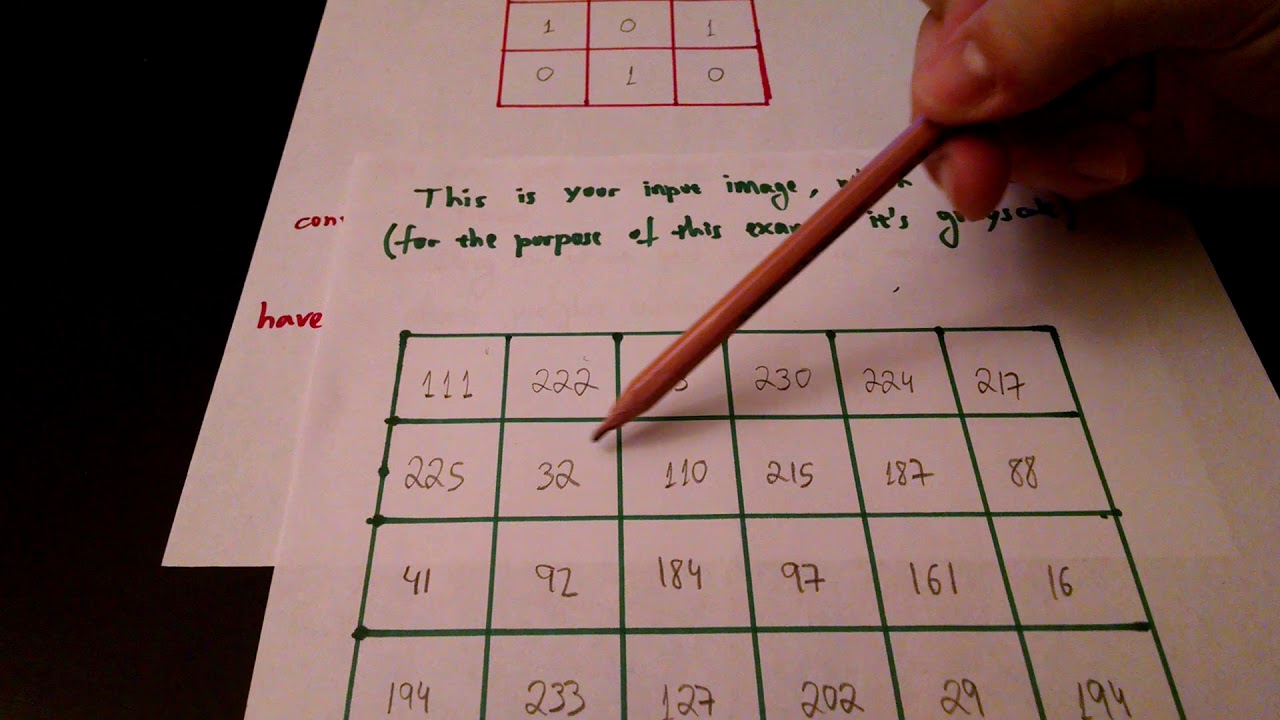 scenic goblet
That’s interesting.
So, it averages the image and reduces it to a lower resolution?
round isle
this video is to help you understand how 2D convolution works
so you could do it for your program
replace the filter in this video by the sobel filter
which will look for local maxima on your surface
since your surface is represented as a grid with value in each grid representing the height of the surface at that location
scenic goblet
What’s a sobel filter?
round isle
it's a filter that can find local maxima
we use it in image processing to do edge detection
scenic goblet
Here’s an example surface. I want my rope to understand where the peaks and troughs are so it can lay across it naturally. How would I apply a sobel filter to this, would you say?
round isle
you should convert this to a 2D grid where (x, y) is the location of a point on the surface and the value at a grid square at some (x, y) location represents the height of the point on the surface
then convolve that grid with Sobel operator
scenic goblet
What is the Sobel operator? How would I apply it here?
round isle
?
have you not been reading anything I just said?
scroll over and read what I just wrote
scenic goblet
Sorry, I don’t know how to replace the filter in the video with a Sobel filter.
obtuse tapir
@dusky surge
scenic goblet
@round isle Ok, I googled it and now I see that these filters are in a common format. So, I can apply this within my program, no problem, but what will the resulting values represent?
It will be reduced to a smaller grid, for one thing.
obtuse tapir
somber coyote
*BC^2 not pb
round isle
to prevent your grid from getting reduced, you can pad it with a border. The new grid, after convolution with sobel operator, will be the same size. You'll get two grids: one after convolving with the horizontal Sobel filter and the other due to the vertical Sobel operator. For each corresponding location, you square and add the Sobel values and take square root. The new grid will now contain a lot of large values (representing minima and maxima). Now, you can define another window where the highest value will be highlighted only and you can use that to check the y value in the original grid (before applying the Sobel operator)
you can also try the Canny Edge detector
you better do some reading on these algos on your own time
scenic goblet
Built a machine that can apply it. Now I need to comprehend what I can do with it.
https://youtu.be/v9qXkVIjJ2U
 round isle
why are you not padding the sides
this will let you get a grid of the same size
after applying sobel operator
scenic goblet
Because I have no idea what I’m doing. I just needed to finish this in a basic form, now I can expand it.
scenic goblet
K
That’s pretty much already there, because I didn’t limit the movement of the filter
And I drop the value cubes with a button press
So, at each location on the grid I square the horizontal and vertical and then add them and then “take the square root”?
 signal wolf
I have a rather hard time figuring this problem out, experimentation with GeoGebra shows me nothing particularly useful
scenic goblet
@round isle In the video he places the sum of the kernel in the top left. Where does the sum of each kernel position go in the Sobel kernel?
round isle
the middle of the kernel
scenic goblet
What's the most straightforward way to find the square root if you only have basic calculator functions? (I told you, I'm terrible at math.)
scenic goblet
How do I get the square root? Your instructions have me doing that.
scenic goblet
I have zero math ability. Basically handicapped.
round isle
what do you mean you have zero math capability
scenic goblet
I don't understand it
round isle
how old are you?
scenic goblet
Very old
round isle
huh?
scenic goblet
40
round isle
you didn't go to school?
scenic goblet
I didn't finish middle school
scenic goblet
US
round isle
???
wtf
I thought every kid is supposed to complete high school in US
legally required to
scenic goblet
Not at all
 glacial dawn
in some states I think compulsory education is up to middle school
round isle
wait a second
you don't know basic math
but you know how to program?
how is that even possible
scenic goblet
I'm using brute force methods and a very friendly programming environment
round isle
what language are you programming in?
round isle
?
scenic goblet
It's a platform, I guess. It's called Dreams.
scenic goblet
Yes
round isle
bruh, is it really possible to make stuff in it without coding?
scenic goblet
That's no coding, per say. It's all visual nodes that you wire together.
round isle
so, you don't know what a square root is?
scenic goblet
No
round isle
well
I could tell you what it is
but before that
please do something about your education
you won't get far with the kind of stuff you're doing
without math
so, now
square root:
scenic goblet
That's why I'm here
round isle
2 x 2 = 4
when we take square root of 4
we get 2
because when we multiply 2 with itself
we get 4
so, taking square root is breaking a number down into its multiplicative components
scenic goblet
Ok, that makes sense
And how would I get the square root with basic calculator functions?
round isle
well you don't
calculators have square root button
let me guess
Dreams doesn't have square root?
scenic goblet
No it doesn't
round isle
ok
so, square root is not necessary
you can just square the x and y results and add them
that alone would be fine
scenic goblet
I don't need it?
round isle
no you don't
 oak citrus
^(1/2) works right
oak citrus
oof
scenic goblet
Dreams has "power of". Is that what that is?
 simple drum
Yes
glacial dawn
If u take ur number to the power 0.5 u will get the square root
upper karma
Use a calculator bro lmao
scenic goblet
So the square root of 150 is 12.247? That's what I'm getting.
simple drum
That sounds accurate
round isle
ha
didn't know Dreams has power of
what exactly are you trying to build in Dreams anyway?
scenic goblet
I'm trying to build a system that gives the program some general awareness of the shape of the terrain.
Lots of uses for that, but currently I hope to make a rope react naturally as it goes across terrain and over ledges.
I want high points to make that portion of the rope resist being dragged, and that kind of thing.
scenic goblet
The pink and green cubes are the horizontal and vertical scan data, and the grey one is the combined and square root.
https://youtu.be/TOZBIWn9xNY
 round isle
what have you tried so far
 neon hamlet
Not much, still confused on how I would start off.
humble pulsar
What's the relationship between <FAD and <CAB
round isle
well you have two important straight lines here
CD and BF
sum of all angles on a straight line is 180
so use that here
neon hamlet
Well since im setting up a system of equations,
9x + y = 180
and I need something else.
hollow raven
Good thing to note here
90-4x+36 = 5x, because 4x + <FAE = 90, so <FAE = 90 - 4x, and 5x is an opposite angle of 36 + <FAE, so 5x = 36 + <FAE
Since both angle summations are equivalent, 90-4x+36 = 5x
neon hamlet
Gotcha, thanks for the help. Solved it now.
dusky surge
obtuse tapir
pq
I'm getting more confused lol
 neon jolt
Solving for theta Cos(Theta/2) Does theta = 2ArcCos(Hyp/Adj)?
can you actually pull the one half out or is this purely a half angle
neon jolt
I assume that this would be some kind of Cos^-1 of a Half angle?
round isle
use half angle formula
neon jolt
you mean set it equal to half angle and solve for theta?
neon jolt
Well I am looking at this quaterion math for complex number and I am trying understand how the half angle become 2ArcCos
I'll link it
round isle
and?
neon jolt
so
q = cos(angle/2) + i ( x * sin(angle/2)) + j (y * sin(angle/2)) + k ( z * sin(angle/2))
at Theta = 0 degrees
imaginary part becomes 0
round isle
imaginary part?
neon jolt
because sine theta/2 = 0
round isle
what imaginary part?
neon jolt
yes
neon jolt
yes
neon jolt
so check this out
round isle
check out what?
round isle
that is not the imaginary part first of all
the i, j and k are unit vectors along x, y and z axis
round isle
your high school is teaching you quaternions?
neon jolt
the imaginary part is the unit vectors
round isle
crap
I am out of my depth here then
I have not studied quaternions
best you wait for someone who has
neon jolt
Ignore it for a moment
I am just rusty
at the trig
all you need to know is as theta -> 0 you get Q = 1 + 0
W = real part
W = cos(theta/2)
so
q = 1 + i 0 + j 0 + k 0
gives us this angle = 2 * acos(qw) = 0
so working back from above equation qw = 1
round isle
angle = 2 * acos(qw)
they are saying angle is 0
so just put that in there and solve for qw
neon jolt
ha
hmm
QW = 1 at 0
but how did they solve for theta
thats the fundamental thing i am forgetting
I assume convert it to half angle
and then solve for theta?
then take the Arc Cos
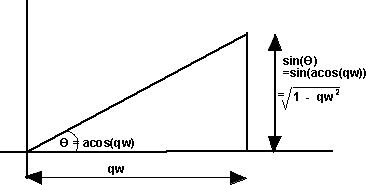
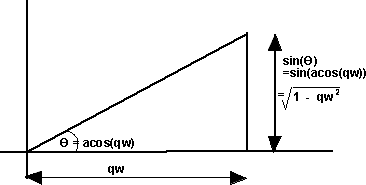
I see it now
thanks
QW = 1 Because the one side is 1
it has to be
 outer trench
im confused on this
y it upside down
if you know that two sides of a triangle have lengths 4 cm and 6 cm, what specifically do you know about the length of the third side if the triangle is a right triangle?
silent plank
consider theorems related to right triangles
outer trench
i mean it 90 degrees
silent plank
well one of the angles will be 90°
ever heard of pythagoras?
if the triangle is right, the sides will satisfy pythagoras' theorem
upper karma
If theta is on radians
Very important to note
290° isn't on radians
@dire scaffold do you know how to manage from degrees to radians?
 dire scaffold
no
upper karma
Ok then that's not the formula you're looking for
dire scaffold
o
west basin
sorry about that kinda just glanced quick
upper karma
The formula you are looking for is $A_s=\frac{\theta}{360}πr²$ where $\theta$ is in degrees
somber coyoteBOT
Al𝟛dium
 blazing pond
 charred osprey
2cos(75-β)-sinβ=0
How could I solve this?
umbral snow
Hey Samwise, you were my favorite star wars villian.
 crisp copper
Wow dude
crisp copper
umbral snow
Hey Samwise, you were my favorite star wars villian.
Of course I understand
After all, I killed Yoda
upper karma
charred osprey
2cos(75-β)-sinβ=0
How could I solve this?
First, I'd get the 75 degrees into radians. Following up, split up cos(5π/12 - β) using subtraction identity for cosine.
After you applied the identity, manipulate the formula in terms of acos(x) + bsin(x). If you are having trouble with getting it in said form, then I'd recommend you to completely expand it and factor out the cos(x) and sin(x).
Using another important identity, acos(x) + bsin(x) = Rcos(x - c), where R is the sqrt(a² + b²) and c = arctan(b/a).
Setting Rcos(x - c) = 0, we have x = nπ + π/2 + arctan(b/a), where n is the set of integers. Don't forget to state this if your teacher wants it to be solve generally.
charred osprey
Thanks!
 plucky pebble
Hey guys, How do i solve this problem. Am I allowed to draw halves?
plucky pebble
Am I allowed to draw between two points
I tried a ton of times
My teacher couldn't solve it
ashen brook
what would be the equation for finding the six sixth roots of z=-1
"Find the six sixth roots for z=-1. Leave your answers in trigonometric form."
weary drift
de moivre
ashen brook
i think its like = (cos (180) + i sin (180)) but im not for sure what to put infront
nvm
i dont think its that
 limpid gust
can someone explain what I need to do to find the missing angles
 stuck dragon
#8: what is the relationship between <1 and 105 degrees?
#9: what is the relationship between <2 and 105 degrees?
#10: what is the relationship between <3 and <7?
#11: what is the relationship between <4 and 80 degrees?
#12: what is the relationship between <6 and <3 or <7?
#13: what is the relationship between <7 and 105 degrees?
#14: think about the sum of the angles of a triangle and the vertical angles around the triangle.
15#: what is the relationship between <9, <8, and 80 degrees?
you might want to rearrange the order you go for these problems


 olive plaza
Can anyone help with trig?
humble pulsar
@olive plaza yes, i can help with that question you totally posted
olive plaza
I can't figure out how to post it
anyways
the question is estimate a value for cot 140
humble pulsar
just post the picture... or type it out
If it's just estimate i'd probably average the values of cot(120) and cot(150)
limpid gust
can somebody tell me if these are wrong please?
umbral snow
@ashen brook
Still looking for it?
ashen brook
umbral snow
<@218119632123330560>
Still looking for it?
yes
umbral snow
@ashen brook
Note that you care about when
z⁶ = -1 = cos(180 + 360k) + isin(180 + 360k)
Where you can put any k in, and that gives a coterminal angle. That bit make sense?
ashen brook
yeah i understood that part im just not sure what to put in cis form for example x
x cis 90
ah i think i got it
 vast python
ashen brook
vast python
ashen brook
@umbral snow thankyou, i was able to complete the problem!
vast python
I did the first one but I don’t understand it I get that sin is y and cos is x but how do I use that for this problem
slate blade
for 58?
@vast python basically you know that within your cartesian plane, each basic trig operation (sin, cos, tan) will be positive in 2 areas
Sorry for the bad drawing btw
Now for 58, you know that Sin is positive, and Cos is negative. There is only one quadrant where this is possible and it can be solved through a process of elimination
Only quadrant 2 overlaps these two properties thus the answer is II
hope this helps
somber coyoteBOT
Ted
 junior light
Please ping me when you answer.
slate blade
I think it's a really badly worded "arrowhead rule"
you know this one
@junior light
junior light
Aah okay, that makes sense.
slate blade
angle at the centre = 2*angle at the circumfrence
junior light
The wording is kinda absurd indeed. Thank you!
vast python
Sorry I’m late at answering but this helped me a lot @slate blade TYSM
outer trench
if you know that two sides of a triangle have lengths 4 cm and 6 cm, what specifically do you know about the length of the third side if the triangle is a right triangle?
i dont understand how to do this
ik u use pythag theorem
but like how
umbral snow
Do you know that the two given sides are not the hypotenuse?
umbral snow
I'll call that unknown side length x. It's either that x is the hypotenuse, or 6 is
So there's only two possible triangles here
outer trench
ok
umbral snow
It can't be the case that 4 is the hypotenuse, as 6 is a longer side
And the hypotenuse is always the longest of course
outer trench
tru
 summer linden
where is the basic algebra channel?
umbral snow
umbral snow
Yep! That's if the unknown side is the hypotenuse
outer trench
ok then theres one more right?
umbral snow
Yeah, the case where 4² + c² = 6²
is possible
umbral snow
Yeah. There's no other triangles you can make
So you know the other side has to be one of those two
outer trench
third side = 2root5 or 2root13?
umbral snow
Ye
outer trench
ok thx for help
umbral snow
Np. Feel free to ask if you have anything else!
 orchid perch
what does m∠C mean? triangle c or angle c?
glacial dawn
measure of angle C
orchid perch
ty
 cold siren
im confused on this
 scenic bolt
Answer to this lol?
round isle
what have you tried so far
 gritty sail
chain rule probably
 kindred rapids
I got through...
 long falcon
there’s not much of it I know how to do
 inland canyon
<@&286206848099549185> i have a simple question, ok so like
is the arc 2x the central angle?
cuz i feel like i remember seeing that
and if not
how does one
get said arc
upper karma
@inland canyon $s = r\theta$, where s is arc length bounded by the central angle, r is the radius, and $\theta$ is the central angle in radians
somber coyoteBOT
Sir Topham Hatt
upper karma
yea what's up?
inland canyon
that made no sense
at all
the fucking a thta
theta
and the fuck is a money sign = 4
r*
inland canyon
well ik that
upper karma
ah ok
so
s is arc length
and it is equal to r (the radius)
and the central angle theta
theta is a variable
inland canyon
wait
upper karma
which typically represents some sort of angle
inland canyon
so the arc is = to the radius
upper karma
arc is = to the radius times the central angle in radians
inland canyon
dawg imma be real i dont even know what a radian is
upper karma
lol i appreciate the honesty
inland canyon
is that like
upper karma
do you have this question for homework or an assignment?
a radian is a unit of angle measure
inland canyon
its just a warm up im doing
upper karma
ah ok
inland canyon
ok so like
upper karma
you know degrees right
inland canyon
hold on
upper karma
360˚ in a circle?
inland canyon
yes
upper karma
ok great
now
by definition
360˚ is equal to 2π radians
so
π radians = 180˚
it's weird