#geometry-and-trigonometry
1 messages · Page 324 of 1
 humble pulsar
 grizzled lantern
@fresh pike segment
 fresh pike
oh okay thx
fresh pike
can someone show me how to determine which angles are bigger than the others?
and on this one, how do i find out which one is the longer side?
 earnest echo
The side just infront of largest angle is largest
fresh pike
infront?
fresh pike
what am i even looking at lmao
earnest echo
Here side c is infront of angle gamma
Ignore the other working
Just look at the traingle
fresh pike
so for this one how would i go on about solving it?
earnest echo
Well, you see angle GHJ is 90*
fresh pike
so the largest side would be HJ?
earnest echo
No
fresh pike
hmm
earnest echo
What's the side infront of Angle GHJ?
fresh pike
the lesson that taught me how to find the longest side was very vague and brief in its wording
what do you mean by infront?
earnest echo
Here side GJ is infront of angle GHJ
fresh pike
man i don't get what infront means lmao

 dark sparrow
down the drain*
earnest echo

 nocturne junco
Hello, I was doing my trigonometric problem that seemed easy at first then i eventually realized that I assumed that the hypotenuse of x and y legs is equal to the m. Is there a way to verify that the red triangles form an isosceles triangle?
dark sparrow
i dont think they do
dark sparrow
i'm sure there exist one or two people good with proofs in a server of thousands
is it a two-col proof question
dark sparrow
,rccw
 rigid dove
Any ideas?
 somber coyoteBOT
rigid dove
somber coyoteBOT
rigid dove
😭
dark sparrow
youll have to find someone else who doesnt have an aversion to them yet
rigid dove
Ur kinda speaking gibberish to me 😂
But its fine thank u for looking
Im sure someone will turn up
 upper karma
AF to FM to MC to CD
FM and MC are equal as M is the mid point
and since you know AF and CD are equal vectors, therefore AM is equal vectors to MD,
@rigid dove
because you start from M, and then you move from M to D, and that would require you going to MC then CD (which MC is equal to FM due to it being the mid point) and CD is equal to AF (as it is stated in the question)
so essentially, AM and MD is equal as essentially being added the same vectors from M
 dark jacinth
I prefer using a parabola
 dark jacinth
that would accuratly show all points that are twice as far from (0,0) than (6,0), but I ma not sure how to do that
upper karma
dark jacinth
do you know how I would go about calculating the parabola
dark jacinth
how so?
 sand sedge
Hello English isn't my first language; i can't find the meaning of 'a dashed ray' in contrary with just a ray.
Nvm. it's the form of the line; dotted, dashed, pointed etc.
dark sparrow
what have you tried & where are you stuck
dark sparrow
you tried the law of sines to get what
upper karma
The oppsoite side of 460m
 round isle
use the law of sines
upper karma
Haha just wrote that i tried that
but i bet im doing something wrong
or putting the numbers in wrong places
thats what i need help with
lol
upper karma
Well i removed it becouse it was wrong lol
dark sparrow
can you redo it
upper karma
Well here you have what i did lol

Thats why i asked here becouse i aint got no clue how to solve it
dark sparrow
i am assuming b is the side you circled in blue
upper karma
yep
dark sparrow
you should have had sin(68)/460 = sin(71)/b
which would then give you b = 460sin(71)/sin(68)
and then the height of the triangle is just b sin(41)
 flat viper
the two sides will be equal since it is an isosceles triangle
@round isle is it answer to my question?
The lengths of two legs of an isosceles triangle are represented by the expressions (3x - 7) and (x + 5).
The perimeter of the triangle is 40cm.
Find the length of the base of the triangle.
Do NOT label your answer.
@!! リℸ ̣ 𝙹リℸ ̣ ⍑ᒷℸ ̣ ∷ᔑᓵꖌ#0001 is it answer to me?
 silent plank
if all those expressions matched the setup in your question then probably
silent plank
oh misread the actual quote
the two sides will be equal since it is an isosceles triangle
yes that is aimed to help you with that question
flat viper
how do we know it is isosceles
silent plank
because you are told that it is
the first line in the question
The lengths of two legs of an isosceles triangle are represented by the expressions (3x - 7) and (x + 5).
flat viper
pi < x < 3pi/2 and 3sinx-5cosx = 0
cos^2.x - sin^2.x = ?
dark sparrow
what are those dots?
 fiery sundial
How do I prove (secθ-1)(secθ+1) = tan²θ?
Here's the best I could do:
Subtract Fractions: (1-cosθ/cosθ)(1+cosθ/cosθ) = tan²θ
Multiply Fractions: 1-cos²θ/cos²θ = tan²θ```
I need to get sinθ in the mix somehow crystal charm
@fiery sundial start with (1/cosθ - 1)(1/cosθ +1), put everything to the same denominator, and multiply
Never say (1/cosθ - 1)(1/cosθ +1) =tan^2(θ) to start your reasoning : it is true so the only answer you can find following this method is.. 1=1
silent plank
you're missing parentheses in multiply places
also this depends on what you;re allowed to use
do you know your pythagorean trig identites?
silent plank
they're used in the vast majority of these proofs
fiery sundial
I see that I can replace cos²θ with 1-sin²θ though
silent plank
that is one option
but doesn't really help that much
what else can you get from that identiy
fiery sundial
Oh!
sin²θ = 1-cos²θ
Which is something I have
And that brings me to my answer
Thanks a bunch!
silent plank
also note that you could also expand the intial expression directly
to get sec^2(theta) - 1
which is tan^2(theta)
(from another pythagorean trig identity)
 livid plume
do tangency to the circle + similarity of triangles questions belong here
silent plank
yes they do, alternatively use a free channel under math-help
livid plume
a list? not that i'm aware of
silent plank
they should be in your book on in notes your teacher should've given you
or you can find a convenient summary of them online
livid plume
tangency of the circle belonged to the curriculum of last year which got cancelled
there are some left over questions about that in the new book so
silent plank
ok. look up some circle geo guides online.
you should also familiarise yourself with terms like chord,secants etc.
here you'd want to relate the tangent AB and secant AC,
which could by done by applying the conveniently named tangent-secant theorem
livid plume
would the euclidean theorem formula work in this situation
nevermind i got it
used euclidean
livid plume
did (AB)² = AD × AC
 sharp plume
How do I do G
It is in an orthonormal axis system
And btw how do I know if a vector or vectors are standardized
Exercise 2a
 west basin
to standardize a vector you are gonna wanna multiply by the vector by a scalar consisting of 1/|v|
so just divide each component by the magnitude of the entire vector
@sharp plume
upper karma
What have you tried so far
 lament shell
um
im not sure if this is right but
i did 180-72 = 108
so is it 108?
@upper karma
upper karma
No
But okay
Let's start by the upper triangle
What properties does a isosceles triangle angle-wise?
ie what can we conclude about the angles on a isosceles triangle
lament shell
ok
sorry
um
2 sides are equal
so two of the angles have to be the same
@upper karma
is anyone else here to help me?
humble pulsar
yeah, angles opposite equal sides are equal
upper karma
is anyone else here to help me?
Are you srs? If you take 5 minutes to answer it's okay but if i take 4 you complain
jeez
lament shell
i wasnt trying to be harsh
upper karma
Be patient is what i mean, i can't stand there 5 minutes sometimes waiting, for then to answer inmediately
Anyways
lament shell
ok sorry
upper karma
The opposite angles of the equivalent sides are equivalent
Would you be able to point where the other 72° angle would be at?
(in the upper triangle)
lament shell
would it be 36?
upper karma
,calc 180-(72+72)
somber coyoteBOT
Result:
36
Yes
And now we move to the lower triangle
If we know that the big angle is 90° (because of the square), and we know that one part of the angle is 36, what would the other part of the angle be equal to?
lament shell
180 - 126 = 54
upper karma
The one at the middle right (with a square on it)
lament shell
yeah
sharp plume
@west basin can u explain how to do
upper karma
What do we know about the angle BCP
(considering we know that it is an isosceles triangle)
lament shell
that one of the angles is 54 and that 2 of the sides are equal
upper karma
Yeah i mean
We know it is isosceles, hence 2 angles are going to be equivalent as the previous triangle
Which 2 angles are gonna be equal on this triangle
upper karma
That's not how you name angles, B and C are points
But either way, i know what you mean and no
lament shell
Oh BC
west basin
ok i can give a short example if you had a vector like v = (1,2,3) you would calculate the magnitude, |v| = sqrt(14) then divide each component by the magnitude so v_n = (1/sqrt(14), 2/sqrt(14), 3/sqrt(14))
@sharp plume
upper karma
CBP is an angle, PCB is another angle and BPC another
The letter at the middle, for example at PCB, C is the point where that angle is located
sharp plume
ohhh i seee now
lament shell
ok
upper karma
Okay but look at this
sharp plume
what about AB, A(1/2,o,o) and B(0,1/2,sqrt(2)/2) @west basin
do i have to multiply A and B
sharp plume
yes
upper karma
@lament shell if you look at this pic, remember that the opposite angles are equal
Do you see how i know now that PCB and BPC are equivalent?
lament shell
umm
upper karma
umm what
lament shell
well arent they just a diffrent order of the same angle?
upper karma
You read it wrong
upper karma
The letter at the middle, for example at PCB, C is the point where that angle is located
Always remember this
Pinpoint your confusion
 wise hornet
technically you ppl have been talking about the same triangle this whole time
angles have hats on 
upper karma
This is how we name angles
The letter in the middle is going to indicate the point where it is located
You can also think of it this way
The angle PCB, is the angle that forms PC and CB
lament shell
i think im getting confused cuz i think we are still solving for x but we arent right?
upper karma
We are indeed
But i had to name the angles in a way it could be understood
Instead of saying: "the angle at the top" "the angle in the middle left below the triangle", etc
Which is obviously worse
Okay if this system is confusing you, let's just name angles to a letter
Would you be more comfortable with that? @lament shell
lament shell
yeah
upper karma
Missing ° but anyways
Forget about the letters naming and all that
Do you understand why we can say now that the angle y is equal to 54°
lament shell
just because its on the oppsite side?
upper karma
Yes
lament shell
but isnt y opposite x?
upper karma
Wdym?
lament shell
is the green line shows the opposite or is the orange one the line
upper karma
The greenish line is just me showing which side it is opposite to y
The orange line is just me showing which side it is opposite to the 54°
lament shell
wait so is x the only one thats not equal because both its sides are equivalent?
upper karma
I mean yeah, x is not the opposite of any of the equal sides
Angles y and 54° are opposite to the sides that are equal (because of the | mark)
upper karma
So y is the angle that is equal to 54, so we can just do this
Hold up
Now do you know how we can finally find x
lament shell
180-(54+54)
lament shell
72
upper karma
Yup
lament shell
Alright thank you
upper karma
Yw
 wary gate
 upper karma
yeah
 slender nacelle
@upper karma use the fact that radius of this circle (distance between origin and point P) is unity.
Is cot positive in quadrant 2?
Yes!
You figured it out. Congratulations
Convert the given equation in the form expression in the question
somber coyoteBOT
ramonov:
silent plank
will be part of the process
they want an equation in the form:
something squared = something
yes
 exotic fjord
hi
 silk zodiac
what does cos(wt-kz) when it becomes an exponential?
e^(wt-kz)
or e^(wt-jkz)?
round isle
are you talking about complex exponentials?
 civic crown
hi can i have help
round isle
yes
upper karma
solve each equation for the function... Problem = x^4-10x^2+9=0
can someone help me with that
 polar whale
Use substitution t = x^2
Then u got a quadratic equation which u can solve
U will get 2 solutions t_1, t_2 which each have 2 solutions for x because t=x^2
@upper karma
upper karma
@polar whale didnt follow the first part
upper karma
ok
polar whale
Then what do you get ?
upper karma
I Could Use Some Help, Heres An Example Of What Level/Type Of Math I'm Doing
slender nacelle
What do you need help with?
upper karma
I Don't Understand How To Determine If It's SSS AAS ASA Or SAS
fresh pike
how do i figure out which is greater
or which is lesser
oh shoot, someone already posted something before me woops
slender nacelle
What does tour intuition tells you? @fresh pike
fresh pike
at first i thought it was AB < De, but i think that's wrong
slender nacelle
It is correct
slender nacelle
Both sides are same. If the angle between them is more, that means other side is more
fresh pike
i might look back on the other lessons and post it here to ask for help
Oh yeah i see now
but there was other ones were I applied the same thing i did for this one, but it was wrong
slender nacelle
You can share these problems as well
fresh pike
def will later
upper karma
Yeah I Know What They Stand For But Nothing Else Really
slender nacelle
So SSS would mean three sides of a triangle is equal to a different pair of sides of a different triangle
SAS would mean that two sides and angle made by those two sides is equal
And so on. @upper karma
fresh pike
oh yes for this one
how would you find the answer for this one?
im sure it's easy, but I guess i missed out on something
slender nacelle
Do you know sine rule?
fresh pike
Nope, could you explain?
slender nacelle
Fir any triangle ABC, a/sinA = b/sinB = c/sinC
Here sides are defined BC =a, AC = b, AB =c
upper karma
@spark star
fresh pike
how do i determine which angles are the specified angle names
humble pulsar
yes it does
 spark star
Can you explain?
slender nacelle
Here, A= 20 degrees, B = 110 degrees @fresh pike
spark star
They are congruent.
humble pulsar
explain what?
humble pulsar
they're congruent
spark star
Yeah.
humble pulsar
it's F pattern iirc
fresh pike
Here, A= 20 degrees, B = 110 degrees @fresh pike
@slender nacelle Okay im following
spark star
2x-6=3x-20
humble pulsar
yeah
spark star
x=-14
humble pulsar
no
spark star
x=14
humble pulsar
yeah
slender nacelle
So if you use a/sinA = c/sinC @fresh pike
slender nacelle
You’ll get a/c = sinA/sinC =sin 20/sin 50 <1
So a<c
humble pulsar
most drawings/diagrams arent to scale
humble pulsar
yeah
upper karma

spark star
The drawing is confusing.
slender nacelle
Sorry we have to compare b amd c
humble pulsar
That's why you trust the math, the drawing is to aid @spark star
fresh pike
what do those "/" represent?
slender nacelle
Division
fresh pike
wuh we divide,
i might just look up some khan academy videos
and try to apply your words to the videos and see if it helps
humble pulsar
Law of Sines: $\frac{\sin{A}}{a}=\frac{\sin{B}}{b}=\frac{\sin{C}}{c}$
fresh pike
thanks anyways 👍
slender nacelle
Sure, you’re welcome
somber coyoteBOT
moshill1:
 inland canyon
wtf do i do if its like
56π
cuz like
it ype 56 in my calculator then hit π
and it only shows me pi
somber coyoteBOT
moshill1:
inland canyon
@slender nacelle ur the only active person i see
slender nacelle
I think you have to multiply it by pi and press =
inland canyon
ye thats what i thought
but like
my work says
"dont type 3.14 unless told to, just the π button on ur calculator"
and im like bruh
pie is 3.14 
well i mean its more than that
but bruh
slender nacelle
Pi is not 3.14
inland canyon
slender nacelle
Yes you will get more accurate results if you use more digits
fresh pike
it was wrong, I just need to figure out why
slender nacelle
So b > c or AC > AB
@slender nacelle @fresh pike
inland canyon
wait so is pi just never ending?
inland canyon
thats pretty poggers i guess
slender nacelle
It is what it is lol
upper karma
@fresh pike size of a side is dependent on the opposite interior angle, longest side of a triangle is always opposite the largest interior angle
round isle
use law of sines
 dim gyro
So I don’t ever remember having a problem like this one
 hollow haven
is anyone free
round isle
draw a line from center of circle to D and C
hollow haven
i need help with a question
round isle
then draw a line from center of circle to A and B
sorry not C but the other side where the triangle is tangent to the circle
hollow haven
wait could i quickly ask a question @round isle
 fair marten
how do you do this?
spark star
hollow haven
use this @fair marten
round isle
you could use the formula for arg
hollow haven
formula for arg is tan y/x tho
hollow haven
i havent learnt arctan yet
round isle
what do you mean you haven't learnt arctan?
hollow haven
can i send u my teachers working
round isle
it's the inverse of tan
hollow haven
what do you mean you haven't learnt arctan?
@round isle in the UK, we dont learn it till later
meaning its doable without it
round isle
you know about sin, cos, tan but you don't know their inverse?
round isle
right
hollow haven
if it helps i have some working out
round isle
so did your teacher show you how to do this by using exponentials?
spark star
Hm?
hollow haven
(2x-12)+(3x-8) =180
spark star
They are congruent.
hollow haven
because a straight line = 180 degrees
fair marten
can someone step this out with me
hollow haven
did u not use the formula?..
round isle
can we call admin to report someone for spam
fair marten
i don't get the formula
round isle
@fair marten do not spam
hollow haven
i don't get the formula
@fair marten ok, have a read on bbc bitesize about the sine rule and how to use it
for a start
round isle
this is so bizarre @hollow haven
hollow haven
lol
fair marten
alright
spark star
I'm sure you can't add to 180@hollow haven
hollow haven
i have no clue what my teacher do
round isle
I don't recall the geometric method for solving this
spark star
Correct me if I'm wrong
hollow haven
thing is i havent really looked into congruent triangles in my school in uk
probably because I never used it after finding out about atan
@round isle try it with atan and see if the answer is the same
round isle
I mean, atan is literally just the inverse of tan. You take the tan of an angle and you take atan of the ratio of sides that define the tan
try it, it's very simple
hollow haven
ok will do cheers
hollow haven
try it
I mean, atan is literally just the inverse of tan. You take the tan of an angle and you take atan of the ratio of sides that define the tan
@round isle if u are still interested, its just trig LMAO
so 180-116
@fair marten assuming u put the angles and side lengths into the equations, probably. 64 sounds correct
 fathom root

 untold peak
could someone help me with this question?
"A construction engineer determines that a straight road must rise vertically 45 m over a 250 m distance measure along the surface of the road (the straight road represents the hypotenuse of the right triangle). Calculate the angle of elevation of the road."
I just can't for the life of me figure out how to draw the triangle for that
I don't understand what it's asking me
it is a right angle triangle I know that much
 glass rover
csn someone help me witha question
@fathom root if your available
\cot\theta>0 \text{ and } (\tan\theta)(\sin\theta)<0
cotθ>0 and (tanθ)(sinθ)<0
o woops
slender nacelle
Do you know which length would measure up to 9.3, other than what is mentioned in the figure?
 zenith anchor
Do you know which length would measure up to 9.3, other than what is mentioned in the figure?
@slender nacelle I received help, thank you though!
untold peak
Does anybody know if the shadow would be the hypotenuse or the adjacent? I can't figure it out
"A communication tower casts a shadow of 55 m when the sun is at an angle of elevation of 72°. What is the height of the tower to the nearest metre? Include a diagram in your solution."
also thank you @fathom root for earlier
big help
zenith anchor
adjacent
humble pulsar
yes
untold peak
ok
zenith anchor
exactly so
untold peak
I don't know how that works
humble pulsar
you dont know how to draw?
untold peak
if the angle is the sun and it's facing up at the tower then how does it make a shadow
nonono
I can draw
just what I said above
sorry network lag
humble pulsar
Z pattern
zenith anchor
how about this
its not the sun facing up lol
either way
damn idk how to explain this
1 second
untold peak
ok
I appreciate it though
even if I can't understand it knowing that the shadow would be the adjacent is good enough for me
thank you @humble pulsar
humble pulsar
that's not the best mentality imo
zenith anchor
right?
so whats confusing
even if I can't understand it knowing that the shadow would be the adjacent is good enough for me
@untold peak im sure i could help you understand the entirety of the problem-
untold peak
well I did end up solving it
I'm not sure if it's right so here
excuse my handwriting for being awful
@zenith anchor @humble pulsar
untold peak
right sorry
teacher doesn't care about that tho
if the number you get is right he won't care
the thing that does bug me is he doesn't know computers too well and he'll get us to take pics of our work on paper and upload it
humble pulsar
and technically $55\tan{72^{\circ}} \approx 169.29$
untold peak
thank you
somber coyoteBOT
moshill1:
zenith anchor
if the angle is the sun and it's facing up at the tower then how does it make a shadow
@untold peak i just thought this was funny
humble pulsar
169.27*
zenith anchor
purely because i thought the same exact thing
when i was first learning trig application problems
untold peak
thank god this is almost the last of it
I've been working on re teaching myself trig all day because I can't withhold math info very well
I made a whole google doc on trig and stuff like that
also how did you get 169.27 @humble pulsar ?
humble pulsar
plugged in 55tan(72)
untold peak
that's exactly what I did
how did I not get that
no u right
I did get it wrong
I rounded up the fourth number after the decimal
that's how that happened
 upper minnow
civic crown
upper minnow
civic crown
can i have help
 plain wyvern
@civic crown @upper minnow help for what. Write the problem.
civic crown
this
“The measure of one acute angle of a right triangle is 6 less than twice the measure of the other acute angle. Find the measure of each acute angle.”
civic crown
yeah
dark sparrow
can i see it
dark sparrow
what did you get and how?
also, normally angle measures are written inside the angle.
dark sparrow
what do you mean by "x1" and "x2"
you should have had a linear equation with one solution only
dim gyro
So this question is it asking for “angle one is less than 90 degrees” or does it want the actual degree
dark sparrow
which question? 8 or 9?
also you do realize that saying "the actual degree" to refer to the size of an angle is like saying "the actual foot" to refer to a length, right
in either case, in both questions the size of angle 1 can be known exactly - and that's what the problem expects of you.
dim gyro
8, i mean like does it want a specific degree or does it want me to say “ angle one is equal to 90”
But u pretty much cleared it so thanks 🙏
dark sparrow
what do you mean by "a specific degree"?
dim gyro
Like “angle 1 is 78 degrees”
upper karma
Assuming the one side of angle of angle 1 is a diameter, it is given that angle 1 is a right angle
dark sparrow
i fail to see how 78 is "specific" but 90 is not
in question 8, angle 1 is 90 degrees.
upper karma
I need help with a trig proof
dim gyro
Ok, sorry im not making sense im not good at descriptions. But i mean would it want me to say “angle 1 is less than 90 degrees” or “angle 1 is 77 degrees”
Again im really sorry
upper karma
In a triangle ABC, where a, b, c are the opposite sides of angle A, B, and C respectively, and angle A is 60 degrees, A segment AD bisects angle A. Point D lies on BC. Prove that AD = sqrt(3)*bc/(b+c)
dark sparrow
did you miss some parentheses
dark sparrow
can you show your diagram
upper karma
You mean the one I drew?
dim gyro
Yeah but I meant it like an example
upper karma
Oh
dim gyro
The 77 and 78
upper karma
I guess I understand
dim gyro
Sorry
dark sparrow
my current instinct is to maybe use law of cosines on ABD, ACD and ABC
this may get ugly but it might just get the job done?
not sure
 timid bridge
Can sb explain to me why the functional expression of half circle is $sqrt(r^2-x^2)$? (Given that the center of the circle is (0;0))
somber coyoteBOT
BennyPenny:
 bright hollow
does anyone understand this?
bright hollow
At x=r and x=-r, y is 0
@upper karma is that for someone else or me?
upper karma
For someone else
upper karma
But the angle sum theorem states that a triangle’s exterior angles add up to 180
*interior
bright hollow
so should i state that as the answer?
upper karma
Don’t state that as the answer
bright hollow
cos i’m just confused on what i should on the question
upper karma
Use the definition of a linear pair and alternate interior angles
bright hollow
how can i explain that in a form of an answer? cos i can’t just write that correct ?
upper karma
So do you want me to answer the question for you?
bright hollow
if possible that can be great but if your busy or just don’t feel like it that’s fine too
upper karma
I’ll write a proof but it’s likely the theorems they ask you to use differ from what I know so you’ll have to fill in the reasons yourself
bright hollow
alright that’s great too
upper karma
Lines AB and CB are parallel. Angle CAD is congruent to angle ACB by the definition of alternate interior angles. Likewise, angle CBA is congruent to angle BAG
Angle BAC plus angle BAG plus angle CAD equals 180 by the definition of a linear pair
bright hollow
thank you so much man
upper karma
Through substitution, angle BAC plus angle CBA plus angle ACB
bright hollow
i really appreciate it
upper karma
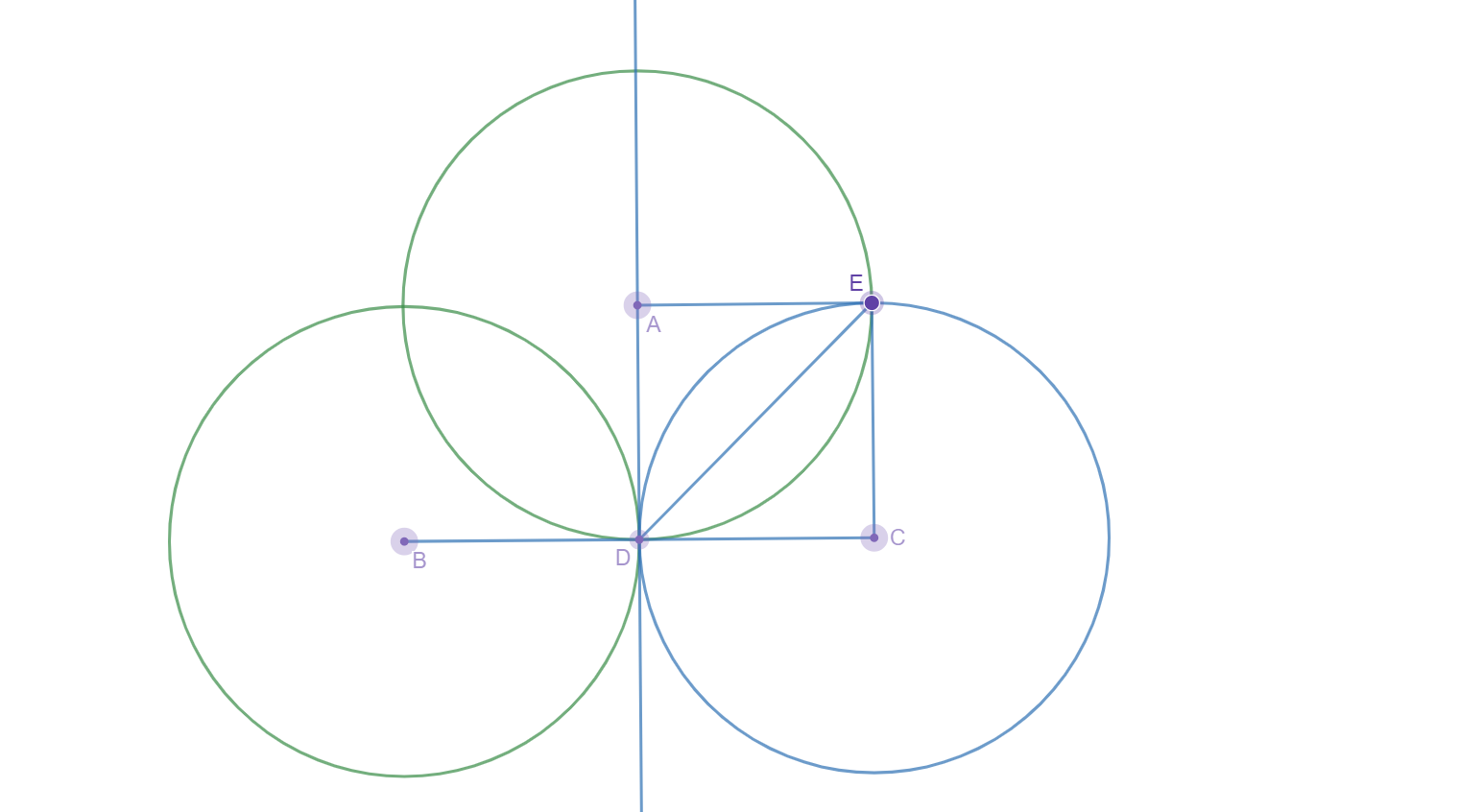
Anyone know how I can do this?
plain wyvern
don't know if this suits you, but a direct solution can be find through integrating
Take the point where the three circles intersect as the origin and pass a vertical straight line through it which passes through the centre of A that will be the y axis
upper karma
Is there a way this can be done without calculus? @plain wyvern
plain wyvern
Ah! I just said that in passing. You don't need integration for this at all, it's pointless
don't mind that
as for the other way, first find the white area b/w the semi-circle and circle, you can make a triangle from the centre of B and then subtract it from area of a quadrant, you get half the white area. I think you can do after that
 vital coral
https://i.imgur.com/aqjxDuw.png Subtract area of triangle ADE from the area of sector ADE. That gives you half the area of the white bit.
 upper karma
OHH Thanks
upper karma
Anyone here
wanna help me with some area?
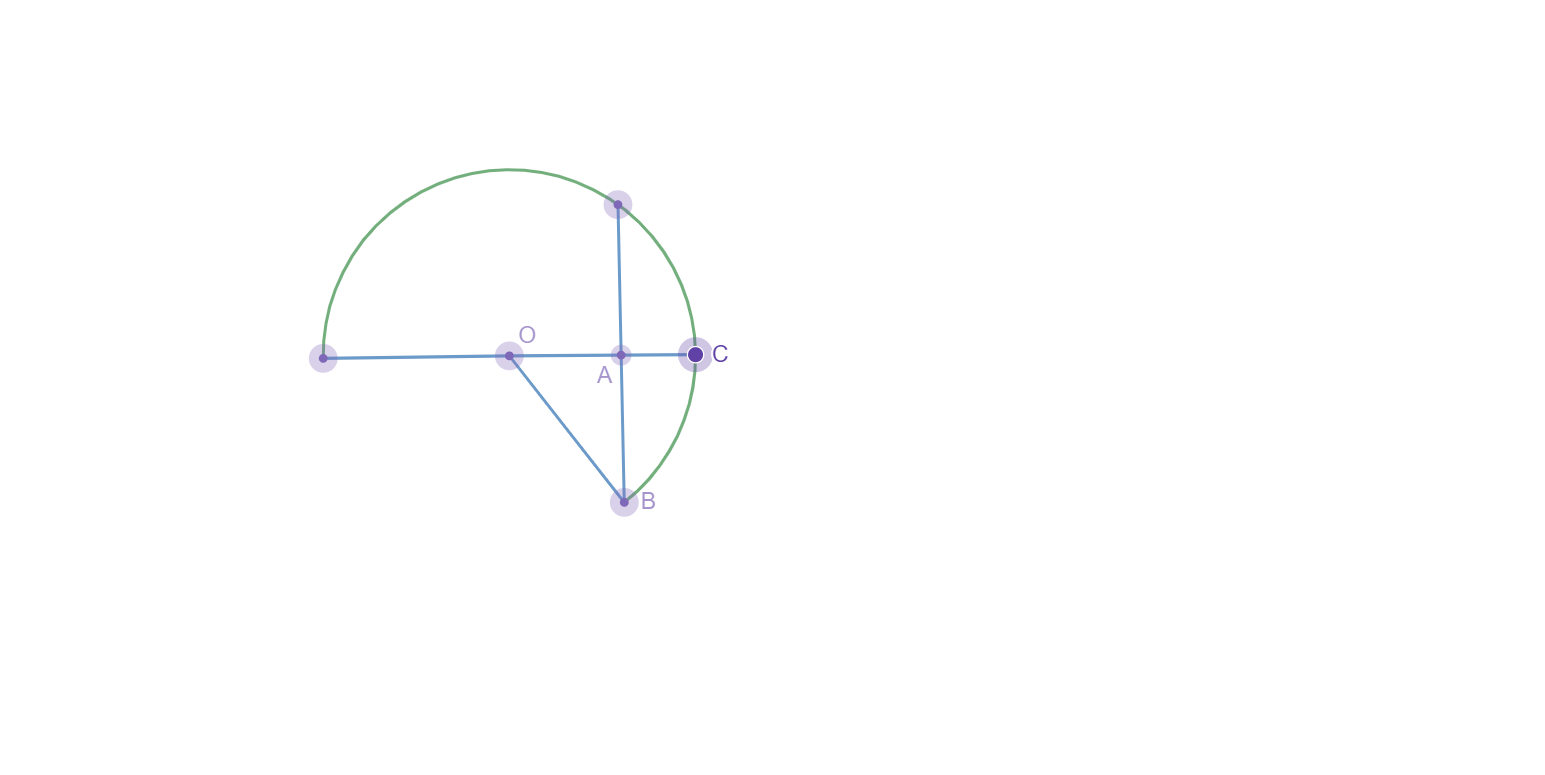
My teacher gave me this
Said solve the area of this
and i have zero i mean zero clue how to do this
vital coral
https://i.imgur.com/vhTke4M.png AC is given to be 9. And OC is the radius and so is OB. You can use trigonometry in triangle BOA to find the angle BOC and then the area of the sector OBC. Of course all this is assuming the arc CB of the extra bit is part of the same circle as the figure seems to suggest.


 upper karma
Okay thanks il try
upper karma
I Don't Understand triangle congruence At All Can Someone Help Please
dark sparrow
is there a problem rn that you're stuck on?
upper karma
Yes
dark sparrow
ok, can i see?
upper karma
All I Don't Understand This
dark sparrow
ok so
upper karma
YEs
 stuck dragon
they share that side
upper karma
On D
dark sparrow
fallen i would appreciate not being interrupted
dark sparrow
okay so @upper karma before we start these problems, do you know what it means for two triangles to be congruent in general?
upper karma
I Think It Means For Them To Be The Same
dark sparrow
is there any reason why you're Capitalizing Every Single Word by the way
upper karma
No Just A Habit
dark sparrow
there are a few rules for triangles specifically which let you conclude the congruence of two triangles from the fact that certain combinations of their elements match up
(i say "element" here to mean a side length or an angle measure)
the abbreviations are a concise description of the matching elements:
for example, if you have two triangles with three pairs of matching side lengths between them, you know they're congruent.
SSS means Side-Side-Side, which denotes the "three sides matching" i just talked about.
SAS means Side-Angle-Side, or in other words two sides and an angle between them
ASA means Angle-Side-Angle, two angles and a side between them
AAS means Angle-Angle-Side, or two angles and a side not between them
does that all make sense to you?
upper karma
Kinda
dark sparrow
ok which part does not make sense
upper karma
dark sparrow
there are two ways a pair of elements in two triangles can be matched: they can be marked as equal (with hatch marks, like sides ZW and ZS in exercise a) or they can be the same element actually common to both triangles (such as side BD in exercise c)
for example, in exercise a, looking at the diagram you see this: ZW = ZS (marked), DW = DS (marked), ZD = ZD (shared)
three matching sides
therefore the triangles can be proven congruent by SSS
upper karma
Wait Isn't ZD An Angle?
upper karma
Wait How Are They Specified Then?
OHHHHHH
THE LINES HAVE ALMOST NOTHING TO DO WITH ANGLES
dark sparrow
three points usually
or one point, if the point in question only has one obviously-drawn angle originating at it
stuck dragon
yeah thats correct
stuck dragon
yeah thats correct
upper karma
Ok So Can We Move On To B @dark sparrow
dark sparrow
sure
upper karma
ty
dark sparrow
in part b we have one pair of marked matching sides and one shared side
nothing else, really, no matter how the diagram may appear
two elements isn't enough to conclude congruence
so we can't prove these triangles congruent just from the info it gives us
stuck dragon
yeah thats correct
dark sparrow
yeah i guess it's impossible for two elements to be shared
keep in mind though that just because there's more than one mark doesn't automatically mean you have congruence
dark sparrow
no, the shared side is not between the matching angles
upper karma
Explain If You Could?
upper karma
So To Be ASA There Can't Be A Shared Side
upper karma
Sorry
dark sparrow
you should go re-read and understand what i have said about these congruence rules
upper karma
Alright
dark sparrow
this person left the server just now ^
upper karma
 umbral snow

dark sparrow
honestly better for me cause their nick is a pain
tspdsld what is this even supposed to mean
upper karma
true how do you even ping them
upper karma
noob
upper karma
The Answer Is Not Congruient Right
What does the question ask for?
Cna you post the entire problem
Because B is clear but A is not
Ignore What I Put In It's What I Think The Answers Are
For A You Have To Put If It's SSS ASA AAS Etc
silent plank
consider some basic geo properties
silent plank
10 and 12 are wrong
upper karma
I See What I Did Wrong For 10 What's Wrong With 12
silent plank
consider some basic geo properties
you can deduce some additional info from the diagram
silent plank
yes
upper karma
And Then It's The Same Thing For 10
silent plank
yes
upper karma
Thank You SO Much
 mellow sand
I was given the information in green and had to find the yellow arc RT. I said it was 40 degrees because of Thales's theorem but that was wrong. I did 180-90-50 which gave me 40.
angle RTS is 90 given Thales's theorem
silent plank
arcRT would have the same measure as the central angle it subtends
(NOT the angle at the circumference which you found to be 40°)
mellow sand
got you
but how would you find the central angle given the information
all you know is the 50 degrees
silent plank
angle chasing
Thales theorem in combo with inscribed angle
after getting <RST, getting <ROT is just 1 step away
mellow sand
I think i can do it but differently then how you said
<R0T = 80 because <0RT and <RT0 = 50
silent plank
there can be multiple routes to reach the solution
mellow sand
so arc RT = 80
silent plank
yes that will work too
mellow sand
but continue how you would do it because im not following that
silent plank
look up inscribed angle theorem
mellow sand
<ABC = 1/2 arc AC
silent plank
(where B is at the circumference)
hence arcAC is 2<ABC,
or in your case:
arcRT = 2 <RST = 2*40°
silent plank
I mentioned this route because you had already found the angle at the circumference
and was to address you were stating the wrong measure
but yeh, isosceles triangle is quite efficient
mellow sand
I got it now, thank you
upper karma
anyone know how to do this?
silent plank
yes
upper karma
can you tell me how please?
silent plank
did you try anything yet?
upper karma
not really i got c = -14? we never really did this stuff
silent plank
how are you getting c= -14,
also what is your c supposed to represent?
silent plank
there's a difference between c and C,
also your setup is nonsensical
it's seems like you're trying to equate <C to 0 for some reason
you should be applying the angle sum of a triangle
and solve for x
upper karma
so how do i do that?
silent plank
what's the sum of the angles in a triangle?
upper karma
180
silent plank
° and what are the sizes of your 3 sngles
upper karma
so to get X i would combine the X's combine the whole numbers and take away the whole number from 180 and divide by the X's right?
idk the sides of the 3 angles
upper karma
m<A= 9x-7
silent plank
you are given the measures and sizes of all 3 angles in terms of x
their sum is 180°
silent plank
yes
upper karma
so how do i find sides from angles?
silent plank
you do t have to explicitly find the sides
don't
longer sides will be opposite larger angles
eg if A is the largest angle in the triangle, side a or BC will be the longest side
upper karma
can someone help me i have the problem 3 +- sqaure root of 115 all divided by 2 how do i get my roots for a graph from that
silent plank
what's $\frac{3\pm\sqrt{115}}{2}$ supposed to be?
somber coyoteBOT
ramonov:
silent plank
do you have the exact wording of the problem?
upper karma
well here ill show you the whole problem i solved it down to there give me a sec
can you help me with this when your done helping synx please?
Solve each equation by using the quadratic formula. the problem is t^2-3t-28=0 and i used the formula -b-4ac to get there
upper karma
my teacher said to use b^2-4ac sorry wrote it wrong
silent plank
still not a formula
silent plank
that actually resembles a formula (ignoring the horrid typesetting)
in your case:
$\red{ t = } \frac{ 3 \pm \sqrt{9+4\cdot 28}}{2}$
somber coyoteBOT
ramonov:
silent plank
the thing under the square root isn't 115 either
upper karma
yup just relized i did it wrong but the 9 is -9
silent plank
but that expression you reached as the t indicates represent the roots for that equation
upper karma
ok so i just neeed so simplify it correct?
silent plank
yes
somber coyoteBOT
Synx.is.a.qt:
upper karma
so thats what i get
silent plank
how are you getting 106
upper karma
oh wait hold on that was the wrong one
silent plank
it should be odd
upper karma
hold on give me one sec
$\frac{3\pm\sqrt{121}}{2}$
thats what is should be if im not wrong
silent plank
**t = **
yes
somber coyoteBOT
Synx.is.a.qt:
silent plank
yes
somber coyoteBOT
Synx.is.a.qt:
upper karma
so in the answer key my teacher gets t=7 and t=-4 how does she simplify from there to get those
btw thank you so much for helping me
silent plank
$t = \frac{3 \pm 11}{2}$ indicates: \
$t = \frac{3 + 11}{2}$ or $t = \frac{3 - 11}{2}$
somber coyoteBOT
ramonov:
silent plank
justify / give reasoning for each statement on the left
 dense crypt
Oof that shouldve been an obvious observation. Thank you
upper karma
Can someone tel me my error
The answers is 121 with 2 real roots and the 2 points are -3/2 and 1/3
..
In quadratic equations, you assign the letter A to the variable with the highest power
And typically equations are written with the highest power in front and then the second-highest and so on
Ya but a is correct the highest value is 3
The highest power
Oh
Which in this case would be m^2
So that would be -6^2
And then how about B and C then
?
I do not know
Ok
If you’re asking for how to obtain $\frac{3\pm 11{2}$
somber coyoteBOT
Second Mikey:
Compile Error! Click the  reaction for details. (You may edit your message)