#geometry-and-trigonometry
1 messages · Page 321 of 1
 obsidian thicket
 upper karma
<@&268886789983436800> ^^ asking for help on a quiz
obsidian thicket
Idk if Asia is your name but it's cute
upper karma
awww and yes it's my preferred name 
 upper karma
well it is because people here don't help on quizzes/tests
 humble pulsar
^
 spiral hawk
Well, Now that your test is probably over, the length of YZ is 12 cm, as angles X and Z are the same 77 decrees
Then, u would take 77+77=154, then take 180-154 = 26 degrees for angle Y
 oak stag
^
All triangles equal 180 degrees. So Y is 26
Ughh I did this last year and my brain is stuck
I’ll look in a textbook later, but currently it’s 6am😂
 inland condor
could anyone help with this
 grizzled lantern
If they are congruent dont their angles equal? Set the equations equal to each other and solve for x @inland condor
inland condor
ty was able to get it.
 main meadow
upper karma
main meadow
upper karma
is that b x pi or is it something else
obsidian thicket
grizzled lantern
@obsidian thicket angles for rt and st are equal so set the equations equal
 remote mortar
i*
remote mortar
one sec
 magic wasp
alright
remote mortar
for this do u do y-(-9) = -1/3(x-(-1))?
and then for the perpendicular do u just replace -1/3 with 3
remote mortar
okay
grizzled lantern
Parallel means the slopes are the same, perpendicular means the slopes are flipped
magic wasp
yes
remote mortar
oh
magic wasp
lol
remote mortar
yeah but like
grizzled lantern
For instance, a perpendicular slope of -1/3 means -3
remote mortar
how do u find the equation for the line
remote mortar
i thought for -1/3 it was 3
remote mortar
oh
magic wasp
its -3
grizzled lantern
Yeah its positive 3 my apologies
grizzled lantern
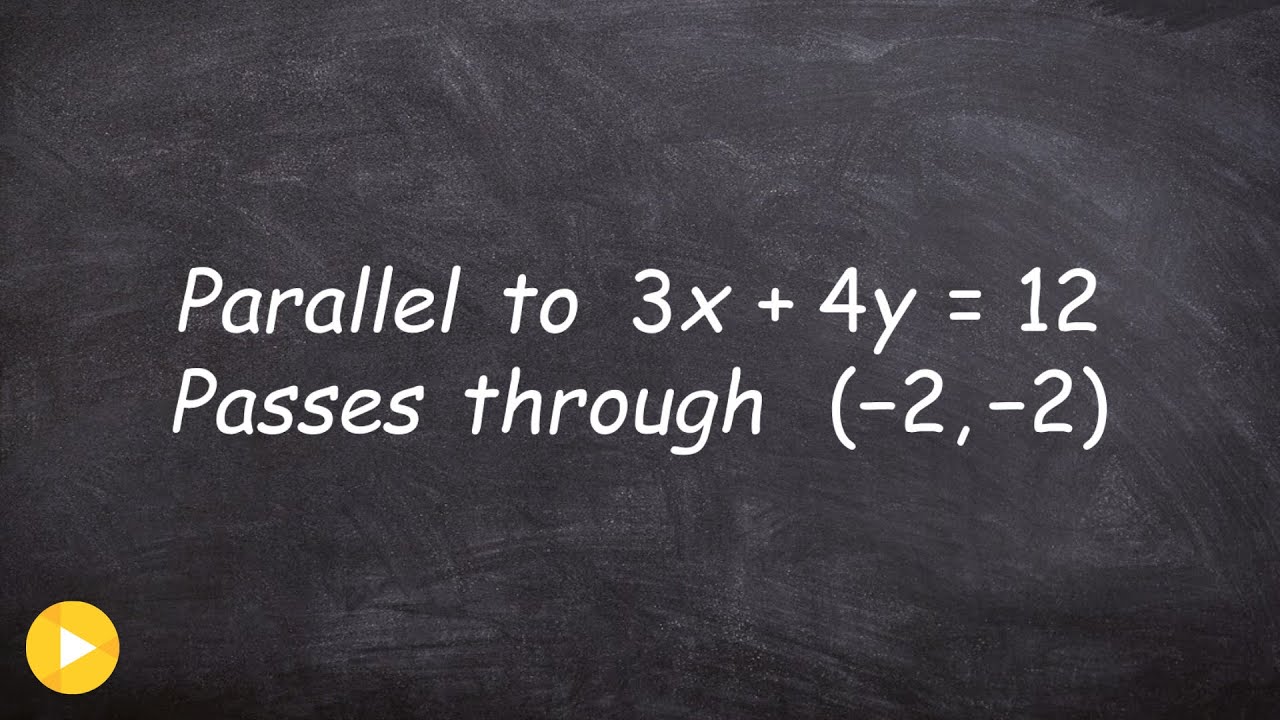
👉 Learn how to write the equation of a line that is parallel to a given line. The equation of a line is such that its highest exponent on its variable(s) is 1. (i.e. there are no exponents in its variable(s)). There are various forms which we can write the equation of a line: ...

👉 Learn how to write the equation of a line that is perpendicular to a given line. The equation of a line is such that its highest exponent on its variable(s) is 1. (i.e. there are no exponents in its variable(s)). There are various forms which we can write the equation of a l...
remote mortar
thank u!
grizzled lantern
Yep, youtube is clutch
obsidian thicket
Ichiro what do you mean
grizzled lantern
@obsidian thicket wassup?
grizzled lantern
Oh you have two sides which are equal which means two angles are equal
obsidian thicket
But how do I do the problem
grizzled lantern
@obsidian thicket do this, 9x+2=13x-8
you solve and get x=5, plug that bag into both equations and they should both equal 47 degrees,
so you have 2 angles that equal 47 degrees... 47*2 = 94
plug 5 into your 17x+1 and get 86
86+47+47= 180
yayyy
obsidian thicket
Damm you mad smart thank you
grizzled lantern
Not smart, just in high school
obsidian thicket
Damn I'm in highschool as well but I struggle with gwo
The only reason I struggle is bc I'm not doing it in person
grizzled lantern
@obsidian thicket I feel you dude, im a senior this year and doing ap bc calculus which is two ap classes in one
@obtuse hornet I think for 10) <A=<B=<D=<E
because their sides are congruent
For 11) you have alternate interior and alternate exterior angles
 obtuse hornet
Ahh i shouldve been able to do 10 lol
Where does alternate exterior angles come in?
obtuse hornet
Is that a pair of parallel lines cut by a transversal tho
Cause theres no exterior angles, no?
grizzled lantern
yeah might just be interior angles then
obtuse hornet
Anyone able to guide me thru how to do the proof on number 12 up there ^
 silent plank
where are you stuck?
 indigo chasm
obtuse hornet
indigo chasm
obtuse hornet
@silent plank Just dont know how to prove it lol
 tulip grail
The equation for line a is given by y=-3/4x-2 support line a is parallel to line B and line T is perpendicular to line A. Point (0,5) lies on both line B and T
Part A Write an equation for line B.
Part B Write an equation for line T.
Im a little lost
silent plank
@obtuse hornet do you know what's needed for congruency proofs? AAS, SAS, RHS?
obtuse hornet

anyone ;-;
Is it ASA? <P and <T are congruent, <R is congruent and sides Q and S are congruent?
 proud arch
For anyone that is available I have a question my little sister gave me for geometry and i cant find the right angle to it...sorry for the pun,
anyway, they are given a right triangle with two missing angles and are given the three edges, the question requires you to solve the missing angles without using sin, cos, or tan, is this possible?
silent plank
depends
proud arch
what will it depend on, i have the edges as a = 12, b=9 and c(hyp)=15
silent plank
depends if you have a special triangle where you technically don't need to involve trig
proud arch
Thats what im thinking..
 upper merlin
its not like a handy 30 60 90 or 45 45 90 triangle
im also pretty sure the angles are irrational
proud arch
nope with trig, the angles dont come out to those special
upper merlin
idk im guessing they are
proud arch
lol i mean i used trig and it didnt come out to beginner friendly numbers
upper merlin
using arcsin you get the ugly number of 0.204832765pi for one of the angles
yeah
if you cant use sin cos or tan use sec csc cot 😳
proud arch
well...i mean none of the trig functions
I think my sister just missed a lecture and maybe they went over the functions without her realizing but also there could be some geometry i just dont know..
obtuse hornet
Are rhombus diagonals always congruent
 heavy haven
 summer spire
there's more to an intersection of planes than just one point
 untold flame
uhhhh
I don’t really know but I would recommend using IXL because they have similar questions like that
 silk patio
It’s easier to do a parallel through V
silk patio
Or a perpendicular to the left of U and W and use angles in a pentagon
upper karma
||180 - 138 = 42||
||angle UVW (marked in blue) is a vertical angle to the sum of the angles on the right||
(the red line is parallel to the line segments at the top and bottom, btw)
silk patio
I didn’t mean like that
I meant using corresponding and alternate angles
The blue angle is split directly
 next jackal
does $\sin^2(-x)= -\sin^2(x)$?
 somber coyoteBOT
lazypawtato:
 dark sparrow
no
 earnest echo
Think about it\\
$\sin²(-x)=(\sin(-x))²$
somber coyoteBOT
The Godfather:
next jackal
okay it just means sin^2 (x) then
upper karma
yes
dark sparrow
that 2 is sus
somber coyoteBOT
lazypawtato:
dark sparrow
yes
 livid moss
Too big for what?
next jackal
to derive, for now. Feels like busy work
upper karma
tbh sin(2x) is already too much work for me
upper karma
okay... I understood how to derive them though, may I skip it?
we are not your teachers
if you understand the mechanism that's good enough
next jackal
Okay thanks
 lyric light
i need help
dark sparrow
what is this
lyric light
geometry
dark sparrow
no, what is this file
dark sparrow
i've never seen a .HEIC file before
 supple onyx
HEIC files are image files
lyric light
does anybody know how to do it
supple onyx
though ive never seen anyone use them
can you put up the screenshot again i didnt have time to look
lyric light
ok
dark sparrow
what program even uses that file extension
lyric light
supple onyx
I dont know but apparently it's supposed to be more efficient at compression than jpeg
supple onyx
i mean the screenshot you sent earlier
dont wanna go around opening it in windows, much easier to do on mac i believe
dark sparrow
i don't trust this image format, can i have a .jpg or a .png please
lyric light
supple onyx
what are you meant to find?
lyric light
x
lyric light
lol you think i know
lyric light
ye
silent plank
apply angle sum on a line
lyric light
so do i make =180
silent plank
make what =180
silent plank
yes
lyric light
thanks
supple onyx
oh the labels are for angles right
silent plank
do i dare apply malicious compliance here
since there's no ° those values are clearly in radians
silent plank
100?
lyric light
180
silent plank
properties of a straight line
 upper onyx
can somebody help me with 26 27 and 28?
 "ĐS" are the answers btw, i want to know how to solve the equations
supple onyx
so first for the sin part. $\sin^2(\frac{x}{2} - \frac{\pi}{4}) = \sin^2(\frac{1}{2} \cdot (x-\frac{\pi}{2})) = \frac{1-\cos(x-\frac{\pi}{2})}{2} = \frac{1-\sin(x)}{2}$
somber coyoteBOT
Little Narwhal:
supple onyx
$\cos^2(\frac{x}{2}) = \frac{1+\cos(x)}{2}$
somber coyoteBOT
Little Narwhal:
supple onyx
so we have $\frac{\sin^2(x) - \sin^3(x)-\cos^2(x)-\cos^3(x)}{2\cos^2(x)} =0$
somber coyoteBOT
Little Narwhal:
supple onyx
$\cos^3(x) + \sin^3(x) + \cos^2(x) - sin^2(x) = 0$ iff $\cos^2(x)\cdot (\cos(x) + 1) + \sin^2(x) \cdot (\cos(x) + 1) - 2\sin^2(x) =0$ iff $\cos(x) + 1 - 2(1-\cos^2(x)) = 0$ iff $2\cos^2(x) + \cos(x) -1 =0$
somber coyoteBOT
Little Narwhal:
supple onyx
$2\cos^2(x) + 2\cos(x) - \cos(x) - 1=0$ iff $2\cos(x) \cdot (\cos(x) + 1) -1 \cdot (\cos(x) + 1) =0$ iff $(2\cos(x) - 1)(\cos(x) + 1) = 0$ iff $\cos(x) = \frac{1}{2}$ or $\cos(x) = -1$
and so i must have made a mistake somewhere since that gets you the wrong answer damn it
upper onyx

somber coyoteBOT
Little Narwhal:
supple onyx
it's probably just a minor mistake somewhere that you should be able to fix though
i have to go
hopefully you can find the mistake
upper onyx
oki
 main totem
Guys quick question. How can i say that if a point in a rectangle divides the side into a 1:3 ratio then on the other side it will also be 4 units
dark sparrow
depends on what you mean by unit
and what do you mean by "how can i say"
didn't you just say it?
 terse scaffold
pandaThink
 eager hatch
I have no clue where to start
 exotic fjord
uhm
eager hatch
I have no clue what that is so probably not
earnest echo
Fuck vectors
eager hatch
Alright
upper karma
If you can call and help me with geometry dm me
upper karma
😳
 kindred rapids
I've got these two...but neither me nor my friends know how to do the questions...
Okay
Thank you
upper karma
first is a quadratic in the variable cos(theta)
kindred rapids
Yes but it couldn't factories...
Factorize*
It's a quadratic yes...but then what do I do..with the quadratic?
I pulled out the common factor of that and I got (cos Ø) (3cosØ + 4)
But then when I try to find theta with the alpha thing, I'm getting error in the calculatator
So I'm not sure what to do...
And the second question...I got a quadratic but it cannot factorize...
kindred rapids
sin^2 Ø + sinØ - 3 = 0
I replaced cos^2 Ø with 1 - sin^2Ø
Then worked it out and ended up with that quadratic ☝️
dark sparrow
please don't use Ø for theta
kindred rapids
Sorry
dark sparrow
anyway ok
so substituting x = sin(theta) we have x^2 + x - 3 = 0
no we don't
we have sin^2(θ) + 2sin(θ) - 3 = 0.
kindred rapids
I dont see how we have 2sin(theta)
dark sparrow
2cos^2(θ) = 2(1-sin^2(θ))
wait shit fuck
put the two in the wrong place
it'll be on the squared sine not the plain sine
kindred rapids
but we will get 2 - sin^2(theta)
 cinder nacelle
The sum of angle and 4 times it’s complement is 20 degrees greater than the supplement of the angle ?
Please help
 glacial dawn
Solve
cinder nacelle
X+4(90-x)=20+180-x
x+360-4x=200-x
-3x=-160-x
-2x=160
X=80?
cinder nacelle
No problem
glacial dawn
Np
 random flume
@cinder nacelle
cinder nacelle
Normal font
 pearl lava
Is number 1 and 3 no
supple onyx
Consider the first triangle in 1. Then make the angle between the two sides with dashes in them bigger. Youll get a triangle with two sides the same but obviously not congruent triangles
As for 3, are the angles indicated equal?
 zenith dew
 limpid gust
can someone help me with this proof
 fallow tusk
hey guys
so when doing cast diagram
the formula for positive value is thetha, 180- thetha, 180+theta , 360 - thetha
what about negative value
what is the formula for cast diagram
i know that it is a bit different
kindred rapids
@dark sparrow Hello...you were helping me, please can you continue to help me?
I got through....yes it will be 2 sin^2(theta)
Then we will put those two brackets = 0 and then find for theta in both
But when I put into the calculator...I'm getting error for one of the equation =0
What do I do..?
upper karma
What is the problem?
kindred rapids
Go further up....in the chat
We talked a while ago
The question and everything is there...
upper karma
So uh
$2\cos²(\theta)+1-\sin(\theta)=0$?
And you tried to substitute (1-sin²(theta)) by cos²(theta)
Wait for the bot
kindred rapids
The bot..?
upper karma
Texit is a bot that renders code into mathematical language
kindred rapids
Oh okay
upper karma
Yeah but you should've substituted before hand right?
upper karma
And after that you get a quadratic which you can factor
kindred rapids
Yes
upper karma
Can i see what your quadratic looked like before failing to factor?
kindred rapids
No I factorised it fine...Ann corrected me and factorised it properly this time...
I*
(2sin(theta) + 3 = 0 ) (sin(theta)) - 1 = 0 )
Those are my two brackets when I factorised...
Quadratic = 2sin^2(theta) + sin(theta) - 3 = 0
upper karma
Yeah so
kindred rapids
But now...I have to find the values for theta in both brackets
First bracket = Second bracket =
sin(theta) = (-3/2) and sin(theta) = 1
Oh
So what's my next step?
upper karma
That's why i ask for how your quadratic looked like before factoring
kindred rapids
Okay
upper karma
Yeah okay it was a misunderstanding
So everything is fine BUT you have to notice that the domain of arcsin is (-1,1)
So sin(theta)=-3/2 won't give real solutions to our problem
kindred rapids
....so what do I do with that sin (theta) = -3/2..?
upper karma
That equation does not give us any real solution
So we are only interested in solving sin(theta)=1
Which should be very remarkable
As it is known which angle gives 1
Do you recognise it?
kindred rapids
90°
upper karma
Yeah π/2 in radians
kindred rapids
Yes
upper karma
Is it asking for all the solutions or just on the interval between 0 and 2π
kindred rapids
...my teacher styled the question herself.....we are instructed to just get the values of theta
We just have to get the answers in degrees....not radians yet
upper karma
Can you copy the exact statement of the problem without skipping any words
Okay yeah so theta=90°, it does not matter
kindred rapids
Okay ...so the first question I sent...could that be worked out..?
kindred rapids
Yes
It was part b ...I worked it out but it just like this question we just did...
Only one set of brackets worked out and the other didnt...which means, just as you said that it didnt give a real solution...
upper karma
The only way i can see if you are correct or not, is if you show me your workout
Or your final answer
kindred rapids
Okay
I'm sorry but it's on scrap paper so...it might be a bit messy
Sorry those scratches at the underneath is theta
This is the way my teacher taught me btw
I'm sure I went right...doing this....everyone else got this.
And I guess it's similar to the previous one....where one doesnt give a real solution...
upper karma
Yeah arccos(-4/3) isn't defined over the reals
So yeah that's correct
(assuming you want the solutions under such intervals)
kindred rapids
Alright thank you...so much for your help...
upper karma
Yw!
cinder nacelle
The bisectors of adjacent angles are opposite rays
Always true
Sometimes true
Never true ???
 wide venture
cinder nacelle
wide venture
cinder nacelle
The bisectors of adjacent angles are opposite rays
Always true
Sometimes true
Never true ???
 polar locust
hey guys
can you help me with this question?
Explain how the graph of y = sinx, over [0 º, 360 º) shows that every sine ratio in the interval has two angles that share the same ratio.
upper merlin
draw horizontal line through graph, it always intersects graph twice
 hidden crescent
Yes
upper merlin
this means that for the constant y represented by the horizontal line, there is always 2 x values that satisfy y=sinx
hidden crescent
this is why there is ambiguous cases for triangle with SSA
hidden crescent
yee
 tired knoll
can somone help me with this problem
The ray of light, emitting from point M, reflects the line AB at point C∈ segment AB, and then goes through point N so that m∠ACM=m∠BCN. Prove that the bisector of the ∠MCN is perpendicular to line AB.
<@&286206848099549185>
tired knoll
um I can try if you would like
@obsidian thicket so what are you confused about
oh wait btw we dont help people with quizs cus thats cheatin 
obsidian thicket
Its not a quiz
That's what my teacher puts everytime but we get unlimited chances etc I can show you
tired knoll
ah no Ill just trust you
so what are you confused about @obsidian thicket
well I have to go to, if your still confused I recommend drawing it out (and dont forget you can use algebra when trying to solve a geo problem)
obsidian thicket
Idk how to draw it out I do school online and its muy difícil para mi
Very hard for me to do
tired knoll
well it says triangle DEF so you should draw a triangle and lable its vierticies D E and F
if a problem has two letters together it means a line segment for instence segment/side DE
 fresh pike
i dont quite understand how to figure out which optiont he information is trying to prove
livid moss
8 and 4 are alternate angles between AD and BC with AC as a transversal
So if they are equal, then the lines are parallel
fresh pike
so which option would i choose to show that?
silent plank
its not really about showing
its applying the theorem(s) concerning alternate angles on parallel lines
 muted spoke
find the signs of a,b,c like - or + and -b/2a ,,, -D/4a are coordinates of the topmost point
anyone
silent plank
consider sum and product of roots and concavity
muted spoke
i didnt understand
 pale dew
next jackal
pale dew
next jackal
@pale dew I might be wrong here but can you see 13π/24 as 12π/24 +π/24?
limpid gust
"write the reason for each conclusion", does that mean the property of equality?
humble pulsar
@limpid gust what do you mean?
humble pulsar
Yes
humble pulsar
Maybe? I'd personally say it's the same as whatever you put for 10
limpid gust
yeah i was thinking that to
humble pulsar
oh shit yeah
dark sparrow
12 should be multiplication property of equality or something similar, 11 i'm not 100% sure on the exact wording but i can tell you with certainty that transitive property ain't it
limpid gust
how is 11 not transitive
dark sparrow
transitivity has precisely nothing to do with addition
it simply is not what the statement is talking about
limpid gust
Oh 12 is multiplication
dark sparrow
maybe additive property of lengths?? i don't know what name your teacher expects you to use.
limpid gust
probably addition property
humble pulsar
probably, we dont know what your teacher uses terminology wise
limpid gust
Then what about 13
limpid gust
is this the same thing?, are the conclusions properties again or something else
like would 15 be midpoint formula
humble pulsar
no clue cause you can make multiple conclusions
next jackal
how did we get those highlighted terms?
 dusky surge
I guess it's from the "intuition" of v²-u² =(v+u)(v-u) =2xy
dusky surge
😁
 limpid gust

dusky surge
Like $$v^2-u^2 = 2xy$$
$$(v+u)(v-u) = \sqrt2 \sqrt2 xy$$
$$\frac{1}{\sqrt2}(u+v) \cdot \frac{1}{\sqrt2}(-u+v) = x \cdot y$$
somber coyoteBOT
Biscuit:
next jackal
Oh okay got it
thanks a lot
wait how did the book factor between x and y?
@junior light
 junior light
Which portion is not clear?
next jackal
wait how did the book factor between x and y?
this one
can you once check the screenshot?
junior light
 I'm looking at it but seem to be missing the context.
next jackal
okay, do you have the copy?
junior light
Anyway, I think you should check the angles and draw a picture.
I think I have, let me see.
Oof I have so many legitimate books it'll take time browsing through them. 
Nvm I'll get it.
next jackal
Oh okay
junior light
Alright, so it's the minus sign in front of u that is bugging you?
Basically, the second part(the one you highlighted) is about proving that the curve v^2-u^2=2, when rotated by -pi/4 counterclockwise, i.e., pi/4 clockwise gives you xy=1.
next jackal
not just that, how did x and y get factored like whatever it is in the screenshot?
junior light
Mmmm check the rotation matrix?
next jackal
okayy
junior light
I don't exactly understand why Lang is trying to prove the converse, the first part was sufficient to justify the curve P' is obtained by rotating the curve P by pi/4.
next jackal
Me neither 😕
dark sparrow
what are we proving exactly
junior light
Yes.
next jackal
yes
dark sparrow
okay,
do we also know that the image of (u,v) under G^-1 is ((u+v)/sqrt(2), (u-v)/sqrt(2))
silk patio
What’s the topic exactly?
next jackal
rotation of hyperbolas
 pseudo quiver
o
junior light
just had to rotate it back again
@next jackalYes, that was the idea, but I'm still not convinced why it is needed.
silk patio
Here’s a cool thing, the discriminant is invariant under rotation
next jackal
Yes, that was the idea, but I'm still not convinced why it is needed.
me neither
silk patio
You rotate xy and get x^2-y^2, they both have discriminant -1
In fact any special linear transformation will preserve the discriminant
dark sparrow
you are proving a two way set inclusion
G(H) = H'
you need to prove G(H) subset H' and then H' subset G(H)
the latter can be more easily proved as G^-1(H') subset H
junior light
Owww, set inclusion makes sense.
I was just perceiving it as rotation of a curve and couldn't see why the curve should be anything else.
silk patio
You can apply G like 3 times instead of doing the inverse
dark sparrow
7
silk patio
Rotational symmetry
dark sparrow
yeah but in general G^-1 is G^7 not G^3 lol
silk patio
Yeah but as a set it’s embedded when you apply it 3 times
junior light
 How is it 7 in general?
silk patio
G^8 = a full turn
So it does nothing
G^4 is a half turn which also leaves the set invariant
junior light
Only if G is rotation by pi/4, right?
silk patio
Yeah
junior light
Okay 
 arctic cobalt
grizzled lantern
arctic cobalt
grizzled lantern
E is a 90 degree angle
arctic cobalt
Can someone help me with this the topic is rhombuses and finding the angles and sides. This worksheet asked me to find the measure of angle BCD and the measure of DE
arctic cobalt
Why is it 180 for Angle BCD I thought the angle was equal to 90
grizzled lantern
Ok so think of that rhombus as 4 triangles
look at triangle AEB
AEB is the same as the rest of the other 3 triangles that make up the rhombus
so AEB's angles equal all the others
arctic cobalt
So angle BED is 37 90-37 is equal to BCD right
grizzled lantern
BED is a line
I think your angle is supposed to be in the middle
lemme send you a photo
arctic cobalt
Sorry Angle BEA is congruent to BEC
arctic cobalt
I think I get solving angles but how do I find side DE
arctic cobalt
How did you get 9
arctic cobalt
Oh ok that makes a lot of sense thank you
grizzled lantern
yep
 odd blade
I need some help with a word problom
Michele phone bill for 30 days was 350 dollers how much should her bill be for 16 days
I did 350/30 x/16
Is it right ?
 orchid hearth
Hi! I would really appreciate some help this 'prove that' question involving the addition formula
grizzled lantern
@odd blade probably more like 350/30 =16X
odd blade
And how whould I go to solve it ?
Because when I add the fraction I can cross multiply then divide then round
grizzled lantern
you could find what 350/30 is and then divide by 16 if your teacher lets oyu
you
do you need it in fraction form?
odd blade
Nope just need to round it
grizzled lantern
ok
odd blade
I just have trouble setting up word problems the solving is easy
grizzled lantern
so 350/30= 11.67
odd blade
So her phone bill for the 16th day will be 11.67 dollers ?
grizzled lantern
hold up
odd blade
When I did my method I got 186.666
Since it’s money I need round that but my rounding is terrible
grizzled lantern
im so sorry
your method works
yeah so keep your method and cross multiply
you should get 30x=5600
upper karma

 urban knoll
Anyone active?
urban knoll
Can someone help me w these?
 chilly moss
90-64=?
chilly moss
Np haha
urban knoll
Got that in like 2 seconds
upper karma
Test?
chilly moss
Nope homework
urban knoll
Nah just homework
chilly moss
Same
upper karma
Micheal try to look up definition of sine and cosine
urban knoll
I have 14 more questions and I don’t know how to do them
upper karma
AD = AB + BD
chilly moss
Ah
urban knoll
How would I find x would I just do some sort of 2 step equation?
grizzled lantern
112=4x
 hollow raven
opposite angles are equivalent
grizzled lantern
urban knoll
112 isn’t a choice tho
upper karma
?
hollow raven
You would need to isolate for x
urban knoll
So I would need to do a 2 step equation?
hollow raven
If that's what you need to do then yes
grizzled lantern
lol
upper karma
dude just 4x=112 and x=112/4
its not magic
limpid gust
Can someone help me what I have circled is what I have done so far, its a 2 column proof
upper karma
How would I find x would I just do some sort of 2 step equation?
@urban knoll idk if im right but just do 112/4
since opposite angles are congruent or equal
limpid gust
if AB is between AC and AT to form CAT, will CAB be congruent to BAT. explain
upper karma
could you show a picture if any
limpid gust
I dont think you get this
upper karma
ye i dont
 inland canyon
bruh
can someone help me rq
ill type it out
Billy is building a frame for his fathers garden in the shape of an isosceles trapezoid. The lengths of the parallel sides are 10m and 14m. The preimeter is 40m what are the lengths of the nonparallel sides?
 silent hollow
am i?
upper karma
lol
hollow raven
@inland canyon the nonparallel sides are equal because it is an isosceles trapezoid
P = a+b+c+d, P = 40 m
a = 10 m, b = 14 m, c = d
40 = 10+14+c+d
Substitute side D as side C
40 = 10+14+c+c
40 = 24 + 2c
Just solve for c
 rotund current
 lime hawk
im so lost
 young knot
I have an exam on Tuesday and we have to understand this but I have 0 clue. I tried it once and my diagram was wrong on so many levels and I can’t work out how to draw this or do the questions.
young knot
I only managed the girls part but got it wrong one sec I’ll screenshot
This is all I had but it’s badly wrong
That’s only for the info given on the girls
I think I put the 25 degrees in the wrong spot
young knot
I’m just confused at the right angles because I would’ve thought those spots would be 40 and 130 degrees but I’ll try it thanks
silent plank
one sec i'll give something more detailed.
your diagram should somewhat what's happening in 3D
B,O,G are on the ground,
T is the top of the tower and extends upwards.
young knot
That makes more sense now, thanks a lot
The questions should be easy enough, thanks for your time and help
upper karma
@mystic pebble what have you tried
 mystic pebble
@upper karma This is my working so far
Let me put it into words so you don't have to look sideways
upper karma
,rccw
mystic pebble
wow
somber coyoteBOT
mystic pebble
I tried to multiply both sides by sin^2(theta)
So I got = 2
then I tried using sin^2(theta) = 1-cos^2(theta) on the numerators on the left
So I ended up with (1-cos^2(θ))/(1+cos(θ)) + (1-cos^2(θ))/(1-cos(θ)) = 2
Which I think is true?
But I didn't know where to go from there or if I was even going down the right path
cc@upper karma
upper karma
Alright
When doing proofs as these, we don't want to modify both sides, but instead only work with one side
But the idea is definitely that
Try to only apply common denominator on the LHS
i.e express the LHS as one fraction
mystic pebble
Okay, so it would be come:
(1-cos(θ))/(1+cos(θ))(1-cos(θ)) + (1+cos(θ))/(1-cos(θ))(1+cos(θ))
Which can be turned into
(2)/((1+cos(θ))(1-cos(θ))
And from there
upper karma
$\frac{1-\cos(\theta)}{(1+\cos(\theta))(1-\cos(\theta))}+\frac{1+\cos(\theta)}{(1+\cos(\theta))(1-\cos(\theta))}$
mystic pebble
Why is it 1-cos(theta) as the numerator for both of them?
somber coyoteBOT
Al𝟛dium:
upper karma
Typo
mystic pebble
Oh
upper karma
But yeah
mystic pebble
So can you always do these identify proofs by changing only one side?
I proved the one after this but by re-arranging both sides into another identity
So maybe this is the wrong way of doing it? I'll send a picture
@upper karma
mystic pebble
Would you be able to quickly go through how you would prove 1/sin(x) - sin(x) = cos(x)/tan(x)
upper karma
Yours isn't wrong but just not recommended
mystic pebble
1/sin(x) - sin(x) = (1 - sin^2(x))/sin(x)
upper karma
Yes
upper karma
Yes
somber coyoteBOT
Al𝟛dium:
upper karma
Yw!
tired knoll
hey can someone help me with this problem
The ray of light, emitting from point M, reflects the line AB
at point C∈ AB, and then goes through point N so that m∠ACM=m∠BCN. Prove that the bisector of the ∠MCN is perpendicular to line AB.
upper karma
not drawn to scale
We are given that m∠ACM = m∠BCN and that there is a bisector of ∠MCN.
Since the bisector bisects ∠MCN, ∠MCD ≅ ∠NCD.
Notice that ∠ACD and ∠BCD are a linear pair.
m∠ACD + m∠BCD = 180°
m∠BCN + m∠NCD + m∠BCN + m∠NCD = 180°
m∠BCN + m∠NCD = 90°
I hope I answers your question correctly.
upper karma
hint: AXY and ABC are similar
upper karma
yes
 haughty karma
Alright thank you
 hot rain
@upper karma too much proof. could have been shorter
upper karma
You're right, thanks for telling me.
 olive cove
The area of a triangle is base multiplied by its hight divided by 2
So if the base is twice as small the area should also be twice as small.
haughty karma
Ok thank you @olive cove
upper karma
Im confused when it comes to proving congruency in triangles. What order would you look at the letters, for example if there was HJK or something
which one would i count first
the angle or the side?
Depends on the location of the third side or angle.
which order would i look at them in?
We are trying to prove the triangles are congruent, right?
yeah
Look at BF. What can you say about the line?
both triangles share line BF
Correct, meaning we should have two congruent sides and one congruent angle.
so whenever you see a line like that there's always gonna 2 congruent sides and 1 congruent angle?
oh wait no
Since the two triangles are sharing the same side, that shared side is congruent to itself.
but then how would i order then
i cant do ASS
SSA?
I think so.
Is SSA a valid option?
wait no
so that leaves sas
im confused
Sorry, I didn't type fast enough.
SSA is not a valid condition for them to be congruent.
yeah so i thought that SAS was the only option
but i think thats where the order comes in
and im just confused on how to order them
Well, I like to look at it in counter-clockwise or clockwise, depending on the triangle.
Let's look at the bottom triangle going clockwise starting with an unmarked side.
Does it help to identify if it is SAS or SSA?
tilting my head clockwise it makes it look like a regular triangle but i still cant figure it out
Oh, sorry, Ima clarify.
Just look at the unmarked triangle side BC.

Only take note of congruent parts.
Going clockwise, we see BF, FC, then angle C.
Thus, SSA.
ohh
i can see that
but then why did the question say the answer was "These triangles cannot be proven congruent."
Lemme list of the conditions for two triangles to be congruent.
SSS
SAS
ASA
AAS
HL
It specifically has to satisfy one of these five.
oh ok
However, we got SSA, which isn't in the list.
We can't make anymore conclusions about the other sides and angles being congruent, meaning SSA is all we have.
Therefore, the triangles are not congruent.
I hope this helped you.
yeah it did a lot tysm
 night basin
Find a point that is equidistant from the following:
( 3, 12 ), ( 5, -2 ), and y = −4
i dont have graph paper so this is diffucult for me to visualize
 unkempt wasp
so I have a function of two parallel lines. How would I get two separate functions for each line?
can't really find any information on this on the internet
is this even geometry?
upper karma
Looks like a conic @unkempt wasp
upper karma
Yep, a degenerate conic
upper karma
No prob
 weary barn
where can i find an exhaustive list of trig identities
for example : cotx - tanx = 2 cot(2x)
another example : product of sin((pi k)/n) from k=1 to k= (n-1) is n/(2^(n-1))
I mean the rare identities you don't see usually
pls ping
dark sparrow
@weary barn if you're looking for an exhaustive list you're out of luck
weary barn
oof
they turn up in my test
and I am supposed to somehow know them beforehand
like 5-6 new things every test including 1-2 new rare indetities
then during the test discussion, the prof says u are supposed to know them before giving the test
summer spire
what textbook are you using?
weary barn
what textbook are you using?
@summer spire none
Nothing except class notes
and a lot of practice problems (from weekly tests)
btw I am in senior year of my HS (I learnt trig last year tho, only tests this year)
and the tests are very tough
shall I give some examples of problems so someone can suggest me how to prepare?
silk patio
Show me problems where you need rare identities
 plain wyvern
@weary barn Ah! I would like to see, how tough are these problems really!
 sinful jay
does anyone know how to match graphs and equations for sec csc cot and tan? iv been trying to look up things to understand but just dont get it
humble pulsar
Probably asymptotes @sinful jay
 stark marsh
and the tests are very tough
I smell JEE
upper karma
Nothing unusual
Product of sines is not something you memorize
Not everything can be taught or compiled in a book
Also "nothing except class notes" is risky unless you are in Sankalp or similar batches in other institutes
weary barn
I smell JEE
@stark marsh yes
Also "nothing except class notes" is risky unless you are in Sankalp or similar batches in other institutes
@upper karma I am in top batch in ALLEN
stark marsh
lol
weary barn
lol ik
 dark bison
how do you get pi/6 from arcsin(0.5)?
earnest echo
You need to remember that
dark bison
cant you get it in calculator?
earnest echo
Yes, Calculator can do that for you
silent plank
depending on your calculator, it may not output they symbol pi
arctic cobalt
The question asks for the length of side RV and SU how would I go about solving this
earnest echo
Did you find the length of the diagonal??
arctic cobalt
That’s what I don’t know how to figure out
earnest echo
Can you see that triangle SUR is right angled?
arctic cobalt
Yeah
earnest echo
How do you find hypotenuse of a right angled triangle if two perpendicular sides are given?
arctic cobalt
I’m pretty sure you use a^2 plus b^2 equals c^2 but I’m not sure how to put the equation together
silent plank
plus: +
equals: =
a^2 plus b^2 equals c^2
→a^2 + b^2 = c^2
(where a and b are you legs and c is the hypotenues)
earnest echo
First step is to recognise what is your a ,b and c is here
arctic cobalt
I’m pretty sure side SU is c because it is the biggest
silent plank
if you're familiar with properties of right isos triangles you could potentially take a shortcut
arctic cobalt
Wait so if c is SU that means the equation would be 25^2+25^2=su which would give me 1250
silent plank
=c**^2** (not c)
arctic cobalt
Then what would the equation look like?
silent plank
25^2+25^2=(SU)^2
arctic cobalt
Oh nvm the variable tripped me up
 orchid perch
What's the deal with square roots and the plus/minus sign? I never know when teachers want me to give both answers or only the positive answer. I get that 64 = 8^2 and (-8)^2, but i never seem to know when they want the negative answer
orchid perch
yes
dark sparrow
when you write $\sqrt{x}$ it refers to only the positive root
somber coyoteBOT
Ann:
orchid perch
$\sqrt{x}$
somber coyoteBOT
Yonder:
$\sqrt{x}$
babbys first latex
humble pulsar
👏
somber coyoteBOT
Yonder:
thanks for the help, i'm not sure if my question's been fully answered. what would it look like if they were referring to the negative root? $-\sqrt{x}$? or how about both?
i've had a pretty good run of just imitating like I know math, but I never seem to know when they want me to provide the positive square root, the negative one or both
it's hard to describe
i'll just get points off and i don't know why
dark sparrow
the negative root is $-\sqrt{x}$ yes
somber coyoteBOT
Ann:
dark sparrow
if you want to refer to both at once it's $\pm\sqrt{x}$
somber coyoteBOT
Ann:
orchid perch
well why?
humble pulsar
x^2 = 64 -> x = +/- sqrt(64)
but sqrt(64) just equals 8 since that's the convention we use
orchid perch
when I see $\sqrt{x}$ should I just assume that they always mean the positive x root?
somber coyoteBOT
Yonder:
humble pulsar
The convention is that square root is positive unless the minus sign is explicitly stated
orchid perch
okay ty thanks for your time
upper karma
which one is wrong?
earnest echo
Check the first one again
upper karma
How would Log(A)/Log(B) expanded look like?
I always thought it would be Log(A) - Log(B)
earnest echo
log(A/B)=log(A)-log(B)
upper karma
oh yeah, right.
 foggy delta
o
 round isle
well, the last question is simple. Two angles on a line must add up to 180
round isle
ah yes you're right
haughty karma
3x + 100 + ? = 180
round isle
hmm lemme see
oh right
so, all angles inside the 4-sided shape must add up to 360
get all the four angles in terms of x
haughty karma
oh rigth
round isle
you get four angles in terms of x
round isle
but I don't understand the remaining questions
sinful jay
Does anyone get how this math makes sense?
humble pulsar
,rotate
somber coyoteBOT
humble pulsar
@upper karma what have you tried for 23?
upper karma
I figured it out thanks though @humble pulsar
 silver spruce

 pliant dawn
What is this triangle looking symbol called and what is it
round isle
it is the angle at vertex C with vertex D and E being the neighbors of C
similar for CAB
livid moss
Well every line has an equation lf the form y = mx + c
Now you are given two pieces of information, a point and that it is parallel to another line
So use that information to find m and c
upper karma
thanks
ok so
@livid moss isnt c 5?
I havent learned this formula so im kind of confused
livid moss
No
c is 5 for the parallel line
You are working out the equation for a different line
silent plank
that does not have the same slope as y=x+5
nor does it pass through the point (2,3)
livid moss
parallel = same slope
@upper karma what happened to this? I thought you were on the right track?