#geometry-and-trigonometry
1 messages · Page 316 of 1
 flint osprey
 bitter jetty
cos180 = 0
bitter jetty
so then what are you expecting lol
flint osprey
Use C + D = 180 to calculate cos C + cos D
bitter jetty
i dont know how to do that
flint osprey
Substitute the first equation into the second one? It's the only thing you can do
bitter jetty
so cos (d-180) +cos d
bitter jetty
i havent learned how
flint osprey
Do you know the cosine identity for addition of angles?
bitter jetty
@flint osprey i got 2(cosD) -1
flint osprey
I think you should write down all the steps then
flint osprey
Right
bitter jetty
wait but @flint osprey how does that help
flint osprey
Well you just showed that cos C + cos D = 0
bitter jetty
yes
flint osprey
Now look at the expression you wrote for c^2 + d^2
flint osprey
= -2ab * (cos C + cos D)
bitter jetty
dam im an idiot
flint osprey
So you're done
bitter jetty
@flint osprey ur a genius tysm
 alpine kite
guys help with the question
"Write a standard form equation of the hyperplane through P (0,-2,1,3,1) that is parallel to the line (x1,x2,x3,x4,x5)=(1,3,−1,2,1) +t(0,−1,0,2,0)"
 pearl comet
<@&286206848099549185>
 dark sparrow
what are those blue boxes? are those your answers or did your teacher fill them in or what
dark sparrow
well 1a isn't even an equation, it's an expression
so that's a bit of a red flag at the very least
 noble goblet
Yeah meaning that D is the number between CE
dark sparrow
no
D isn't a number, it's a point
and it's not the only point between C and E
there's an entire segment consisting of such points
what makes D the midpoint?
noble goblet
It’s just the point in between, idk how to explain it
dark sparrow
okay, let's forget about this problem for a moment and im gonna try to clear up this gap in your knowledge
noble goblet
Not because both sides aren’t even
dark sparrow
wording
noble goblet
XY and YZ aren’t the same
noble goblet
Yes
dark sparrow
it's the point which splits the segment into EQUAL parts
noble goblet
Correct
dark sparrow
great so now back to this
noble goblet
I just can’t find out how to solve the equations to find it
dark sparrow
before you solve an equation, you first have to write it down
cause it's gonna be very hard to solve anything when you don't know what it is
in this diagram, D splits the segment CE into two parts, one with length 2x+5, the other with length 3x-2
but D is the midpoint of CE so these parts are equal
can you write that down as an equation
noble goblet
I would assume it’s something like (2x+5)+(3x-2)
noble goblet
The find the whole length?
dark sparrow
you aren't doing that yet
you need to find x first, and THEN once you have the value of x you can use it to find the length of CE as asked
but first you need to turn the info (CD = DE) into an equation, then solve it
it's a simple matter, you're just overthinking it and/or trying to kill two birds with one stone
what stopped you from reading what i said and doing what i asked you to, and writing 2x + 5 = 3x - 2?
noble goblet
So I would write it as an = not a +?
Honestly I know I sound like a dummy, but I’m really bad at this
dark sparrow
yes, obviously?? have you solved any equations before?
noble goblet
Yes but it’s been a while so I’ve kinda forgot
dark sparrow
it sounds like you're viewing your mistake as a typo and not a misunderstanding of what you're even doing
so much so that you've forgotten what the most basic of notations mean
noble goblet
I just need my brain refreshed, it doesn’t help that last year for algebra 2, the teacher never had the time to show me how to do it when I wasn’t getting it
Pretty much failed it
noble goblet
I remember something like you had to flip the sign at the end at add it to the other side
dark sparrow
god yikes what
noble goblet
😂
dark sparrow
sounds like some crap-tier, circumvent-understanding-at-all-costs mnemonic
cause this is just a matter of like
subtracting 2x from both sides
then adding 2 to both sides
and doing the necessary simplifications
 livid moss
Keep going
livid moss
Yay
noble goblet
That was so damn easy 😂
livid moss
So what is x?
noble goblet
7
livid moss
Can you now find CE ?
livid moss
Yes
livid moss
Again, you have to set up an equation? What do you think it is?
livid moss
Are you trying to advertise yourself as a tutor? I think that goes against the rules of the server.
I can only hope you meant that, and not some kind of weird sex ed joke
 worthy igloo
@pearl comet Cheating is against the rules here.
 upbeat olive
Oh how many people did he ask? 
 upper karma
Some other guy was flaunting his alg1 skills
Asking people to feel free to dm him for doubts
upper karma
anyone know how to do this?
 silent plank
can the question be any more ambiguous
silent plank
do they know how many freaken angles are formed in the construction of a transversal
upper karma
8 in total i think lol
and those are actually answers for other problems nvm
but wouldnt 4 of the angles in total be 178 and the other four 2?
silent plank
ig. though other could also refer to another 178° angle
but 2° would make the most sense here
 stray whale
sorry to ask but can anyone help me with this question?
silent plank
it's a composite shape.
split it into stuff like triangles and traps
stray whale
i see
bitter jetty
i need some help
i have that problem
and i got too
but idk how to get rid of 4ab
silent plank
where's the 4ab coming from
bitter jetty
basically i cross multiplied
and i had 2ab -2abcosC = c^2 - (a-b)^2 RHS = c^2 -a^2 -2ab -b^2
silent plank
check your signs
silent plank
you didn't expand properly
bitter jetty
(a-b)^2 part?
silent plank
yes
bitter jetty
how so
silent plank
no
dark sparrow
since when is (a-b)^2 equal to (a-b)(a**+**b)?
bitter jetty
o sry isee
so its (a-b)(a-b) and then u foil it
and get a^2 -2ab +b^2
or am i still wrong
silent plank
yes
bitter jetty
ok
silent plank
that's ok now
bitter jetty
and then i factor out the negative?
silent plank
distribute or factor, works either way
bitter jetty
but then dont i end up with c^2 -1
silent plank
what do you have atm?
bitter jetty
what happened to the stuff inside the parentheses
silent plank
yes
exactly
that's not the same as what you wrote
unless you changed other things,
a^2 -2ab +b^2 would be what's inside your parentheses
bitter jetty
yes
silent plank
because that's what (a-b)^2 is
bitter jetty
ya sry idk what i was doing
so then i end up with
a^2 -b^2 -2abcosC +2ab = c^2 -2ab
bitter jetty
2ab - 2abcosC = c^2 -a^2 -2ab +b^2
silent plank
go back even more
bitter jetty
2ab - 2abcosC = c^2 - (a^2 -2ab +b^2)
o i didnt distirbut ethe negative
im an idiot
tysm
 paper vale
5cos5x
 ashen brook
thankyou!
 severe kayak
I don’t really understand this and my teachers didn’t explain it well to me...
Please ping me if your gonna help! Thanks!
ashen brook
can someone help me find the equations for these graphs i think i have part of the bottom one but im not for sure
 high shell
Both are sinusoids with some amplitude, frequency and phase shift. Find them by looking at the graph
ashen brook
how do i find the period
ashen brook
so it would be 2?
high shell
Yes.
 wintry fog
- Given the system of linear equations: {6x-6y=-8 and 2x-2y=-14 ,
a. Solve the system.
 mellow sand
Try solving for one of your variables then using substitution
mellow sand
That’s not right @wintry fog
wintry fog
yeah i didnt think so
mellow sand
Show me how you did it
wintry fog
i did use x but i got lost from there
mellow sand
I solved for y
wintry fog
thanks so much
wintry fog
i just wrote them on a graph and it showed they were parallel
so i assumed at that point
but thanks so much
mellow sand
np
oops I actually did that wrong, That should be a positive ( - 8 / 6) and positive (-7) 
But you still get no solution
 tropic tide
 forest pebble
I need help finding all real zeros of a function. Such as
F(x)=x^3-12x^2+35x-24
 earnest echo
For polynomials of degree greater than 2
It's always a good idea to test if 0,±1,±2 are zeroes or not
forest pebble
Ok so I get that you have like
P
Q
P/q
But then after that it’s a little confusing
earnest echo
Huh?
forest pebble
Rational zero theorem
earnest echo
Okay, rational root theorem
forest pebble
Ya P= factors that apply to the constant
Q= factors that apply to the leading coefficient
And p/q is Pdivided by Q
earnest echo
Possible roots are =factors of constant/factors of leading coefficient
forest pebble
Ya I get that
earnest echo
Where are you exactly stuck?
forest pebble
I just don’t get after you find all those factors how you get the possible roots
earnest echo
You start inserting them into the polynomial and see if anyone of them satisfies
 unborn bison
paper vale
unborn bison
paper vale
transitivity
 wicked grove
How do I prove that AB' = B'A? I'm trying to prove the first law of reflection, i = r
 keen fern
lord i forgot this
ig its an equal sign with a wavy thing on top
upper karma
$\cong$
 somber coyoteBOT
Al𝟛dium:
upper karma
congruent.
keen fern
thanks
 rough stone
Can I set cos^2x = to 1-sin^2x?
Then multiply the num/denom on the left hand side by 1-sinx
?
paper vale
complete the square and use difference of two squares in numerator and denomintator
((sinx+2)^2-1)/(1-sin^2(x))
u can continue from here
rough stone
so i can't do it the way i initially specified?
paper vale
when proving identities you need to make sure that everything u do is an equivalence relation, for example u cant necessary divide by x, or square root something
the way to do things if u do that would be to create cases, for example when it is nonzero and zero; or positive and negative; etc
rough stone
ah ok
paper vale
like for instance i could literally multiply both sides by 0 and then say they are the same
but the issue is that u cant reverse, ie u cant divide back by 0
paper vale
oh if u do it to one side then it is ok
rough stone
i couldn't get both sides to be equal lol
paper vale
have u seen my method that i said
rough stone
yeah i did
i tried that method already
it works
😛
(sinx+1)(sinx+3)/(1-sin^2x) = (3+sinx)/(1-sinx)
paper vale
i havent read it properly but u probably made an arithmetic mistake somewhere
rough stone
(sinx+1)(sinx+3)/(1-sinx)(1+sinx) = (3+sinx)/(1-sinx)
(sinx+3)/(1-sinx) = (3+sinx)/(1-sinx)
or (3+sinx)/(1-sinx) = (3+sinx)/(1-sinx)
proved
where did i make an arithmetic mistake
using the previous method
paper vale
idk i havent read it
i glanced at it again and u have made a big mistake
u assumed that u factored out (3+sinx) when u actually factored 3+ (sinx)
rough stone
o
ashen brook
can someone help me with the question : cos (theta) = -0.7672 with theta in QIII. i need to find theta and i’m not sure how to
livid moss
First consider a reference angle in the first quadrant, socos(ref. angle) = +0.7672, then you can use arccos to see that ref. angle = arccos(0.7672)
,w arccos(0.7672) in degrees
I assume you are working in degrees, so correct me if you are not
somber coyoteBOT


 Requested by Lunasong#7197
ashen brook
Requested by Lunasong#7197
ashen brook
i am yes
livid moss
Then ref. angle = 39.9
Now remember the identity: cos(180°+x) = -cos(x)
So cos(180°+ref. angle) = -cos(ref. angle) = -0.7672
So the angle in the third quadrant is 180° + ref. angle
ashen brook
ohh ok i understand it now thankyou so much
 high geode
 jovial axle
 silent rover
sin(2x)sin(2) - cos(2)cos(2x) = 0
How do I simplify this equation to solve for x? I’ve tried using the following identities sin(2x)=2sin(x)cos(x), cos(2x) = 2cos²(x) -1, cos(2x) = 1 - 2sin²(x) but nothing seems to work? I popped this in my calculator, and it simplifies to -cos(2x+2), if that helps! Thank you in advance :)
somber coyoteBOT
Orange905:
silent rover
@novel flax i'll try this and see how it goes :) thank you !!
 novel flax
ok
 valid crag
can someone help me with trigo 🤕
 cyan osprey
I think this is the best place to ask, I'm not a math guy but it frequently shows up in my life so thats why I'm here. I would like to make a wireframe dodecahedron, and was wondering what the most efficient way to fold one is. I can't double up the edges. Idk if it's possible with just one piece of metal, so it might need to be 2 or 3 pieces
 obtuse tapir
valid crag
obtuse tapir
valid crag
 hollow raven
Midpoint = ( (x2+x1)/2, (y2+y1)/2 )
Distance = sqrt( (y2-y1)^2 + (x2-x1)^2 )
Midpoint is like an average but represented as a coordinate, while distance is just pythagorean theorem
upper karma

 worn echo
Anybody know a good book to catch up on all highschool geometry?
My teachers were incompetent and didnt teach me highschool geometry that well
Im doing calculus rn and i can do a basic level of geometry but yes
Things like circle theorems and parallelogram theorems are still unknown to me somewhat
If you have any course recommendations that i could find for free online then I'll take those as well
 umbral snow
I don't know the circle theorems either. They're not really useful for calc
If you know trig and triangle stuff you're probably golden
worn echo
Ah okay okay
earnest echo
Do you want to solve for x?
 fleet crag
Yes
earnest echo
Have you tried something?
fleet crag
I tried dividing by cos(x)
(both sides of course)
then dividing by 5 on both sides
then you get tan(x) = 3/5
atan(3/5)
high shell
then you get tan(x) = 3/5
that's right. And what are the solutions to this?
high shell
You can after proving that cos(x) = 0 can't be a solution.
When cos(x) =0, sin(x) is +-1, so that's clearly not a solution.
So dividing by cos(x) doesn't change the set of solutions.
fleet crag
Okay
But what about this equation: "3u=u"
The obvious answer is -u on both sides
But if I divide by u instead
I get 3=1
Which is obviously wrong
Why's that?
earnest echo
Because here u=0
fleet crag
Okay then
earnest echo
You cannot divide both sides by u
upbeat olive
you cannot divide by 0, it breaks space time!
earnest echo
That equation is false in the first place
upbeat olive
It just has no solutions ;)
fleet crag
hmm
you're right
BUT
This is the problem I'm ACTUALLY having trouble with:
How do you solve that one?
Because first I -5cos(3x) on both sides
high shell
@fleet crag
Okay
But what about this equation: "3u=u"
The obvious answer is -u on both sides
But if I divide by u instead
I get 3=1
Which is obviously wrong
Why's that?
You want to divide by u. You check if u=0 is a solution, it is. You write that fact down and divide by u to get other solutions. You get 3=1, which has no solutions, so the only solution is the u=0 one.
high shell
look at the first equation more closely 😛
fleet crag
bye
you guys will never see mye again
I'll leave this server and cry in a corner lol
thanks @high shell
 sweet dew
novel flax
sweet dew
novel flax
permutation: order matters
combination: order does not matter
in otherwords, permutation is for distinct or distinguishable (different) objects, and combination is for undistinguishable objects
paper vale
tbh this should actually be a permutation question as arrangement incorporates order
 green aspen
yea 6C3 * 3!
 left fractal
would this be correct for the question "4. A rectangular football field has a diagonal length of 150m and field length of 110. The angle formed between the diagonal and the width of the field is closest to:"? Im not very good at trigonometry
upper karma
@left fractal it's not cosine
When you have the opposite side and the hypothenuse, which one do you use.
Hint(use if stuck):||sin||
left fractal
ohh thanks, ive been getting my sohcahtoa stuff mixed up
green aspen
do you know what is the midpoint formula?
upper karma
 stone tulip
- Requesting or offering the exchange of money for completing homework assignments is a bannable offense.
 scarlet grail
Yeah don't just post four pages of problems
paper vale
lol wtf

 grim cairn
How do I do this?
 dark cradle
lol, @grim cairn , was about to ask a very similar question, trying to help my son with his homework
the difference being the interval
 zinc dragon
@late otter you don't. 
dark cradle
that's my son's problem that i'm trying to help him with
i think the answer might be (3pi)/4
but i'm not sure
earnest echo
It is indeed 3π\4
upper karma
yeah
earnest echo
Wrong slash
upper karma
@grim cairn what have you tried
earnest echo
Smh
dark cradle
do you mind if i explain my reasoning, to make sure it's sound? and if my reasoning is wrong, you can tell me where my mistake is?
upper karma
go ahead
dark cradle
i don't want to teach him a wrong way. thanks!
so the interval (pi/2, pi) is everything from 90 degrees to 180 degrees. so i flip the unit circle so that 90 degrees is facing to the right, like it'd be 0 degrees.
normally, if i'm not mistaken, sin(theta) is equal to sqrt(2)/2 at 45 degrees. so i add 45 degrees to 90 degrees and i get 135 degrees, which is 3pi/4
i am confused about this one, though
earnest echo
There is no such value
earnest echo
Use Unit circle
dark cradle
i have the unit circle here next to me, but it's the process that i'm not sure on. the process i explained above doesn't work on that interval
i looked it up on youtube, but all of the examples there always have the interval of the entire unit circle
earnest echo
What I would do is
I know that sin(-π/3)=√3/2
dark cradle
i think i see a process that is simpler, but not sure if it's correct
dark cradle
could i just look at the unit circle and look for all values that match the answer within that interval? so, for example:
earnest echo
Yes, you could
 late otter
@late otter you don't.
@zinc dragon
 upper karma
Help with number eight please.
I don’t know how to find congruent sides for this particular question and I don’t know how to write the two column proof.
I took notes but I’m still oblivious to what’s being asked.
silent plank
its pretty much the same as Q7, if you were able to do that
upper karma
I’m doing evens, how do you do Q8 please?
silent plank
apply properties of parallel lines
silent plank
which one or both statements
upper karma
4 and 7
I have no clue, just a guess based off of the fact they look similar to the 55 degree angle.
silent plank
apply properties of parallel lines
do you know stuff like corresponding, alternate interior/exterior, co-interior
and stuff like vertical angles
upper karma
Yeah, they look like corresponding angles.
silent plank
look like as you know they're corresponding or guessing.
upper karma
Okay.
silent plank
there should be a concise list of what you need to apply
 opal quest
Is it possible to use the law of cosines when only one edge is known, but all three angles are?
I need to find one of the other edges, doesn't even need to be both
dark sparrow
no it's not enough info for the law of cosines
you wanna use the law of sines here instead
opal quest
Thanks, I'll give that a read!
 stone salmon
How can I figure out tan Pi/4 is equal to 1 without a calculator
silent plank
pi not Pi,
know your special angles and ratios
you can derive it from a pi/4,pi/4,pi/2 right isosceles triangle
opal quest
@dark sparrow
Oh
My
God
This actually works! And it's so simple!
I have been trying to solve this problem the whole day long, and now it finally works
Thank you so very much!
stone salmon
Why are all the possible values of sin (1/x) between 1 and -1
earnest echo
Because sin(theta) is always bounded between [-1,1] irrespective of the argument
stone salmon
lmao ok then
upper karma
what's the process/steps to find the solutions?
silent plank
plug in appropriate values of k
upper karma
ty
 turbid fjord
Hello sorry to bother however, I’m having a hard time with this I don’t really understand. I’m just practicing some aleks to prepare for up coming assignments.
 sharp iris
 polar wave
just use supplementary angles and complementary angles to get your answers
ashen brook
If θ = π/4 is a central angle that cuts off an arc length of π centimeters, find the radius r of the circle.
how would i find this
 stoic star
oh shoot
uh
ok
@ashen brook https://www.khanacademy.org/math/geometry/hs-geo-circles#hs-geo-arc-measures use this link
there's this formula
either way it helps
 winged vine
hey
I said that sin(x) could be 1/3k and cos x could be 1/5k.But result turn outs to be wrong why?
dark sparrow
what's k?
 pearl lava
is the answer 1/3(-x+3)^2?
 stone valley
upper karma
stone valley
upper karma
,rccw
somber coyoteBOT
upper karma
@stone valley are you still wondering?
 agile socket
I posted this on the wrong channel (I think) Does anyone know how to solve this? I have no clue!
earnest echo
To find the lenths,
You need the coordinates of the end points of the line segment
The y coordinate is clearly given to as -1/2 and it remains the same for both the ends
We just to need to find the x-coordinate of the end points of the given line segment
@agile socket
Do you follow?
agile socket
Kind of
So there isn’t any algebra involved other than the diff. in distance solved by using the points?
earnest echo
There is trig involved here
agile socket
How would it be applied?
agile socket
So .05=-cos(theta)?
earnest echo
Why 0.05?
earnest echo
Where is the negative sign?
agile socket
0.5= -cos(theta)
earnest echo
It'll be -1/2=-cos(theta)
agile socket
oof right, umm but wouldn’t that solve for only just one point?
earnest echo
Why only one point?
agile socket
Because if you were to solve -1/2=-cos(theta) there is only one unknown so once it‘s solved wouldn’t that give you either the starting point of the chord or the endpoint?
earnest echo
Huh?
agile socket
It can have same output for multiple inputs
@earnest echo you say that it can have the same output but would x vary
earnest echo
Yeah, here theta would vary,
Same thing
agile socket
Would the answer be 120 when you solve?
-1/2=-cos(theta)
cos(theta)=-1/2
cos^-1(-1/2)=theta
theta is 120?
agile socket
When you switch sides
earnest echo
Vague...............and evem going by that terminology, you have to switch the side of -1/2
agile socket
So it is -cos^1(1/2)=theta
earnest echo
No, it's not
agile socket
Then what is it?
earnest echo
First off
It's cos(theta)=1/2
earnest echo
Yes, z=-1/2 is below zero
And given equation is z=-cos(theta)
So when we solve we get
-cos(theta)=-1/2
Now we multiply both sides by -1
agile socket
Ok so the coordinates are (-1/2, -60)?
 arctic vortex
i did my geometry final and got 98% i think on august so tell me if u need any help
 lime hawk
im not sure how to do this problem
 small frost
Can you teach me how to do trigonometry fully?
 orchid roost
could anyone help me with grade 11 functions i just have one questions
 rain holly
is there any other info for the problem?
 sharp plume
. A segment of a circle is
that it touches the midline. The
touchpoint divides the center line into line pieces
lengths 3 and 1. How long is the folding line?
sharp plume
I used hawkingsradiationderivative and dunno if the answer is correct
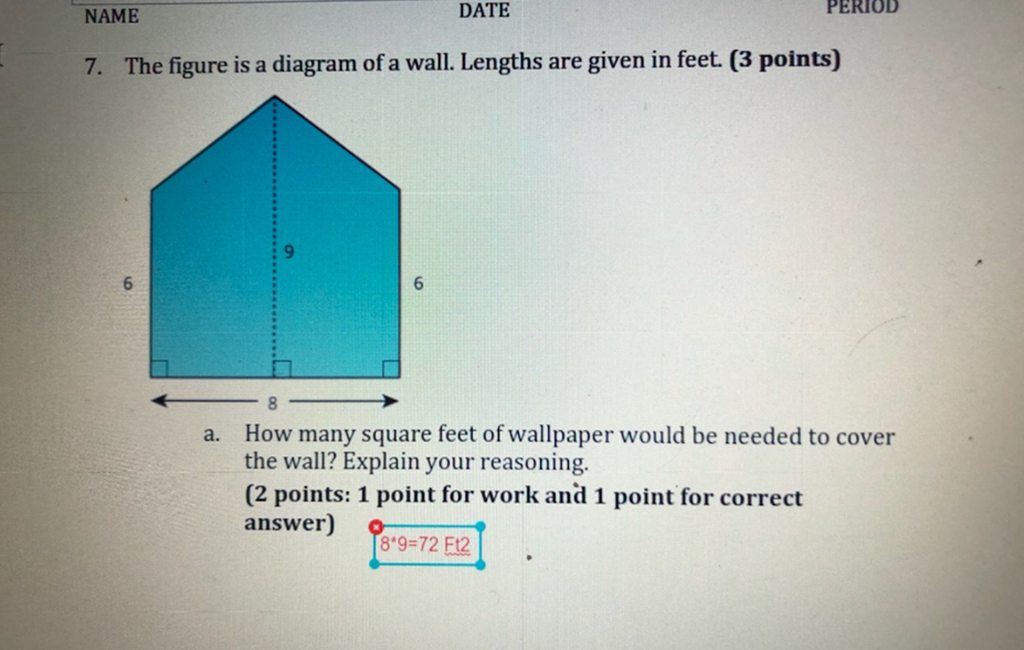 silent plank
area of trapeziums
sharp plume
Area of trap is just area of the rectangle + area of the triangle
Rectangle or square
 spice cargo
how would i go about that? I'm totally braindead at this, just helping my nephew. Been years since Geometry.
sharp plume
Area of rectangle is lxb and triangle (b.h)/2
spice cargo
okay ty
so in that image, length would be 9, base would be 8 so 9x8= 72
and then for the triangle it would be 8X6/2 which is 21
so 72+21?
silent plank
why not use the clearly marked reflected traleziumd
spice cargo
Now I'm lost :(
sharp plume
Just do 6x8 for rectangle then (8x3/2) for triangle then do sum both areas
48+12=60
60feet
spice cargo
so it would be 192 for one wall?
and 384 for both walls?
oh no it would be 192 for all the walls
48 for one wall
i think thats right?
spice cargo
not sure 😦
spice cargo
it doesnt say 😦
sharp plume
The triangle wall of the side walls would be the roof
Dunno if they're gonna put the roof in wallpaper
pearl lava
Given the triangle ABC with vertices A(-1,-1), B(2,3), and C(5,-1), show that the equation of the median from vertex B is also the equation of the perpendicular bisector of AC.
Can I just use the sss postulate to prove that the triangles r equal?
then cpctc?
forest pebble
F(x)=x^4+5x^3-7x^2-29x+30
Find all zeros of the polynomial function
silent plank
not geo-trig but try applying rat roots
forest pebble
 calm umbra
 weary dock
Yeah you can probably ask it here if it's relevant
 mighty wharf
do you know the 4 quadrants
 lavish mesa
Getting answers for quizzes is a bannable offense.
paper vale
note that those angles sum to 180
upper karma
@red oxide what have you tried so far
 red oxide
5x+16 = 8x-2
red oxide
no im just not sure what to do after that xd
upper karma
Aight
So the ideal when solving eqns is to arrange it so that you get all the x terms on one side and the rest on the other
upper karma
Yeah so now just plug x=6 into the equation that describes DU @red oxide
upper karma
Once again
Do you know any geometry book that explains well?
I don't have the geometrical bases *
 civic fiber
??????????????
 faint gazelle
how would i solve for x?
 west basin
set AN + ND = AD
 novel idol
<@&286206848099549185>
 glacial gorge
can not figure out 7 8 or 9
 cosmic pebbleBOT
From
Rule 4
If your question has not been answered for a minimum of 15 minutes, you may use the Helpers tag once. Please do not try to bump your question using this ping unnecessarily. Do not abuse this ping. Do not individually ping users with the Helpers tag without their express permission.
 onyx cloud
thicc start by writing out every angle you know
 brittle echo
Here’s what I’ve got
I don’t know what to do passed this point to figure out angle 1
For either of them
onyx cloud
@brittle echo for 21 draw a line perpendicular to the parallel lines on the left side
it should make a pentagon, and you should be able to sum the angles inside of the pentagon
which should give you 540
brittle echo
how about number 22?
upper karma
ive been trying to convince myself that all triangles have a circumcenter,
but im not sure how i can go about it.
im wondering if theres a way to show that there is no triangle which has no circumcenter.
or like to show that, for all triangles, the line appearing from the middle of each angle meet, or something.
maybe its a bad idea, but it seems like im trying to show the existence of an intersection.
dark sparrow
or like to show that, for all triangles, the line appearing from the middle of each angle meet, or something.
that would be the incenter
you want the perpendicular bisectors
upper karma
oh right
dark sparrow
in Euclidean geometry, given four lines L1, L2, M1, M2, if L1 is perpendicular to M1 and L2 to M2, then L1 and L2 intersect if and only if M1 and M2 do.
upper karma
oh ok yea that makes sense
tho id imagine mainly getting a rectangle unless..
L1 intersects L2, at the point which M1 appears out of
or vis versa
okay, i guess that kinda works for cicrumcenter
im gonna go try do the incenter, hopefully its similar
lol i guess its not, https://en.wikipedia.org/wiki/Incenter#Proof

In geometry, the incenter of a triangle is a triangle center, a point defined for any triangle in a way that is independent of the triangle's placement or scale. The incenter may be equivalently defined as the point where the internal angle bisectors of the triangle cross, as ...
oo.. nvm herons proof is pre nice
paper vale
carnot's perpendicularity theorem basically trivilises it
another nice proof is considering a zero radius circle on the three vertices, and noting that their radical centre is the is the circumcentre
lavish mesa
Can someone help with a math homework problem?
dark sparrow
if you post it, you have a high chance of getting help
upper karma
@paper vale never heard ot it, but yea that looks really interesting
it led me to projective geometry which looks pre interesting
apparently u can derive euclidean stuff from it (i think?)
upper karma
i think the problem wants you to use "cosine law", very specifically since all the values fit in it.
but
thats assuming her second shot, wasn't off by any degrees, and and somehow was aimed perfectly
but yea, @lavish mesa use cosine law:
lavish mesa
no
i don’t have 1 angle
oh i do
So what I would do is do cosine law
To figure out the lengths and stuff
Then make a second triangle to where the second ball hit
And do sin law?
dark sparrow
nah you only need one triangle
the second shot is aimed at the hole so it's aligned with the missing side
 grizzled kindle
how would u guys do this q
ik the answer is 10 but i cant seem to get it
i tried using the general formula taking Un/a = 1/2 and r=0.93
but i didnt get it
upper karma
what a wonderful geometry question
upper karma
i think ur looking ofr something like:
(1 - 0.07)^n = 1/2
the formula for that i believe is:
p(1 - r)^n
which can be expressed as a geometric series, but is also called the compound interest
in this case, principle can be anything so ill just use 1
grizzled kindle
oh i thought we would be using the
formula instead of the compound interest formula
upper karma
i guess you could use, that, but you might need to mainpulate it
grizzled kindle
how so?
upper karma
hmm, maybe im misinterpreting the problem
so if its like $10
$10 - $10 * 0.07 = 9.3
$9.3 - $9.3 * 0.07 = 8.649
...
etc
which if u look at the behaviour:
a - ar
a - ar - (a - ar)r
a - ar - (a - ar)r - (a - ar)r^2
...
which generallizing takes the shape a(1 - r)^n
and as a test:
10(1 - 0.07)^1 = 9.3
10(1 - 0.07)^2 = 8.649
grizzled kindle
ah ic
i kinda just assumed that it was a general solution for geo prog
then for that formula where does the 1/(r-1) come from?
@upper karma
 void wind
Hello guys! Im stuck on this question, i have tanv=5/2 and i have the hypotenuse which is 7. I need to solve a with the help of tan and 7. How should do it? a is not 5, b is not 2. Thanks! 😄
I just joined if i've asked in the wrong channel lmk 😉
somber coyoteBOT
HoboSas:
void wind
i solved it boss! :d
 serene hawk
anyone got any idea how can i find range of a function like 85sin^2(x)-66sin(2x)+36 (or (6cosx - 11sinx)^2 after some simplifying) without using calculus? For this particular one it's supposed to be <0, 157>
 signal pumice
what's a and b?
upper karma
intersecting secant theorem and chord theorem
signal pumice
still not getting it. can u say from where to approach
silent plank
apply intersecting chords theorem to the chords in the left circle
(that'll give you a)
faint gazelle
so, i need to make a problem that corresponds to this diagram, and it needs to require the equation: 5x - 8 = 3x + 20. how would i do this?
upper karma
should I make a tikz
silent plank
for circle geo?
upper karma
ye
upper karma
too easy
silent plank
I'd probably hand draw and scan
faint gazelle
@silent plank can you help? im not sure if this would work
somber coyoteBOT
HoboSas:
 weak quartz
Hi! can someone help me with this? : Each angle in a regular polygon measures 171 degrees. How many sides does the polygon have?
silent plank
@faint gazelle no. instead use definition of a bisector
apply exterior angle theorem
weak quartz
<@&286206848099549185>
Hi! can someone help me with this? : Each angle in a regular polygon measures 171 degrees. How many sides does the polygon have?
faint gazelle
@weak quartz ramanov just explained
and, thank you ramonov, i just now realized i was writing it completely wrong, i appreciate the help
weak quartz
ooh i thought he was talking to you
 weak quartz
@upper karma try (n-2)*180 where n is the total number of sides in the shape
weak quartz
Oh I figured out that question already
 heady lynx
Can someone explain how
so I know that sin/cos = tan, and sin / - cos = -tan, but that leaves -cos, how does that become +1?
upper karma
soo like
swap out the sin and cos with s and c, so its nicer to work with
(s - c)/(-c)
(s)/-c - (c)/(-c) (split the fraction)
(s)/-c - (-1) (c cancels out)
(s)/-c + 1 (double negative)
-(s/c) + 1 (move negative out of denominiator)
heady lynx
okay
That makes sense.
I was just not thinking about it properly
I was completely missing the "divide both" part, and focusing on the fact that sin/cos was tangent, leaving me with a dangling cosine
I hate making stupid mistakes like that
Thanks box 🙂
bitter jetty
for 3c did my teach write the problem wrong?
i keep ending up with
1/2(2cosAcosB-2sinAsinB)
factor out 2
you get cos(A+B)
ive done it like 4 times
upper karma
i am still confused how to do this
thats a lot of questions
yes
it's like study guide practice
teachers be like "what do you mean! there are only 4 questions!"
@bitter jetty the question is wrong,
it should be:
1/2 * (cos(a + b) + cos(a - b))
your result is correct given, the right side of the equation.
probably a typo
upper karma
@upper karma are you confused starting with 1
@signal swallow yes...
so all these problems are the same, 2 is easier tho
just help me figure out formula
 signal swallow
Okay. So starting with 1a, you want to find like terms to pull out.
upper karma
id recommend u remember completing the square (forget the formula)
signal swallow
So what do those two terms have in common?
signal swallow
Let's start at the beginning though
upper karma
where did "e" came from?
Let's start at the beginning though
@signal swallow yes
imo, factoring is a "shortcut", which should do after u know how to complete the aquare
signal swallow
So in 1a, what do the two terms on the left side have in common?
upper karma
X?
signal swallow
correct
so that is something that you can pull out, or factor out
now rewrite the equation, but pull out an x of each
upper karma
oh lol these ones are super easy to factor i guess
signal swallow
if you were to pull an x out of x^2, you get...
and if you were to pull an x out of 6x, you get...
upper karma
how do I "pull out"?
signal swallow
think about it like this: you want to multiply the ENTIRE THING by x
i'll do the first one for you, to show an example
the factored version would be x(x-6)
if you were to expand that, you would multiply x by x, giving you x^2
as well as x by -6, giving you -6x
which gives you the original equation, x^2-6x
so the factored version is just pulling out like terms and putting them on the outside
remember if you have a term on the outside of a quantity that is in parenthesis, you have to apply that term to every other term in the parenthesis
upper karma
so, I just power by 2 the whole equation?
signal swallow
no
alright
so x^2-6x shares the term "x"
you found that out immediately
so, because you know this, you know that both terms are multiplied by x
-6 times x is -6x
x times x is x^2
you know that there are terms in that equation that are multiplied by x
your goal with factoring is to determine those terms
i'll draw out a
see how you take the terms in the equation and break them down?
i did that to find the term that they share
since i know that they share the term x, that means they can both be multiplied by x
upper karma
OOOOOHHHH
signal swallow
yeah it's really easy once you understand it
but you have to get a solid understanding of it before you do anything else
you will use factoring a LOT in the upcoming years
you'll get very good at it
upper karma
okay, I got it, how to the first 7, i guess. What about number 2?
signal swallow
alright, so you've learned that if you do something to one side you have to do it to the other as well, correct?
wait
before we move on
i assume you were taught about the zero product property
which is what you need to use to solve once you get a factored equation
upper karma
o_o
signal swallow
that's okay
i can explain that as well
so your equation is equal to 0 here
x^2-6x = 0
so when you factor that, you still have it equal to zero
and in the factored equation, x(x-6)=0, the thing that MUST be true is that one of those terms you're multiplying together MUST be zero
because to multiply two numbers together and get zero as your answer, you MUST have multiplied one of those numbers by zero
so you take a list of what you multiplied together and set them equal to zero to solve
in this case, you multiplied together x and x-6
so you set those things equal to zero and solve for x
so
x=0
and x-6=0
so your answers would be x=0 and x=6
upper karma
got it
signal swallow
alright, so with number 2
starting with a
the square root method is as straight forward as it sounds
literally take the square root of both sides
so for a, x^2=25
since the square root is the inverse of ^2, that cancels
leaving you with x
and the square root of 25 is 5
so x=5
signal swallow
and just to clarify, for 2b
it says (x-1)^2=4
remember that it means the entire quantity (x-1) is squared
which can be rewritten (x-1)(x-1)
not that we're doing that, but always remember if the square is on the outside of the parenthesis, the entire thing is squared
but in that question you again just do the square root of both sides
completing the square is a bit trickier
the way i was taught it, if i remember correctly, you need (b/2)^2 in order to shove it into the equation
so take the b term, which is the second term, divide it by two, and square it
in 3a, that's (6/2)^2 which is 9
then that number becomes your C term
and you also add that term to the other side
so your new equation for 3a would be (x^2+6x+9) = 0+9
then you factor the left side
which can be a bit tricky, but there's a trick when it comes to completing the square
b/2 is the term you can factor it into
so 6/2 = 3
so the factored version of that is (x+3)(x+3) OR (x+3)^2
then you do the square root method
upper karma
@upper karma watch a video on completing the square
how to do the "c" problem on the 2 section
upper karma
how to power by two the 2x? Do I multiply 2 by 2?
signal swallow
no need to multiply anything out there
since (2x+3) is a quantity being squared, taking the square root of the entire thing will get rid of the exponent
upper karma
so 2x powered by 2?
signal swallow
what do you mean by 5th part
upper karma
i mean 4th, I am retarded a bit
signal swallow
lol
just use the quadratic formula
you gotta memorize that eventually
determine your a, b, and c terms
then plug them into this equation
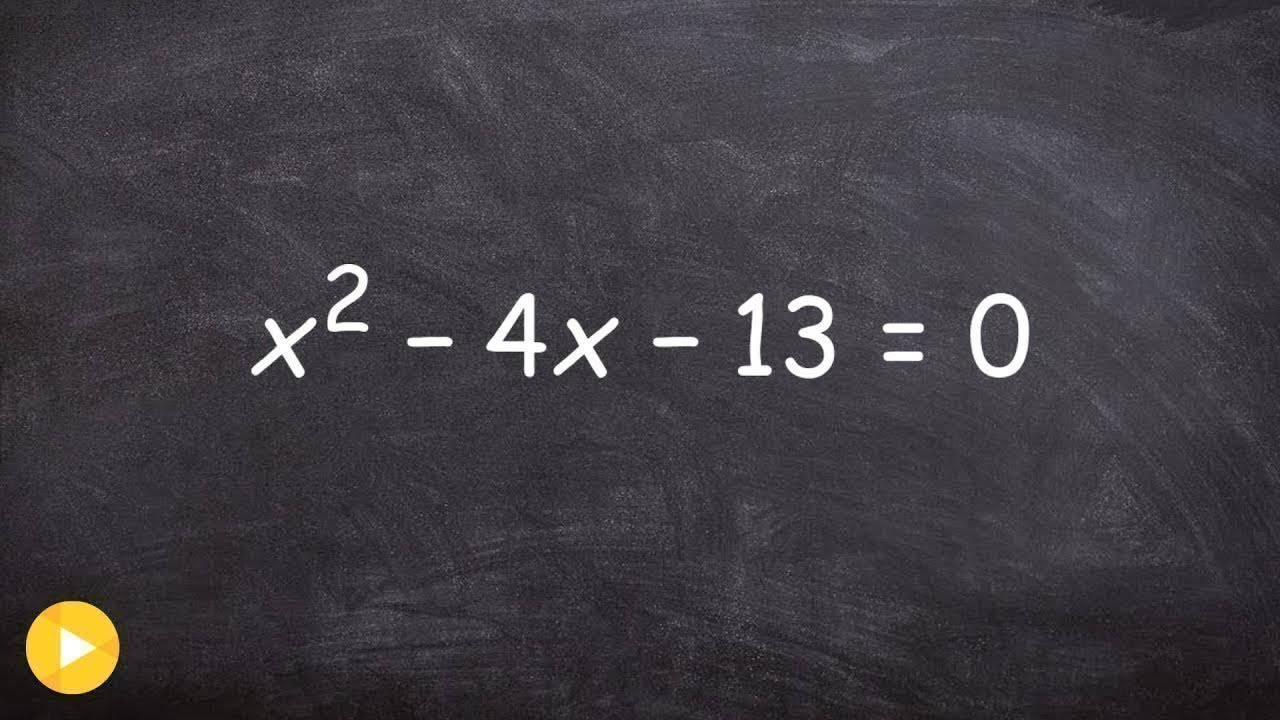
👉 Learn how to solve quadratic equations by completing the square. When solving a quadratic equation by completing the square, we first take the constant term to the other side of the equation and create a perfect square trinomial with the quadratic term and the linear term.
...
here's a really good video on completing the square
upper karma
determine your a, b, and c terms
@signal swallow is this for 4th part?
 barren meadow
signal swallow
barren meadow
signal swallow
yes @upper karma
signal swallow
ah, i didn't look far enough to see they got a bit more difficult
in this one, you have to multiply two binomials together
my teacher taught me what's called the AM method
let me illustrate it real quick
basically, what two terms will ADD to 5 while also MULTIPLYING to 6?
signal swallow
what do you mean?
signal swallow
what are the factors of 9?
upper karma
idk what to do with 9
signal swallow
determine the factors of 9 and 16
an easy way to check your answer when you get one is to multiply the two binomials you get by each other and if it equals your original equation you did it right
upper karma
?
signal swallow
that is how to correctly factor it and check
then simply apply the zero product property i talked about earlier to solve for x
upper karma
Oh, okay, thank you so much
 iron shadow
HELP🤮
dark sparrow
if you flipped a line segment left to right you wouldn't say its length would change from, say, 6 cm to -6 cm, would you?
-V_B has the same length as V_B it's just pointing in the opposite direction
@iron shadow
 hollow hazel
It's a covention to represent vector in a negative direction having magnitude same.
 next flower
hey could i have some help on a geometry problem?
 slim remnant
can someone help me out?
signal swallow
no need to ask, just send the question
somber coyoteBOT
MoeUsrof: