#geometry-and-trigonometry
1 messages · Page 305 of 1
 wheat swan
 silent plank
yes
silent plank
subtracting n360° from both sides would be one way to approach it
wheat swan
And make it n1390
silent plank
that would be the value of **-**t
silent plank
yes
wheat swan
Ohhhhh
silent plank
now applying definitions of comp, angles
t needs to be between 0 and 90° inclusive for a complement to exist
so you can keep adding 360 to -1750 to get such a value
or set n to be ceil(1750/360)
wheat swan
ceil?
silent plank
ceiling
wheat swan
Ive never heard of that term
silent plank
smallest integer greater than or equal to
wheat swan
So keep adding 360 to - 1750 until when exactly
silent plank
when you get something between 0° and 90° inclusive
silent plank
well you determined t to be 50° and that's all that was needed
wheat swan
So the answer to this: Let t be an angle measure in degrees. Adding together t’s complement, t’s supplement, and a certain one of t’s coterminal angles yields a total of 2020 degrees. Determine t. is 50?
silent plank
yes
wheat swan
Man I dont understand that
silent plank
t was what you wanted to find, and the equation you set up is in terms of that variable
wheat swan
Why did we only need to find the complementary angle
wheat swan
Why did it need to be between 0 and 90
silent plank
that's applying the definition of complementary angles
eg. if t was greater than 90°, there wouldn't be a complement
wheat swan
Ohhhh
Well thank you very much for the help! I really appreciate it.
Sorry for being slow lol
 tidal river
;calc (8.90*10^-2%)(138amu) +(99.9%)(x) = 139
,calc (8.90*10^-2%)(138amu) +(99.9%)(x) = 139
 somber coyoteBOT
The following error occured while calculating:
Error: Value expected (char 13)
 dark sparrow
this bot cannot solve equations.
 nocturne thorn
how can i form an equation only knowing: one x-intersect and a point on the parabola?
dark sparrow
as stated, you can't
nocturne thorn
@dark sparrow you can, but i dont know how to
nocturne thorn
Find, in the form y =ax^2+bx+c, the equation of the quadratic whose graph touches the x-axis at 4 and passes through (2,12)
dark sparrow
oh TOUCHES the x-axis at 4.
why didn't you say that.
as stated, it sounded as if you knew one root but not the other
but now it's clear. your equation can be written in the form y = a(x-4)^2, and the value of a will be fixed by that other point they give you.
nocturne thorn
i think i figured it out, thanks anyways @dark sparrow
 alpine wadi
I just started the Khan academy trigonometry course, but I am wondering if I should do the similarity one first
this one
 lean lagoon
 upper karma
What have you tried? @lean lagoon
 coarse kayak
@lean lagoon moving here. What thing did you do which got the wrong answer?
coarse kayak
Hmmm, so is it rounding error or an arithmetic mistake?
silent plank
rounding errors
lean lagoon
in pink the answer in my calculator came up as 52.062 etc.
coarse kayak

Wolfram|Alpha brings expert-level knowledge and capabilities to the broadest possible range of people—spanning all professions and education levels.
silent plank
consider doing the algebra and only using a calculator at the end
lean lagoon
yeah
coarse kayak
Is calculator using radians?
silent plank
either that or store intermediate values in the calculator, but the former is preferred
lean lagoon
it wasnt on radians whoops
coarse kayak
Well you want it to use degrees
lean lagoon
yeah
coarse kayak
For the problem with has degrees
upper karma
I just started the Khan academy trigonometry course, but I am wondering if I should do the similarity one first
You should
alpine wadi
ok
thanks
is there anything else I should check out?
I want to understand the basics of trig and geometry so I can follow my college classes a bit easier
upper karma
Trig is more important than Euclidean geometry for calculus
upper karma
Algebra
alpine wadi
and is there any other site or book better for this than khan?
Algebra
@upper karma what exactly?
upper karma
All of it
alpine wadi
I am mostly comfortable enough with algebra to attent classes
upper karma
and is there any other site or book better for this than khan?
"Art of problem solving" if you want more challenging problems
alpine wadi
thanks, I will check that one out
I mostly need the basics now, so if you know any, please recommend
 junior light
Paul's Online Math Notes
 sour jacinth
I want to understand the basics of trig and geometry so I can follow my college classes a bit easier
@Mr.Pancake🥞#6070 Khan Geometry is pretty good. Trigonometry can be a mess sometimes
If you're into books I can recommend you one
 fresh pike
just started 9th grade so not sure if this is EXACTLY geometry. Doing this online but can someone explain to me in simple terms what a disjoint set and complementary of a set is? It's literally right there but I dont get the explanataion.
TL;DR: Explain to me what a disjoint set and complementary of set is and how it's supposed to relate to the Venn Diagram
 twilit zenith
Disjoint sets are two sets which share no elements between them.
For example, the sets:
A = {1, 2, 3, 4} and B = {5, 8, 10}
are disjoint sets, because they share no elements. However, if you were to take the sets:
A = {1, 5, 8, 11} and B = {3, 5, 14}
then they would not be disjoint, because they share an element. Namely, 5.
The complementary set of a set A with respect to a certain "universe" U is the set that includes all the elements of the universe that are in U, but not in A.
For example, if the "universe" was U = {1, 2, 3, 4, 5, 6, 7, 8, 9, 10}, then the complement set of:
A = {1, 4, 9}
would be the elements that are in U, which aren't in A, meaning:
B = {2, 3, 5, 6, 7, 8, 10}.
Note that two complementary sets will always be disjoint sets, and that their union, meaning the set that includes all the elements in either one of them, is the entire universe.
How does this all relate to the Venn Diagram?
Venn Diagrams are used to represent in what manner elements in sets are "shared" between the different sets.
For example, if you have two circles representing sets A and B, then the Venn diagram would show whether there are elements that are in A that aren't in B, or vice versa, or elements that are both in A and B, or neither, etc.
Here are the respective Venn diagrams.
Notice that in the disjoint set example, the two sets don't intersect, meaning they have no elements in common.
In the complementary example, notice that the two sets have no elements in common (so they are disjoint), and that together, they make up the entire universe.
fresh pike
thx for the explanation really appreciate the detailed work
This is asking for the union of M and N so I'm thinking it's option 1 . Is this correct? Since im "uniting" all the numbers in the venn diagram
twilit zenith
Sorry for responding late.
Also, you're correct.
According to the diagram:
9, 3 belong strictly to M,
4, 7 belong to both M and N,
6 belongs strictly to N,
2, 5, 8 belong to neither set.
You're asked about the union, i.e., the elements belonging to at least one of the sets. Which are, indeed, 3, 4, 6, 7, 9.
fresh pike
all's good
but can i ask
this lesson doesn't really go into the bold line on top of MuN
can you explain to me what it means?
i just know it means complement but it never really told me the use of having the line on top of it like that
twilit zenith
The bold line means the complement of the set that it's over In this specific example, since you found: $\$
$M \cup N = {3, 4, 6, 7, 9}$ $\$
then the set $\overline{M \cup N}$ would be the complement of that set, meaning all the items in $U = {2, 3, 4, 5, 6, 7, 8, 9}$ that don't belong to $M \cup N = {3, 4, 6, 7, 9}$.
somber coyoteBOT
RoiKadmon:
twilit zenith
To use a visualization, if M U N are the elements in at least one of the sets, then the complement would be the elements that are included in neither of the sets.
fresh pike
i would be lying if i said that i got the explanation of the first one
so basically it would be outside of the venn diagram
2,5,8 to be specific?
twilit zenith
Yup!
The complement of a set would be every element in the universe, that isn't covered in the initial set.
Meaning, if {3, 4, 6, 7, 9} was your "initial" set, then the complement would be all the elements in the universe which aren't in that set, meaning, as you said, {2, 5, 8}.
fresh pike
"MuN with line over the top" is basically in other words saying "find the complement of the set of MuN"
ahh i seee
messages on discord can be great things
twilit zenith
Also, if I may note one more thing: Keep in mind that $\overline{M \cup N}$ would NOT be the same as $\overline{M} \cup \overline{N}$. $\$
$\overline{M} \cup \overline{N}$ would be the union of the items not in $M$ with the items not in $N$. This means that their union would be the items that don't belong to AT LEAST one of the sets, whereas $\overline{M \cup N}$ would be the elements that don't belong to BOTH of the sets.
somber coyoteBOT
RoiKadmon:
twilit zenith
It's a command in LaTeX, a mathematical / graphical language for mathematical text.
fresh pike
oh
when it's stated that "Inlcuding 3 students on both teams" does it mean it's already included in the said fact that there are 20 students on gynastics and 10 on chess team
i suck at story problems
upper karma
G for gymnastic and C for chess obviously
when it's stated that "Inlcuding 3 students on both teams" does it mean it's already included in the said fact that there are 20 students on gynastics and 10 on chess team
Ugh wait a sec
upper karma
But it is indeed asking for that
fresh pike
What is the process
fresh pike
intersect and
complementary not
upper karma
Wdym
fresh pike
read that somewhere
upper karma
Oh yeah
fresh pike
I also had "U" as "or" in my notes
fresh pike
just didnt think it would matter as much
upper karma
I just didn't understand what you meant
fresh pike
i guess ill go highlight
upper karma
Ok but yeah
fresh pike
okay so how do you solve it step by step
upper karma
Now notice it says are "not" ...
fresh pike
yes or not
upper karma
So instead of asking for the union itself
We have to add the complementary part
As you said
upper karma
How many students in the school are not members of either the gymnastic team or the chess team
Yeah
fresh pike
what got me confused was the part that said (including 3 students who are on both teams
wait no
upper karma
Almost
How many students in the school are NOT members of either the gymnastic team or the chess team
fresh pike
uh huh
fresh pike
complement
upper karma
Yes
So basically asking for ${\text{Total n}}-n(G\cup C)$
n is just to denote the number
fresh pike
what is 1?
somber coyoteBOT
Al𝟛dium:
fresh pike
what does n stand for?
fresh pike
denote meaning?
fresh pike
but why n-n?
upper karma
Total n-n(G U C)
fresh pike
total number?
upper karma
800-(g u c)?
My mixing of probability and sets may have confused you, i'll try not to do it again lol
fresh pike
say wat
upper karma
can't it just be 800 (g U c)
What do you mean by 800 times G U C?
fresh pike
dunno
i thought that was just saying total number of students
but
since is story problem
it just requires logic
upper karma
The total number of students - the number of (G U C)
Do you understand it this way better
Because we are asked for the ones that are NOT either on the chess team or gymnastic one, that's the reason for the "substracting the total number of students"
fresh pike
800 students
20 gymnastic peep
10 chess peeps
(3 included on both clubs)
*my guess is that the 20 gymnastic students and the 10 chess students are just there for counting. But it says 3 people are on both (included).
Im guessing it's tricky because it says (3 people are on both clubs)
800-30=770 would be the quick answer but it's wrong
upper karma
Are you reading what im trying to say
fresh pike
i am
upper karma
What do you not understand
fresh pike
i just dont understand why you have to set it up like that
upper karma
Can you specify more
fresh pike
n-n(G u C)
upper karma
No, i said "total n"
Total number of students
Do you not understand why it is total n minus the rest?
fresh pike
well the reason i dont understand is because in this online course they never set anything up like that
it was just venn diagram and identifying types of "sets"
upper karma
You can visualise it with a Venn's diagram if you want
fresh pike
i think im just gonna move on as this is gonna be very long conversation if we continue
upper karma
Can you not do that
fresh pike
i've already worked it out on notebook paper and solved it like a few minutes ago
just had to sit and think for a bit
upper karma
Thank you for letting me know...
fresh pike
woops it's just i thought it was wrong
being honset, it's because you were saying a lot of stuff i wasn't familiar with, so I just had to find my own answer
sorry for inconvenience
alpine wadi
If you're into books I can recommend you one
@sour jacinth sure, please do. I am currently watching Khan academy and I am not sure if it is right for me. I don't really understand stuff properly. Any source is welcome
sour jacinth
What are you having difficulties with?
alpine wadi
getting started
currently I struggle with similarities
When I start learning something new I usually have a breaking point where I suddenly come to a realization and everything falls into its place
that is at least what happened with algebra
now I am just reading through khan and while I remember what I read, I don't really understand it nor know what to do with it
 paper vale
it isnt that complicated 
alpine wadi
Idk, maybe I am going in with a negative bias, but I always struggled with trig and geometry
any tips on how to learn and practice?
or some key concepts I should look up first
sour jacinth
With both?
sour jacinth
Algebra and Trigonometry with Analytic Geometry by Swokwosky
the only area in which I am even worse is probability
@Mr.Pancake🥞#6070 Are you me?
alpine wadi
🤔
sour jacinth
I struggled with geometry
alpine wadi
glad I am not the only one
sour jacinth
In my country there was a time when teachers did strikes during several years
And my understanding of geometry was defficient. Khan Academy helped me a lot.
alpine wadi
My teacher didn't go on a strike but was just bad in general
sour jacinth
That happens
alpine wadi
she never explained how or why anything works
just learn these 2 formulas
and plug in the numbers
sour jacinth
That's the exact way it was explained to me
alpine wadi
while it was somewhat easier to get good grades
I now regret it
and almost resent her for that
sour jacinth
What's your grade?
alpine wadi
I loved math in elementary school but started hating it in HS because of her so I didn't practice on my own
I just finished HS and will be going to college in october
that is why I want to get the basics done so I can follow classes without too much struggle
alpine wadi
yeah
That is why I am looking for good study material
I had a similar problem with algebra
but when I got into it, I managed to go over almost 3 years worth of material in less than 2 months
did study for 7+h daily though
alpine wadi
damn
that's unfortunate
I was thinking about using this pandemic to learn math
but I had tons of work at home and also started learning how to code
and that is 100 times more interesting to me, so I pushed math back a lot
sour jacinth
I would advise to learn math first
Math helps you to get a certain mindset that makes coding easier
 acoustic jungle
Need help proving AN_2: N_2N_1:N_1D=3:3:1
I don't need help with the question itself
 high hemlock
?
acoustic jungle
Ah yes, the probability is over 100%.
 simple oyster
I forgot how to know when there is more than one possible angle?
cos theta = 10/11.18
like when im solving for theta
wondering if i need to worry about multiple possible angles, like I remember something about subtracting 180 or something in the past but i dont remember
silent plank
depends on the context of the question
simple oyster
oh i guess since they are asking for the angle between vector v and w its just one answer
silent plank
then just applying arccos would be sufficient
you're thinking about the ambiguity with the sine law
simple oyster
okay
 obtuse kayak
Working on trig right now. Still a pretty new math student and still really early in Trig. But we're doing Unit Circle at the moment and we're having to write a paper on it at current. Maybe the unit is just worded badly but this question just seems to be giving me more problems than it should.
Which angle has terminal side which crosses the unit circle at your point? How did you determine this?
Would anyone help me decipher it so I can understand what it's asking a bit better?
currently this is what I am working with, I know pretty basic
upper karma
what you have looks like it's on the right track (or is already solved)
what is your question exactly?
how to use trig to find the angle?
obtuse kayak
So basically, my current PreCalc class has papers due kind of breaking down what is happening. We're starting trig stuff at the moment. I am just a bit confused on the wording as I need to give a bit of an in-depth explanation on the above question. Maybe the question is poorly worded but I am not sure what exactly it is asking
The question was Which angle has terminal side which crosses the unit circle at your point? How did you determine this?
upper karma
"your point" is point B = (b,a) right?
obtuse kayak
yes
upper karma
is it an arbitrary point or is it the point (.8, .6)?
obtuse kayak
it's basically arbitrary, we were asked to select a point anywhere on the unit circle
obtuse kayak
okay
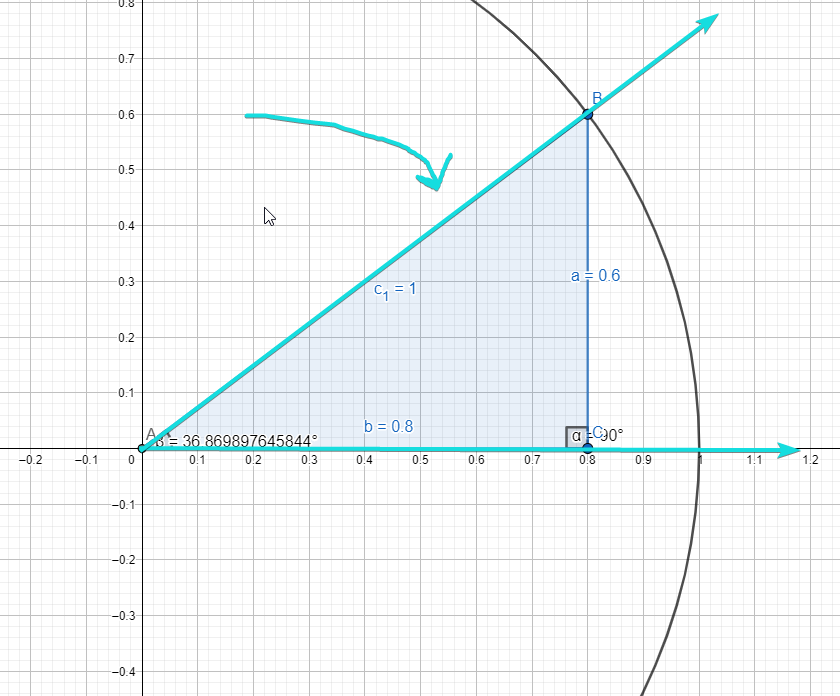 obtuse kayak
that is what I was thinking
upper karma
fix one side to the x axis, and the other is the terminal one
obtuse kayak
yeah, i had already found the coterminals and all that too, i was just a bit confused I guess
upper karma
so let's suppose we have an angle with one side fixed on the x axis and the other going through point B
obtuse kayak
so we'd be using, in this example, the origin?
upper karma
for this context (and any other unit circle contexts), the angle will always be from the origin, and with one side fixed on the positive x axis
obtuse kayak
alright, so than from A to B would be the terminal side crossing the unit circle?
obtuse kayak
Alright, I was thinking that was what I was looking for but the question wording was a little poorly worded
so just didn't think it would be that easy
We're just dipping into trig and it's been years since I took any math. So this has been pretty weird getting back into
I honestly think they're just trying to get me to show that I know what a terminal side is
upper karma
hm I'd say it's more to recognize the link of triangles and trig to the unit circle
obtuse kayak
ah yes, that's a really good way to put it
thank you so much for your help. I think I know what I need to write now. Really helped unjumble my thoughts
upper karma
ok great
upper karma
Do you know the bisector chord theorem?
upper karma
Sure, the radius a bisects AC from the theorem, which basically reduces our steps but this could be done without it i think
As AC is a chord
But why not just use pythagoras?
On triangle ABD
upper karma
And then after getting AB just remember that it bisects AC
paper vale
Just use Pythagorean’s and times by 2
Also consider proving why it bisects it, it is easy
upper karma
Kane, i was trying for him to reason through that. This server is for them to help and when you are alone on a test, they won't have you to tell that. So please leave
paper vale

 dull kernel
What do I plug in for abd
paper vale
It can be helpful as he knows to what extent he needs to prove
dull kernel
my exam is on the 25th
paper vale
Abd is already given
dull kernel
Where
upper karma
No, it is not helpful, they won't have you there to tell them what to do, stop please.
paper vale
Do you see that box
upper karma
Abd is a triangle is not given
upper karma
@dull kernel do you know what pythagoras theorem looks like?
paper vale
So use it
upper karma
Where c is the hypothenuse, agree?
upper karma
However, here it is not the hypothenuse
paper vale
Bruh
dull kernel
16^2 +14^2= c^2
upper karma
No, the c is already given
paper vale
Does that look like a hypotenuse
upper karma
Letters can vary, they just represent values
dull kernel
Ok
somber coyoteBOT
Al𝟛dium:
upper karma
My point is, you have to use the pythag correctly, side²+side²=hypothenuse²
Answer this question
Which side of the triangle abd, is the longest of all (hypothenuse)?
Answer me with: AD is the hypothenuse or BD is the hypothenuse or AB is the hypothenuse
@dull kernel
dull kernel
it is
upper karma
Answer me with: AD is the hypothenuse or BD is the hypothenuse or AB is the hypothenuse
dull kernel
AD is the hypothenuse or BD is the hypothenuse or AB is the hypothenuse
dull kernel
AB
upper karma
No, AB is not the longest side
dull kernel
oh AD
upper karma
Yes!
dull kernel
It’s the opposite of the bottom right ?
upper karma
AD is the hypothenuse, therefore the longest side
dull kernel
yeah I meant that
upper karma
It’s the opposite of the bottom right ?
The opposite of where the right angle is located
upper karma
I wouldn't always say the bottom because you can find a rotated triangle downwards
Ok good
So
$a²+b²=c²$ we just said that AD is the hypothenuse, so $\a²+b²=\underbrace{c²}_{\overline{AD}}$
somber coyoteBOT
Al𝟛dium:
upper karma
Agree?
dull kernel
Yeah
dull kernel
16 and 14 yes
upper karma
Nono, you forgot what we said, the a and b of the pythag formula aren't the same as the a and b from the problem
dull kernel
Oh wait no 16 and 14 are different from that my bad so a and b are the 2 other sides
upper karma
Yes
dull kernel
yeah
dull kernel
Yes
upper karma
$a²+b²=c²$ we just said that AD is the hypothenuse, so $\ a²+b²=\underbrace{c²}{\overline{AD}}$ and let's just use a on the pythag formula as the missing side which is in fact AB,
$\ \underbrace{a²}{\overline{AB}}+\underbrace{14²}{\overline{BD}}=\underbrace{16²}{\overline{AD}}$
somber coyoteBOT
Al𝟛dium:
upper karma
Yes?
dull kernel
Just curious but
why is Bd and ad Those numbers
Why wouldn’t a^2 not be one of those numbers
How do u know where to plug Which number for each part
upper karma
why is Bd and ad Those numbers
We are given those, they call them a and b in the problem, but we won't use their a and b
These 16 and 14 are basically what we were given that a and b where from their problem
upper karma
I understand your confusion, the letters they are given are the same as the pythag and it confuses you. But you have to remember that letters just represent side lengths
Okay
$a²+14²=16²$ do you know how to solve this?
somber coyoteBOT
Al𝟛dium:
upper karma
Try and if you have problems, let me know
upper karma
,calc 16^2-14^2
somber coyoteBOT
Result:
60
Yes
dull kernel
A^2 =60
upper karma
Yes.
somber coyoteBOT
Al𝟛dium:
upper karma
You took the sqrt on both sides remember
dull kernel
Yeah sqrt of 60 is 2 sqrt 16
upper karma
So it ends up as a and not a²
dull kernel
15
upper karma
Yes
dull kernel
Oh yeah
dull kernel
Yeah
upper karma
Bisected means it divides the side in 2 equal parts
Just in case
So what you have to do now
It is a simple movement to get AC
Knowing we have half of AC, because of the bisector theorem
What we'd have to do to get full AC?
upper karma
Okay
 little osprey
Hey Zicro
dull kernel
hi denton
upper karma
Answer this: if you have a ruler that is 10m long, you decide to cut it in half so that you get 2 equal parts, what would you do to get the measure of one of the parts?
dull kernel
Divide it
dull kernel
Yes
dull kernel
Yes
upper karma
Remember we have AB=2*sqrt(15)
And remember that due to the bisector theorem, BD bisects AC in 2 equal parts
dull kernel
Yes
upper karma
What do you think the measure of AC will be? If we have half of AC, Remember what i said of dividing in 2 equal parts
dull kernel
Would I divide 2 sqrt 15
upper karma
Almost
If we'd divide 2sqrt(15) by 2, we'd get half the length of 2sqrt(15)
But we want the other half, remembering that AC is bisected in 2 equal parts
upper karma
Okay, another example: say we have that ruler that was split in 2, 2 equal parts one of the parts is 10/2=5m and the other one is 5m AS WELL as it was divided in 2 equal parts! But say we have glue, and we want to get the full ruler again, we have that 1 half is 5m and the other is 5m, what would the full length be? 5 multiplied by 2=10m
Do you get why?
dull kernel
Why
upper karma
Because it was divided in 2 EQUAL parts
If we say they are equal parts, they length will be the same!
 dire sand
Sup gamers
dull kernel
Nah Damon chill he help a lot but, ok I understand partially what u are saying about equal parts and sort.
ohh
I understand I think
upper karma
Then
Do you know what to do if we have the same exact case but a different length for the half? How to get the full AC from what i just said about 2 equal parts?
(note that one half was 2sqrt(15))
paper vale
It is trivial
dull kernel
Ok
upper karma
Okay, another example: say we have that ruler that was split in 2, 2 equal parts one of the parts is 10/2=5m and the other one is 5m AS WELL as it was divided in 2 equal parts! But say we have glue, and we want to get the full ruler again, we have that 1 half is 5m and the other is 5m, what would the full length be? 5 multiplied by 2=10m
It just the same exact thing done at the end
upper karma
But instead of a half length of 5m, of 2sqrt(15)
dull kernel
?
upper karma
So do you know what to do to get the full side length of AC?
Remember the thing i did at the end of
Okay, another example: say we have that ruler that was split in 2, 2 equal parts one of the parts is 10/2=5m and the other one is 5m AS WELL as it was divided in 2 equal parts! But say we have glue, and we want to get the full ruler again, we have that 1 half is 5m and the other is 5m, what would the full length be? 5 multiplied by 2=10m
If they are divided in 2 equal parts
Try to think of it that way
dull kernel
So 2 sqrt 15 2 sqrt 15?
upper karma
Yes!!!
Add
2sqrt(15)+2sqrt(15)
Because both half lengths are equal! And we want the length of the 2 half together!
upper karma
Yes.
Good job
Also 2*2sqrt(15)
Because 2*2sqrt(15)=2sqrt(15)+2sqrt(15)=4sqrt(15)
dire sand

upper karma
Are you conscious of what we did? Or where you saying random things
dull kernel
I knew what was going on however I am just confused on
Also 2*2sqrt(15)
@upper karma
What does this do
dire sand
It doubles the length 2sqrt(15)
dull kernel
oh
dire sand
It's the same as 2sqrt(15) + 2sqrt(15)
dull kernel
So AC=4sqrt 15
dire sand
yes
dull kernel
Ok
dire sand
cool
dull kernel
Same as 5 x 2
dire sand
exactly
dull kernel
Thx u very much I will go sleep now it is 5:50 am lol will be on in 4 hours
dire sand
gn
dull kernel
Been studying all day
somber coyoteBOT
Al𝟛dium:
dark sparrow
wow, who knew that adding a thing to itself was the same as doubling it
upper karma
I knew what was going on however I am just confused on
If you were concious of what we were doing for 1 hour, you would have just not asked "so what do we do know". What we were discussing and i wrote a million of examples for you to say "what do we do now"
dire sand
a Copernican revolution in our understanding of math
upper karma
Sigh
Like, i feel you are gonna ask more in the future, just so this does not happen again, when someone tells you: do you understand it? Or whatever means just do you understand it, i'm asking if you are conscious of what we are doing and the reasons behind it. So instead of saying "i understood" while it seems like you did not far at all, say no i don't so that we can proceed without having a hole in your head. @dull kernel
dire sand
I was being sarcastic
upper karma
What?
dire sand
I'm talking to DrunkenDrake
upper karma
sigh
dull kernel
Ok thx I will in the future
fresh pike
would the intersection just be {0,2}? or is there no need to include the zero. Just asking bc i was wondering if it was needed.
paper vale
yes
 shell fulcrum
including 0, it's an element of the set and nothing special
paper vale
why would u not include the 0
fresh pike
can anyone explain to me what this C symbol means?
paper vale
proper subset
fresh pike
so for ex
B C A
"b is a proper subset of a"?
fresh pike
for example
paper vale
also btw it isnt actually a C, it just looks a bit similar
paper vale
for union
paper vale
well i guess maybe it is universal set tbh
when i was taught it a different symbol was used but it doesnt matter
fresh pike
paper vale
in this instance, yes
shell fulcrum
they even used the Union symbol in the text it appears
somber coyoteBOT
Manan:
 arctic vortex
hi guys if u know me thats nice but i finished my final test and i got a 95% overall in geometry so yeah i am a geometry expert thank you ann and hobo sas for helping me now i iwill help you so ping me if u neeed help yea
 pallid edge
sour jacinth
pallid edge
sour jacinth
Good job @arctic vortex
upper karma
@arctic vortex very happy to hear that! Good job
 glad veldt
studying for a maths test on trigonometry and found this question. Given the domain −π<x<π, at what interval(s) is slope of the function f(x)=sinx positive?
0<x<π
−π<x<0
−1/2π<x<1/2π
−π<x<−1/2π, 1/2π<x<π
how would i go about solving this
 versed river
thats very funny, deleting the message.
 livid moss
Multiplying out gives $\cos(3x - \pi) = 1$. Do you know reduction formulas with π and 2π?
somber coyoteBOT
Lunasong:
 long totem
also did i do b) right?
Multiplying out gives $\cos(3x - \pi) = 1$. Do you know reduction formulas with π and 2π?
@livid moss ohhhh thank you sm
livid moss
How do you go from sinθ/cosθ, to 3/5 + 5/3?
Also 3/5 + 5/3 is not 1
And 1 is not -1
 earnest echo
Multiply luna
long totem
i think i wrote 3/5 * 5/3?
earnest echo
How did you get those values, that's what Lunasong is asking?
long totem
ohhh
earnest echo
How do you go from sin(theta) by cos(theta) to 3/5 * 5/3
livid moss
Wow that's an ugly times, just saying
long totem
cause isn't tan(thete): sin(thete)/cost(theta)
livid moss
That's true, but why is cos θ that
long totem
i thought itd be negative since its in a quadrant where cos is negative, but iwas following this formula:
livid moss
But you don't know what sin(θ + π/2) is either
long totem
shoot i'm sorry; i have no clue what i'm doing ://
long totem
how do you find tan directly?
livid moss
You are in the second quadrant, and sinθ is 3/5
long totem
so that means i use pythag to figure out cos yea?
livid moss
Or just tan, you don't need to finr cos first
long totem
but to find tan you need cos..?
long totem
could you please explain? I don't think i'm following...
livid moss
Yes
long totem
ohhh right right i think i've got it
livid moss
And you have to do that for cos or for tan, so there's no need to get cos first
livid moss
Well, based on it being in the second quadrant...
long totem
-3/4?
livid moss
x is negative, so it's -3/4, yeah
long totem
thank you!
 keen goblet
hello is this channel occupied?
ok nvm, so i have cone
so they have filled this cone with water, up to 90% of the cone
They want me to show that the water occupies 70% of the volume of the cone
any ideas?
dark sparrow
you mean 90% of the height of the cone?
is it apex-down or apex-up
cause the percentage you're looking for won't be 70% in either case
dark sparrow
it's not 73% it's 72.9%
keen goblet
says 73%
dark sparrow
does it say "rounded to the nearest percentage point"
keen goblet
it says occupies "about" 73%
dark sparrow
oh ABOUT 73%
the cone formed by the water has 90% of the height and 90% of the radius of the container.
0.9 * 0.9^2 = 0.729
upper karma
It's perfectly fine, it's related to cone which comes in geometry
 runic beacon
I have a question. If there is a circle and I take a fraction of its circumference out which leaves me with an arc. Now that arc is all the information I have about that circle. Just from that, how can I find the centre of that circle , the radius and the what fraction of the circumference did I originally took out of that circle?
dark sparrow
take the triangle formed by the endpoints and the midpoint of your arc
or really any triangle whose three vertices all lie on your arc
its circumcircle will be the circle that the arc came from
 hearty gale
What is a good proof for this theorem?
Through a point outside a line, there is exactly one line parallel to the given line
runic beacon
its circumcircle will be the circle that the arc came from
can you please elaborate?
dark sparrow
what is there to elaborate on?
pick any three points A, B, C on your arc
the circumcurcle of ABC will be the circle you're asking for
runic beacon
ok
thank you very much
arctic vortex
thanks
 lament shell
Locate point X on segment AB so that AX is 3/4 the distance from A to B with A at position -1 and B at position +11
please help
lament shell
Thanks ❤️
 nimble moon
Hey Guys, im new here. I've got a pretty hard mathematic problem and need to code an algorithm for it so i can use it in a videogame i am working on:
I have got a cubic bezier curve:
Imagine this one https://cubic-bezier.com/#0,.5,.5,1
And i need to somehow project a point (it can be anywhere) to this bezier curve so i can find the closest point on the curve and get the t-value from it
have you guys got any idea how i can solve this the easiest and most efficient way?
 crystal pike
paper vale
crystal pike
paper vale
lol u didnt even show the function
 crimson smelt
$\theta=\cos^{-1}(\frac{2}{\sqrt{5}})\
0<\theta<\frac{\pi}{2}\
\tan(3\cos^{-1}x)=\frac{11}{2}$
somber coyoteBOT
Yes:
crimson smelt
how do i found the possible values of x ?
2/\sqrt{5} is a solution
i can see
but i dunno how to find the other solutio ns
upper karma
Hi, I am doing question 6, I have an answer for the following question, given in form of the surd 1/15 * (4 + 6sqrt(2))
I am using double angle formula for sin - sin(x+y)=sin(x)*cos(y) + cos(x)*sin(y), but I don't know how to obtain cos(x)sin(y) in terms of a surd
@crimson smelt where does the theta part come from?
livid moss
@upper karma looks like channel is busy, but draw a picture of a triangle where x is one of the angles, and use pythagoras to find the other side length. Then you can get cos x. Similar for sin y.
upper karma
@livid moss thanks
crimson smelt
@crimson smelt where does the theta part come from?
@upper karma given from question
@crimson smelt where does the theta part come from?
@upper karma the top 2 lines are given facts from question, the 3rd line is what its asking to solve
paper vale
so u are given that theta is a solution?
crimson smelt
yeah
crimson smelt
theta is restricted by 0<\theta<\frac{\pi}{2}
tan doesnt get repeated within that domain of theta
paper vale
cos(theta +2kpi)=2/5^-2, so adding multiples of pi onto theta works for a solution to x
acoustic jungle
@upper karma secy=5/4 cosy=4/5
crimson smelt
$cos(theta +2kpi)=2/\sqrt{5}$
paper vale
the 1/2 exponent is only in the 5
upper karma
@acoustic jungle Thanks, I solved it already👍
crimson smelt
ah
paper vale
it is still positive half tho
somber coyoteBOT
Yes:
paper vale
it just means square root
crimson smelt
ok so your using the cyclic nature of cosine to find another value of 2/sqrt5 ?
paper vale
yea
paper vale
so there is theta and 2pi -theta
and adding multiplies 2pi's on to both gives families
somber coyoteBOT
Yes:
crimson smelt
$x= \frac{2}{\sqrt{5}} \pm 2\pi$
somber coyoteBOT
Yes:
paper vale
we want cos^-1x to differ by pi/3
as 3times that gives 3 theta plus pi which gives same output in tan function
so basically we are concerned for the inputs of the cosine which differ by pi/3 and such that one of them outputs 2/root5; which is 0<theta<pi/2
paper vale
so we need 3cos^-1(x)=3cos^-1(2/root5)+kpi
crimson smelt
$3cos^-1(x)=3cos^-1(2/root5)+kpi$
somber coyoteBOT
Yes:
paper vale
so divide by 3
crimson smelt
i dont get it 😫
 fathom root
how can i use the calculator from the discord
fathom root
,calc 9=d*sqrt2
somber coyoteBOT
The following error occured while calculating:
Error: Invalid left hand side of assignment operator = (char 2)
fathom root
how would i enter, 9=d*sqrt2
fathom root
im having some problems with a couple questions one being

for the bottom right triangle, i set it up as 9=d*sqrt2
but dont know where to go from there
silent plank
divide both sides by sqrt(2) to get d
silent plank
and similar ideas with special ratios to get a and b
fathom root
@silent plank So I get to the point where i put
d=9/sqrt2 * sqrt2/sqrt2
am i going in the right directionm?
silent plank
and simplify
paper vale
have u solved it, @crimson smelt
fathom root
err i mean
9/sqrt2
on the video i watch for the problem, it would be 9sqrt2/2
i dont get how though
silent plank
$\frac{9}{\sqrt{2}}$ is equivalent to the correct value. That can be rationalised by multiplying by $\frac{\sqrt{2}}{\sqrt{2}}$ which gets you:
$$\frac{9}{\sqrt{2}} \times \frac{\sqrt{2}}{\sqrt{2}} = \frac{9\times \sqrt{2}}{\sqrt{2}\times \sqrt{2}} = \frac{9\sqrt{2}}{2}$$
paper vale
also @crimson smelt a probably easier way to realize why would be to just take the inverse tan function of both sides, but yea once you get that just divide by 3, and cosine both sides, to get expression for x
somber coyoteBOT
ramonov:
fathom root
ah okay i get it.
crimson smelt
@paper vale
fathom root
so now how would i find b? in the example that a video im watching provides, it says that we should solve for b next, i get that a=2b, but how do i get what b=
silent plank
have you started trig yet?
somber coyoteBOT
Yes:
Compile Error! Click the  reaction for details. (You may edit your message)
fathom root
not really, its just like a review of geometry. I haven't done math for two years as I took an off year, so its all a blur to me
silent plank
you may want to look up special triangles. trig isn't necessarily needed but it helps.
crimson smelt
$x=\cos(\cos^{-1}(\frac{2}{\sqrt{5}})+\frac{k\pi}{3})$
somber coyoteBOT
Yes:
 crimson smelt
would using the addition angle forumula thing for cosine be a good idea
paper vale
did u read my point about just taking inverse tan on both sides at the start
crimson smelt
taking inverse tan wouldnt work?
silent plank
ratios in a 30°-60°-90° triangle
paper vale
the addition thing probably makes it less simplified
yea im talking about taking the inverse tan as another way to see why what we did works
like an easier way
but yea, cos(m+n) is more simple than expanding it
crimson smelt
yeah id use the previous one
paper vale
yea there are infintie
fathom root
how would i solve
An escalator in a department store is to carry people a vertical distance of 10 feet between floors. How long is the escalator if it makes an angle of 30° with the ground?
paper vale
does it ask for x to be in a certain parameter @crimson smelt
crimson smelt
no
paper vale
ok, if that was the case you would just plug in values of n whcih fit the parameter
crimson smelt
yh
paper vale
An escalator in a department store is to carry people a vertical distance of 10 feet between floors. How long is the escalator if it makes an angle of 30° with the ground?
what is this question?
the size of the escalator? it could be anything
fathom root
How long it is
crimson smelt
draw a triangle
fathom root
would you figure out all 3 sides with the 30 60 90 triangle formulae and add them all together?
paper vale
wait so u are literally finding the elevator's height?
 paper vale
you cant do that
fathom root
this is the question
paper vale
oh wait i was confusing an escalator with an elevator lmao
crimson smelt
lool
paper vale
this question is just asking for the width which is pretty trivial
but yea it is tan not sin
fathom root
im so confused :c
crimson smelt
Would escalator be the hypotenuse
silent plank
it would be sin
crimson smelt
wouldnt h be the length of the escalator
paper vale
h=10=o
silent plank
huh
silent plank
escalators are slanted conveyor belts
crimson smelt
yeah ....
silent plank
instead of 20ft, the height is 10ft for your question
paper vale
but yea i guess it isnt that tbh
fathom root
i just have no idea where to go forward to solve it, so frustrating
fathom root
so what do i plug in?
paper vale
no?
paper vale
lol
silent plank
technically that was true:
sin(30) is indeed negative, and isn't the same as sin(30 degrees)
crimson smelt
so what do i plug in?
@fathom root well have u used sin cos and tan before
silent plank
review special angles,ratios,triangles
you should be well versed in stuff relating to 0°,30°,45°,60,90° angles
somber coyoteBOT


 Requested by Reformed#0409
fathom root
Requested by Reformed#0409
fathom root
right?
silent plank
yes
fathom root
sweet. thank you. just took a bit of reading in the textbook.
Find the remaining sides of a 30°-60°-90° triangle if the longest side is 9. (Enter your answers as a comma-separated list.)
when it says longest side it means hypotenuse right?
not the long side / short side?
crimson smelt
ye
fathom root
ok ty
well i went completely wrong somewhere


lul
finally got to my last problem, everything else right but this one
acoustic jungle
9/sqrt2 = 9sqrt2/2 not sqrt9/2
acoustic jungle
ye.
fathom root
when i plug that tan60 into the bot, it gives me a weird looking response
,w tan60=sqrt3=c/b
somber coyoteBOT
 Requested by Reformed#0409
acoustic jungle
Requested by Reformed#0409
acoustic jungle
c is 9
fathom root
,w tan60=sqrt3=9/b
somber coyoteBOT
 Requested by Reformed#0409
fathom root
Requested by Reformed#0409
fathom root
is that the right way to plug it in?
oh that means
b= 9sqrt3?
hmm got a and d just says b isnt correct.
silent plank
the output says b=3sqrt(3)
fathom root
oh my god
silent plank
is which is also half of a, which is what you should be entering
somber coyoteBOT
 Requested by Reformed#0409
 proper rivet
question
versed river
question
proper rivet
i dont get it to be honest
dark sparrow
you don't get what
proper rivet
a surd
dark sparrow
that's british math speak for radical
basically just the answer in exact form
no decimals
dark sparrow
you're not asked to "find" the segment*, you're asked for its length
i.e. the distance between H and T
proper rivet
so its basically just (-5, -4)
dire sand
surd is also australia :c
proper rivet
so how do you find it
dark sparrow
do you know what the word "distance" means
proper rivet
yes
dark sparrow
ok what does it mean
proper rivet
how far something is
dark sparrow
great so you know that the distance must be a number, and a positive one at that
now do you know how to find the distance between two points?
proper rivet
you minus them i guess