#geometry-and-trigonometry
1 messages · Page 303 of 1
 unborn holly
 pastel anvil
ya go ahead
 tidal river
so we know the total periemeter has to be 90
and its a rectangle
and we a given 18
so
pastel anvil
90 ft2 is area
tidal river
I did 90 -18 -18
tidal river
so the final answer is
pastel anvil
wat
tidal river
whats the answer
pastel anvil
it's 18+18+2(90/18)
tidal river
, calc 18+18+2(90/18)
tidal river
nvm
pastel anvil
woah
tidal river
I figured it out
pastel anvil
technology is amazing
tidal river
I know right
pastel anvil
u have more problems
pastel anvil
so u want to find the area of the entire rectangle then minus the area of the 6 circles
I forgot how to minus
oops
u know what the formula for a circle is
tidal river
I cant find the area of 1 cirle
pastel anvil
well what's the area forumual
tidal river
I know that
But we dont have the radius or the daimeter
nvm
I can do 36/2
to find the diameter
tidal river
then radius
pastel anvil
yep
tidal river
, calc 6^6^3.142
 somber coyoteBOT
Result:
5.9982085016251e+216
technology is disapointing some times
pastel anvil
lel
tidal river
, calc 113.112^6
somber coyoteBOT
Result:
2.0943636365788e+12
bru
Im not getting the correct answer
I did 36/2
18
/2
to get 9
as the radius
pastel anvil
yea
tidal river
then 9 times 9 times 3.142
and got
254.502
times 6 becuase therer are 6 cirles
I got 1527.012
is that how much wood will not be used
tidal river
so I subtract it from 54 times 36
pastel anvil
yea
tidal river
I got 417.19
well actually I got 416.988
but that was the closeset multiple choice answer
so it prob correct
This is the last one
I have no clue how to do this one
I know theres a formula but
I dont know it
pastel anvil
bruv this is like the easiest one out of all of them lol
ok
so the formula for arc length is this:
for a circle
n/360° × 2πr
ah damn nevermind wtf
which one is ST the shaded one or the not shaded one
pastel anvil
when it says arc ST which one is it referring to
tidal river
the shaded area
tidal river
yeah
pastel anvil
ok
so use the formula for circle arc length:
n/360 × 2πr = L
solve for the radius then u can circumference ez
 earnest echo
2pi times r is already circumference
pastel anvil
o yea that's right solve for 2πr
pastel anvil
length
earnest echo
It clearly says the length of arc ST
tidal river
my
bad
So the final answer for the circumference I got was 23.312
correct me if Im wrong
 austere dragon
what's the symbol k for if we already have symbol AB to denote it?
 sand cairn
I would say Line segment k.
 silent plank
to denote the actual line, you'd need to write $\overset{\leftrightarrow}{AB}$
somber coyoteBOT
ramonov:
silent plank
using a single letter without arrows can make it look simpler
sand cairn
I unequivocally concur with Ramonov.
austere dragon
where does they get 7 from and how did they get 8ps/7 (ps is 9)
 dire sand
 dark sparrow
$PT - \frac{1}{8}PT = \paren{1 - \frac18} PT$
somber coyoteBOT
Ann:
dark sparrow
does that make it clear @austere dragon
austere dragon
1 is 8/8 correct?
austere dragon
🙏 thank
sand cairn
You are welcome.
austere dragon
wait but why is pt = 8ps/7?
austere dragon
"what is the maximum possible number of points at which at least two of the five figures intersect?"
what does the final question mean?? i thought they meant if i choose 2 of the 5 figures mentioned what would be the maximum number of points they intersect which is 2, but apparently they asked to try to intersect all of the figures mentioned? what?
earnest echo
For maxima, all the figures need to intersect each other
2 circles can intersect each other at most of 2 points
2 lines can intersect each other at most of 1 point
And a line and circle can intersect each other at most of 2 points
So we have
Intersection of circles, intersection of lines and intersection of lines and cirlces
 livid moss
I think I need to draw a Venn diagram to make sense of all these intersections
austere dragon
oh sorry i went to eat porridge lemme read it
earnest echo
If you can figure out, then all well and good otherwise ping me
austere dragon
oooooooo ok make sense, thank 🙏
earnest echo
Np
 supple wedge
can i use discriminant to solve part 2
centre is (1,0.5) and radius=sqrt(11.25)
i used it and the answer was nice so i assume its correct??
earnest echo
Yeah, you can use discrimination
supple wedge
aight thx
dark sparrow
@earnest echo wrong word
earnest echo
Lmao, My fucking autocorrect
I'm not even gonna edit it
 paper vale

 mortal mesa
Hi. I was solving the following trig equation without squaring both sides: $1-\sin 2x = \cos x -\sin x\Rightarrow \sin^2 x +\cos^2 x - \sin 2x = \cos x -\sin x\Rightarrow (\sin x - \cos x)^2 + \sin x - \cos x = 0\Rightarrow (\sin x - \cos x)(\sin x - \cos x + 1)$ and I got $x=\pi/4 + \pi k, -\pi/4 + 2\pi k$.
However, $x=0$ also solves it, but I didn't get it. Can you please tell me why?
somber coyoteBOT
idan:
 final aspen
quick question, i always used (x,y,z)=(x,y,x) + k(x,y,z) to define the plan in space
silent plank
@mortal mesa show your work for the last part
final aspen
oh didnt realize there was a quation already on going sorry
mortal mesa
@silent plank Sorry for the mess..
$\sin x - \cos x = 0 \Rightarrow \sin x = \cos x \Rightarrow \sin x = sin (\pi/2 - x) \Rightarrow x = \pi/2 - x + 2\pi k \Rightarrow x=\pi/4 + \pi k$
For the second part:
$\sin x - \cos x + 1 = 0 \Rightarrow \sin x - \cos x = -1 \Rightarrow \sin x - \tan \pi/4 \cos x = -1 \Rightarrow \sin x \cos \pi/4 - \sin \pi/4 \cos x = -1 \Rightarrow \sin (x - \pi/4) = -1 \Rightarrow x - \pi/4 = -\pi/2 + 2\pi k \Rightarrow x = -\pi/4 + 2\pi k$
somber coyoteBOT
idan:
livid moss
But, one comment, sin(α) and sin(β) are not only equal when the angles are a multiple of 2π apart. You could have α = π-β + 2πk, too
silent plank
fk that was hard to follow
i see the mistake
you changed the value of the LHS
i.e. you effectively multiplied the left side of the equation by (sqrt(2)/2 by introducing cos(pi/4) and sin(pi/4) but left the right side untouched
instead you should have: $\sin(x - \frac{\pi}{4}) = -\frac{\sqrt{2}}{2}$
somber coyoteBOT
ramonov:
mortal mesa
@silent plank
I didn't multiply LHS, I just replaced the coefficient 1 of the cosine with tan(pi/2)
mortal mesa
@livid moss
I'm not sure which part you're referring
@silent plank yeah sorry
@silent plank oh great, you're right
silent plank
i also prefer using the cosine form of that identity since its more convenient to write its general solution
mortal mesa
thanks very much! again, sorry for the mess
silent plank
using tan like that was unnecessary
the identity pretty much abuses the fact that sin(pi/4) = cos(pi/4) = sqrt(2)/2
mortal mesa
Just trying new things.. I don't agree about the abuse, tho.
It's a valid way
 rotund cypress
Been working on this for a personal project, I don’t know really know if it’s solvable 😅
After playing with it for a while I think it’s equivalent to these
 upper karma
Maybe this will help
Dividing 360-phi into 3 parts
alpha_1 and alpha_2 are easy to find
alpha_3 will need some calculations
@rotund cypress
rotund cypress
hmmm
im not sure what we know about alpha3 triangle
we could calculate the length of the bottom side
but i dont think that's enough to find the thoer angles
upper karma
If we get all 3 sides (we can get 2 easily) then you use cosine law and you can get alpha3
rotund cypress
yeah i should have made it clear in the orignal picture that i think the common tangent between the two cricles lenght can be calculated
so we can find 2 sides of the alpha3 triangle but i dont see a way to find the 3rd side
upper karma
You can in terms of phi2
So at the end you'd get phi1 in terms of phi2 and phi2 in terms of phi1
rotund cypress
hmm i see so there is a family of solutions
rotund cypress
is there some sort of wolfram alpha for plane geomtry?
 lean monolith
Hello
rotund cypress
hi
lean monolith
Will they teach me there?
 prisma cape
idk
rotund cypress
they might lol
upper karma
@rotund cypress can you continue from there?
rotund cypress
@upper karma im trying, i dont see it yet but im slow
earnest echo
What is that
A question from JEE advanced
upper karma
By Pythagoras you can easily get AB and CB
then cosine law/rule to get angle <BCA
Angle <DCF is easy to get
Same thing for phi2
rotund cypress
oh okay ill try that and get back to you, thank you so much
upper karma
Np
rotund cypress
@earnest echo no, this for a physics lab, I'm an asistant and was told to "make sure these things fit right" this geometry problem is a very simplified picture of 2 toruidal rings that shot jets of vapor around in a ring
which is why didnt even know if the problem was well posed/ solvable
upper karma
I think it is
rotund cypress
being a stupid physics person i just loaded it in cad and came up with a numerical solution but then i thought i should try to understand it better
upper karma
lol
upper karma
@rotund cypress it should look like this
somber coyoteBOT
HoboSas:
rotund cypress
Oh nice!, I just finshed redownloading mathematica
is the 270 in degrees?
also is L3 the distance between circle centers?
rotund cypress
That would be amazing 😅
upper karma
Brb
somber coyoteBOT
HoboSas:
upper karma
Here you go
Nothing too hard, just cosine law and definition of tan
You should try to get those results yourself
rotund cypress
Thank you so much! Is it bad form to use mathematica to solve systems like this?
rotund cypress
Yeah it took me a while to realise that it had to be a rectangle
 umbral snow
Can you form a few equations? What have you seen so far?
 boreal adder
Y is between X and Z. If XY = x + 5 ,
YZ = x , and XZ = 14 , find XY and YZ.
this is from my math warm up and cant figure it out
 brisk palm
Quantum, the figure is made entirely out of right triangles, and since you know how to find the area of a right triangle, try to find a way to add/subtract right triangles to get the area of the shape
tidal river
what does b r d a and c stand for
upper karma
@tidal river BR is the segment from B to R, same thing with the rest
tidal river
oh thanks @upper karma
so the equation would be 3 times x = 4 times 4.5 I would get x and add br or 3 to it
and that would get me the daimeter
from which I could use to find the radius
Correct me if im wrong
upper karma
so the equation would be 3 times x = 4 times 4.5 I would get x and add br or 3 to it
$$\overline{BR}\cdot\overline{RD}=\overline{AR}\cdot \overline{RC}$$ $$3\cdot \overline{RD}=4\cdot 4.5$$ leave it like RD, no need to be called x
somber coyoteBOT
Al𝟛dium:
 upper karma
There is document at #resources that deals with TeXit
@finite sky it is not free, move to another channel
@tidal river are you good with the problem? now that you have RD, simply add it with 3 as you said and divide the result by 2 to get the radius
tidal river
yeah
I also have another problem I did it all but could you like check it to make sure I did it correctly
thats the pproblem
@upper karma so 9is the diameterr
becuase algebra
upper karma
,w [[(4*4.5)/3]+3]/(2)
somber coyoteBOT


 Requested by Al𝟛dium#4084
upper karma
Requested by Al𝟛dium#4084
upper karma
Yes.
tidal river
nice thx
also could you check a problem that I did
its above this message
I already did all of it
just make sure its correct
upper karma
Sure
Let me see
Okay a is correct but on b:
You have to put parens in plain text so that they know you mean $\frac{y_2-y_1}{x_2-x_1}$. So you shouldn't be writing it as \verb|y2-y1/x2-x1| which can be understood as $\frac{y_2}{x_2}-\frac{y_1}{x_1}$ and not $\frac{y_2-y_1}{x_2-x_1}$ which is what you actually want.
And also at b you used the point (-12,0) instead of (-12,6)
tidal river
@upper karma at b I did use (-12,0)
upper karma
Yeah so use (-12, 6) not (-12, 0)
tidal river
on ur message you wrote " use the point (-12,0) instead of (-12,6)"
somber coyoteBOT
Al𝟛dium:
tidal river
my bad just got a litle confused
upper karma
Okok dw
Replace the point and use the appropiate parens
(y2-y1)/(x2-x1) and NOT y2-y1/x2-x1
upper karma
Sure so it's using another circle theorem
tidal river
go on
upper karma
Okay wait a sec
The first one
(i gtg go rn) hope you find what you want, remember the alternate angles for this one too
 solar hollow
Anyone here?
upper karma

 cosmic pebbleBOT
From
Rule 1
The help channels are solely for help with math, so feel free to post your question. Asking whether you can ask a question or if anyone knows about some specific topic is unnecessary, so please try to avoid questions of that nature.
 calm shoal
earnest echo
calm shoal
earnest echo
First of all fuck this imperial measurement system
Now coming to your question
Speed=radius x angular velocity
@calm shoal
 quiet mason

upper karma
I only use length of 3 American football fields per average time to cook a medium-rare 1 inch steak
 little osprey
I use 1/8 of shrek time to cook a steak
 rose tulip
In geo will there be a case where they dont give you any numbers.
Just x and y
and no protractor needed
upper karma
Yes
rose tulip
How would you solve those?
rose tulip
Im not at those questions yet. Just wondered how to solve no numbered questions.
rose tulip
Pythagorem theroms?
rose tulip
Ok. I was confused.
rose tulip
https://youtu.be/Ld7Vxb5XV6A
Where did he get 180 from? At the end of the equation.

Practice this lesson yourself on KhanAcademy.org right now:
https://www.khanacademy.org/math/geometry/parallel-and-perpendicular-lines/ang_intro/e/parallel_lines_2?utm_source=YT&utm_medium=Desc&utm_campaign=Geometry
Watch the next lesson: https://www.khanacademy.org/math/geo...
upper karma
They are supplementary angles
rose tulip
Yeah
upper karma
As it is true that both angles add up to 180. This equation must be true:
[first angle]+[second angle]=180
What he did basically
rose tulip
So if we are solving for a complemantary angle we gotta add that =90 at the end
rose tulip
And what did he do to get -90?
rose tulip
180-270 right?
tidal river
Could someone help me with this
and yes I know this a probabilty
but it showed up on my geometry course
 hard forge
how can you derive the sum/difference trig identities
 lost osprey
Geometrically
lost osprey
Set up a unit circle diagram where you partition an angle into two arbitrary segments
hard forge
ok
lost osprey
And find the sine of their sum in terms of their individual sines
 versed river
Trigonometry from the very beginning.
both of those go over it
oh it was 3 hours ago
kek
austere dragon
how did they get "x + y = 60"?
 versed river
diwide both swides by thwee
 ashen axle
I am generally looking to pay someone to do my geometry class. 200$. Its a decent amount of work, not sure if this is allowed in this discord if not I apologize. Im just not smart in math and i dont have a teacher so id rather just pay someone than have a huge stress on my back. Dm me if intrested! Thanks.
dark sparrow
uhh yeah this is not allowed
upper karma
Rule 2: Requesting or offering the exchange of money for completing homework assignments is a bannable offense.
On #rules
ashen axle
ok ill head out ✌️
livid moss
Lmao, not even helping with an assignment, just doing the whole class
little osprey
ikr
supple wedge
bruh
brisk palm
$200 for a whole class?
paper vale
 covert rune
I’m more worried as to how a grade 8 student has 200$ to spend
 surreal bolt
Eh Good Will Hunting ... quote about learning and a few bucks in library fines
upper karma
Hello everyone, I have a trigonometry-related question.
While trying to find the arctan of -1, I looked at the unit circle trying to find angles whose sin and cos values are the same as far as the number part goes, but with opposite signs. And I noticed that this occurs in both the 2nd and the 4th quadrants. I would like to understand the reasoning behind choosing the correct angle.
Thank you in advance. :)
upper karma
Arctan has a limited range
(-pi/2,pi/2)
Ah, so that limits it to the 1st and 2nd quadrants?
Because tan is bijective between (-pi/2,pi/2)
Ah, so that limits it to the 1st and 2nd quadrants?
Yes
That's a convention
Tan is also bijective like between (pi/2, pi)
My knowledge in this department has gotten a bit rusty, but I think I now understand which direction I should go. Will revisit bijective functions to fully grasp this. Thank you a ton!
As a convention you use this
No problem
My knowledge in this department has gotten a bit rusty, but I think I now understand which direction I should go. Will revisit bijective functions to fully grasp this. Thank you a ton!
Look up also inverse functions
How they relate to the original
I absolutely will!
Actually at least injective, (which includes bijective)
For a function to be invertible
I should perhaps go back to surjective functions too, since I remember bijective functions are the ones that are both injective and surjective
upper karma
Correct
hard forge
how do you derive the power reducing identities?
paper vale
just work backwords from the double angle formula
somber coyoteBOT
Rubidinium:
hard forge
and
$\cos(2\theta)=\cos(\theta+\theta)=\cos(\theta)\cos(\theta)-\sin(\theta)\sin(\theta)$
somber coyoteBOT
Rubidinium:
hard forge
$\cos(\theta)\cos(\theta)-\sin(\theta)\sin(\theta)=\cos^2(\theta)-\sin^2(\theta)$
somber coyoteBOT
Rubidinium:
hard forge
so I should just plug that in to the power reducing identity?
$\sin^2(\theta)=\frac{1-\cos^2(\theta)-\sin^2(\theta)}{2}$
somber coyoteBOT
Rubidinium:
hard forge
oh
paper vale
nah u cant do that
just add 1 on both sides then divide by 2 in the double angle identity
then use 1 = sin^2 + cos^2 on RHS
then rearrange
somber coyoteBOT
Rubidinium:
hard forge
so I add 1 to both sides here?
paper vale
yea im talking about that
somber coyoteBOT
Rubidinium:
paper vale
yea use the identity that i said for the 1 in RHS
hard forge
RHS?
paper vale
right hand side
hard forge
but it's cos^2x-sin^2x
I thought u could only use the identity for sin^2x+cos^2x.... which equals 1
paper vale
yea
hard forge
ohhh that makes sense
$\frac{\cos(2\theta)+1}{2}=\frac{\cos^2(\theta)-\sin^2(\theta)+\cos^2(\theta)+\sin^2(\theta)}{2}$
somber coyoteBOT
Rubidinium:
paper vale
no
somber coyoteBOT
Rubidinium:
paper vale
yea now that is it
hard forge
yeah I made a mistake with the latex lol
paper vale
for sine one, just use this identity again now
hard forge
ok
paper vale
cos^2=1-sin^2 and rearrange
somber coyoteBOT
Rubidinium:
 bronze onyx
Hi @hard forge 
hard forge
hello
rose tulip
Prolly a bad time but could this go both ways?
Proof that the sum of the measures of the angles in a triangle are 180
Watch the next lesson: https://www.khanacademy.org/math/geometry/parallel-and-perpendicular-lines/triang_prop_tut/v/triangle-angle-example-1?utm_source=YT&utm_medium=Desc&utm_campaign=Geometry
Missed the ...
With Z and Y being the Sup angle.
Oh shit it is
Fuck sorry
surreal bolt
Do you know what theorems might be helpful here?
surreal bolt
This is for class right?
supple wedge
nah just a practice exam paper
surreal bolt
How soon do you need this?
supple wedge
like anytime but i wanna do it now
surreal bolt
sure. If you want to try it yourself. I have two hints.
supple wedge
go ahead pls
surreal bolt
- separate the two triangles (draw them on different pieces of paper even) and 2) google "similar triangles" or "similar triangles proportions"
supple wedge
aight
surreal bolt
come back in 20 minutes 🙂
supple wedge
ok so i gussed
DCE and ABD are similar
and AC:CE is also sqrt(5):3
@surreal bolt
surreal bolt
er AC: CE isn't important 🙂
surreal bolt
AC isn't a line in the picture 🙂 and you don't need it 🙂
surreal bolt
it's fine
surreal bolt
I dunno what other ratio are you comparing it to?
supple wedge
the one in the qn
surreal bolt
what is the ratio in the question?
supple wedge
sqrt(5):3
surreal bolt
What sides does that ratio describe?
surreal bolt
(read the problem). What sides does sqrt(5):3 describe?
supple wedge
AE:ED
surreal bolt
(I know you don't know me, but i wouldn't be asking you so many annoying questions if you were right.)
supple wedge
guess im wrong
supple wedge
no how do i get the other ratio
surreal bolt
Did you draw two triangles?
supple wedge
no
surreal bolt
lol
supple wedge
can see it tho
supple wedge
then what now
surreal bolt
My point is find AD.
supple wedge
the fuck whats ur plan now
surreal bolt
find AD:ED ...
supple wedge
aight
surreal bolt
Hey I gotta go.
supple wedge
bye
surreal bolt
Two fucks a night is enough 🙂
earnest echo
@supple wedge you here?
earnest echo
Do you know about similarity?
earnest echo
Do you know AA similarity condition?
supple wedge
heard of it before
earnest echo
Do you know the concept or not?
earnest echo
First you need to learn what similarity is........
Go on YouTube, there are many videos on similarity
Try to understand it and then try the question again and if you are still stuck, then post your question again
supple wedge
link one if u dont mind?
earnest echo

Similarity of Triangles : LIVE Class on Similar Triangles at 8 PM Today!
Maths CBSE Class 10 Course 70% OFF! : https://bit.ly/2Zi4Z5g
Physics CBSE Class 10 Course 70% OFF! : http://bit.ly/2CZXQui
Chemistry CBSE Class 10 Course 70% OFF! : https://bit.ly/2KvaZ2h
Maths CBSE C...
This might help
supple wedge
Find, in radians, the two principal values of $y$ for which $tan^2y+tany-6=0$.
somber coyoteBOT
Hmm:
supple wedge
yes
dark sparrow
does your book ever define what it means by principal values
dark sparrow
i have a hunch it might be asking you to solve this thing for y ∈ (-π/2, π/2)?
supple wedge
thats what i thought too
not sure tho
ok found my book
it says
wait let me test something
$\deg$
somber coyoteBOT
Hmm:
dark sparrow
^\circ
supple wedge
oh
For the function $y=sin(x), -90^\circ\leqx\leq90^\circ (or -\frac{\pi}{2}\leq{x}\leq{\frac{\pi}{2}}$ are chosen to be the principal values of $x$ or $sin^{-1}y)$.
fuck
somber coyoteBOT
Hmm:
Compile Error! Click the  reaction for details. (You may edit your message)
supple wedge
whatever
@dark sparrow
lets see
For the function $y=sin(x)$, when ${-1}\leq{y}\leq{1}$, the principal values of $x$, or $sin^{-1}y$ are -90^\circ\leq{sin^{-1}y}\leq90^\circ$
somber coyoteBOT
Hmm:
Compile Error! Click the reaction for details. (You may edit your message)
supple wedge
For the function $y=cos(x)$, the principal values of $x$, or $cos^{-1}y$ are $0^\circ{\leq}cos^{-1}y{\leq}180^\circ$
somber coyoteBOT
Hmm:
supple wedge
For the function $y=tan(x)$, the principal values of $x$, or $tan^{-1}y$, are : $-90^\circ<tan^{-1}y<90^\circ$
somber coyoteBOT
Hmm:
dark sparrow
bad latex
dark sparrow
solve $\tan^2(y) + \tan(y) - 6 = 0$ for $y \in (-\pi/2, \pi/2)$
somber coyoteBOT
Ann:
dark sparrow
y in radians obviously
supple wedge
aight
upper karma
what are some ways i can calculate the area of an irregular polygon?
upper karma
calculate
austere dragon
how am i supposed to figure out the sum of the interior and exterior angles of this hexagon can someone give me a hint this is nearly impossible
 its real quite here
i dont wanna cheat by just looking up the sum of the interior angles first because i think the exercise assumes that i do not know the sum of the interior angles of a hexagon
 lean plaza
What is the question
austere dragon
thanks
versed river
that gives you 6*180=1080 in total, but thats including some angles you don't actually carte about
those angles are all in the centre in a circle, so they add to 360
so the sum of the interior angles is 1080-360=720
 runic beacon
Or you can just consider one vertex of the polygon and then draw diagonals to the rest of the vertices of the polygon from that vertex.
This will consider every angle of every triangle that you will make.
So then it would just be (number of triangles )* 180
By number of triangles I mean when you will be dividing the polygon the triangles formed then
dark sparrow
@austere dragon in euclidean geometry the exterior angles of a convex polygon add up to 360° always
 rich wolf
Makes sense if you think about it
Exterior angles of a convex n-gon form supplementary angles with the interior angles of the polygon
So you can subtract the value of the sum of the interior angles from 180n
So you have
,w 180n - 180(n-2)
somber coyoteBOT


 wuh
wuh
 dark sparrow
ok yknow what
think of it this way
imagine you're driving a bike along the polygon
exterior angles are the angles by which you need to turn on the corners
but by the time you made one full lap around the polygon you will end up facing the same way you started
so all the turns you've made at every corner, combined, give you 360 degrees
austere dragon
then why doesnt the interior angles sums up to 360 too
dark sparrow
why would they
austere dragon
cuz they go around too
rich wolf
pretend those are circles
dark sparrow
@austere dragon no??
the angles by which you turn are the exterior angles, not the interior angles
austere dragon
ok im understand now thank
austere dragon
why is d + dab = 180 and b + bad = 180??
upper karma
Notice that it is a parallelogram
austere dragon
is it bad to guess in geometry
like if theres an obvious right angle in a diagram you shouldnt guess that its a right angle and do it the hard way instead
cause ive been doing that method
earnest echo
If it's not clearly mentioned that a given angle is right angle, then don't assume it to be right angled
upper karma
Yes it is in general bad to assume with no argument
austere dragon
🙏 thank guys
 solid sequoia
For #11, I have 1/6th of the circle is the arc, but that would mean 1/6 x 36pi would be 6pi and that isn’t an answer
This is confusing
silent plank
how are you getting 1/6 th of the circumference for the arc?
or more specifically why are you doing 60°/360° ?
solid sequoia
I got it by doing the 2 angle thing, 30 + 120 = 150 which would be the outer angle of the circle x 2 = 300, leaving the other arc as 60 so 60/360 of the circle
Looking at it now, the graphic doesn’t really match up, so how would you do this the proper way?
silent plank
@solid sequoia
what "2 angle thing"?
you seem to be just doing random things.
do you know which angle you're supposed to be using to get the arc length?
solid sequoia
When the 2 angles in the triangle can find the outside angle @silent plank
I'm not sure since I haven't taken Trigonometry thoroughly so this is probably wrong
silent plank
when calculating the arc length AB, the angle you want to use would be angleAOB
solid sequoia
So 120?
silent plank
yes
upper karma
Hey guys i have another arc question
upper karma
lol tysm
this is the question 🙂
$s=r\cdot \theta$ where $\theta$ is on radians and s is the length of the arc
somber coyoteBOT
Al𝟛dium:
upper karma
@upper karma
How do we determine the radian length though?
I mean the radians
What?
 abstract narwhal
it tells you the radian measure is between 3pi/4 and 5pi/4
abstract narwhal
👍
upper karma
yay thx guys
Yep
i love this discord server already 😄 the helpers dont give you the answers, but help you find the answer on your own which is awesomeee
upper karma
I believe some do, but not much of the ones you'll see active helping
But u guys r sooo helpfull u shud become part-time educators
lol
welp here i am as a 13 yr old and im learning from some of the best teachers ever 😄
upper karma
Yeah
Depends on the time needed to help you, i will help or not bc i gtg sleep
If not anyone else will
abstract narwhal
alright np. thanks
 rotund hull
I can help
rotund hull
I got you kewl
upper karma
I got you kewl
@rotund hull thx bro
Yes, but on another channel you are free to do it @upper karma
rotund hull
@upper karma lets go see if a #questions is open
upper karma
Oh kk
abstract narwhal
let say you have an irregular tetrahedron with faces a, b, c (these are 3 triangles meeting at one vertex). i have found out that you can caluculate the dihedral angle between each triangle using the formula below, where A is the angle of face a at the vertex, etc. θbc means the dihedral angle between faces b and c
is there such a formula to calculate dihedral angles between the triangles when there are more than 3 meeting at a vertex (e.g. irregular octahedron)?
i cant find anything similar online so i'm beginning to think it's not possible
abstract narwhal
<@&286206848099549185>
 onyx cloud
@abstract narwhal i couldn't find a formula for an irregular octahedron or other polyhedrons but how did you go about solving it for the tetrahedron. maybe you can apply a similar method to other polyhedrons
abstract narwhal
@onyx cloud well i didn't come up with the formula myself, but it's derived using the normal vectors to each plane.
and it doesnt specifically have to be octahedron; just any 4+ angles meeting at a point
onyx cloud
it might be a good idea to try the same approach (using the normal vectors to the planes) to find the dihedral angle for an octahedron, or any other situation you were mentioning
 glad veldt
I was really surprised when I could not figure out this question that my younger sister asked me to solve for her because she didn't know how. I thought that their was not enough information given but i would like to see if any of you can solve it; If an isosceles triangle has an area of 4 units squared, find its exact perimeter.
I don't know if i am somehow missing something
surreal bolt
um, pretty sure that depends.
Sorry. As in you are right. Are there restrictions on the sides otherwise?
glad veldt
nope thats all it gives
 wary wind
Hmm....I don't recall any relation w.r.t area and and perimeter of isosceles triangle.
I think there's some algebra involved here to figure this one out
paper vale
umm maybe it assumes integer side length for no reason
surreal bolt
Draw a 4 x 4 square. connect the bottom two corners to the midpoint of the top segment.
oops 🙂
nvm it's late and my brain is mushy
paper vale
bruh
wary wind
Like, let's say -
Area = 1/2 bh = 4
So, b = 8/h
Then you would have to apply Pythagorean theorem to find out what's the hypotenuse side (let's say a).
After which you have both a and b - so you can find perimeter as 2a + b
paper vale
it is pretty clear that there are infinite solutions
wary wind
I think that's what the problem is going for though?
I might have to solve this get a better idea of what's going on
glad veldt
yeah i got to 2a + b before and i didnt know where to go from their
it asks for exact perimiter so i was expecting some surds or somthing like that
surreal bolt
Draw a 4 x 2 rectangle and connect the two bottom corners to the midpoint of the top side.
Ditto for an 8 x 1 rectangle. Sorry for the wrong answer earlier.
paper vale
it doesnt have to be integer sides
glad veldt
ive tried drawing boxes around the triangle but i still get stuck
surreal bolt
I know I didn't make it as such. hmm one sec.
wary wind
There's one slight issue with that approach, @surreal bolt. You assume the triangle to be right isosceles in nature - Which may not be true
glad veldt
yeah well, thanks for the help, i guess there are many solutions then
surreal bolt
Think this is right.
paper vale
there are infinte bruh
surreal bolt
I know. But you only have to show two to poke holes in the problem's logic 🙂
paper vale
an example, just make the base bigger, and the height smaller
this is clearly a monotonic increase in the permiter
but constant area
surreal bolt
The original question was ... the poster thought there was more than one solution ...
paper vale
surreal bolt
ok ok
 lost granite
what is the number of faces of an n-cube?
i meant like sides
so for the square it's 4
for the cube it's 6
is it just 2n?
wary wind
It doesn't work that way.
For square, you are asking for many edges are there.
While for a cube you are asking for number of faces.
And Faces != Edges.
 sour jacinth
is there a term
@lost granite What do you mean?
lost granite
the sides or faces idk of a hypercube
sour jacinth
the sides or faces idk of a hypercube
@lost granite Depends on the dimension of the hypercube
upper karma
Can someone tell me what Trig identities and the Unit Circle are applicable to in the outside world? Thanks.
I wouldn't say identities are directly useful in real life but trigonometry in general is very used
As in, will I be using it in engineering? Will it be useful to know if I am building a drone?
Very much
If angles are involved, then trig comes in
Much appreciated
Trig is also very useful for calculus, analysis and many more subjects
Thanks very much!
Np
sour jacinth
As in, will I be using it in engineering? Will it be useful to know if I am building a drone?
@upper karma Of course. For example, if your drone is travelling in a certain direction, you can know the components of that force in the x, y, z axes by using trigonometry and algebra
sour jacinth
How did you get it?
sour jacinth
I realized I don't have enough data to state what I wrote
It's easy, it's just similitary and congruence
sour jacinth
I didn't know how to reason and f one out ans
@split escarp Don't worry, we'll do it
Final question: Is angle BCD equal to angle CED, right?
 split escarp
Yh
split escarp
k
sour jacinth
@split escarp Is A collinear to E?
split escarp
yes
sour jacinth
OK... That will help a lot
split escarp
on the question it didnt directly state that they're collinear but they can be
you can construct a line
passsing throuhg a and e
sour jacinth
Found DC
split escarp
Kool
sour jacinth
Trying to see where to go next
Still working on it
Found ED
Only AB is missing
Found AB
@split escarp Done!
Do you have the answers? Just to confirm...
I have AB= 11.25, DC= 5, ED= 4
split escarp
I don't haveanswers
Thx
Can u show me if working out
I will try and make sense of it
sour jacinth
@split escarp Do you want to do it via voice or written?
 pallid edge
ok so ik that like
cos sin tan are used in right triangles
(i learned them this year along with solving for side and angle and stuff liek that law of sines cosines)
 vale nimbus
any triangle works
pallid edge
BUT WHY DOES IT APPEAR OUT OF RIGHT TRIANGLES AND IN RANDOM EQUATIONS
umbral snow
Have an example?
pallid edge
ummm ig?
lemme find one
well like
arent the ratios only for right triangles??
like howcome if u have a triangle
area = .5 a * b * sin(c)
if the tri is not right
silent plank
be careful with capitalisation
pallid edge
huhh
why does that matter
ohh
right
wait i think i just realized
sin is hte ratio
not the measurement
Ohhh
i get it now
umbral snow
These objects are defined originally on right triangles, but if you're clever they can be used on more than that
Worth checking is the cosine law
vale nimbus
pallid edge
oh ik cosines
c^2 = a^2 + b^2 -2absinC
another question
why is the surface area of a sphere
four times its area
of the middle section
this is a geometry question right
@umbral snow
@vale nimbus
i hope the proof is simple
umbral snow
Oh I have no idea why rofl
vale nimbus
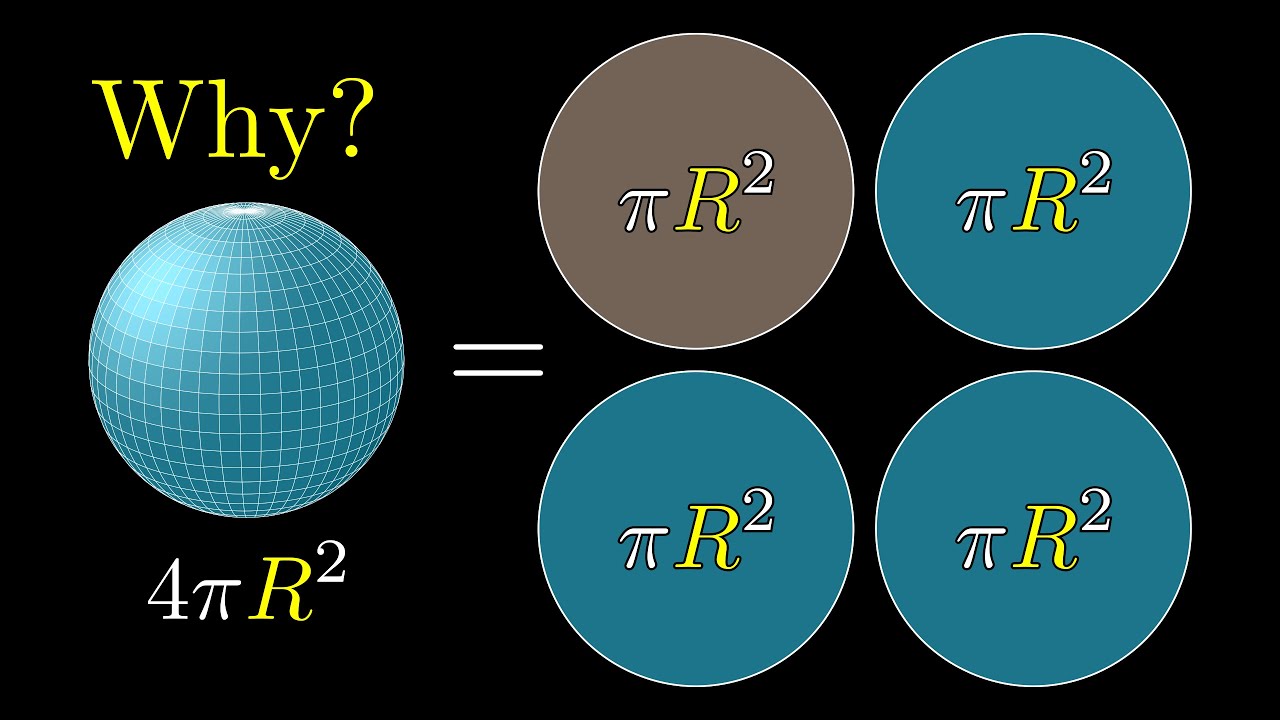
The formula is no mere coincidence.
Store: http://3b1b.co/store
Home page: https://www.3blue1brown.com
Special thanks: http://3b1b.co/sphere-thanks
Discussion on Reddit: https://www.reddit.com/r/3Blue1Brown/comments/a2gqo0/but_why_is_a_spheres_surface_area_four_times_its/
Th...
umbral snow
I'm sure there's some 3000 year old proof of the surface area of a sphere
pallid edge
WAIT IS THAT CALC I SEE ON A GEO PROBLM
vale nimbus
idk
pallid edge
bruh
umbral snow
A lot of geometry ends up being very calculus
You can prove this result with calc, but you don't have to
sour jacinth
@finite sky OK
sour jacinth
But you'll have to answer my questions, because I'm not gonna hand you the answers in a silver dish
split escarp
ok...
sour jacinth
Let's start
split escarp
i told him
split escarp
tru
sour jacinth
Let's say I have a triangle
sour jacinth
And that triangle has 2 congruent angles inside
split escarp
ok
sour jacinth
Do you know what happens with the sides that are not common to those angles?
split escarp
no
split escarp
ok
split escarp
yh
sour jacinth
Graphically stated:
Red angles are equal, so the sides with the double mark must be equal
split escarp
ok
sour jacinth
Why? Fold the triangle in half using its height as an axis and check why
split escarp
nice
 finite sky
Yeah
sour jacinth
Any questions so far?
split escarp
no
split escarp
yes
sour jacinth
Let me do some graphs in powerpoint
split escarp
also what year would you say this question is for
we encountered it in year 8
is it at our standards?
sour jacinth
No problem, you're welcome
split escarp
also may I ask what level of maths are you studying
university or high school or like what?