#geometry-and-trigonometry
1 messages · Page 299 of 1
 little osprey
 rigid thunder
Blew my mind when I first read about it 😄
 upper karma
Heron's formula be looking thicc tho
 lusty quest
little osprey
lusty quest
little osprey
no worries
upper karma
Hey how do I find the height of a triangle to one of its sides if I already know all the lengths of the sides of the triangle
,w heron's formula

 charred zephyr
Ok that probably took too much time
@upper karma thanks for the help!
upper karma
Ask if you have any doubts
 solar shale
How do I find the area
Ik how to solve
I just don’t know what to set it equal to at the end
solar shale
Here
upper karma
They gave you the surface area
so now add up all the faces and set it equal to 718
And then solve for a
S*
Make sense?
solar shale
Yeah
 solar shale
Rn nah I’ll @ u when I do if that’s fine with you
solar shale
Ok
 fading zinc
if nobodys in the middle of a question
Id like ask one
I have no idea how to do this
 glacial haven
just multiply by 5/2
 bitter sequoia
glacial haven
bitter sequoia
glacial haven
just use special triangle
upper karma
@glacial haven Wdym Special triangle?
Like I know how to get to the answer
But I don't know how to answer in terms of pi
<@&286206848099549185> Can you help pls?
 umbral snow
Well, what is the answer you got?
upper karma
I didn't get any answer, because I don't know how to answer in terms of pi
 idle bloom
what did you use to get the answer?
upper karma
But I got $$x=6\sqrt{3}
 somber coyoteBOT
ℂηαrℒ∫ξ:
Compile Error! Click the  reaction for details. (You may edit your message)
upper karma
I used Sine
somber coyoteBOT
ℂηαrℒ∫ξ:
Compile Error! Click the reaction for details. (You may edit your message)
umbral snow
Oh, haha you're correct, this isn't expressible in terms of π
 onyx cloud
all those answers look wrong lol
umbral snow
Yes, I thought it was asking for a radian angle but it isn't
idle bloom
well you got the right answer for x
umbral snow
So... uh
upper karma
Another typo
onyx cloud
i think they meant to ask for the last angle maybe
onyx cloud
cause d would work as the answer if x was the last angle
idle bloom
cause we know x has to be > 9
and also the side length can't be expressed in pi as stated earlier
so the exam is just wack
 hasty citrus
why is 10 *1 less than 5 * 5
or i mean 9 * 1
as in,
if there is a square, A, and rectangle, B, such that
the perimeter(A) = perimeter(B)
why is Area(A) >= Area(B)
upper karma
So
10(1)>9(1)?
In arithmetic it’s a basic and true statement
Geometrically you can understand that 10(1) > 9(1) if you construct some rectangles.
hasty citrus
Sorry that was unclear, i meant if we hold perimeter constant why does a square always have greater than or equal volume to a rectangle
 dark sparrow
@hasty citrus you saw it for yourself
a 9 by 1 rectangle has area 9 while a 5 by 5 square has area 25
same perimeter does not mean same area
oh you're asking why it's ALWAYS true for rectangles and squares specifically
there are a bunch of ways to explain that
are you comfortable with completing the square?
dark sparrow
@hasty citrus?
 supple onyx
No need to complete the square, if a square has sides x and area x^2 , then we can make a rectangle of the same perimeter with sides x-a and x+a. (x-a)(x+a) = x^2-a^2 which is always smaller than x^2 when a is non zero
dark sparrow
okay yeah true
hasty citrus
@supple onyx awesome thanks for the explanation, that makes sense but i still dont understand the intuition behind it, is there anything you would suggest
 silver spruce
can someone teach me this?
we can go to a voice chat where it may be more usefull
*useful
 mossy narwhal
Welcome pancake
mossy narwhal
lol I didnt help him and idk how to help 😬
silver spruce
haha lol
its okay
can i move this convo to a diff chat?
i think it may be more help there
mossy narwhal
Wait what
Ill stop talking here. I didnt mean to distract. Just saying welcome to a thank you.
upper karma
@silver spruce why exactly do you have a problem with almost 30 diff answers
silver spruce
haha lol
upper karma
that is a pretty extreme multiple choice question
upper karma
$f(x) = a(x-(9+7i))(x-(9-7i))$
somber coyoteBOT
polynomial:
silver spruce
so i just have to plug it in?
somber coyoteBOT
polynomial:
upper karma
then solve for a
silver spruce
i remeber now
upper karma
and that's it
upper karma
np i guess
and @dark sparrow taught me to tell people to go to right channels
so next time, ask in #prealg-and-algebra since this is an alg question
mossy narwhal
Nvm poly said it
hasty citrus
@dark sparrow i’d be interested in seeing your completing the square argument as well if you want
upper karma
@hasty citrus what is your question
dark sparrow
take a square of side a (perimeter 4a, area a^2). take a rectangle with dimensions x by 2a-x (whose perimeter is, again, 4a)
the rectangle's area is x(2a-x), or -x^2 + 2ax
complete the square on this and see that its max value is a^2 and occurs at x=a
silver spruce
wait @upper karma what does a =?
upper karma
that's what you're supposed to solve for
silver spruce
its just like a thing you may need to multipy for so the y int is 390 rite?
silver spruce
i still can' t find the awnser
i got 314.6590 thats obviously not the right awnser
can someone move to voice chat with me and explain it
thank you so much if it is possible
should I list my steps here?
somber coyoteBOT


Requested by polynomial#4757
somber coyoteBOT

Requested by polynomial#4757
upper karma
fucking useless
somber coyoteBOT
Commander Vimes:
 surreal bolt
hi?
 azure reef
i am from Ankh-Morpork
silver spruce
oh
lol im so sorry
thank you so much for your time
let me try again
wait
what was your awnser
i got X^2-18x+88=390
x^2-18x-302
1-18-302=319
silver spruce
okay
azure reef
because 319 is wrong answer
azure reef
1-18-302=319
moreover here it shold be negative
azure reef
so ok
silver spruce
but like its not in the awnser key
azure reef
9-7i is one of the roots
silver spruce
or like the thingy thing
azure reef
second root obviously is 9+7i
silver spruce
yea basically he wants a quadratic with real coefficents and a y int of 390
let me try
azure reef
?
somber coyoteBOT
Commander Vimes:
somber coyoteBOT
AZ.0629:
azure reef
why y
silver spruce
but then we solve to get $x^2-18x+88$
somber coyoteBOT
AZ.0629:
silver spruce
sorry i meant -7
upper karma
$y \approx 7$
somber coyoteBOT
polynomial:
azure reef
second 88 is wrong
silver spruce
is it?
azure reef
ye, there is no 88
silver spruce
thre is only two numbers
azure reef
do you know how complex numbers are multiplied?
somber coyoteBOT
Commander Vimes:
silver spruce
yea
azure reef
i mean to be precise
upper karma
the y-intercept occurs at x = 0.
azure reef

silver spruce
lol
azure reef
ok so AZ
silver spruce
yea i know
upper karma
good job deleting your messages
azure reef
look
silver spruce
*too
upper karma
AZ
silver spruce
wait can commader vimes just help me?
azure reef
multiply inner parts
azure reef
do not touch a yet
silver spruce
okay imma solve the s stuff right now
azure reef
but prolly it is better to keep (9+7i) and (9-7i) bracketed
upper karma
i am not sure how you can't solve it when i give you the answer
you should review how to expand binomials
i am not trying to be mean
but seriously
Multiply (3x+2)*(5x-7)
Practice this lesson yourself on KhanAcademy.org right now:
https://www.khanacademy.org/math/algebra/introduction-to-polynomials-and-factorization/multiplying-polynomials-by-binomials/e/multiplying_expressions_0.5?utm_source=YT&utm_medium=Desc&utm_campa...
silver spruce
$a(x^2-9x+7xi-9x+81-63i-7xi+63i+7)$
upper karma
and all you need to know is that sqrt(-1) = i
somber coyoteBOT
AZ.0629:
azure reef
ok so you are getting fucked up at that stage
silver spruce
its okay @upper karma , thanks for the help, but i'm pretty sure i think i get explanding
did i do anything wrong?
@azure reef did I do anything wrong?
somber coyoteBOT
Commander Vimes:
 crimson smelt
Why does everyone refer to khan academy
silver spruce
okay
upper karma
surely there shouldn't be any unclear steps using khan academy
crimson smelt
A good ol textbook
silver spruce
$x^2-x(9+7i)-x(9-7i)+(9+7i)(9-7i)$
somber coyoteBOT
AZ.0629:
azure reef
yes
silver spruce
should we expland the x(9+7i) stuff now?
silver spruce
wait what do you mean?
somber coyoteBOT
Commander Vimes:
silver spruce
oh okay
somber coyoteBOT
Commander Vimes:
crimson smelt
Factor out x
silver spruce
$a[x^2-18x+[81-63i+63i+7]
crimson smelt
$a[x^2-18x+[81-63i+63i+7]$
silver spruce
then a(x^2-18x+81)
somber coyoteBOT
Yes:
silver spruce
yea
azure reef
again fucked up
silver spruce
so we get a(x^2 -18x+88)
azure reef
i mean coefficient near x is correct
somber coyoteBOT
Commander Vimes:
crimson smelt
Bruh youre litterally just multiplying stuff
upper karma
will you review
the video i linked
or do you still want to stand strong with your "principles" and ego
azure reef
can you show exactly what you do here @silver spruce
azure reef
show multiplication literally step by step as for childs
silver spruce
9*9=81
azure reef
true
silver spruce
9*-7i=-63i
azure reef
true
crimson smelt
$i = \sqrt{-1}$
dark sparrow
{}
silver spruce
7i*9=63i
azure reef
true
somber coyoteBOT
Yes:
silver spruce
so 130
crimson smelt
How do people get the honourable role btw?
somber coyoteBOT
Commander Vimes:
crimson smelt
130a=390
azure reef
yw
upper karma
lol
1 hour and 4 mins ago
i gave you everything you needed to solve the problem
had you watched the khan academy video
this would've been done so much earlier
silver spruce
haha lol
its all good now
thanks @upper karma @azure reef @crimson smelt for helping me!
crimson smelt

azure reef

silver spruce
👍 👍 👍

 tepid dragon
If a pyramid is to a Pentatope, and a cube is to a tesseract, what is a regular icosahedron to?
dark sparrow
the 600-cell might be what you're looking for
 austere dragon
this might sound extremely dumb, but why do we add exponent 2 and 3 for volumes and area?
dark sparrow
wym
austere dragon
like cm^2 cm^3 that stuff
does it represent a different type of unit or is it just an exponent?
dark sparrow
different unit lmao
austere dragon
why
dark sparrow
when you find the area of a rectangle you multiply its length (in meters) by its width (also in meters)
meter * meter = square meter
little osprey
Good question not a dumb one
austere dragon
 i still cant differentiate length and width
 arctic vortex
can anyone help me with some geometrry homeworks??
 silent plank
dark sparrow
silent plank
dark sparrow
@austere dragon wym
little osprey
What do you think @arctic vortex
austere dragon
sorry i was just confused about the difference with length and width, i didnt know that length is actually the longest side instead of being named accordingly to the axis and stuff ^^^^
little osprey
I think youre right though
little osprey

This video shows how we can construct the perpendicular from a point on a line
would this be Z?
@arctic vortex I have no idea because I dont have the sheet of paper
little osprey
well what do you think
arctic vortex
i think i know the first one
idk about the second one
do you know it @little osprey
little osprey
Ok so its really confusing
have you drawn it maybe?
the wording
@arctic vortex
little osprey
Then how will you draw a circle 
upper karma
use a water bottle cap
little osprey
Ok fair
arctic vortex
this is important one
little osprey
as long as you know its a circle ig
little osprey
yeah its b
arctic vortex
yea
little osprey
The first one is based on the question you just posted
arctic vortex
yea
little osprey
So what do you think the first one is
The second one you have to draw and show me
I know the answer
But I want you to try and find out
arctic vortex
i think either a or c
little osprey
Why a and why c?
arctic vortex
because abd and cbd look congruent and they have an arc passing through the B
and ba = bc bc b is the common point of both
arctic vortex
idk
little osprey
because A and C are not necessarily equidistant
They just serve as points on the line
arctic vortex
o
this would be false right @little osprey
since there is no right angle formed
little osprey
Im sorry but I dont know
Honestly I havent done compass and angle constructions in a really long time
silent plank
its unclear what that construction even represents
little osprey
^
silent plank
it would help if things were numbered
little osprey
yes
arctic vortex
yes
little osprey
so what do you think
arctic vortex
and its asking for the measure of the space
little osprey
since the arcs will be congruent
little osprey
yes
arctic vortex
what
little osprey
wdym what
arctic vortex
its 90
little osprey
thats what I agreed to
arctic vortex
o
upper karma
@arctic vortex Did it solved?
upper karma
okay sure lemme go
silent plank
have you drawn a diagram?
why don't you think its 90°?
upper karma
..
upper karma
okay go
silent plank
seriously nfi what that's asking
arctic vortex
o lol

 olive solar
@arctic vortex which illustration
olive solar
if the angle ADH is the illustration why does it ask you to use point D
wait but it refers to an arc from the angle
like you have to draw an arc left of the arc in ADH
arctic vortex
o
olive solar
this question is incomprehensible
upper karma
Its like a gud qn to pass ur Lockdown period
upper karma
True
upper karma
It seems to be like
arctic vortex
o
arctic vortex
i have poor eyesight
silent plank
there's no clear information relating the 2 angles
upper karma
No, they are asking to observe the figures
arctic vortex
im thinking its false
silent plank
if its unclear, the default response would be false and ignore it
upper karma
Cool @silent plank
 lofty adder
Is it possible to convert a scalene triangle into an isosceles triangle?
Like is it possible if i construct a new 3rd side such that the median of the original triangle is the perpendicular bisector of the new side?
anyone?
this has been bothering me since 2 weeks
 paper vale
What do u mean convert, like obviously if u just change a side then sure
lofty adder
im sorry i didnt mean convert
is it possible to construct an isosceles triangle on the existing scalene triangle
ABC is scalene
im trying to construct a side EF such that AF=AE and AD is the perpendicular bisector to EF
paper vale
Well all u need is 2 sides to be the same, so u can do that
AD is perpendicular to midpoint iff it is isosceles
lofty adder
why is it that if i multiply BC by cos(alpha), i get a value equal to EF
paper vale
Is the line other than AD defining alpha perpendicular to BC
lofty adder
i dont understand?
paper vale
Well that line could just be arbitrary so it it meant to be perpendicular to BC
lofty adder
yeah i get that
that line is perpendicular to BC
hence forming alpha with the median
how does cos(alpha) give a result equivalent to EF
 midnight hearth
Looking for someone who'd be willing to spend a bit of time with me to explain me how to find the points of intersection of three spheres and implement it into code and vector arithmetic. Willing to pay
solar shale
X=10 is that right
upper karma
I think he might be but there’s a dispute so just send yes/no to clarify.
,w solve for x 30=1/2((5x+10)-3x)
No its not right.
solar shale
Ok
solar shale
Thanks I understand now x=25
upper karma
AO = 8 + radius
Now what’s the question
Looking for the angles?
Finishing the sides?
Area?
Area of the circle not including the triangle?
@solar shale
solar shale
Its asking if AB is tangent to circle O
upper karma
Hmm
You need to figure out if AB is perpendicular to BO
Meaning if there’s a 90* angle there
solar shale
Ok got it
charred zephyr
what? i actually got it's a right triangle
upper karma
perhaps
 cloud stump
do pythagoras and then if BO is equal to the missing part then it's tangent
wait
never mind
cloud stump
AO is 20
upper karma
And clearly the only possibly right angle on that thing is where it intersects AO
er
AB
solar shale
So I can’t just do 12^2 + 16^2 ≠ 16^2
charred zephyr
no
charred zephyr
u need to check if
AB² + OB² is equal to AO²
upper karma
Where’d you pull those from
@charred zephyr yes
But why the equation 12^2 + 16^2 = 16^2 @solar shale
charred zephyr
u have AB and OB, u need AO and it's easy to find since AO = 8 + r and radius is already pointed out by OB
upper karma
Where’d the other 16^2 come from
cloud stump
ok let's say the point where AO intersects the circumference is X then XO is 12 because it's a radius. That directly implies OBA is 90 degrees
upper karma
sex degrees what
cloud stump
sexagesimal
upper karma
Mmm yes
solar shale
I got the other 16^2 because half of one side was 8 so I added 8 now (other side) I have 16^2 now so I used 12^2 + 16^2 ≠ 16^2
@upper karma
upper karma
Half of one side is not 8, that is part of one side though
Half of that side would be 10 in fact
But good try
charred zephyr
are u done @solar shale
solar shale
AB² + OB² is equal to AO² ok so 16^2+12^2=AO^2
cloud stump
that's waste of time
solar shale
One side would be 400=AO^2
charred zephyr
whats the waste of time?
solar shale
I’m lost now
Ok I I get it so radius is 12 so I can do 12+8=20 and that is AO=20 so 16^2+12^2=20^2
400=400
charred zephyr
Step 1: Finding AO
AO = 8 + r (r is the radius of the circle)
Since OB is the radius of the circle, and OB = 12
AO = 8 + 12 = 20
Step 2: Applying the reciprocal of pythagoras
You have sides AB = 16, OB = 12 and AO = 20.
AO is the longest side.
Check if AO² is equal to AB² + OB² and deduce the nature of triangle OBA.
Step 3: Angle ABO
After deducing the nature of triangle OBA, conclude the measure of angle ABO.
Using a famous circle tangent propetry (hint: perpendicular lines), is AB tangent to the circle?
charred zephyr
gr8
solar shale
Someone verify that?
solar shale
Ok thanks
solar shale
I got 2870 for an answer can someone verify that
 runic beacon
What is the question? To find area?
solar shale
Oh wait nvm I confused two problems ignore the pi
Feel free to @ me once someone verifies that if 2870 is the answer
glacial haven
@solar shale yes sir
cloud stump
the volume?
find the volume of the parallelepiped and divide by 2
o wait
never mind
it's not perpendicular
silent plank
@solar shale show work
upper karma
cos20=cos40+cos80
somber coyoteBOT
HoboSas:
 novel flax
ok i will try
$\cos (40)+\cos (80)=2\cos (60) 2\cos (20)
= 2\left(\frac{1}{2}\right) \cos(20) = \cos (20)$
somber coyoteBOT
Orange905:
novel flax
wow thanks @upper karma
upper karma
Np
upper karma
if i have two line segments coming out of the middle of a circle and they have two points on the edge of the circle, how do i find the minor arc between the points
Middle of a circle?
Do you mean center?
yes
There's a formula
If you know the angle between the 2 segments
o i think i got it
 next fable
The rules for rotating a point in a plane are something to the sort of 180 degree rotation counter clockwise (positive) or clockwise (negative) as "-x. -y", but what about rotations such as 130, 120 etc is there any rule for these or do they just have to be done using a protractor?
next fable
<@&286206848099549185>
 weary drift
rotation in the plane by any angle t can be viewed as a linear map on R^2 and can be represented by this matrix R_t @next fable
$R_t=\m{\cos(t)&-\sin(t)\\sin(t)&\cos(t)}$
somber coyoteBOT
RokettoJanpu:
weary drift
a rotation by $\pi$: the image of $(x,y)$ under $R_\pi$ is
$$R_\pi\m{x\y}=\m{\cos(\pi)&-\sin(\pi)\sin(\pi)&\cos(\pi)}\m{x\y}=\m{-1&0\0&-1}\m{x\y}=\m{-x\-y}$$
somber coyoteBOT
RokettoJanpu:
solar shale
@ me
 hollow mica
Form is perfect dude
And calculations are ok
To check yourself : put your answer where "r" is at in the volume equation
umbral snow
Easy way to check, what's the volume of a 4.5 cuft radius sphere?
Also, be sure to put cuft on your answer
Units and all that
hollow mica
Well, just feet right? It's raidus
solar shale
Just feet
umbral snow
Oh haha yes.
hollow mica
Why did you drop the pi*r^2 before that part of the equation for the surface area of a cone?
solar shale
I’m not sure what you mean like where that go
hollow mica
Sorry let me show you the eq I was thinking of
But if your assignment defines it as whatever you just showed me as then I'd continue using that
From what I saw in your screenshot your math was correct
solar shale
Wait I’m not sure honestly
I’ll just solve it and give my final answer and then someone could verify that
hollow mica
Stuck?
Show me your work m80
Is the computer you're doing your hw on the same one with discord ?
upper karma
How do I find the side length of an equiangular triangle if I know the radius of the triangle
dark sparrow
wym by radius
austere dragon
what do people use as an alternative to pi in a job or career somethin like that? do they use calculators? 22/7? 3.14? or just leave the pi symbol?
austere dragon
i mean, there has to be a convention or something, calculating with pi would be impossible wouldnt it? and theres a whole lotta method out there
glacial haven
nah they use pi
austere dragon
but pi is infinite?? it has to be estimated
austere dragon
 what
what
dark sparrow
pi is a finite value. it's less than 4.
austere dragon
oh i mean, it uh.. hmm idk what word to use
dark sparrow
its decimal expansion is infinite but so what
dark sparrow
by your logic, so's the number 1/3.
 shit
dark sparrow
shit
dark sparrow
yes pi is irrational yes its decimal expansion is infinitely long and non-repeating but again so what
austere dragon
you cant calculate it if the decimals never ends!! it's like multiplying a number you dont know the exact value of, you need to estimate it
dark sparrow
...
if you're doing any calculations with computers you aren't storing anything with infinite precision anyway
you can't calculate 1/3 exactly as a terminating decimal either so what

 dark sparrow
if you want an approximation then take as many decimal places as you need, and i can hardly imagine needing more than 40, tops
as far as symbol manipulation is concerned, pi is just pi
 twilit zenith
I could be mistaken.
Since you are required to perform a projection, it would be more convenient to transform your current basis (the standard basis with e1 = (1, 0, 0), e2 = (0, 1, 0), e3 = (0, 0, 1)) to an orthogonal basis where (1, 2, 2) is one of the vectors.
Then, you can convert your vector x from the standard basis to the new basis, and then you can apply the "projection matrix" on the "converted" vector.
More formally, you begin with a matrix $P_{B}^{E}$ that converts from the standard basis $E = { \begin{pmatrix} 1 \ 0 \ 0 \end{pmatrix}, \begin{pmatrix} 0 \ 1 \ 0 \end{pmatrix}, \begin{pmatrix} 0 \ 0 \ 1 \end{pmatrix} }$ to an orthogonal basis where $b = \begin{pmatrix} 1 \ 2 \ 2 \end{pmatrix}$ is one of the basis vectors, and then you apply $T_{B}^{B}$ which is the projection on a vector whose components are given in the new orthogonal basis $B$, and in the end, the desired transformation is $T_{B}^{T} \circ P_{B}^{E}$.
somber coyoteBOT
RoiKadmon:
twilit zenith
I think that was a blob of text with no real explanation. I'll try to give a simpler example: $\$
Let's say that you're interested in finding the projection of a vector to the subspace spanned by $e_1 = \begin{pmatrix} 1 \ 0 \ 0 \end{pmatrix}$. In this case, you need to find an orthogonal basis where $e_1$ is one of the basis vectors. Fortunately, the standard basis, $E = {e_1, e_2, e_3}$ is already such a basis, and thus, in order to perform the projection operation, we must only consider what the projection $T_{E}^{E}$ does on each of the basis vectors. Indeed, since the projection only considers the component of the first vector, keeps it as is and "ignores" the other vectors, our desired transformation is $T_{E}^{E} = \begin{pmatrix} 1 & 0 & 0 \ 0 & 0 & 0 \ 0 & 0 & 0 \end{pmatrix}$. $\$
Indeed, for an arbitrary vector $q = \begin{pmatrix} a \ b \ c \end{pmatrix} = a \cdot e_1 + b \cdot e_2 + c \cdot e_3$, the result of the projection is $T(q) = \begin{pmatrix} a \ 0 \ 0 \end{pmatrix} = a \cdot e_1 + 0 \cdot e_2 + 0 \cdot e_3$, and if we compute the matrix, we get: $\$
$T(q) = \begin{pmatrix} 1 & 0 & 0 \ 0 & 0 & 0 \ 0 & 0 & 0 \end{pmatrix} \cdot \begin{pmatrix} a \ b \ c \end{pmatrix} = \begin{pmatrix} a \ 0 \ 0 \end{pmatrix}$.
somber coyoteBOT
RoiKadmon:
 earnest sphinx
Great! Very useful! Thanks!!
 livid sequoia
is this right?
 near trail
How can I calculate how fast to rotate the corner piece texture around it's axis, in order to make it match the texture movement for the joining straight pieces.
Picture for clarification. Any tips are appreciated!
upper karma
Establish an angular velocity
Every pixel will have the same angular velocity
The linear velocity is just the distance from the center of the circle times the angular velocity
@livid sequoia can you provide more context?
livid sequoia
nvm I figured it out
 pearl lava
How do I write a proof for this?
https://gyazo.com/e8e35a545a5b3eb672e1d2c53a67cf0b
 upper karma
"How do I write?" or "how do I prove this?"
pearl lava
where do I start
pearl lava
it's an isosceles triangle
pearl lava
FH=GJ?
pearl lava
HK=KJ
pearl lava
do I use SAS?
upper karma
Yes you got it
upper karma
Np
paper vale
FIK is congruent to GIK is another way
upper karma
help please :)
i think this is where SOHCAHTOA could apply..?
i'd recommend looking into SOHCAHTOA to solve this problem and other similar problems
 prisma cape
Hint: what trig function is opp/hyp
upper karma
@prisma cape sin
prisma cape
That would be correct. @upper karma
twilit zenith
In this specific case, you are given that the two dimensions of the rectangle are equal, so it's a square pyramid.
However, assuming you have 3 right angles (meaning this is a rectangle) and you aren't told that the dimensions are equal, that it's a square or any other information that would indicate that this is a square, I think you can only assume it's a rectangular pyramid.
solar shale
Ok so if 2 sides of a square are the same then I can say that is a square pyramid as a rectangle would be different numbers @twilit zenith
twilit zenith
Indeed. (assuming the two sides are next to each other. The opposite sides are equal in any rectangle.)
Also, just a tiny correction:
A rectangle in which all the sides are equal (i.e. a square) is still a rectangle, so it's probably more accurate to say "a non-square rectangle would have different numbers" as opposed to "a rectangle would have different numbers".
idle bloom
 upper jetty
solar shale
upper jetty
solar shale
Can someone verify that?
dark sparrow
total surface area or lateral surface area?
solar shale
Total
 hidden phoenix
So I just popped on to have a quick question about a video I saw
So in this one video

Inspired by the "comparison" videos that are recently popular on YouTube, we examine how fast are various geometries/graphs/groups growing.
It claims there is a "chigorchuk group"
dark sparrow
 hyperrogue
hidden phoenix
but it looks like {8,3} schläfti thing
dark sparrow
hmm
hidden phoenix
and then it goes through the vertexes and fills it
is that really ghigorchuk group?
dark sparrow
you mean grigorchuk
dark sparrow
In the mathematical area of group theory, the Grigorchuk group or the first Grigorchuk group is a finitely generated group constructed by Rostislav Grigorchuk that provided the first example of a finitely generated group of intermediate (that is, faster than polynomial but slo...
dark sparrow
@strong sage mind explaining? i don't seem to get it either but you may have a better idea since you made the vid
hidden phoenix
wow he is here
hidden phoenix
@strong sage So isnt the "grigorchuk set" featured in the video same as if you take {8,3} schläfti tiling and fill it though the edges
 strong sage
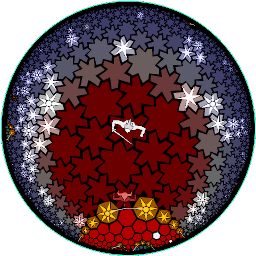
@hidden phoenix generally this is a visualization of the (index 2) subgroup generated by ac, ca, and b. Each of these generators corresponds to a move (isometry) in the hyperbolic plane. You have (ac ac)^4 = (ca b)^4 = (ac b)^4, which is exactly the same as in {3,8}, so the three moves are the moves in {3,8} which makes these relations hold. There are of course also other relations in the Grigorchuk group (which do not hold in {3,8}) -- these are represented by using a hyperbolic manifold (with its isometry group = Grigorchuk group) rather than the hyperbolic plane, so you can take a path in this space which would move you back to the starting point, while in {3,8} the same path would end in a different spot. (The gray lines at the end of the video visualize this.) The implementation and some more comments are in https://github.com/zenorogue/hyperrogue/blob/master/rogueviz/grigorchuk.cpp [I must update it to yesterday's changes in HyperRogue engine, it does not compile at the moment]
GitHub
A SDL roguelike in a non-euclidean world. Contribute to zenorogue/hyperrogue development by creating an account on GitHub.
hidden phoenix
ok
dark sparrow
so what you're saying is that in the video we're looking at a quotient?
strong sage
quotient space of the hyperbolic plane, yes (although this quotient is a bit too large, so repeated images are only in faraway, small, unseen regions of the Poincare disk)
upper karma
when i mention derivatives i get yelled at
when people talking about groups and hyperbolic planes in #geometry-and-trigonometry it is fine
Still geometry
strong sage
geometric group theory
 dim pulsar
analytical geometry
hidden phoenix
Hyperbolic geometry is geometry
livid sequoia
Can someone check if I got this right?
paper vale
it is 14.2
supple onyx
Hyperbolic geometry might be geometry but it aint pre university stuff
That's what #point-set-topology is fo
For*
 radiant nimbus
how many 0.2 km^3 cubes would fit in a 1 km^3 cube would it be 125?
like if a 1 km^3 cube was scored by increments of 0.2 in each dimension, that would be 5 per dimension so 5^3?
radiant nimbus
sqrt(5^2+4^2)
 next jackal
Pythagoras
 idle bobcat
My logic being that since we can separate the triangle into two 30 60 90 triangles, the hypotenuse would be double the shortest angle
yeah I did the pythagorean theorem to solve
but the more i thought about it if the 30 60 90 proportions check out the answer should be 8
radiant nimbus
its sqrt 41
the length 5 stays same, 8 is divided
so 5^2+4^2=r^2
to get r you square root both sides
idle bobcat
but if you split the entire triangle into two equal triangles you get two 30 60 90 triangles
radiant nimbus
no
idle bobcat
and therefore shouldnt I be able to use the 30 60 90 proportions
radiant nimbus
you get 2 45 45 90s
the original is a 30 60 90
when you split it down the middle it becomes a perfect right triangle
well 2 of them anyway
idle bobcat
im confused
how is the original triangle 30 60 90
the base angles are equal
its isosceles
radiant nimbus
well im assuming since it's not listed
ah well
in that case
i stand corrected but splitting it wouldn't form 2 30 60 90s, i know that for certain
radiant nimbus
well
actually you might be right lol
eyeballing it it looks like all 3 sides could be different angles
but
the important thing is that you are dividing the bottom length in half
so it becomes 4^2
5 stays the same
since both triangles share it
idle bobcat
its definitely not 30 60 90 otherwise x would be 8 lol
yeah
it actually just makes another isosceles triangle
now that i think about it
wait no it doesnt lol
ok im confusing my self im gonna stop
radiant nimbus
lol it's all good. were you using the angles to solve?
you don't really have to in this case you just need the lengths
you would only need angle info if you weren't given info about lengths, then you could solve for a sides length using sin, cos etc
radiant nimbus
yeah that's all it is
idle bobcat
but I just tried to disect it more and thought I had a 30 60 90
and then we end up in this rabbit hole
lol
radiant nimbus
lol
i think it is a 30 60 90 though
but
that would make the length 16 i think
idle bobcat
if it were 30 60 90 wouldnt it make x = 8
 primal flicker
I did the math
radiant nimbus
well
idle bobcat
since shortest side is 4
radiant nimbus
yeah
radiant nimbus
well the hypotenuse of a 30 60 90 is 2x
radiant nimbus
so
pythag for the win lol
I wish I was still doing geometry. I'm taking differential equations next semester and I'm a little nervous about that
idle bobcat
im 21 and im only just finished pre algebra recently lol
didnt care for math in highschool
radiant nimbus
nothing wrong with that. I'm in my 30s and going back to college lol
idle bobcat
went onto community college for programming
got an internship doing full stack development
idle bobcat
now im trying to learn math from the ground up
ive been using khan academy for 6 hours a day everyday the past month
lol
its a grind but im enjoying it
radiant nimbus
a few things that will help you be a better dev, learn some linear algebra (mostly basic matrix ops) and learn some discrete mathematics/ stats/probability
idle bobcat
yeah thats the plan, i wanna get to a level where I can understand the core machine learning algorithms and start implementing my own neural nets
and yeah I heard discrete math was a big part of computer science
radiant nimbus
its pretty important. you can probably mostly ignore the stuff with proofs. but boolean algebra is a godsend for writing algorithms
learn how to write karnaugh maps too, most people find that easier than simplifying/reducting the boolean
idle bobcat
dont know what any of that means but 🙂
radiant nimbus
if you're already doing full stack stuff, chances are you've already been doing some form of boolean algebra and didn't realize it lol
like your statements like say if (this):
then this
etc
or if(not this and not that or this) stuff like that is boolean expressions
and the stuff we come up with is often redundant so you can use boolean algebra to get it in its simplest yet equivalent form to your original expression
helps make programs more efficient basically
idle bobcat
ahh I see what you mean
hmm, still a bit difficult to imagine what a whole field of math dedicated to booleans could entail
im intrigued
radiant nimbus
well discrete math is more than just boolean algebra. but boolean algebra in general will be really useful to you. boolean algebra is less of its own field and more of a set of tenets or rules for handling expressions that only deal in trues of falses, or 1's and 0's
like if I gave you an expression if(A or B) you could write a truth table that would show there is only one state that can exist for that expression where the output would be false, any other time and it's a true result
and with boolean algebra you can do cool things that are basically equivalent expressions like if I said (Not A and Not B) it is logically equal to (A or B)
idle bobcat
man that sounds it would be incredibly useful for lower level development
when do you typically start learning discrete math
radiant nimbus
its like
probably a sophmore level class at uni
maybe freshmen if you started higher in your math classes
some people can skip a level or 2 of calculus
I think you need at least Calculus 1 to take it
but really, you might be able to get by without Calculus if you are studying it on your own
though knowing basic derivatives and integrals is always useful
radiant nimbus
It's pretty useful lol
idle bobcat
ye
radiant nimbus
some of it is pretty boring tbh, but I thought it was fun for the most part
idle bobcat
my only fear is that by self learning on khan academy I'll be missing out on a lot more core mathematical concepts
radiant nimbus
A lot of Calculus, especially Multivariate is really more critical thinking and less "plug and chug" numbers