#geometry-and-trigonometry
1 messages · Page 295 of 1
 weak shoal
Yea sure
pi = 180
so each angle has measure 60 degrees
or pi/3 radians
? have you not covered this in class?
 ancient vine
 dark sparrow
have you made a diagram?
 upper karma
F
 finite vigil
Does anyone have time to help me with some Geometry IXL work? Similarity Theorem? If so please @ me thank you in advance! 😄
If I don't get the ping I won't know you responded haha
upper karma

finite vigil
Should I send the question?
upper karma
upper karma
there will be a second season
upper karma
it's been a long time since ive worked with similar triangles, so lemme try to recall how things should work out here
finite vigil
The pythagorean theorem doesnt work for this one @glacial haven
also okay np TTerra
upper karma
well, first you want to figure out some similar triangles in the diagram here, and then look at the ratios of corresponding sides
those ratios will be equal iirc, so then you use the given information to find KM
just a matter of picking the right correct triangles and ratios
which is, for some reason, escaping me
alright, here is my suggestion: see if the triangle i shaded in red is similar to the entire triangle (i am choosing to use this triangle in the diagram because i know two sides of it, and so it's more likely to tell me more information via similarity)
and then because the triangle in red shares a side with the entire triangle, you can use the fact that corresponding sides of similar triangles have equal length ratios to finish the problem
(i actually haven't done this in about 4 years so sorry it took so long to get something out)
@finite vigil
(im assuming the similarity theorem has something to do with justifying that the triangles are indeed similar)
 glacial haven
wait you do use pythagorean
upper karma
maybe you can use pythagorean and some trigonometry
but it's asking (implicitly) for similarity to be used
finite vigil
ty terra for the help my teach explained we can solve it thru a table
 arctic vortex
is this good for my angles of elevation project
upper karma
@meager pendant still here?
 meager pendant
yeah
upper karma
Solved it?
meager pendant
not yet
upper karma
Have you taken a look at my advice?
upper karma
Ok
meager pendant
thanks for your concern tho , I’ll report back to you
upper karma
Ok
 livid sequoia
I got the answer for this but I want to know how to actually do it step by step can someone explain?
dark sparrow
how did you get the answer?
livid sequoia
My teacher told me last second and she left, I wanted her to explain how but the class ended
dark sparrow
okay...
big picture, there are two steps here
- calculate the area
- calculate the total cost
the area can be calculated in a bunch of ways, but they'll all involve rectangles combined in one way or another
livid sequoia
A = L x W, so the L would be 3 and the W would be 3.6?
dark sparrow
this is just one of the rectangles in one of the possible area calculation methods
3.6 * 3 is the area of the red rectangle
livid sequoia
oh
upper karma

livid sequoia
I use pi?
dark sparrow
...no
there are no circles here
if you subtract off the area of that little white rectangle in the corner, you will get the area of the bedroom.
livid sequoia
3.6 minus the 1.2?
dark sparrow
what does that give you?
livid sequoia
2.4
dark sparrow
no
i didn't ask you to calculate it
i asked you what the answer would represent for this problem
livid sequoia
that would give you a rectangle
dark sparrow
no, it'd give you a number.
what does the number represent?
what does this 2.4 figure mean for the problem?
livid sequoia
the width
dark sparrow
the width of the white rectangle, great.
so now what's the area of the white rectangle?
livid sequoia
2.4 times 0.6= 1.44
livid sequoia
you add the 3.6 with 1.44?
dark sparrow
why would you add a length to an area
dark sparrow
10.8 m^2 is the area of the red rectangle
1.44 m^2 is the area of the white rectangle
what would their sum represent?
dark sparrow
don't you think the white rectangle, instead of being counted TWICE as you did, shouldn't be counted AT ALL?
livid sequoia
I guess not since its not part of the bedroom
can we cut it, do the L x W with 3.6 and 3 and the area for the small piece 0.6 times 1.2?
dark sparrow
3.6 * 3 will give you the red rectangle
if you're asking whether or not you can cut it up like this: you can
but the blue rectangle will not be 3.6 by 3
dark sparrow
if you want to phrase it that way, sure...
livid sequoia
2.4 times 3.6 = 8.64
arctic vortex
is the asnwer to this 1788.30
livid sequoia
then I can do 0.6 times 1.2= 0.72+8.64= 9.36
then times that by $9.50
OH
Thank you!
arctic vortex
good luck in ur test corosu
livid sequoia
I'll get a high score thanks to Ann
arctic vortex
yeah ann is a genius at geometry
@dark sparrow sorry for the ping but can u check my asnwer??
for tihs one is the answer 1788.30
dark sparrow
did you write this problem yourself
dark sparrow
you have conflicting info between the problem statement and the diagram
dark sparrow
well ok you've cleared up the altitudes
what's the angle of elevation supposed to be
arctic vortex
from the bird to the airplane
dark sparrow
i got that much
but is it supposed to be 34 (as per the diagram) or 64 (as per the text)
arctic vortex
what
how
is it the distance from the bird to the plane
i used sin34 = 1000/x if that is correct
dark sparrow
no it's not
the duck isn't at ground level
it's 500 feet above the ground
so the vertical distance between the duck and the plane is 1000 - 500 = 500
(feet)
dark sparrow
the calculation would happen to be exactly the same
dark sparrow
500/sin(34°).
dark sparrow
the duck isn't at ground level
it's 500 feet above the ground
so the vertical distance between the duck and the plane is 1000 - 500 = 500
upper karma
@finite vigil is it a test?
upper karma
Okok
finite vigil
I'm on this one rn
upper karma
Actually its a special right triangle
So do you know the relationship between the sides? @finite vigil
finite vigil
no
upper karma
@finite vigil srry had to eat, still need help?
upper karma
Okay so
Hold up
Click on it
That's a truth for every 30 60 90 triangle with the angles in those positions
@finite vigil
x can be whatever and the truth will hold as long as it has the conditions i said above
finite vigil
I clicked on it
upper karma

Proving the ratios between the sides of a 30-60-90 triangle
Watch the next lesson: https://www.khanacademy.org/math/geometry/right_triangles_topic/special_right_triangles/v/45-45-90-triangle-side-ratios?utm_source=YT&utm_medium=Desc&utm_campaign=Geometry
Missed the previous ...
finite vigil
ty
upper karma
Alternatively, using the law of sine would also work here for a more general approach to these types of question (see also: https://en.wikipedia.org/wiki/Law_of_sines)
 silent plank
where are you stuck?
 gritty flicker
entire question
actually
nevermind
i got it
this one
is the one i dont get
silent plank
have you tried drawibg a diagram?
upper karma
but idk where 1.6 comes in
@gritty flicker you know that the eyes are not on the ground right?
silent plank
so indicate that that position is 1.6m above the ground
 quick gyro
You might want to include the tree, ground, and thomas' eyes
upper karma
Think about angles
👏 👏
@upper karma note that the triangle XYZ is isosceles...
Actually equilateral...
arctic vortex
can someone check this
silent plank
can't you fix your diagram or text for the details to match?
diagram labels could be clearer, that 1000 could be misinterpreted as the distance of that edge instead of plane altitude
also 10000ft actually seems like a more reasonable flight height. i'd be concerned if a plane was flying horizontally (not landing/taking off) at 1000ft
upper karma
Actually equilateral...
@upper karma holy fuck why did i not realised lol
@upper karma hello?
upper karma
👻 👻
upper karma
yes its awesome
 vapid vector
How do we know that they are equal?
silent plank
inscribed angle theorems
vapid vector
Oh ok
dark sparrow
this is not a proof
dark sparrow
it's the statement of a theorem
arctic vortex
can anyone check my homework answers for like 10 questions?
and i might need help with some questions
dark sparrow
if possible, could you post the questions all at once and your list of answers, so that we don't have to go through them one by one?
i for one find that extremely annoying
upper karma
👻
upper karma
I didn't know 1 second lasted 1h
dark sparrow
if possible, could you post the questions all at once and your list of answers, so that we don't have to go through them one by one?
arctic vortex
oh ok
5 minutes pls
@dark sparrow which one would this be
i think its the pythagerona theroen
dark sparrow
so much for not going through them one by one huh
arctic vortex
sorry
ok i will do that
i like to do things where after i finish 1 i go to the next
@dark sparrow wait so is it the pythageoran theorem
dark sparrow
all at once, please.
dark sparrow
all at once.
arctic vortex
ok
i understand most of them there are just a few that i dont understand
@dark sparrow
dark sparrow
okay, i see the questions. can i have your answers for them all?
no, i am not going to verify them one by one.
dark sparrow
what don't you understand about this?
do you know what it means to fold something in half?
arctic vortex
i dont know how to get x
dark sparrow
that neither answers my question nor makes it clearer to me where your confusion lies.
 stray pelican
ill reupload
stray pelican
arctic vortex
oh
stray pelican
make sense?
arctic vortex
isnt it suppposed to be tan
tangent
because opposite and adjacent
and yeah it makes sense now
stray pelican
I'm just using law of sines
arctic vortex
oh ok
stray pelican
you get it now?
arctic vortex
yesss
stray pelican
good
dark sparrow
to be honest i'm not terribly inclined to help at this point
arctic vortex
oh
stray pelican
im not gonna tell you the answer i want you to figure it out but ill give u a hint
it looks like you should use the pythagorean theorem
arctic vortex
oh ok
i will use that
by the way how do u get honorable rank
@stray pelican can u check this if it is correct
arctic vortex
guess what guys
i got a 23/24 on my homework
now i need to study for the test
yesss im quite a genius
 royal edge
AED is a straight line. I am completely stumped on this question
It’s not a parallelo gram
weak shoal
@upper karma What is the issue you're having?
 idle bobcat
Hello, so I know that <QPR + RPS = 180, and thus u can solve for x, but can't you do the same thing by doing 180-<QPR = <RPS?
because if you subtract one angle from 180, cant you find the other angle
 stone adder
Yeah, you can do that
since 180 degree - <QPR = <RPS is derived from <QPR + <RPS = 180 degree
It's the same thing, since in the end you're asked to find the value of x, which <QPR and <RPS has x on them
idle bobcat
ok just making sure, because when i did it this way i keep getting the wrong answer
so im doing 180-2x+122 = 2x+22
 somber coyoteBOT
Wilston Lynx:
stone adder
You're welcome!
silent plank
what have you thought about?
 tidal river
royal edge
tidal river
royal edge
Quantum try drawing it out first
Let’s start with that, and once you do that, tell me
upper karma
F
royal edge
Xi can you send me that profile picture?
upper karma
Hmmmm
royal edge
Pretty please?
upper karma
Anyone know what the foci for this is
stone adder
What's foci?
upper karma
idk but it's asking for it
focus
oh
how do you get it
yes
what
I believe there's a formula
yep
Google it
k ty
 sleek thistle
okay thanks lmao
upper karma
Np
finite vigil
Could anyone help me with a trig IXL? I need to get up to an 80 if so please @ me ty in advance
 deep stump
can you help with these problems ?
upper karma
seems pretty hard
dark sparrow
@deep stump do you still need help with these
and if so, which ones
ok, now that you've (presumably on accident) DM'd me saying you do need help on these
which ones do you need help on
@deep stump are you gonna respond here or are you gonna insist on DMing me even after i've made it clear i would prefer you didn't?
deep stump
@dark sparrow It's just clear to me now, thanks
dark sparrow
okay so are you gonna answer my question
which of these problems do you need help with
so that we can go through them in order
deep stump
@dark sparrow They clear to me now, when I need help with other ones, I ll ask again, thanks
dark sparrow
ok
sleek thistle
anybody know of a rule or just how to get this length?
don’t even know how to start
dark sparrow
consider that ABCD is a rectangle, as the problem literally tells you
what do you know about the diagonals of a rectangle
sleek thistle
that it’s equal
deep stump
@dark sparrow available now?
I have this problem to find the eccentricity of an ellipse if the sides of the square inscribed in it pass through the foci of the ellipse. Can you help?
sleek thistle
omg
it’s 5 i’m a pop tart
damn
well i overthought the shit out of that for no reason
dark sparrow
@deep stump have you made a diagram yet
deep stump
I am doing game development and I had to solve this problem
@dark sparrow How would you solve that?
dark sparrow
well my first step would be to make a diagram
deep stump
can you help more?
dark sparrow
actually heres a more extensively labeled diagram
notice that this diagram is symmetric about both axes of the ellipse so we have that F1 and F2 are the midpoints of AD and BC
taking $AF_1 = 1$ for convenience, we have that $$2a = F_1P + F_2P = F_1B + F_2B = \sqrt{5} + 1$$ and $c = F_1O = 1$
somber coyoteBOT
Ann:
 elder shuttle
does anyone know what is arcsin(1 - sin^2x)?
dark sparrow
i don't think this can be simplified any further than arcsin(cos^2(x)) @elder shuttle
is there a problem you're doing where you found this expression?
 misty plume
Anyone has a intuitive method to part a? I ended considering the area of an individual triangle then multiplying it by n sides for A, but would be cool to know if there are faster methods...
dark sparrow
nah that's p much the fastest
arctic vortex
Can anyone help me with this please
Your explanation is not correct, you state that the given pair of angles that add up to 180 are supplementary In your correction, please state the name of this supplementary angle pair, as formed by parallel lines cut by a transversal?
this is what the teacher said
oh
never mind
i just need to name the angle pair
royal edge
Makes sense
arctic vortex
yes
@royal edge what kind of angle pair is this??
i think its congruent angles or consecutive interior angles
royal edge
I got it, it was SAS
They were corresponding angles Bcs they were parallel lines cut by a transversal
elder shuttle
@dark sparrow It is this problem:https://mainapp-frontend-preprod.toppr.com/ask/question/the-diagram-shown-the-graphs-of-y-tan-x-and-y-cos-x/

Toppr Ask
(i) tan x = cos x →sin x = cos2 x sin x = 1 - sin2 x sin x = 0.6180. Allow ( - 1 + √(5))2 x - coord of A = sin-10.618 = 0.666radians (ii) Eitherx - coord of B is (π - 0.666)radians = 2.48 y - coord of B is tan(2.475) or cos(2.475) x = 2.48 , y = - 0.786 or - 0.787 x = 2...
 dapper solstice
hi i need some help with trig pls, i dont get when to use or how to see which one to use between cos sin and tan
why do they use tan here and not anything else, also how do they get 23degrees from 0.429??
dapper solstice
emm
how do i write this in my calc? tan(0.429)^-1?
tan^-1(0.429) this gives me error
also is it ^-1 for all sin cos tan to find its degree
silent plank
depending on the calculator, probably a variation of
shift + tan
or
function key + tan
or some trig submenu
dapper solstice
hm
i do have mode button but that only changes from radian to degree and vice vers
assume thats the wrong 1
ooooooooooooo i found it n v m
it was just the "2nd" button lul
ty brother
 silk crown
ok, send me your working/reasoning
silk crown
let me see
what is the cosine rule @upper karma
you did not write an equation lol, if you did it would have been clearer
upper karma
c^2=a^2+b^2-2abcosC
silk crown
yes
upper karma
yea i was kinda rushing
silk crown
then write the equation this time
c^2 = ....
and then at the end take sqrt on both sides
your expression is correct, but the square root of that is the answer
i checked with a calc and it is the right answer
¯_(ツ)_/¯
upper karma
I'm gonna check the book's answer
silk crown
5.6cm lol
you get 5.59... something
this is why you dont rush
write your equations properly
upper karma
yea the books answer is the same as written
I got 5.598 for my solution
Book's answer is 5.64861 which i just checked
silent plank
the books crap
silk crown
oh lmao i only saw their final answer
upper karma
so there answer is wrong?
 silent plank
theoretically, both the sine and cosine laws can be applied, but due to rounding issues, the values obtained are off
cosine law only focuses on triangle ADC. calculations using that don't rely on external info which is what you applied and what i'd recommend
although you should make your square root clearer
and don't split equations on two lines
upper karma
my bad again i was rushing through this
silent plank
(there's rushing and there's being oblivious to math rules/ettiquete)
upper karma
true
silent plank
based on the values within triangle ADC, angle ACD actually works out to be around 99°
silk crown
im pretty sure the book's working is wrong though
silent plank
nah, its just that the values are inconsistent
if they were actually consistent, applying the sine law like that would get the same result
silent plank
yeh. over specification is an issue
leads to multiple different answers from "correct" methods
silent plank
both methods are acceptable
but technically there are no correct answers due to inconsistencies
but i mean if you're rounding to 1dp
you'd get 5.6 for both which is just a coincidence
 teal stag
 wooden current
bruh
@arctic vortex What's giving you trouble
Unless you have solved it already
wooden current
It's ok. Sorry for the ping 😅
arctic vortex
its ok
upper karma
just wondering is there a name for when imput to trig funcsions are the same?
 nova prawn
can you proove that this triangle = formula of circle

Practice this lesson yourself on KhanAcademy.org right now:
https://www.khanacademy.org/math/geometry/cc-geometry-circles/equation-of-a-circle/e/pythagorean-theorem-and-the-equation-of-a-circle?utm_source=YT&utm_medium=Desc&utm_campaign=Geometry
Watch the next lesson: https:...
have found it
upper karma
like are you looking for a circle that touches everypoint?
nova prawn
like are you looking for a circle that touches everypoint?
@upper karma no, i have found what i was looking for, thanks again 🙂
how to prove this formula any ideas?
upper karma
Yes
nova prawn
how?
somber coyoteBOT
HoboSas:
upper karma
Id just write it but its kinda long
Lol
That's a long proof that's fine
I mean if you wanna write it and i remove the video go ahead

Btw there's no proof in the video
Shoot
nova prawn
yeah only formula
upper karma
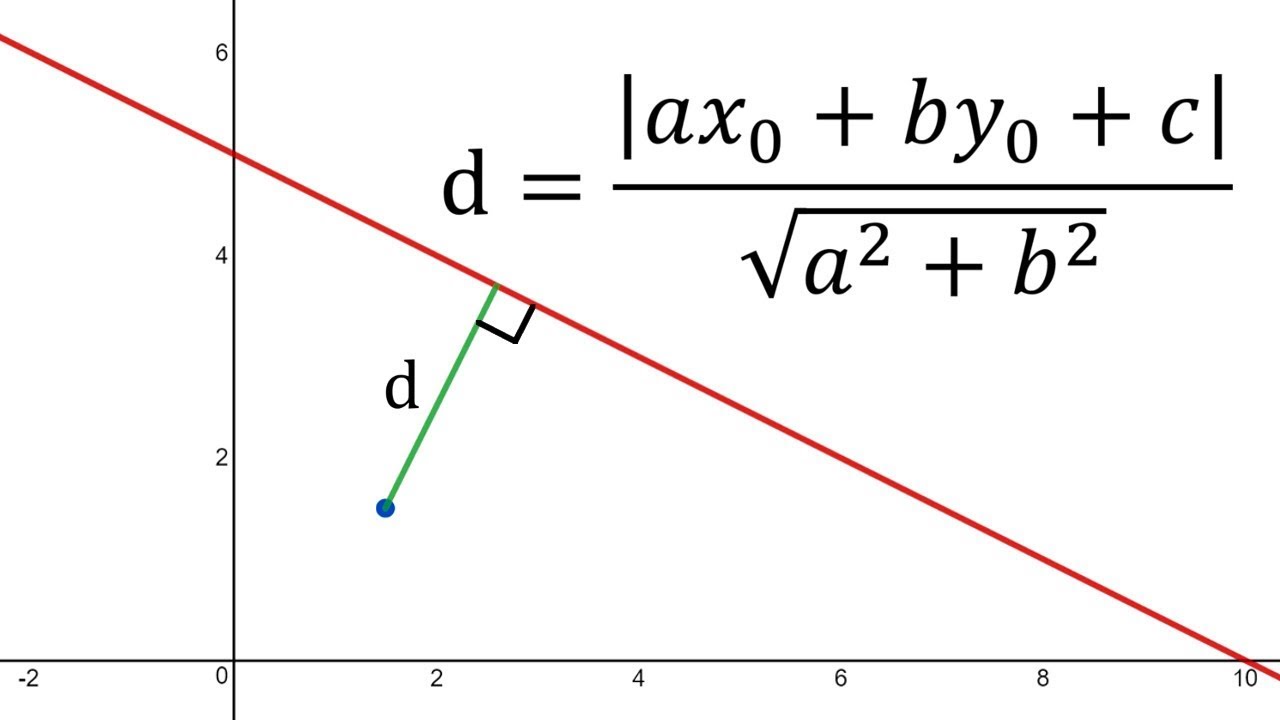
In this video I go over deriving the formula for the shortest distance between a point and a line. There are several different ways of deriving this, and in this video I use an algebraic derivation. This method involves using the fact that the shortest distance between a point...
Now lol

In this video I go over the distance formula between a point and a line once again, but this time take a look at a Geometric Proof. This proof, just line in my earlier Algebraic Proof, is only valid for slanted lines but nonetheless the final result is still applicable for hor...
I mean im not fan of formulas
Here's the geometric proof
nova prawn
thanks a lot
upper karma
Finding perpendicular to the line that goes through the point and the the intersection between line and perpendicular
Then distance between two points
Like for example to draw an auxiliary plane
The connection was bad there and it got sent half an hour later but yeah
Oh i was referring to the auxiliary plane
@nova prawn
May i post another video of it lol
nova prawn
ofc
upper karma
F there are no english good videos
In my lative there are some
(Spanish)
Shieet
Post anyway
Ig you can put subtitles
What if we speak spanish

En este vídeo de geometría analítica en el espacio para 2º de bachillerato, se calcula la distancia entre un punto y una recta dados mediante el método del plano perpendicular.
// Suscríbete y activa la campana //
▶ https://www.youtube.com/channel/UC73702acnOOmrWMzFRHe4oA?s...
nova prawn
Practice this lesson yourself on KhanAcademy.org right now:
https://www.khanacademy.org/math/geometry/analytic-geometry-topic/parallel-and-perpendicular/e/distance_between_point_and_line?utm_source=YT&utm_medium=Desc&utm_campaign=Geometry
Watch the next lesson: https://www.k...
upper karma
Lol
@nova prawn does it cover auxiliary plane method
^ that's what I was trying to say
Sniped headshot
nova prawn
what is that
upper karma
The method i was all the time referring to is a better method than the formula one
https://youtu.be/JRchvOLNCFU
@upper karma .
En este vídeo de geometría analítica en el espacio para 2º de bachillerato, se calcula la distancia entre un punto y una recta dados mediante el método del plano perpendicular.
// Suscríbete y activa la campana //
▶ https://www.youtube.com/channel/UC73702acnOOmrWMzFRHe4oA?s...
nova prawn
like I have the center and the equation of tangent line
how to find radius, hope those will work
 keen aspen
Uhh what are you having issues with
keen aspen
Yes what part of the problem do you not understand
 rich mist
I just need the answer
keen aspen
Bruh
keen aspen
I can walk you through it
rich mist
okay please
keen aspen
So just solve the equation
tantheta+1=0
so tantheta=-1
Now think of a theta that when you take the tan of it, it is -1
Notice here that tan is negative, so theta is in the 2nd and 4th quadrant
What theta comes to mind
rich mist
what do you mean what theta
keen aspen
What value of theta comes to mind such that tan of it is -1
 remote heart
Theta is $\theta$
somber coyoteBOT
silent plank
timed...
remote heart
is this a test @rich mist?
keen aspen
Lol
keen aspen
Good
rich mist
are those the only two answers?
keen aspen
In that interval
rich mist
Hello
my answer is x=3/1+4logbase15(3)
^17 not 15
how would I write that with these resources
keen aspen
You need it in log base e or 10
 urban egret
@rich mist PJS said it best you need to take the natural log of both sides. For some reason you don’t have natural logarithm in your final answer.
Review your natural logarithmic properties
 signal hornet
how do I solve this 0= x + 2sin(x) domain [0, 2pi]
no idea how to get x on its own
I know 0, and 2 pi from just looking at the unit cricle
 umbral snow
There's no way haha. That one isn't something doable by algebra
keen aspen
Yeah
umbral snow
,w graph x + 2sin(x)
signal hornet
what about with calc 1 knowledge?
somber coyoteBOT


 Requested by Kaynex#7520
umbral snow
Requested by Kaynex#7520
umbral snow
In fact it looks like 0 is the only solution
umbral snow
Honestly yes, the derivative could help. It's pretty easy to see where the mins/maxes are because the derivative is just
1 + 2cos(x)
signal hornet
I want to to know x-intercept
umbral snow
Plug the mins/maxes into x + 2sin(x), that's enough to show that the only solution is 0
nova prawn
I am looking for circle's equation which has:
center on the line y = 3x and tangent to the line x = 2y at the point (2,1)
dark sparrow
what have you tried so far
nova prawn
Perpendicular line I was looking for
but from point, if i get perpendicular line, it will be perpendicular to line that is on center. I need perpendicular from center -> tangent not tangent -> center i think
I checked internet, could not find anything.
dark sparrow
if you construct the perpendicular to x = 2y at the point (2,1) then you get another line on which the center must lie
 dusky surge
perpendicular to x = 2y at the point (2,1)
nova prawn
did not get it
silent plank
you aren't interested in any lines perpendicular to the line the center lies on
nova prawn
yeah, i need line that is perpendicular to tangent right?
silent plank
yes
silent plank
yes
nova prawn
how to calculate this?
silent plank
do you know the property of perpendicular lines?
nova prawn
yeah, sloped are reversed.
silent plank
that's vague
nova prawn
like if one them is x, isn't the other 1/x
silent plank
no
(for non-horizontal and vertical lines) the slopes of 2 perpendicular lines are negative reciprocals of each other (or their product is -1)
$m_1m_2 = - 1$ or $m_1 = -\frac{1}{m_2}$
somber coyoteBOT
ramonov:
dark sparrow
there seems to be a language barrier here
silent plank
you grammar is bad. can you at least clearly understand what we are saying?
nova prawn
i can understand you guys, books, videos don't worry 🙂
silent plank
ok
nova prawn
I just type fast. That's why i guess
nova prawn
You are right, i must have thought you before i had clicked enter. Sorry.
silent plank
currently you are looking for equation of the line perpendicular to your tangent x=2y at (2,1) right?
nova prawn
yes
silent plank
what is the slope of x=2y
nova prawn
The slope of the equation x=2y is 1/2
silent plank
what would be the slope of a line that is perpendicular to that?
nova prawn
-2 as you said m1*m2 = -1
silent plank
yes
and can you determine the equation of a line with:
slope: -2 passing through the point (2,1)?
dark sparrow
congratulations
nova prawn
then I will solve it with center line.
dark sparrow
now you have two lines, y = 3x (the original) and y = -2x+5 (the one you just found)
and you know the center lies on both of them
nova prawn
Yeah, intersection point which is solution set of these 2 equations.
Thanks a lot, it has been like 3 years I didn't spend time with geometry, just started back. Also, sorry for mistakes while typing.
upper karma
@silent plank @silk crown @silk crown I have found the issue... the triangle is impossible
I appreciate your help!
upper karma
@arctic vortex
 cosmic pebbleBOT
From
Rule 1
The help channels are solely for help with math, so feel free to post your question. Asking whether you can ask a question or if anyone knows about some specific topic is unnecessary, so please try to avoid questions of that nature.
 frail rock
I need help with this problem. I tried setting up the cosine and sine for angle B and I ended up getting stuck.
I managed to get up to this point. I have a feeling that I forgot something here.
 plucky marlin
where exactly are u stuck
frail rock
I have a feeling I've forgotten how to divide an integer by a radical.
I tried looking it up but I got something really weird when I tried to solve it
hold on let me look for my other work
plucky marlin
both ur equations for sin and cos are correct
frail rock
Ah, I see.
plucky marlin
but the thing is, the options rationalized the denominator
so you should do the same and see which one matches up with the options
frail rock
To rationalize the denominator, I just multiply it by the square root of 5 right?
plucky marlin
yeah
ofc
and cancelling out the 3's should be the first thing you do
just to reduce the calculations
frail rock
Ah I see. I thought for a moment you could only reduce it f they had the same radical
And I did the one for cosine too
plucky marlin
yup perfect
frail rock
I think I see now how they got those answer choices. I didn't understand it at first, I guess I just forgot how to divide radicals with integers
So that would eliminate A and C as an answer choice because that's not even the right equation
Then it's either B or D
Wait
Yeah
wait no that would also eliminate D
Ah so it would have been B
I get it now
Thank you for helping me :D
 frail rock

 brisk holly
How do I solve this?
 ionic bluff
 weary drift
R_AB is a reflection wrt AB
 austere dragon
this is a no brainer but are kites parallelograms but not always?
dark sparrow
no, there exist kites that aren't parallelograms
austere dragon
but some kites are parallelograms though, is it still classified as not parallelograms?
silent plank
kites that are parallelograms are parallelograms
kites that are not parallelograms are not parallelograms
dark sparrow

silent plank
a kite that is also a parallelogram is a rhombus
upper karma
Is it?
silent plank
the phrasing of:
are kites parallelograms but not always
has bad implications
upper karma
Isn't it only squares that are kits and oarlagrams?
silent plank
squares are rhombuses
upper karma
just wondering is there one triangle you can make on a sphere with three points or are there infinitely many
 sly belfry
hello everyone! quick question.
can we interchange the ellipse parametrisation? instead of (cos(t), sin(t)), to have(sin(t), cos(t))?
dark sparrow
sure? you'll just have the curve get traced out in the other direction
(sin(t), cos(t)) specifically will trace the circle of radius 1 centered at the origin clockwise from (0,1)
sly belfry
hmm
I'm not very good at parametrisation, but this seems a little awkward
but yes -- it does make sense
thank you so much.
upper karma
What makes a parallelogram a rhombus?
For example perpendicular diagonals
So you can use a famous theorem....
upper karma
@arctic vortex
arctic vortex
diagonals bisect each other @upper karma
upper karma
For example perpendicular diagonals
This is more useful
Any ideas?
Consider triangle MSP
upper karma
Yes
upper karma
What's the value of the angles of a square?
 acoustic bone
PM=13
arctic vortex
its only lm
arctic vortex
is it 82
arctic vortex
but its right
upper karma
What is right?
Im talking about <MLA not <MAL
They are alternate angles...
So they are equal
But AM=AL, triangle MAL is isosceles so <AML=<MLA
Your turn now
@arctic vortex
upper karma
Yes
livid sequoia
is this SAS?
upper karma
SAS
upper karma
30 and 31 are yes
livid sequoia
both are AAS and congruent
upper karma
Yes
 mortal mesa
Hi,
Having troubles solving the following equation:
$(1+\cos(4x))\sin(2x)=\cos^2 (x)$
somber coyoteBOT
idan:
upper karma
@mortal mesa you have to prove it or solve it
mortal mesa
@upper karma solve it
upper karma
Ok hold up this is an ass-long problem @mortal mesa
mortal mesa
@upper karma tell me about it 😩
upper karma
Just expand cos(4x)
Hahahah
@upper karma have you finished solving it?
I have not even tried
Kinda stuck lol
My black ink is gone and i can't see shit
Hahah
What if you use complex numbers
Should be juicy
I won't try THAT hahah
Why noy
Not
2 lines of solution
I don't think he wants that method
somber coyoteBOT
HoboSas:
upper karma

cos(4x) in terms of cos(x),
write cos(4x) in terms of cos(x), using the angle sum formula and the double angle formulas,
prove trig identities,
verify trig identities,
simplify trig expressions,
blackpenredpen
mortal mesa
It's for my students. I got stuck trying to solve in class lol
Unfortunately, complex solution won't help
upper karma
Damn
Wait I have an idea
Express cos^2 in terms of cos(2x)
Then t=2x
$$(1+\cos(4x))\sin(2x)=\cos^2 (x)$$ $$(1+\cos(4x))\sin(2x)=\frac{\cos(2x)+1}{2} $$ $$
(1+\cos(2t))\sin(t)=\frac{\cos(t)+1}{2}$$
somber coyoteBOT
HoboSas:
somber coyoteBOT
HoboSas:
upper karma
@mortal mesa you can guess what to do now
mortal mesa
@upper karma @upper karma
Nice, tnx.. Sorry, but I'm not sure how to go from here. I still have that 1/2 on RHS.
somber coyoteBOT
HoboSas:
stone adder
Is $1-sin^2(2x)=cos^2(2x)$?
somber coyoteBOT
Wilston Lynx:
stone adder
Okok
upper karma
Use \cos and \sin to make it look better xD
upper karma
$2u^2\sqrt{1-u^2}=u/2+1/2$
somber coyoteBOT
HoboSas:
upper karma
$\sqrt{1-u^2}=\frac{u+1}{2u^2}$
somber coyoteBOT
HoboSas:
upper karma
$1-u^2=\frac{u^2+2u+1}{4u^4}$
somber coyoteBOT
HoboSas:
upper karma
Nice u^6
stone adder
Oh god u^6\
somber coyoteBOT
HoboSas:
stone adder
Btw I tried the question and got, $$2 \sin{2x}[1-\sin^2{2x}]=\cos^2x$$
upper karma
Damn son
somber coyoteBOT
Wilston Lynx:
somber coyoteBOT
HoboSas:
upper karma
,w u^6-4u^2+u^2+2u+1=0
somber coyoteBOT

 Requested by HoboSas#3200
stone adder
Requested by HoboSas#3200
stone adder
Oof
somber coyoteBOT
 Requested by HoboSas#3200
upper karma
Requested by HoboSas#3200
upper karma
Still fuck
Try putting the trig
Back?
Like what you said u is
$u^6-4u^4+u^2+2u+1=0$
somber coyoteBOT
HoboSas:
upper karma
Like u=cos(t)?
This is shit
Like what did you sub for u
Ikr whatever
Like u=cos(t)?
Doesn't look good
Doesn't look good
@upper karma i mean, what did you u-sub on
Yes but
No bueno
Rip
dusky surge
I'm quite sure it is not 51
 solar shale
How would I go with solving it
silent plank
what were you doing to get 51?
solar shale
I got two different types of problems mixed with this question
 drifting drift
12/9=x/8.5
solar shale
So cross multiply 12 and 8.5 then divide by 9?
silent plank
not a fan of how the term cross multiplication is being thrown in here
firstly do you understand how to get that initial equation?
solar shale
Sort of
silent plank
properties of similar figures
as for isolating x, simply multiply both sides of the equation by 8.5
sleek thistle
am i supposed to make it equal to 9 since it’s equilateral?
dark sparrow
make what equal to 9?
sleek thistle
3/2x+30
dark sparrow
does an equilateral triangle have angles equal to 9 degrees?
sleek thistle
equal to 180 right
dark sparrow
what's equal to 180
sleek thistle
the entire triangle
dark sparrow
the SUM of the ANGLES in the triangle is 180°
but what's the measure of ONE angle in an EQUILATERAL triangle?
dark sparrow
60 degrees yes
mortal mesa
@upper karma @upper karma
Thank you for your help!
It looks unsolvable using regular methods.. Sorry it was shit
upper karma
don't worry we had fun trying to solve it 👍
austere dragon
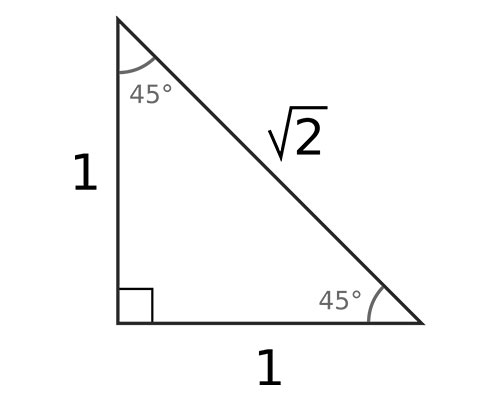
is a right triangle always scalene?

 dark sparrow
the what
upper karma
o yea i forgot about the phyton theory sry bout that
huh?
glacial haven
python coding theory
upper karma
My answer here is 198.585 sq.units but the books says the answer is 103.2 sq.units how is the area of this irregular figure id 103.2 if the area of rec only 9 x 15 = 135 is already larger than 103 ?
dark sparrow
the circle isn't part of the shaded region
you're supposed to subtract away half its area from that of the rectangle
upper karma
Ohhhh so thats why thanks.
My answer here is 32.0632sq .units and in the book is 38.24 sq.units i use 3.3 as the base of the rectangle and use 6.5 height for the height of it. The diameter i use is 5.2 divide 2 for the radius and i use 1/2 pi x r squared
Epic
dark sparrow
the lower part is not a rectangle.
upper karma
Is it a trapezoid?
dark sparrow
yes