#geometry-and-trigonometry
1 messages · Page 292 of 1
 nova prawn
 upper karma
Uh hold on for the name
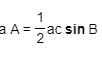
Tho it is used to get the area of a triangle
Wait a sec
Welp i don't think there is an specific name
 pine oar
dang
yeah its used to find triangle area
i wanted to see some application
on a video
 silent plank
trig formula for area of a triangle probs gets you what you need
pine oar
ok
upper karma
Yes
 naive harbor
Hello. I have a couple of identically sized rectangles like such:
If i were to calculate the x distance between the centers of both rectangles would the following expression be correct?
(2 x distance from rectangle center to edge) + x seperation.
upper karma
That's not a formula, that is an expression
naive harbor
Sorry expression, i mean.
upper karma
If you mean "x separation" as the white part between those 2 rectangles, i think you are right
naive harbor
Ah okay. so assuming that the distance between a rectangle's center and an edge is 0.5 units, and the y seperation is 0.8 units, to get an x separation that is 0.8 I should calculate it as (2 x 0.5) + 0.8?
upper karma
Iff the y separation and x separation are both 0.8, the general expression for the distance between 2 rectangles that form a horizontal or vertical is (2*0.5)+0.8
But if you choose 2 rectangles, which are located like diagonally, the expression will obviously change
naive harbor
Ah okay, thank you .
upper karma
Np
 drifting sorrel
I am doing a practice test (not graded) and I'm stuck on this problem. I mostly just guessed because I'm pretty lost on how they'd get any of these answers.
So far I've tried breaking out tanx+cotx to see if those simplify more and getting them under an LCD which gave me sin^2x + cos^2x. I tried breaking that up in a few different ways, but didn't get any of their options.
silent plank
which gave me sin^2x + cos^2x
could you make that clearer? what's that supposed to be for?
@drifting sorrel
drifting sorrel
Sorry, it's hard to write these kinds of problems in Discord. Let me try to take a picture of the paper.
upper karma
Ight
silent plank
, rotate
 somber coyoteBOT
drifting sorrel
somber coyoteBOT
drifting sorrel
I got there and the rest of my scratch paper is just trying every combination of identities to try to get to one of their options
Kind of a crap shoot
silent plank
you cant just multiply the numerators by something like that
drifting sorrel
Oh wait, they'd both be over sinxcosx
Dur that was the point of multiplying them lol
silent plank
need to multiply to both the numerator AND denominator
(otherwise you aren't multiplying by 1, and are changing the value of the expressions)
drifting sorrel
Right, I was trying to get the denominator to the LCD of (sinx)(cosx) and didn't write it out after multiplying the numerator. So I got the same thing, but just over (sinx)(cosx) now. Let me try playing with this a bit.
Turns out I'm best guesser in all the west and the one I had selected is correct - haha! Thank you for your help, that was a dumb mistake not to put the denominator under it after. I got (cscx)(secx) in the end. :)
somber coyoteBOT
ramonov:
drifting sorrel
Yeah, that's what I got! Then 1 over sin x 1 over cos can be written as csc x sec via reciprocal identity 👌
 rugged timber
Is anyone available for help? Specially need help for f=asin/cos(b(x-c)+d
 dark sparrow
what have you tried so far
 novel flax
TW is an altitude to hypotenuse
 lunar plover
Well, i dont even know where to start!
dark sparrow
if you knew TW, would you be able to do the problem?
lunar plover
Whats TW?
lunar plover
Oh, i dont
dark sparrow
so you could not do your problem even if you knew how long TW was?
lunar plover
Yes i could
I know how to get the area of a triangle knowing the base lenght and its height
dark sparrow
yes ok that's what i wanted to hear
idk why you said no earlier
anyway ok
so why not attempt to find TW then
lunar plover
Because i dont know where to start
Hmmm
Ok, imma call the TW x
So i think i can do 9/x = x/16 right?
novel flax
yes @lunar plover
lunar plover
So the height would be 12?
novel flax
yes
lunar plover
And it would be 300 cm^2
dark sparrow
uh huh
lunar plover
So first off, i need to calculate the area
dark sparrow
you don't NEED to, but that's definitely a possible path
novel flax
that's right
 weary heart
Given the ellipse:
x^2 + y^2 - 2axy = b^2 ,
Find the length of semi major and semi minor axes for the above ellipse. (a and b are constants)
<@&286206848099549185>
weary heart
@upper karma
Hey man, I was trying to do this since morning.
Only to realize just now that I was making a silly mistake.
upper karma
alright
 idle bloom
Top two ways to realize your mistakes
1: turn in the test and leave the room
2: ping helpers
pine oar

hey guys
for this question
i know that you need the distance formula to get the sides
does it matter what qualifies as x1 and x2 and y1 and y2 when you plug into distance formula?
 raw pagoda
hi, how should i approach this problem
im not as fluent in geometry and i have no idea what i should do first, i tried trig and tried summing up the triangles and squares
but i got stuck
 wooden current
@raw pagoda Consider the smaller triangles formed by the squares and the sides of the main triangle and their angles
raw pagoda
thx man
wooden current

 dusky surge
I think yes.
 tender kite
@pure pendant For the circle one, imagine drawing a radius and x is equal to the angle the radius makes with the horizontal axis
in the regular sine graph x is equal to the x-axis value
 blazing panther
a square floor is covered with congruent square tiles, the tiles on the diagonals are black, all the rest are white. If there are 101 black tiles, how many are there in total?
How do i do this
dusky surge
Hello @blazing panther
blazing panther
Hello
dusky surge
So, diagonals are black tiles.
blazing panther
Yes
dusky surge
Lemme draw it out.
Ouch, my drawing sucks
So, I make the middle red
That is where the 2 diagonals meet
So, can you count how many black tiles are there in 1 diagonal?
blazing panther
Completely across or until the red dot
dusky surge
Completely across
blazing panther
51
dusky surge
Yep
Since it's the diagonal, every tile move down and right from the top left.
That is horizontal and vertical of the whole square would be 51 tiles wide and 51 tiles long
blazing panther
Oh but that wouldnt work in a regular square right
Because these are tiles so you can easily see how the diagonal tile number equals that width
dusky surge
Well... If the diagonal becomes a line with no width, then you're right, it's hard to find it like that.
But for Area type question, you can always count tiles :)
blazing panther
Thanks so its 51^2?
dusky surge
Yea
blazing panther
Ok i got confused because i tried to do it like a regular geometry problem
So i said it was 51 and i used the pythagorran theorem instead of just matching up the tiles
blazing panther
Thank you
dusky surge
You're welcome!
 minor field
if theta is between pi/2 and pi then sine is positive but tangent is negative
(because cosine is negative)
upper karma
👻
 wraith drum
Guys, how do i get the real and imaginary parts of sin^-1(a+bi)?
 versed river
Have you seen cos(ix)=cosh(x) and sin(ix)=isinh(x) before?
Although my simultaneous equations from my method seem pretty fuckin messy without wolfram alpha 
I found this on the net http://mathonweb.com/help_ebook/html/complex_funcs.htm but it doesnt exactly reveal how those formulas came to be. Dont feel like try figure it out but it looks like it vaguely follows  not gonna bother further with this one
 nimble horizon
i had a thought
i wanted to find out when cos(x) = tan(x)
there are clearly solns to that but the only solns im getting are complex numbers
my strategy was this
$cos(x) = tan(x) = \frac{sin(x)}{cos(x)} => cos^2(x) = sin(x)$
somber coyoteBOT
somber coyoteBOT
somber coyoteBOT
nimble horizon
then that's a quadratic in sin(x), solving for sin(x) you get the golden ratio
then i tried doing sin^-1(golden ratio) but i got a complex number
and actually when i plot that function
it coincides exactly with the values
but then when i evaluate sin^-1(golden ratio) i get completely incorrect results
i guess it probably has something to do with complex values not being able to translate to the real plane, but id like a second opinion
dark sparrow
uh
 eternal crag
i'm pretty sure this has infinitely many solutions
dark sparrow
this looks like WAY too little info
eternal crag
i.e.^
dark sparrow
are you absolutely sure this is all you have
 open rune
Yes
dark sparrow
then it is impossible to determine the values of x and y.
 supple onyx
i personally cant figure out any unique solutions yeah
wraith drum
@open rune Your teacher screwed up
open rune
it was on a test I took but idk how to solve it
supple onyx
i highy doubt it's possible to solve
wraith drum
Do you know if it involves trig?
upper karma
by "solve" do you mean get numerical values for x and y?
wraith drum
or is it "y" as a function of x?
open rune
it involves geometry and yes to solve for x and y
wraith drum
k
open rune
i'll figure something out
upper karma
it's impossible, you can "stretch" y however you want
open rune
im not sure..
supple onyx
@wraith drum i assumed they were perpendicular and i personally couldnt solve it
as @upper karma said y can be stretched as far as you want
wraith drum
I've got the area as 1/2 x^2 + 3y - 3x + 9/2 , I might be wrong though...
versed river
@nimble horizon i apologise if im missing something here but your quadratic sin^2x+sinx-1=0 should have had 2 solutions, one of which was sinx=-goldenratio(x not real), and the other one was (sqrt(5)-1)/2, which if you take inverse sine of should give you your answer
nimble horizon
yeah ive done that too
it doesn't match up
i get -0.666
no intersection at that point
versed river
Bruh you forgot to take arcsine of it
Or sorry i mean
You have the wrong sign
It shoulld be positive
nimble horizon
(1-sqrt(5))/2 is the negative solution, no?
versed river
No the negative solution is sinx= (-sqrt(5)-1)/2
You made a mistake solving the qquadratic somewhere theb
versed river
 peak mesa
hey anyone knows how i can make a square with sin/cos? i cant find nothing in internet
peak mesa
https://gifer.com/en/8ri9
https://gifer.com/en/CXSu
I found this in internet but i think is not a help
versed river
Ok, do you agree the quadratic is 1-x^2=x?
versed river
Do you agree thats the right quadratic
nimble horizon
yeah it is
nimble horizon
$x^2 + x - 1 = 0$
somber coyoteBOT
versed river
Braces aroubd whatev needs to be sqrted
somber coyoteBOT
versed river
Should be negative 1 at the start
Oh you figured it out
Do you see how to get the general solution from there and everything?
versed river
No worries mate. Have a good one
nimble horizon
mhm right back at u
wait wait hold up a second
now the other one is the wrong sign
the (-1 - sqrt(5))/2 one
and the (-1 + sqrt(5))/2 is slightly off
tho it's closer now
versed river
You are forgetting the arcsin
nimble horizon
wait so it looks like this isn't the golden ratio
it just looks very close to it
hM
versed river
Sometimes (sqrt(5)-1)/2 is reffered to as the second golden ratio
nimble horizon
or its actually the negative of the golden ratio woah
ohhh i see
oh wait im reading on wikipedia
apparently people call it the silver ratio
woah cool
ty
 hushed spear
hello
dusky surge
hello
hushed spear
how are you
dusky surge
Question(s) on geometry-trigonometry?
hushed spear
yes
thank you
my friend needs help he just needs to be in the server for 10 minutes to talk
she*
so i will speak for her
upper karma

hushed spear
okay so basically
i walk forward on a bearing of x to point B
then i turn and walk forward on another bearing to point C
I start on point A
how would i find the bearing of point C from A?
thank you in advance
dusky surge
it really depends on the angle. I made an example.
the red angles are the same, the green angles add up = 180 degrees.
silent plank
are you given the distances walked?
 fast burrow
yes
A --> 20km --> B on a bearing of 100 deg
B ----> 15km -----> C on a bearing of 190 deg
silent plank
so yeh, construct a proper bearing diagram
and find the information needed by applying stuff like the sine and/or cosine laws
fast burrow
okay
so we know that triangle is right angled, right? how do you prove that? do you use what i learnt two years ago with co-interior and different types of angles adding up to 180deg?
silent plank
which triange are you referring to?
fast burrow
the one made up by the three points
silent plank
1 sec
fast burrow
okay
fast burrow
yes
silent plank
NS axes are parallel to each other
similar with EW axes
fast burrow
so you can use cointerior angles
silent plank
yes, that could be applied here
fast burrow
wow! thanks for your help
silent plank
note that if the angles weren't as nice, you would probably need to apply those laws stated
silent plank
don't even need to involve minutes and seconds
eg if the bearing from B was 180° instead of 190°.
you won't get a right angle at B, and would involve more calculations
 dark sparrow
radians are just a unit of angle
there are 2π radians in a full circle
really all you need here is a calculator with a radian mode and an understanding of basic trigonometry
 unique junco
well I would need to know what to press on that calculator
dark sparrow
are you familiar with the basics of trigonometry? what one might call "SOHCAHTOA", after the mnemonic central to it?
unique junco
Yes I am
dark sparrow
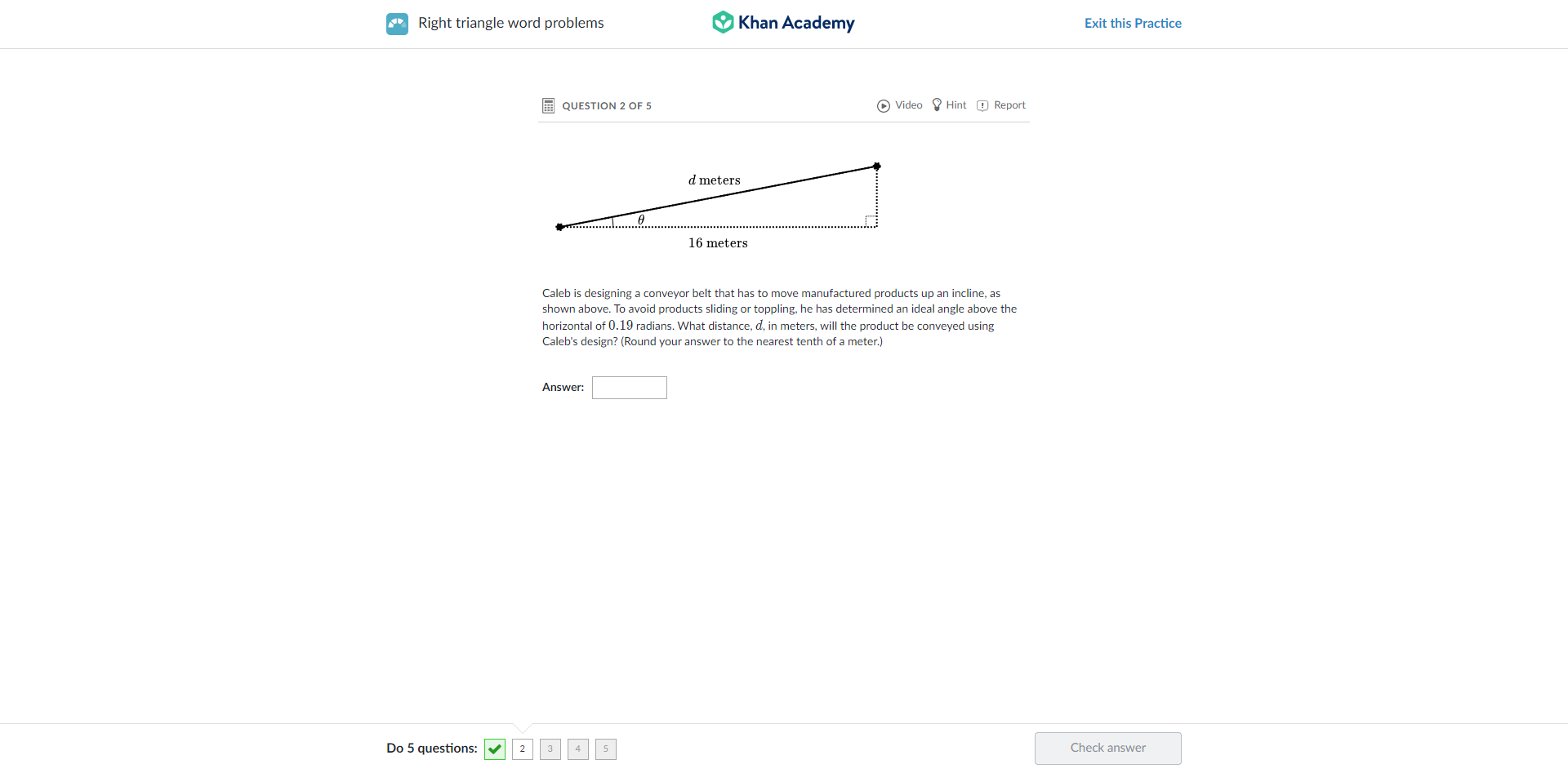
so is it clear that $d = \frac{16}{\cos(0.19)}$?
somber coyoteBOT
Ann:
unique junco
Yes
dark sparrow
and you don't know how to evaluate cos(0.19) using your calculator?
if so then that is an issue with your lack of knowledge about your calculator and not the problem itself
unique junco
oh so ican uust plug in .19 radians into cos?
dark sparrow
how else do you think you would evaluate cos(0.19) if not by entering cos(0.19) into your calculator?
unique junco
I thought that I would have to do some more math to find what .19 was equal to
dark sparrow
what do you mean "find what 0.19 was equal to"
unique junco
in degress
dark sparrow
your calculator almost certainly has a radian mode
unique junco
it does, ive solved the problem now
dark sparrow
BUT, if you wanted to convert 0.19 radians to degrees, that's a matter of multiplying by the number of degrees in a radian
i.e. 180/pi
unique junco
0.19 times 180/pi?
dark sparrow
converting between radians and degrees is no different than converting between two units of the same physical quantity like feet and inches
yes that's what i said
unique junco
Cool, thanks
upper karma
Hei can i agsk a qestion?
 cosmic pebbleBOT
From
Rule 1
The help channels are solely for help with math, so feel free to post your question. Asking whether you can ask a question or if anyone knows about some specific topic is unnecessary, so please try to avoid questions of that nature.
upper karma
Go with it
Ill take that as a yes?
Of course.
So i made up this wacky question, and im tryna find a and b
So the given information is two points, and the angle between them.
And I want to see if I can find out the point where the angle starts, the lengths of a, b, etc
Idk if its possible tho.
Maybe 2 points an angle is too little?
(So the actual points used to be (2.3, 0) and (-1.6, -1.4), but I added some numbers to make it harder since the original points give away length a)
So should be a = 2.3, and b = sqrt(4.52)
But yeah idk how i'd solve it just given information (5.8, 7.9) (4.2, 4.2) and 140 degrees
 glad anvil
There's too little information. Remember your circle geometry? If you mark two points on the circle, and then draw lines from both those points to a 3rd point on the circle, the angle is the same no matter where the 3rd point is
upper karma
Yea, tho id see how that'd help?
glad anvil
Your intended solution is point C
But point D, or point E, or any other point on the circle also works
glad anvil
True, it doesn't show a way to calculate the coordinates of the point
upper karma
I think linear algebra can probably be used to fill in the missing point, and solve for it.
Using cosine rule for dot product or something
glad anvil
Yea, I think that probably works
upper karma
Which was how I constructed the problem in the first place, so it feels a bit like cheating
glad anvil
xD
upper karma
AB, can be found really easily, so I was hoping there was some clean nice geometric solution
wraith drum
Hey peeps, I have a question, prove that sin(nx)/1+cos(nx)=tan(nx/2) for all natural values of "n"
i haven't tried complex analysis, but i'm scared it will get complicated
upper karma
we already proved this few days ago
dark sparrow
$\frac{\sin(nx)}{1} + \cos(nx) \neq \tan(nx/2)$
somber coyoteBOT
Ann:
dark sparrow
it is not
dark sparrow
well, i'd go with "are you allergic to parentheses" on any other day, but that would probably make you write sinnx / 1+cosnx = tannx/2 or something to that effect
wraith drum
@dark sparrow that spacing is bigger than my future
dark sparrow
it was exaggerated on purpose.
anyway, let θ = nx/2 and apply double angle identities on the left hand side
wraith drum
oh got it, thanks
dusky surge
@upper karma About your question. There is not enough information to find a and b. What I was taught in school is that you need at least 3 of the 6 information of a triangle, namely the length of the 3 sides, and the 3 angles, to find the remaining information.
I am not sure if this can help you.
upper karma
Right, so that question only gives 1 side and 1 angle, so its not enough. That makes sense
 fluid moat
Hi
is ther e a place i can learn the trig functions in depth
i only really know 2 things
trig ratios
and this other thing on the calculator
im a nob
dark sparrow
khanacademy
upper karma
idk unit circle mebe?
fluid moat
ok
the algrebra 2 book i got isnt really that helpful
it just has questions
lol
ill use khan academy
thanks
supple onyx
I mean id probably serahc for a lot of practice questions
to really learn the identities
fluid moat
okay, thanks
 quaint quarry
Find the midpoint of the segment that has endpoints at (a+b, a-b) and (a,b)
wooden current

 graceful narwhal
😦
quaint quarry
Yeah
Sorry I was busy
X+X divided by 2 equals the x coordinate for midpoint
And just replace the x’s with y’s
upper karma
What
 plucky marlin

 brave drift
I am trying to prove that if the an n-sided convex polygon has at least one side parallel to x and at least one side parallel to y. Then, n is the multiple of 4.
dark sparrow
if you have two sides that are perpendicular to one another then some multiple of the external angle will be 90°
brave drift
if you have two sides that are perpendicular to one another then some multiple of the external angle will be 90°
@dark sparrow This is what I am unable to understand.
In order for one side to align to the vertical and another side to the horizontal, the sum of the exterior angles of some k consecutive sides must equal 90.
Why sum of the exterior angles of some k consecutive sides must be equal to 90?
dark sparrow
i could give you either an informal explanation of this fact or an alternative proof that isn't handwavy
brave drift
The one which will help me to solve some more similar questions would be the best.
upper karma
yus mission accomplished
I successfully proved law of cosines independently... I just had to look at a triangle for 10 minutes before being able to do anything. Aaaand my proof is more algebraic than geometric so yus
dark sparrow
take your pair of perpendicular sides
connect their midpoints to the center of the polygon
the resulting angle at the center will be 90° by assumption
but on the other hand, if you considered the angle subtended by one side at the center, that'd be (360/n)° bc your polygon is regular
ok i think it's time i made a picture
or not bc i'm lazy
brave drift
I will check that if (sum of exterior angles + 90) = 180 in this case. If it is then, I am happy to move on.
Proofs should be easy because they are just logic. ;_;
3x+x+90 = 180
So, 4x = 90. That is the sum of the exterior angles should be 90 degrees.
upper karma
Next up on my list of things to prove:: i have no idea whatsoever but I think perhaps Euler’s identity that e^pii = -1.
wait either that or binomial theorem...
Either seem reasonable
prove/construct real numbers and its arithmetic operations
its seems pretty reasonable
;^)
dark sparrow
@upper karma try e^ix = cos(x) + i sin(x)
unique junco
 wooden current
What's the problem?
unique junco
 versed river
I think tilde means "whats the problem you have" more specifically
unique junco
Oh ok
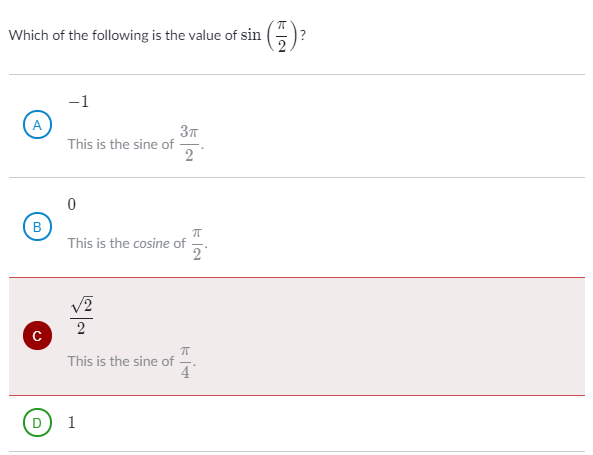
I honestly dont know what the specific problem is, I have absolutely no clue how 1 is the answer
silent plank
have you ever worked with radians before?
unique junco
Yes
somber coyoteBOT
HoboSas:
silent plank
and do you know the ratios for trig functions of special angles?
unique junco
I definitly learned them, probably just forgetting what they are
silent plank
revise them
unique junco
like 2pi = 360 and stuff liek that?
silent plank
they're very common
unique junco
r u talking about the angles and radians of the trig circle?
unique junco
Yea
silent plank
and the numerical value of something like
sin(pi/2) = sin(90°) is something you should definitely know
unique junco
Oooh so in the problem I posted the pi/2 was radians
I was trying to plug it in for opposite/hypoeneus
silent plank
plug what in for opp/hyp
unique junco
sin(o/h) sin(pi/2)
wooden current
If it's easier for you to think in terms of degrees, you can convert radians to degrees by multiplying the radians by 180/pi.
silent plank
and isn't the ratio of the opposite and the hypotenuse
 arctic vortex
i dont understand how to do 2) and 3)
upper karma
same
arctic vortex
oh
dusky surge
Hello kurax
For number 2, can you find any real life situation that you'll have to use the scalene triangle?
Like can you find a real life object that is of triangular shape and it's useful for you?
@arctic vortex
dusky surge
That's a good one too
arctic vortex
but its not scalene
arctic vortex
it said to do it in a scalene triangle shape
dusky surge
Okay, is the flatiron building a scalene triangle?
upper karma
real life triangles are too regular 😦
dusky surge
Artificial stuff~
arctic vortex
yes
i cant find a scalene triangle
am i allowed to say deformed in a school assignment
dusky surge
If you can point out why a deformed one is useful, then yes
dusky surge
Like if you have to hang different stuff, or need to use the hanger to do other things
silent plank
doorstop?
dusky surge
Oh, nice one
dusky surge
Do you recall the triangle inequality?
arctic vortex
yes
dusky surge
Use that
arctic vortex
sum of 2 angles must be greater than the third side?
dusky surge
Sum of 2 sides
arctic vortex
yea
dusky surge
Done?
arctic vortex
i still dont understand it :(
arctic vortex
oh ok
dusky surge
And then try to calculate all 3 situations of the triangle inequality
arctic vortex
how do i use a ruler in microsoft word
dusky surge
Hmm.....
Place the ruler on the screen, I do that when I am doing measuring myself before I print it out
dusky surge
But make sure that the paper in the screen fits the paper in real life
Oh....
There's another method, use the insert line function, and draw a line directly on top of the given line of the triangle
Microsoft words would tell you the horizontal span and vertical span of the line. Use Pythagoras theorem to calculate the length of the line
dusky surge
Double click your drawn line
arctic vortex
ok
dusky surge
It should show on the top right
dusky surge
Yea, that's the dimension.
arctic vortex
ok
dusky surge
Hmmm....
Do you know how to reshape your line so that it is exactly the same with one side, let's say 'a'
arctic vortex
yea
dusky surge
That's good!
arctic vortex
like this one
dusky surge
Yea, seems like it
arctic vortex
ok
dusky surge
Remember to jot down your results!
arctic vortex
\
dusky surge
Nice!
arctic vortex
ok so do i measure them?
dusky surge
Do you know Pythagoras theorem?
dusky surge
Yea
arctic vortex
yeah i know that
dusky surge
Since height and width is given, you can use Pythagorean to solve the length by
arctic vortex
ok
dusky surge
$\sqrt{Height^2+Width^2}$
somber coyoteBOT
Biscuit:
dusky surge
Please continue for b and c and mark down in your file 😁
dusky surge
Did you take the square root?
dusky surge
Good! Remember for sides of triangles, we keep our letters in lowercase
a=1.97
b=2.9
c=3.92
dusky surge
Now we have to compare sum of 2 sides is larger than the remaining side
We have 3 cases
dusky surge
Yea, you just have to type that into your document like
a + b = 1.97+2.9 = 4.87 which is bigger than c=3.92
arctic vortex
is this good
dusky surge
That's pretty good, but we still got to add in the numbers to 'show' it is really 'greater'
dusky surge
Sure
dusky surge
See ya later~
arctic vortex
back @dusky surge
dusky surge
You're fast
arctic vortex
wait whats the difference betwen lines and angles?
dusky surge
Huge difference.
Basically they are not the same.
Have you ever heard of Law of sines?
dusky surge
But it's good enough for an assessment I guess😁
arctic vortex
oh
dusky surge
Oh, you want me to point out or just submit?
arctic vortex
can u point it out pls?
dusky surge
Sure
For Q3, you might wanna do the addition for your teacher since this would truly show that you did the math.
arctic vortex
oh ok
dusky surge
the teacher wouldnt know you did the math if you don't write it down
arctic vortex
ok
i will do that
thanks!
can u also help me review for a test
"parallel lines intersected by a transversal"
dusky surge
Q4, the Pythagoras just help you find the length of the sides but but not the angles, so it's not right.
arctic vortex
oh
dusky surge
Angles should be marked with CAPITAL LETTERS like A,B,C. And sides should be in lowercase letters like a,b,c
Law of sines can be used to find the angles, but I am not sure if you have learnt that.
dusky surge
can u also help me review for a test
And for this, I don't know if I can do it because I gonna sleep soon😂
Have you learnt 'sine'?
dusky surge
You can use direct comparsion on the 3 angles to see which is the smallest
arctic vortex
oh
dusky surge
You can say, use fingers to 'measure' them as a tool of comparing
dusky surge
Like making an angle with 2 fingers, and find that the smallest one the fingers will be closest together
arctic vortex
oh
dusky surge
That's one method of estimation for elemetary school
I am not sure what your teacher wants, but IMO it's something that you'll have to figure out.
Which you did use your understanding and concepts to tackle this problem, which is already better than most of the students

arctic vortex
rlly o wow
dusky surge
Just wanna say you did great. By asking, and by trying it out yourself.
dusky surge
Sure
arctic vortex
yay
upper karma
Thank you @dark sparrow for that sliver of info.
pretty straightforward proof.
now to prove that e^ix = cos(x) + isin(x)
upper karma
this is a normal equation, but I didn't understand what my teacher did
She subtracted 30 degrees from both sides.
$x+30-30=y-10-30 \ x = y-40$
somber coyoteBOT
leviosa:
upper karma
Why the y is after the equal sign?
?
What's the original problem?
I was taught that letters are before the equal sign
x is a letter?
When you're looking for the value of a "letter" or otherwise known as a variable.
You want to look for what that specific variable is equal to.
he isolated the variable x
So
Exactly. And that gave him the x value.
Alternatively, y=x+40.
Idk what the problem is asking for etc.
I didn't know that moving numbers between the first and second member counted how to isolate the variable, I thought that what counted how to isolate was to move another variable.
I understood it now
Sorry for my english, I'm using the translator for hard words XD
Nah it's fine.
How school level are you?
I'm 16 years old.
I'm 15
I turned 16 6 days ago 
I am Nine year (1 year until high school
I did 15y yesterday lol
Ooo.
Nice.
Happy birthday lol.
I'm going to 11th grade in a few months.
After the summer is over.
Nice
u smart for a 16 yr old @upper karma
I dumb asf.
But pls clarify.
@upper karma
u be answering bare question with ease
and im pretty sure you answered some difficult questions before

But thanks lol.

i might be mixing u up with someone else tbh
LOL.
Thanks for the ego boost ~~and unboost  ~~
~~
im sorry fit the unboost 😦
nah but i have a feeling u be solving hard ass questions
upper karma
Awesome
upper karma
yo so is sin squred of lets say 5x plus cos squred of 5x equal to 1
versed river
sin^2(5x)+cos^2(5x)=1 yes
dark sparrow
"squred"
upper karma
Ok
 pearl lava
https://gyazo.com/fb58cfbe15c190a58a230980e2b61887
how would you do this?
 silent plank
multiple applications of pythagoras and properties of addition
pearl lava
I got 28.9, is that correct?
silent plank
not what i'm getting. show work
 paper vale
silent plank
paper vale
silent plank
wait. sry misread the question
thought it was asking for CD,
so just one application of pythag,
properties of addition
and inverse trig
but still doesn't get 28.9 (°) for me
no, not 6/14
pearl lava
nvm I got 27.6
somber coyoteBOT
 Requested by ramonov#0921
pearl lava
Requested by ramonov#0921
pearl lava
why is it multiplied by 180 degrees over pi?
silent plank
conversion to degrees
since the default output on wolfram is in radians
pearl lava
ok
silent plank
if your calc is already set in degrees, you don't need to
pearl lava
kk
upper karma
Hello, I was hoping someone could help explain how this is working?
I'm meant to find AC, but I have no idea why they're able to multiply both sides by sin(B)
why not?
what's wrong with multiplying both sides by sin(B)?
I don't know how they managed to go from
to
$b=a\frac{\sin(B)}{\sin(A)}=\frac{a\cdot\sin(B)}{\sin(A)}$
somber coyoteBOT
HoboSas:
upper karma
But why? I don't get it
you multiply both sides by sin(B)
$\frac{b}{\sin(B)}=\frac{a}{\sin(A)}$ $\frac{b}{\sin(B)}\cdot\sin(B)=\frac{a}{\sin(A)}\cdot\sin(B)}$
somber coyoteBOT
HoboSas:
Compile Error! Click the  reaction for details. (You may edit your message)
upper karma
ofc, I just don't see how they're equal
It just says to do something without explaining why it works
 warm basin
okay now listen
upper karma
?????
warm basin
let's say 5 = 5 ok?
if you multiply BOTH sides by 2
you would get 10 = 10
right?
So you see the equality still holds?
upper karma
warm basin
They're still equal to each other.
Both sides
This is the same thing that happens there.
if you multiply BOTH sides of the equality, the expression on the left will still be equal to the expression on the right
Do you get it now? or
upper karma
That's not the issue, it's a Khan Academy trigonometry thing I'm following and up until this point they've covered the stuff that's come up in the questions beforehand explaining why everything works the way it does. I got to this question and was stuck, I can see that they're equal but I don't know why.
upper karma
so you have never heard of law of sines?:
a/sin(A) = b/sin(B) = c/sin(C) I think
I don't see how
b = a(sin(B)/sin(A))
comes into it
you forgot the c/sin(C) part
and you multiply both sides by sin(B)
What? I just copied what was on the screenshot
I meant that you leave it in the bin
somber coyoteBOT
trece:
warm basin
if we find b from here
we can plug it back in the equation to see if the sides are equal
$b = \frac{5\cdot\sin(108)}{\sin(31)}=9.23$
somber coyoteBOT
trece:
warm basin
$\frac{b}{\sin(B)}=\frac{9.23}{\sin(108)} = 9.7\
\frac{a}{\sin(A)}=\frac{5}{\sin(31)}=9.7$
somber coyoteBOT
trece:
warm basin
as you can see both give 9.7
i mean thats really just what law of sines says
the law of sines tells us that those will be equal to each other.
so you dont need to doubt it
upper karma
Thanks I guess
I'll sleep on it because I'm lost here
we are not getting your question
lmao
whats the question?
scroll up
it was an interesting discussion
i just skimmed thru it and damn i'm lost for words
 nocturne dove
I dont know if this fits in this channel, but could anyone help me with this?
https://cdn.discordapp.com/attachments/701658660526620702/725791761049452634/unknown.png
 upper karma
It does fit here.
well if x + y + z = 180 then the angle BCD = angle x
and angle BAZ = angle y
@nocturne dove ^
^
You can develop loads of stuff from there
^
Lol
^
nocturne dove
aite thanks guys
upper karma
np
 chrome lake
Hmmm
upper karma
Hmmm
 sick rover
Can someone please tell me what my mistake is? The result should be 5dm2 but I got 6,9dm2
upper karma
I'll use a meme
silent plank
use the formula indicated above. (i.e. apply the cosine law)
silent plank
also not a fan of using h_m and h_f to indicate the respective altitudes of your triangles.
wait 1 sec.
that formula looks questionable
either that and/or the diagram
sick rover
I guess the diagram
But like, I‘m not sure
That‘s just what I got to work with
And thank you for helping me
My teacher didn’t answer my Mail with the question
silent plank
for the formula to be correct, the epsilon should be marked at angle RPQ
which takes quite a bit of effort to determine
upper karma
@upper karma ahahah
silent plank
also "general square"...
upper karma
sick rover
Sorry I translated it from German
I had to use google translator, I‘m not familiar with English math vocabulary at all
So, I guess I tried what you said but either I made a mistake again or idk
silent plank
the english term would be (convex) quadrilateral
sick rover
Uhh
Okay
silent plank
but as mentioned the formula/diagram arent consistent and/or wrong
sick rover
So, I should just not try to solve it and tell my teacher that it‘s not solvable?
silent plank
technically its solvable. is that the original diagram as given?
sick rover
Yes
silent plank
to be consistent with the formula
epsilon should be here:
and you can determine possible values of that with the use of the sin law.
sick rover
Yeah well the diagram is given but I made the labels that aren‘t black
sick rover
Sorry I thought that was clear because it stated that one should label the diagram
Okay so
When epsilon is there
What would I have to do then?
Because like
No matter where it is
It is given that it‘s 32 degrees
And I calculated the Formular with that
silent plank
angle RQP is given as 32 but that isn't the angle you should be using to find x
sick rover
Okay, so the Formular itself is wrong?
Which one should I be using?
silent plank
the formula is fine with a correctly labelled diagram
you can first apply the sine law to determine possible values of angle QRP
sick rover
How do I do that?
somber coyoteBOT
ramonov:
sick rover
Okay I‘ll try
Wait but wouldn’t according to that epsilon be at yet another place
Like
Where R is instead of P like you drew it
Or no
Sorry
I was getting sth wrong
Or am I
Now I‘m not sure anymore
Yeah
Like
When you take 312 which is f, the angle would have to be at R wouldn’t it?
silent plank
that is a bit unclear,
but the ratio of the sin of that angle (unambiguously referred to as angleQRP) and the side(f) is represented on the left side of the equation above
wraith drum
Guys, I'm having problems with a question. Let ABC be a triangle right-angled at B, If the opposite side to an angle "theta" has a length (x^2)-4 and the adjacent side to "theta" has a length 4x, then what will be the smallest value attainable by the ratio between the area of the triangle and sin(theta).
dark sparrow
have you made a diagram yet
wraith drum
tried it, but the ratio is a polynomial and the minimum value is negative infinity
dark sparrow
can you show me the polynomial?
also keep in mind that 4x and x^2 - 4 both have to be positive
 finite vigil


 cosmic pebbleBOT
From
Rule 1
The help channels are solely for help with math, so feel free to post your question. Asking whether you can ask a question or if anyone knows about some specific topic is unnecessary, so please try to avoid questions of that nature.
upper karma
Ask :)
eternal crag
that is simply not true
upper karma
That's kinda spoiling
eternal crag
no it's not...
 weary drift
,calc cos(sin(tan(1)))
somber coyoteBOT
Result:
0.54037772137207
it being a show question implies that its true,
when its not one needs to point out there is likely and error with the problem
upper karma
is that in degrees though? @weary drift
weary drift
,calc cos(sin(tan(pi/180)))
somber coyoteBOT
Result:
0.9998476796922
regardless of whether the argument of tan is in degrees or radians,
its still false
eternal crag
it is exactly approximately true
upper karma
That's unlucky
eternal crag
that was a copswing bait rokabe
 charred zephyr
input it on your calculators with degree mode
eternal crag
calculator is not precise
upper karma
Neither is wolfram
eternal crag
wolfram is precise enough
upper karma
Mmmh
charred zephyr
then what should i do with the question
silent plank
can you show exactly how the question is being presented
eternal crag
problem: show that 1 = 2
what would you do with this question?
it doesn't make sense, just as the last one, you're asked to prove a false identity
upper karma
Apply (mod 0) both sides
charred zephyr
can you show exactly how the question is being presented
@silent plank
show that cos(sin(tan(1°))) = 1
upper karma
Are you using Taylor's approx?
silent plank
if it were: $\cos(\sin(\tan({\color{red}{0}}))) = 1$ then it would be true. in which case you can simplify stuff from the inside.
somber coyoteBOT
ramonov:
upper karma
Report him
upper karma
just a math question
silent plank
might be a bit of an exaggeration,
but if your teacher asked you to prove 1+1 = 3 (something trivially false)
would you be confident in their ability to teach math?
upper karma
A small mistake can crash a rocket into a planet
charred zephyr
but 1+1 is approximately equal to 3
upper karma
a large 2 is basically 3
charred zephyr
you can say 10 is approx equal to 20 just so you can know
eternal crag
just so you can know, that is incredibly dumb to say
charred zephyr
approximations are always true unless you put that weird sign
eternal crag
are you high or trolling now
charred zephyr
lol absolutely not
in the question the teacher gave cos(....) is approx equal to 1
so stop saying i should report him
eternal crag
cos(....) is approx equal to 1
that was never mentioned
silent plank
$=$ does NOT mean approximately equal to
somber coyoteBOT
ramonov:
silent plank
and when one writes =, one would assume it means equal to
silent plank
or if you cant find a symbol for it, explicitly state it in words
eternal crag
for what?
eternal crag
jesus fucking christ it's NOT A TRUE IDENTITY
silent plank
what class are you in and what are you allowed to use?
he backtracked and stated its meant to be $\approx$
somber coyoteBOT
ramonov: