#geometry-and-trigonometry
1 messages · Page 286 of 1
 slate bay
When I do sin(361/2 degrees), I get -0.008...
 upper karma
you never calculate with anything like "361"
you always reduce it between 0 - 360
361 deg = 1 deg
 viscid ginkgo
wtf
upper karma
if you subtract 360 from 361, you get 1
viscid ginkgo
but (361/2) is 180.5
upper karma
180.5 is negative sin, yes
 viscid ginkgo
no 360 is positive
upper karma
True or false: if sinA is positive, then sin A/2 is positive as well.
@viscid ginkgo
slate bay
you always reduce it between 0 - 360
I don't see why this is true.
upper karma
because you end up in the same spot
slate bay
No, I get that. But if A = 361, then A/2 = 180.5.
upper karma
@viscid ginkgo "if sin(A) is positive"
not "if angle A is positive"
sin(180.5) is negative
slate bay
I thought A had no restrictions?
upper karma
for it to be positive, it needs to be in this top half: https://cdn.discordapp.com/attachments/326138757474680852/715344919920771084/unknown.png
 slate bay
Sorry, lemme check original statement.
upper karma
sin(A) "positive" means top half
viscid ginkgo
ok so if 361 = 1 degrees...
slate bay
That is where I disagree.
viscid ginkgo
hmm
slate bay
Is that a definition?
I mean, yes, sin(A) positive means top half.
However, I don't agree that you have to have angle A be from 0 to 180 for sin(A) to be positive.
That's my problem.
Like, if we just forget the unit circle and just treat sin(A) as a power series, for example.
viscid ginkgo
I don't get it
upper karma
180.5 is not in the top half
viscid ginkgo
true
slate bay
Also, I said I don't agree that 0 < A < 180 for sin(A) > 0.
upper karma
why Q3?
slate bay
Ok, let me go back to the beginning, just so we can start on the same page and remain on the same page.
slate bay
True or false: if sin(A) > 0, then sin(A / 2) > 0.
This is the problem statement, right?
upper karma
if sin(A) = positive value, yes
slate bay
Ok, so you qualified your answer.
Does that mean there's something wrong with the way I stated the problem?
slate bay
Let's not jump there yet.
sin(A) needs to equal a positive number.
This is equivalent to sin(A) > 0, correct?
upper karma
yes
slate bay
Ok.
So,
True or false: if sin(A) > 0, then sin(A / 2) > 0.
This is the problem, correct?
slate bay
Why is it necessary to insert "something"?
upper karma
sin(A) needs to equal a positive value (value greater than 0)
slate bay
What is the difference between sin(A) > 0 and sin(A) = "something" > 0?
sin(A) is a value, is it not?
upper karma
yes
slate bay
I don't see a need to say value = "something" > 0.
I feel it's unnecessary.
However, you insist on it, so there must be a reason behind it.
upper karma
ok, "sin(A) > 0"
slate bay
If there is a difference in the understanding of the problem, we need to iron it out as early as possible.
This is why I insist on making sure we're on the same page.
upper karma
True or false: if sinA is positive, then sin A/2 is positive as well.
slate bay
Yes, that's the original problem statement.
And I asked if it's equivalent to how I stated it or not.
If it is not, then I need to know why in order to correct any errors I make.
slate bay
Ok.
I am just going to say I have a habit of misreading things.
So, although it may seem trivial, this is in fact a very important step.
True or false: if sin(A) > 0, then sin(A / 2) > 0.
So, I propose a counterexample.
Let A = 361 degrees.
The first quantity that we should agree on is sin(A).
,w sin(361 degrees)
 somber coyoteBOT
 Requested by Red Herring#8090
upper karma
Requested by Red Herring#8090
upper karma
they don't specify a range domain
slate bay
A range for what? As in there is no domain restriction?
If so, then yes, they do not, and that's what my counterexample hinges on.
Anyways, #2, the next quantity to agree on is A/2. A/2 = 361/2 degrees = 180.5 degrees.
If we agree on #2, then we would need to agree on a value of sin(A/2). I say, #3, that sin(A/2) = sin(180.5 degrees).
,w sin(180.5 degrees)
somber coyoteBOT
Requested by Red Herring#8090
slate bay
Then, we see that sin(A) > 0, but sin(A/2) < 0, concluding the counterexample.
 oak shale
x^2+y^2+6x-24=8y
already asked about it before, but i didn't see the response until later and it was too late for me to ask a question about some stuff I didnt understand.
Anyone know how to convert the equation into a standard circle equation?
 versed river
this channel is taken i think, maybe go #precalculus or #❓how-to-get-help
slate bay
@viscid ginkgo If the counterexample above is without flaw, then you can conclude that the statement is indeed false.
However, don't take my word for it.
 eternal crag
what have you tried?
eternal crag
are you familiar with the idea of soh-cah-toa?
 blazing panther
yes
eternal crag
right, use exactly that
eternal crag
oh fuck.
eternal crag
nvm
 devout harbor
$\sin2x = \cos(3x-10)$
eternal crag
i read the wrong question lmao
somber coyoteBOT
Sup?:
eternal crag
sorry
blazing panther
o
 regal shell
Do u know sin2x formula?
blazing panther
no
regal shell
What’s regents geometry
eternal crag
,w sin(2x) = cos(3x-10) exact solution
blazing panther
what
somber coyoteBOT
 Requested by Publius#2314
blazing panther
Requested by Publius#2314
blazing panther
o
eternal crag
it's gonna be a nightmare
blazing panther
BRUH
eternal crag
if this is a regent question i suppose they want to approximate the solution with a calculator
 pearl lava
does determining if the orientation of a figure will change depend on the vertices or no?
 silent plank
let the height be h
and |AC| be x.
apply the appropriate trig function for the two triangles and solve the system.
silent plank
that could work, but consider using something simpler
blazing panther
ok
let me think
but here is my problem
if only i could find the middle line
in between my two triangles
but i cant because i only have that one side
without a right angle in that triangle
silent plank
find the length of that line isn't needed
consider that the height (h) is common in both triangles
and try to express in two different ways
silent plank
parentheses
blazing panther
sorry
blazing panther
Thank you so much
silent plank
note that there is a condensed formula, and this is a method to derive it
 supple gazelle
Are you guys allowed to help on projects?
I only saw rules about helping on test being forhibited. Projects are okay, correct?
 upper karma
That L isn't capitalized.
What a heathen.
Also doesn't bother to say PM or AM.
But that's alright ig.
 rich wolf
Maybe it's a FINAI exam
viscid ginkgo
XD
I keep getting confused about the fraction rule
symbolab is tripping me out
a/b/c = a/bc
a/b/c = ac/b
what's up with that?
a/b/c = a/b * 1/c
and a/b/c = a/1 * c/b
I'm confused which way to properly work with it
well
ac/b is one result
the one which is confusing me a lot
is
b/c/a = b/ca
upper karma
?
somber coyoteBOT
AASlavoj:
upper karma
@viscid ginkgo
I hope this makes sense
Enjoy the videos and music you love, upload original content, and share it all with friends, family, and the world on YouTube.
 azure reef
nah
the issue is that parentheses are omitted
but a/b/c should be read as a/(bc) since we go from left to right
 onyx beacon
someone please help
viscid ginkgo
upper karma
You went for the RHS didnt ya? @viscid ginkgo
upper karma
Nw lol
viscid ginkgo
I'm stuck
 obsidian ravine
where?
silent plank
consider: $2 + \sqrt{3} = \frac12 \times (4+2\sqrt{3})$
somber coyoteBOT
ramonov:
viscid ginkgo
how?
silent plank
the idea behind it is to generate the 2\sqrt{3} term which may make it easier to apply binomial theorem to calculate square roots
silent plank
$=\sqrt { \frac{4 + 2\sqrt{3}}{8}}$
somber coyoteBOT
ramonov:
viscid ginkgo
yes
silent plank
now also consider that 4 = 1 + sqrt(3)^2
silent plank
$=\sqrt { \frac{1^2 + 2\sqrt{3} + (\sqrt{3})^2}{8}}$
somber coyoteBOT
ramonov:
silent plank
can you continue from here?
viscid ginkgo
ill try
I factored out 1/4
=sqrt(2+ sqrt(3))/4
-_-
alright what's confusing me is how fractions work
like I don't know what to factor out first, you know?
silent plank
ok. do you understand how we got to this point?
viscid ginkgo
yes
silent plank
applying the property of square roots, we can split it since both the numerator and denominator are positive
$=\frac{\sqrt{1^2 + 2\sqrt{3} + (\sqrt{3})^2} }{\sqrt{8}}$
1 sec
somber coyoteBOT
ramonov:
silent plank
you should be able to simplify the denominator relatively easily
viscid ginkgo
yes
silent plank
and the radicand in the numerator is in the form: a^2 + 2ab + b^2
(where a=1 and b=sqrt(3))
viscid ginkgo
(1 + 2sqrt3 + sqrt(3)^2 /sqrt 2) / 2
silent plank
missing the sqaure root on the numerator
$=\frac{\sqrt{1^2 + 2\sqrt{3} + (\sqrt{3})^2} }{2\sqrt{2}}$
somber coyoteBOT
ramonov:
silent plank
and consider what i said and try and simplify it
silent plank
should be + not -
silent plank
yeh, the middle term is positive
viscid ginkgo
(1+sqrt(3))/2sqrt2
silent plank
parentheses around the denominator
when writing in plain text
(1+sqrt(3))/(2sqrt(2))
viscid ginkgo
ok
somber coyoteBOT
ramonov:
viscid ginkgo
so I see
that was really complex
idk why the book doesn't explain stuff like u did
ty so much
silent plank
were you able to reach the simplfied answer from here?
 merry smelt
Is cos^-1 the same as the cosecant? If not, how do I calculate the cosecant with the hypotenuse and opposite sides? I know the cosecant is found with hypotenuse over opposite side, and I know if I had cosine it would be cos(adj/hyp), but my scientific calculator only has sin, cos, tan, and sin^-1, cos^-1, and tan^-1
 dark sparrow
no, cos^-1 is not the same as csc.
merry smelt
Okay then how do I calculate that
dark sparrow
csc(x) = 1/sin(x)
merry smelt
Ooooo okay ty
dark sparrow
also sec(x) = 1/cos(x), in case you need that too
merry smelt
So if I want to find csc(17/8), would that be 1/sin(8/17) (since 8 is opposite and 17 is hypotenuse) or 1/sin(17/8)?
(I don’t know theta, just the sides)
And ty
This is the problem with my work so far
@dark sparrow
merry smelt
Did I overthink it
dark sparrow
you
well
yeah you kinda did because you are not taking the cosecant of an angle measuring 2.125 degrees
or radians for that matter
csc(θ) = 17/8
that's it really
merry smelt
@dark sparrow You said csc(x)=1/sin(x) and sec(x)=1/cos(x). What is cot(x)?
silent plank
1/tan(x)
upper karma
wait csc is 1/sin(x)? always thought that that was 1/cos(x) and sec(x) = 1/cos(x)
 wooden current
@upper karma keep it family friendly
wooden current
😆
 red isle
@upper karma cscx=1/sinx and secx=1/cosx.
upper karma
wait csc is 1/sin(x)? always thought that that was 1/cos(x) and sec(x) = 1/cos(x)
@upper karma why would you have 2 terms for the same thing

upper karma
dude wtf is up with my grammar today
rich wolf
Yeah for real
upper karma
i meant to say i thought sec(x) = 1/sin(x)
rich wolf
 shrewd edge
is this legit?
rich wolf
@shrewd edge wdym
upper karma
is this true?
shrewd edge
@rich wolf did I do my work right 😅
shrewd edge
@upper karma https://www.geogebra.org/classic/rgegcugv
I'm shit at geogebra/geometry in general, so my construction lines are probably horrid, but yep
@upper karma did you prove this? how?
@upper karma here's a gif
upper karma
phew
hold on, i'll show you how i proved it
so, a full rotation has 360 degrees
and if you draw 3 lines from the center of the circle to where the circle is touching, you'll have 3 equal angles
so you have 120 degrees on each
and then you connect the lines
since it's an isosceles triangle, the other two angles will be equal, so it's 120 + 2x = 180, and x is 30°
solving for the missing side, you get $r\sqrt{3}$
somber coyoteBOT
Mofumofu:
somber coyoteBOT
Mofumofu:
silent plank
don't use x to denote both the side and the angle
upper karma
oops
forgot that i had used x for the angle
imagine it's y then lmao
i use x for small problems within a larger problem
silent plank
that seems like a complicated approach but it works.
consider the right triangle formed from
upper karma
that's how i did it 🤷♀️
silent plank
the centre, a vertex and an appropriate point of tangency
silent plank
this is less complicated than what you did
upper karma
i don't even know what a vertex or point of tangency is, so, i guess that's why i didn't do it like that
silent plank
vertex here refers to a corner of you triangle
upper karma
oh wait
silent plank
a point of tangency is a point where a line is tangent to a curve (in this case, the circle)
upper karma
this?
silent plank
yes
upper karma
well but how is it going to solve the problem? you don't know the hypothenuse @silent plank
silent plank
properties of an equilateral triangle, bisection theorems
that will be a 30,60,90 triangle
upper karma
well idk that
silent plank
it's pretty much the same concept as how you got 120° in your work
upper karma
🤔
but my 120° was simpler
i also don't know how you can create a triangle and find the missing side just by telling the measurements of 2 sides. like, i don't know what angles they have
without drawing it to scale
silent plank
if all the sides have the same length x, you have an equilateral triangle
upper karma
you don't know if these are the smaller sides
silent plank
determine the length of the 3rd side from the options and check whether a triangle can actually be formed
upper karma
i don't know if it can be formed
silent plank
checking a) if the total length was 34m, what would be the length of your 3rd side?
are you referring to your problem or m1n1s atm?
upper karma
m1n1
silent plank
there's an even better way with inequalities
@rotund yew
sum of lengths of 2 smaller sides > third
try applying that to determine the minimum and maximum length of the third side
upper karma
well, applying that you'll only get a 50% chance of getting it right. A or B
upper karma
🤔
 sullen pollen
would like some help on this problem totally confused
instruction is to solve for variables. Write the equations, and any segments that appear are tangent are tangent to the circle
silent plank
apply the tangent secant theorem
somber coyoteBOT
silent plank
intersecting chords theorem is what is being described in that chunk of text
sullen pollen
okay
 analog mantle
Hi, I am having a test now for one hour, who would be able to help? message please
dark sparrow
what
<@&268886789983436800> we got another test cheating attempt here
from @analog mantle
 worthy igloo
ok
dark sparrow
thank you
wooden current
people are wilding these days
upper karma
LOL
upper karma
upper karma
What are some common ways of remembering the pi values of the unit circle?
(I can go around the circumference npi times and then chop it into the fraction, but this takes a while...)
 graceful narwhal
do you mean cos(pi/4) = 1/sqrt(2)?
upper karma
No, none of the sqrt values, just basic pi values
silent plank
pi = 180°
silent plank
180
graceful narwhal
ya sorry
upper karma
No I meant, e.g. 7pi/4, however, I just realized the pattern  too tired. Thanks.
graceful narwhal
$7 \cdot \frac{\pi}{4}$
somber coyoteBOT
deekaan:
 bitter jetty
upper karma
bitter jetty
upper karma
@bitter jetty
upper karma
anybody around?
wooden current
yes
wooden current
You can see that the object is composed of a cylinder and two equal parts of a sphere which makes up a sphere.
So the volume is Volume_cylinder + Volume_Sphere
If you know the formulas for the volumes of these you are good to go
 stone spoke
wooden current
stone spoke
wooden current
breh
upper karma
Seems like so if he doesn't answer lol
wooden current
oof
 tight tide
ok is it just me is the trig material on Khan Academy kinda trash ?
upper karma
why do you think that?
tight tide
there are sections on here that are just straight up not explained
upper karma
you have to go through the lessons first, duh
tight tide
... my literal point is that the lesson isn't there
upper karma

Khan Academy
Learn trigonometry for free—right triangles, the unit circle, graphs, identities, and more. Full curriculum of exercises and videos.
tight tide
as in I'm going through Graph sinusoidal functions: phase shift
and there is no details on there on how to deal with it
upper karma
🤔

Khan Academy
Sal solves a word problem about the annual change in the length of day by modeling it with a sinusoidal function that has a phase shift.
personally, I didn't have a problem understanding the "phase shift" (I call it horizontal offset)
what I didn't like about their trig lessons was how they mangled the periodicity coefficient
tight tide
I mean I probably wouldn't either if any of the material on there actually explained it
(that video didn't either )
upper karma
I had to learn it the "proper" way from this guy: https://www.youtube.com/watch?v=NtNIGO9FHIk&list=PLX2gX-ftPVXWiPVqdVFdCvLDGEtCj8iyy&index=32

THIS IS RE-UPLOAD OF A PREVIOUS VIDEO:
https://www.youtube.com/watch?v=kGQ6SWJmpG4
WHICH CONTAINED AN ERROR.
Visit http://ilectureonline.com for more math and science lectures!
In this video I will explain the up/down shift of the general form of the sine and cosine functions.
upper karma
sure thing
I highly recommend that entire playlist
and always read the comments
because sometimes other people point out some mistakes
tight tide
will do
wooden current
what do you mean?
b/c = p/q => b/(b+c) = p/(p+q) <=> b/(b+c) = p/a <=> p = CD = (ab)/(b+c)
The same for DB
silent plank
by convention the lowercase letter is the side opposite the respective capital letter denoting the point/angle (where it isn't ambiguous)
i.e. lowercase c is AB
silent plank
no
upper karma
ok, then which one is lowercase "a"?
silent plank
BC
upper karma
p/q = a ratio
which should be identical to b/c from the image I posted above
since they split those edges by exactly half
(bisector)
silent plank
why don't we just throw labelling convention out the window
wooden current
what
silent plank
since they split those edges by exactly half
the angle bisector doesn't necessarily bisect the edge
it would if the base angles were equal (which isn't the case here)
upper karma
yeah, you're right
 paper vale
yeah thats a median
wooden current
what to heck is going on 😭
silent plank
Dspider spouting nonsense
wooden current
D:
upper karma
 wooden current
epic
ok but why the intersection of perpendicular bisectors of a triangle is the center of the circle circumscribed about the triangle
wait nvm
upper karma
😂 👍
 molten holly
ZY is tangent to both circles (hence right angles), need to find x. Any help?
silent plank
consider splitting the trapezium into a rectangle and triangle
molten holly
Ohh I see it now
Rectangle with width 9 and length 25, then I can find hypotenuse with Pythagorean
Yeah it worked much thanks
 lavish umbra
am I retarded because I keep getting ~1065units^2 for this
upper karma
I have no idea
upper karma
@lavish umbra you forgot to subtract the inside of the shape
https://discordapp.com/channels/268882317391429632/326138757474680852/716047659923800074
F and H seem plausible to me
wait, spherical geometry
still F and H
molten holly
@lavish umbra You are correct, it is ~25.17, though I didn’t use the same method as you
Sorry wrong @ @upper karma
upper karma
25.179 rounds off to 25.18, tho 🙂
molten holly
Right right I just used ~25.2
molten holly
Yeah it’s just a practice sheet and the key didn’t have exact form so
But you’re right got to look out for that
molten holly
Alright thanks for taking the time to do out the problem have a good night
upper karma
I'm having a really hard time grasping the concept of degrees. My teacher keeps telling me to just think about it as a slice of a circle - which does not make sense at all. Does anyone have a good explanation of what degrees are?
Yes
Would you please explain?

To understand angles, their types, and the ways in which they are measured, please visit https://DontMemorise.com .
Don’t Memorise brings learning to life through its captivating FREE educational videos.
New videos every week. To stay updated, subscribe to our YouTube chann...

Learn More at mathantics.com
Visit http://www.mathantics.com for more Free math videos and additional subscription based content!
Let's come up with an exact way to measure an angle using a protractor. We'll also learn about acute angles. Not to be confused with augly angles :)
Watch the next lesson: https://www.khanacademy.org/math/geometry/parallel-and-perpendicular-lines/Angle_basics/v/using-a-protra...

The two most common ways to measure angles are degrees and radians. In this video, we introduce the idea of angles and how to measure them using degrees. We also talk about common terms to describe the size of angles: acute, right, obtuse and straight angles.
Geometer: Lou...
Thank you, I will watch these vidoes now.
can someone help me understand this task im reading it and having a headache
Yea
The ship is sailing 150km from point A to point B. Than it turnes towards north-west for 34 degres and sails 275 degres to point C. How far is point A from point C?
Take picture of whole problem?
@upper karma
it is in croatian so
and there isnt a photo just text
I can understand Croatian
Just take a picture of it
sec
and is 1. b) even possible
Gimme a sec
 keen aspen
Yeah with law of sines
upper karma
@upper karma yea with law of sines
See how it forms a triangle
Just use the law of sides to find the other side
Which is point á to point c
but i get errors for 1.b
and i dont get how should sketch look for 4.
Just follow steps on what it says
It forms a triangle
is 275 degre angle CAB? than
or BCA?
versed river
well do you know anything about the angle a tangent makes with the radius?
upper karma
No... :( this is an online course and I'm terrible at learning math just visually.
versed river
well, i suggest you read up on circle theorems. I would recommend khan academy personally
the important theorem here is this one:https://youtu.be/St3MU5i3chc

Sal proves that the radius that connects the intersection point of a tangent line with the circle is perpendicular to the tangent line.
Watch the next lesson: https://www.khanacademy.org/math/high-school-math/math2/math2-circles/math2-tangents/v/segments-tangent-to-circle-fro...
versed river
this channel is occupied
 brisk ginkgo
OK SORRY
versed river
also read #❓how-to-get-help
dont ping helpers for 15 minutes
anyway @upper karma once you have your head around this theorem, you can use it to deduce what the measure of angles ONM and OPM are, then you might see how you could figure it out
all it means is that any tangent to a point is perpendicular to the radius to the same point (in a circle)
upper karma
Hmm okay. Thank you
versed river
if any of this doesnt make sense to you or you still arent sure feel free to come back
 rotund yew
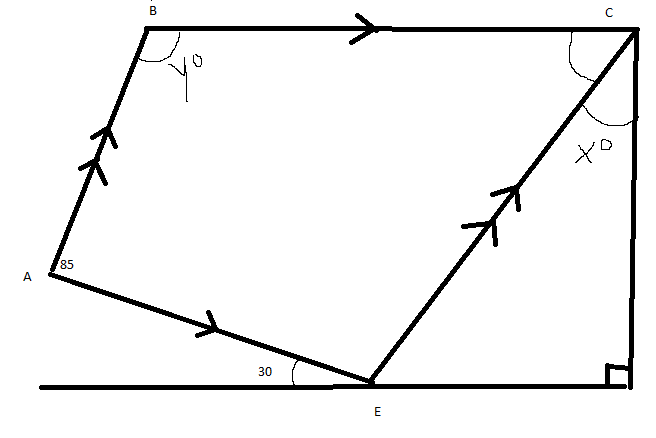
I don't understand how to do this
 regal shell
We don’t know that bc is parallel to e, so I think you can’t technically
But it looks like it
viscid ginkgo
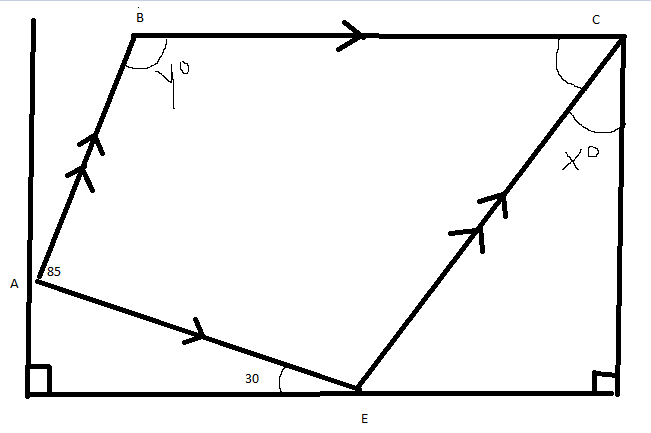
ok so I redrew it, and now I see that there's a right triangle right?
so we have a 30-60-90 triangle
alright I think I solved it
I believe x = 55, and y = 125
regal shell
If bc is parallel to e, then yeah ur right
viscid ginkgo
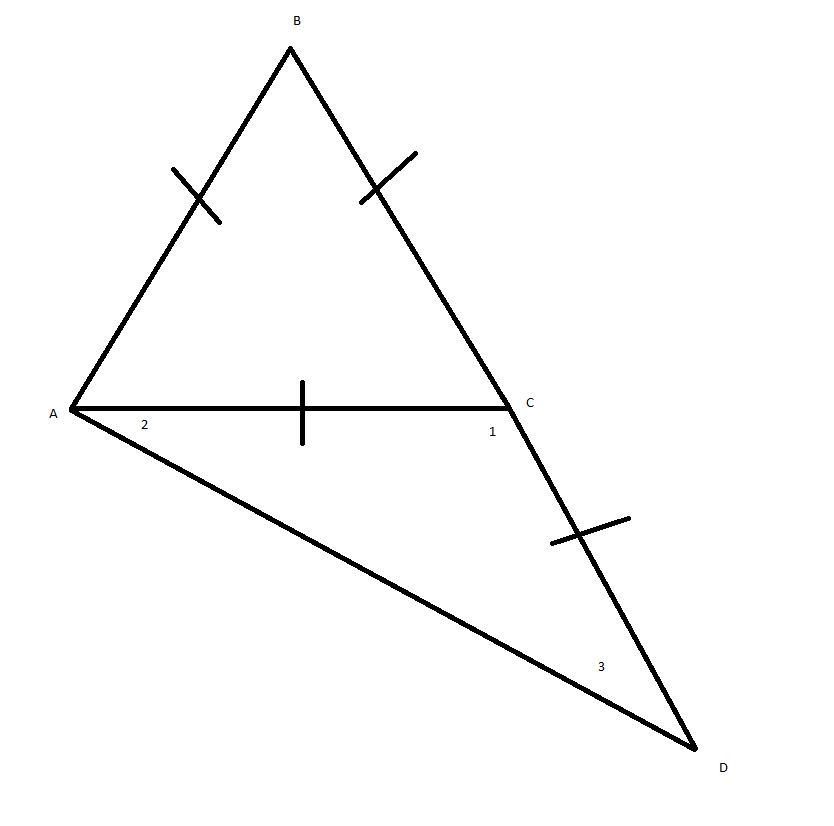
triangle ABC is obviously 60-60-60
so then angle 1 is supplementary, so it's 120 degreesd
since side AC and CD are congruent, ITT tells us angle 2 and 3 are congruent
regal shell
So then other angles are 30 each
upper karma
in an equilateral triangle, draw 3 lines from each vertex to a side such that the line is perpendicular to that side. will the crossing point of the 3 lines be the the same as the center of the circle inscribed in that triangle?
dark sparrow
yes all centers coincide in an equilateral triangle
in your case, the orthocenter and incenter
upper karma
how does one prove that though?
dark sparrow
in an isosceles triangle the altitude and bisector (and median) originating at the apex coincide
an equilateral triangle is isosceles but any point can be its apex
upper karma
ahh i see
viscid ginkgo
what am I doing wrong?
I don't know what to put as a reason for why CH is parallel to AN, since I already did so.
dark sparrow
yikes, two col proofs
silent plank
is this the original problem with all the information?
why did you label those angles as 60° when that didn't seem to be mentioned?
azure reef
yes i now trying to understand how he derived it
if it was given that CH = AN it would be trivial
but without looks like meh
like if we assume that NH is parallet to CT then it follows
but nah
silent plank
wait
viscid ginkgo
@silent plank the original doesn't have the 60 degrees written.
silent plank
read the wrong points
dark sparrow
what deos ITT even stand for
viscid ginkgo
isoscoles triangle theorem
silent plank
not all isosceles triangles are equilateral
viscid ginkgo
equiangular?
viscid ginkgo
cool!
azure reef
external angles are the key
silent plank
you can conclude that <1 and <2 are equal but they're not necessarily 60°
azure reef
what is external angle of triangle, aaron?
silent plank
don't need that
silent plank
ditch 4 and 5
azure reef
i am not understanding that notation meh
azure reef
just what equals exterior angle of triangle?
silent plank
conclude that <1 = <3
azure reef
what
viscid ginkgo
measure of angle 3 + measure of angle N = measure of angle CAN
azure reef
conclude that <1 = <3
well that angles near base are equal is trivial
silent plank
and apply converse of corresponding angles on parallel lines
azure reef
measure of angle 3 and measure of angle N = measure of angle CAN
i ask general case
azure reef
yes
viscid ginkgo
60
azure reef
nah
silent plank
not all isosceles triangles are equilateral
azure reef
given two angles $\alpha$ what equals third angle?
viscid ginkgo
o.o
somber coyoteBOT
Commander Vimes:
viscid ginkgo
2a
viscid ginkgo
180 - 2a
viscid ginkgo
120
azure reef

viscid ginkgo
120+60 = 180
silent plank
not all isosceles triangles are equilateral
silent plank
don't use 60° anywhere in your problem
viscid ginkgo
I don't understand, it's a linear pair
azure reef
there is no paint on my ubuntu, can you please redraw the task?
silent plank
because you are trying to prove it works for ALL isosceles triangles and not just for the special case where it is equilateral
viscid ginkgo
to the ... what do I call it? x-axis, of line ... CT?
I don't know the term
and it's kinda outside of CT
but I think my prof said you can call a line whatever you want
as long as it's a "member" of the line
hmm
viscid ginkgo
my book says that if the 2 sides are congruent, then the base angles are also congruent./
silent plank
yes. but not 60°
silent plank
if you introduced those labels,
<1 = < 2 is fine
silent plank
and <2 = <3 is given is also fine
silent plank
from which you can get <1 = <3
silent plank
wasn't what "I" wanted...
silent plank
from which you can get <1 = <3
azure reef
silent plank
in your new diagram, don't make it seem that HN and CT are parallel
azure reef
we are particularly interested in angles c and b
silent plank
make triangle ANT distinctly scalene
azure reef
so aaron, between angles a, b and c there is a marvellous relation
which yields AN || CH
do you understand why there is 2 b's?
silent plank
this is overcomplicating it
viscid ginkgo
azure reef
ramonov why overcomplicating?
silent plank
in your new diagram, don't make it seem that HN and CT are parallel
azure reef
literally 3-4 operations which yield parallel lines
viscid ginkgo
so 4. angle 1 = angle 3
silent plank
yes
viscid ginkgo
we are particularly interested in angles c and b
there's no angle b
oh
in your diagram
azure reef
ye here
azure reef
c = a + b ok
viscid ginkgo
180 - angle a
azure reef
and CAN = ?
viscid ginkgo
= angle a + angle b
silent plank
fine do extra stuff and completely ignore me and make the 2 column proof longer than it needs to be
viscid ginkgo
im not sure
azure reef
oh lol i now got what ramonov meant
viscid ginkgo
im confused as fuck right now
like
who do I listen to
and I don't know what angle c =
if it = angle CAN
ok angle 1 = angle 3
for #4
azure reef
they are bot equal to 180 - a
that what was ramonov saying
and what i did by long route
and if two lines cross third line and make equal angles it yields
silent plank
so yes,
#4. angle 1 = angle 3 (transitive)
and apply converse of corresponding angles on parallel lines
silent plank
corresponding angles on parallel lines are equal
converse: if corresponding angles are equal then the lines they're on are parallel
viscid ginkgo
oh yeah I did that one earlier
yeah
makes sense
so
- angle 1, angle 3 are corresponding angles -- reason: Def. of Corresponding angles
- parallel
Reason: if corresponding angles are congruent, then the line is parallel
the line is parallel part doesn't sound right
what line, you know?
silent plank
the lines they're on
viscid ginkgo
then their lines are parallel?
or can I say
Thm: if lines are parallel, then corresponding angles are congruent.
turned around
Thm: if corresponding angles are congruent, then the lines are parallel.
idk if it matters?
upper karma
Sure
azure reef

regal shell
Other guy ftw 💪
 stark wraith
how can i prove that for any a>0 tan(a) x tan(a+90)=-1
dark sparrow
did you use x for multiplication there?
please don't do that
anyway, "proving tan(a)tan(a+90°) = -1 for any a > 0" is a bit of a tall order given that there are many values of a for which tan(a)tan(a+90°) is undefined
for example, if a = 90°
how are you going to take tan(90°)
stark wraith
i have two Z numbers that i know have 90 degrees difference between their angels , and i need to prove that the lines that go from (0,0) to each of them are vertical
dark sparrow
"Z numbers"?
dark sparrow
anyway, it'd be a very different story if you asked how to prove tan(a)tan(a+90°)=-1 for all a where the left-hand side makes sense rather than "for all a > 0"
because then i could tell you that for all real a you have sin(a + 90°) = cos(a) and cos(a+90°) = -sin(a)
and so as long as sin(a) and cos(a) aren't zero you can write tan(a)tan(a+90°) = (sin(a) sin(a+90°))(cos(a) cos(a+90°)) = (sin(a)cos(a))/(-cos(a)sin(a))
anyway, it looks like you're heavily misusing mathematical terminology
and i'm not sure if it's due to a language barrier or a lack of understanding what means what or both
stark wraith
i didnt get your way of getting to sinacosa/-sinacosa
dark sparrow
for all real a you have sin(a + 90°) = cos(a) and cos(a+90°) = -sin(a)
stark wraith
oh ok thank you
dark sparrow
did i really have to repeat myself
or did you just choose not to read what i said the first time round
upper karma
Sorry
stark wraith
you didnt have to repeat yourself either way
its your choice if you want to help or not
upper karma
@stark wraith Yep nice comeback
viscid ginkgo
in my proof if I assume in an indirect proof that rays BA and BC are perpendicular, given that they're not, and then reach a contradiction
what do I put for reject and therefore?
Reject: rays BA and BC perp
Therefore: Assumption is false. rays BA and BC not perp
 night wind


 wooden current
um
upper karma
Some Overwatch short film lmao.
wooden current
why here
keen aspen
reduce tan down to sin and cos
upper karma
yea
keen aspen
the negatives cancel
keen aspen
not negative
upper karma
is
keen aspen
sin^2(-x) is sin(-x)*sin(-x)
upper karma
sin(-x) just -sinx
upper karma
gotcha
keen aspen
so its just sin^2(x)
upper karma
but sin(-x)=-sinx
keen aspen
yes
keen aspen
You cant really do so
 graceful anchor
sad
keen aspen
Its ok
 umbral snow
Newton's method af
devout harbor
if it's sin(kx), that means an amount of k sin curves in an interval of 2pi, or each sin curve has an interval of 2pi/k. so you have sin(2pi / 365) which means an interval of [(2pi) / (2pi / 365)]
which is just 365
@brisk holly
for simplicity, take sin(2x). in an interval of 2pi, you have 2 sin curves
or each sin curve has an interval of 2pi / 2 which is just pi
 brisk holly
oh i just forgot multiplying two fractions
I thought 2pi/2pi/365 simplified to 1/365
 neon jolt
Hello, I have a question regarding this expression
vA dot vA = Theta = 0 therefore va dot va = a^2cos(0) = a^2?
where is this a^2cos(0) come from?
is it |a||a|cos(0) = a^2?
hence aa1
 weary drift
where is this a^2cos(0) come from?
the geometric definition of the dot product
neon jolt
Perfecto
upper karma
What are the basics of Geogebra
upper karma
cheese
azure reef
basics of Geogebra is alge-bruh
wooden current
guys imagine if algebra was spelt algebruh 😂 😂 😂
upper karma
upper karma
Aight Cool
regal shell
U can treat that like a regular cylinder
 lavish glacier
I got 14071.26?
upper karma
Hold on son
lavish glacier
Ok papi
upper karma
@lavish glacier Well did you do everything correct?
lavish glacier
Let me try again
upper karma
Ok
I’m not saying you got it wrong
I haven’t even tried it myself
What makes you doubt your wrong?
If you did everything correct then sure
lavish glacier
Its not 1 of the multiple choice answers
regal shell
I got one of the answer choices
upper karma
Do u see how 26.1 represents the height?
regal shell
What formula did u use?
lavish glacier
V = pi r²h
upper karma
Ya good
lavish glacier
Oh i used pi instead of 3.14
upper karma
Ya it specifically says just to use 3.14
regal shell
O ok u got it right then if u use 3.14
lavish glacier
D!
lavish glacier
Thanks papi!
regal shell
Xi can you be my papi too?
regal shell
Yay
lavish glacier
Brutha?@regal shell
upper karma
👨👦
regal shell
O
lavish glacier
regal shell
Who’s the one on the left