#geometry-and-trigonometry
1 messages · Page 281 of 1
 upper karma
 candid terrace
I got 10 more questions
upper karma
Ok
candid terrace
Ik
candid terrace
I can’t find the length of the chord
What is the equation for chords
@upper karma
 silent plank
look up tangent-secant theorem
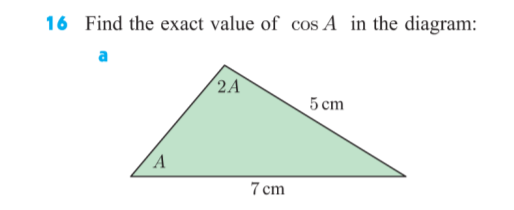 silent plank
apply laws that work for all triangles
 fringe canyon
if i draw height, will it divide 2a into to equal parts right?
so the angle would be x and x from each side
 keen aspen
Dont worry about making a right angle
upper karma
Not really
if i draw height, will it divide 2a into to equal parts right?
@fringe canyon
silent plank
my comment implied that additional construction isn't necessary
silent plank
i.e. consider the sine law
upper karma
^
fringe canyon
but i am not supposed to know sine law and cosine law while studying this chapter lol
it comes a little later, i mean i know how to use it
its just its not point of chapter ;p
it is currently in double angle identities
fringe canyon
this book sucks, this is second time i need to use it even though it comes later..
well, i dont know i am just following order of the book
silent plank
well the thing is that certain things are taught around the same time
and topics need to be split for the book to have at least some structure
fringe canyon
so in order to solve this what i would do is $ 5/sin(a)= 7/sin(2a) $
 somber coyoteBOT
ZeusBotko:
fringe canyon
and it would form $ sin(a)(10cos(a)-7)=0$
somber coyoteBOT
ZeusBotko:
fringe canyon
so then i would have sin(a) =0 or 1cos(a) -7 =0
silent plank
um that looks weird
fringe canyon
how?
silent plank
ah nvm
silent plank
don't worry about the sin(a) since its non-zero
unlike solving other trig equations, factoring like this wasn't really needed
silent plank
yeh
keen aspen
?
silent plank
wdym?
fringe canyon
and questio clearly asks for exact results
silent plank
youre just asked for cos(A)
fringe canyon
10cosx-7=0
fringe canyon
i dont know what you mean by jumping between vars
silent plank
you're using both a and x while the question uses A
in fact you'd be going backwards, because I'm pretty sure you should've had something like:
10cos(A) = 7 in a previous line
fringe canyon
oh, sorry i just tend to always transfer anything to x
silent plank
and that's just 1 step away from getting cos(A)
fringe canyon
i write everything for myself with x
but when i am typing in discord i need to change my x's to correct var the one that is in exercise
i dont make that mistake on paper
somber coyoteBOT
Requested by DSpider#6917
upper karma
how do you increase the precision of the bot?
silent plank
you're just asked for cos(A)
 graceful narwhal
,ask N[arccos(0.7), 100] * (180/pi)
upper karma
oh, I see
somber coyoteBOT
 Requested by deekaan#8505
graceful narwhal
Requested by deekaan#8505
graceful narwhal
no worries
upper karma
@fringe canyon yeah, you're asked for the value of cos(A)
which is 0.7
no need for the inverse (to get the actual angle)
cos(A) = 0.7
@candid terrace you still need help with those?

I mean, come on
even if you didn't know about inscribed angles you could still look at the numbers
which number is greater?
(though admittedly, angle CED looks a bit wider...)
 sturdy orchid
are the triangles on a parallelogram(divided by its diagonals) equal in area?
 dark sparrow
yes
upper karma
@candid terrace
remember, all angles from a triangle add up to 180 degrees
he ded
a'ight


Desmos
there you go
only one of those points does

hint: ||Pytha... wait for it||
||...gora||
 acoustic jungle
Good job
fringe canyon
I soved this but i an missing some solutions
And i cant seem to be able to find why
D)
And x€[0,2pi]
<@&286206848099549185>
silent plank
you cancelled the sin(2x)s
silent plank
erasing sin(2x) from existence loses the solutions you would get from sin(2x)=0
upper karma
but... sin(2x) doesn't = 0
sin(2x) = 2 * sin(x) * cos(x)
^it's one of the trig identities
silent plank
i.e. you shouldn't divide by stuff that could be 0
fringe canyon
Then how shall i solve it
silent plank
factorisation,
fringe canyon
Yes ramonov is right
Sin2x can be 0 so i am not actually allowed to divide by ut
It*
 twilit turret
Hello everyone. I need some help in a geometry problem.
A polygon has n sides. (n - 1) sides are 1 and last side is L. 2 adjacent angles (which use side L) are ang1 and remaining all angles are ang2. Given n, ang1 and ang2, how can I find L.
twilit turret
I want to use this in a problem on codeforces.
It will look like this for n = 5.
upper karma
adjacent angles (which use side L) are ang1 and remaining all angles are ang2
twilit turret
Oh I'm sorry so I marked angles wrong in picture... but I hope you understand it mow.
now*.
upper karma
the formula for the interior angles of any polygon is (n-2) * 180
if n is 5, it also means that there are 5 angles
so (n-2) would be ang2+ang2+ang2 in this case (labeled correctly, that is)
and the other two angles would be ang1+ang1
twilit turret
OK
upper karma
twilit turret
Thank you for the correct diagram. Now how can we solve it?
upper karma
silent plank
that isn't what's being asked
consider constructing some lines to get something like this:
x can be determined since the edge triangles formed are isosceles
all other relevant angles can be determined from angle sums
and you can find L from a few applications of the cosine law
silent plank
start with a pentagon worry about others later
upper karma
why not start with a triangle then?
acoustic jungle
seems like a lot of cosine law stuff when there are more sides
oh.
also need to separate if n is even or odd I think.
upper karma
the minimum would be this:
(n-2) * 180
3 sides
3-2 = 1
1 * 180 = 180
which makes sense because all angles from a triangle add up to 180
as long as you use (n-2) * 180 it will work for all kinds of shapes
which brings it back to:
ang2 will always be at the top
and should always stick to those rules
silent plank
that isn't what's being asked
 fluid stream
you wrote down an equation for the angles, but everything in that equation is known
upper karma
if you increase the angles marked in red (the top part), the bottom angles would automatically adjust
because all the angles from a triangle need to add up to 180
fluid stream
this seems like a problem where you might want to start with a small case then see if you can generalize the result
acoustic jungle
First of all it should be L^2
acoustic jungle
I can find the value of L for all odd sided polygons by doing in manually and connecting all the vertices to the top of polygon, then using cosine law, but I can't do the general form.
I can also do the even thing manually if I had the values but I can't do it in general form
 high wren
upper karma
high wren
upper karma
Standard form is written like this:
So switch 24 onto the left side. Factor 24 and simplify that. Then keep factoring and simplifying. Then you can rewrite it as the standard form.
silent plank
check you signs
the vertex is above the focus, so your equation should represent a concave down parabola
upper karma
it's an up-down facing parabola, vertex: (h, k), focal length: |p|
 latent wing
yo can someone help me
latent wing

 wooden current
logiic is gone 😭
upper karma
if you take each point of the parallelogram and move it across that line... what do you end up with?
remember, it's a reflection
not a copy
you don't just copy-paste it to the other side
latent wing
yo i am baked but ok i get it now kinda
no lie i still got it wrong but i think i know now
bruh
im so lost
silent plank
did you manage to finish the previous question?
upper karma
upper karma
law of sines
 versed aspen
😑 Finding tan(θ) works too
upper karma
LOL
Remember that a triangle adds up to 180 degrees
then use a trig function to find x
 echo panther
upper karma
echo panther
upper karma
wait, so you solved the other problem already?
versed aspen
He's posting problems all over the server
upper karma
@echo panther is this a test?
upper karma
well, for the first one you have two options: law of sines or just straight up soh cah toa (emphasis on the toa)
upper karma
you've never heard of SOH CAH TOA?
versed aspen
Also, just one problem at a time
echo panther
this is my first time hearing word trigonometry
upper karma
Alright, let's do this.
Sine = opposite/hypotenuse
Cosine = Adjacent/hypotenuse
Tangent = Opposite/Adjacent
These are your trig functions for solving right triangles
SOH CAH TOA is an abbreviation to help you remember it
As you can see, your problem involves right triangles, so we can use trig functions to answer your questions

Khan Academy
Learn trigonometry for free—right triangles, the unit circle, graphs, identities, and more. Full curriculum of exercises and videos.
Let's look at this, to find an angle measure, we have to use-
😆
oops..
echo panther
op
upper karma
We have to use khan academy
I recommend you look at it
I'll just help you out with one to get the main idea
echo panther
okay
upper karma
We have to use an inverse trig function because we're finding an angle measure.
echo panther
okay
upper karma
15 is the hypotenuse, and 5 is adjacent to b
so we can use the inverse of sine
sin^-1(15/5)=Angle B
wait no
echo panther
15 divided by 5 is b?
upper karma
We use cosine
since we have the adjacent to B, and we have 15 as the hypotenuse
Cos^-1(5/15)=Angle B
Then you plug that into your calculator, make sure you have it on degrees
upper karma
And you'll use the shift key, press cosine, and then do 5/15
There's radians and degrees, set it to degrees
arc is another word for inverse
versed aspen
,calc cos(5/15)
somber coyoteBOT
Result:
0.94495694631474
It's not regular cosine
versed aspen
Its the inverse
upper karma
It's the inverse of cosine because we're finding an angle measure
And that gives about 70.53
from that image ^^
echo panther
she said this problem is suppose to take less than 30 seconds to finish
upper karma
It is, if you have a calculator and you know your trig
echo panther
okay what do i do wih 70
upper karma
That's your angle measure
echo panther
no but this is all new to us
echo panther
since we never have done online learning its hard for all of us
upper karma
Indeed it is, but check out my pal Sal
echo panther
okay 70 is that angle
echo panther
and now how do i find the tangent of it
upper karma
Tangent of B is opposite over adjacent. Find AC and then put that over 5
Find AC by using the pythag theorem
upper karma
14.1421356237 is AC, and put that over 5
So tanB=14.14/5
I don't think you're supposed to divide them
upper karma
good job
echo panther
now im on sine and cosine ratios
upper karma
Awesome! :D
echo panther
this is not fun
echo panther
woah woah woah the law of sines is one of the final parts of the trig unit
theres 6 parts of trig unit and law of sines is part 5
upper karma
There’s also a law of cosines
There’s multiple ways to approach those problems
You don’t have to do it like that
echo panther
woah woah thats the final part of trig unit
upper karma
😄😄
somber coyoteBOT
Result:
1.7320508075689
,calc 8 * sqrt(3)
somber coyoteBOT
Result:
13.856406460551
okay not sure how to find
length of other sides
with just a angle degrees and a side lenth
upper karma
you need 3 things to solve a triangle
if angle B = 30 deg... what's the measure of angle A?
remember, all angles from a triangle need to add up to 180
upper karma
yep
upper karma
meters
echo panther
angle a 60 degrees
echo panther
okay now how do
upper karma
Now tan(A)=?/?
echo panther
i find that with angle degrees
upper karma
Tan(A)=opposite/adjacent
Plug in your opposite of angle A
And then “b” is your adjacent
And you’re not using an inverse, since you’re finding segment length
use either sin or cos
 orchid grove
Hey, I'm trying to teach myself trig, and I'm trying to solve this problem where the tangent of an unknown angle equals a value. So I know that to solve that you move everything to one side, etc etc, but what is the opposite of tan? How would you undo that? Is it tan^-1 or arctan or something?
orchid grove
Oh okay, thanks! So I just need to get arctan of the value that I know, and then I'll get the unknown angle, correct?
upper karma
Yep
orchid grove
Thanks!
upper karma
👍
tan^-1 is just a notation
you don't actually raise it to the power of -1
Yep
Arctan
Or that
Same thing
arctan, tan^-1, or inverse tan, inverse tangent
same thing, yes
@upper karma Yep I love u
Smart boi
😘
 rich wolf
DSpider
rich wolf
@upper karma why did you delete what you wrote earlier?
somber coyoteBOT
aaron:
 viscid ginkgo
I need help with this identity idk how to prove it = sec
acoustic jungle
try multiplying num and deno by cosAcosB-sinAsinB @viscid ginkgo
viscid ginkgo
ok
viscid ginkgo
ok so we have [(cosAcosB)^2-(sinAsinB)^2] / (-1 + cos^2 A)
acoustic jungle
also covert everything to cosine
also cos^2A isn't right
wait.
ok don't expand the denomenator yet.
leave the deno as (cos^2A+cos^2B-1)(cosAcosB-sinAsinB)
acoustic jungle
alright here I'll just show you my work, wait a second.
I hope this helps @viscid ginkgo , you made a tiny mistake since you forgot the brackets and -1
there.
viscid ginkgo
how did you get rid of the denominator
on step 4
for LHS
it's definitely helping, I appreciate it.
acoustic jungle
hmm, step 4? or the second last step?
oh the '' is for "same thing but I don't want to write it again"
viscid ginkgo
oh ok
I think you accidentally wrote +cos^2b
instead of -cos^2b
wait no
my error
awesome!
finally finished with this section
thanks a lot fishraider
upper karma
UwU
latent wing
?
acoustic jungle
if (x,y) is reflected across x axis, it becomes (x,-y)
 ripe dove
get a mirror, place it on the x axis, look at the reflection of that parallelogram, plot those points
but, yes, I think it looks like you have the reflection of Q correct
 gritty sail
gritty sail
gritty sail
<@&286206848099549185>
 graceful hemlock
Ahh
I think you use law of cosines for that
Are you familiar with it? You should probably draw the triangle and the points first
Wait nvm
No need for law of sines I believe
Cosines*
But you can use features of the triangle that you would have drawn
If you assume that ABC ABD and ACE are similar, then they can have angle angle similarity and you can use that to compute the cos of angle BAC
Sorry if I cannot help effectively by giving some illustration, I’m in bed right now lol
But I do advise you to draw the triangle and points, and look at each feature given
upper karma
Lmao.
 pallid shadow
@grizzled trellis a and e
there is a reason why
it is a cool trick
you use pythag triads
 coral sapphire
Don't give the answer right away :p
pallid shadow
all the triangles with pythagorean triads are the correct ones
 grizzled trellis
ty
pallid shadow
because it is impossible for a triangle to be in a pythagorean triad if it aint right angles
This is one of the many reasons why Pythagoras Theorem is so powerful
because it is if and only if
grizzled trellis
so you are sure that it is a and e?
pallid shadow
not only is a^2 + b^2 = c^2 in right angled triangles. But it is only in right angled triangles
lemme check again
yes
i am 99% sure
a and e
upper karma
Aight
pallid shadow
@grizzled trellis did you get it correct?
pallid shadow
kk
upper karma
@grizzled trellis Kk
pallid shadow
Yeah I now realize how powerful some of the tools in math are
pythag is If and only if
upper karma
Yes you can rule the world 🌍
pallid shadow
it is right angled
grizzled trellis
tom i got another for you
pallid shadow
you can prove this using cosine rule.
grizzled trellis
im not sure which one it is
upper karma
U just basically do the math with the last one
grizzled trellis
13/100 was shown as incorrect so did 1 1/3
grizzled trellis
would it be 12/90?
grizzled trellis
alright ty
upper karma
Why would I pick 1 1/3 tho
U*
It’s okay I won’t criticize you
We all make mistakes
But don’t you see how 0.33333 is less than 1
pallid shadow
kek
pallid shadow
it is just d
pallid shadow
12/90
upper karma
Yep
pallid shadow
13/100 is 0.13
upper karma
Yep
grizzled trellis
grizzled trellis
answer is 2?
pallid shadow
I hope the question doesnt force you to use units
actually even if it did it wouldnt matter too much
grizzled trellis
it hases an answer box where youre allowed to type numbers
pallid shadow
doesnt look right
grizzled trellis
i clearly got it wrong
pallid shadow
The answer of 2 is incorrect
wait
wait
i misread the question
round to nearest whole number
upper karma
Answer is 16 Pi Multiplied by 15
pallid shadow
what is the units?
cm^3?
@upper karma depends, what if the units is metres cubed? 
upper karma
?
grizzled trellis
its cm
grizzled trellis
what did he say
upper karma
Just round to nearest whole number
pallid shadow
16 * pi * 15
upper karma
@grizzled trellis Do u understand what I did to get that tho?
grizzled trellis
so 16 times 3.14 times 15 = answer?
pallid shadow
then you go 16 times pi times 15
upper karma
@grizzled trellis Do you understand what I did to get that tho?
grizzled trellis
not really
pallid shadow
So the question states that the pencil is perfectly diagonal Which is unrealistically convenient but important.
This means that the pencil , the height of the cup and the length of the bottom of the cup form a right angled triangle.
Now the question gives us the height of the triangle, and the question gives us the length of the pencil. But it doesn't give us the length of the bottom. We need this value to do the question.
Do you know how to get this value?
pallid shadow
I checked it, it is that value
grizzled trellis
753.982236862 is correct?
pallid shadow
though I use the online calculator
So, do you know how to get the length of the bottom of the cup?
grizzled trellis
no, but is the answer 753.982236862?
pallid shadow
Yes, but you better know how to calculate that length or else in the long term you are gonna fail hard.
grizzled trellis
okay please explain
pallid shadow
So the question states that the pencil is perfectly diagonal Which is unrealistically convenient but important.
This means that the pencil , the height of the cup and the length of the bottom of the cup form a right angled triangle.
Now the question gives us the height of the triangle, and the question gives us the length of the pencil. But it doesn't give us the length of the bottom. We need this value to do the question.
Do you know how to get this value?
grizzled trellis
i do not know how to get the value
pallid shadow
Do you know Pythagoras Theorem?
grizzled trellis
yes
grizzled trellis
o bye xi
pallid shadow
Alright, so do you how to use Pythogras Theorem to solve for the length of the bottom of the cup?
grizzled trellis
i think so
pallid shadow
Alright try it out
grizzled trellis
ima have to go sleep very soon, ima ask 1 more question and hit the bed
pallid shadow
Look, I am not gonna waste my time with this.
It seems you aint gonna put the work in 
grizzled trellis
wdym
upper karma
Yes try it yourself first
Don’t rely on us for everything
Learn stuff
Watch YouTube videos
Ask your teacher
grizzled trellis
okay ill give it a try trying to solve it on my own
upper karma
Ok good luck 👍
pallid shadow
It honestly seems that you are not even trying Kek.
Like, you weren't even done with the previous question.
grizzled trellis
not wrong im trying to do another one because i have to wake up early tomorrow
or do as much as possible
pallid shadow
Yeah nah this is not worth it for me. Ask someone else.
grizzled trellis
mhm okay thank you for helping me anyways
silent plank
did you mean whether the slope is positive or negative?
rearrange it to the slope intercept form: y = mx + b
to easily identify it
 weary drift
writing a test
 ripe dove
friend a teacher?
weary drift
your friend is taking a test and you are helping her do it?
ripe dove
nah, my point was, we don't help with tests. if she was creatingthe test it would be fine
weary drift
helping students with tests is against the rules of this server. you should stop helping your friend and wish her good luck
dark sparrow
not our problem
ripe dove
or technically yours
weary drift
poor manners get you less help
ripe dove
<@&268886789983436800> ?
 copper valve
hi
upper karma

 twin heron


 ripe dove
I understand requesting help on exams is a banable offense?
weary drift
bambi's "friend" needed the answers, not bambi directly
ripe dove
and politely telling them no did not work
true, but that is simply us helping at second hand
weary drift
i do admire bambi's loyalty to their friend, however misplaced it is /s
 remote heart
very nice /s there
weary drift
i don't think /s is needed but put it there just in case
remote heart
ya
upper karma
@ripe dove he did say very insultive things
I don't ban merely for requesting help without a warning
ripe dove
fair enough. I was simply reporting the issue
had you decided to issue a warning rather than a ban I would have been content
had he not been rude when told we wouldn't help with a test and simply accepted the rebuff I wouldn't even have called y'all in
acoustic jungle
Ok.
 brisk ginkgo
I need help!!!!
ripe dove

ripe dove
do you recall a theorem about angles with a vertex on the edge of a circle and the arcs they subtend?
@brisk ginkgo
upper karma
@brisk ginkgo Hola
What do you mean by JH is a diagram and angle 3 = 39
JH isn't a "diagram", it's a diameter
Do you JH Is a diameter and angle J = 39
ripe dove
pretty sure the 3 is a J, just handwriting issue
upper karma
Ah yes
ripe dove
and there is a degree symbol
ripe dove
but they posted it and seem to have ghosted out so, hard to help
upper karma
Ah yes
@brisk ginkgo Abadaababbaabba
that was rude
if you ask a question at least stick around
any way, if you know what an inscribed angle is, it's very easy to solve it (and even if you don't, google it)
the diameter splits the circle in half
that means 180 degrees on one side, 180 on the other
once you have arc KH, JK is just 180 - KH

brisk ginkgo
@ripe dove oh I feel bad I already got help from somewhere
Thank u so much thoigh
I read what all of u said
ripe dove
it's fine, i moved on. it a good idea to stick around if someone starts replying to try helping you though
brisk ginkgo
@ripe dove thank u sm! I actually do need help another problem tho
If u don’t mind I can understand if ur mad
ripe dove
not mad
what you got?
i am answering other questions at the same time tho, so might not be split second responses
ripe dove
so long as you know it's not good manners (at least to give a heads up you are getting help elsewhere) it's fine
what is the measure of an arc that goes all the way around the circle?
ripe dove
ok, does DBC go all the way around? If not, what arc would take you the rest of the way around?
acoustic jungle
why is arc AB necessary
brisk ginkgo
@ripe dove the central angle formula we use?
ripe dove
@acoustic jungle i assume it is simply included in the original question as a potential distractor
@brisk ginkgo that wouldn't be needed to answer the question i asked
brisk ginkgo
I don’t know what arc though
ripe dove
if you go along the arc DBC, starting from D going through B and ending at C, have you gone around the whole circle?
brisk ginkgo
Oh kmfao no @ripe dove
ripe dove
ok. so what would it take to get you the rest of the way around?
you are now starting at C and have to get to ?
ripe dove
that doesn't get you back to where you started your trip around the circle
ripe dove
O is at the center, you shouldn't end up there ever
where did we start originally?
if you go along the arc DBC, starting from D going through B and ending at C, have you gone around the whole circle?
brisk ginkgo
We started at D!
ripe dove
so that's where we need to get back to
so CD is what would get us back to where we started, having gone once around the circle
brisk ginkgo
DC is 118
ripe dove
CD and DC are the same arc, just going in different directions
and DC is 118 degrees long
ripe dove
and since DBC + DC takes us all the way around the circle (which is 360 degrees)
@upper karma doesn't matter
DBC = FullCircle - DC = 360 - 118
brisk ginkgo
Oh ok
upper karma
it does matter, because angle DBC is this:
brisk ginkgo
Ab= 34
ripe dove
and?
upper karma
34, ok
ripe dove
it doesn't matter
upper karma
it would've been a different result if it was 39
brisk ginkgo
We are finding DBC
upper karma
yeah, you're right
ripe dove
A itself was completely irrelevant to the problem
brisk ginkgo
Ok so I minus 360 and 118 it’s 242
ripe dove
@upper karma because of the way I took them through the problem
upper karma
arc AB really doesn't matter
ripe dove
It is true that you could do it with the semicircle, but I think that requires more complicated thinking
brisk ginkgo
@ripe dove would that be the answer 242?
ripe dove
arc length
upper karma
arc, angle...
brisk ginkgo
Thank u!
upper karma
it's from the origin so it's the same thing
ripe dove
synonymous, yes, but the question dealt with arc lengths
silent plank
*arc measure
upper karma
does it work if you apply Pythagoras' theorem?
because that works with right triangles
brisk ginkgo
Yeah I think u can use phythagrpa theore
upper karma
,w 8^2 = 4^2 + 3^2
somber coyoteBOT
Requested by DSpider#6917
upper karma
^the bot says nah
 calm lintel
when something says it requires 4 bricks to the square root and I have the area of the pathway.. how would I know how many bricks are needed?
upper karma
ok, so 1 square foot = 4 bricks
 pearl lava
what do you learn in high school geometry?
upper karma
the area is correct
but if the surface area is 66
and for each one of those 66... you need 4 bricks...
how many bricks do you think you would need?
calm lintel
66x4
upper karma
yep
calm lintel
im retarded
upper karma
lol
calm lintel
bro ithought i had to do so much more
upper karma
calm lintel
lol wow thanks man
upper karma
sure thing
 novel marsh
is this correct?
novel marsh
thanks
calm lintel
oh god if i want to be an architect and cant do these simple problems i think my future is ruined
calm lintel
that's true .. practice makes perfect I guess.
upper karma
law of cosines
 urban breach
o... thank you!
upper karma
Or that
So it looks like 10*(10+6)=x*(x+6)
Then just solve for x
@urban breach
@upper karma External segment tho
I did include the external segments
It’s 6(10+6) = 8(8+x)
Adding the segments and multiplying by the outer segment=adding the segments and multiplying by outer segment
So it looks like 10*(10+6)=x*(x+6)
@upper karma
No it’s 6
6 is the outer segment
6(10+6)
Ah ok
👍
 little compass
Can anyone help me with this problem? Please!
upper karma
Enjoy the videos and music you love, upload original content, and share it all with friends, family, and the world on YouTube.
That’s very general...
If b and d are points of tangency, ADC form a right triangle
So then you can use the Pythagorean theorem
yeah, Pythagora
DC^2+5^2=(8+5)^2
My guy 😌✊
little compass
thanks i didnt know how to do cause my teacher didnt know how to explain it to us and i couldnt find help online 👌
upper karma
Ahh, no problem! I’m glad I can help ☺️
I recommend you read up on point of tangency and tangent lines, those can be really useful
little compass
yea im watching the vid @upper karma sent also
upper karma
Awesome!
little compass
Thank you i found the answer its 12
brisk ginkgo
@upper karma so 4 is my answer
upper karma
Yup! Nice job :)
upper karma
Sure :)
brisk ginkgo
@upper karma
upper karma
,rotate -90
somber coyoteBOT
upper karma
So the two opposite angles equal 180 degrees
Since it’s a trapezoid inscribed in a circle
Thanks spider btw
😉
So 21x-2+38x+5=180
Then after you get your X, plug it back in to solve for angle A
And Arc BCD is 2x Angle A
Because of the inscribed angles theorem
That should cover it, if you have any questions, please ask ☺️
brisk ginkgo
@upper karma thank you so much!
upper karma
You’re welcome! :D
brisk ginkgo
When I divide I gets like a .3
upper karma
So 21x-2+38x+5=180
@upper karma x=3
Putting it back into A: 21*3-2=61
So Angle A=61 degrees
Them multiplying that by 2 would yield 122
So Arc BCD is 122 degrees
upper karma
@brisk ginkgo
first you move all numbers that have x in them on one side
and the rest on the other side
Hot
(reversing their polarity if they go on the other side of the equal sign)
so, yeah
there's no ".3" in there
@upper karma You’re awesome
Smart Boi
true, true
Ahah 👍
 pastel anchor
how can u find the area of the shaded region?? wtf?
upper karma
do they give you any numbers to work with?
upper karma
well, yes,
since AD is a diameter
do you know the formula for the area of a circle (google it if you don't)?
pastel anchor
yea i do
pastel anchor
yea
upper karma
then what's the problem?
pastel anchor
well i found both area
of circle and rectangle
but what about the shaded part
idk how to find area of shaded part
upper karma
well, only half of each circle is overlapping the rectangle
two circle halves = 1 full circle
do you see where I'm going with this?
pastel anchor
tbh no
upper karma
what if we had only one half of a circle overlapping it?
pastel anchor
im still not getting it
pastel anchor
15*12
upper karma
would you say that you subtract the area of the semicircle (which is smaller) from the area of the rectangle (which is bigger)?
then you'd be left with the shaded area
pastel anchor
how would u find the area of semi circle?
pastel anchor
so i find area of rectangle
upper karma
so you can use 1 full circle
pastel anchor
and then subtract it from area of circle
upper karma
you subtract from the area of the rectangle
pastel anchor
so 180-36pi
upper karma
because that's what you want to "cut out"
pastel anchor
do i have to factor in 3.14 for pi?
pastel anchor
so 144pi works
upper karma
,w 12 * 15
somber coyoteBOT
Requested by DSpider#6917
somber coyoteBOT
Requested by DSpider#6917
upper karma
36 pi = area of a circle
(full circle, that is)
(or in other words, the two halves on the side)
180 - 36 pi
pastel anchor
so next time i encounter a problem with a circle inside a rectangle, i just need to subtract area of circle from area of rectangle?
that's all i need to do?
upper karma
yes
pastel anchor
alright thanks 👍
upper karma
sure thing
upper karma
why do you quit Discord immediately after posting?
After you add angle a and c, it equals 180 degrees. Then you solve for x and plug it back into 21x-2.
brisk ginkgo
@upper karma my mom keeps calling me 😑
upper karma
upper karma
Are you in highschool?
brisk ginkgo
Wbu?
upper karma
Middle school: 8th grade
brisk ginkgo
Oh ur young lol u take geometry?
brisk ginkgo
Oh ok I thought I would 360
upper karma
Then we already are given arc CD
So arc AD+arc CD=arc CDA
118-360 yields a negative...
upper karma
didn't we just solve this?
brisk ginkgo
No it’s a different problem @upper karma
upper karma
360-118= arc CAD
brisk ginkgo
Oh
upper karma
brisk ginkgo
Thank u!
upper karma
264 I got
@brisk ginkgo awesome
brisk ginkgo
Yeah similar