#geometry-and-trigonometry
1 messages · Page 274 of 1
 upper karma
Id love to
mmmm
well put in a request? not rlly sure how these things work but hhhhhHHHHHHHH
Me neither lol
oop i smell radiation, gotta head out
upper karma
Lol
 nova sand
Helloo, if i have a square with 4 half sirkles in. and i need the find the circumference of the square without the 4 half sirkles, cant i just take circumference of the full square - circumference of the 2 sirkles?
 limpid tide
do you have a picture
upper karma
well, if 4 cm is the diameter of the circle, how long is the radius?
nova sand
2cm
upper karma
good
and do you know the formula for the circumference of a circle?
because this is half that
(since it's half a circle)
nova sand
pi*d
nova sand
but can i do circumference of the full square - circumference of the 2 sirkles?
for the circumference of the yellow part
nova sand
yeah thats what i did
upper karma
then, yes
perimeter of the square (4 * 8) minus the circumference of 2 full circles
(pi*4 * 2)
nova sand
32
upper karma
minus... ?
nova sand
wait no
6,8
thats what i got
but the solution in the back of the book says 41
wich is why i asked here
nova sand
yeah
upper karma
you sure it's not area that they're asking you to find?
nova sand
they are asking for both
nova sand
i got the area correct and then 6,8 on the ones we just talked about
but it says 41...
confused
 silent plank
perimeter of orange figure = perimeter of square - 4diameters + 4semi-circle arcs
 keen zenith
hello, guys hi. so i am taking a trig test today and its not timed, but on a worksheet and i'm so lost
nova sand
-4 diameters? @silent plank
keen zenith
so can i send this test to you guys and someone possibly do it so i can see how they did it? I can use my outside sources so
silent plank
those 4cm parts
nova sand
all 4 of them?
silent plank
yes
upper karma
UPDATE: this is wrong 😦 needs to say 12.57/2 because it's half of a circle
8 * 4 = 32
as I was saying... @nova sand 8 * 4 = 32, but you need to subtract the diameter of each half circle from it
nova sand
okay
silent plank
subtracting 4*4cm from the perimeter of the 8cm square will get you the length of the red parts
keen zenith
i dont know if my answers are even correct
upper karma
@keen zenith we'll get to you in a moment 🙂
keen zenith
@upper karma okay sorry. thank you though~
silent plank
we're not allowed to help people in tests
upper karma
even if it's a finished test?
keen zenith
im allowed to get other people to help me though
upper karma
or wait, are you supposed to send this in the mail or something?
because then no
sorry
keen zenith
im not supposed to send it in
nova sand
ahh okay @silent plank
keen zenith
like my instructor said that im allowed to get other people to help me
im not lying either
our entire class is working together
upper karma
🤔
silent plank
and then you just need to add on those semicircle arcs
not sure why it's even called a test then
keen zenith
it was a test before we went online and then everything changed and she is keeping the same sheet for us to do
silent plank
so is it actually just homework now? is it getting assessed?
nova sand
im not quite understanding what u mean i need to take away
keen zenith
its homework, not graded, but we need it to review for our upcoming exam so its helpful if we have the answers and work
silent plank
to find the full perimeter, you'd need to add arcs of those 4 semi-circles
which would be equivalent to added the circumference of 2 full circles
nova sand
so its not 8+8+8+8
silent plank
calculations are split into multiple parts
as mentioned earlier do you see how:
4*8 - 4*4 gets you the red stuff?
upper karma
to get the measurements of the ones in red, you need to subtract the small line from the big line
nova sand
yeah Ramonov i see that
upper karma
you do this for every side (meaning you do this 4 times)
and you get the ones in red
then just add the the half circles (either 4 half circles, or 2 full circles)
silent plank
and you know how to calculate the length of the arc of a semicircle?
nova sand
so thats gonna be 16 on the reds
silent plank
yes, the reds will have a total length of 16cm
silent plank
no, that is the formula for the area of a circle with radius r
upper karma
that's for a full cricle
C = pi * d = 12.57
but since you need half of that...
or you could think of it like 12.57 is for a full cricle, and you need two full circles
nova sand
C is the arch? sorry if im not understanding quite, blame it on the language barrier
upper karma
C = circumference (of the circle)
silent plank
the length of an arc is just: r*theta
and for a semi circle it is: pi*r
nova sand
so 12.57*2
nova sand
nope
silent plank
an arc here refers to a part of the circumference
nova sand
wdym 41 DSpider?
upper karma
16 + (12.57 * 2) = 41.14 = 41
 umbral blaze
Help
nova sand
i think i understood now Dspider and Ramonov
upper karma
@umbral blaze https://www.youtube.com/watch?v=I1C-fJyMQ1M

Geometry hardest easy problem
sure thing
nova sand
thanks kings 👑
upper karma
I agree that if they don't mention anything about rounding it off you should leave it as (16 + 8pi) cm
@umbral blaze I also solved it last week here using the law of sines: https://discordapp.com/channels/268882317391429632/326138757474680852/702219100176384105
if you pick a side and give it a value (e.g. "1.0"), you can figure out all angles from there using that law
what's weird is that you posted the exact same picture as that guy did
with the same gradient at the top
🤔
upper karma
B is a mid point, yes
 strange laurel
ok ty
upper karma
because you can also think of it like this:
ADC is an isosceles triangle
which means BD splits it in half
since these angles are congruent:
 twilit zenith
It seems to me that angle CBD should be 116° - like the angular magnitude of the arc CD.
Could it be that they were referring to CAD, by any chance?
strange laurel
yeah i also thought that it should be 116, but i don't think that they were referring to CAD bc the problem asks to find what BDC is
twilit zenith
I see.
B is the center of the circle, by the way, right?
strange laurel
it doesn't say in the problem.
i thought you could assume if it looked like it was
twilit zenith
I assume that was the intent in the question and they forgot to mention it, but I'm not sure.
Could you please take a picture of the entire question, just to be sure?
strange laurel
ohk idk why my friends are all getting 58
 acoustic jungle
they must be wrong then.
 little coral
how would I draw -390 degrees on a coordinate plane?
acoustic jungle
draw -30 degrees
little coral
how?
acoustic jungle
-390 degrees is basically -30 degrees.
because 360 is a full rotation
and -30 is also 330 degrees
from another full rotation
little coral
oh ok
acoustic jungle
do you know the 30 60 90 triangle.
or at least or to derive that.
You would use the pythagorean theorem to derive that.
try finding the height of the equilateral triangle.
I'm going to tag you
@dim gyro
 dim gyro
oh sorry
acoustic jungle
what are you sorry about lol.
dim gyro
not responding
acoustic jungle
what do you think the height of the triangle is.
dim gyro
dim gyro
m
acoustic jungle
Find the height of triangle ABC then you can apply the pythagorean theorem to find BE.
dim gyro
mm ok
wait so i think im doing something wrong
@acoustic jungle how do i find out the height of ABC
 agile tree
Would anyone willing to help me?
 weak shoal
Sure, what do you need help with?
weak shoal
Yea sure
So what are you struggling with? What do you need to determine if the above is a function of x?
weak shoal
Don't multipost, by the way
weak shoal
Right, so let's think about this logically, okay?
agile tree
wich one is the right chat
weak shoal
The idea here is that every x should be mapped to a unique y
weak shoal
Yea if it was a function, every x must be mapped to a unique y
In other words, if i pick a specific x, i shouldn't be getting multiple values of y
So, let x = 3, okay?
agile tree
so this relation describes a function
agile tree
oh ok my bad
weak shoal
I'm literally walking you through that right now
So, anyways, we picked a specific x and we've said that y^2 = 9
But y = 3 or y = -3
In other words, there are two possible y-values that this x-value could be mapped to
So, it's not a function
weak shoal
You're getting the wrong idea there
A relation is either a function or it is not
That's something you decide once you look at the properties of the relation
agile tree
oh ok i see
weak shoal
So, we have a clear definition of what a function should be and if a relation satisfies that, it is a function
agile tree
for every y there is one specific x right
oh ok i appreciate it im getting confused in my head
agile tree
thanks appreciate you bud
honestly helped me i am getting these confused for some reason
agile tree
ok ima try some more home work problems like the ones i just asked about
weak shoal
Alright 🙂
 outer smelt
can some one help me with this
 urban egret
@outer smelt what did you start with?
agile tree
How bout for a question like this one @weak shoal
outer smelt
@urban egret what do you mean by that
urban egret
@outer smelt what work have you completed so far
outer smelt
in online school we have learned tan sin cosine
urban egret
@agile tree if someone does not help you I will but im helping @outer smelt now
agile tree
ok sounds good thanks bud
urban egret
You also requested someone and please stay in one room
urban egret
@outer smelt what about the angles of the triangle I would start with the triangle on the left to find the length where both triangles meet
outer smelt
how would you find that
urban egret
SOHCAHTOA have you heard that before
outer smelt
yea
urban egret
Ok so let us look at where it meets
outer smelt
ok
urban egret
Your angle is 65 your hypotenuse is 26 and you don’t have lengths where it is opposite or adjacent do you agree?
outer smelt
opposite
urban egret
I was asking a question to see that we don’t have given lengths of adjacent or opposite?
outer smelt
yes
urban egret
Ok awesome so we would only need to see what equation we would use out of SOHCAHTOA to find the opposite angle as you said earlier
Sine and tangent is something we can use
Cosine can not help us solve the length of opposite
We would use sin because we have a given length for hypotenuse and we can solve the opposite length
outer smelt
ok
urban egret
So sin(65)=o/h
outer smelt
ok
urban egret
So our h is 26 and you can solve for the opposite does that make sense. After you solve for the opposite you can use the angle 47 degree to solve for the x variable
@agile tree I’m still consulting with @outer smelt I need to make sure he understands this I will get to you when we are done
outer smelt
yes
agile tree
ok thanks
outer smelt
wait what is the eqaution for the opposite
urban egret
You would use sin(65)=o/26
outer smelt
ok
urban egret
Rad(X+3)
agile tree
wait so like this
agile tree
dim gyro
@acoustic jungle so like this
agile tree
so it would look like this
urban egret
It is in the radical
agile tree
sure?
urban egret
Positive cause your going left/right
agile tree
ok thanks
and one question also
what is this asking
not understanding this
rewritten function
urban egret
No doesn’t look like it
agile tree
jeez how im so lost
urban egret
When you multiply it out is it equal to what they gave you?
urban egret
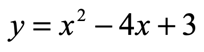
Completing the square should be looked up
urban egret
Yes the middle term you divide by 2 then square it to add to both sides of the equation
agile tree
so
urban egret
Let me find something
agile tree
ok
upper karma
factor out a 1 from the 1st 2 terms
urban egret
Cause they are asking you to put it in vertex form
agile tree
plus or minus square root of 13 over 2+ 1/2
now what do i do with that
after i completed the square
like how would i put it in the equation
urban egret
You leave everything on the same side
upper karma
you plug it into x
urban egret
Look up put it in vertex form using completing the square I feel it is too convoluted to explain on here
You have to leave everything on the same side
I put up the wrong picture
upper karma
yah i was gonna say that doesn't look correct
urban egret
ChiliMath
How to Complete the Square In a regular algebra class, completing the square is a very useful tool or method to convert the quadratic equation of the form also known as the “standard form”, into the form which is known as the vertex form. Find the Vertex Form of using Completi...
I was trying to find a simple screenshot but I couldn’t follow the directions on this link it does it step by step everything needs to be on the same side.
agile tree
thats the exact form
now how would i plug it in the equation
@urban egret
after completing the square
upper karma
you don't have an x in your equation
upper karma
Yes
agile tree
xi yes what
upper karma
i think that's just the point you plug in for x
urban egret
@agile tree I posted a link above for you to follow my previous post I posted the wrong thing
They want you to rewrite as the vertex equation.
agile tree
yea i figured it out i had to do another similar one earlier but it asked for the vertex form not this one was confused
thanks tho @urban egret appreciate u bud
and also thanks to you @upper karma
urban egret
@upper karma somebody thanked you at least 😑😑😑
urban egret
Yes but I don’t know what happened and you tried as well that is all that matters @upper karma
Clarification does help I just don’t know what happened
urban egret
Shoot so you were really blocked I thought they were just giving an idle threat
upper karma
She seemed upset and she said I'm blocked so I assumed she wasn't messing around
 dull remnant
if it's 4sinx=2sinx+1
just making sure, is that the same as 2sinx=1
like subtract the 2sinx from the 4sinx
that works?
 versed river
yes that works
 novel flax
dull remnant
novel flax
dull remnant
yes
ty
@novel flax can u answer one more question rq
so ik how to do 2sin^2x-cosx-1=0 because i can use the pythagorean identity but i can't do sqrt3cosxtanx-cosx=0
because there isn't a pythagorean identity for tan
versed river
write it all in terms of cosx and cos^2x using the pythagorean identity
i.e. sin^2(x)=1-cos^2(x)
then come back if you still don't know what to do after that
versed river
o
dull remnant
do i need to use pythagorean identity of 1+tan^2x=sec^2x
versed river
sqrt(3cosxtanx-cosx)=0?
versed river
write tan as sinx/cosx for a start
dull remnant
ok i did
i have it written as the sinx/cosx way and the sqrt1-cos^2x way
do i square everything in the sinx/cosx way
versed river
idk what you mean but you should have something like this?
sqrt(3) sin(x) cos(x) - cos(x) = 0
dull remnant
there is a cosx before the sin as well
versed river
sqrt(3)cos^2(x)*(sinx/cosx)-cosx=0
versed river
then the cos's cancel
dull remnant
o no i wrote it wrong then
versed river
dw
so then you have sqrt(3) sin(x) cos(x) - cos(x) = 0
from which you can factor cosx
dull remnant
so it's cosx(sqrt3 sinx-1)=0
 pallid cloud
2sinx=1
sinx=1/2
x=30° or x=150°
Meaning x=π/6 rd or x= 5π/6 rd
The solution is not unique
There are two principal measure and infinty of solutions congruent to them modulo 2π rd
@novel flax @dull remnant
versed river
so it's cosx(sqrt3 sinx-1)=0
@dull remnant
so then you can say
either cosx=0 or sqrt(3)sinx-1=0
pallid cloud
Yes, but I was referring to up there when you and orange got only one solution
dull remnant
o yes
either cosx=0 or sqrt(3)sinx-1=0
@versed river
and then the final one for cosx=0 is x=+ or - pi/2 +2pik
but i can't get the sinx one
dull remnant
but on the table
sinx=sqrt3/3
doesnt correspond
wait why does pi*k-pi/2 suffice?
versed river
because that covers every possible value that gives you cosx=0. i.e. the values at the top and bottom of the unit circle
at k=1, it equals pi/2
k=0, it equals -pi/2
k=-1, it equals -3pi/2
k=2, it equals 3pi/2
etc
versed river
pi/2+ what?
dull remnant
i got plus or minus
pi/2+2pik
because the original formula was
x=plus or minus arccos(0)+2pik
arccos(0) is pi/2
so it becomes x=plus or minus pi/2+2pik
versed river
i think i know what you mean, but pi*k-pi/2 is a lot simpler and still covers all the solutions
dull remnant
ok
for the second solution
sinx=sqrt3/3
it doesnt correspond on the table though
dull remnant
sorry
versed river
its fine
dull remnant
radian 0 is sin 0, radian pi/6 is sin 1/2, radian pi/4 is sin sqrt2/2 and radian pi/3 is sqrt3/2
how would i make a general solution out of sinx=sqrt3/3
versed river
2* pi*k+sin^-1(1/sqrt(3)) and 2 π k + π - sin^-1(1/sqrt(3)),
versed river
dwdw
versed river
do you mean why didnt i change it to sqrt(3)/3?
dull remnant
yes
versed river
because i had no reason too. if i put it into a calculator its gonna give me the same answer. maybe some teachers would prefer you rationalise the denominator, but i can't see a situation where its gonna make anything easier or harder to do anything to do with it
dull remnant
ok ty!
 olive scarab
any idea to solve this problem ?
give ellipse (E) $ \frac{x^{2}}{a^{2}} + \frac{y^{2}}{b^{2}} = 1 (a \textgreater b) $. point O(0,0). 2 points A,B are mobile on (E) that $\widehat{AOE} = 90° $. H is projection of O on AB. Prove that the length of OH is constant.
 somber coyoteBOT
.,.:
pallid cloud
First thing I think of is writr the equation of the ellipse parametrically, i.e., x=acosθ;y=bsinθ
Then find xA, yA, xB, yB
Knowing that AOB=90°
So if you plug θ for B, you'll plug θ+π/2 for A
You have this metric relation for the height in a right triangle(some call it inverse Pythagorean theorem, and I hate that)
$\frac{1}{OH^2}=\frac{1}{OA^2}+\frac{1}{OB^2}$
somber coyoteBOT
Patrick Salhany:
pallid cloud
You have to do a lot of simplifications, since there gonna be a lot of trigonometric lines involved
If you get this expression to be constant
Then OH is constant and q.e.d.
@olive scarab
You can also plug θ-π/2 for A, depending on the position of A and B on (E)
olive scarab
yes I have thought of $\frac{1}{OA^{2}}+\frac{1}{OB^{2}}$
but I couldnt prove it's constant
somber coyoteBOT
.,.:
pallid cloud
Hmm
olive scarab
I tried to calcute OA and OB depend on θ and π/2 -θ too but still cant get to a constant result
pallid cloud
So if it didn't work, we have to do it in another way
olive scarab
I thought of HB.HC= OH^2 too but couldnt prive it's constant
pallid cloud
We have:
$ \ OH \times AB = OA \times OB \ OH^{2} = HB \times HA \ OB^{2} = BH \times BA$
somber coyoteBOT
Patrick Salhany:
pallid cloud
So if anything, we can use the first two
olive scarab
hmm... but none of them is a constant unit, I think to prove OH is constant by only that is impossible though
pallid cloud
The first one will lead to what we tried earlier
olive scarab
yes..?
pallid cloud
I tried many things other than 1/OH^2, but they lead eventually to it
So there must be a way to prove that it's a constant
 pallid cloud
Lol
You were posting for the last week or so some interesting problems about conics
Where do you get them?
olive scarab
it's my homework but in vietnamese
pallid cloud
Ah
olive scarab
cant find them online though...
pallid cloud
In what class are you?
olive scarab
i'm first year senior high school
pallid cloud
Like grade 10?
 pallid cloud
Our education system is other than yours
We learn about conics in grade 12
And the classes aren't divided to statistics, calculus, geometry, algebra...
It's just maths, and the teacher goes through all the lessons
They can alternate between the subjects
olive scarab
we do that here also
pallid cloud
That's good
Because this way I think it's better and more correlation between the subjects, not like isolation between geometry algebra trigonometry calculus...
olive scarab
we learn it bit by bit, but some of them are pretty hard :( like these conics assignments
pallid cloud
Yeah these are not direct application for the properties
The hardest problems in conics we used to do were like those
Using no coordinates
Just geometry and geometric properties of the conic
To find locus of a point, or to show that a vector or distance is constant
And so..
olive scarab
yes, I often do it with coordinates but this is damn hard to think about
olive scarab
erm...Vietnamese?
olive scarab
if we study in international school, it would be english
English skill of our teacher improve so much through out the time, but it's still not enough for teaching something so complicate like maths in second language
pallid cloud
Lmao 99% of schools in my country teach maths in 2nd or 3rd language
Less than 1% teach maths in native language
olive scarab
where are you from ?
pallid cloud
Because that way it'll be complicated
I'm from lebanon
Native language: lebanese arabic
olive scarab
oh, you language look so complicated
olive scarab
I like french, but it's not popular in my country so I can only learn it online or in some big city
pallid cloud
Yeah french is my favorite language out of arabic english and french
I like to write and read in french
 dark sparrow
where are you stuck?
upper karma
do you know the formula for the area of a rectangle?
dark sparrow
the first thing
the first thing you should do
IS STOP BOMBARDING THIS CHAT WITH PROBLEMS
without so much as saying whether you're done with the previous one or not
upper karma
😆
dark sparrow
do you need help with the first problem you posted? the one with the blue diagram?
dark sparrow
if you are done with a problem then please say so
so that we know that we don't need to help you with it
dark sparrow
what?
why are you giving an answer in square feet
when all measurements are given in yards and the area is asked for in square yards
dark sparrow
you got 725 square yards for the area of the lawn?
no, that doesn't look right
can you show how you got 725 so i can look for where you messed up?
upper karma
k
So I did 12 * 38 to get the area of the rectangle which was 456
then I did 10 * 20 to get the area of the vertical rectangle which was 200
dark sparrow
what rectangle
why 12 * 38
is that meant to be the area of the rectangle to the left of the dotted line?
upper karma
OH
THE 8 ISN'T FOR THE horizontal
I see
so it's 360
which makes the answer 629?
dark sparrow
where did you get 629 from now
dark sparrow
and how did that give you 629 in total
upper karma
360+200+69
dark sparrow
i don't know, you didn't give me pete's rate per sq yd of mowed lawn
upper karma
5 cents per square feet
dark sparrow
per square foot or per square yard?
dark sparrow
,calc 620*0.05
somber coyoteBOT
Result:
31
yup
upper karma
double check calculations multiple times
reread question before answering
does anyone know how to find the area of the square inside
dark sparrow
@upper karma this channel is occupied, please move to a free #❓how-to-get-help channel!
@upper karma ok so do you have an answer i could check or a doubt i could clear?
dark sparrow
no, why would it be that?
dark sparrow
you're not soaking the table through with paint
upper karma
o
dark sparrow
you're only painting its top and lateral surfaces
you're not interested in the tabletop's VOLUME
upper karma
so what are we looking for?
acoustic jungle
Surface area.
upper karma
oh
dark sparrow
surface area, not counting the bottom face as instructed
dark sparrow
@upper karma you are late
upper karma
so 7200?
dark sparrow
we already got done with these
that doesn't match what i got
can you show your work for how you got 7200 cm^2 as the area to be painted
dark sparrow
ew
acoustic jungle
please read the question
upper karma
Well Idk the formula
then use your insight
?
calculate area of all sides in question for surface area if you don't know formula.
it's a longer way but it works
upper karma
and that formula doesn't discard the bottom side.
Well if I knew what to do why would I be here lmao
dark sparrow
which should be burned in your head by nwo
upper karma
So I do Surface area - area in order to discard the bottom?
look
question asks how many things of paint you'll need to get the top and lateral surfaces of the table, discarding the bottom side obviously.
So how do I discard the bottom
dark sparrow
total area minus bottom area, perhaps.
upper karma
alrighty then.
that's your surface area, discarding the bottom.
I'm so confused at what yall want me to do
was i right in saying SA - A?
yes
cool
if A is area of bottom figure of course.
5040
if that is the correct answer to the SA-A question, hurray. but you are not done yet.
reread the question and then tell me the last step.
I do that /720
dark sparrow
5040 cm^2 is the area to be painted, yes
dark sparrow
yes
acoustic jungle
Is this an assignment
upper karma
It is
acoustic jungle
or a test.
acoustic jungle
Good job.
upper karma
it's correct?
dark sparrow
yes 888 cm^3 is the correct answer
upper karma
how do scale factors work
bruh
what is the formula for the volume of a pyramid?
lwh/3
dark sparrow
how do scale factors work
volumes scale with the cube of the scale factor
areas scale with the square
upper karma
can u explain it without using the word scale
acoustic jungle
suppose the width, height, and length is w,h and l
scaling it by 4
means 4w, 4h, and 4l
dark sparrow
no, since i'd have to refer to the scale factor
and that uses the word "scale"
so you're kind of tying my hands behind my back by forbidding me from using the word "scale"
dark sparrow
but if you scale a shape by a factor of k, its volume is multiplied by k^3
and its surface area by k^2.
yw
acoustic jungle
that's not the volume of a pyramid
dark sparrow
the volume of the original pyramid is not 3 * 2 * 6
acoustic jungle
that's a rectangular prism
upper karma
(3 * 2 * 6)/3
dark sparrow
there we go yes that's the volume of the original pyramid
upper karma
so (12 * 8 * 24)/3
dark sparrow
there we go
dark sparrow
yup sounds right
upper karma
i don't understand the wording
am i doing volume?
volume, yes
what is the volume of a sphere that has a radius of 0.5 cm?
figure out how many balls you can make with that kind of molten steel
0.52
I don't think you've tried any of these
actually trying to solve them yourself
@upper karma
what
Is the answer 10?
upper karma
Prove that for any triangle ABC: h<=sqrt(p(p-a)), where h is the altitude dropped from A, a is the length of BC and p is half of the perimeter of the triangle.
 sacred pendant
Yo
 merry abyss
For adv. functions, do we have to memorize these? Or just the sum and difference formulas?
sacred pendant
What do I do for this one
merry abyss
Picture isn’t loading for me lol gimme a sec
sacred pendant
Same, this app sucks
merry abyss
Might just be discord then
sacred pendant
Am I stupid or something because I literally have all good grades yet I have a low F in geometry and no matter how much tutoring or help I get I can never get it
 drifting parrot
You're not stupid, MyMathLab is a pain in the butt to understand
sacred pendant
Like I’ve always struggled in math since elementary
drifting parrot
i'm in the same boat. Is there a specific math subject that you don't get or is it math overall?
drifting parrot
What math are you taking?
sacred pendant
Geometry
drifting parrot
Idk if this will help you, but there are videos on youtube that I have used.
What are you learning in Geometry rn?
sacred pendant
I’m just accepting the fact that I’m gonna have to take it this summer and there’s no point to keep wasting my time trying to do it
drifting parrot
btw, I have a math problem that I need help with
sacred pendant
We’re doing “volume of prism and cylinder”
upper karma
Ok
drifting parrot
ok @sacred pendant
upper karma
@drifting parrot Send
drifting parrot
@sacred pendant https://youtu.be/EDIbRdg9ozg

The BEEometry needs to know how much space he'll need for his new honeycomb condo. Or, honeycombdo, if you will. In order to do that, we need to calculate the volume of prisms and cylinders in this case. Good news, the formula is very intuitive, and we explain using our hands ...
drifting parrot
@upper karma
sacred pendant
Lmao wtf is that guy wearing
drifting parrot
You can’t see it?

 soft dagger
do you know what is means by x and y coordinates of the vector?
 gentle bear
adj / opp ?
soft dagger
yes and no, you use those concepts to find their values
but the coordinates themselves are just the magnitudes in the x and y direction that the vector points
gentle bear
it looks familar
i feel like i just multiply 84 cos 73 for x
but that seems way to easy
soft dagger
no you're absolutely correct in your thinking!
however, notice that the angle is below the xaxis
for cosine that doesn't matter because cos(-x) = cos(x) but to get the y component you have to make sure it is sin(-73)
soft dagger
yes
soft dagger
yup
drifting parrot
Can someone help me with my problem?
soft dagger
sure
 dark sparrow
no, you're not finding $\bd{u} + \bd{v}$
somber coyoteBOT
Ann:
dark sparrow
nor $\bd{u} - \bd{v}$ for that matter, but what you wrote doesn't even represent that
somber coyoteBOT
Ann:
gentle bear
what is this called if you can point me in that direction so i can research it @dark sparrow
dark sparrow
dot product. or scalar product.
upper karma
Don't you just multiply the terms with i wirh eachother and then multiply terms with j wirh eachother and then add them?
gentle bear
-14
upper karma
Are I and j imaginary numbers in this question ?
gentle bear
no
from the video i watched they just put it into component form
and just multiplied like you said
then solve
drifting parrot
@elfin radish do you want me to send it again?
soft dagger
on?
 devout kraken
This
gentle bear

Never seen this before but I found a resource which looks like
I need to use dot product
and then this formula
 soft dagger
@devout kraken do you see how it says sin(angle) = oppisite / hypotenuse?
devout kraken
yes
soft dagger
and you're given an angle and a side length
see if you can plug those in to that equation
soft dagger
yes
soft dagger
np
@gentle bear you do the second equation because the geometric definition of a dot product is |u||v|cos(theta)
soft dagger
@devout kraken if a = b/c then c = b/a, does that help?
devout kraken
not really fjfj
soft dagger
@gentle bear the theta = arccos(u•v/|u||v|)
soft dagger
@devout kraken you're trying to find x, so you need to get x on it's own
@gentle bear yes
because in euclidean space u•v means two things
u1v1+u2v2 AND |u|||v|cos(theta)
therefore you can use u•v to find theta without already knowing theta
devout kraken
So would i cross multiply and divide .80 by 14?
gentle bear
and do sqrt(-9)^2 + (7)^2
soft dagger
yes
gentle bear
got sqrt(130)
soft dagger
@devout kraken
devout kraken
oh my god
soft dagger
@gentle bear now multiply that with |t|
soft dagger
yeah
soft dagger
what
soft dagger
yes
gentle bear
since the dot product wasn't 0 that means these angles aren't parallel
it's neither
i believe
gentle bear
this second one
is orthogonal tho 🙂

i just did -2/4 and compared to 4/-8
and it matches
wait
it's parallel
i got it mixed up
soft dagger
yes
2 vectors are parallel in R2 iff they're scalar multiples of each other
w = -2u so they're parallel
can you think of why a dot product of 0 would imply they're orthogonal?
soft dagger
oh
gentle bear
online math is hell
soft dagger
orthogonal means they're perpendicular
and remember that u•v = |u||v|cos(theta)
and if the magnitude of both vectors is >0
how could u•v=0?
 pulsar merlin
Im in algebra 1
and my teacher is giving us geometery
i have no clue how to do this
help........plz
upper karma
Do you know what the y intercept is in this question?
soft dagger
@gentle bear 180° is correct
pulsar merlin
no...\
devout kraken
How would I start the equation for the inverse trig side
upper karma
So what u do is: Pick two points from the line and subtract the x coordinates with eachother and subtract the y coordinates with eachother
Then divide the differnece in y wirh the differnece in x
That's your slope
pulsar merlin
OHHHH
upper karma
Then, to find the y intercept, you look at the line where x=0
soft dagger
@devout kraken if sin(x) = opp/hyp then arcsin(opp/hyp) = x
upper karma
In this case ×=0 at -1000
soft dagger
inverse trig is just the inverse function so it's basically how you reverse a trig function
upper karma
So your y intercept is -1000
upper karma
So the equation would be, in slope intercept form, y=x-1000
soft dagger
@devout kraken no, 90° = sin-1(a/b) only if a=b
you're trying to find the angle so you have x° rn
devout kraken
-.77
gentle bear
https://gyazo.com/bf81a2de077e6c4fe0edf5fd93e1efff Is there a name for this so i can look up what I need to know
 devout kraken
?
devout kraken
it just cancels out?
soft dagger
yes, can you think of why?
devout kraken
Negative and positive cancelled out since they’re the same value ?
devout kraken
kind of yeah
soft dagger
@gentle bear you solved a problem like that a while ago