#geometry-and-trigonometry
1 messages · Page 270 of 1
 copper valve
k i just kicked them
 acoustic jungle
hmmmmm....
 high zephyr
why does he think fishraider is being a smartass
high zephyr
im confused also
copper valve
not a big deal
 upper karma
He mentioned how The Formula is 1/2 R^2 x Theda
What does this mean
He wanted to do it another way
high zephyr
that's another formula
acoustic jungle
that's the way with radians I believe
upper karma
How I do this
high zephyr
which question?
upper karma
The 31 5.12
And the 8 11
For the following write the correct equation
Is it
Sin(b) 31/c?
high zephyr
nono, 31 degrees is the angle here
you can take angle A for trig, which is 31 degrees
 marble parcel
Do i just rotate each point by 45 degrees?
high zephyr
@marble parcel channel seems taken atm
upper karma
@high zephyr so how do I write it
high zephyr
first, do u know your trig ratios?
upper karma
No
upper karma
Ohh yes that
I know those my teacher taught us sohcahtoa
Idk how to do the correct equation tho
It’s for sin
@upper karma what
Idk
Need help wirh msth
Help with what
The write the correct equation
Write correct equation of what
What equation
Sin
Sin(31) = 5.12/c
Since 5.12 is the opposite side
Ohh ty
And c is the hypotenuse
How abt
Sin = opposite/hypotenuse
Is it
Sin(x) 8/11?
Yea
Ty
You could use arcsin to find what x is
But idk if ur trying to get that rn
Not yet
Alright
Your welcome
🙏
acoustic jungle
||you're 💩||
upper karma
Lmao
 silent plank
apply the intersecting secants theorem
then solve for x
example of what?
what's the equation you have after applying that theorem?
For all those people who find it more convenient to bother you with their question rather than search it for themselves.
upper karma
Bruh
Look it up
Thats like him doing your homework
At least put some effort
X = 66
If 66 is the central angle
silent plank
it's not 16
upper karma
Oh wait
silent plank
read the theorem carefully
silent plank
can you show your work?
 silent plank
the 1 is just a label
upper karma
Oh
silent plank
ok. type your work.
silent plank
yes
silent plank
what equation do you have after applying that theorem
silent plank
^
intersecting chords theorem
(because those are chords that are intersecting each other)
 novel flax
use tangent chord theorem: 53 is half of x
 eternal solar
also it's a triangle
silent plank
and also consider alternate segment theorem
novel flax
yes
silent plank
no
silent plank
how are you getting those values?
upper karma
Nope it isnt mate
Umm wait i might have spoked too far
I didnt said anything yet lol
silent plank
that does sound right
upper karma
Grats
acoustic jungle
x is not 88-64 over 2
upper karma
👍
high zephyr
u're trying to find x right?
silent plank
,w 9(9+x)=12(12+12)
 somber coyoteBOT
 Requested by ramonov#0921
upper karma
Requested by ramonov#0921
upper karma
Yes
acoustic jungle
what question are you talking about
the angle one or the side one
the side one is 23 but the angle one is 40
upper karma
Lmao
marble parcel
@high zephyr did you ping me
 gray marten
Hey, so I was thinking about a cone today, and I was trying to derive the volume of the cone.
My first thought was:
- Get circumference of circle: 2πr
- Get area of triangle: ½bh
- And then multiply the two, so it's like a bunch of triangles appearing on the circumference:
- 2πr * ½rh = πr²h
This is clearly wrong. But I'm not sure why.
I imagine its because the relation between area/volume and circumference/perimeter of shapes doesn't work the way I think.
acoustic jungle
hmm.
That is not making any sense because you are multiplying by the area of the triangle
it would've made more sense if you did area of base * height /2 instead of /3
gray marten
Area of b*h/2 instead of b*h/3?
high zephyr
it would've made more sense if you did area of base * height /2 instead of /3
@acoustic jungle he did do base*height /2
acoustic jungle
oh no I meant like area of base (circle) * height
high zephyr
👌
gray marten
Right, the other intuitive way that seems to work is by getting the volume of a pyramid: ⅓lwh
And then replacing the base area: lw
With area of a circle: πr²
Getting you: ⅓πr²h
Im still slightly upset as to why the circumference*triangles didn't work, but I imagine something like the left side of the image happened.
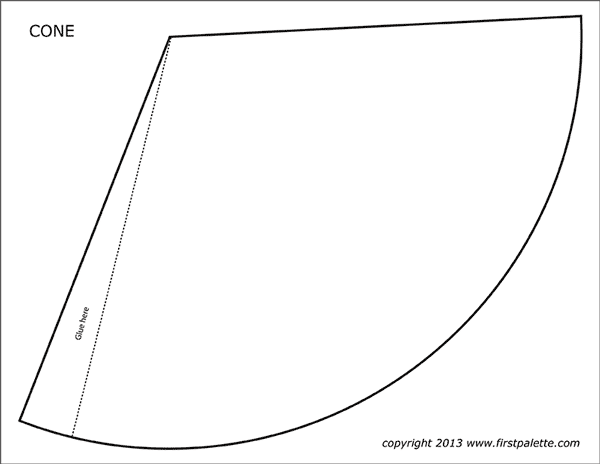
This whole ⅓ thing about cone's pisses me off, but turns out when people make cone cutouts, it usually looks like ⅓ or a circle too.
https://www.firstpalette.com/images/printable-mainpic/cone.png
 acoustic jungle
oh I see what you mean now.
gray marten
It feels unintuitive that, it doesn't work.
acoustic jungle
However why do you have 2pi * r inside the circle
gray marten
Oh, that's the circumference.
Because I initially imagined the triangles appearing out from the rims of the circle.
acoustic jungle
You extended the inside of the circle at origin O to 2pi*r
so you are getting a larger value.
gray marten
Oh crap yeah.
acoustic jungle
it's like saying the area of the circle is 2pi*r^2
gray marten
So yeah, it'd be impossible for that to work, since no matter what I do, there's going to be the big gap in the middle of the cone.
gray marten
Yeah big rip.
I think my misunderstanding is coming from mixing up circles/cones with how squares/rectangles work.
acoustic jungle
,rotate
somber coyoteBOT
 brazen quarry
Appreciate it
 remote heart
what do you need help on?
upper karma
hrm
i need some help in understanding the relationship between 79, then 118
and then separately, 54 and x
errr uhhh. like how to solve it
 humble pebble
 tawdry mural
hi
so
how would one
solve this
from my hw assignment
Determine the height of the hypotenuse if alpha = 34 ° 12'33 '' and b = 9 cm.
 rose sphinx
Length of hypotenuse will sound more grammatically correct
high zephyr
oh he left the server 
acoustic jungle
@upper karma it's not around 30, it should be 15 off from 30, use the secant secant angle theorem.
 onyx epoch
how do i get the area of ABC
i know the coordinates for A,B and the angle v
and also calculated the circles equation
acoustic jungle
What unit is this ? (I don't know how to do it either)
onyx epoch
unit?
acoustic jungle
like what unit is this
onyx epoch
what is a unit? sry english isn't my main language
acoustic jungle
What have you learned during this time when solving this question.
onyx epoch
I've calculated the circles equation and the equation for the tangent going through B
if that's what u mean
acoustic jungle
What I mean is, what similar questions have you done, what is this question related to?
acoustic jungle
is AB the diameter
onyx epoch
Yes
onyx epoch
yep
acoustic jungle
calculate length of AC and CB
 solid swan
i thought it was the area including the curved part
acoustic jungle
then multiply then divide by 2.
onyx epoch
It is
acoustic jungle
and add the area of that chord thing (the central angle is 2 times that angle)
acoustic jungle
Is the question supposed to be tedious.
acoustic jungle
You can find the length of CB and AC using trig since ACB is a right triangle
onyx epoch
how
acoustic jungle
and you know the length of AB using the length formula.
onyx epoch
i was thinking of making a straight line through AC and finding C from intersection with circle
acoustic jungle
Well you wouldn't need to find the exact coordinates
if yo know the lengths you can find the area of the triangle
onyx epoch
but how
acoustic jungle
I'm really not sure if it's the easiest way, because after finding the area of the triangle you have to calculate the area of that chord by doing 2v/360 * pi *r^2 - area of small triangle OBC
I'll post your question again, maybe someone will have an easier way
onyx epoch
how do i get the area of ABC
i know the coordinates for A,B and the angle v
and also calculated the circles equation
acoustic jungle
You can find the area of ABC by finding AC and BC by doing sin(v) = BC/AB
but this is probably not a good way to do the problem.
 fleet wolf
draw the centre of the circle. Call it O, say and observe that it is on AB. Draw line OC. This will split your region into two areas, triangle AOC and sector BOC. Find the areas of both and add them.
solid swan
yeah and the angle for BOC would be 2v because of angle at center
onyx epoch
wouldn't i need the coordinates for C for all of these solutions?
solid swan
no not really
you have the equation for the circle right?
then you also have radius
acoustic jungle
That's a much better way than what I had.
onyx epoch
area of sector BOC is r²(2v)/2
area of triangle AOC is r²sin(π-2v)/2
@solid swan shouldn't it be BOC is r^2*sin(2v)?
solid swan
A_2 + A_3 still gives the same thing so works too
acoustic jungle
If you are given the angle in degrees you should use degrees to find that sector PBC
40/360 * pi *r^2
and to find triangle APC use the 1/2 ab*sin(c)
I just realized something, APC and PBC have the same area? (The triangles)
since they are both r^2 * sin(40)/2
solid swan
wait no
angle APC is 180° - v_0
which is 140°
oh
nevermind i forgot about identities
onyx epoch
they have same area yea 😛
acoustic jungle
I think it will.
solid swan
but at 90 degrees though
let PC be perpendicular to AB
then area of triangle APC should be equal to that of triangle BPC
but what about the remaining part
acoustic jungle
angle APC is always 180 - angle BPC
I believe they are always equal.
since the area of APC is always r^2 sin(180 - BPC)/2
or just r^2 sin(BPC)/2
solid swan
wait no no no no
sinθ = θ only applies for small angles of θ only
the formulas are different
area of sector is r²θ/2
area of triangle is ab(sinθ)/2
there's no sine in area of sector
acoustic jungle
I was talking about the triangle.
 stark snow
Probably I'm trying to be too smart for my own good by using De Moivre's theorem
Why did this way not work?
(the reason why this way immediately jumped out to me is because I thought it would give me an easy way to evaluate out the sum)
somber coyoteBOT
rockpaperscissors:
upper karma
Need a bit of help—
When given an intersection on the unit circle, I need to determine an angle measure.
And I have no idea how to do that
“Finding angle measures (in degrees) in standard position”
How do I do that?
stark snow
@fleet wolf I tried to multiply through so that I could get a term with k+1 so that I could cancel stuf fout
Like
You know
The standard trick for evaluating a geometric series
stark snow
For your question
Draw a diagram
Take the x coordinate of the point of intersection
You then have how far along it is on the x axis and you know the radius of the unit circle
You can then find the angle using the standard trigonometric functions
Or the y coordinate
Depends on what you want to do
stark snow
Good
stark snow
<@&286206848099549185> It's been an hour and a half please help me
gray marten
o yea btw, most people ehre dont like doign questions in dm
upper karma
@acoustic jungle thank u
upper karma
hi
 agile tree
hello
 humble quail
Send problems here
upper karma
determine the remaining sides and angles of the triangle ABC A=140 40', C=20 20', AB=9
140 and 20 are degrees
does anyone know how to do this u need to find the area of the shaded area
humble quail
@upper karma
I don't have functions of degrees with minutes on my calculator, so calculate it yourself pls :<
novel flax
@upper karma find the radius of the small circle and big circle, then subtract the area of the small circle from the area of the big circle
upper karma
do i subtract 21-3.5 to find the diameter?
novel flax
the diameter of the big circle is 21
and the diameter of the smaller circle is 21-2(3.5)
novel flax
ok
novel flax
draw a line connecting the vertices at the top @upper karma
you will find that the shaded area is the area of parallelogram minus right triangle
upper karma
how do i find the other side for the rectangle
novel flax
the two points
upper karma
the parallel points?
novel flax
yes
novel flax
,rotate
somber coyoteBOT
novel flax
draw this blue line @upper karma
upper karma
i did it just didn't show
novel flax
oh
novel flax
which side @upper karma
you move the basic sinusoidal function vertically or horizontally @upper karma
novel flax
The Phase Shift is how far the function is shifted horizontally from the usual position
the bottom side is 23.8
upper karma
upper karma
ya
novel flax
is pi/2
upper karma
so 2PI
novel flax
find amplitude, period, and midline
also it helps to identify whether it's better to use a cosine or sine graph
upper karma
can u help me wit this @novel flax
novel flax
the diagonal of the square is the diameter of the circle
upper karma
its 8?
novel flax
the diagonal is 8root 2 which is also the length of the diameter
the radius is half of the diameter so radius is 4root2
the area of the circle is the radius squared so it's 32 pi
the area of the square is 8*8 = 64 so subtract it from the area of the circle
and u get 32pi-64
acoustic jungle
Do you mean 2c.
acoustic jungle
cos u is -4/5
acoustic jungle
also your teacher is very smart to put two variables that look like the same thing
 jolly bear
What variable
acoustic jungle
lol the u and the v
jolly bear
Lol
acoustic jungle
sin v should be negative as well
acoustic jungle
I agree.
jolly bear
Make sense now
upper karma
Algebra
 rich wolf
Algebra
 granite cypress

silent plank
is that 70 or 7°?
rich wolf
Whats that thingy next to the seven
granite cypress
0
granite cypress
no its 7^0
rich wolf
Oh
granite cypress
its the exponent
granite cypress
hehe sory
silent plank
I guess that's a good place to start.
what's 7^0?
granite cypress
Would it be 1?
silent plank
yes
granite cypress
ok
silent plank
do you know how negative exponents work?
granite cypress
They are not negative they just only are being like divided which makes them positive
like
a^2 = 1/a^-2
like that?
silent plank
negative exponents is a term used to refer to exponents expressed with a negative power
yes.
granite cypress
oh okay.
silent plank
so what would 3^(-2) be?
silent plank
apply what you just posted moments ago.
maybe rearrange it a bit
silent plank
3^(-2) isn't 9
granite cypress
So I need to use the negative exponent?
silent plank
I mean the exponent is negative here...
silent plank
yes
silent plank
and overall what will the entire expression simplify to?
granite cypress
1/3² * 5/7⁰
silent plank
simplify everything
granite cypress
5/9?
silent plank
yep
silent plank
also what's this doing in the geotrig channel
granite cypress
lol idk
rich wolf
Its not that out of place lol
I learned factoring quadratics in Geometry class
Even though polynomials are more algebra
(x+a)(x+b)=x^2+(a+b)x+ab
Isnt that cool
 frail rock
Is this channel open? I was kinda hoping to ask about the Hinge Theorem, I don't think I quite understand it.
rich wolf
Ill break this down into four steps
jolly bear
Yes
rich wolf
Find the midline
jolly bear
What’s the midline
rich wolf
Find the midline of the function
jolly bear
Y=6
jolly bear
Yes yes, continue
rich wolf
Now you must find the amplitude
humble quail
Is this channel open? I was kinda hoping to ask about the Hinge Theorem, I don't think I quite understand it.
@frail rock
Why don't you understand it? It looks intuitively easy to understand, for example with this picture I found in the internet
jolly bear
What dis
rich wolf
Not u donnie but deltaphi guy
frail rock
Oh, thank you. The course I'm doing rn didn't really explain it well.
Sorry if I caused some trouble.
humble quail
Ofc u didn't
rich wolf
@jolly bear find the amplitude
rich wolf
Ur thinking backwards
You use the period to find b
Not the other way around
How often does the function repeat itself?
jolly bear
Depend, for trig function alway
rich wolf
Let me just tell u
The horizontal distance between a min and a max is half of the period
2pi/period = b
jolly bear
Really
rich wolf
Yeah
jolly bear
Shouldn’t it be full period
rich wolf
No
A period is how long it takes to get back to the same position
Like from a minimum to the next minimum
But you have a minimum and a maximum
jolly bear
Oh my bad, messed up
jolly bear
Vertical shift?
rich wolf
Horizontal
jolly bear
Lemme think
rich wolf
It is "c" on that paper you sent
jolly bear
Yes
rich wolf
Yes
rich wolf
Where is your "starting point"?
jolly bear
8,2
rich wolf
What did you choose as your starting point?
jolly bear
Uhm,I choose 0,4
jolly bear
0,5
jolly bear
I’m so bad at calculating lol
 languid swan
jolly bear
languid swan
jolly bear
What do we do with the midline
rich wolf
The function is equal to its midline halfway between the min and the max
So that must be your starting point
Because sine curve starts on the midline
jolly bear
So that halfway distance is the horizontal distance?
rich wolf
It is not 2
Im sorry i phrased that weird
The starting point for a sine curve is halfway between the min and the max
So in this case it is as x=6
And y=6
So 6,6
jolly bear
Wat
rich wolf
That is your starting point
Which is how you determine the horizontal shift
It is 6 to the right of a normal sine curve
jolly bear
So Basiclly to find the starting point. U take the average of the max and min coordinate?
Which is 6,6 right
 north basin
 long estuary
alright
jolly bear
@rich wolf
 upbeat bone
Hello all i have a qeustion
I need to find 24 points evenly spaced around a circle where the ceneter of the circle is 0,0 and the radius is 33
I have no idea how to do this im no math man
 twilit zenith
Do you mean that you need to place 24 points on the circumference of the circle such that the arcs created by these points are of equal lengths?
 limber patio
Doing Euclidean geometry
whats the second line mean
For context, the problem is
frail rock
I'm pretty sure it means parallel.
limber patio
oh wow im dumb
twilit zenith
Rat is correct.
A bit strange, since generally there are only 2 end points picked for the line. 🤔
frail rock
Nah, it's fine. I don't think I've ever seen the parallel sign written like that til now.
Yeah, the latter line confused me a bit.
limber patio
My teacher's handwriting just gives me a headache lmao
frail rock
Wonder why they did PRTU instead of PU or something kek.
limber patio
Yeah that's what tripped me up
I misread PRTU as SRTU so I was like... tf is the relationship between these 2 segments and that segment
And then I was thinking if he meant angle and jesus christ almighty the sudden realization that that was a parallel symbol just makes me feel like such an idiot
Thanks a lot!
upper karma
Your welcome
frail rock
Happy to help. :D
limber patio
:)
twilit zenith
Cameron, if you're still there, is it still relevant?
jolly bear
But what does it tell us about the shift
rich wolf
where does the normal sine curve start
jolly bear
At 0,0
rich wolf
and we are trying to find the horizontal shift
jolly bear
Yes
rich wolf
or whatever the variable is
jolly bear
Now how do we find the d


 jolly bear
What
rich wolf
d is the "midline" of the function
jolly bear
Oh damn
rich wolf
which is the amount the function is shifted vertically
jolly bear
Ok, this make sense now
jolly bear
What else
rich wolf
just write the eq and i'll show you
jolly bear
Ok
jolly bear
Yes
rich wolf
but the max came before the min
so the way our sine curve goes, according to our starting point, is down first, then up
jolly bear
Yes
rich wolf
so if you have a sine curve that goes down first, what does that mean?
jolly bear
It mean they are not showing u what is before what go down first
rich wolf
sure.
you can calculate that point though
because we know the period
but there's an easier way
jolly bear
Yes
rich wolf
the red curve is sin(x)
the blue curve starts at (0,0) and goes down
what is the blue curve?
rich wolf
yes. it is negative sin(x)
so if a sine curve goes down first, its amplitude must be negative
so take that eq you have there
jolly bear
Ok
rich wolf
$f(x)=4\sin(\frac{\pi}{4}(t-6))+6$
somber coyoteBOT
AMD:
rich wolf
and make the amplitude negative
somber coyoteBOT
AMD:
rich wolf
that is your answer
acoustic jungle
@limber patio did you get it? could you tell me what you did because I used the angle bisector theorem to prove it which probably isn't that good of a way.
rich wolf

limber patio
I'll try and see how to prove it though
acoustic jungle
I did it by the angle bisector theorem and similar triangles.
limber patio
there's the problem again
my diagram is pretty much exactly that
Alright i got it
I was being the big dumb
So first you know that v is the midpoint of arc pvu via the given
As such, arc pv and vu are congruent
and because angles spv and uqv intercept congruent arcs, theyre congruent
then you know that sq and prtu are parallel
so because the arcs between two parallel chords are congruent, sp and qu are congruent
then finally because sq is congruent to sq via reflexive property
we can use arc addition and get arc psq is congruent to arc squ
and because angles spr and qut intercept congruent arcs
then are congruent
so we have ASA congruence
and as such, pr is equal to ut
acoustic jungle
just "ignore" the pi and add it later
acoustic jungle
You would do it in terms as pi meaning don't evaluate pi
it should look something like (some number) * pi
 tame ore
so 226(pi symbol)
tame ore
im confused i dont really understand all these symbols
acoustic jungle
you should have something that looks like 6pi*12+9pi * 2
and you factor out the pi.
rich wolf
@tame ore bro think about it this way
What is a cylinder
It is a "net" (folding) of some 2D objects
acoustic jungle
He's asking what in terms of pi means.
tame ore
so 6 pi
acoustic jungle
Treat pi as a variable and put your answer in terms of that variable.
rich wolf
A cube is 6 squares
What is a cylinder?
A cylinder is a combination of some 2d shapes
tame ore
so 226 divided by pi and thats the answer?
rich wolf
Ok just listen to fish
tame ore
so my answer is 3.14 pi symbol
rich wolf
Let me make this one thing clear:
Pi is a transcendental number
Which means its exact value is not known
rich wolf
Which means that we can only approximate it to a certain extent
If we say "in terms of pi" that means do not approximate
Leave pi as pi
 surreal ingot
When would a function not have a limit?
rich wolf
If it doesnt approach the same value from both sides
surreal ingot
By chapter of Limits using properties of limits
acoustic jungle
45 degrees.
acoustic jungle
the circumference is 2pi*r
and that shaded circumference is 200/360 of total length
 tender coyote
thx
rich wolf
Theta =s/r
tender coyote
how do i find s
twilit zenith
The area of the sector corresponds to the portion that the angle is out of the entire 360° turn that is the circle.
Meaning, for example, if you had a sector with 90°, which is a "quarter turn," then its area would be a quarter that of the circle's.
 glad gorge
Can someone please help tell me what I need to do to find r
 teal frigate
can someone help me find the angle of a right angle triangle
acoustic jungle
inscribed angle theorem @glad gorge
twilit zenith
Obama, could you please show the question, for context?
acoustic jungle
use arcsin to find x.
twilit zenith
Are you comfortable with sin, cos, tan and what they mean?
acoustic jungle
sin^(-1)
twilit zenith
The inverse function of sin.
It's a function that takes the value of sin and returns the angle that creates that sin value.
twilit zenith
Could you please take a picture of your calculator?
Alternatively, can I show you how to do it with Google?
teal frigate
i have the casio fx-82 plus 2
acoustic jungle
twilit zenith
By the way, do you know how to tell whether you're using radians or degrees?
twilit zenith
I see.
It's just that sometimes, people don't know they're using the wrong units on the calculator and get a wrong answer.
teal frigate
ye
so how should i lay out the equation?
just like if im trying to find a hypoteneus or adjacent?
twilit zenith
You know two sides in the triangle:
The opposite side, and the hypotenuse.
In this case, you must figure out the trigonometric ratio with:
novel flax
surface area: 2 pi r h + 2 pi r^2
high zephyr
^ we're not gonna straight off give u an answer
solid swan
ok think of the cylinder as 2 circle plates and a piece of paper wrapped around it
the area of each of the plates is πr² = 9π so if you multiply it by 2 you get 2πr² = 18π
and then the piece of paper wrapped around
the width of it is 12cm given
but then the length would be equal to the circumference of the circle plate
which is 2(3π) = 6π in this case
so the area of the piece of paper would be 12(6π) = 72π
upper karma
@teal frigate you can also use the Law of Sines
17/sin(90) = 15/sin(x)
17/1 = 15/sin(x)
17 = 15/sin(x)
15/sin(x) = 17 (same as above, only reversed)
1/sin(x) = 17/15 (move the 15 to the other side)
sin(x)/1 = 15/17 (reciprocal gives the same result but makes it easier to get sin(x))
sin(x) = 15/17
x = sin^(-1)(0.882) (also called arcsin)
x = ~62 degrees
 rose rover
How does one solve this? Getting a few ideas but im not rlly sure
upper karma
@rose rover
Start off from doing Pythagoream
yeah, there are 90 degree triangles around the edges
Ofc its a square
find the area for those (which is really only one right triangle x 4)
then find the area for the large square
then subtract the two areas
and you get the one in the middle
rose rover
there is overlapping tho
upper karma
Lmk when you got the hypothenuse
rose rover
assuming hypotenuse c, c^2 = 250
somber coyoteBOT
 Requested by Al3dium#4084
upper karma
Requested by Al3dium#4084
upper karma
sounds good
once you find the area for this section everything falls into place
it's basically the area of the big 90 degree triangle (at the top) minus the area for the two small 90 degree triangles
you have 4 small triangles and 4 "middle" sections
once you have the area for those, you add them all up and you get the "outer" ring
then you find the area for the entire square
and subtract the area for the "outer ring"
acoustic jungle
?
Where did you prove the triangle is a 3,4, 5 right triangle @upper karma
i assume we can use pythagorean triplets?
no??
upper karma
Yeah i was wondering the same
twilit zenith
If I may give a hint:
||You can note that the triangles around the square are right-angled, and that the vertices connecting the inner and outer square are perpendicular to the hypotenuses. How can you go about calculating the areas of these triangles?||
acoustic jungle
I don't know how you would solve it that way. You would be over counting.
I would use similar triangles.
twilit zenith
Notice that you are over-counting if you calculate the area of the 15 - by - 5 right-angled triangles.
However, if you were to calculate the triangles generated by the height and the greater portion of the hypotenuse, then you wouldn't be.
I'm referring to these.
Happens to the best of us. Don't let it get to you.
acoustic jungle
why do you want to find the height of that?
you can find it by doing 5 *15/2=15 *x/2
upper karma
where's the 5 coming from?
 quick schooner
upper karma
quick schooner
upper karma
15 is the base, right?
but 5 is not the height. Look closer
acoustic jungle
oh I see what you mean.
quick schooner
thank you so much
acoustic jungle
you could easily solve the square question using trig, but that's a small brain move.
but I would use similar triangles.
twilit zenith
Hint:
||What can you say about the relation between the sides, heights and areas of right-angled triangles?||
upper karma
the image is wrong, probably on purpose (to throw you off)
the sides are almost identical
the blue square looks rotated to 30 degrees, but it's not
lol
silent plank
not the law of sines, just basic trig ratios.
@quick schooner what don't you understand about them?
area should be: ||an integer||
upper karma
@quick schooner
quick schooner
is it law or basic?
quick schooner
thanks alot
upper karma
it works with any kind of triangle
not just right triangles
but yeah, you can also use SOH-CAH-TOA
silent plank
which is the purpose of this exercise
upper karma
true
quick schooner
our teacher didn't specify but i would assume basic since we just learned basic
but yeah we are using sohcahtah
silent plank
is there a particular question you are struggling with atm?
upper karma
@quick schooner
as long as you keep in mind that all angles from a triangle need to add up to 180 degrees, you should be fine
the hypotenuse is always the longest side from a triangle
now that I think about it, they probably want you to use use the 70 degree angle
in that case, you'll have to use cosine
SOH-CAH-TOA (the bold letters stand for: sine, cosine, tangent)
so CAH is cos(angle) = adjacent / hypotenuse (A and H)
cos(70) = 36 / x
x = 36 / 0.342
x = ~105.3
acoustic jungle
are you allowed calculators.
 latent iron
@acoustic jungle yeah