#geometry-and-trigonometry
1 messages · Page 267 of 1
 wary bone
 remote heart
yea
 little osprey
looks god
little osprey
Nah im not MURRRRICAN
remote heart
o
little osprey
@wary bone A pipe?
remote heart
I've seen people spell it strangely like "American", are you this?
little osprey
Doesnt sound free enough ngl
wary bone
wdym a pipe?
 prime jewel
I got it, thank you guys.
remote heart
nice!
prime jewel
I forgot i had to divide.
I can do complex problems but can't understand basic ones! Nice 😄
xD
remote heart
but how do you get the surface area?
wary bone
yeah but in what case would i only know the cross area but not the radius of that pipe?
remote heart
without knowing radius, in that case
little osprey
in the case that you work for a company
thats a really hard question
ig you would know the radius as well
wary bone
yeah i think about that a week now for my 8th grader and can't find any suitable
little osprey
what was the initial thing
wary bone
you example is still a good idea, if i think about pneumatic delivery (if thats the right word for shooting letters through pipes)
remote heart
it is
wary bone
i need a real circle where i know the surface area but not the radius
remote heart
what about a fan?
I'm not sure
like you know the area that the fan blows, and you know it's circular
wary bone
if i think about a fan for air condition that could work, cause i could start with the air flow
little osprey
Theres a room for teachers lounge
 versed iron
can someone help me with a bunch of these? I'm in grade 9
 compact spire
 compact spire
Hmm
wary bone
@versed iron in fact you only need to draw a lot of (partial) circles. you know how many edges a hexagon has? try to get that many on the starting circle at equal distance
versed iron
@wary bone idrk even where to begin, quarantine school has been tough ngl
little osprey
@prime jewel Is that all the info you're given?
prime jewel
All the info is in the picture, i can put the problem too
wary bone
begin with: what s a regular hexagon?
wary bone
ABD** 😉
remote heart
@compact spire still need help?
compact spire
yes
remote heart
okay
remote heart
okay
compact spire
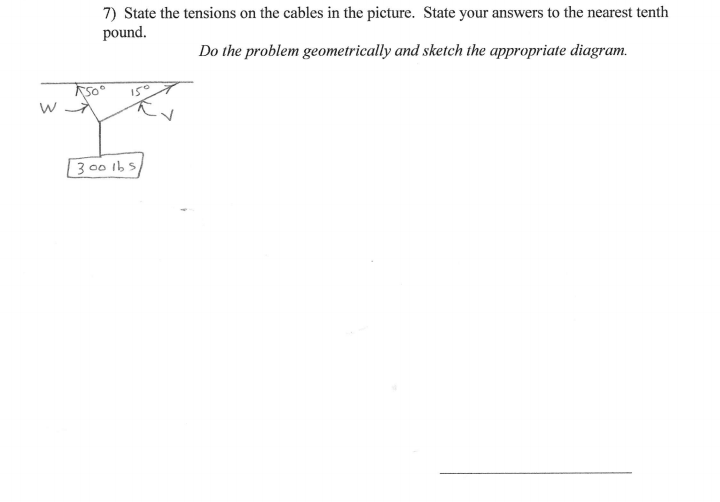
okay so this is what I have so far
forgot to write sin65 on the bottom
$ x = 300sin(40)/sin(65) $
which after crunching the numbers I got 141.8 degrees
remote heart
yes, but sin(40) and sin(65) are numbers
compact spire
wait I wrote 200 and not 300
 somber coyoteBOT
Pony Boy:
remote heart
yes
compact spire
so tension x = 212.7 lbs
and tension y = 319.7 lbs
$ y/sin(75) = 300/sin(65) = y =300sin(75)/sin(65) $
remote heart
but since it's being multiplied you can divide sin(65) by sin(40)
and multiply that by 300
compact spire
Okay
remote heart
but that equals ~270.35...
 mystic shadow
Just a simple geometry question
in a sphere, what portion of it corresponds to .2 steradians
 upper karma
@prime jewel are AB and DC parallel?
upper karma
there's this property that if AB and DC are parallel, the angles between them are also congruent
and all the angles from a triangle need to add up to 180 degrees
it's really easy to find angle ABC, imo
and the "magnitude" is just a fancy word for size of the edges
then, once you know two angles, you can use the law of sines to get the length (or "magnitude") of the other edges
also, yes, if we're talking about vectors, those edges are parallel
because we're talking about a cartesian coordinate system (x, y)
basically a grid
@prime jewel do you still need help with this?
 tacit quail
I'm working on a robot arm that can draw things. Is there anyone that can help me with the inverse kinematics?
I have 2 arms of length L1 and L2. Given (x,y), I need to find q1 and q2 so the pen mounted on this arm reaches this point.
upper karma
law of sines
what's the length of L1 and V?
@tacit quail then, to get the angle you need the arcsine
upper karma
is 4sinx • cosx - 2sinx = -2sin^2x?
 dark sparrow
no
dark sparrow
$4\sin(x)\cos(x) - 2 \sin(x) = 4 \sin(x)\cos(x) - 2\sin(x)$
somber coyoteBOT
Ann:
dark sparrow
if you wanted to SIMPLIFY it rather than merely get an example of something it is equal to, then i can offer the simplification $$4\sin(x)\cos(x) - 2 \sin(x) = 2\sin(x)(2\cos(x) - 1).$$
somber coyoteBOT
Ann:
upper karma
ahh, sorry i should have specified. thank you
If I do tan^-1 (0) in a calculator i get zero! Why?
dark sparrow
tan^-1 is bad notation
tan^-1, better known as arctan, returns values between -90° and 90°.
 steep marsh
So if anyone has the time can someone explain how am I supposed to calculate something like cos(A) = 5
I haven't properly learned this but got a test this morning and I can't figure it out
dark sparrow
cos(A) = 5?
steep marsh
Just a random one
dark sparrow
there are no real solutions to cos(A) = 5, just so you know
steep marsh
The more ya know
I just need the concept of how I would solve it explained, Can't find anywhere online that I understand it
upper karma
@steep marsh https://www.khanacademy.org/math/trigonometry

Khan Academy
Learn trigonometry for free—right triangles, the unit circle, graphs, identities, and more. Full curriculum of exercises and videos.
 wheat river
Unless you have very specific values, cos(x) = something can rarely be solved in any nice way. For example, I don't think cos(x) = 1/7 has a solution which can be described in any "nice" way. That's why people will just write that the solution to that equation is cos^{-1}(1/7).
but yeah I i magine that khanacademy link will teach you something good about the unit circle; that's usually the best way to calculate sine/cosine-things
 gilded acorn
 acoustic jungle
@gilded acorn negatives
acoustic jungle
There are.
 tawny linden
can someone explain this my teacher refuses to teach us and i dont understand how proportions work in these triangles
 hollow tiger
the way I do this is I look at what elements of the triangles are compared
like in the example number 2, a and c are hypothenuses in triangles afd and abc respectively
and f is the smaller cathet in the triangle afd
so the question mark should have the smaller cathet in the triangle abc, which is b
acoustic jungle
Why are there no right angle symbols
but yeah you would look at similar triangles
If you don't know what I mean, the answer for the first one would be a/c=f/b
a/c is also equal to d/a
 pliant matrix
!clean
upper karma
hey guys
i need help with circles
3 questions i dont get cuz i didnt attend class cause my computer was bugging out
 lucid nacelle
You can ask
acoustic jungle
First one ON = MO because a theorem - I apologize I don't know the name of that. Check the organic chem tutor on circle theorems, it should be in the first 10 minutes of the video
second one for a) CB=4 and you would use pythagorean
for b and c use trig
Third one from another theorem a perpendicular bisector always passes through the center of the chord
it's an if and only if
so if it's a bisector and passes through the center, it's 90 degrees
upper karma
thank you so much
i checked with my friends and your answers were right
thank you @acoustic jungle
 lime storm
i’m having some confusion with this problem
dark sparrow
no wonder
it's impossible as drawn
line WL definitely does not pass through the center
hang on wait
i spoke too soon
this is possible
lime storm
I emailed my teacher and she has not gotten back to me so im stuck
dark sparrow
angle WLK can be found as angle MLK minus angle MLW
MLK is 90°, MLW is half of arc MW
by the inscribed angle theorem
lime storm
so is the Angle WLK 55°?
acoustic jungle
You are right.
lime storm
Thanks!
 silent plank
the probability of your probability question getting answered in the geo-trig channel is very close to 0.
silent plank
one of the unoccupied greek letter channels
 willow tendon
Ah ok thx
upper karma
the probability of your probability question getting answered in the geo-trig channel is very close to 0.
@silent plank savage
Lmao
upper karma
oh ol
upper karma
ok
 knotty merlin
to ping helpers
 summer spire
what is the definition of a square?
upper karma
4 equal sides and 4 90 degree angles
summer spire
for problems like this, I usually start by gaining as much extra info as possible and hope the answer falls from those observations
are there other statements you can prove about this shape right off the bat with the information given?
upper karma
Opposite sides are equal and parallel
summer spire
how do you know?
upper karma
Because in parallelograms opposite sides are congruent/parallel
summer spire
what else can you add to the proof pile?
summer spire
how would you prove that?
upper karma
idk
summer spire
also, is the "type of statement" a drop down box? Or do you have to type something in by hand?
upper karma
its a drop down
it gives you types to fill in
Would i need to prove the inner triangles to be equal in order to prove the sides to be equal via cpctc?
summer spire
worth a shot
summer spire
@chrome ice can you move to one of the #❓how-to-get-help channels, please?
 chrome ice
o sry
summer spire
@upper karma after thinking about it a bit, the most focused approach would be to prove the requirements of more strict quadrilaterals
so what requirements are different between a parallelogram and a square?
summer spire
that's part of the definition of a parallelogram, so that's a given
I mean all squares are rectangles, with the restriction that all sides are the same length
upper karma
oh ye
summer spire
and in turn all rectangles are parallelograms, with the restriction that all corners are right angles
summer spire
how do you go from parallelogram to rectangle?
upper karma
4 equal angles
summer spire
can you prove that?
upper karma
i proved that 2 of the angles are congruent
because one was given as right
and opposite angles are congruent in a parallelogram
so how would i do the other 2?
summer spire
CBD is a right angle?
upper karma
Nah
DAB was given as right
i proved that DCB is also right
idk where to go from there
summer spire
sets of parallel lines always preserve the angle between them
so if BA is parallel to CD, and BC is parallel to AD, the angles must be the same between all lines in each set
if what I'm writing makes enough sense 
upper karma
idk how to put that into my software
summer spire
could also take an algebraic approach, if that's an option. All angles in a quadrilateral must add up to 360 degrees, and
you've already proved BAD = BCD = 90, and
from the definition of a parallelogram, opposite angles are equal, so
the two remaining angles must equally share the remaining 180 degrees
summer spire
now to go from rectangle to square
 golden panther
YO! how do turn x=3tan(t) , y=2cot(t) into rectangular equation
upper karma
so i know the opposite sides are equal
but how do i prove adjacent sides are congruent
summer spire
I think I'll have to say that the key lies with point E
upper karma
wdym
How do I do the first one
oh
I know the vertical displacement is 4
and the amplitude is 11
Idk how to find the period when its really wack like this
or the phase shift
so find the values of the angles formed by diagonals and then say that sides opposite of congruent angles are congruent?
summer spire
I think that would work
 high zephyr
ping helpers only after 15 mins
and just ask the question
no need to ask if you can be helped or not
summer spire
@high zephyr he already posted the problem a few messages up
 rich wolf
sure thing buddy
upper karma
thank
rich wolf
what seems to be the problem here
upper karma
Alr
So I don't know to find the phase shift
and
period
I know the amp is 11
and the vertical displacement is 4
rich wolf
write what you know so far into the equation
rich wolf
do you know the formula
upper karma
for Sin?
rich wolf
for a general wave function
upper karma
so right now its
4 + 11(b[x-theta])
@summer spire how would i get two of the consecutive angles formed by the diagonals to be equal
im still on the problem
upper karma
so the sine function should be starting at 4
sine0 = 0
add 4
thats where the period starts
but it appears that
sine0=0
rich wolf
4 is the y-value
upper karma
yea
rich wolf
you need the x value of where sine starts
upper karma
yea thats the thing
idk
where it starts
becuase
sine0 in that equation is 0
instead of 4
rich wolf
at what point on the graph does the function start at the midline and go up?
upper karma
the sinusodial axis is 4
I dont know the x value
I can't find it
i just literally dont know it
upper karma
I'll just say 1.5
rich wolf
they actually did give you the x coordinate, it's a point on the graph lol
look at 10.5
upper karma
well thats when sin90=1
rich wolf
(10.5, 4)
upper karma
so sin360=10.5
rich wolf
there's your starting point
rich wolf
4 + 11sin(b(x-10.5))
upper karma
ya
rich wolf
you still need to find b
upper karma
mhm
summer spire
@upper karma the most concice way I can think of is to use properties of the altitude of an isosceles right triangle, but I'm struggling a bit to come up with a clear explanation
upper karma
ok
uh
and how exactly will i be able to find the period
Ik the period is 2pi/B
but there really isnt a critical point that will help me w that
rich wolf
look at the graph
how long does it take for the function to repeat itself?
@upper karma still having trouble with that?
upper karma
idk
yeah
been on it for like 2 hr
idk bruh
its a little bit before 10.5
for the fucntion to repeat
so i have no clue
high zephyr
just be patient, someone wll def help
upper karma
there was that cool 15m ruke'
 storm mortar
Can anyone help me with some Trigonometry homework? <@&286206848099549185>
storm mortar
Right
So this is a question that I'm stuck on
I'm not sure how to solve it at all and I'm struggling to learn math online
storm mortar
This is online hw through pearson since the school shut down due to COVID 19
Our tests are on paper through pdf
high zephyr
ok good, so not a test
storm mortar
Nah
high zephyr
well first, you can draw the triangles to help u out
i havent read the question, just skimmed through it
storm mortar
So for Sin(s) it would be 5 as Y and 13 for Hypotenuse
upper karma
bro
i stg
<@&286206848099549185>
please
help
?

How
Don’t know
do i find the period for this
bruh
I’m only in geometry
Sorry my man
I stg
fucking corona
Alright
Good luck
ya thanks
storm mortar
Bro
If this dumb virus wasnt here I'd be thriving in class right now, its so hard to learn online
 eternal crag
personally it has been a positive impact on my learning lmao
 gray marten
 bitter wedge
@storm mortar, better than doing 100% MathXL from the start.
Based on that problem, it looks like you guys are a tab bit behind.
The next unit is easier, so at least there's that.
Still need help with the problem?
I think I can help since I just took that test not too long ago.
storm mortar
o
bitter wedge
Let me go clean myself up for a second.
bitter wedge
Alright, let me try to work it out.
Deleted that because it sounded rude.
||And in case I don't know it either||
storm mortar
lol it's all good
bitter wedge
Did you receive that formula sheet?
storm mortar
No we haven't
bitter wedge
Are you allowed to use it?
storm mortar
Yeah it's just hw
bitter wedge
Alright
Cause this is important:
So replace s and t with a and b (respectively)
So for the first problem, you'd use the third formula on this sheet to solve it.
So you'd figure out (cos(5/13)(cos(-3/5)-(sin(5/13)(sin(-3/5).
Tbh, it's really late, I'm really tired, and I don't feel like figuring what each of those values are, but when you do, you just do basic multiplication and subtraction (edited that).
storm mortar
Okay thank you
bitter wedge
Np
Not sure how much I helped tbh, but I hope it gave you a good start
I feel like this is a lot easier than I'm making it, but why is Angle C = 45?
~~https://cdn.discordapp.com/attachments/326138757474680852/700931536056352878/unknown.png~~
Bumping this post down.
<@&286206848099549185>
 viscid ginkgo
I'm having trouble with if tan (A+B) = 7 and tabB = 1/43, find tan A
the formula is hard to use
tanA + 1/43 / 1 - tanA /43
 onyx cloud
@bitter wedge diamonds have 90 degree angles
and the home plate is directly below the pitching spot
which means that it bisects the 90 degree angle
90/2 = 45
bitter wedge
ah
I feel like this is a lot easier than I'm making it...
Figured
Thanks for your help
bitter wedge
Order of operations would mess me up when I tried to punch this bad boy into the calculator. Maybe try approaching it in parts.
 boreal adder
This is my math warmup, I forgot how to find the answer
upper karma
Pythagorean theorem
 fleet wolf
if a radius is perpendicular to a chord then it must bisect that chord
somber coyoteBOT
DSpider:
high zephyr
longest*
acoustic jungle
( ͡° ͜ʖ ͡°)
rich wolf
,w sqrt(21.1^2-16.2^2)
somber coyoteBOT
 Requested by AMD#4434
 drifting parrot
can someone help me with a problem?
I am
Give me a minute
This is a trigonometric function that has multiple angles
high zephyr
you can turn secant to its reciprocal trig function
drifting parrot
I know that. But i'm not sure where sqrt2) is on the unit circle
drifting parrot
why wouldn't it be cos3x = sqrt(2)/3?
high zephyr
bc the reciprocal of sqrt2 is 1/sqrt2
drifting parrot
ok
high zephyr
you reciprocated one side and u have to do the same for the other
the boundaries of x are not given in the question


 drifting parrot
This problem only needs three solutions if that’s what you mean
high zephyr
oh i meant the range of x values
alrighty if the problem only needs 3 solutions im assuming the boundaries are 0<x<pi
@ me when ur back
drifting parrot
Sorry about that. My computer shut down @high zephyr
I’m not sure. My professor didn’t ask me to set a range
drifting parrot
I do
high zephyr
so u have $\cos(3x)=\frac{\sqrt2}{2}$
somber coyoteBOT
nighty:
drifting parrot
yes
high zephyr
where x is 0<x<pi, let's make that assumption
drifting parrot
that would be the first and second quadrant?
high zephyr
uh huh
but now u have to deal with the 3x
so u can make 3x equals to t or smth like that
and solve for t within the range of x values assumed
drifting parrot
high zephyr
take ur time
drifting parrot
high zephyr
that doesnt seem correct
the pi/12 is correct tho
try working it out without using general solutions
it's not tedious
drifting parrot
general solutions?
high zephyr
as in the formula for reoccurring angles
try solving this $\cos t=\frac{\sqrt2}{2}$
uh
somber coyoteBOT
nighty:
drifting parrot
$pi/4 and 7pi/4$
somber coyoteBOT
CoraXSkull:
drifting parrot
Is that a different way to solve the problem?
high zephyr
since the question is equivalent to cos3x = sqrt2/2
to make it easier, you can let t=3x
and then solve for cos t = sqrt2/2
later, u can sub back the 3x afterwards
drifting parrot
I don't understand
high zephyr
try solving this $\cos t=\frac{\sqrt2}{2}$
somber coyoteBOT
nighty:
high zephyr
try doing that first, for 0<t<3pi
drifting parrot
I thought the answer was pi/4
high zephyr
there are two more solutions
for t
you'll know what's going on after u worked through this
drifting parrot
pi/12, 7pi/12, 9pi/12, 17pi/12, 29pi/12, and 37pi/12
high zephyr
nono, for t
try solving for t first
but u got the answer correct anyways
only the first three
cuz we are assuming 0<x<pi
drifting parrot
I don't know how to solve for t
high zephyr
$\cos x=\frac{\sqrt2}{2}$
somber coyoteBOT
nighty:
drifting parrot
I don't understand why I don't get this
high zephyr
i think it's best for u to work it out step by step instead of jumping to a solution
$\cos t=\frac{\sqrt2}{2} for 0<t<3\pi$
bear with me for this
somber coyoteBOT
nighty:
high zephyr
try doing that first, after u go through each step, you'll get it
drifting parrot
I go around the unit circle three times?
high zephyr
nono, going around the unit circle three times is 6pi
drifting parrot
I actually solved the problem another way, that's where the solutions came from
once is 2pi, so would going around 2 1/2 times be 3pi?
high zephyr
yup
btw, u might have solved the problem, but u dont have the correct number of solutions
this is why the steps im going say next ensures that u have the correct no. of solutions within the given range of x values
somber coyoteBOT
nighty:
high zephyr
brb gotta eat brekkie
high zephyr
nani
....you solve this just like a normal trig question
cos t = (sqrt2)/2
t = arccos ((sqrt2)/2)
@modest spear channel seems taken
 modest spear
huh
drifting parrot
yes
high zephyr
take ur time and read my msgs
drifting parrot
ok
high zephyr
i think you're overcomplicating it
literally just cos t = (sqrt2)/2
t = arccos ((sqrt2)/2)
drifting parrot
high zephyr
is that...in radians?
drifting parrot
yes
drifting parrot
I got 44.99......
drifting parrot
there are more angles with that cosine
I haven't gotten a problem that used the restriction 0 < t < 3pi
this is new for me
high zephyr
ohok
anyways, u seem to have trouble doing trig with common angles
try solving sin x =1/2
dont mind the restriction
drifting parrot
ok
high zephyr
$\sin x =\frac{1}{2}$
somber coyoteBOT
nighty:
high zephyr
yes correct, im hoping u can do these common angles in ur head?
drifting parrot
I have a unit circle with me
high zephyr
you seem to have trouble with $\cos x= \frac{\sqrt2}{2}$
somber coyoteBOT
nighty:
drifting parrot
high zephyr
you know u can just type it out right?
drifting parrot
how do you type out the pi?
high zephyr
for the solution on paper just type:
x=pi/4 and 7pi/4
drifting parrot
$ x= pi/4 and 7pi/4 $
somber coyoteBOT
CoraXSkull:
high zephyr
x=pi/4 and 7pi/4
u can just type it out like what i just did
u dont have to use texit
drifting parrot
I feel stupid rn 😆
high zephyr
try $\cos t=\frac{\sqrt2}{2}$
somber coyoteBOT
nighty:
drifting parrot
t = pi/4
high zephyr
yes indeed
high zephyr
nonono
that is correct
both of these solutions satisfy 0<t<2pi
pi/4 and 7pi/4 is within 0<t<2pi
there's an infinite number of solutions here, that's why there are restrictions
drifting parrot
soo, I wasn't wrong last time? because i had those two solutions
high zephyr
last time as in what
cant remember
btw, for common angles like sin, cos, tan with 30, 45, 60 degrees
try not to rely on the unit circle
drifting parrot
nvm I couldn't find it
high zephyr
anyways
drifting parrot
high zephyr
,rotate 90
somber coyoteBOT
drifting parrot
This is what I had before, but some of the solutions are wrong
drifting parrot
ok
high zephyr
and also, we're still assuming 0<x<pi
so you eliminate the ones outside the range of x values given
for ur working out, that's not how u use general form of trig for cosx
drifting parrot
do you add pi/4 to get the next solution?
high zephyr
nono, consider the unit circle
you already got pi/4 and 7pi/4
which is within 2pi
you add 2pi to pi/4
bc like the previous revolution, it has the same base angle
acoustic jungle
@high zephyr it should be pi/4 and 9pi/4
high zephyr
the angle is between 0 and 3pi
acoustic jungle
I thought you were adding 2pi, didn't see.
high zephyr
okok
acoustic jungle
ok.
drifting parrot
soo, are my values right?
high zephyr
eliminate the one outside 3pi
the values are right yes, but one is outside the range of x values
drifting parrot
oooh. the 15pi/4
drifting parrot
yes
drifting parrot
yes
high zephyr
since u know the three solutions for t, and u know that t=3x
what are the three solutions for x?
drifting parrot
high zephyr
ok what are the three solutions for t?
type it out instead of sending another photo
does this seem correct to you?
t= pi/4, 7pi/4 and 9pi/4
drifting parrot
ok
high zephyr
you get that those are the 3 sols right?
high zephyr
and earlier on, we subbed 3x as t
so t=3x
and u can find the 3 sols for x
which part do u not understand?
drifting parrot
My professor has me solving the problem in a different way. I think that's why I'm confused
high zephyr
there's nothing wrong
the 3 sols u got for t are correct
im not even sure what's troubling you atm
drifting parrot
I think it was because I couldn't use 7pi/4.
My professor wants both 7pi/4 and pi/4
high zephyr
I think it was because I couldn't use 7pi/4.
@drifting parrot wdym u couldnt use 7pi/4
drifting parrot
Based on the restriction, 7pi/4 wasn't in 3pi
drifting parrot
I was able to solve it!
high zephyr
that's why i was wondering why u were confused
high zephyr
whut
drifting parrot
high zephyr
,rotate 90
drifting parrot
I realized what I did wrong
somber coyoteBOT
high zephyr
,rotate 180
somber coyoteBOT
drifting parrot
I checked the answer key and finally got the answers right!
drifting parrot
X
high zephyr
for x, it should be pi/12, 7pi/12, 3pi/4 for 0<x<pi
drifting parrot
high zephyr
that's why i said earlier in response to ur working out, the way u used the general sols are is incorrect
,rotate 270
somber coyoteBOT
high zephyr
then that means they already gave u a restriction
the restriction seems like 0<x<2pi
then u already have a restriction in the very first place
drifting parrot
if that's the restriction for cosine
high zephyr
No
that's the restriction for the angle x
the restriction is the limited range of x values for the angle
drifting parrot
ooooh
high zephyr
the restriction here seems like 0<x<2pi
drifting parrot
I didn't read that right
high zephyr
now follow on from the solutions of t
since the restrictions for x is 0<x<2pi
and t=3x, so the restrictions for t is 0<t<6pi
keep going to solve for t in cos t = (sqrt2)/2 within the range
high zephyr
phew this has been almost 3 hrs
high zephyr
but u understood everything i said right?
drifting parrot
thanks! you too
acoustic jungle
How do I do this with trig. https://www.youtube.com/watch?v=5vhklRWogzo

This is a pretty tricky problem. Can you solve for the angle? Watch the video for the solution. I thank Barry, and I thank Akshay Dhivare from India for suggesting the problem via email.
Sources
https://gogeometry.blogspot.com/2008/05/elearn-geometry-problem-10.html
https://w...
The question is on the thumbnail.
How would I do this with trig?
acoustic jungle
Could you write the equations?
wait
I just have to define a variable as a number
that was what I was missing
thanks.
because I had some equation like sin20/n=sin80/h; sinx/n=sin80/l;h^2+n^2-2hncos20=l^2
so I just have to define n as something like 1 and solve for x.
upper karma
how would you simplify tan x sec x into a single number/function?
i only get sin x/ cos^2 x
rich wolf
@upper karma what is secant?
upper karma
1/ cos x?
rich wolf
Yeah so you cant really simplify that further
upper karma
ok thank u
dark sparrow
imo $\tan(x) \sec(x)$ and $\frac{\sin(x)}{\cos^2(x)}$ are about equal in complexity but i personally prefer the latter
somber coyoteBOT
Ann:
 gritty sail
help pls
how did they reach the conclusion of EBA being a 30-60-90 triangle
i get how they got the 90 degrees
but how did htey get the other 2 angles
and then after, for all those sides being equal to 5, is that because you first see AB = DE, then because the other angles are the same, DE = DC = BC??
 modest vine
I multiplied 12 x 8 x 6 and then I multiplied 6 x6 x 2 and then subtracted the results
dark sparrow
,calc 12 * 8 * 6 - 6 * 6 * 2
somber coyoteBOT
Result:
504
okay yeah you're all good then @modest vine
modest vine
Thx
dark sparrow
@noble coral what's giving you trouble here
 noble coral
I dont understand it
like I need to find the edge but I only have the volume
@dark sparrow
dark sparrow
denote the edge length with a letter (like a, for example)
make a diagram of your prism and find its volume in terms of a
set up and solve an equation
noble coral
ok
dark sparrow
and there you have it
modest vine
dark sparrow
do you have your diagram
 modest igloo
How do I get angle 7?
modest vine
noble coral
u need to find the Base Area first
dark sparrow
so @modest vine could you please move to a questions channel
modest vine
Ok
dark sparrow
@noble coral yes
upper karma
Do you need answer now Lon
dark sparrow
(a/2)/tan(60) is not the base area of your prism, i can tell you that much
noble coral
why
dark sparrow
why don't you tell me why you think it is the base area of your prism
i.e. why you think a/(2 tan(60)) is the area of an equilateral triangle with side a
noble coral
no i didnt say (a/2)/tan(60) was . the base area
dark sparrow
then what is (a/2)/tan(60)?
noble coral
part of it
dark sparrow
be more precise
noble coral
part of the equation
dark sparrow
why don't you write out the expression for the base area
in its entirety
and not just part of it
upper karma
 supple wedge
lmao
remote heart
if a channel is occupied please don't post in it
upper karma
I was getting ad=1010 am I right
supple wedge
@upper karma use other channel, also draw a diagram
noble coral
Can someone smart help me
dark sparrow
can you explain your reasoning for why $\frac{1}{2} \times \frac{a/2}{\tan(60)} \times 9a$ is the base area of your prism
somber coyoteBOT
Ann:
dark sparrow
what bottom parenthesis?
dark sparrow
i see a bunch of symbols strewn around in a messy way
modest igloo
Is it always sometimes sometimes for 345
remote heart
that looks like your homework
 novel flax
3 and 4 are both always
little osprey
@remote heart Isnt this server for math help in general excluding tests
remote heart
oh, I'm sorry
modest igloo
So it’s all always? Isn’t 3 never since it has to be 2 of the same angles?
novel flax
inscribed angle is 1/2 the measure of the arc it intercepts
tangent-chord angle is 1/2 the measure of the arc it intercepts
so if they intercept the same arc, they have the same measure @modest igloo
modest igloo
Geometry for enjoyment and challenge
novel flax
ok i have the same one
modest igloo
So all of 1-4 are always and 5 is sometimes?
novel flax
i think the last one is never @modest igloo
upper karma
I understand that my teacher is writing out the asymptotes for the function but I can't clearly see what she wrote, does anyone mind explaining what she wrote
rich wolf
Bro just use wolfram alpha itll tell you the domain and range
little osprey
lmao
remote heart
da
upper karma
da?