#geometry-and-trigonometry
1 messages · Page 266 of 1
 little osprey
DSpider do you understand what im trying to do
 austere terrace
I set up a meeting with my math teacher at 10:30 so I’ll be getting help
little osprey
when is that
austere terrace
45 mins
little osprey
I got 14^2 = (16-d)^2 + 14^2 - (16-d)^2
austere terrace
Uhh
 upper karma
upper karma
upper karma
Area = 1/2 * a * b
Area = 1/2 * base * height
(for triangles)
little osprey
yeahhhh
 runic peak
Guys, I can't imagine what is radical position, what is the difference between radical and tangential?
 devout harbor
do you mean radial
runic peak
Yeah
 pastel anchor
i dont even know m8
upper karma
there should've been a little square marking it if it was
angle ACB is definitely a right angle
pastel anchor
im just gonna assume theres a right angle
actually i think ican use pythagoras and secant tangent
upper karma
well, you know AC = 8 and AB (which is the hypothenuse) = 10
 fleet wolf
you dont need to assume anythin since CPA is 90 (AC is a diameter and P a point on the circle) and APB are collinear
for the second one, call the centre O
then ABO are collinear
draw riht trianle OBC (or OBD doesnt matter by symmetry)
see what you get from there
pastel anchor
what is special about it
fleet wolf
a circle is the set of points the same distance away from the centre
that distance is the radius
pastel anchor
so how do i find that distance
fleet wolf
the important thing is that CO is the radius
r
so substitute that in to ur formula and solve for r
do you see how its the radius?
pastel anchor
yea ok its the radius, but is the equation im kinda lost
 acoustic jungle
baby pluto I thought we went over this 3 days ago
acoustic jungle
The perpendicular bisector of a chord passes through the center of the circle
and you obtain the equation (r-4)^2+12^2=r^2
r=radius of the circle
pastel anchor
so how do you do that equation?
acoustic jungle
Pythagorean theorem
pastel anchor
im confused
acoustic jungle
You have to draw the picture on paper
You will not be able to understand it if you just look at what I am writing
pastel anchor
yea i did draw it on paper
acoustic jungle
just know a perpendicular bisector bisects the line into two equal pieces at a right angle
and the perpendicular bisector of any chord passes through the center of the circle
show me what you drew
pastel anchor
acoustic jungle
CBC is a right triangle
so you can apply the pythagorean theorem
You did it correctly
 rose oracle
Can i get help on ym math
acoustic jungle
put it in brackets though
rose oracle
my*
rose oracle
Find the length of the arc indicated in bold. Round your answer to the nearest tenth.
help
pastel anchor
@acoustic jungle so i put the thing into teh calculator, but it became r^2−8r+160=r^2
how did 12^2 go to 160
austere terrace
@upper karma Thanks! I just got off my meeting with my teacher!
upper karma
@austere terrace and was I right?
runic peak
@pastel anchor (r-4)^2 =r^2-8r+16,
austere terrace
Yeah
runic peak
16 + 12^2 =160
pastel anchor
where did u get the 16 @runic peak
runic peak
From the (r-4)^2
runic peak
@rose oracle product of the radius and radian of the angle =10yd×30degree×pi/180degree=5×pi/3=5,2yd
 silent plank
all of them?
upper karma
@rose oracle I think the answer is 12 120, but I'm not 100% sure
silent plank
consider connecting some points and applying something like the inscribed angle theorem @upper karma
 rich wolf
@rose oracle theta = s/r
upper karma
again, not 100% sure about this, but it's plausible
 gentle hollow
Hey guys, if the radius of the circle is 5 and AB is 6, then the area of triangle is 25 right?
 quiet mason
if AC is a diameter,yes
gentle hollow
Ok, just making sure!
acoustic jungle
No, it would be 24
runic peak
How?
acoustic jungle
@gentle hollow
acoustic jungle
He probably thought BD is the altitude
BD is not the altitude
Unless it's a isosceles
which it isn't
runic peak
Wait a mỉnutes, guys, please explain to me what is racial position?
upper karma
racial?
runic peak
Radial
upper karma
i think its the angle made by two radii
@gentle hollow is angle ABC a right angle?
there's no marking to indicate that it is
@upper karma it has to be
how do you figure?
since it is the inscribed angle that intersects an arc with measure 180
and incribed angles have 1/2 the measure of the arc
runic peak
Or you can say: if a triangle is inscribed in a circle such that one side of that triangle is a diameter of the circle, then the angle of the triangle that is opposite the diameter is a right angle.
acoustic jungle
This wording
upper karma
I just (re)learned what inscribed angles are 🙂 thank you
@gentle hollow
sorry about the poorly drawn circle 😛
angle ABC is indeed a 90 degree angle
little osprey
Pretty good drawing
upper karma
@pastel anchor
pastel anchor
thanks
little osprey
yeah what theorem is that
upper karma
because it said BE = CD
upper karma
yeah, I cropped it out
upper karma
where are the letters on the corners of the triangle? 🙂
little osprey
^Great start
 lyric summit
?? i have it labeled on my paper already
upper karma
eh, even without the labels...
little osprey
Well what are you doing in class rn
lyric summit
like which unit this is from?
lyric summit
lyric summit
my geometry teacher is scary
little osprey
well have you drawn everything
lyric summit
yes
upper karma
@upper karma
- is ... 🙂
something, something, tangent
arc BA is twice angle CAB
arc BA?
oh?
doesn't look like an inscribed angle
well the thing is idk how to do it at all
my teacher never teached this
ty 4 the help
silent plank
ignore that work
upper karma
arc BA is twice angle CAB
@upper karma
it's not called an inscribed angle, is it?
no
but its still true
i think i just started learning this
after learning the arcs and secant
I know that angle CAB is a supplementary angle to BAD (both form 180 degrees)
yes
draw the radii
connecting to B and A
upper karma
180 - 74 = 106. So angle BAD is 106. And if you say that it's twice the angle... that means arch BEA = 2 * 106 = 212
correct?
yes
i have
but, i'm struggling
yes
@upper karma
silent plank
consider constructing RQ and/or PS
upper karma
there you go then, @upper karma answer to 3. is 212
upper karma
but...
2 * 74 = 148
2 * 106 = 212
148 + 212 = 360 degrees
can u help me by step by step
silent plank
the question itself doesn't make sense
upper karma
@upper karma with 3. ?
with 1-4
ok, what didn't you get?
the first one
do you know what an inscribed angle is?
(I just re-learned this myself today)
silent plank
upper karma
an inscribed angle is an angle with its vertex on the circle

For a complete lesson on inscribed angles, go to http://www.MathHelp.com - 1000+ online math lessons featuring a personal math teacher inside every lesson! In this lesson, students learn the definition of an inscribed angle, and that the measure of an inscribed angle is equal ...
"X" = "angle QTS" in your question 1.
"X" = half the measure of the arc
if you multiply something by 1/2 (or 0.5), you get half
i get it now
but how do u do numb 3
its different
from the rest
@upper karma said it's twice
scroll up
ok
BEA is twice of BAD so its 212
we got more questions
that needs helps
acoustic jungle
what is going on
upper karma
geometer question
@upper karma you don't expect us to do all your homework, do you?
no
just need adive
on 5-6
you learned what inscribed angles are, so give it a shot yourself, see where you get stuck, then ask for help
acoustic jungle
@upper karma your answer for 1 is incorrect
 tawdry mortar
Yeah I thought so too
silent plank
why did you think that would work?
acoustic jungle
because you applied the wrong theorem
silent plank
^
upper karma
its just arc and angles
silent plank
did you ignore that stuff and do it properly papi?
acoustic jungle
@upper karma https://www.youtube.com/watch?v=GppOSNTi5OA
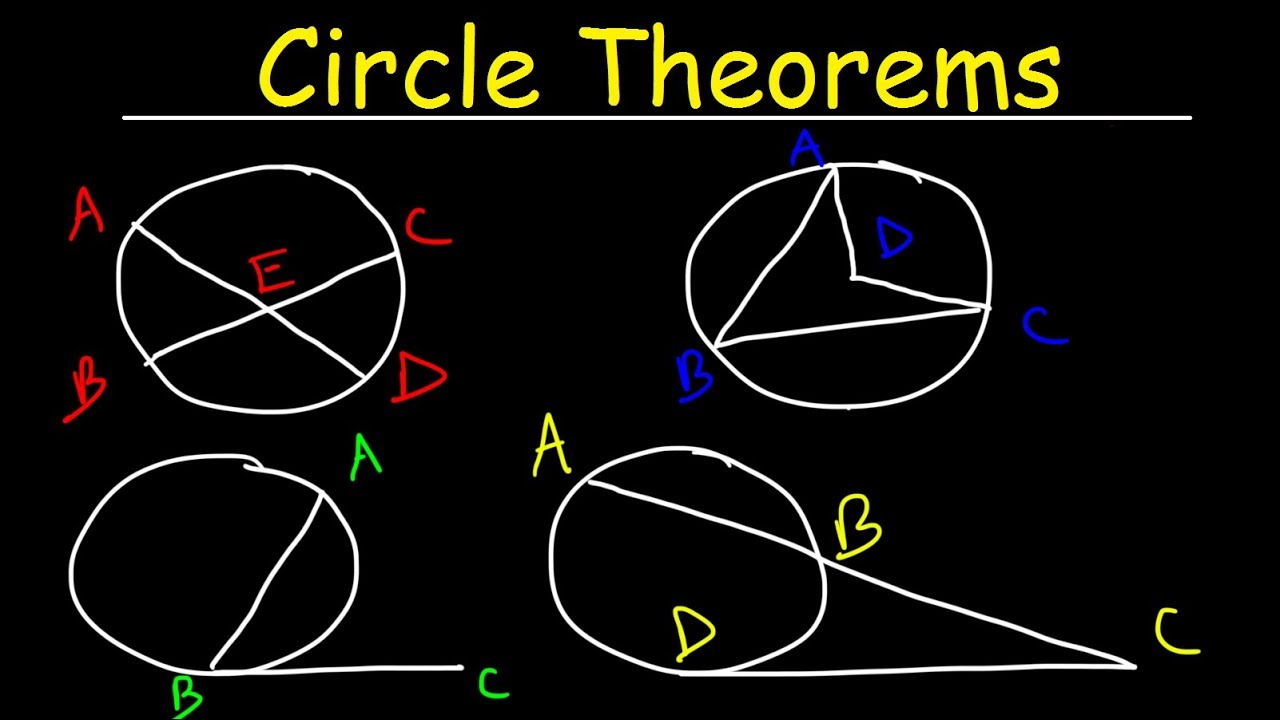
This geometry video tutorial provides a basic introduction into circle theorems. It contains plenty of examples and practice problems.
Here is a list of topics:
- If a radius is perpendicular to a chord, it bisects the chord into two congruent segments. The point of conta...
upper karma
yeah it seemed little wrong
acoustic jungle
that being said all the answers from 1-4 are wrong
I guess except for 3 because he didn't do that one
for 4 you didn't even use the other angle provided by the question
It's okay though
silent plank
4 is a bit tricky
acoustic jungle
🍉
silent plank
q3 had same bad notation.
minor and major aren't needed if you label your arc with 3 letters
and it doesn't make sense to call it minor especially since it takes up the majority of the circumference
upper karma
at 2. it says that arc GI = 76 degrees, but angle GKI = 55 degrees?
silent plank
yes
upper karma
but the video posted by Fishraider at 4:45 says otherwise
"angle ABC and arc AC have the same measure"
silent plank
K isnt the centre of that circle
acoustic jungle
it's good to prove the theorems so you don't accidentally misuse them
I think something is wrong with 5
I am not sure how to solve it unless it states those are tangent lines
silent plank
in circle geo its a reasonable assumption that things that look like tangents are tangents
also only 1 point is labelled at each contact
acoustic jungle
It could be a secant line that doesn't extend beyond that point
but I see what you mean
upper karma
the formula for 5. seems to be at 16:37 from the video above
if arc HF = 97, then arc HIF = 360 - 97
so angle FGH = 1/2 * ((360-97) - 97)
acoustic jungle
Yeah
That is still using the fact that they are tangent
and you could've also done it by drawing the right triangles and getting FGH+HF=180
 steep marsh
Would somebody be able to explain how one would determine the angle of A for range of 180 < A < 360 where : sec A = 2
silent plank
do you know the definition of sec?
little osprey
^
steep marsh
I don't understand any of this honestly. Never did it anytime before now
silent plank
if you don't know definition, consider looking it up
steep marsh
Been looking up stuff related but now really sure what you mean by definition honestly
silent plank
tell me what you know about (the trig function) sec
steep marsh
It's something like the inverse of cosine where it's equal to 1/cos(theta) where 1 is the hypotenuse or something.
Most calculators and libraries don't have functions for it. Beyond that I'm not entirely sure about much
silent plank
be careful with the use of "inverse"
steep marsh
reciprocal
silent plank
it is the multiplicative inverse.
reciprocal function (of cos) works too
so for your question you can rewrite it as:
$\frac{1}{\cos(A)} = 2$
 somber coyoteBOT
ramonov:
steep marsh
So, doesn't this just change the difficulty from sec to cos as A is unknown so I can't use the cos function on it
silent plank
perhaps if i then rearranged it to
upper karma
Geometry is awesome 👍
silent plank
$\cos(A) = \frac12$
somber coyoteBOT
ramonov:
silent plank
would you be able to determine the possible values of A
steep marsh
From what I know of math wouldn't it be 2*1 since whatever you do to one side you do to the other?
silent plank
wouldn't what be 2*1?
steep marsh
cos(A) = 2*1
steep marsh
I don't even know anymore. This stuff hurts my brain trying to figure out.
silent plank
i took the reciprocal of both sides to get cos(A) = 1/2
multiplying both sides by cos(A)/2 would've achieved the same result
steep marsh
I feel like there's information I'm completely missing or my brain has just melted. So sec A = 2 turns into the reciprocal of 1/cos(A) = 2, what the importance of moving the 1 over to the other side?
silent plank
wdym by moving 1 to the other side
steep marsh
moving from above cos to above the 2
silent plank
the idea is to rearrange it to a form that you should be familar with
that's cos(A) = 1/2
is something that you shouldn't have too much trouble solving
steep marsh
I'm familiar with exactly 0% of trigonometry. I apparently should have done it in high school but it was never covered.
silent plank
and if you can't then you pretty much have to start trig from the very beginning
try khan to get the basics
steep marsh
khan?
silent plank
khanacademy
upper karma
I love khan academy 👍
steep marsh
I'll have to look into that later, don't got enough time to properly learn this stuff at this time
upper karma
Good website! And it’s free 👍
I don't know if I'm putting this in the right chat, but i need someone to tell me if i did this right. I think this is supposed to calculate the size of the triangle or something like that... I'm not good at maths but the Points are A(-2,1) B(3,2) C(4,-5) thanks in advance
@upper karma it's not very clear what the problem is
 unborn jacinth
logically speaking, why do they h and k also get flipped when the x and y do
it becomes y-k
acoustic jungle
@upper karma "Size of triangle" ? Do you mean area? Use the shoelace theorem
upper karma
it's fine i asked a classmate and he said it's correct so
acoustic jungle
@unborn jacinth well now you are looking at the graph in respective to x, so the values are flipped
It is not easy to explain
upper karma
also it wasn't clear what the problem was to me either since i missed out on 2 weeks since no one told me we were having online classes
unborn jacinth
ok
acoustic jungle
Maybe it's because 1/4p is unnecessary here
acoustic jungle
like consider rotating the graph 180 degrees
then "subbing" y for x if that makes any sense
Wait a second, it doesn't make sense
@unborn jacinth those equations shouldn't be equal
acoustic jungle
also I just realized I meant to say 90 degrees not 180
unborn jacinth
oh ok
 wide fox
can anyone help me with some of my geometry hw?
steep marsh
Okay I don't even know if this is trig.
Convert 98 degrees 51 ' 16 " to an angle in decimal degrees.
What even is this?
wide fox
okay
steep marsh
How is that a unit of measurement? I can't even.
little osprey
@steep marsh Google it perhaps?
wide fox
i did
wide fox
i have 3 other ones that far
i googled asked my friends and tried to solve it by plugging it in with these formulas
wide fox
okay thank you
little osprey
eh
ok
so basically
let x be the radius
therefore the slant height is 3x
do you follow so far
wide fox
yes
wide fox
for the question?
little osprey
just in general
whats the formula
to finding the surface area of a cone
Im asking you so I can make sure you understand
wide fox
oh its the lateral plus the radius squared x pie
wide fox
yes
wide fox
yes
wide fox
what is LHS?
little osprey
Left hand side
wide fox
oh
wide fox
gimme a sec
little osprey
ok
wide fox
okay
wide fox
yes
wide fox
yes
wide fox
4r^2
wide fox
square root
little osprey
give a guess even if youre not sure
wide fox
2=12
little osprey
nope
divide both sides by 4 first
you have to isolate the r
actually
you know
square root would work
but traditionally dividing by 4 comes first
ok lets do it your way
wide fox
okay
little osprey
2r = 12
wide fox
we have more tho
wide fox
yes
wide fox
i will if i need to
upper karma
Yes 👍
wide fox
thank you @little osprey
little osprey
no worries
 golden panther
GUYS! can i turn r=2cosθ into rectangular coordinates
golden panther
idk
 simple slate
Fr?
 round anvil
@simple slate problem is too blurry
upper karma
@keen nexus just do Pythagorean theorem
round anvil
pinged the wrong person there buddy
upper karma
@simple slate
Maybe idk
What’s that 54
Ya just do Pythagorean theorem I think since it’s a kite or rhombus
And diagonals of a kite are perpendicular
Your welcome
golden panther
GUYS! can i turn r=2cosθ into rectangular coordinates
 subtle gate
Start by thinking how do you express r in terms of x and y?
and then how do you express θ in terms of x and y
then just plop that in and you should be good to go
golden panther
so its the same as a rectangular equation
golden panther
Forget i said that
 vocal hound
I keep failing on this question can someone help me
subtle gate
is the base a regular hexagon?
vocal hound
yes i believe so
subtle gate
i don't get why they felt the need to specify the height to the middle you can calculate that
Do you know how to calculate the area of one of the triangles of the pyramid
vocal hound
I tried to view the example they give but I feel like the y skip a step
Wouldnt it just be the base x height /2
subtle gate
You see that all the triangles of the pyramid are identical
and that the base of them is 22m each and the height is also 22m
so what's the total area of the triangles?
vocal hound
1452?
vocal hound
how do i solve for the area of a hexagon
vocal hound
Yes I did
subtle gate
now do you know the height and the base of one of these triangles?
subtle gate
the height is?
vocal hound
how do we figure out the height?
vocal hound
Oh is it 11 rad 3
subtle gate
yeah so now do the same thing you did for the triangles before but with these measures
vocal hound
is it 726 rad 3
vocal hound
ok so do we need to multiply that by rad 3
subtle gate
do you have a calculator on hand to approximate that
vocal hound
yes
subtle gate
what does it come out to?
vocal hound
1257.468888629....
subtle gate
so now add it to the original
which was 1452
and then round and that should be your answer
vocal hound
2709
subtle gate
now is that the correct answer?
subtle gate
good luck if there is more questions :)
vocal hound
thanks
acoustic jungle
are* 
golden panther
naw bruh 😂
acoustic jungle
is this geometry
somber coyoteBOT
Pony Boy:
 versed river
hey mate try not to ping specific members, but yes
 compact spire
Oh I'm sorry Sneaky
versed river
so what's the trouble you're having with this question?
compact spire
Okay part A is my problem with converting the W
versed river
so we have V=3i-j
and W=4i+sqrt(3)j
we want V-W
so we have 3i-j-(4i+sqrt(3)j)
do you agree so far?
versed river
we group and we have (3-4)i +(-1j-sqrt(3))j
ya
so thats -i-(1+sqrt(3))j
sometimes it may be appropriate to convert that to a decimal
compact spire
Okay so I can't do anything with that sqrt part
Are you talking about the sqrt part?
compact spire
Okay
versed river
and it will make your job easier on the questions finding the magnitude
compact spire
If I dont?
versed river
then you bracket 1+sqrt(3)
yes
because you're gonna have to square it later
is why i said you shouldnt turn to decimal
(in d when calculating the magnitude)
compact spire
Okay D is the other part I was stuck on
versed river
sure, what was your trouble?
versed river
sure
 brittle ember
heyy
versed river
5 degrees?
compact spire
Okay
versed river
Yes
compact spire
Okay
somber coyoteBOT
Pony Boy:
compact spire
That's what I'm aiming for right?
versed river
Not nessecarily, no
compact spire
Oh
I'm trying to think where I'm messing up then.
Dont I use the answer from part a for part d?
versed river
You have the i and j components for v-w, so do the same thing you did to get magnitude for w
Nope
somber coyoteBOT
Pony Boy:
compact spire
So something like this
compact spire
Yeah I'm not either, kinda hard on the phone lol
versed river
Also, we usually dont write the is and js under the sqrt
compact spire
Oh
 remote heart
I don't think you'd square the i and the j
somber coyoteBOT
versed river
What happens to a negative number when we square it?
Sir you're right, but i already corrected him on that
Also, we usually dont write the is and js under the sqrt
@versed river
remote heart
Sir you're right, but i already corrected him on that
sorry, I had a lot of lag and didn't see that
versed river
Yes like (-2)^2
Imaginary numbers are an expression for the square root of negative numbers
versed river
Yes
compact spire
Sorry I was thinking sqrt
versed river
So what im getting at is you can rewrite that without negatives so you can solve it without a calculator
Although looking at it more you may still need a calculator
versed river
Like the length of an arc of a circle?
remote heart
you can determine what fraction of the circle it is and then find the formula and multiply it by that fraction
compact spire
So it would just be $\sqrt{1+(1+\sqrt{3})^2}$
remote heart
binomial theorem
upper karma
like, I'm doing a math test online and it shows the measure of the arc is 135 but then it says calculate the linear measure and says "PQ = _" but somehow I have to have pi in the answer
versed river
The 1 +root3 would be squared but yeah
compact spire
But the negative wont cancel it?
versed river
Assuming the measure 135 means degrees find it as a fraction of the circumfrence
upper karma
how
somber coyoteBOT
Pony Boy:
compact spire
Can I simplify the 1 out of the sqrt?
versed river
You most defibitely cannot
versed river
135 degrees is what fraction of a full circle
compact spire
So that would be the final answer? Seems like I did something wrong
When it comes to the squaring the negative
somber coyoteBOT
remote heart
or pascal's triangle
versed river
$\sqrt{(-1)^2+(-(1+\sqrt{3})^2})=\sqrt{1+(1+\sqrt{3})^2}$
compact spire
I'm confused now
compact spire
Yes
remote heart
then just plug in a = -1, and b = -sqrt(3)
compact spire
a^2+ab+b^2
remote heart
indeed
somber coyoteBOT
Sneaky:
versed river
what he's getting at is that theyre equal
compact spire
Okay so the answer is
versed river
and that you can expand with or without making the simplification that its positive and get the same answer
compact spire
$\sqrt{5+\sqrt{3}}$
somber coyoteBOT
Pony Boy:
compact spire
Hmm
versed river
i think 5 is pretty correct
remote heart
I forgot about the other 1
compact spire
Oh cool
versed river
but you're missing something, i believe
remote heart
it's 2ab
versed river
$\sqrt{1+(1+\sqrt{3})^2}=\sqrt{1+1+2\sqrt{3}+3}$
compact spire
Ohhh
versed river
where is my tex
remote heart

somber coyoteBOT
Sneaky:
compact spire
2ab I forgot
versed river
so thats actually $\sqrt{5+2\sqrt{3}}$
somber coyoteBOT
Sneaky:
versed river
there we go
compact spire
Okay cool
versed river
that all?
compact spire
I have a lot more but I'm going to try and figure them out again
This is helping me a lot with understanding vectors
Thank you
versed river
sir i'll let you answer since you're typing
compact spire
Still answering one sec
remote heart
okay
compact spire
(-3i)+(-5j)
versed river
bruh you got it
compact spire
Yes!
versed river
oh wait
remote heart
wait, isn't it 3, and 5
compact spire
Lol
versed river
i misread which one was which point
compact spire
Positive?
remote heart
yep
 high zephyr
isnt it positive?
compact spire
Why is it positive?
remote heart
you subtract initial from terminal, I think you just got them switched up
compact spire
So its 3i+5j?
remote heart
indeed
versed river
yes. draw a diagram to conceptualise this if you aren't sure
high zephyr
it's positive becuz it's an increase of those values
compact spire
Ohhh
high zephyr
not decrease
remote heart
ye because the terminal values are greater than the initial
upper karma
@compact spire You can do it! I believe in you! We all do! 👍
 carmine sundial
lello?
remote heart
hello
carmine sundial
cani ask questions here?
remote heart
indeed you can
carmine sundial
trigo-related
remote heart
yessir
remote heart
I'm sorry, I can't see the question
carmine sundial
i sent it through pic
remote heart
I can't see the question in the pic I mean
carmine sundial
- In triangle RST, the measurment of angle RST is 60, and ST is 8, find RS
remote heart
yes
remote heart
these:
remote heart
well, you can use those to find cos(60) = 1/2
 silver radish
 remote heart
then you just multiply 1/2*8
carmine sundial
oh its 1 half because the measurement is 60?
remote heart
ye, because we want cos of 60
silver radish
anyone know how to do my question?
remote heart
that looks like a quiz on canvas
carmine sundial
cos(60)=1/2*8 = RS?
remote heart
indeed
carmine sundial
nice
silver radish
its called online school
remote heart
yes
compact spire
I think I figured out my problem 🙂
remote heart
nice!
compact spire
yeah I had to redraw my diagram
remote heart
what was your final diagram?
compact spire
ill post a picture of part a and b, need me to repost the question too?
remote heart
I've got the question
compact spire
Okay
carmine sundial
@remote heart what do i use to find ST if ever i want to?
this shows as false in photomath
carmine sundial
no 8?
remote heart
but you said you had 8*cos(60)
compact spire
remote heart
nice!
compact spire
I got it good right!?
remote heart
I believe so
compact spire
Cool
Okay im having trouble with this next problem because I dont remember how to calculate it properly
Okay so I have this so far which I believe is correct
not sure if you can read it
remote heart
ye
compact spire
I think I might know how to calculate it if its the same as part d from earlier
where I just sqrt it all and square the v1 and v2
remote heart
is there a target?
remote heart
okay
compact spire
$\sqrt{(2509.4)^2+(1312.1)^2$
somber coyoteBOT
Pony Boy:
Compile Error! Click the  reaction for details. (You may edit your message)
compact spire
I was at $ <1000(cos(0)+2000(cos(41)),1000(sin(0))+2000(sin(41))>$
somber coyoteBOT
Pony Boy:
compact spire
and I narrowed it down to $<2509.4,1312.1>$
somber coyoteBOT
Pony Boy:
compact spire
$||v1+v2|| = \sqrt{(2509.4)^2+(1312.1)^2$
somber coyoteBOT
Pony Boy:
Compile Error! Click the reaction for details. (You may edit your message)
remote heart
just a sec
compact spire
Okay
remote heart
isn't it asking for the horizontal force on the stump?
somber coyoteBOT
Pony Boy:
rich wolf
$\mathrm{you, didn't, really, need, to, type, that, out, in, latex}$
remote heart
lul
somber coyoteBOT
AMD:
rich wolf
$💩$
remote heart
@compact spire I think to solve that problem you would find the i components of each one and then add them together, no?
compact spire
how do you mean?
remote heart
you know how you can visualize vectors using graphs?
compact spire
Okay
remote heart
the i component would just be the change in x
compact spire
Okay
remote heart
41 and 90
remote heart
yesyes
I'm not too sure how to describe this, but we want to find the leg that coincides with the x axis
the leg adjacent to the 41 degree angle
compact spire
so the opposite
remote heart
yes
silver radish
The volume of a pyramid is 50 cubic units. The base is a square with sides of length 5. What is the height?
how do i solve
remote heart
what are you stuck on?
compact spire
can I use the form Side-Angle-Side?
silver radish
idk how to start it should i use volume equation for pyramid?
remote heart
side-angle-angle, I believe
little osprey
yes
remote heart
yes, yk
little osprey
recall the volume of a pyramid
compact spire
2000lbs(hyp)-41deg(theta)-90deg
remote heart
ye
silver radish
A cone and a cylinder have the same radius and height. The volume of the cone is
100 ∏
cubic feet. What is the volume of the cylinder? Round your answer to the nearest tenth.
how do i start this
remote heart
do you know the relation between a cone's volume and a cylinder's?
silver radish
v=pier2h ?
high zephyr
no, their relationship
remote heart
^
silver radish
nope
high zephyr
go on mister
remote heart
do you know the formula for the volume of a cone, or the area for the volume of a cylinder?
silver radish
yeah
silver radish
v= pie r2 h
high zephyr
compare the two formulas, what relationship do u see?
silver radish
pie r2 h
versed river
pie
high zephyr
no, i meant relationship
remote heart
yes, but in the cone it's being multiplied by what?
silver radish
1/3
remote heart
indeed
silver radish
so 1/3 x 100?
remote heart
100 is the volume of the cone
high zephyr
you're trying to find the volume of cylinder
silver radish
substract 1/3 from 100?
remote heart
why subtract?
high zephyr
@compact spire taken atm
versed river
use a #❓how-to-get-help channel
remote heart
indeed, 100/(1/3)
 prime jewel
hey guys i have a question, so i have this example and i can't really find the way to get the answer with my calculator
I'm trying to get that -0.893
Idk what i'm doing wrong
I'm following the formula.
The main question is about 2 forces that lie on 1 point A
 wary bone
what are you trying to solve for in the end?
prime jewel
I'm trying to find the angle between two forces
wary bone
so angle abc
wary bone
no.
 haughty summit
set AC=1012, AB to 567...
prime jewel
That is what i did, but i get an error.
somber coyoteBOT
Result:
-0.89288231148696
cos is a function. you cannot get rid of that by division.
haughty summit
watch me
wary bone
@prime jewel so you got cos (abc) = somehting. you want only (abc) in the end. remember what you do then?
silver radish
A pyramid has a height of 4 inches and a volume of 40 cubic inches. Circle all figures that could be the base for this pyramid.
a 5 inch by 2 inch rectangle
a 3 inch by 10 inch rectangle
a heart with area 30 square inches
a right triangle with one side 5 inches and the hypotenuse 13 inches
a triangle with height 10 inches and base 3 inches
haughty summit
arccosine lul
remote heart
taken, post in a questions channel
prime jewel
How would you go into the problem, you replace the Terms, and then you solve, you square it and you move all terms to the left
and then arccosine.
But when i do it i get an error
silver radish
oof
remote heart
what's the error?
prime jewel
Could you pop into a channel so i can explain?
Anyone?
I'm on Mathematics voice channel rn.
wary bone
no voice here 😦
little osprey
Youre backkkkkk
upper karma
I know that it’s 2pi/b
remote heart
the period is just when it returns to the starting value
upper karma
Yeah man. Thanks to sneaky I passed my test with a 98/100
little osprey
Amp is not -3
remote heart
da
little osprey
yeah no we all make mistakes
remote heart
just a happy accident
little osprey
frequency
upper karma
Is it pi/4
little osprey
Imma let Mistersir handle this
it'll be confusing if both of us type over each other
upper karma
So is B pi/4?
remote heart
y has not yet been > 0 at pi/4
wary bone
full circle 🤔
so a full cycle
@remote heart
remote heart
at 3pi/8 y isn't 0
upper karma
Wth
remote heart
full circle 🤔
@remote heart
@wary bone
wary bone
guess both work 😄
little osprey
it says full cycle?
remote heart
yes!
upper karma
hmm, so why at pi/2 it is considered to be a full cycle
remote heart
because at pi/2 y has already been > 0 and < 0 and at pi/2 it is 0
so it has returned to it's original value
upper karma
I see
remote heart
and been greater and less than zero
little osprey
Its had one maximum and minimum value done and came back to the principle axis
upper karma
gonna screen shot this so i dont forget
wary bone
you can look at the distance between two maximums aswell. or two minimums.
remote heart
oh yea
upper karma
also to get the period, we do : 2pi/(pi/2)
wary bone
yeah because the default period would be 2pi, have to adapt to that
remote heart
da
little osprey
are you Russian by any chance mister
remote heart
nyet
little osprey
Ukrainian?
wary bone
can you help me FIND an exercise?
i need a real life example of any circle, where you know the surface area but not the radius. (i only find ideas where you know/measure the radius first)
remote heart
a circular kiddie pool covered in water?
but just the surface
no, that's a bad example
upper karma
So guys is the graphs equation come out to f(x)= -5sin(4x)