#geometry-and-trigonometry
1 messages · Page 259 of 1
 somber coyoteBOT
 cold oriole
I have soluti9on
Its like goniometric relations in german
like sin(2x)=2*sin(x)*cos(x)
 upper karma
Does anybody has a pic of ALL the trigonometric identities, like that one
It'd help a lot to a lot of people
 sly grove
i dont have a pick but i have a link to a website with them

Purplemath
Lists the basic trigonometric identities, and specifies the set of trig identities to keep track of, as being the most useful ones for calculus.
 acoustic jungle
upper karma
acoustic jungle
upper karma
Thank you two c:
 bitter jetty
how do i do his, the corners are not on exact points
 idle bloom
those look to be half-way between points @bitter jetty
oh wait no
those are on points
look at the x and y axis scaling
bitter jetty
how do determine their exact coordinates
g and f are good but e and d arent on exact points
so how do i determine them
 devout harbor
@bitter jetty kinda looks lke E's y coordinate is 17 and D's is -7
 daring solstice
I have a quick question, in a 45-45-90 triangle is one of the congruent sides the heightv
bitter jetty
@devout harbor but if i dont use the exact numbers the website that the teeacher uses to give us assignments marks it off completely
so is there any way to figure it out
?
devout harbor
i dont think so @bitter jetty
 lofty dust
how would i do this?
 chrome quarry
anyone know what this solid is called?
 dark sparrow
looks like some sort of... irregular square antiprism i guess?
acoustic jungle
@lofty dust there is a lot of unecessary information in there I think
I found a with pythagorean in 2 steps
 loud fulcrum
ik this is probably really simple for some of u guys but how would i solve this
 silent plank
consider finding BD first
 spice flax
rectangle $12 * 20$ mm
somber coyoteBOT
Da Storyteller:
silent plank
sure. use the appropriate trig function
loud fulcrum
ok thanks alot @silent plank \
 digital gulch
If u were to make this net of an octahedron into an octahedron, which faces would be next to face number 3?
I can’t imagine this in my head
digital gulch
Ok
 paper mauve
Imagine the 7 and everything else above that 5 folding upwards
digital gulch
Ok
paper mauve
Then you’re off. Just start slowly folding things piece by piece in your head
Orr you can construct this yourself with paper and scissors and pencil
digital gulch
Yeah constructing sounds like a good idea I’ll do that
 upper karma
look at the radii
what is the radius of this circle?
in fact im not sure this is even a possible diagram
lofty dust
i dont see a radius
upper karma
lofty dust
ohhh
silent plank
you could apply chord bisection theorems directly
lofty dust
so would you do Pythagorean theorem with 5^2+3^2= x^2?
upper karma
there seems to be a issue with this problem
because if you take the legs, 5 and 4, you get r = sqrt(41)
but if you take the legs 3 and 7, you get r = sqrt(58)
silent plank
lol rip
lofty dust
yeah i got the same thing ig ill just ask my teacher about it
upper karma
i believe its the base angles theorem
 pliant matrix
why
upper karma
base angles theorem says that if you have an isosceles trapezoid the opposite angles are equal
 unborn jacinth
alright so I had question where it said z1 = -6+i and z2 = 6+i and I had to find what z1/z2 is in standard form
so I converted z1 to trig form and z2 to trig form
and used a theorem to get cis161.08
but if its no calc, I can't rlly convert that back to standard form
so how would I do it
chrome quarry
@dark sparrow thanks dude!
 steep lion
what are the practical aplications of radians
 rapid pollen
I have a question, am I doing this right?
Or does this not even involve the law of sines? I think it’s a simpler approach to the problem lol I’m probably totally wrong.
 ancient jacinth
you should need law of sines for this
rapid pollen
OHHHHH I JUST REaD THE directions
ancient jacinth
tis ok happens to me a lot
rapid pollen
Good to know I’m not the only one
ancient jacinth
ahah it happens to everyone
 high zephyr
ok wait a sec
upper karma
Sure
upper karma
No worries,I appreciate you trying
 umbral snow
Ooh these are a mess
high zephyr
:(
 rich wolf
this is why wolfram alpha was invented
 vale nimbus
wtf those are painful
upper karma
Lol this problem United people
I know but I have to solve it
And I feel like elegance is right around the corner
<@&286206848099549185>
high zephyr
question?
 visual mist
for part b, can i say that because DC=CB=AB=DA and also <AEB=<DEA=<DEC=<CEB because they are corresponding angles in congruent triangles?
acoustic jungle
yes
 vivid parrot
could someone explain to me how to do cos(sinx)-1=0
high zephyr
this channel is taken @vivid parrot
vivid parrot
wat do you mean
high zephyr
as in, somebody already asked for help first and they're still waiting for a solution
oh no wait
edited just then
ok yea
visual mist
@acoustic jungle thanks
 fresh pawn
Anybody can help with circle theorem?
fresh pawn
if youre finding a then x is the same
so both i guess
any one first is going to get the same result
 odd shuttle
If someone could help me on #1 that would be great I’ve been stuck for around 10 min
high zephyr
what's the angle of straight line minus the 108 degree angle
@odd shuttle channel's taken
odd shuttle
Ok
fresh pawn
idk that's what i was missing out on
high zephyr
ok
180-108=72 degrees yep
and that's the middle angle at point O
you see the angle labelled x?
fresh pawn
yes
high zephyr
well that angle, you can stretch it so that it goes on top of O
so just imagine that the angle x is moved to top of point O along the circumference
high zephyr
so just imagine that the angle x is moved to top of point O along the circumference in an anticlockwise fashion
ok only focus on angle x
for now
edited
fresh pawn
ok
high zephyr
do u mind drawing it?
the new shifted angle on a new diagram
the intersection of the two legs of the angle x and the circumference stays as it is
so it kinda becomes a pivot point when shifting the angle x along the circumference
😅 this is prob the best way i can word it...
dark sparrow
@acoustic jungle don't fucking call me "it"
high zephyr
@fresh pawn ?
dark sparrow
azrol left the server
high zephyr
:|
 onyx basin
@high zephyr https://cdn.discordapp.com/attachments/326138757474680852/695118527056707605/unknown.png

in reference to azrol's question
if we're finding angle a, and O is a given center
high zephyr
i wouldnt assume that
onyx basin
since the triangle is formed at a center point and two radii
high zephyr
oh you meant the small one mb
high zephyr
azrol said it doesnt matter which angle so i just lead azrol into finding x
wifi lag
onyx basin
ah ok
high zephyr
so you're good?
onyx basin
yea I thought you were solving for a my bad
I was wondering why you wanted him to draw out stuff haha
nvm then
high zephyr
ok
rich wolf
Ok boomer
 lethal tangle
Could anyone help me out with some year 12 trig questions
dark sparrow
until you post them, nobody can
when you do, there may be someone who can and will help
lethal tangle
Question 1
cold oriole
you can help me? Its ALPHA 2.3° and BETA 65°. I Have calculated h1 but i also need h2 and b and idk
lethal tangle
I just not sure how to start off I'm confused
I think it's the way the teacher has shown us
How would you approach the question?
 mystic dock
I dont want to spoil the answer to question 1 but notice that the angle is 45 degrees, thats fishy right? its another 45 to make 90.
dark sparrow
nah there's nothing special about the 45° angle here
@lethal tangle okay so there are many, many formulas for the area of a triangle
maybe one of them could apply here directly
another one a bit less so
lethal tangle
Wait would I be using area=1/2 bc sin A
Or finding the opposite, adjacent and hypotenuse
Then using cos, sin or tan
@dark sparrow
dark sparrow
well you want the area don't you
dark sparrow
you... don't?
there's no names here
names don't matter anyway, what matters is that the angle should be between the two sides
which in your case, it is
upper karma
@cold oriole do you still want help?
 steep temple
how many sides does a circle have
dark sparrow
a circle does not contain any straight line segments which one could call sides
a circle is not a polygon
 languid swan
Can anyone help me with the questions I circled?
languid swan
I mean i tried figuring out all of them but I got no clue
 supple wedge
ok q5
what have u tried
@languid swan
notice that it is a right angles isosceles triangle
so both sides r 17
km
then use pythagoras
languid swan
You know my boi
I think if you gave the answers I’d appreciate it because if you did then I could probably figure out what I did wrong and what I was supposed to do
But yes thank you
What about the bottom?
upper karma
If sidewalk is the square diagonal just use Pythagore
 mild barn
@supple wedge my teacher was very vague with my instructions can you help me with this problem
somber coyoteBOT
Hmm:
mild barn
That’s how I’ve been doing the rest of the packet so lol I guess
mild barn
So for choice 2 how many numbers would I need to assign
Norm for #1 then
Norm for #1 then
supple wedge
scroll
supple wedge
@mild barn its 3/4 area since its 3/4 circle and a square
bitter jetty
kk thx
 versed river
cosine law works
mild barn
Wait so I’m confused 3/4 was your answer then???
bitter jetty
what do they mean second set of answers
acoustic jungle
@dark sparrow what??
dark sparrow
what
acoustic jungle
what was the message
"don't fucking call me it"??
@bitter jetty there are two possible values when you are given that information
dark sparrow
acoustic jungle
ok.
bitter jetty
@acoustic jungle how do u find the second set of values
acoustic jungle
The angle B2 is basically H here
notice what the two angles add up to
the two possible angles
And it's not because the sin law is wrong, it's right but sin (theta)=sin(180-theta) however your calculator doesn't show the other result so you'll have to do that manually
Cold male?
acoustic jungle
The center of the circle is the midpoint of the diameter
The radius is half the diameter
axe
@upper karma
upper karma
so its the radius?
acoustic jungle
The endpoints of the circle are those points. 1. The center of the circle is the midpoint of those points, 2. and the radius is exactly half the diameter
- tells us the position of the center (For LHS equation) and 2. tells us the distance (RHS)
bitter jetty
@acoustic jungle sry i had to help my brother
ya it kinda makes sense now
so i have to do
sin(180-38)
ok
 acoustic jungle
@bitter jetty no that is incorrect
angle "I" can't change because it's given in the question: https://www.youtube.com/watch?v=S1oDtGHC2iA

Learn how to solve a triangle using the law of sines when it is the ambiguous SSA case in this free math video tutorial by Mario's Math Tutoring.
0:55 How to Drop an Altitude to Analyze the Triangle
1:07 Solving for the Height Using Sine
1:36 sSa Condition
2:13 Showing How th...
dark sparrow
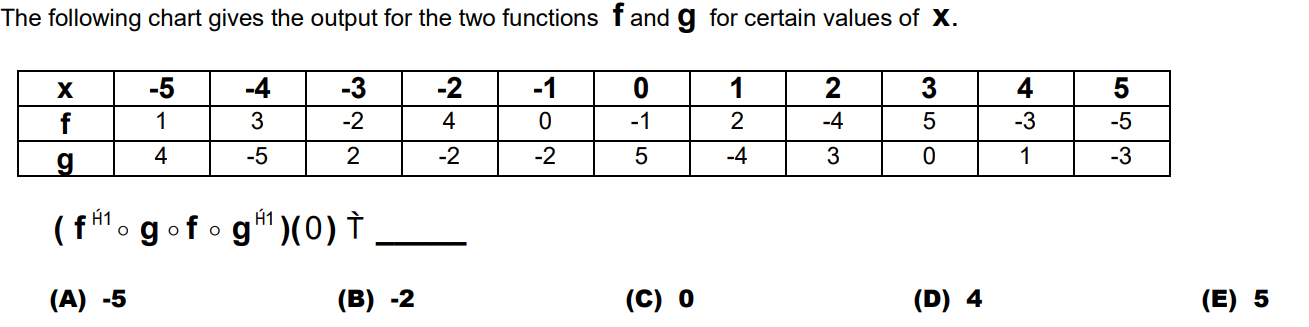
is that meant to be $(f^{-1} \circ g \circ f \circ g^{-1})(0)$ @narrow plume
somber coyoteBOT
Ann:
dark sparrow
if so, your answer is correct
 narrow plume
Yes, and thank you
https://i.imgur.com/35lWtV8.png Can anyone help me with this word problem?

budget = 9,000
cost of construction = $100/ft. for the bare walls + $100/ft. for bookcase.
Bookcase = half length of its wall
Not sure what I have to do with these values...
ancient jacinth
could i get some help here?
 quiet mason
which angle is 60,70 and the y
narrow plume

Any1 know how to do this? I assume i plug in the value to x somehow
and find what is exlcluded
dark sparrow
can you talk to your teacher and tell them this document is corrupted
i have no idea if that G with an accent is a plus or a minus or something else entirely
narrow plume
mhm
somber coyoteBOT
Ann:
dark sparrow
the domain of f consists of all real numbers except -1
the domain of (f o f) will consist of all real numbers except for -1 and all the solutions of the equation f(x)=-1
upper karma
x+1 =/= 0
And f(x) + 1 =/= 0
narrow plume
Ok, so basically if I graph this function (?) I will see that it includes all real numbers except -1?
dark sparrow
you're overthinking it
narrow plume
😆
dark sparrow
if a number x is such that (2x+5)/(x+1) = -1, you can't plug it into f o f
ancient jacinth
lol
narrow plume
Lmao all g
 haughty summit
wat is dis
I know that it's geometry lol im just saying that question is so badly formed haha
one sec
what polygon am I looking at
I just see a circle
which is not a polygon
lmfao
My best guess? Add your sides up and you would get 45
round your answer
quiet mason
i guess you have to find the perimeter of the circumscribing polygon
no they havent said that 8.8
is the length of the entire side
haughty summit
ah I see
haughty summit
maybe it's propotional?
Bonchu is right about not stating the entire sides.
figure out the other half of the two black lines
oh
11.5x2+15.7x2=23+31.4=54.4
hmmm
yeah just take that and round it
thats my guess
upper karma
How do i go about this: (cos(70°)/cos(80°)) - cos(10°). By finding a common denominator?
Nvm, i figured it out
acoustic jungle
@upper karma use the property that when 2 tangent lines intersect their distance to their tangent point is the same
and yes it's 54.4
None of the answers are right
 summer spire
because it's less arbitrary than degrees or gradians?
it's a simple enough conversion
just depends on convention
 loud pike
"An isosceles trapezoid with bases 12 and 16 is inscribed in a circle of radius 10. The center of the circle lies in the interior of the trapezoid. Find the area of the trapezoid"
<@&286206848099549185>
I've been thinking maybe the radius has something to do with the height, but that doesn't seem right
 modest vine
i have been trying to do this for a while but i am stuck
 iron rain
What are you supposed to find?
modest vine
Surface area
modest vine
need to find the surface area have been trying for a while but i cant do it
upper karma
A lamp must be hung on an inclined wall. It is therefore suspended in two strings, as shown in Figure 7
below. The angle between the two inclined cords is denoted 𝑣 = 53 °. The angle between the vertical and one of the inclined cords is denoted 𝑤 = 142 °. The inclined wall has the angle 𝑢 = 45 ° to the horizontal.
When the lamp hangs still, the sum of all forces must be zero. The vertical vector is gravity having the length Ft = 100 𝑁, forces in the cords are designated F1 and F2, see Figure 8
a) Determine the magnitude of the forces F1 and F2
modest vine
im stuck need to find surface area
 void moat
look at ur surface area equation
what is it for tianglar pyramid
Base area + 1/2(perimeter x slant height)
so ur slant height is 13.8
u need to find the perimter of ur base
and also the area
@modest vine
this is an ez problem
u just need to surface area formula
 steel thorn
 glad comet
<@&286206848099549185>
upper karma
is the arc circular
because if it is then Q would be the center of that circular arc
which means point A is on circle P and circle Q
now consider the radius of circle P and circle Q
what can I say about the two in relation
upper karma
ok then what is the radius of circle Q and radius of circle P
what line segment specifically
glad comet
PQ
upper karma
correct
this would imply that the circles have the same length radii
now consider triangle PAQ
what are the angles of this triangle
glad comet
<PAQ & <PBQ
upper karma
sorry, what are the measures of this triangle
glad comet
45-45-90
upper karma
how do you know that
glad comet
because both circles are the same and share the same tangent making those arcs equal which makes the lengths equal
the radius is its own thing which could be the base
glad comet
im just making them tangent considering they are exactly 1 point
 chrome fiber
vale nimbus
chrome fiber
vale nimbus
@upper karma sin²(A) + cos²(A) = 1
upper karma
high zephyr
conversion of degrees to radians
vale nimbus
yup
high zephyr
what trig ratios would u use here
upper karma
Tan?
high zephyr
yeah correct
upper karma
Oh so tan(31)=h/25
 cunning night
Is the tree 11 feet tall??
high zephyr
np
glad comet
i still do not understand this
high zephyr
is the question asking for the cut-off length of arc?
glad comet
yeah
high zephyr
there are no numbers...im assuming they would be the same length
visual mist
any help? im stuck
high zephyr
you can divide the rhombus into four triangles
visual mist
yea i did that
high zephyr
since the diagonals are bisectors of each other, AM=MC and DM=BM where M is pt where diagonals intersect
since it's a rhombus, all sides are equal (given)
therefore triangles are congruent (SSS)
acoustic jungle
@glad comet find the angle of APB then go from there. Try drawing the rest of the circle Q for it to make more sense
visual mist
is M where they intersect?
high zephyr
i said it
visual mist
0h oops didnt see
high zephyr
what do u notice when the triangles are congruent?
visual mist
idk
high zephyr
when they're congruent, their corresponding angles at the centre are equal
vale nimbus
@high zephyr cant u use the law of cosines for this too?
high zephyr
???
vale nimbus

 high zephyr
nani? it saves soo much time
high zephyr
try googling trig ratios for sin cos and tan
acoustic jungle
You can figure it out by finding the height of the tree with tangent (yes) , finding the hypotenuous with pythagorean, then finding the height of the tree with cosine law
vale nimbus
i know what sin =
like the ratio
but we just never used it
we just learned it and then moved on
acoustic jungle
 proper zinc
I know the radius is 3.7, but how would you find that out? I can't see any indication of radius/diameter here?
high zephyr
it's a hemisphere
the 3.7cm is the radius
the centre of a sphere to the bottom of it is the radius
and in this case it's half a sphere
high zephyr
haha so you're good now?
proper zinc
Yes, thanks :)
high zephyr
np
acoustic jungle
GodGamer, what is the answer
Just trying to varify
@digital gulch
@digital gulch https://www.youtube.com/watch?v=f-ETwjwwOAM
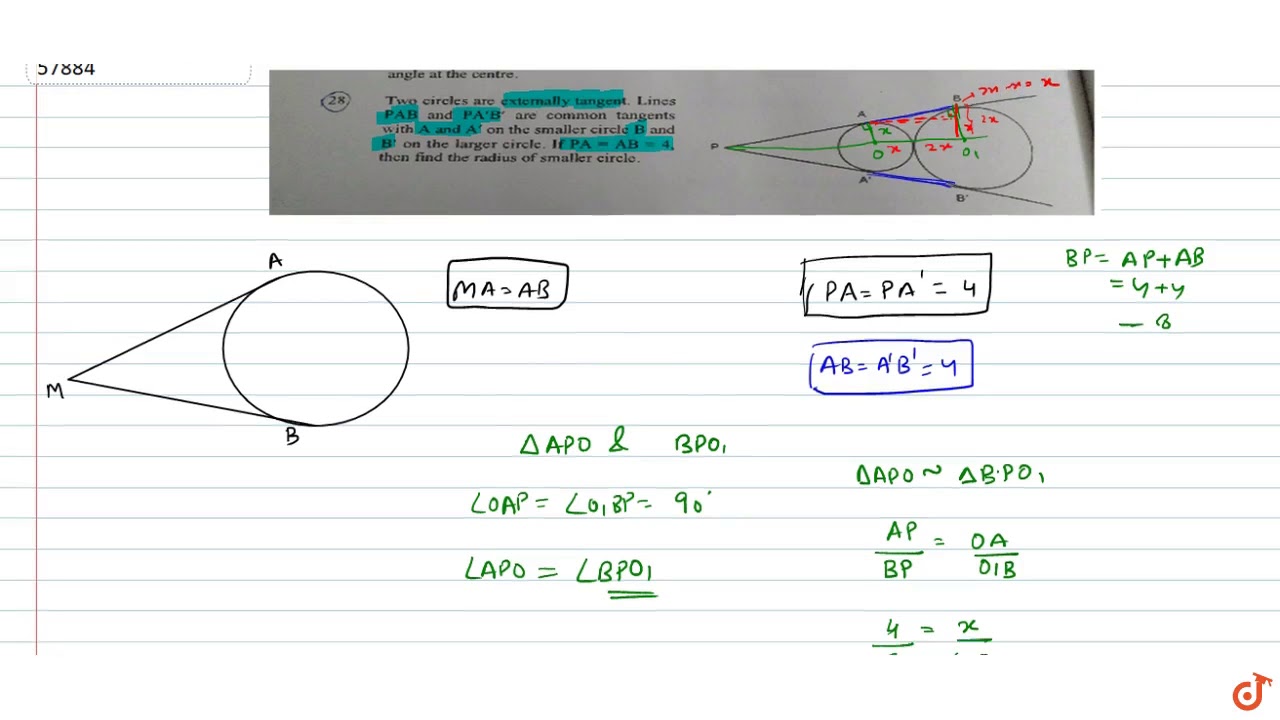
To ask Unlimited Maths doubts download Doubtnut from - https://goo.gl/9WZjCW Two circles are externally tangent. Lines PAB and PA'B' are common tangents with A and A' on the smaller circle B and B' on the larger circle. If PA = AB = 4, then find the radius of smaller circle
high zephyr
what a legend
acoustic jungle
I just searched up the question lol
acoustic jungle
is this a trapzoid
acoustic jungle
use trig, find the top value, use trig, find the height, then use the trapzoid formula
acoustic jungle
draw a line down from the top to the bottom
loud pike
specifically
 plain pollen
Heyo, I asked this question a while back but due to miscommunication with the kind person trying to help me I didn't get a chance to go through it. Would anyone be willing to help?
part b in particular
devout harbor
For the x coordinate, we have x = 1+t and it needs to be 0.
What's the value of t that makes this happen?
plain pollen
-1
devout harbor
np
 viscid ginkgo
for y = 3 + 2tan(x/2 + pi/8) how can I find the period? using 2pi/B formula gets me 4pi / x
devout harbor
You should know that if y=Atan(Bx+C)+D, then the period of the function is pi(period of tanx) / b
so it's just pi / (1/2) or 2pi.
@viscid ginkgo
viscid ginkgo
someone else helped me, but thank you.
devout harbor
All g
silent plank
construct line DP
bitter jetty
how?
silent plank
by drawing a line connecting the points D and P...
silent plank
what does the given information tell you about (m)angle DPA
bitter jetty
ceentral angle
silent plank
with the size of:
bitter jetty
its 40?
silent plank
degrees yes
bitter jetty
so how does that help me find x and y
silent plank
were there any angles you were able to find yourself?
bitter jetty
arc sc is 110
silent plank
eg. (m)angle APC?
silent plank
now consider the properties of triangle DPC
silent plank
show your calculations for x
bitter jetty
i got y
then i did 180-y
added the 2 angles and subtracted that form 180 to get x
silent plank
how did you get y?
bitter jetty
crap o did smth wrong
silent plank
you should be finding x first
bitter jetty
?
silent plank
what's the ? for?
bitter jetty
how do i find x first
silent plank
now consider the properties of triangle DPC
bitter jetty
p is 70
silent plank
what type of triangle is it?
silent plank
yes
acoustic jungle
@bitter jetty it's a straight line
bitter jetty
im sry im the biggest ding dong ever
 languid pagoda
yoooo
 flint heath
no
and i need help too
whatcha need
okay
yeah same lol
whats your review sheet look like brother
upper karma
flint heath
can u do question one
thats just looking on your unit circle bruv
BOI
GOOGLE
\
okay google is kinda bad
so there are 4 quadrents in the unit circle
upper karma
mhm
flint heath
you go from the right side and rotate counter clockwise for a positive angle
flint heath
im just dumb im sorry
upper karma
wait
if u go around the circle tho it adds up to 630
635 minus 360 is?
so the extra 5 would be in the 1st quadrant
275 is in the fourth quadrant.
flint heath
no he is rigght mayoo
upper karma
k
flint heath
if u take 635/90 you get 7.05 repeating
upper karma

upper karma
what about number 2
upper karma
ok
flint heath
so like a 90 degree angle looks the same as a 450 degree angle
vale nimbus
360 fits once into 630 then ur left with 270°
flint heath
which makes them coterminal
vale nimbus
you might aswell substract 2.360° from 630 then ur left with an angle of -90°
wait whats the question now 
lagging behind i feel
flint heath
yup @upper karma
vale nimbus
yup
upper karma
how do i find the angles
flint heath
so if you add 360 degrees to 150 thats one coterminal angle
vale nimbus

 upper karma
so do i -360
vale nimbus
yeah
you can either add 360° or substract 360°
because thats like adding or substracting a whole circle
which puts you back into the same place
if that makes sense
vale nimbus
yes
flint heath
151,350 degrees is a conterminal too
upper karma
why
upper karma
whered u get 420
flint heath
Out of my ass
vale nimbus
funny weed number probably
flint heath
ding ding ding
upper karma
so 360 X anynumber + the value of the angle equals another coterminal
vale nimbus
yup
upper karma
bettttttttt
flint heath
okay now mayoo, find a negative coterminal angle
vale nimbus
put into symbols thats
α+k360° (k belongs to the whole numbers)
upper karma
do i divide
flint heath
wait
upper karma
;0
 upper karma
o
flint heath
because you start at 150 degrees
upper karma
-3450
flint heath
my bad
upper karma
so -3450 would b a coterminal
vale nimbus
yup


 upper karma
k
flint heath
so im pretty sure what that is about is converting your 300 degrees into radians
vale nimbus
radians = $frac{π}{180°}.degrees$
somber coyoteBOT
piece:
radians = $frac\{π}{180°}.degrees$
```Compile error! Output:
! Extra }, or forgotten $.
l.54 radians = $frac{π}
{180°}.degrees$
I've deleted a group-closing symbol because it seems to be
spurious, as in $x}$'. But perhaps the } is legitimate and you forgot something else, as in \hbox{$x}'. In such cases
the way to recover is to insert both the forgotten and the
deleted material, e.g., by typing `I$}'.
(/usr/local/texlive/2018/texmf-dist/tex/latex/ucs/data/uni-0.def
File: uni-0.def 2013/05/13 UCS: Unicode data U+0000..U+00FF
yeah how do i convert 300 to a radian measure
vale nimbus
$frac{π}{180°}.degrees$
somber coyoteBOT
piece:
Compile Error! Click the  reaction for details. (You may edit your message)
flint heath
is it
vale nimbus
work
upper karma
for radian ?
upper karma
can u just do 3.14 divided by 180
flint heath
are you on your phone?
google has pi on their calc
and the desmos app is a calculator as well if you only have a smartphone
flint heath
okay take that value and multiply it by the angle that you have
and that is a 300 degree angle in radians
upper karma
5.23598
flint heath
degrees and radians are like inches and centimeters
both measure the same thing but have a different value attached to them
flint heath
try figuring it out, look at your notes/book i'm working on a question right now myself
vale nimbus
@upper karma if an angle is 1 radian, the arc its faced at is equally as long as the radian of the circle
that should be enough of a hint to solve 4
 dull remnant
am i supposed to put this in one of the questions channels?
 dusky surge
Does this help?
Usually there are 2 answer for the arc sin cos tan question within the range of 0≤θ<360°
dull remnant
yea ik the alt students take calculus thing
but
how would that help?
i dont know which method is correct
dusky surge
The table is correct. But since there are 2 answers (usually) you might have to use the one in suitable range or both
Maybe a real question or two will clarify your uncertainty
dusky surge
Hm..... The range of values of arc sin cos tan has specific range. It really depends on which answer you need. Like which range of angle you need.
For example. What is arcsin(1/2)
upper karma

dusky surge
Yea
dull remnant
ok
arcsin(1/2) is
30 degrees
because the table says 1/2 ratio when entered in sin is 30 degrees
its postiive so it has to be in quad 1
so 30 works?
dusky surge
But remember that picture I send it out here? For quad 2, sin can also be positive
dusky surge
So 150° can also be a correct answer
Oh
You mean you have fixed it should be in quad 1 and 4
But then cos will be weird
dull remnant
well i have a picture
it says inv sine has to be in 1 and 4 same with tan but cos has to be in 1 and 2
dull remnant
so when it is a function the rules of 14 and 12 are still there, but when its not
it can be anywhere
dull remnant
ok i get that. but back to the question of how do i find the degree from the ratio of inverse sin, tan or cos,
wait why 30 to 150 to 390
dusky surge
Lemme find the table
dull remnant
do u want me to send it i have it
 dull remnant
that is not the table i have rip
dusky surge
Take a look at the second one, it's more clear
dull remnant
but i understand that concept
dusky surge
Cool
dusky surge
The angle
First one is graphically clear, 2nd one is mathematically clear
Just pick one that suits you
dusky surge
Oh... Okay...
Like we have a basic table for sin cos and tan
0, 30, 45, 60 ,90 degrees
But after that we have many more
Like 120,135,150,180... And so on
dusky surge
So it's stupid to memorie them all because there are so rules
It's hard to explain why it works in a short period of time.
But you can try to search the relationship between a unit circle and trigonometric functions
dull remnant
i think my main problem is i dont know how to do questions like arcsin (1) or arctan(-1)
i dont know the method
of solving the problems
dusky surge
If your teacher says the range is within something, then just stick to the range and answer the questions.
E.g.
Arcsin , arctan will be Q1,4
Arccos will be Q1,2
dull remnant
ok so step one is to find what quadrant it is in
dusky surge
Yea, go on
dull remnant
step 2 is to
determine the quadrant
based on whether the ratio, (which is the thing in the parentheses?) is negative or positive
dusky surge
Yep
dull remnant
if the ratio is positive, than for sin and tan its in q 1 and not q4 and if its in cos its in q 1 and not q 2
so after that
step 3 is to just determine the ratio form the table?
im stuck there
or is it to find the reference angle
dusky surge
You're right
But the point you can't understand is why it doesn't work on cosine
Well, if you just want the answer, memorize cos(180-θ)=-cosθ
dull remnant
so u can do the table on tan and sin
but for cosine
u need to get the angle form the table and then subtract it from 180
dusky surge
Yes.
dull remnant
yes
dusky surge
arccos(1/2)=60°
dull remnant
yea
dull remnant
-135?
dusky surge
Then use cos(180°-θ)=-cosθ
dull remnant
im p sure thats against the rules @ornate locust
 stuck torrent
<@&268886789983436800>
dusky surge
For this example we first find 60°
stuck torrent

 copper valve
lol
 ornate locust
deadass
stuck torrent
Ok
ornate locust
owner wait
stuck torrent
But you said whoever
dull remnant
@dusky surge ok it is 60 degrees
ornate locust
ok thank you
dull remnant
so arccos(-1/2) is 120?
dull remnant
ok
the ratio is actually
-sqrt2/2
which means it is in quad 2
also means its 45 degrees
so u want to fidn the ref angle
which means the answer is 45 degrees
dusky surge
Hmmm...
The terms we share may not be the same
How about just....
The angle that when the ratio is postive
And then 180 minus that angle for Q2
dull remnant
what is q2
dusky surge
Quad2
dull remnant
ok
dusky surge
Is it better?
dull remnant
can u give me another question please
dull remnant
so its in quad 2
dusky surge
Yes
dull remnant
according to table it is 30 degrees so answer is 150?
dusky surge
Yep
dusky surge
Yes
dull remnant
can u give me a problem that is tangent or sine
dull remnant
so the ratio is -sqrt 3/3
which means it is 30 degrees
its in quad 4
answer is 30?
-30*
dusky surge
For now yes
dull remnant
and tan and sine its just table
o no...
do u have time to answer 1 more question, its about the same concept
dull remnant
oo.
ok
so
2 contradicting methods again
for question 21 it is sin theta=-0.45; the angle has to be between 180 and 270
for question 24 it is tan theta=-5.3 angle must be from 90 to 180
i got 100.7 degrees for #24 by doing arctan(-5.3) and then doing 180+ the answer to that
dusky surge
When doing such questions, always first find the reference (acute) angle when the ratio is positive.
Then, find the Quad of the angle.
dull remnant
but it already gives u the quad
for #21 the method changes and now i added the answer of arcsin(-.45) to 180 instead of the bigger number
but #24 was adding the answer to the bigger number why is that?
dusky surge
Wait, I'm finding the picutr
The first picture I gave you
Then, find the Quad of the angle.
@dusky surge
After this, do what list on this table
θ will be the angle when the ratio is positive
dusky surge
Example time.
sin theta = 1/2
Theta between 90 and 180 degrees
What will theta be?
dusky surge
Yep
dusky surge
Now arctan(-1)
Theta between 90 and 180 degrees