#geometry-and-trigonometry
1 messages · Page 256 of 1
 golden panther
i guess 1 degree
golden panther
Bro I dont know
golden panther
it doesnt say
 weary drift
$\tan(1)$ or $\tan\inv(1)$?
 cinder portal
best way without calculator is just messing with identities
 somber coyoteBOT
RokettoJanpu:
golden panther
the right one
cinder portal
you got this then
golden panther
what is the best way
 rich wolf
ok
weary drift
ask yourself what angle between -pi/2 and pi/2 is such that tan of that angle produces 1
golden panther
sin/cos
rich wolf
so if sin/cos=1, what does that imply
golden panther
yes
rich wolf
what is a
golden panther
b*1
rich wolf
so a = b
golden panther
yes
golden panther
do i need the unit circle memorized for this
rich wolf
kind of
golden panther
crap
rich wolf
not really tho if you know your special right triangles
cinder portal
hint: it involves pi
golden panther
Nah im just going to open a new tab
i have the degrees memorized just not the square roots
Its 45
cinder portal
👏
golden panther
bro dont roast
golden panther
oh ok
golden panther
so i have to memorize the square root part of the unit circle to do these
 compact spire
Can anyone help me with this? been trying it out myself but I can't even finish it without getting a super crazy number
cinder portal
try this
$\sin^{-1}(- \frac{3}{5}) = \alpha \
\tan^{-1}(\frac{2}{7}) = \beta$
holy shit
somber coyoteBOT
Cytis:
cinder portal
make this substitution
compact spire
I've done that for the difference of sine
cinder portal
what did you get
 plucky jacinth
compact spire
plucky jacinth
plucky jacinth
compact spire
plucky jacinth
i have no clue how to do this
cinder portal
WAT
when you do what I told you to do, you should just get this
$\sin{\alpha - \beta}$
somber coyoteBOT
Cytis:
compact spire
okay so sin (a-b) = sin(a)cos(b)-sin(b)cos(a)
cinder portal
use the sin subtraction identity
yes
and then evaluate each term individually
in order to do this
you have to know the domain of your inverse trigonometry
compact spire
yeah I am lost with finding the domain of the inverse.
So is this where I find out which quadrant they are in?
compact spire
so a = Q2 and b = Q1
Okay, so I've been trying to figure out the rest of this and im having trouble with the 2/7 part. when completing the triangle I keep getting sqaure root of 53.
compact spire
Im just not sure if im doing it wrong
so it would be (-3/5)(7sqrt53/53)-(2sqrt53/53)(-4/5)
I think I know where I messed up.
Thanks for the help @cinder portal and @rich wolf
the (-4/5) is supposed to be (4/5)
 somber coyoteBOT
Ann:
cinder portal
😦
 dark sparrow
@plucky jacinth what is giving you trouble here?
plucky jacinth
all of it
plucky jacinth
0
dark sparrow
does the mnemonic "SOH CAH TOA" ring any bells
 dark sparrow
it's a definitional mnemonic. the one exception.
plucky jacinth
no i have not been to school for 2 weeks
dark sparrow

Khan Academy
Learn the basics of trigonometry: What are sine, cosine, and tangent? How can we use them to solve for unknown sides and angles in right triangles?
have this, then.
compact spire
@cinder portal so with a calculator I got -0.79 etc and without using one I got 94.64 for that problem you were helping me with
compact spire
so 94.64 is better to use
I hate using calculators but I use them to reference what I should aim for in an answer, should I not be doing that?
cinder portal
actually try to compute each term
you can do it without a calculator
and the answer comes out incredibly nice
dark sparrow
symbolab 
compact spire
@rich wolf what are those?
dark sparrow
don't bother with symbolab. it's crap.
rich wolf
Say what you want about symbolab but its free
dark sparrow
it's free crap.
rich wolf
Photomath also works
 rich wolf
WA is of course top tier
compact spire
what is WA
rich wolf
But sometimes you dont feel like matching your grouping symbols
Also kind of expensive
@compact spire it is an easy way to get answers
But dont use it unless you're really stuck on something
compact spire
Im really stuck on all my homework im doing because school is cancelled and my professor is leaving us to learn everything on our own. But thank you all for the help so far. I greatly appreciate it.
OMG
I think I got it
(-3/5)(7sqrt53/53)-(2sqrt53/53)(4/5) = -29sqrt53/265
@cinder portal
cinder portal
looks correct
compact spire
YES!
cinder portal
compare it with ur calculator
cinder portal
nice
compact spire
Thank you so much
cinder portal
no need, u did all the work
compact spire
Is there a limit of help I can ask for?
rich wolf
@compact spire no more than once every minute
compact spire
Okay
so im pretty sure I just sub the tan-1x for a and sin-1y for B and do the difference of cosine
cinder portal
yup
compact spire
which has me at cos a cos B - sin a sin B
compact spire
oh really?
I thought since it was minus it would be minus, is it the opposite of what is shown?
dark sparrow
well you WILL need to simplify $\cos(\arctan(x))$, $\sin(\arctan(x))$, $\cos(\arcsin(y))$ and $\sin(\arcsin(y))$
somber coyoteBOT
Ann:
compact spire
simplify?
compact spire
Okay
cinder portal
$x = \frac{x}{1}$
somber coyoteBOT
Cytis:
cinder portal
that's the hint for ya
compact spire
how do you mean?
dark sparrow
i mean exactly what i said
if you had marked the angle arctan(x) in your triangle, you'd be able to find its sine and cosine with ease now
compact spire
Im sorry, my brain isnt processing so well. been working like crazy
Okay, I think I got it
$frac{sqrt{1-y^2} + xy}{sqrt{1 +x^2}}$
somber coyoteBOT
Pony Boy:
dark sparrow
\ \ \ \ \ \
compact spire
Was trying to learn but didnt workout
dark sparrow
you droped some of these
compact spire
$\frac{sqrt{1-y^2} + xy}{sqrt{1 +x^2}}$
somber coyoteBOT
Pony Boy:
somber coyoteBOT
Pony Boy:
compact spire
Okay, thats what I got.
dark sparrow
ok so this actually was alright and it really did only look sus and that's it
 upper karma
 dense trail
Is e the ans
upper karma
Is e the ans
@dense trail 😦
upper karma
Is e the ans
@dense trail the ans is c
dense trail
Are there any relation betwwn the radii of the circle
upper karma
Are there any relation betwwn the radii of the circle
@dense trail idk
dense trail
Its not working
compact spire
Okay im back, does anyone know what I should google to learn how to solve this problem? I have 0 clue on how to solve this
rich wolf
@compact spire use a graphing calculator
compact spire
I don't have one.
compact spire
so .14 and 3.0
Thanks for the help @rich wolf
the formula is 2sinxcosx
=2(3/5)(4/5)
=2(12/5)
am I on the right track?
 umbral snow
That's exactly right
compact spire
=24/5 ?
umbral snow
Oh oop. (3/5)(4/5) = 12/25
umbral snow
You can also use a calculator to confirm the answer. It is correct here.
compact spire
Awesome, thank you
okay so half angle formula would be cosx/2 = +- sqrt 1+cos2x/2
umbral snow
I tried
somber coyoteBOT
Pony Boy:
$ cos(\frac{x}{2}) = ± \frac{\sqrt{1+cos(x)}{2}$
```Compile error! Output:
! File ended while scanning use of \frac .
<inserted text>
\par
<*> 98531807913349120.tex
I suspect you have forgotten a }', causing me to read past where you wanted me to stop. I'll try to recover; but if the error is serious, you'd better type E' or `X' now and fix your file.
If x is 45, then the left side is cos(22.5) which is what we want
umbral snow
You could try it, but you'll find quickly it doesn't work here
compact spire
Okay
so ±√[(1+cos(45))/2]
do I just plug this into a calculator?
wait
cos of 45 is just √2/2
so = √[(1+√2/2)/2]
umbral snow
Yep, that's a way you can express it
You can clean it up a little by multiplying numerator and denominator by 2
compact spire
$=\frac{\sqrt{2+\sqrt{2}}}{2}$
somber coyoteBOT
Pony Boy:
umbral snow
Yus that works
dark sparrow
double angle identities no bueno?
compact spire
Well I was supposed to learn double and half angle this week but schools been cancelled so im trying to learn on my own
umbral snow
Nothing you aren't capable of. That ² should scream "quadratic" at you, so see if you can get rid of the cos(2x)
upper karma
Does anyone know this one?
compact spire
yeah
umbral snow
If you're lit with your unit circle, that should ring a bell
compact spire
pi/6
umbral snow
Also [0, 2π) solution range
You're correct with π/6
The other would have been 11π/6
 viscid ginkgo
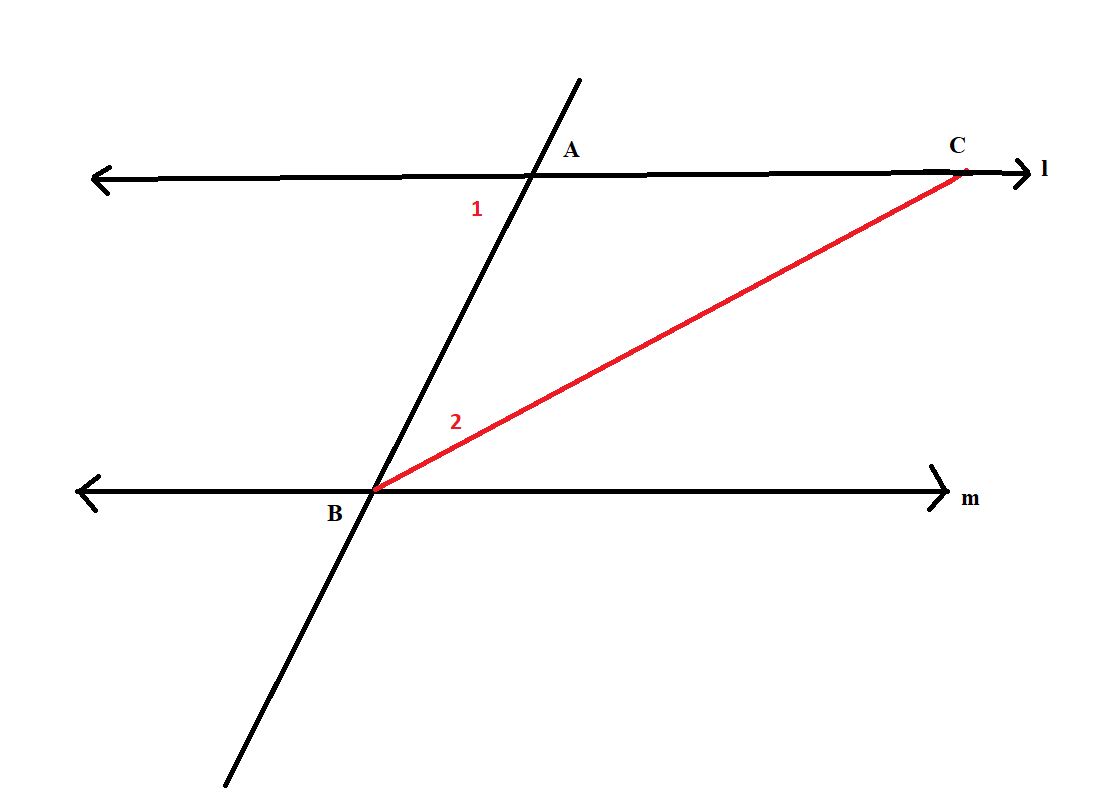
can someone please explain to me why these are parallel, coplanar lines? https://i.imgur.com/kBH8GFe.png

 plucky jacinth
this hurts me
i have 2 hours to take and turn in a test i have no idea on how do this
dark sparrow
were you asked to round to ten decimal places
plucky jacinth
yes
dark sparrow
to ten decimal places?
 stone quiver
plucky jacinth
stone quiver
stone quiver
plucky jacinth
stone quiver
I am getting 64/40 can someone check?
dark sparrow
@plucky jacinth ANGLES should be rounded to the NEAREST DEGREE, and even otherwise there's a BIG DIFFERENCE between "TEN DECIMAL PLACES" and "TO THE NEAREST TENTH"
plucky jacinth
so 49.5
plucky jacinth
49
dark sparrow
to the NEAREST DEGREE.
there we go
rounding π to the nearest tenth gives 3.1
while rounding π to ten decimal places gives 3.1415926536
just so you know
stone quiver
plucky jacinth
35
 paper mauve
$$\tan(\theta)=\frac{opposite}{adjacent}
somber coyoteBOT
Jaboi:
Compile Error! Click the  reaction for details. (You may edit your message)
plucky jacinth
soo arctan(27/38)
 paper mauve
so the thing here i want you to do is to draw what is given
@plucky jacinth
if you can, take a picture of your drawing with the given dimensions in the right places
plucky jacinth
sin68 x/15
paper mauve
$$sin(68)=\frac{x}{15}
somber coyoteBOT
Jaboi:
Compile Error! Click the reaction for details. (You may edit your message)
compact spire
plucky jacinth
how would i put that into a a calculator
dark sparrow
@paper mauve \sin
@plucky jacinth you wouldn't, unless you're allergic to algebra you should be able to solve this rather simple equation for x
$x = 15 \sin(68)$
somber coyoteBOT
Ann:
compact spire
so I googled double angle identities and I have 3 options I guess for cos2(x) so I can use 2cos^2(x)-1
is that correct?
paper mauve
@dark sparrow ty
compact spire
$2cos^2(x) - 1$
my answer from my problem was -7/25 can anyone confirm that for me?
somber coyoteBOT
Pony Boy:
compact spire
$2(\frac{3}{5})^2 - 1$
somber coyoteBOT
Pony Boy:
compact spire
$2(\frac{9}{25})-1$
somber coyoteBOT
Pony Boy:
compact spire
$\frac{18}{25}-\frac{25}{25}$
somber coyoteBOT
Pony Boy:
compact spire
$= -\frac{7}{25}$
somber coyoteBOT
Pony Boy:
compact spire
Can someone help me with reducing cos^4(x) to the first power?
stone quiver
Can you reduce cos²x into first power ?
stone quiver
wait, you want linear terms with the same angle i.e x and not like 2x or sth?
compact spire
My professor never taught us anything like this so I'm trying to learn on my own since he can't
stone quiver
Isn't $((1+cos2 x)/2)^2)$ a valid answer then?
somber coyoteBOT
Vatsal:
compact spire
How would I get rid of the fraction in that situation
because it says to factor out all fractions
so $cos^2(x) = \frac{1}{2}[1+cos2(x)]$
somber coyoteBOT
Pony Boy:
compact spire
that's correct?
stone quiver
yes
compact spire
okay so if it were the fourth power it would just be
$cos^4(x) = (\frac{1}{2}[1+cos2(x)])^2$
somber coyoteBOT
Pony Boy:
stone quiver
Yea exactly
somber coyoteBOT
Pony Boy:
compact spire
which I need to get rid of as it says in the problem
how would I go about doing that
or am I just overthinking it
 gentle dome
I have a strange question.
When I was looking at how Archimedes approximated Pi, I was wondering about a few assumptions.
When he was inscribing and circumscribing a circle with polygons, how can he assume that the circumference is between the two perimeters?
I can also draw a picture like this.
In my 2nd diagram, you can easily see that the white perimeter is way bigger than the outer square.
If he were comparing the area of the circle with the area of the two polygons, it would be obvious to understand, but I’m troubled that he used perimeters instead.
Can anyone help me in any information or step I’m missing?
 languid hemlock
 silent plank
bisecting and intersecting chords theorem
 rain galleon
We are given 2 radius's and the distance between centers, no other information, how do I find the area of the intersection?
 supple wedge
can u send the full qn
upper karma
Hi, can someone help me out with this triangle? I'm given the angle in A and told that the bisectors of B and C intersect at I (incenter). I have to find the angle BIC.
,rotate
somber coyoteBOT
upper karma
nvm
 crisp phoenix
hey, so i have a quiz on circles coming up, would anyone be able to help me find the answers while im doing it? would highly appreciate it since theres some very smart ppl in here
 idle bloom
no
we will help you understand the concepts before the quiz
but while you're doing the quiz you're on your own
 coral sapphire
Is there any comments on how you should do it?
golden panther
No
coral sapphire
Then, just plug it into the calculator if you don't need an exact form
golden panther
Wth
 ionic bluff
hello friends
i have a kind of dumb question
how exactly is multiplication and division defined geometrically
i've been thinking about the tangent function
and how it is sin/cos
i get that sin is vertical
and cos is the horizontal part
but what does the tangent of that tirangle look like
dark sparrow
how exactly is multiplication and division defined geometrically
wdym
 somber coyoteBOT
Space Pirate Wesley:
umbral snow
but what does the tangent of that tirangle look like
@ionic bluff
The tangent is the slope of the terminal arm
z2 - z1 is the line AB
 livid epoch
ye
umbral snow
z3 - z2 is the line BC
When you divide one complex number by another, you subtract their angles
That is,
Arg(a/b) = Arg(a) - Arg(b)
umbral snow
I'm not crazy certain what the arg of either is
 reef wren
Hi. I have some struggles with proofs in coordinate geometry. From the textbooks I saw, it seems to be common practice to only prove statements in the first quadrant. So, for example, say I wanna find general equation for a line that has intercepts with axes of x and y at a and b at the respective axes. Then its equation will be:
$\frac{x}{a} + \frac{y}{b} = 1$
somber coyoteBOT
TimkaSolnze:
reef wren
And almost always, when authors prove it, they 1. Pick up a line that has positive a and b intercepts, 2. Pick up a point on the line that is in first quadrant.
I want to know, why do they do so? Is there's a reason why we don't have to prove statements in other quadrants? Does proof in the first quadrant immediately applies to any other quadrant? Is there a shortcut(s) for proving for all the quadrants and their combinations(i.e., say a line might occupy 1, 2 and 4 quadrants, or 1, 2 and 3.)?
dark sparrow
there's like 6 problems here all with multiple subproblems
 steady forum
So its cos(90-35)=sine 55
dark sparrow
which one are you talking about
dark sparrow
yes
steady forum
My workings r all not relevant to question
silent plank
can you do anything/ apply any identities to:
cos(310°)?
steady forum
Not to my knowledge
silent plank
express in terms of relative angle?
silent plank
not -
 white cradle
thats just cos50
silent plank
^
steady forum
Z
white cradle
cos is positive in fourth quadrant
steady forum
Rite
silent plank
which gets you: $\cos^2(50\deg)$
somber coyoteBOT
ramonov:
silent plank
and you should be able to get the required answer now
steady forum
Idgi
silent plank
idgi?
silent plank
how ironic
white cradle
whats the question actually
silent plank
3ii
steady forum
3ii
silent plank
here you can apply something very famous
white cradle
i cant read it ;-;
silent plank
those most common trig identity
silent plank
which is essentially pythagoras
silent plank
$\sin^2(x) + \cos^2(x) = 1$
somber coyoteBOT
ramonov:
white cradle
because you know sin(50)=b
silent plank
you had sin(40°) = cos(50°) right?
steady forum
Yes
silent plank
and we established just then that cos(310°) is also equal to cos(50°) right?
steady forum
Yes
white cradle
so there is your cos^2(50)
white cradle
oof
silent plank
which gets you
cos(50°) * cos(50°) = cos^2(50°)
white cradle
cos(310) = cos(-50) = cos(50)
silent plank
cos is 360° periodic and even
steady forum
Oh ya cuz in
Then 4th quad
Everything becomes pos
Cos(50) =/= b or a
Sine 40 =/= b or a
steady forum
Sine 40 isnt b or a in the question
white cradle
so the whole expression becomes cos^2(50)
silent plank
which gets you
cos(50°) * cos(50°) = cos^2(50°)
white cradle
^
steady forum
They want me to express the equation in b or a
white cradle
that is what we're trying to do..
silent plank
$\sin^2(x) + \cos^2(x) = 1$
somber coyoteBOT
ramonov:
silent plank
$\sin^2(50\deg) + \cos^2(50\deg) = 1$
silent plank
do you see a or b anywhere there?
white cradle
aw cmon
silent plank
hah
steady forum
Sine(50)=b
white cradle
custom tex 😠
steady forum
Sine^2(50)= b
white cradle
no
silent plank
no
steady forum
B^2
silent plank
still questionable
white cradle
^
silent plank
math is case senstive
white cradle
lol
steady forum
b^2
steady forum
Haiz
silent plank
and what's your final answer
silent plank
lowercase cos but seems ok
steady forum
Thanks
 lament pumice
Not at all.
 vague lance
do you think you could explain it
lament pumice
Sure, the formula you wrote for a cosine of an angle works only for angles between cathetus and hypothenuse
golden panther
YO! do i need to calculator to find the max of y=2cos^2(x/2) in the closed interval from -π/2 to 3π/2?
 burnt bolt
No. Think about the shape of the cos(x/2) graph and where it would be a maximum then work out what the maximum y value for your specific function would be in that interval
 rapid pollen
I don’t understand the law of sine
somber coyoteBOT
Beef101:
coral sapphire
What do you not get?
coral sapphire
A better way to phrase it in English is that the law of sines states "the ratio of any side and the sine of the opposite angle are the same"
Since you already have the triangles labelled, you can just plug values into the equation
Lets look at the last triangle you posted
rapid pollen
Ok
coral sapphire
Wait, you did it correctly
rapid pollen
Wait for angles is it b/B sin
And for degrees is it B/bsin
Or is it the same for both
rapid pollen
Opposite over hypotenuse
coral sapphire
Wait for angles is it b/B sin
@rapid pollen
rapid pollen
Yes
coral sapphire
I meant what is this referring to? Sin has no argument
rapid pollen
I mean for the equation a/sin A= b/Bsin
coral sapphire
b/sinB?
 rapid pollen
Oh it is
coral sapphire
Yeah, this is correct
rapid pollen
I’m just tired I should go to sleep lol. I’m studying for pre calculus after trigonometry what’s next?
coral sapphire
Law of cosines if you didn't learn it yet
Then, you will probably learn about graphing trig functions
rapid pollen
Is that the same as law of sines
coral sapphire
Uhhh, yeah
rapid pollen
Sounds great 👍
coral sapphire
Is there more info?
crisp phoenix
yeah thats what i think it is
coral sapphire
Wdym think
crisp phoenix
also poco this one
coral sapphire
That is the answer
coral sapphire
Try it yourself first
coral sapphire
So the stuff entered is what you think is correct
coral sapphire
What is arc WTU
crisp phoenix
230 degrees
coral sapphire
So do you know any theorems relating an inscribed angle to the arc it intercepts
crisp phoenix
ok wvu would be 115 correct?
yeah the intercepted arc is half the length of the arc length right?
coral sapphire
Should be
coral sapphire
Please stop pinging me for every question, expecting me to be there
coral sapphire
He already got it
viscid ginkgo
Would this be a case of alternate interior angles?
And the line is not tranversal right, it would have to be a straight angle
So the sum should be 80 + 30?
silent plank
,rotate
somber coyoteBOT
viscid ginkgo
sorry about that, cool bot though
silent plank
And the line is not tranversal right, it would have to be a straight angle
what's that in reference to
silent plank
that'd be 2 separate lines
silent plank
yes
viscid ginkgo
y is 80, x is 30
ty
there's a theorem here that says alternate interior angles formed by two lines cut by a tranversal are congruent if and only if the lines are parallel
so I wonder how does the problem I Showed you relate to this
 plain pollen
Does anyone have a decent proof for this? (I couldn't find out how to place arrows above letters but a and b are vectors in the second half of the equation)
lament pumice
Are you asking why half of the length of cross product equals half of the area between two vectors?
plain pollen
Uh, well. My teacher just showed us that the area formula for a triangle can be rewritten as half of the vector product of a and b
And I'm trying to find a mathematical proof for that
lament pumice
Basically, cross product is defined to have a length of a parallelogram between those two vectors and if you connect any two opposite points of a parallelogram you'd divide it in half(because two those triangles are equal because their sides are equal).
white cradle
area* not length
lament pumice
Or that formula could be proven without cross product. Just take a regular formula with triangle height and express that height using sine.
white cradle
magnitude of cross product = area of parallelogram
plain pollen
oh and 1/2*parallelogram is a triangle
lament pumice
Sure, I never said length of a parallelogram, I've said length of a cross product.
white cradle
Basically, cross product is defined to have a length of a parallelogram between those two vectors
plain pollen
lol
lament pumice
Lol, how did I write that, hah
lament pumice
Nah, what I meant is that a vector of a cross product has length equal to the area of that parallelogram.
plain pollen
oh and the cross product of two vectors yields a perpendicular vector?
is that a given?
lament pumice
Yep, that's part of a definition
plain pollen
wait but how is that relevant here? Is it? lol I'm confusing myself
lament pumice
Nah, in that case we don't care at all where our vectors point.
 uncut cradle
can someone give me SOHCAHTOA problems?
dark sparrow
gimme a moment.
uncut cradle
tnks bro
dark sparrow
i'm not your "bro". and would prefer not to be addressed as such.
anyway, here
make sure to read the instructions carefully.
if you want to check your answers then pm them to me indicating which problem you're giving me the answer to. but do take note that i can and will reject answers which are not properly formatted. you may omit the degree sign in problems that ask you to find the angle.
uncut cradle
ok ok thank youu
 storm cave
Can anyone help me with my math soon
storm cave
I took a look at it before, had a lot of trouble with it, took out the dog and I’ll be back soon
dark sparrow
wdym by "things like"
steady forum
the two i stated
dark sparrow
i mean, tan(-θ) = -tan(θ) for all θ where both sides make sense
but if you didn't know anything about tan, then you could not say automatically that negating the input and then passing it through the function would just so happen to produce the same result as passing your input through the function and then negating the output
steady forum
So its similar but diff
dark sparrow
...
tan(-θ) and -tan(θ) are EQUAL.
functions for which this thing works are called "odd functions"
steady forum
A1bi) if they question asks for -tan(theta) steps wld be same?
dark sparrow
"the" steps?
steady forum
Working
dark sparrow
if they asked for -tan(θ) then maybe you could cut the step where tan(-θ) is replaced by -tan(θ) out of the solution
so maybe no the exact set of steps could differ
steady forum
What the heck
dark sparrow
you ask a stupid question you get a stupid answer
steady forum
:(
dark sparrow
"what's the difference between these two things that are actually the same"
"would The Steps™️ differ for these two superficially different problems even though each problem admits multiple different sequences of steps to solve it so the question as stated just doesn't make any sense and there is no constructive answer to it"
 dark sparrow
consider that you can calculate the lengths of DB and EB
supple wedge
EB is the opposite side of triangle BDE
and 8 is the hyp
so u should use $sin25=\frac{8}{EB}$ and solve for EB
somber coyoteBOT
Hmm:
supple wedge
@storm cave
storm cave
Ohhh I see! Thank you!
supple wedge
:))
dark sparrow
yes EB
storm cave
For EB?
dark sparrow
it's $\sin(25) = \frac{EB}{8}$
somber coyoteBOT
Ann:
supple wedge
fuck(
dark sparrow
8 is the hypotenuse.
supple wedge
REEEEEEEEEEEEEEEEEEEE
hahhahhahhahahhahaha i am rart
sure
thanks st. big brain ann
storm cave
The answer is -0,016... I doubt thats correct.... Is it my calculator?
somber coyoteBOT
Hmm:
supple wedge
hehe
supple wedge
,w calculate sin 25
somber coyoteBOT
 Requested by Hmm#2554
supple wedge
Requested by Hmm#2554
supple wedge
,w calculate 8(sin25)
somber coyoteBOT
Requested by Hmm#2554
supple wedge
there u go @storm cave
storm cave
It's my calculator.... Sin(25) gives me -0.13
Any idea how to fix that?
TI-84 Plus
Also thank you
storm cave
Radian
supple wedge
its supposed to be in degree
storm cave
Ohh yes I see, thank you!
storm cave
Wait do I need DB to get A?
supple wedge
yes
wait i thought u were finding a length mb
ignore the subtract part
after u find AB use cosA to find A
storm cave
isnt it tan?
storm cave
You're good, thanks for the help man :)
supple wedge
sorry for fucking up my ratios so badly omg
storm cave
It's fine man, ty!
Last one
If C1 has r = 2 and C2 has r = 3, how do you go about calculating PS?
 grizzled zinc
i have literally 0 clue what this is asking me to do
golden panther
lel
grizzled zinc
Yo nvm had to inverse
 quiet mason
@storm cave what have you tried
storm cave
nothing much.... I dont understand it at all
quiet mason
do you know what similar triangles are or trigonometry
rich wolf
,w calculate sin(25 rad)
somber coyoteBOT
 Requested by AMD#4434
 spice ridge
then what is it?
i graphed both on desmos and its a mirror
thats not very helpful by just saying im wrong
spice ridge
must've put in a different equation my bad
rich wolf
Lmao
upper karma
f(x) =1,5x-18
g(x)=0.5x+6
how can i calulate the angle?
 wind heart
Does anyone know how to do this? I got it wrong and I have no idea how to to get -5,7
 lyric lichen
I think I can help, imagine a coordinate grid, and the point (3, -1) on it, if we reflect it across the line y = 3 (a horizontal line that crosses (0, 3)) then we just take the distance the current point is from the line and move it that length away in the other direction
That's not a great explanation, but in this case, since the y value of (3, -1) is 4 away from +3, the new y value is 4 away on the opposite side of the line
(3 + 4 = 7, so the new point is at (x, 7)) then do the same thing across the vertical line x = -1
@wind heart feel free to ping me if you need any further assistance :)
wind heart
Oh thanks sm!
upper karma
@loud pike ?
 loud pike
upper karma
loud pike
upper karma
btw here's a geo problem it's kinda competition math
Solution:
||So what I did was first make the square into a 3x3 grid. The total area is 9. Then, I drew the diagonal from the top left to the bottom right. That diagonal will divide the square into 1/2, so you know that the non-hashed area divided by that diagonal is 9/2. Then you want to find the area of that trapezoid, so you set up two equations:
y = -x + 2
y = -3x + 3
Solve for the system of equations:
-x + 2 = -3x + 3
2x = 1
x = 1/2
y = 3/2
Now, find the distance from that to (2,0), which is root(2)/2.
The other side is similar, so you subtract the 2(root(2)/2) from 2(root(2)).
You then get root(2). That is the first base of the trapezoid.
You can get the second base, which is just the diagonal, which is 3(root(3)).
If you have the grid drawn out, you can recognize that the height of the trapezoid is root(2)/2.
The average of root(2) and 3(root(2)) is 2(root(2)).
Now, multiply root(2)/2 and 2(root(2) to find the area of the trapezoid.
You get 2.
9/2 + 2 = 13/2
(13/2)/9 = 13/18
But don't forget that we have only calculated for the non-hashed out area!
The final solution is 5/18!||
lyric lichen
That's awesome, I'll give it a go, wish me luck
 lilac isle
Can anyone help me I’m stuck.
dark sparrow
is the tank meant to be cylindrical
lilac isle
I believe so
lilac isle
yup
dark sparrow
and it stands to reason that 15 ft and 20 ft are the dimensions of the interior of the tank
ie the part that actually holds water
lilac isle
15-ft in diameter and 20-ft tall.
dark sparrow
so really it's a cylinder with a diameter of 15'1" and a height of 20'1" with a hole inside shaped like a cylinder of diameter 15' and 20'
1 inch bc the half-inch of steel contributes to the diameter and height on both sides
anyway, with that in mind, you should be able to figure out the volume of steel used in the making of the tank
lilac isle
yup
dark sparrow
yeah ofc i'm leaving the specific calculations to you
in part bc i'm a bit too lazy to do them
lilac isle
👏🏿
dark sparrow
so i don't think i can check them if you send them to me
lilac isle
it fine, thank!
dark sparrow
alright yeah i guess i'm gonna have to ask for help again lmao
let α, β and γ be the angles of a triangle. prove that sin(α)sin(β)sin(γ) ≤ 3sqrt(3)/8 and find all triangles for which this inequality becomes an equality
i have a hunch that equality holds iff α=β=γ=π/3 and i've tried naïvely applying am-gm but this didn't really get me anywhere productive
i have... this?
where a, b and c are the sides of the triangle and S is the area
but honestly i have little to no clue how to progress
i've got another four of these angle inequality problems and honestly i'm just as stuck on them as on this one
hang on
i think i have an idea.
yeah nvm, i solved it.
turns out jensen's inequality did the trick lmfao
viscid ginkgo
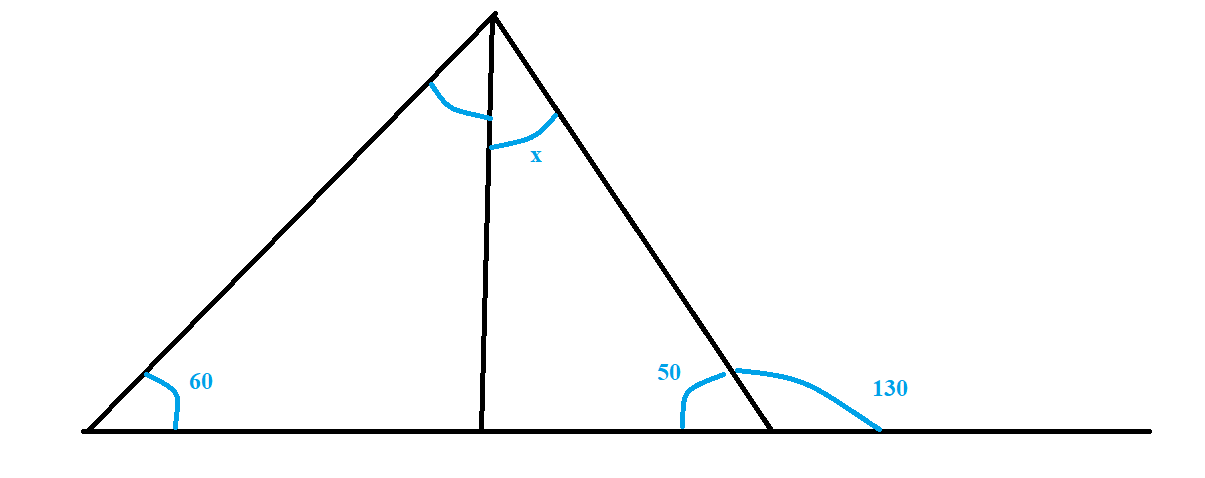
how can I prove that x is 35?
the remote interior angles on the left should be 60 + 70 = 130, but that won't work.
x = 35.
dark sparrow
what's known about that angle next to x
viscid ginkgo
yeah man
the middle line is not even straight, so it doesn't seem like a bisector.
dark sparrow
the middle line can be swung back and forth as much as you want within that triangle, and x will change but none of the other data will
so you MUST be omitting some info
can you show the problem exactly as stated
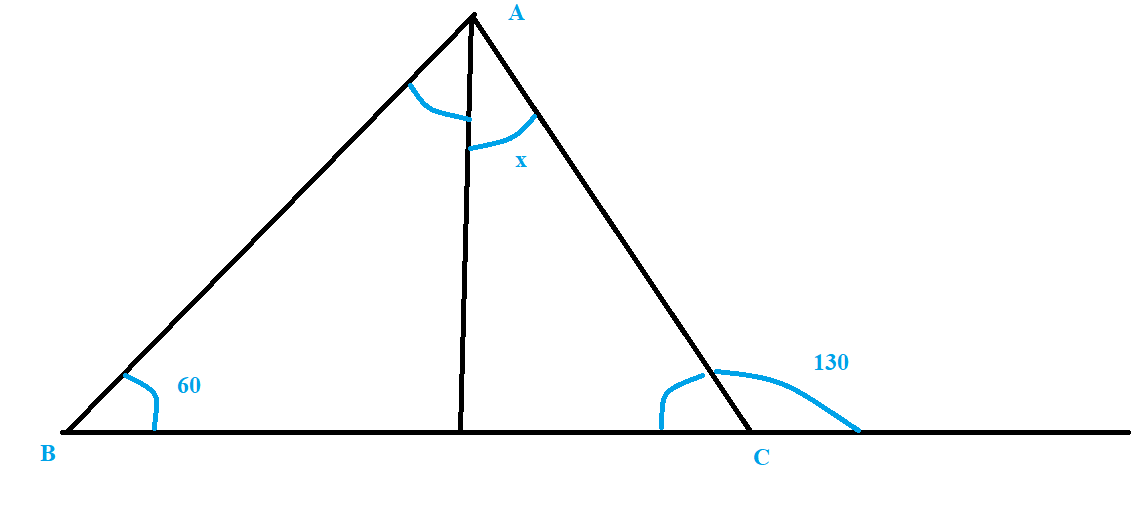
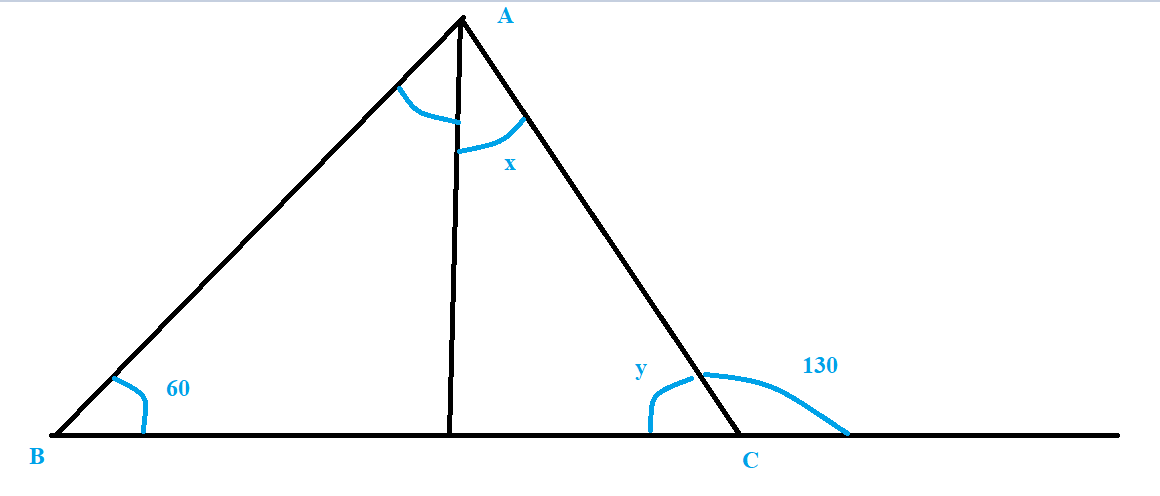 cinder portal
ok yea this question is broken
viscid ginkgo
lol
 flint osprey
who gave you a question in the format of ms paint?
viscid ginkgo
I copied it from my book.
ms paint is just useful as hell for this lol
would be nice for a more professional software
flint osprey
so you drew this, it's not the original problem
you really should take the advice that's given to you and take a picture of the problem
viscid ginkgo
lol I drew it exactly but ok I'll take a picture
cinder portal
its fine, we cant track where you are when you send a pic
viscid ginkgo
Number 11
lmao

they make a lot of spelling errors in this book, probably rushed
viscid ginkgo
ok now I'm stuck on #17
I don't see same side interior angles, corresponding angles, alternate interior or exterior angles
I tried using the remote interior angles trick
that doesn't help either
silent plank
^ did you get x?
viscid ginkgo
no
I saw the answer in the book but no
I don't think y is 30 though, it could easily be 20
by same logic
silent plank
well x is alternate interior to the 30°
are you able to spot it after i tell you?
viscid ginkgo
ah yeah I see that
silent plank
and then to find y, consider the external angle theorem
and/or angle sum of triangle + angle sum on straight line
viscid ginkgo
thanks
 ruby inlet
Need some help: is sin(wt-phi) = -sin(wt+phi)?
 gritty siren
it doesn't quite work with phi=0 for example
 daring solstice
 dim sable


 timber coral
upper karma
lament pumice
timber coral
upper karma
lament pumice
Oh yes, the geometry question
upper karma
@timber coral how would i go about finding the locus
it's just a quartercircle
right
 pure pivot
 solid sequoia
I'm trying to find the equation of the hyperbola: Foci (0,-8), (0,8); difference of focal radii is 10
I've been looking online for hours on how to solve this problem and all I can muster up is that apparently C = 8, which means that A = 4. But 64 = 16 + B^2 makes B = positive negative 6.92820323028 please halp
<@&286206848099549185>