#geometry-and-trigonometry
1 messages · Page 255 of 1
 iron rain
iron rain
iron rain
b = (6 6 0) and BT = (-3 -3 8)
(6 6 0) + 1/4 (-3 -3 8) = (5.25 5.25 2)
So P = (5.25; 5.25; 2) ?
 hexed kraken
sup guys
i have not done trig since my freshmen year of highschool, so this is easy sin cosine and tangnt stuff, can someone help me refresh my memory?
 weary drift

Khan Academy
Learn trigonometry for free—right triangles, the unit circle, graphs, identities, and more. Full curriculum of exercises and videos.
hexed kraken
i need help wish basics basics.
but thanks. In triangle ABC, let AB = 34.1, LaTeX: m\angle A:=:62^\circm ∠ A = 62 ∘, and AC = 31.8. Find the area of the triangle. <-- thats a problem i need help with then ill remmeber everything
if someone could add me/ help me id be greatly appreciated!
 hallow rose
Anyone?
 cerulean tundra
find BC
then the area is easy
m²
if cm² there
so cm.cm
/2
because a triangle is a square
/2
@hexed kraken @hallow rose
hallow rose
Random pings?
cerulean tundra
you said "anyone"
 hot pumice
Does an unchanging, infinite series like this converge and if so at what value?
 upper karma
No
 somber coyoteBOT
N/𝔄:
upper karma
If you have a sequence whose members are gonna be the summands of your infinite sum and this infinite sum converges, then this sequence must converge to 0
That means no constant sequence other than the sequence that is 0 everywhere is allowed there
hot pumice
Ahh right, it doesn't diverge either though right?
upper karma
If it does not converge it diverges
hot pumice
Got it, ty
 idle bloom
@hot pumice think about it
you're infinitely adding up 11/12
all converging series at some point you add up stuff that tends to zero
Now just cause your terms tend to zero it doesn't mean you converge
but if your terms don't tend you zero you definitely diverge
 rare pollen
Have an upcoming test and me and my friend are working through revision books etc. we had this one question which we thought we had the answer and yet the answer in the booklet had something completely different hoping you guys could help?
A box in the shape of a square prism has a base 12 cm by 12 cm and is 40 cm tall. Find to the nearest whole number:
a) the length of the longest diagonal ( we got this right, and the booklet matched)
b) the angle the longest diagonal makes with the base (This we think we have right, didn't match the book)
 jade valley
what are your answers first?
 midnight trout
I'd probably use atan2 on ba, then bd, then subtract one from the other.
 turbid garden
@old ferry I highly suggest drawing it then placing in all the numbers you know, then working from there
you also know each of the three angles of ABC is 60 degrees (It's an equilateral triangle)
I find that finding all of the angles that I can at the time, even if they don't help me in the end, can be helpful.
Here's something to get you started:
BCD=6
CBD=12
BDC=180-BCD-CBD -> 162
Knowing CBD, we can also know ABD - it's just 60-CBD -> 48
 old ferry
i did all those, but didnt progress after that
 eager pendant
@turbid garden you won't be able to solve something like this just using simple angle chasing
turbid garden
Oh 
I mean you'd use that to start out
eager pendant
@old ferry try trig
old ferry
trigonometric form of ceva's theorem didnt get me anywhere
midnight trout
What happened when you tried atan2?
eager pendant
with ceva you'd have to extend those lines and that seems a bit unwieldy
midnight trout
I'm curious why it would've failed. It might help me to know.
turbid garden
this is wack
 sharp patio
Is there a channel for tri dimensional geometry
 dark sparrow
dunno but it'd probably go here
old ferry
i've just solved it
turbid garden
... what year of hs is this
old ferry
3rd
turbid garden
Wait multiple years of geometry?
old ferry
not the US
eager pendant
yay nice construction
most of these types of problems involve some type of construction then some cyclic quad / similarity: what not
or you can draw the diagram accurately, get the angle using a protractor and verify that it’s right (ceva would work)
upper karma
I want a circle between 0,0 and 1,1. what is the equation
 dire rampart

upper karma
no im serious
I need this for something I'm working on
what equation or system of equations or whatever
dark sparrow
what do you mean by "between (0,0) and (1,1)"
do you want the segment joining those points to be its diameter?
 split geyser
or do you want one to be the center? or just an arbitrary circle that passes through those points?
dark sparrow
@upper karma
upper karma
@split geyser @dark sparrow I mean that its centered between those points, and the edges go to the edges of the square between those points
dark sparrow
yes
 gleaming creek
Hey, could someone help me with some problems?
upper karma
@dark sparrow this is what it does. thank you.
 quick otter
hey guys, does a dice become less equal as if its not a cube?
 tribal wind
usually yea
quick otter
classifying the symmetry can someone explain what that means
is just the rotational and reflections
tribal wind
yea just those
quick otter
im trying to express in words have a cube has 24 symmetrie
but I don't know how without just copying someone online
i can describe it with an actual cube though
im trying to express in words have a cube has 24 symmetrie
@quick otter i mean 48
tribal wind
uhh I'd just say it's fully decided by the orientation of the top face
so like you have 1-6, 4 rotations around the top, and a mirrored version, giving 6*4*2=48
quick otter
so does a cube have 24 rotations, and 24 reflections?
 drifting barn
Hello.
is
sin5*cos25+sin25*cos5
sin(5+25)=sin(30)=1/2?
Just wanted to check, not sure if it was correct or not
drifting barn
Yes, in angles
and that is multiplication
Sorry, that made no real sense
I know about the formula
sin(a+b) =sina*cosb+sinb*cosa
dark sparrow
you are telling me you know the formula sin(a+b) = sin(a)cos(b) + sin(b)cos(a), and are asking if it remains correct if you insert a = 5 and b = 25
of course it does lmao
drifting barn
Okay, good, just wanted to be sure
The exercise itself is quite easy, just scared me because there are 10 of those xd
 lethal narwhal
How would I work out for 0 <x < 360 degrees:
3sinx = 4cosx
 silent plank
what have you tried?
lethal narwhal
trial and error
lethal narwhal
thanks
 tall flower
can anyone help me complete this online test?
silent plank
#❓how-to-get-help rule #6
 crisp sparrow
no help on tests
 cinder portal
what have you learned that'll help you solve this
cinder portal
go use that
cinder portal
you're going to have to set up equations properly
set up equations here and there
and then see if that get's you anywhere
 surreal ingot
👌
Is this so far looking right?
Oh shoot I forget 1/2
Oh wait
I set up a better equation
Not quite sure what to do next
Ohh
Turn sin2ø to 2sincos
silent plank
you used the incorrect substitution
surreal ingot
Oh
silent plank
but yes, apply the double angle identity after fixing those
dark sparrow
i'll bite
what's giving you trouble here
(but also don't multipost)
(i've deleted your post in #help-0)
dark sparrow
define "these problems"?
do you know how to solve basic trigonometric equations, i.e. ones of the form sin(x) = a, cos(x) = a or tan(x) = a?
 ruby pulsar
Yeah, but with the intervals, I do not.
dark sparrow
where a is a constant
ok wait
if your problem didn't say "on the interval [0, 2π)", would you be able to do it
ruby pulsar
Nope, lol. The interval thing is complicating me.
dark sparrow
no, that's not what i'm asking you
ruby pulsar
Would I have to crunch it down with identities?
dark sparrow
if you were just asked to solve $\sin\paren{\frac{\pi}{6} + x} + \sin\paren{\frac{\pi}{6} - x} = \frac{1}{2}$ without any mention of an interval to solve on, would you be able to do it?
ruby pulsar
Uhw hat
somber coyoteBOT
Ann:
dark sparrow
there we go
ruby pulsar
Like I mentioned above, I am not able to.
dark sparrow
and yet you said immediately afterwards that "the interval thing was complicating you", making it seem as if the interval was the issue
ruby pulsar
I require step-to-step assistance on that matter.
Yeah, it's making me more confused.
dark sparrow
and if there WASN'T an interval, you would still be unable to do the problem?
did i get that right?
dark sparrow
is that a way for you to say "fuck off, i wanted a quick answer and you refused to provide and i don't want your help anymore you idiot"
 white cradle
it just makes your own life harder, later on
oof
if they were too easy then you should've been able to solve it without wasting much time anyways
the server isn't for asking aid for graded tests or papers anyways
i probs wouldn't enjoy it per se, but I did do those stuff
and maybe unbeknownst to me it helped me gain confidence in those basic stuff
 formal hamlet
Find the exact value of tan Θ , given that Sin Θ = 1/2, and Θ is in quadrant 2.
$$-\frac{\sqrt{3}}{3}$$
somber coyoteBOT
DeadEye:
dark sparrow
yup
 deft sleet
idk if this is the correct place to put it so if this is the wrong place please show me where to ask.
We got a task to create this graph which went fine
but then we were asked to read the crossing points of h with the x axis which i think was okay
however, the next task was to calculate the crossing points of h with the x axis
i dont know how to do that
deft sleet
i can send you the entire thing but its in norwegian and i tried to translate as well as i could
 round isle
????
deft sleet
b) read the crossing points of h with the x axis
c) calculate the crossing points of h with the x axis
round isle
what is the difference between read and calculate here?
deft sleet
Thats what i dont understand
round isle
Is this something special in norwegian polynomials?
deft sleet
well read is just to look at it and see where it is
calculate is to calculate the point
round isle
that does make sense
 hard gale
i mean in a) they ask you to graph the function i guess
deft sleet
yes
round isle
maybe first it wants you to find crossong points by drawing
hard gale
well yeah just look at the graph
round isle
and in the next one they want you to calculate it
deft sleet
Okay well i already drew it
and made a value sheet
but i dont know what the meaning of calculating the crossing point is
round isle
equate it to 0 and solve
deft sleet
can you give me an example?
round isle
do you know how to solve a quadratic equation of the form ax^2 + bx + c = 0
round isle
do this here by equating h(x) = 0
at crossing point with x axis, the y values will be 0
deft sleet
uhh i dont think i understand
round isle
h(x) = 0
left hand side of equation becomes 0 at crossing point
put a 0 on LHS and solve it
would be much easier and faster if you factorize it
quadratic formula looks overkill here
round isle
-x^2 -4x + 5 = 0
I hope you understand why I did that
the points at which any graph crosses the x axis are the points whose y value will be 0. Here y value for any point is h(x). Any point A on this graph has coordinates (x,h(x)). Any point B that is a crossing point on the x axis has coordinates (x,0)
Just imagine h(x) as y
round isle
are you asking me how to solve this?
deft sleet
i guess so?
round isle
hmm, I must ask you what grade are you in
deft sleet
upper secondary school first grade in norway
round isle
did your teacher show you how to solve equations of this type?
if you are uncomfortable with factorizing, you can use the quadratic formula. However, I would highly advise you learn how to factorize since that is a useful trick in maths in general
deft sleet
Yeah he did a week ago but we were supposed to go more in depth this week however due to the corona virus, there was no more school except for this homeschool type
round isle
well first thing you should do is multiply both sides with -1 to make the coefficient of the 2nd degree variable positive
round isle
yes
now
you need to break down 4x into a sum of two numbers
but the two numbers must be factors of 5
do you know what a factor is?
deft sleet
We have different terms in norwegian but would it be 4= 2^2?
deft sleet
i dont know
round isle
what two numbers can you multiply to get 5
deft sleet
1 and 5?
round isle
yes, there you go, those are called factors of 5
deft sleet
okay
round isle
now
4x = -x + 5x
replace 4x with that
hopefully you are able to proceed from that point
round isle
4x is not a factor of 5
we are breaking down 4x into a sum of numbers
4x can be written as a sum of any two numbers
but 4x = 1000x - 996x doesn't really make sense here now does it
However 4x = -x + 5x does make sense here because you have two numbers who share something common with the left and right hand side numbers
I think you should wait for your teacher to explain this to you in more detail
No point in rushing like this without proper explanation
deft sleet
okay well i think you helped me atleast a little bit
Would the quardratic formula work here aswell?
even if it is overkill
round isle
of course but how do you know the quadratic formula but not factorizing?
deft sleet
no i know factorizing
but we have different terms in norwegian
so i was confused
thats all
round isle
I see
try to do by factorizing. Always look for the easy way out
that is literally how maths developed
people got tired of using lengthy formulas
so they looked for shortcuts and better ways
deft sleet
Cool. I liked your way by factorizing but i couldnt really wrap my head around it i think
 supple wedge
@deft sleet quadratic formula works everywhere
round isle
I remember my teacher told us a step by step procedure for factorizing when I was your age
obviously I don't remeber it now
supple wedge
if u can factorize factorize it
round isle
It's now muscle memory
supple wedge
imo quadratic formula is last resort
deft sleet
Well thanks for the help and showing me other ways :D. I'll try to do my task now
round isle
good luck
deft sleet
Can you explain with the equation that was given? @ionic bluff
 ionic bluff
what eq?
round isle
@deft sleet multiply the coefficient of x^2 with the last number in your equation
ionic bluff
this one?
x^2+4x-5=0
factors of 1*5
which is plus or minus 1, 5
add to equal 4
so plus 5, minus 1
(x+5)(x-1)
round isle
I think some exercises in factorization would clarify this to you
deft sleet
The graph gave -5 and +1
ionic bluff
yes
round isle
yes that is correct
round isle
no harm in practice
deft sleet
true
round isle
build up that muscle memory in your hand and your confidence
deft sleet
okay but shouldnt it be (x-5)(x+1) to fit the graph?
round isle
I suggest you ask your teacher
ionic bluff
(x+a) is a negative root
(x-a) is a positive root
round isle
has your teacher explained all of this before?
ionic bluff
8
deft sleet
yeah we had all this (a+b)^2 stuff but i dont understand what you guys are getting at
deft sleet
x^2+x-5x-5
deft sleet
x^2-4x-5?
ionic bluff
no that's fine actually
round isle
(x-5)(x+1) = 0
what are the values of x in the above?
round isle
how will you find the value of x then?
deft sleet
uhm
round isle
how did your teacher solve it in class?
makes no sense for you to do these exercises if your teacher didn't show you how to do it
deft sleet
i remember that he did
deft sleet
but i guess i forgotr
ionic bluff
if i have two numbers, a and b
round isle
I think you should review your lecture notes
ionic bluff
and i say that a * b = 0
deft sleet
yes
ionic bluff
what does that imply
deft sleet
they can be whatever as long as one is 0?
ionic bluff
yeah. it says that either a or b MUST be 0
deft sleet
thats what i said
deft sleet
-5
round isle
think of the expressions inside brackets as numbers
and manipulate them as you would with numbers
round isle
do you have a maths textbook?
deft sleet
we dont
round isle
that cannot be possible
deft sleet
?
round isle
when I was your age, we had a thick textbook and we would go home and do 100s of sums
round isle
no handouts or anything
opened a big ass textbook and did sums back home. Call me old fashioned but that stuff built a lot of muscle memory that I don't think I would ever forget
round isle
your professor should give you dozens of trivial sums and exercises to help you build your muscle memory with basic tasks like factorization
round isle
can you show me an example handout from your professor?
deft sleet
sure
round isle
you should be able to do this stuff if you did lots of exercises
deft sleet
deft sleet
tasks?
round isle
why so few?
deft sleet
ask my teacher
round isle
norway is supposed to have the best education system, either I am missing something or norwegians are natural born mathematicians who don't need to do as many sums as we do
deft sleet
I agree
round isle
also try to understand the theory too
ionic bluff
hey rainlinkz wanna see something cool
deft sleet
sure
ionic bluff
deft sleet
yup
round isle
ahhhhhh
deft sleet
we had that
ionic bluff
that's what (a+b)^2 is
round isle
this and the Pythagoras proof made me fall in love with maths as a child
ionic bluff
i had to figure that out on my own because my teachers would just say yeah it's a^2+2ab+b^2
ionic bluff
idk if it's just my school but it feels like there's too much random info without any reason why
deft sleet
he wants us to understand the concepts and proves everything he shows us
ionic bluff
like memorize this and that
round isle
theory is as important as doing sums
deft sleet
he goes deep into it
round isle
do you know the proof of the quadratic formula?
ionic bluff
wait is there a geometric proof
deft sleet
yes
round isle
I used to complain about completing the squares
deft sleet
he showed us that aswell
deft sleet
found it
he is a great teacher tbh but sometimes hes not
thanks for the help @round isle and @ionic bluff
 drowsy pond
can someone summarize special right triangles in an understandable way? we are doing them in class this week and i have no clue whats going on except something about 30, 60, 90 and 45, 45, 90
 drowsy walrus
30-60-90 triangles and 45-45-90 triangles
dark sparrow
those refer to the angle measures @drowsy pond
drowsy pond
okay
drowsy walrus
it’s basically Pythagorean theorem
drowsy pond
okay
 proper solstice
How do I explain the relationships here with words/formulas?
<@&286206848099549185>
Did I do the right ping? :3
 stoic steeple
 rich wolf
,rotate
stoic steeple
The second one(if you know the first one... Let me know)
somber coyoteBOT
 golden panther
I need Halp
supple wedge

round isle
Usually you should follow that with your question
golden panther
its my first day here
round isle
what is your question
golden panther
sin2x/2sinx=cos^2x/2-sin^2x/2 after a couple steps i get to this cosx=cos^2x/2-sin^2x/2 what do i do now
 olive plover
why is secant negative in third quadrant if tangent is positive there and tangent is sin/cos
golden panther
I cant because im on a laptop
round isle
then you need to find a way to write it down properly
golden panther
wth
round isle
maybe use paint
please write down the equation in a proper way so it makes sense. At the moment, it is very hard to understand what your equation is exactly
@olive plover well secant is geometric inverse of cos
round isle
ok
golden panther
im at this part : cosx=cos^2x/2-sin^2x/2
round isle
are you trying to make x the subject of the above equation?
what is your end goal with this equation?
round isle
I see
right
RHS is a trignometric identity
(cosx)^2 - (sinx)^2 = cos(2x)
please solve now and the equation is proved
golden panther
how the heck did you get that
golden panther
are you using half angle identity formula
round isle
you can verify this by expanding cos2x
now please use the trignometric identity on RHS to verify the equation
golden panther
There is no cos2x
round isle
(cosx)^2 - (sinx)^2
that is equal to cos2x
here it is x/2 and not x
so make the appropriate substitution
dark sparrow
im at this part : cosx=cos^2x/2-sin^2x/2
parentheses
dark sparrow
how do you know whether cosx/2 refers to cos(x/2) or cos(x)/2 and how do you know you won't forget what you actually mean
the answer is you don't so you gotta put those parentheses there
and ideally you should just always put parentheses around the inputs of trig fictions
golden panther
wth. My Apologies
round isle
obviously it should be clear to you now
golden panther
No
round isle
what is not clear?
cos(x/2 + x/2) can be expanded using the cosine formula and you would get the original RHS
best you review trignometric identities again
dark sparrow
cos(2t) = cos^2(t) - sin^2(t)
now replace t with x/2
dark sparrow
uh yeah that just gives you the thing you were stuck at
golden panther
thanks ..i guess
upper karma
so my mcq exams are giving me problems such as if 3 i + 2 j + a k and 4i -3j + k are perpendicular to each other, what is the value of a?
(it's a vector problem so i,j,k are vector co-ords)
if they are A and B respectively, then the formula is A × B = 0
 weak shoal
i,j,k are not vector coordinates, they're unit vectors.
upper karma
yeah, sorry, that
weak shoal
There's a simpler way to approach this with the scalar product.
weary drift
standard inner product on R^3
upper karma
how should i go about it?
weak shoal
In particular:
$\overrightarrow{A} \cdot \overrightarrow{B} = 0$
somber coyoteBOT
Abhijeet Vats:
upper karma
my dumbass forgot about dot product
weary drift
abhi, don't swear at god or He will smite you
upper karma
don't swear at god because the dude don't exist
weary drift
find $a$ that maximizes $\norm{A\cross B}$. this is painful
somber coyoteBOT
RokettoJanpu:
weak shoal
Yes.
$||A \cross B|| = ||A||\cdot ||B||$
somber coyoteBOT
Abhijeet Vats:
upper karma
is that the latex programming language?
how does so many people know all the syntax to use this bot
weary drift
experience
 fleet roost
hey guys can anyone help me pls?
silent plank
it should be
round isle
I mean technically you can keep decreasing the base and keep increasing the height
While maintaining the same volume
So height can potentially be infinite with the base area close to zero
silent plank
after a certain point the total SA would start increasing
round isle
How so?
If I keep increasing the height and decrease the surface area, the volume would remain the same
So ideally I could bring the surface area down to a very small value and the height to a very large value
silent plank
you're making a very bad assumption
what evidence do you have to backup
"increasing height decreases the SA (at large values of h)"
round isle
Take a very large height and divide the volume with that
You will get the surface area
And that surface area would be really small
silent plank
uh what?
silent plank
yes
round isle
We want to find the smallest surface area for this volume
Pi * radius * radius = cylinder volume / height
Keep increasing height
Increase height to infinity
The base area becomes 0
silent plank
gets close to 0 but ok
round isle
Exactly
silent plank
how does that decrease the total SA of the cylinder?
round isle
I think he is asking for the base area
silent plank
SA of a cylinder is not the same as the base area
round isle
The total surface area
Hahah
Right, you could take the derivative of the total surface area and find the value of h that gives you a minima for that
upper karma
is this true for all cases?
 agile axle
Could someone tell me how I should calculate this one?
http://prntscr.com/ri9n7p
The line AC is just as long as the cirkels radius. The Angel BAC = 40 degrees.
what angle is v?
silent plank
consider constructing AM and CM
agile axle
@silent plank Thank! I got the answer 😉

 wooden citrus
I suck at math, I was hoping I could get some help on a simple problem
I want to calculate a slope of a series of pipes. Let's say X1 is (34.05) and I know that I want to have a Y% slope to X2 which is 56 meters away, how would I calcuate thaT?
round isle
Can you formulate this problem in a more formal way.
Slope is between two points.
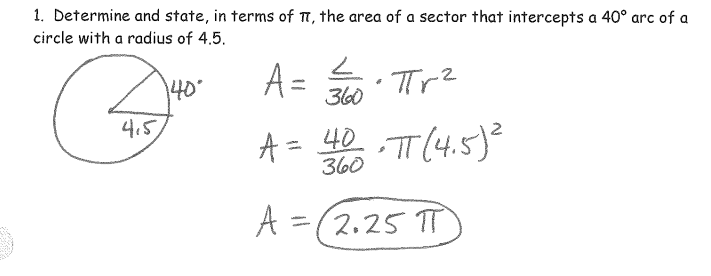
@outer ravine yes it is right
 outer ravine
can you explain how she did it because I screwed it up
I pretty much screwed up all of my notes 🙃
round isle
Well your teacher has written the Formula for area of a sector
Then she just substituted the right values into it
You do know what the Formula of a sector is right?
outer ravine
yeah I do
but this part

I don't get that part
like the way I solved it was you take the 4.5 and multiply 40 by 4.5 then divide by 360... which is wrong
round isle
Sorry I didn't understand your procedure. Best you show your calculation
outer ravine
silent plank
,rotate
somber coyoteBOT
silent plank
that looks fine. simplify your fraction
silent plank
multiplication commutes so yeh.
outer ravine
oh
also idk why the last 2 problems on my homework just got a lot easier, we just haven't done any algebra for a couple months or so. I kinda forgot a bit of it
weak shoal
Where are you stuck?
weak shoal
Alright, do you have any ideas for an approach?
 dire yarrow
That would be much appreciated
weak shoal
So, consider the identity:
$\tan^2(k) + 1 = \sec^2(k)$
somber coyoteBOT
Abhijeet Vats:
weak shoal
You're welcome. I do hope you're able to solve it now.
dire yarrow
That should help slot cheers @weak shoal
 hot sable
Hey could someone tell me
how can i find AB from ABC with (<ACB = 90) when i only have P=60cm and S=120cm?
<@&286206848099549185>
 quiet mason
hot sable
quiet mason
hot sable
Perimeter and Area
idle bloom
Set up some systems of equations
You have 3 unknown variables and 3 equations you can make
hot sable
aight
rich wolf
Draw a picture
 acoustic peak
a^2+b^2 != (a+b)^2
upper karma
a²+b²=(a+b)²-2ab
upper karma
np
acoustic peak
Ye looks right
upper karma
i need help 😫
anime cooch :|
lets start from the center's height
the center of the ferris wheel is 55ft above the ground
so whatever your sine function spits, you'll have to add 55to it
so d=55
now... the radius is 50ft
so the amplitude gonna be 50
so a=50
finally, since f(t) is a function of time, the b is gonna be it's period
which is the total time needed to complete the cycle multiplied with 2π
so b=2π/4min
 idle lynx

 onyx basin
well
do you have values for any of those letters
well there's many ways we can calculate y
it might just be confused, but i dont know what you're asking
you asked for the value of y
but you have no values for the others
so we can write expressions for y
e.g. sinA = y/v
sqrt(wz) or sqrt(w) * z
i feel like i've learned this before and my mind is just blanking
upper karma
for part b would it be (-3, 7pi/4) ???
like im confused how to find another pair that represents (3,pi/4)
weary drift
make it easy for yourself. keep the same radius and just find an angle coterminal with pi/4
upper karma
isn't 7pi/4 a coterminal angle with pi/4
olive plover
guys I dont understand how to find lengh of an arc of a cicle
 sly marlin
@olive plover do you know any formulas that may help?
olive plover
2pi r times x/360?
upper karma
pi describes the length of half a unit circle you should able to deduce more things from there
weary drift
@upper karma close. and i suggested you keep the same radius. same radius+coterminal angle describes the same point
olive plover
they give me central angle of 80 and diameter of 20
i put 80 in x
but then i dont know about 20
upper karma
i put 80 in x
@olive plover what does that mean
@weary drift so would it be (3, -7pi/4)
weary drift
@upper karma that's one good answer. ANY angle coterminal w/ pi/4 is ok
olive plover
4pi/9
upper karma
Right so can you find what the length is in the circle you described?
It scales linearly
olive plover
no
upper karma
@weary drift ok and then converting it into a rectangular equation what would that be ?
@weary drift is it just sqrt2 / 2 , -sqrt2 / 2 ???
4pi/9 is the arc length with the angle you want on the circle of radius 1. The length scales with the radius of the circle. Do you know how to scale this arc length up to your circle?
upper karma
@weary drift not a rectangular equation i mean to rectangular coordinates***
olive plover
@upper karma
upper karma
By what?
olive plover
4pi/9 times 20?
upper karma
No
That is double the size
You have 1*4pi/9 because the circle we calculate radians in is the unit circle
Which means we want to look at the radius
The unit circle has a diameter of 2
olive plover
oh its 40pi/9
olive plover
given diameter is 20
olive plover
i got it correct
upper karma
If you say so
weary drift
@upper karma always remember the conversion between polar and rectangular. if you have (r,t) in polar then (x,y) in rectangular is given by (x,y)=(rcos(t),rsin(t))
upper karma
ok
upper karma
right triangle
rich wolf
How
upper karma
well since its a right triangle the angle opposite of 450 is 90
and i subtracted 180- 90 - 38 an got 52 for the last angle
then i used law of sines
rich wolf
You dont need law of sines lmao, and you got the wrong answer anyway
upper karma
oh lmao
i completely forgot about that
did you get 277.047
for the side opposite of angle 38 degrees
@rich wolf
 umbral snow
,calc 450sin(38 deg)
somber coyoteBOT
Result:
277.04766389655
,calc 450cos(38 deg)
somber coyoteBOT
Result:
354.60483912302
@upper karma
Those
umbral snow
Wat u mean? That's the answer
upper karma
oh that's it ?
umbral snow
Well, they want it in a <x,y> format
upper karma
@umbral snow so < 354.604, 277.047> ???
umbral snow
Ya
 tepid finch
yeah people just call it volume
rich wolf
@ashen mica what
4D volume
What
Yeah i get that dude
But what the fuck
Why
OMG ITS GRANT SANDERSON
From 3brown1blue
supple wedge
heil
rich wolf
He needs to do a bsauce collab
supple wedge
st. 3blue1brown
umbral snow
It is called volume.
"Area" and "length" are the exceptions
tepid finch
you still see area and length called volume sometimes
0 dimensional space is a point
-1d isnt a thing
oops i literally repeated you
umbral snow
One way to answer it is with linear algebra. How many vector spaces are zero dimensional? That is, has a basis of zero vectors?
The question doesn't make any sense, there's no 0D vector spaces
tepid finch
is {()} a vector space?
umbral snow
Nvm I just looked it up
tepid finch
() is additive identity and multiplicative identity
umbral snow
The zero vector space is defined to have dimension 0
tepid finch
yea
 jolly geode
Hey Vsauce!
Michael Here!
Where are your fingers?
D-Don't touch your face!
Go wash your hands for 20 seconds.

golden panther
how does sinxcosx+sinx = sinx(cosx+1)
Please
ive been trying for two hours please
silent plank
distributive property / factorisation
the lack of parentheses is a little disturbing
golden panther
dude i did that
silent plank
$\sin(x)\cos(x) + \sin(x) = \sin(x) (\cos(x) + 1)$
somber coyoteBOT
ramonov:
silent plank
ab + a = a(b+1)
golden panther
is that correct
silent plank
is what correct?
silent plank
do you agree that:
ab + a = a(b+1)
golden panther
i guess I thought i woud be using a trig IDentity
silent plank
don't overthink it
no trig identites needed at all
recognise when they are/aren't needed
rich wolf
@golden panther it can be helpful
To introduce new variables
Like a or b
And set them equal to parts of the equation
 viscid ginkgo
if I want to find s when v = 21 mi/hr and t = 20 min
I do 20/60 * 21 mi/hr to get 7 mi
how does the /hr get canceled out?
(20/60hr) doesn't make sense
round isle
Convert t to hrs
viscid ginkgo
I can say 1/3 of an hour
round isle
Yes
viscid ginkgo
1/3hr?
round isle
Yes
viscid ginkgo
seems so wrong, because I'm kinda saying 3 hours
round isle
????
viscid ginkgo
it would look right if it was hr/3
1hr/3
20 mins is 1/3 of 1 hour
so it makes sense logically
round isle
Yes
1 min = 1 hr / 60
So 20 min = 20 hr / 60
Just multiply both sides by 20
All of this becomes second nature soon with practice
viscid ginkgo
well I'm calculating to find the distance traveled
if it's 20hr/60 then isn't that 7mi/hr²
 grim wharf
please help;
is this a Yes or No?
dire rampart
yes
 vale nimbus
i dont know if this belongs here since its a physics problem but i have cos(a) = (x)/(y*z) (x,y,z are actual numbers in the problem)
i have to find what angle a is
i think i have to use Arccos or something for it but we havent covered that in math class yet
 vital sedge
So what you can do is use arccos at both sides
a = arccos((x)/(y*z))
Is the angle 0deg<a<360deg or are you looking for multiple answers?
because if you're just looking for one answer then hitting cos^-1(x/(y*z)) should be enough
@vale nimbus
 was it really that simple
 vital sedge
@vale nimbus  np mate
 static kiln
5r + 5
upper karma
no i meant what else do you know about DM
static kiln
It’s 60
upper karma
so what can you do
static kiln
Is the value of r 30
 crisp phoenix
guys
upper karma
i don't know, is it?
upper karma
why do you think it is 30?
static kiln
Because dm is 60 and it is split in 2 and if u divide it it’s 30
upper karma
what does that have to do with r, though
static kiln
Wait is it 11
upper karma
i don't know, is it?
static kiln
Because 4 times 11 equals 44 and 11 plus 5 is 16 and 44 plus 16 is 60
upper karma
@static kiln are you guessing the answer?
static kiln
No
I looked at the choices
And I saw 11 and did the math
At first I didn’t even look at the choices so that’s why I said 30
Is 11 wrong?

Okay thanks for answering me
static kiln
I’m leaving this discord y’all can’t help
onyx basin
lmfao okay cya
upper karma
Lol
 halcyon coyote

upper karma
what
i went to eat
and i asked him if he was guessing the answer
so i suppose the answer is yes
onyx basin
i dont think he guessed
upper karma
he did
he said "i saw 11 and did the math"
so he thought that looked like the one that is the most right lol
onyx basin
ok let's think about it
you know the base
you know the area
A = base * height / 2
for now, we're solving for height
h = 2 * A/b
now we know the height, and we know the base
if we drew in the height, we'd find that the isosceles triangle splits into two equal right triangles
divide the base by two to find the base for one right triangle
use pythagorean theorem to solve for length of the hypotenuse
and that's your leg
viscid ginkgo
if we have omega = 4 radian / second, r = 2 in and t = 5 sec
doesn't the second become sec²
which is (1/60)²
we get 4 rad/second = s / 10 inches / second
so 4 / sec * (10 in. / sec)
40 in. / second²
 gritty sail

 viscid ginkgo
nvm I found my answer. 60 ^2 seconds/ 60^2
 brazen depot
How would I do question 6 or 7? I could not solve it at all 😂
viscid ginkgo
@brazen depot do you still need help with this?
brazen depot
No i have solved it after asking my classmate! Thank you though :)
viscid ginkgo
ok np
 quick mesa
This is just a review but I've honestly completely forgotten how to do segment proofs
What I'm having trouble with is at #5 because I cant tell whether I should use definition of midpoint or angle bisecter
An explanation is also much appreciated 😁
 novel flax
Transitive Property @quick mesa
because 4 is PQ = NM and 3 is PN=NM so when you combine them you get PN=NM=PQ or PN=PQ
 mellow flicker
hey
round isle
yes
golden panther
guys whats the best way to find the exact answer to y=tan^1(1) without using a calculator
rich wolf
@golden panther