#geometry-and-trigonometry
1 messages · Page 253 of 1
 dense sky
dense sky
dense sky
I got the answer
 gritty flare
 be sure in yourself!
dense sky
Thank you
gritty flare
okay anywaus
dense sky
Ok what now
gritty flare
For the next problem
I gotta go back to what i was explaining when you told me please 5
dense sky
We are in number 13
gritty flare
I know
this wilbe relavant for the next 6 problems
Okay so Length and Measure of arc differ
Length is how long it is and measure is how much degrees it is
The measure of the arc is determined by the central angle which is intercepting that arc
O is the center and AOC is the central angle
So measure of arc AC = measure of angle AOC = alpha
Since the full rotation in the full circle is 360 degrees
full rotation of the measure of a circles circumference is 360 degrees also
dense sky
Is the answer 23
gritty flare
now you should be able to solve problem 13
Wat.
lemme... solve it wait
qwq
Yes the answer is 23
5x+245=360
x=23
dense sky
The next one is 5
dense sky
Ok now onto number 15
gritty flare
and ill check
dense sky
Is BAC 180
gritty flare
that is impossible
gritty flare
Well central angle is equal to measure of the arc its intercepting
What is the central angle in our picture
Mark the angle by 3 letters
dense sky
Where is the central
gritty flare
The angle which is in center

if you look at the picture I sent its the angle AOC
the my drawing one
dense sky
This is for 15?
 dense sky
It’s 36
dense sky
18 is 44
gritty flare
Okay then
Now
ABC is the central angle intercepting the arc AC
So mABC =mAC=110
BA=BC. can you tell me why?
dense sky
They are similar sides :/
dense sky
They are tangent
 dense sky
Because they just are
 vale nimbus
u have a point in the center of a circle connected to a point on the circle itself
whats the line connecting them called?
gritty flare

gritty flare
@dense sky would you like to take a rest? you seem tired
 mossy shoal
a clock
dense sky
A bisector
gritty flare
@mossy shoal get out
vale nimbus
a clock 
gritty flare
SK its a radius
dense sky
Oh right
 dense sky
No not yet
gritty flare
maybe grab a coffee
 dense sky
Thank you for the help
 mossy shoal
big takeaway is in any circle if u have a line from the edge to the center of circle
its the radius : )
dense sky
Their are more problems
gritty flare
how muxh time do tou have left sk
dense sky
Plenty
vale nimbus
go take a break then bro
dense sky
No
mossy shoal
this mans is determined
dense sky

mossy shoal
Go put on 10 hours of brain power on youtube
gritty flare
OKAY THEN
mossy shoal
Lets get it
mossy shoal
hit up a homie for some coke™
gritty flare
brb
dense sky
 dense sky
Yes
vale nimbus
holdup can someone explain 29
vale nimbus
@gritty flare can u tell me the answer for 29 in dm's please?
vale nimbus

 mossy shoal
o gotit
gritty flare
gritty flare
AB ans BC are equal cause they are radii
dense sky
Ok
gritty flare
so what kind of triangle is ABC SK?
dense sky
Obtuse
gritty flare
Yes but what ELSE kind of triangle is it
whose two sides are equal
and the other one is a base
dense sky
Equilateral
 dense sky

dense sky
Yes yes
gritty flare
That mild panic needs rest but since you dont
What angular properties does an isosceles triangle have
If two sides are equal them the angles opposite to them?
dense sky
2 equal sides
dense sky
EQUAL
gritty flare
correct
dense sky
So if the base is 110
gritty flare
So we have the peak angle or top angle or watever which is 110
nd then two equal angles
so
let those base angles be x
what is the sum of the angles in the triangle?
dense sky
AB + BC =110?
dense sky
Oh wait
dense sky
Is it 70
dense sky
35
dense sky
20
dense sky
Ok on to 21
dense sky
41?
gritty flare
nope
gritty flare
Its connected to inscribed angles
dense sky
112
gritty flare
yes
dense sky
Epic
gritty flare
If a quadrilateral is circumscribed thrn sum of the opposite angles is 180 degrees
cool to remember
Comes from inscribed angles its really easy to prove
same with 20
what is the answer on 20?
dense sky
131
gritty flare
yes
dense sky
Time for 21
gritty flare
Do yiu know anything connected to 21?
dense sky
Not really
gritty flare
oof 23 needs lotsa drawins
dense sky
Can it be explained without drawing
gritty flare
Nope not rly
dense sky
You gonna draw it?
gritty flare
Well ig you could remember this but i wanna show you how its proven
Ye im gonna draw it if its okay with you
dense sky
Sure
dense sky
140
gritty flare
Yep
Angle alpha is intersepting that arc so
as a central angle what is its measure
dense sky
360
dense sky
70
gritty flare
Central angle is equal to the measure of the arc its intersepting
dense sky
Boi
gritty flare
dense sky
So it’s 140?
gritty flare
Ye it is 140
Now
Look at the quadrilateral
since the angle x creates tangents which touch the circle
then the radii to those tangents will be perpendicular
so 90°
now we have a quadrilateral with angles
90°; 90°; 140° and x°
what is x
dense sky
130
dense sky
Ok
gritty flare
Now this is a formula which you have to remember
This is
Angles of intersecting chords theorem
gritty flare
Arc measure
dense sky
We are doing it now
gritty flare
Okay so
gritty flare
measure of angle QUS
m stands for measure
Anyways
Okay QUS and TUR are what kinds of angles
if you can remember that
what kinds of angles do we call those
dense sky
I know they are related to each other
gritty flare
They are VERTICAL ANGLES
What is the property of vertical angles
do you remember?
dense sky
Yes I think
gritty flare
tell me then
dense sky
QR=ST
gritty flare
No
The property of vertical angles
Is that they are equal!
so Angle QUS and Angle TUR are equal
okay now the angle of intersecting chords theorem states that
dense sky
They have to equal 180?
dense sky
So 85+65/2
dense sky
117
gritty flare
nani
gritty flare
Do you rly need calculators
dense sky
yes..
 dense sky
._.
gritty flare
okay anyways solve 22 by yourself
dense sky
65
 summer spire
@gritty flare what's what drawing app, btw?
gritty flare
Its uh Speednote it came on my phone
well tablet
Okay what can you tell me about this
dense sky
So EA=EC?
gritty flare
Ye and?
gritty flare
BC; CD AND
dense sky
EC
dense sky
21
gritty flare
hm
dense sky
Wait
gritty flare
is it?
dense sky
They are equal
gritty flare
No!
When we have a radius on the tangent line
The radius is ???
CB is what to AB
dense sky
.-.
dense sky
Perpendicular
gritty flare
ye
it creates 90 degree angle
so CB is perpendicular to AB
then what kind of triangle is ABC
dense sky
90 degrees
gritty flare
Type of triangle
dense sky
Right triangle
dense sky
Pythagorean’s
dense sky
5 and 18
dense sky
BC EA
dense sky
5
 dense sky
ABC?
gritty flare
Okay ill just tell you
we know BC = 5; AC=23 and we need to find BA
make the pythagorean theorem equation
gritty flare
ye same
lemme actually
hold on
6√(14)
is the answer apparently
A pretty ugly number
dense sky
Onto 27?
gritty flare
26
dense sky
28.3?
dense sky
How to do 27
dense sky
85
gritty flare
dud
dense sky
95
gritty flare
keep this pic
inside your head
yes it is 95
angles YZX and XZW create together a straight line right?
dense sky
Yes
gritty flare
Then
dense sky
So it equals 180
gritty flare
yes the sum
gritty flare
okay gj
dense sky
Is 29 130
gritty flare
im guessing problem is talking about the smaller arc
Hm okay
Central angle = Arc measure and the reverse is true also
So if central angle is 100
the arc measure is?
dense sky
100
 dense sky
I think we are
gritty flare
30 should be 140
dense sky
People say this is an easy lesson
gritty flare
but dude it seems too easy compared to others
dense sky
NO
dense sky
No ;-;
dense sky
Wish me luck
gritty flare
you could dm me the answers
dense sky
I’ll try my best
dense sky
 rich coyote
how do i find the center of a rectangle that is not aligned with the axes
vale nimbus
@dense sky which ones do u ahve left?
i'd help but i still dont understand what this sign means
vale nimbus
so just how big those angles are?
 silent plank
minor angle
 brazen depot
How would I graph something like this?
I understand sin and cos graphs, but not tan
amplitude - none
frequency - 1
period - pi
for this function
its super easy for me to find amplitude, frequency, and period but i have no idea how to graph tan graphs
ik they go up and down with asymptotes, but i seriously dont know how to graph
(pls ping if you respond :))
 feral wind
I mighttry to see it as a rational graph.
Since its tan(sin theta/cos theta) or y/x
With how cos behaves with sin
brazen depot
a rational graph?
feral wind
I always seen the tan graph as a a rational since it has asymptotes
brazen depot
wym by a rational graph tho? (sorry im lost 😅 )
feral wind
Oh have you heard of them before?
feral wind
They basicly like in the tan graph have "asymptotes".
Like imagine 1/x.
As the x values get larger and larger the y values gets smaller, like 1/1 =1, 1/4 = 0.25, 1/10 = 0.1 but as you can imagine it will never reach 0
brazen depot
ah yes
feral wind
Oh! But theres a asymptote at 0 as well since 1/0 is undefined
feral wind
And so thats why i believe tangent takes a rational form
vale nimbus
i draw faint lines on each asymptote value
feral wind
But im sure theres a actuall answer somewhere xD
brazen depot
i get why theres asymptotes, but I don't get where I can graph 😂
vale nimbus
and then just pray it looks somewhat decent when i give the line inbetween the asymptotes a tan function sort of look
vale nimbus
wait whats graphing u mean just drawing the graph?
not native so i could be on about something different
vale nimbus
what i'd do is literally just draw lines at every value where there's an asymptote
and then draw the typical lines of a tan function inbetween
but thats probs not the proper answer
vale nimbus
is it allowed to link vids in here?
brazen depot
u can dm me if not, but i think so
vale nimbus

This trigonometry video tutorial explains how to graph tangent and cotangent functions with transformations and phase shift. It discusses how to also use the amplitude and period to identify the vertical asymptotes and to graph trigonometric functions such as tan and cot. Th...
brazen depot
YES
vale nimbus
from my experience this guy's vids are pretty solid
vale nimbus

brazen depot
👏
vale nimbus
goodluck bro
brazen depot
thank u bro
 upper karma
What would i do to caculate for x?
would i make a theoretical line (y) and caculate pythagorean therom?
upper karma
aitee
 onyx basin
love imperial measurement system
onyx basin
then 1 mi is your hypo
 cobalt turtle
might be american but i sure dont
onyx basin
so you'd set up pythag thm
cobalt turtle
except for carpentry i like it there
upper karma
c is curved tho
onyx basin
oh that's a good point
cobalt turtle
once again jumped right to tan kill me
onyx basin
i thought that was just a drawing error
cobalt turtle
droid?
upper karma
ye
cobalt turtle
yusss
upper karma
im doing some big brain math
A+B = 180 degree right?
So since the angle of the sectore = (θ ÷ 360 degrees) × πr^2, then we could get anglle of the theta/a
ok
OK
so angle a = 0.05644314 degrees
im getting somewehre
vale nimbus
thats quite the small angle
 digital gulch
s=44\pi\cdot\cos^{-1}\left(\frac{3960}{3960+h}\right)
upper karma
im trying to caculate earths angle of delevation over a mile @vale nimbus and so i found the angle of the sector if the arc length is a mile so now in theroy i can begin finding other angles
vale nimbus
jesus goodluck
upper karma
my brAIN HURTS FROM trying to conceptualize this
In theroy a and be are supplementary
so b = 89.9090633525
I think i might have got it
wanna be sure tho
wait
the angle of delevdation would be constant as earth is round and thus you can start on an infinite amoutn of set start points go forward a mile and have the same length of delevation
WAIT I KNOW IT I JUSt need to caculate Angle of elevation per mile = 8inches/Circumfrence of earth
SO The angle of delevation over 1 mile of earths suface would be 5.07058457e-9 degrees @vale nimbus
onyx basin
i have literally no idea what you just said but go off
 upper karma
Idk
 rich wolf
@vale nimbus lmao
upper karma
i dont know either
vale nimbus
cant u just google it
upper karma
I want to do it on my own and see how close i am
vale nimbus
well ur done no?
upper karma
im trying to find if some1 has an angle measure
and i cant find 1 yet
i think im right
all myt caculations came out the same on caculators distance wise
so unless i oofed on pressing buttons then it should be right
vale nimbus
be sure to let us know how close u were
vale nimbus
cant u find the delevation angle online?
upper karma
no
not rly
you can find the distance earth curves over a mile
which is the basis i built of of this
 olive plover
for conterminal angles do I just take the given angle and +-360 to find both positive and negative?
 visual mist
find the coordinates of the point that divides the segment joining (-2,0) and (3,4) into the ratio of 1:2. Ratio is to be considered from left to right. can someone help me?
visual mist
yeah but u didnt say how to do it
rich wolf
U never responded lol
rich wolf
@visual mist sorry for late reply i got caught up in something else
Still need help?
Basically its asking for a 1:2 ratio
So that means finding the length of the segment that is 1/3 the original length
Since you found the vertical and horizontal components you just add them to the original point
So the point is at (-2+5/3, 0+4/3)
Since a third of the segment is a third of the horizontal and vertical components
visual mist
why do u need to -2+5/3?
rich wolf
@visual mist because you start at -2
And you are adding a third of the horizontal distance to the original point
 west robin
Dm me if you wanna make some money and understand college algebra
silent plank
parentheses and lowercase
2tan(x)/(1 + tan^2(x))
its easier to start from the right side.
figure that out first then work backwards
 long venture
yeah from RHS I proved
So I was trying to prove
Sinx+Siny=2Sin[(x+y) /2]Cos[(x-y)/2]
I used a trick like
but i actually proved that
Sinx+Siny=2Sin[(x-y) /2]Cos[(x+y)/2]
now I don't understand what did I do wrong
🦧
plox help
I proved
Cosx-Cosy=-2Sin[(x+y)/2]Cos[(x-y)/2]
from the same method without trouble
hmm it doesn't seem to work for proof of
Sinx+Siny
and
Sinx-Siny
nvm it works
vale nimbus
@long venture
2SinxCosx=2Tanx/1+Tan²x
i proved this today aswell lel
write the tan²(x) in the bottom part of the fraction in sin and cos
multiply 1 by cos²(x)/cos²(x)
and from then on its pretty straight forward if you keep in mind that sin²(x) + cos²(x) = 1
 mint drift
Yo anyone know if upper triangulation deteriminant method works for a matrix that was put in row echelon form?
If the n * n matrix isn't original in row echelon form
vale nimbus
are you talking about the basic sin(x) and cos(x) functions or also transformed ones?
 dark sparrow
what's "it"
 eager kraken
oh just basic ones
I am kinda lost on how to graph sin, cos, tan functions...
like where do i start the parabola on this graph?
the peak of the bottom of the parabola be at positive pi/2?
dark sparrow
i mean i'd rewrite this as 1/cos(x - π/2) and then as 1/sin(x) ¯_(ツ)_/¯
if you can graph csc(x) then you can graph that thing bc they're lit the same
 quiet mason
is it always possible to draw a circle which passes through an external point from which through two tangents to another circle are drawn,the centre of the other other circle,the tangent points
upper karma
I have no idea 🤷♂️🤷♀️
quiet mason
ok
suppose i have a circle with centre O
i have an external point P from which i draw two tangents PA and PB to circle with centre O
now can i always draw a circle such that the centre O,point P ,point A,point B lie on the cirumference of this circle
Anna
dark sparrow
yes, OAPB will always be a cyclic quadrilateral.
 limber anchor
Hey fellas I was just wondering a quick thing before I do a math test, would I do the pythagorean theorem to find that missing side or could I do something with similar triangles?
 languid ingot
definitely not pythagorean theorem because it needs to be a right triangle
limber anchor
that’s right i forgot about that
languid ingot
hm. i think i remember this from geometry. i think the two triangles are similar but im not sure
oh yeah. it's the the Angle Bisector Theorem
quiet mason
are those top two angles equal
limber anchor
ohhhh i think i remember what to do
so it’s like X over 4 equals 1 over 2
and then i cross multiply
Right?
languid ingot
ye.
limber anchor
alright sweet thanks fellas
limber anchor
What do you mean
quiet mason
how did you even prove the two triangles are similar
languid ingot
Angle Bisector Theorem @quiet mason
basically states that: (image taken from internet)
quiet mason
was it given that the two angles are equal
limber anchor
i mean that’s what the little arcs imply doesn’t it
quiet mason
mb idk
quiet mason
yes this will all work if the angle is actually bisected
but im not familiar with that notation
 grave python
 sly marlin
hmm...
dimension is already wrong
needs d^3
@grave python
height is d cos beta
width is d sin alpha
depth is just d sqrt(1-cos^2 beta - sin^2 alpha) = d sqrt( sin^2 beta - sin^2 alpha)
 weary drift

 devout harbor
can u show ur working
 somber coyoteBOT
nebula:
devout harbor
It should be $8^2 = x^2 + 10^2 - 2(x)(10)\cos32$
I remember it like this: The one opposite to the angle is on the LHS
The ones adjacent to the angle are on the RHS
no worries, you can perform the next test better
np
somber coyoteBOT
Sup?:
upper karma
Can someone help me with number 1 please?
upper karma
Is the answer the third one?
brazen depot
How do I do a question like this
onyx basin
can't you use arccos to find theta
 umbral snow
@upper karma
There's no problem. That's a proof of the Pythagorean Theorem
onyx basin
oh u got the cos -1 at the bottom
brazen depot
@onyx basin wym arccos?
brazen depot
u mean cos-1?
oh i see
yeah i have no idea how my teacher got 5pi/4
all i saw her wrote down was the 225 degreees times pi/180=5pi/4
but idk how she got 225 degrees
brazen depot
i think i just put into my calc wrong, as i tried it again and now its 135 degrees
but how would u get 225 degrees?
(non related but ur music taste is awesome)
onyx basin
lmfao
i mean, theta is defined as greater than pi, pi = 180deg
3pi/4 < pi
so they'd need to find an equivalent of 3pi/4 that equals 180?
honestly my brain kinda crashing rn
onyx basin
ohhhh
i got it
think about it
cosine finds the x value, right?
so that means the x value must be -sqrt2/2
which limits us to the second and third quadrant
by doing arccos, we find that theta = 3pi/4
but we're also told that pi < theta < 3pi/2, which restricts us to the third quadrant
so we need to find the next possible theta value that satisfies cos(theta)=-sqrt2/2
which would be 5pi/4
onyx basin
mhm
brazen depot
so u would have to memorize the unit circle for this?
is there a way u can solve mathematically?
onyx basin
well it's good to memorize the unit circle when dealing with trig
brazen depot
😓 u r totally right... but i wont be able to memorize in time for my test tmr 😂
onyx basin
it will be extremely useful to you if you memorize the sin and cos of common values in the unit circle
unit circle is pretty easy to understand
cosine is x, sine is y
do you know how to convert deg to rad and vice versa
brazen depot
yes
brazen depot
yes
onyx basin
im trying to think of how to explain this to you in a fashion that would make it easy to memorize
honestly i only know these because of repetition
onyx basin
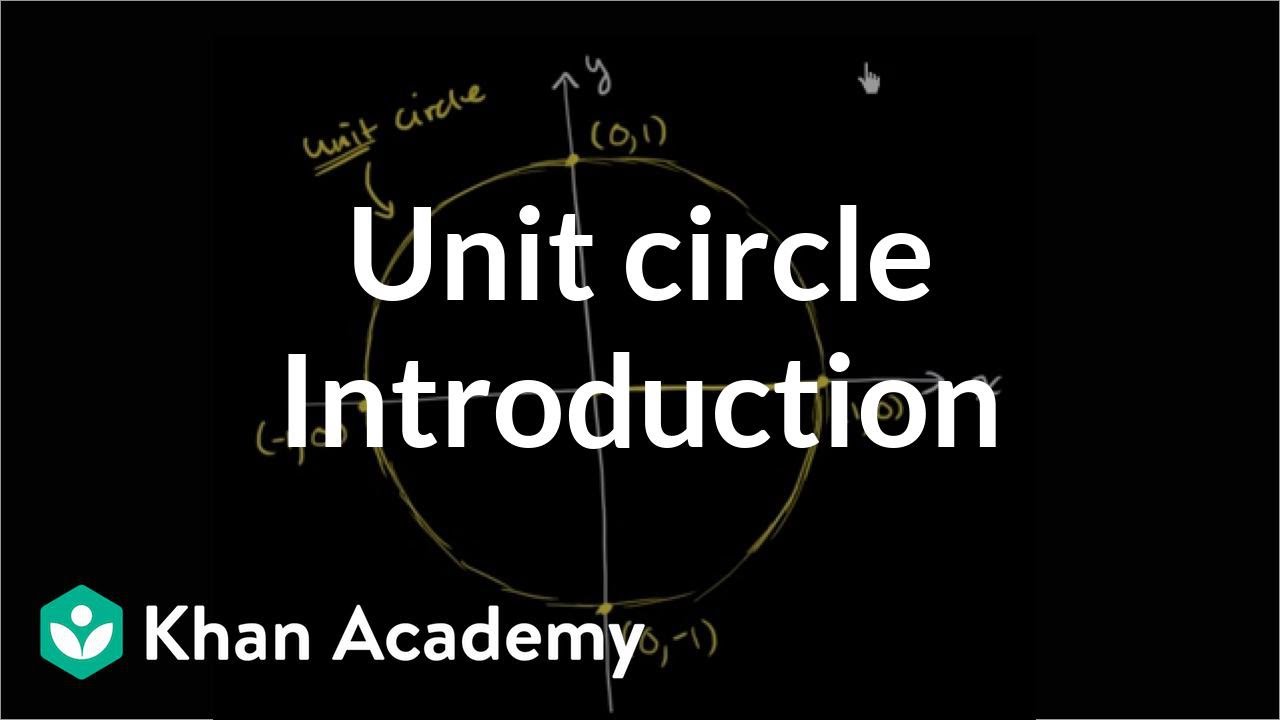
Extending SOH CAH TOA so that we can define trig functions for a broader class of angles
Practice this lesson yourself on KhanAcademy.org right now:
https://www.khanacademy.org/math/trigonometry/unit-circle-trig-func/Trig-unit-circle/e/unit_circle?utm_source=YT&utm_medium=De...
brazen depot
the only way is to memorize the unit circle?
onyx basin
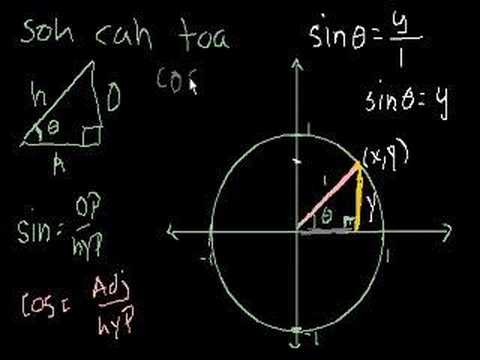
Using the unit circle to define the sine, cosine, and tangent functions
well i dont think it's the only way
there's probably another way
i was just taught through repetition
 robust crane
when told to find an area but not given units is it better to say, "thus the area is 26 units squared" or just 26?
 gritty sail
depends on teacher
robust crane

what about in general pure math world of communication
is it technically wrong to declare an area which is unitless
robust crane
ok then
devout harbor
@robust crane Yeah I always wrote unit squared and I still do!
 ember maple
Hello, why does cos(27,5°-(x/2))=sin(62,5°+(x/2)) ?
As in why the -(x/2) changes to +(x/2) ?
upper karma
Guys
So I memorized the unit circle
But tbh, Idek what it really does
Can someone please explain its purpose
devout harbor
@ember maple $\cos\theta = \sin(90 - \theta)$
somber coyoteBOT
Sup?:
ember maple
Oh I see now
 tropic sedge
silent plank
tropic sedge
silent plank
,w cos(60deg)cos(40deg)cos(20deg)
somber coyoteBOT
 Requested by ramonov#0921
long venture
Requested by ramonov#0921
long venture
Damn, Yeah the algebraic mistake I got lol
My school gave me that question in exam such idiots
 uneven kestrel
Do functions sin(x) and cos(x) give absolute extremum? Basically if there is a max/min point reached multiple times is that still considered an absolute extremum
Is uniqueness a quality of absolute extremism
uneven kestrel
<@&286206848099549185>
 knotty merlin
well in the complex world
sin(z) can be arbitrarely large i think
same with cos(z)
 surreal ingot
<@&286206848099549185>
silent plank
Q4?
surreal ingot
Yes sir
surreal ingot
Sorry, I should done on a piece of paper.
 eternal crag
silent plank
eternal crag
silent plank
$\tan(\alpha) = \
\tan(\beta) = \
\text{compound angle formula for} \tan$
somber coyoteBOT
ramonov:
silent plank
no, there's something very dodgy with that
surreal ingot
Where did I make mistake?
silent plank
tan(a) isnt tan(3/4) etc
surreal ingot
But I got from doing Pythagorean
silent plank
its just 3/4
surreal ingot
Thanks
silent plank
and how you even got those radicals is very questionable
surreal ingot
Tan 5/12 = tan 75 = tan 40 + tan 30
Then I find each value and sum the up
Tan 5pi/12
silent plank
Tan 5/12 = tan 75
???
surreal ingot
I use as tan 5pi/12
Tan 5(180)/12
Tan 75
surreal ingot
I was looking at the angle.
silent plank
$\frac{ \frac34 + \frac5{12}}{1 - \frac34\cdot\frac5{12}}$
somber coyoteBOT
ramonov:
silent plank
after proper notation and subs, you should get something like that
surreal ingot
Yea, I got it. Before I was looking at angle instead of value that was my fault.
vale nimbus
since u have sin and cos of the angles cant u just use sin²(x) + cos²(x) = 1 to find everything u need?
or is there a problem with that
 loud geyser
so, i can't figure this out in my textbook itself
given two planes in the form of ax + by + cz = d
is the norm <a,b,c> regardless of d?
 finite osprey
silent plank
finite osprey
silent plank
consider double angle identites
languid ingot
i thought when you're proving trig identity stuff you're not suppose to manipulate the other side
somber coyoteBOT
Dog:
upper karma
im taking an algebra 2 trig placement test soon, what is osmething that is prob gonna show up a lot?
i rly want to get into pre calc
dark sparrow
$-1 = \sin\paren{x + \frac\pi2} - \sin\paren{x - \frac\pi2}$
somber coyoteBOT
Ann:
dark sparrow
this?
surreal ingot
Yes
dark sparrow
what have you tried so far, where are you stuck, and what is giving you trouble?
dark sparrow
... what
dark sparrow
well you can also just write sin(x + π/2) as cos(x) and sin(x - π/2) as -cos(x) and end up with 2cos(x) = -1...
...i have to go now
 ebon minnow
SC = 2x and SO = x, because 30° is in front of SO
You get that AC is 2 from the pythagorean theorem
rich wolf
@ebon minnow i am assuming that this is a square pyramid
Yes you are right on that first part
AC is 2
OC must be half of that because the base is a square
It's very easy now
ebon minnow
Yeah, forgot to mention it's squared
dark sparrow
yeah so you did
 tepid rapids
hi guys
so i just wanted to ask, why arent trig functions defined for scalene triangles or isoceles triangles?
why right triangles only?
dark sparrow
what
tepid rapids
even the unit circle definition of trig functions that extends it to the real line is still defined in terms of right triangles (just in different quadrants)
dark sparrow
trig functions are not defined for triangles
the input of a trig function is an angle
tepid rapids
right but when defining a trig function, you use a right triangle
why is that necessarily the case?
dark sparrow
i mean i could just say "that's just how the definition is"
tepid rapids
i wouldnt be satisfied xD
dark sparrow
the reason you can't use an arbitrary triangle is because if you only fix one angle (the one whose sin or cos you are trying to determine) this isn't enough to pin down the shape of the triangle and thus the ratios of its sides
tepid rapids
ah right
so if a trig function took two args maybe we could define it for arbitrary triangles?
tepid rapids
hypothetically
dark sparrow
i don't even know wtf you're on about or what you're smoking
vale nimbus
hey could i get some help with the usage of simpson's formulas in triangles to prove certain identities that are valid for those triangles? (will send an example in just a sec)
(they're asking to prove that the triangle has 3 equal sides)
is there anything more to doing exercises like these on your own other than just playing around with the formulas hoping it somehow fits?
vale nimbus
<@&286206848099549185>
 twin prawn
da's wel een pittig bewijsje op zich
vale nimbus
ik kan veel van de goniometrie dingen maar die driehoekstoepassingen lukken echt niet
twin prawn
Da's altijd een minpuntje van dit soort bewijzen doen, soms zijn ze niet echt makkelijk om te "zien"
Enige manier die ik me kan bedenken om beter te worden is gewoon meer en meer opdrachten en sommetjes doen
vale nimbus
had een week vakantie en heb daarin de andere soorten bewijzen ingeoefend en deze proberen uit te stellen omdat ze er moeilijk uit zagen, niet mijn slimste plan
de toets is namelijk morgen 
 muted jacinth
Can someone check me with this solution ? I have used extra things to solve the problem.
<@&286206848099549185>
 grave hatch
devout harbor
grave hatch
devout harbor
@grave hatch We know AC = 4, so you can break it into two equal parts and get that OC = 2
Now that you have OC and BC, figure out the angle OCB
grave hatch
cos^-1(2/4) yea
60
degrees
why do you need that angle
i got the rhombus area as 8root3
quiet mason
ok if its an ellipse
you havr both the axes or whatever
and you can find the ar of the rhombus
devout harbor
You need that angle because we can find the area of the sector with it. OCB = 60 degrees or pi/3 radians, then angle DCB = 120 or 2pi/3 radians
quiet mason
cant you use ar of ellipse = pi*product of axes lengths
and then ar ellipse - ar rhombus
grave hatch
yeah
devout harbor
but there's actually four
grave hatch
thank you so much omg
 primal dune
Could anybody help me understand a geometry problem?
 dire rampart

 crisp grove