#geometry-and-trigonometry
1 messages · Page 252 of 1
 weak shoal
weak shoal
weak shoal
Yes, hunans
 marble topaz
What rokabe is talking about is when trig gets fun
 grim halo
does this type of geometry ever get used except trig?
I have never used it tbh
in like any of my classes
 lofty scaffold
Wait
grim halo
is it like way higher level math?
marble topaz
It's hella important in tons of fields
weak shoal
You'll learn it almost right after you learn about sets & functions in more detail.
marble topaz
Higher maths, applied sciences, applications, trig and trig functions show up everywhere
weak shoal
Anyways, it's not the geometry that's super important. It's the concept of a function that is more general.
lofty scaffold
$\tan\alpha =\frac{\sin\alpha}{\cos\alpha}$
 somber coyoteBOT
PristineWolf:
grim halo
well yea trig, but I have yet to use concepts such as triangle similarity
lofty scaffold
$\sin\alpha=\cos\alpha\cdot\tan\alpha$
somber coyoteBOT
PristineWolf:
weak shoal
You'll use similarity in calculus
grim halo
oh cool
weak shoal
Since calculus, as it is taught normally, is mostly geometric
marble topaz
Yeah that's valid @lofty scaffold
lofty scaffold
$\cos\alpha=\frac{\sin\alpha}{\tan\alpha}$
marble topaz
You can play with all the trig identities algebraically like this
somber coyoteBOT
PristineWolf:
weak shoal
Inb4 alpha = 90
lofty scaffold
Inb4?
marble topaz
Okay in that case it's wrong lol
marble topaz
But assuming theta is just theta its oke
grim halo
can all trig identities be derived from tangent?
lofty scaffold
For this year teacher said only acute angles no 0° no 90°
marble topaz
All trig identities can be derived from other identities
weak shoal
What's an actute angle?
grim halo
probably
lofty scaffold
So my formulas are right?
marble topaz
Yes
lofty scaffold
@weak shoal an angle less than 90°
marble topaz
There's cooler formulas you'll learn later too
lofty scaffold
By definition, I read it in Euclid's Book
weak shoal
Oh cool, thanks
lofty scaffold
Ah lmao didn't see it
grim halo
why no 0 degrees?
lofty scaffold
Vats, I'll meme a surprise limit
marble topaz
0 and 90 cause interesting things to happen
weak shoal
No u
marble topaz
Depending on the trig function you're working with
So the teach is probably avoiding that
lofty scaffold
Vats what did it feel like for Rokabe to get rekt by 14yo
grim halo
lol my geometry teacher was quite interesting to say the least
marble topaz
By interesting I really just mean "it might be undefined"
marble topaz
Radians are very important and they'll never go away
grim halo
yea but in geometry its confusing
lofty scaffold
Vats IQ$= \lim_{x→∞}\frac {x^\frac{1}{x}}{x} = 0$
grim halo
it was a summer class so thats probably why
marble topaz
Prank
lofty scaffold
Wtf
grim halo
my teacher got mad at me for not using limits for end behavior statements
somber coyoteBOT
PristineWolf:
marble topaz
That's a new one
grim halo
she said "you're an e v o l v i n g math student, no more baby stuff"
marble topaz
Well if that's the case did she make you define limits in terms of epsilon-delta
grim halo
no
marble topaz
IDK what her deal was then lmao
marble topaz
Ohh you hate it now but it'll be a huge boon in higher courses
It's very nice to be able to look at a function and have an idea of what it'll look like without any extra work
grim halo
i just hate looking at piecewise graphs
marble topaz
Pff
weak shoal
Why? You can use them for many interesting things
grim halo
and like having to write every little thing down about it
marble topaz
Implying I need a piecewise function to make phallic graphs
You underestimate my power
grim halo
yea we did a whole unit on piecewises
but like I just hate it cause its mostly review
like finding absolute extrema, or intervals of increasing
marble topaz
You'll see those again in calc
Turns out knowing absolute extrema is pretty helpful
grim halo
I guess
idk just seems like a lot of things we do in class is kinda useless, but maybe Im just totally ignorant on whats to come
marble topaz
I understand that feeling
grim halo
we had one extension that felt extremely useless
marble topaz
Later on you'll appreciate it, but learning stuff in a vacuum always has this feeling of "why bother??"
grim halo
it was like find f(g(f'(g(g'(f(f''(g))))))
marble topaz
Are you using 'for inverse or for prime
grim halo
inverse
marble topaz
Okay
 dark sparrow

marble topaz
I was about to be like "Christ"
weak shoal
Welfare, it's just your bread and butter stuff. You gotta do all of that before you get to the cutting edge stuff.
If it makes you feel better, everyone here had to do it lol
grim halo
i guess one pro of it is my algebra skills have like improved a lot
lofty scaffold
$\sin 30 = \frac 12 \sin 60$
somber coyoteBOT
PristineWolf:
lofty scaffold
That's not valid right?
 weary drift
another thing, if you exclude the degree symbol, i'm reading the left side as sin(30 rad)
 upper karma
This Rokabe guy..... nerd
 tawdry pivot
,calc sin(30)-1/2*sin(60)
somber coyoteBOT
Result:
-0.83562631354175
who's Rokabe
 deft ingot
rudy is nerd also
 floral harbor
I need Proof of pythagorean theorem
dark sparrow
there are many
look up "pythagorean theorem" in wikipedia
you'll get like a dozen different proofs
@floral harbor
 tardy junco
upper karma
tardy junco
upper karma
Hello
Can someone help me
Why does sine work?
Why can we say that the ratio of opposite to hypotenuse is the same for any two congruent angles between 0 and 90 degrees?
 flat spruce
dark sparrow
flat spruce
dark sparrow
@upper karma tl;dr similar triangles
upper karma
@dark sparrow what do you mean by similar trianglee, how doees similar triangle help us prove that any two congrueent angles between 0 and 90 degrees are same
sorry for the tag if you don't like getting tagged
dark sparrow
two triangles are similar whenever their angles match
and two triangles being similar means the ratios of their corresponding sides are the same
upper karma
right
Ohhh
I see
But
Why can wee say that ratio of oppo and hypo is same with two congruent angle
is it because theeir have the corresponding sides?
dark sparrow
...yes
i mean
if your TRIANGLES are CONGRUENT
their corresponding sides match up
so of course the ratios do too
upper karma
Right
 blazing basalt
Which quadrant is -pi/4 (clockwise) located?
weary drift
-pi/2 or -2pi/4 is right between quad 3 & 4
blazing basalt
okay cool
 rain oracle
Why cos(π)=-1
 dire rampart
why not
rain oracle
😄
 quiet mason
cos(pi)=cos(2*pi/2)=1-2sin^2(pi/2)=-1
 mossy shoal
but why 
 silent plank
show your work
silent plank
mistake in the very first line
24 and 20 aren't the side lengths of your 2nd triangle
silent plank
wait 1 sec
 wind heart
I got 12. 5 now
silent plank
what you want is something like:
$\frac{4x-6}{(4x - 6) + 24} = \frac{3x-2}{ (3x-2) + 20}$
somber coyoteBOT
ramonov:
wind heart
Ohhhhh were doing that thing
I thought you didn’t need that like
When you have the parallel things
And are only doing the outsides
silent plank
you're applying the properties of similar triangles
the side AM = 4x-6 of the smaller triangle corresponds to
the side AB = 4x -6 +24 of the bigger triangle
similar for AN and AC
silent plank
as for 17, first identify the similar triangles
which allows to conclude something special about triangle WYZ
which then allows you to apply something starting with ||p||
and to reinforce that comment about rounding:
$\frac{104}{3} \neq 34.7$
somber coyoteBOT
ramonov:
silent plank
wait 1 sec, it does work; been a while
fml
sry about that
yeh, mistake was you used 4x - 26 instead of 4x-6
solving:
$$\frac{4x-6}{24} = \frac{3x-2}{20}$$
should be fine
somber coyoteBOT
ramonov:
wind heart
Oh, thanks
Dw it’s all good my teacher himself makes mistakes all the time
For this,
Why would I put 46+n as the numerator?
Like, why does n have to be the bottom
 drowsy walrus
proportion isn't set up right i don't think
should be 36 over 46.8-n equals 42 over n
 drifting lava
if i send my hw here can u guys do it for me
im a female
ok bull dinky he is a guy
drifting lava
but whhhyyyy not
drowsy walrus
because that goes against the server rules
drifting lava
rules smules
drowsy walrus
you are welcome to send your assignment and specify what you need help on
but we can't do the assignment for you as that is your responsibility
 paper mauve
 umbral snow
You'll want to set up a Pythagorean Theorem in each of the two triangles
umbral snow
Ya
 crisp phoenix
ok
umbral snow
The line "144-100 = 44" is strange. I get you're trying to show how you rearranged that equation, but you'll be a bit cleaner if you write the next line as
x² = 144 - 100
instead
Do rearrangements mentally imo
umbral snow
Otherwise your work is very clean @crisp phoenix
crisp phoenix
ok, i have a lot more questions so be prepared lmao
umbral snow
Sounds good!
drowsy walrus
@limpid vector just send it
drowsy walrus
find the total area of the circle
drowsy walrus
what is the formula for finding the area of a circle
 limpid vector
A= pie r to the 2nd
upper karma
What effects tension of a cord between 2 masses on an inclined plane? Coefficient, the angle, or the masses?
 spice ridge
crisp phoenix
spice ridge
crisp phoenix
guys i need help with one question please
ill be eternally grateful if someone could help me find the answers
 winged zinc
@crisp phoenix
crisp phoenix
ye
winged zinc
This is fairly simple
crisp phoenix
ok
winged zinc
There are a few ways to go about it
crisp phoenix
ok
winged zinc
Yep
So since we have two side lengths we can use the inverse trigonometric functions to determine the angles within the triangle
Because we know that the triangle is a right angled triangle.
crisp phoenix
ok
winged zinc
Also, you know that if one of the angles aren't 30, 45 or 60, it belongs to neither triangle because a 180 in a triangle, 90 degrees from the right angle, therefore 90 for the other two angles, so if one angle is 60 degrees, the other has to be 30, but say one is 15, the has to be 75.
If that makes sense.
crisp phoenix
not rlly but loo
look
heres what i came up with, is this correct @winged zinc ?
@winged zinc hello?
 sonic perch
How does Sin work? I know its the opposite side divided by the hypotenuse, but how does the sin button on calculator get that ratio from an angle
winged zinc
Flexify
crisp phoenix
yesir
winged zinc
Do you know about inverse trig functions?
crisp phoenix
yeh
winged zinc
So you know that since sin(X)=o/h
crisp phoenix
yeah
winged zinc
Then X =sin^-1(o/h)
winged zinc
So you know the hypotenuse is 2
winged zinc
So you take one of the side lengths, say 1, and do sin^-1(1/2)
crisp phoenix
yeah
winged zinc
What does it evaluate to? Should be 60 degrees.
crisp phoenix
i think so, im not sure
winged zinc
Do it on your calculator
sonic perch
My point is not getting the value of an angle using sides
crisp phoenix
its 30 @winged zinc
sonic perch
My point is, when you do sin(90) for instance, how does it give you 1
Or sin(56(
How does sin function work
sonic perch
When you press sin on your calculator and put 56 as the input
What does your calculator do to get the ratio of opposite over hypotenuse
crisp phoenix
ohhh
sonic perch
Especially since it doesn't know any of the sides
crisp phoenix
i just press 2nd
winged zinc
@sonic perch
crisp phoenix
look
https://nj.testnav.com/client/index.html#login?username=LGN415881023&password=GTCWK5S6 this is the calculator i use
winged zinc
I do agree with you learning about what trig functions and ratios are
But I think it is first best to learn about how to simply use them
crisp phoenix
i know that In mathematics, the trigonometric functions are real functions which relate an angle of a right-angled triangle to ratios of two side lengths.
sonic perch
Mate I'm in Calc AB
I know fully well how to use them
I want to understand them now
sonic perch
No
I mean how they worm
Work
You normally find the sin of an angle by taking the ratio of the opposite side of a right triangle over the hypotenuse of said right triangle
But calculators simply have a degree or radian as input
How do they figure out that ratio with that simple information?
Is there a formula or equation that allows you to get the ratio of an angle from just that angle
 languid ingot
sonic perch
languid ingot
sonic perch
There most definitely is, otherwise calculators would be pulling this scheisse out of its behind
crisp phoenix
@sonic perch in retrospect, trig functions just compress basic theorems to do things quicker
they arent very complex
winged zinc
Yeah, there is
sonic perch
I want to know what that is
crisp phoenix
@sonic perch read away https://en.wikipedia.org/wiki/Trigonometric_functions

In mathematics, the trigonometric functions (also called circular functions, angle functions or goniometric functions) are real functions which relate an angle of a right-angled triangle to ratios of two side lengths. They are widely used in all sciences that are related to ge...
winged zinc
That
winged zinc
Ok, let me try and explain this now
So we have a unit circle
And if we draw a radius with some angle theta between the positive x axis and the radius going in a counter clock wise direction
The position of where the line touches the circle is the coordinate (cos(theta), sin(theta)) - this is if the circle is centred at (0,0).
@sonic perch
sonic perch
Yeah I know that much already
And because of the right triangle formed by angle theta with the hypotenuse being the radius
Then cos^2+sin^2 = 1
As it should as the circle has the equation x^2 + y^2 = 1, and every point on its graph should be 1 away from center
Ok what next
upper karma
Can someone give me the answer to this please ????A spring is attached to the ceiling and pulled 20 cm down from equilibrium and released. The amplitude decreases by 5% each second. The spring oscillates 9 times each second. Find an equation for the distance, D the end of the spring is below equilibrium in terms of seconds, t.?
winged zinc
@sonic perch There is no simple formula you can use
There is an infinite series that converges to the correct value.
@upper karma
Are you saying the spring's amplitude of oscillation reduces exponentially or linearly?
sonic perch
Thank you
winged zinc
There is one for cosine and tangent - along with other things like e^x
Have a look at taylor series.
upper karma
winged zinc
Hmm
Doesn't say
Because it could say be an amp of 20 at t=0
Then amp of 19 at t=1, and then at t=2 have an amp of 19*0.95
Or it could be 20, 19, 18, ...
But anyway, the position of the end of the spring is going to be modelled by either a cosine or sine curve
Let us use a cosine because it has a max at 0 when there is no horizontal translation
Now we know that it will be in the form of Acos(bx)+c
Calculating b is simple enough
T=2pi/b
where T is the period
Period is the time divided by the number of oscillations
As for c
We are going to make it such that y=0 is when the spring is in the equilibrium position
And so we don't need to worry about the c value
As for A
It is difficult
It could either be an exponential or as a linear function
@upper karma
upper karma
i think its linear because the next question asks exponential
winged zinc
Ok
So we some function of time that describes the sequence, (20, 19, 18, ...)
What do you think that is?
upper karma
is it just -1
winged zinc
Expression please
winged zinc
Haha
upper karma
im so bad at this 💀
upper karma
and its due in 12 minutes 😫
winged zinc
Is the amplitude at t=0, t=1, ...
And that is described by the equation 6(1-0.2t)
So our final equation is 6(1-0.2t)cos(n2pit)
Where n is the number of oscillations a second
and we were told 8
So D=6(1-0.2t)cos(2nt*pi)
Should be the equation you are looking for.
upper karma
oh okay
winged zinc
Well then I'm not sure sorry
winged zinc
Can the spring go 'above' the equilibrium?
upper karma
it says below
winged zinc
Yeah, but spring typically exhibit harmonic motion. so they go below then above, then below and so fourth
upper karma
what would it be if it was above
winged zinc
It should be described by that equation
Are you meant to answer only with sine or something? Anything about how answers should be expressed?
That equation should describe the harmonic motion of a spring
winged zinc
Ohh rip
winged zinc
Did it matter much?
upper karma
not really its just hw
winged zinc
Graded?
upper karma
yeah
winged zinc
Summative?
upper karma
yeah
i have good quiz scores and did good in my mid term so i should be fine
i appreciate the time you gave to help me tho
@winged zinc
upper karma
yeah i know 😅
winged zinc
That way people can explain it and let you get there - we don't love simply giving people answers
upper karma
i just totally forgot about it
winged zinc
All good
That is what I found online
Phi is simply a phase shift
But if we wanted to write the answer in terms of cos
we just need to change the phase shift
So I'm still unsure as to why it was wrong
upper karma
yeah idk
winged zinc
Unless it was exponential
upper karma
yeah
winged zinc
Nice, doing what degree?
winged zinc
Nice
upper karma
yeah im majoring in computer science
 upbeat fog
I don't really understand the logic behind calculating the area of a hexagon.. anybody mind explaining
why is this not true man 😂
dark sparrow
the blue height isn't 4 and even if it were the area would not be 4 + (2*4)*4
blazing basalt
where would -pi/4 clockwise be?
dark sparrow
what
blazing basalt
Well it's a linear algebra question. I'll just post the quesiton in linear algebra
 vale nimbus
i dont know if this belongs here because in my country we dont use these terms but can someone explain this to me?
this was what i tried (sorry for bad camera quality) but this is not what sin(3a) equals to
(task is to prove the equality)
 devout harbor
You need to do some more work, I think it would've been easier if you started with sin(2a + a) then expand
then expand 2a into a + a
vale nimbus
sorry for the inconvenience, i looked into it some more and found out that tripple angle formulas exist
and the thing i have in my last line is one of them for sin(3a)
devout harbor
yeah they do
devout harbor
np you didnt say if you were allowed to use triple angle identities
vale nimbus
we havent learned them yet sadly
@devout harbor hm i dont see how i could do it with the method you suggested, i tried it out but didnt work
i cant seem to get the pi/3 into the equation
dire rampart
are you just asked to prove that identity?
vale nimbus
yea
dire rampart
like u can expand sin(a+b)?
vale nimbus
yup
dire rampart
ok thats all u need tbh
vale nimbus
yea
dire rampart
expand the sines on the rhs
vale nimbus
yeah thats what i went with
just expanded those and then solved the stuff i got
but now i need to prove that sin(3a) = what i made the RHS equal to
and that isnt working out for some odd reason
dire rampart
you should get 3sinx-4sin^3(x) eventually
vale nimbus
got it
ty
wait no @dire rampart im supposed to get 3cos²(a)sin(a)-sin³(a)
i simplified the rhs down to the top one
but i cant get sin(3a) to equal it aswell
 so dumb
dire rampart
cos^2=1-sin^2
upper karma
Can y’all help me on this? Maybe give me a private session?
 visual mist
find the coordinates of the point that divides the segment joining (-2,0) and (3,4) into the ratio of 1:2. Ratio is to be considered from left to right.
 nocturne grove
anyone have like a song or anything to help memorize the, sum to product and product to sum trig things?
 desert vortex
yeah I’m not even in geometry anymore but how do you do this again lmao
nocturne grove
sin73 = 6.3/x
cause sin of that angle is equal to opposite (6.3) over hypotenuse (x)
desert vortex
okur just making sure
bruh what is it not 9.3
@nocturne grove
I’m TRIPPING hard
nocturne grove
make sure your calculator is in degrees not radians
desert vortex
I hate calculators
nocturne grove
rip lol
desert vortex
ok I just got like 5 wrong in a row because of that I actually feel bad for my friends
;rotate
what’s the command to rotate
you’re telling me
That is not 1..7
11.7
,rotate 270
somber coyoteBOT
nocturne grove
i got 11.6 dunno
desert vortex
Yeah I’m gonna have an aneurism why would you actually use 0.600860619 be 0.6
visual mist
find the coordinates of the point that divides the segment joining (-2,0) and (3,4) into the ratio of 1:2. Ratio is to be considered from left to right. can someone help me?
desert vortex
uh graph it?
visual mist
but still how do i find the coordinates
 rich wolf
@visual mist think about it this way
What is the vertical and horizontal distance between those points
visual mist
vertical is 4 and horizontal is 5

 gritty flare
If I were to guess Id say A
Cause it should be Regular hexagon area minus the all unnecessary parts
 dusky thorn
what is a in that formula
gritty flare
the answer A
dusky thorn
and also how do i find the "unnecessay parts"
gritty flare
Ye I said "If I were to guess" im tryinf to figute out how to get them
dusky thorn
oh ok
 wise pawn
can't be A cause 6sqrt(3) is the hexagon, 3pi is the area of the 6 half circles of radius 1
but there's an overlap
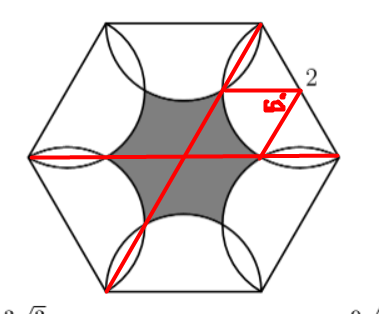
check out this parallelogram, with that corner of 60 degrees
there are 6 grey copies, and you have a simple circle sector to take out of that parallelogram to compute the area
 dense sky
Is anyone familiar with how to do these kind of problems
gritty flare
@dense sky radius is perpendicular to tangent
dense sky
Can you help me
gritty flare
which problem
dense sky
It’s like a retake form
gritty flare
wats dat
dense sky
Cuz I messed up on a test
gritty flare
@zenith ember is this allowed?
vale nimbus
just had a very quick look at the last one and that looks like sin/cos formulas galore
sk is this graded?
vale nimbus
oki
gritty flare
Okay then ig ill help you?
vale nimbus
id try helping but not home atm sadly
@gritty flare can u use sin and cos formulas for this? yeh right
gritty flare
After samantha confirms i can help
 zenith ember

gritty flare
You dont need sin/cos
vale nimbus
thats how id solve it
zenith ember
We can't be certain. Helping is a reasonable action.
dense sky
Alright
gritty flare
A central angle is __ its intercepted arc (degrees)
Do you know this
Its a rule that we cant give you answer directly
so sorry
vale nimbus
i wanna know nr 1 now
vale nimbus
i dont understand the question cuz not native tho xdd
dense sky
Dude
gritty flare
Now what is said that:
Central angle is always equal to the arc measure it is intercepting
dense sky
Please the number 5..
vale nimbus
i wanna know 
dense sky
Is it Pythagorean’s theorem
gritty flare
Radius is perpendicular to Tangent line at the point of touching
so ye it si Pythagorean theorem
What is OV then
dense sky
One sec
gritty flare
👀
 gritty flare
Some pythagorean triples which are really helpful to know:
Side-Side-Hypotenuse
3-4-5
6-8-10 (multiplied by 2 3-4-5)
5-12-13
^remember these
definitely
dense sky
Is OV 5?
dense sky
Is it 9?
gritty flare
Mm yes
dense sky
Ok on to number 7
dense sky
How do I do this
gritty flare
Okay another property
If the radius is perpendicular to a chord it splits the chord into half
Now you should be able to do this
dense sky
I can’t remember the parts
vale nimbus
can i put my answer in spoil things
gritty flare
No
vale nimbus
bruh
gritty flare
Some people are impatient and click
vale nimbus
yeah fair
dense sky
What’s the formula .-.
vale nimbus
for pythagorem?
dense sky
No for number 7
gritty flare
There is no formula
dense sky
Am I cutting 17 in half then doing the theorem?
vale nimbus
no
vale nimbus
can i say what he cuts in half or should i sh?
dense sky
Am I doing 8^2+b=17?
vale nimbus
thats a good start but keep in mind its b²
gritty flare
dense sky
DO I CUT 8
vale nimbus
and 17²
gritty flare
Okay now
OK is 8 (Distance from centre O to midpoint of chord K)
OA is 17 (Radius of the circle)
By the problem text itself
dense sky
Ok so..
dense sky
p y t h a g o r e a n ?
vale nimbus

dense sky

dense sky
I don’t know what it finds but
gritty flare
Can you write out the pythagorean theorem for right triangle pls?
dense sky
It’s 15?
 vale nimbus
no almost
gritty flare
I want you to write it out to understand what youre finding
dense sky
What do you mean almost?
vale nimbus

gritty flare
ignore him he is just making mt job harder
dense sky
a^2+b^2=c^2?
gritty flare
That is not what I want
dense sky
What do YOU WANT
vale nimbus
use his letters
dense sky

gritty flare

dense sky
Ok I see it
 dense sky
help 
vale nimbus
write the formula using his letters
dense sky
AOK WHAT DOES IT EQUAL
vale nimbus

pythagorem
with his letters
side opposite of a point(angle) = lowercase of that points letter
dense sky
18
vale nimbus
what
dense sky
I don’t know
vale nimbus
dont guess :(
write pythagorem with his letters and then itll be noice to solve the problem
dense sky
OK + OA?
vale nimbus
wait lemme draw u smth aswell
gritty flare

@dense sky look at the drawing I sent
THEN look at the TRIANGLE AKO/AOK/OKA WHO GIVES A SHIT
then write out the pythagorean theorem for the SIDES
USING THE LETTERS FOR THE SIDES
dense sky
...
gritty flare
Like if we have a line with one end having point A and second end having point B then that line is AB
Ill send my picture again
Focus on the triangle AOK
The one which is created by the lines AO:OK:AK

dense sky
AO+OK= AK? ._.
gritty flare
It needs practice nothing else
vale nimbus
^
gritty flare
Okay look
Pythagorean theorem: The sum of the squares of the sides of a right triangle is equal to square of the hypotenuse
AK²+OK²=AO²
Now we know OK =8 ans AO=17
dense sky
OH
dense sky
AK
vale nimbus
8
gritty flare
yes
dense sky
OH
gritty flare
wat
dense sky
AK
dense sky
AB
dense sky
It’s 34
 dense sky
Wait nvm
gritty flare
So If AK is 15 what is KB
dense sky
Oh
gritty flare
If AK is 15 what is KB
dense sky
15
dense sky

gritty flare

dense sky
30
gritty flare
yes
8 is the same youll do it
while you do ill see 9
tell me the anewer you get on 8
gritty flare
ye it is 16
dense sky
Awesome
gritty flare
okay now 9
dense sky
Alright
dense sky
Isn’t it just 3-10
dense sky
Is the answer 7
 dense sky
And is the next one 3
 olive plover
do we ask questions here about trigonometry or #❓how-to-get-help
devout harbor
Both
dense sky
@gritty flare Dont leave me ;-;
devout harbor
Are you O levels?
dense sky
??
devout harbor
just asking
dense sky
What do you mean
devout harbor
Nothing
gritty flare
omg thata a lot
dense sky
Are you willing to help ._.
devout harbor
You need to try yourself first
dense sky
Yes but no
gritty flare
Okay
Another thinf for you
two Tangent lines coming from the same point until the touching to the circle are equal
lets say we have two tangent lines coming from point O and touching the circle at A and B
them OA=OB
this should be enough to solve this problem
dense sky
So
devout harbor
^ Iscoceles triangle
dense sky
DZ=ZW?
devout harbor
Yes
 dense sky
WHAT IS EQUAL
gritty flare
Okay lemme draw it to you
devout harbor
Yes @vale nimbus
devout harbor
I'm not takin anything I was just asking sk
devout harbor
np
gritty flare
dense sky
CZ is tangent
gritty flare
Now what I want you to do on your paper is
mark where the tangent line DW touches the circle
and name it some letter name

and tell me what you named it
dense sky
X
dense sky
Is this Pythagorean’s theorem
gritty flare
nope
dense sky
Is their a formula for this

 gritty flare
Lemme think
Nope
its not 16
You have to use the property i fucking told you
I wouldnt tell you if it wasnt used
gritty flare

dense sky
Bruh..
gritty flare
Ye it is 13
dense sky
Actually?????
gritty flare
But are tou fully sure you solved it
100%
I dont think you understood the whole thing
so im gonna explain now
dense sky
So I was correct?
gritty flare
Okay
By the property I gave you
ZC=ZN
DC=DX
WN=WX
Do yoy understand why this is?
dense sky
Yes
gritty flare
Next by the problem DZ=12 and ZC=5 so DC=7
ZN=ZC=5; by problem ZW=11 so NW=6
DW=DX+WX
DX=DC=7
WX=WN=6
DW=7+6=13
👍
Youll be able to solve next one by the same way
gritty flare
Okay did you get thr answer on the next one?
dense sky
Is it a low number
dense sky
6
gritty flare
thats correct
dense sky
Really?
dense sky
I had the answer for awhile
gritty flare
It was a simple trick to make you douvt yourself