#geometry-and-trigonometry
1 messages · Page 251 of 1
 buoyant hinge
 dark sparrow
yeah (1) gives you 25-odd million in^3
and you should only divide by 2150.42 once
does your textbook show the volume of the four cylinders in cubic inches being divided by a bushel thrice?
 upper karma
@dark sparrow do you remember all these identities btw or do you look them up
dark sparrow
i happen to know them off the top of my head bc i've used them a lot
upper karma
i mean apart from cos(a+-b), sin(a+-b), cos(2a), sin(2b)
so you know for example like
sin x - sin y?
dark sparrow
do you mean sin(x)-sin(y) = 2sin((x-y)/2)cos((x+y)/2)
buoyant hinge
@dark sparrow yes it does
dark sparrow
that's weird.
 faint cove
However, I think you should see the derivations to understand them better
dark sparrow
uh
can you take a picture of what you're looking at @buoyant hinge
i'm just curious
upper karma
@dark sparrow damn you are a nerd
i can't remember that stuff at all
even tho i've only been learning for a week
trig
faint cove
if u know the derivation u can logically know why it's like that
dark sparrow
a week ain't enough
upper karma
why not
dark sparrow
i've been doing shit with trig in one form or another for years
nothing wrong with not remembering stuff perfectly if you've only been at it for so little time
dark sparrow
seriously don't worry about it
buoyant hinge
dark sparrow
uh.
wow what
this is fucked up lmao
taken at face value, a bushel according to them is a unit of LENGTH, not volume!
faint cove
Lmao
buoyant hinge
I'm good with math.. no wiz or anything. I took calculus in high school but promptly forgot all of that. But pretty much anything under I'm pretty good with.. and I tried to reconcile what they had and couldn't figure out what they were doing to get there
Because if you calculate what they have written.... it doesnt even equal what they show
So I didnt know if I'd fallen further than I thought and was missing something vital
dark sparrow
yeah as i said
this is fucked up lmao
faint cove
If you’re worried, you can always check the dimensions/write them
Like this
Vtotal = 4πr²h
Vtotal = 4π(6 ft)²(32 ft)
Vtotal = 4π(36 ft²)(32 ft)
Vtotal = 14469.12 ft³
1 ft = 12 in
Vtotal = 14469.12(12 in)³
Vtotal = 14469.12(1728 in³)
Vtotal = 25002639.36 in³
Vtotal/bushel
= 25002639.36in³/2150.42in³
= 11626.86
The final dimension should be as what you expect
which here is no unit, because you’re just counting how many bushels fit in 4 cylinders
buoyant hinge
That's what he had as his answer. When I checked it and saw how far it was off, I looked at the teachers key and that's when my world started not making sense
Because to get their answer you have to divide 11626.86 by 3. And i have no clue why they did that... and not even show that's what they did
Thank you all for confirming for me that i didnt miss anything and their answer key is just wrong. Makes me highly suspect of the rest of it
faint cove
Just believe in yourself, books can be unreliable sometimes
dark sparrow
their answer is majorly screwed and your answer of 11626.86 is correct
buoyant hinge
Thanks. I've been wrong before, atleast according to my wife.
faint cove
Do you know what cos(α-β) equates to
upper karma
yes
faint cove
use it then
 languid ingot
There is question like: find sin (x/2), cos(x/2), and tan(x/2) for each set of conditions:
sin x = -3/5 and pi < x < 3pi/2
Ik how to plug in to the half angle formula thing. but how would i would like know if sin (x/2), cos(x/2), and tan(x/2) should have negative signs?
 silent plank
use that they tell you about x to determine which quadrant x/2 is in
languid ingot
oh wait x/2 will always be in II quadrant?
silent plank
yes
languid ingot
okay is it same to assume:
if x is in first then x/2 is always in first
if x is in second then x/2 is always in first
if x is in third then x/2 is always in second
if x is in fourth then x/2 is always in second?
dark sparrow
why do you even need to assume anything
take pi < x < 3pi/2 and divide through by 2
or yknow any other quadrant info you may be given
why not do that instead of these weird heuristics
languid ingot
okay
 spiral niche
think about it this way:
think of moving x around the circle and x/2 changing as x changes
when x gets to pi/2, x/2 is still trailing behind in the first quadrant
when x gets to pi, x/2 finally made it to pi/2, so any point less than pi results in x/2 in the first quadrant
as x continues to go around the circle, x/2 still remains in the second quadrant. when x gets to 2pi, x/2 finally made it to pi
languid ingot
okay
dark sparrow
espo that is honestly overcomplicated
like seriously
pi/2 < x/2 < 3pi/4
so x/2 is in the second quadrant
i don't understand why that's insufficient as far as clarity goes
spiral niche
some people work better with numbers
others work better with a geometrical understanding
telling someone "look, the numbers work out this way" doesn't always help
sometimes it helps to get an intuitive understanding of what's happening
upper karma
if i’m solving for cosine theta
and it gives me 2nd quadrant
is the answer going to be negative
cosine is (1,4) positive (2,3) negative
so cosine is forced to be negative
did i just answer my own question
can someone make sure im doing this right
 dire rampart
didnt check the arithmetic but looks good
upper karma
bet
how do i find angle theta from the given cosine value?
that’s question 2
cosine is = .1736
do i do inverse?
 thorn talon
Yes
upper karma
do i use sinh or cosh
 median crown
 limpid tide
wouldn’t sin(theta) be -0.5?
limpid tide
other than that looks good to me
upper karma
how do i calculate $\sin 6^\circ \sin 42^\circ \sin 66^\circ \sin 78^\circ.$
 somber coyoteBOT
polynomial:
limpid tide
i’d just chuck em in a calculator
limpid tide
oh
i’d start with the sum and distance formulas, do you know those?
not distance, difference
sorry i’m very sleep deprived
upper karma
is it ok just to write this as .5
limpid tide
i mean probably unless your teacher’s a prick
limpid tide
sorry i meant sum and difference
upper karma
she does this stuff with margin of error
limpid tide
ok so
limpid tide
yes
okay
so first we have 6 degrees
can you think of standard angles that sum or subtract to 6?
upper karma
no?
@limpid tide what are they
?
probably a dumb question but to find tangent from a reference angle
i divide sine/cosine
with keep change flip right
because they’re both fractions
@limpid tide ??
dude
calm
he’s probably not on right now
pinging someone won’t make people respond faster
just probably piss them off
people have lives my dude
lol easy for you to say asking easy questions that anyone can answer in 5 sec
yeah that’s probably why people answer them
yeah so go away asking your easy questions when anyone can answer them and telling others as if their situation is the same lol
🤔
hmm
how would i find sine, cosine, and tan of -5pi/6
when that’s not an actual radical
idk how to make it one
can u not
im gonna assume i have to convert that radical to a negative degree
then switch that negative degree to a positive one
actually i think im stupid
i don’t know how to convert radicals to degrees
 marble topaz
@upper karma back to what Sam said, think of angles that can get you 6
You already know quite a few special angles already, think about how you can relate them
@upper karma are you meaning to say radians? Just remember that pi radians = 180 degrees
And you can convert with that
upper karma
@marble topaz i mean, i know how to get 60, just not a "good" angle for both of the values
one of the values will be "bad"
 glad falcon
need help in voice chat.
 fleet wolf
@upper karma i think you wrote the question wrong
fleet wolf
the standard question has sums and differences not multiply
upper karma
question
@fleet wolf no... i didn't...
It’s actually fucked
to calculate sin(6)
@upper karma then you're doing something wrong
well i am too so idk lol
@upper karma
This guy did it
Tedious as balls
the response below is like 4 lines
fleet wolf
hmm it seems like it is just multiple applications of sun to product
upper karma
how's that tedious lol
 upper karma
is there a way to split any triangle into two right trinagles computationally
i know all of the sides (a, b and c)
 umbral snow
@upper karma
I would suggest cos law to find an angle, then sohcahtoa once you're dealing with right triangles
languid ingot
@upper karma search up how to find altitudes of triangles
 wind heart
Hey
I’m pretty sure I already asked this question and it was answered but honestly I forgot how to do it either way so here ;
How would I do #5?
spiral niche
What does it mean for two shapes to be similar?
 verbal summit
i've got questions on how to do certain geoemtry problems wiith similar figures and dialations and i can send pics if i can be guided in the right direction on how to get the answer
@here
 deft ingot
@verbal summit still need help?
languid ingot
@wind heart
to find the ratio, get the side of the first polygon, and then divide it by the second one with its corresponding side
so for your problem:
we know |AB| = 20. and |PQ| = 25 because |SR| and |PQ| are congruent
thus we need to just do: 20/25 or 20:25, which would simplify to 4:5
so now we have the ratio we can just multiply it by the original one to get the second one. for e.g.,
|AD| = 14, so |PS| = 14*(4/5) = 11.2
languid ingot
np
 jade solar
If they are right angles then B will lie on CD right?
 clear falcon
nvm i got it
 blazing panther
How to find tan and arctan using unit circle
dark sparrow
draw the tangent line to the circle at the point (1,0), a.k.a. the line x=1. call it "the tangent axis"
for all θ that aren't π/2 or 3π/2, the line passing through θ's point on the unit circle (i.e. (cos(θ), sin(θ))) and the origin will intersect the tangent axis at one and only one point
the y coordinate of this point is tan(θ)
does that answer your question or would you like an illustration
@blazing panther
dark sparrow
👻
dire rampart
👻
upper karma
how do i calculate radius from degrees in my calculator
like
451°10'
Texas TI 84 plus ce-t
marble topaz
@upper karma recall that 180 degrees is equal to pi radians
That should enable you to convert pretty easily
upper karma
in calculator?
dark sparrow
"radius" did you mean radians
are you trying to convert 451°10' to radians
bc that'll be (451 + 10/60) * pi/180
upper karma
oh yeah I got that
i see what I was doing wrong
I got 7.87434 rad now
🙂
ty for help
This can only be done through calculator right?
dark sparrow
wdym
upper karma
Formula can be written, but the calculating, through calculator right?
dark sparrow
unless you're allergic to calculations with four-digit numbers
marble topaz
You could absolutely do it w/pencil and paper
dark sparrow
you can do the calculation by hand just fine
it's gonna be a bit painful but it's absolutely doable
upper karma
let me try
okay i might not do it if it's painful
xd
I can use calculator on tests, so I guess i'll just stick with that
 hot pumice
How do I deal with a question like this when there are no solutions?
Hope this is the right channel
dire rampart
why do you say there are no solutions
hot pumice
Sorry, meant infinitely many solutions
spiral niche
@hot pumice say what y has to be in terms of x
so in this case, y = x
but sometimes y might have to be 4x
or nx
so y=nx, where in this case n = 1
hot pumice
Ahh right I get it, ty
 upbeat trail
In sin(x), sinh(x), arcsin(x) and arcsinh(x).. Is the x in rad or in degree?
Mention me if someone answer
 weary drift
@upbeat trail it doesn't make sense to plug in angle measurements into the arc trig functions... as for the non arc functions, either are fine
upbeat trail
Alright thanks
 dense sky
Can I math god help me complete the squares with circles
silent plank
what issue are you having with completing the square?
verbal summit
if there is 5 green and 7 yellow pencils the chance of getting 2 yellow pencils is 16%?
somber coyoteBOT
Result:
0.31818181818182
 flat spruce
verbal summit
flat spruce
verbal summit
anyone good with probability
 clever heron
hey so i have an easy question about circles and arcs but i forgot all the properties of arcs would this be the place to ask
limpid tide
presumably
clever heron
cool
how would i find the measure of angle D and angle A
my old math binder fell apart so i lost all my notes on arcs, no other info given in the problem
 fringe crater
Hey @lyric summit, so if you want to find the distance between M and N, you can try to visualize some squares in the diagram, like this:
 dusky cobalt
Yea
 lyric summit
oh
lyric summit
why r heRe
lyric summit
ok
dusky cobalt
Welll
Multiply by root 2
Do that for both
Then add
And
Booom
Big brain
Right there
lyric summit
and is it 12
fringe crater
I got 24*sqrt(2)
lyric summit
oh
lyric summit
thx both of yall
dusky cobalt
:)))))
fringe crater
yw 🙂
lyric summit
:)
 twin prawn
 wind heart
Hi
How do I complete 6 7 and 8?
Let’s see
Does is 6. 15, is 7. 60, and is 8. 8?
spiral niche
7 isn't 60
spiral niche
Yes!
spiral niche
yes, 6 and 8 were correct
 onyx basin
quick question
for arcsin x = theta, why is it restricted to the first and fourth quadrants of the unit circle
weary drift
arcsin is defined as the inverse of sin where sin has been restricted to the interval [-pi/2,pi/2]
spiral niche
think about it this way:
 noble coral
URGENT
spiral niche
do you remember the definition of a function?
noble coral
onyx basin
mhm
noble coral
HOW WOULD I FIND THE RAIDUS OF THIS CIRCLE please
spiral niche
sin takes in any angle
onyx basin
mhm
spiral niche
do you know what the range of sin is?
like the function?
how do I graph
,graph sin(x)
onyx basin
-1 to 1 right
onyx basin
$,graph sin(x)$
somber coyoteBOT
analyst:
spiral niche
lol
onyx basin
yes thank you texit
spiral niche
it's always -1 to 1
onyx basin
mhm
spiral niche
however, if arcsin(x) is going to be a function, it can only give one output for every input
so if you want to know where sin(x) = 1
you do arcsin(1)
but it can only give one output
onyx basin
mhm
spiral niche
even though sin(x) = 1 at pi/2, 5pi/2, 9pi/2, etc.
so it only gives the answer that's in quadrants one and four
spiral niche
does that make sense?
onyx basin
mhm
spiral niche
@noble coral
I have an answer for you, but it's not rigorous
like it isn't a proof, but it gives you the answer
since the large box is 6x6, you can put 9 2x2 boxes in it
the middle box is going to have one corner touch the bottom left box and one corner touch the center of the circle
and the radius of that box is going to be
noble coral
yes
noble coral
but we aren’t given if the TOP square box is a square
deft ingot
The problem is the little segment
noble coral
yea
deft ingot
But, maybe you can use pythagoras
deft ingot
noble coral
Uhm I don’t get it
deft ingot
sqrt(2) × (4 - r) = r
The middle triangle is a 45 45 90 with hypothenuse R and sides 4 - R
noble coral
So uh what’s the answer?
deft ingot
r = 4× sqrt2 / sqrt2 + 1
noble coral
@deft ingot
ok
im really sorry
but can u explain it to me step by step
I beg you
Im soooo so sorry
deft ingot
hmm
noble coral
like starting from the first picture
deft ingot
see that middle triangle i made?
deft ingot
Which box?
noble coral
but I asked some guy and he said that it was a square cuz of the point at the raidus
look
deft ingot
Yeah it is a box
deft ingot
Middle triangle i made there
Hypothenuse is R
their sides is 6 - 2 - R
Do pythagoras
noble coral
ok
deft ingot
r = 4× sqrt2 / sqrt2 + 1
@deft ingot
noble coral
where does the one come from
deft ingot
R + Rsqrt2 = 4sqrt2
deft ingot

 lofty scaffold
How do we pronounce\
$\arcsin 0.5$
somber coyoteBOT
PristineWolf:
twin prawn
How would you pronounce it
umbral snow
Jk about that part
lofty scaffold
Lmao don't joke in trig pls
weary drift
except kaynex isn't really jk'ing
umbral snow
I am in the sense that you wouldn't pronounce that like that
lofty scaffold
Rokabe I wanna ask you some stuff but awk
Imma finish reviewing for tomorrow's French test and I'll come back
silent plank
'bad' questions get 'bad' answers
lofty scaffold
Me?
silent plank
what else were you expecting other than
arc sine zero point five
lofty scaffold
I just wanted to know if the part "arc" in arcsine was pronounced the same or smth diff
silent plank
just read it normally
lofty scaffold
Well you don't read "cos"
Lmao if you say cos in my country it is REALLY close to a swear word here
😂
twin prawn
cosine
umbral snow
I only ever read cos
weary drift
when speaking fast i pronounce cos as cuss
umbral snow
But I also read sine
twin prawn
saying sin is a sin
lofty scaffold
Imma gtg n come back
silent plank
shine for sinh is quite fun
weary drift
you say shine instead of sinch?
silent plank
yeh
weary drift
what about cosh
twin prawn
cosh
silent plank
just cosh for that
weary drift
tanh?
silent plank
(th)an or fan?
been a while
twin prawn
"tan AITCH"
silent plank
don't think i've ever had to pronounce it
weary drift
never heard of than or fan, interesting
twin prawn
"hyperbolic tangent"
weary drift
i pretty much go with how khan would say it
weary drift
thfan sounds like so much effort
silent plank
geez that first vid when i searched it was horrid
 keen rose
guys this last question is one of those (whats 2+2 hense solve the surface area of the moon) type questions
silent plank
um what?
weary drift
expanding & using trig identities may get you somewhere
weary drift
expanding
silent plank
which trig identit(ies) do you know?
silent plank
not tan(x)
keen rose
ye that
silent plank
sin^2x + cos^2x = 1
in addition to basic exponent/distribution laws
should be all that you need
 quiet mason
no you confused D with sine(D)
silent plank
(and d with D)
somber coyoteBOT
 Requested by NoaH#5497
upper karma
Requested by NoaH#5497
upper karma
uh
im leaerning special angle
i dont think my teacher was asking for that
oh
thats radian
thats why
@upper karma special angle ez
yeah but then
silent plank
this isn't a special angle
upper karma
WHY WOULD MY TEACHER
put this in
a google docs
if it wasnt special angle
Can’t you find it with Inverse sine
**Special Angles and Unknown Angles **
Yea
the thing is we haven't learned how to use einverse sinee
Fr?
yep
Just use calculator it u can
quiet mason
then just write arcsin(that frac)
upper karma
i have my casio in
quiet mason
then, i guess
silent plank
wdym if you didn't know the ratio?
silent plank
since you're given all 3 sides you can use whichever ratio you want
the ratio would only involve 2 sides
somber coyoteBOT
PristineWolf:
Can we call this $\arcsin$ sin inverse
Or is it just for sin^-1
weary drift
arcsin & sin^-1 refer to the same function. Referring to either as inverse sin is misleading. Remember that talk I gave about making a certain restriction on the domain of sin in order for it to be invertible
lofty scaffold
rokabe..
Pls
Give me a moment then
Lemme finish math hw n come
Guess we're not ending
weary drift
I won’t relent til you stop asking trig qs
lofty scaffold
So you mean you're not leaving me confused?
dark sparrow

lofty scaffold
@weary drift
weary drift
你要什么?
weary drift

 rain oracle
Hello. I have 2 questions. I want to ask my first question;
The number of pi can be 3.14 or 180. Is pi's 3.14 value in radians or degrees?
I have researched in many sources, many say different things
weary drift
You can never truncate digits of pi and still have its exact value. Almost never do it. pi is approx 3.14 but not 3.14
pi is the ratio of a circle’s circumference to its diameter. And pi radians = 180 degrees
dark sparrow
The number of pi can be 3.14 or 180.
no
any resource that says "pi = 180" outright is not a resource ever worth reading
rain oracle
pi radians = 180 degrees. I don't understand this sentence. pi radian must be equal to a radian value, right?
weary drift
rad & deg are units describing angle measurements. The above relation gives how to convert between the two units
rain oracle
In other words, does pi number have 2 values as degrees and radians?
Can we use the number pi in radians or degrees
I'm so confused 😄
dark sparrow
no, you're overthinking it
pi is pi. it's a number. it's equal to the circumference of a circle whose diameter is 1.
it's approximately equal to 3.14159. and that doesn't depend on what units are attached to it.
radians and degrees are units of angle
it's not like "pi degrees" is not a valid angle for whatever reason
you can have a length of π meters, a timespan of π hours, a volume of π liters, whatever
rain oracle
sometimes we could write 180 instead of pi. I am trying to understand the logic of this
dark sparrow
if you see it as "writing 180 instead of pi" then there is no logic to it
because pi and 180 are two very different numbers. they differ by about 176.86
rain oracle
I've never seen trigonometry before. I'm trying to understand some things myself😄
because i need this informations about trigonometry
can i post a photo here?
@dark sparrow
dark sparrow
sure
 idle bloom
Ok so
ignore the stuff in the middle
do you understand what's going on on the circumference of the circle?
rain oracle
No 😄
idle bloom
ok
So it's a new way of defining angles
we're used to degrees
360 degrees in a circle correct?
rain oracle
Yes
idle bloom
but it's kind of arbitary, 360 just happens to divide into alot of nice factors so it's useful in that way
but it's still arbitrary
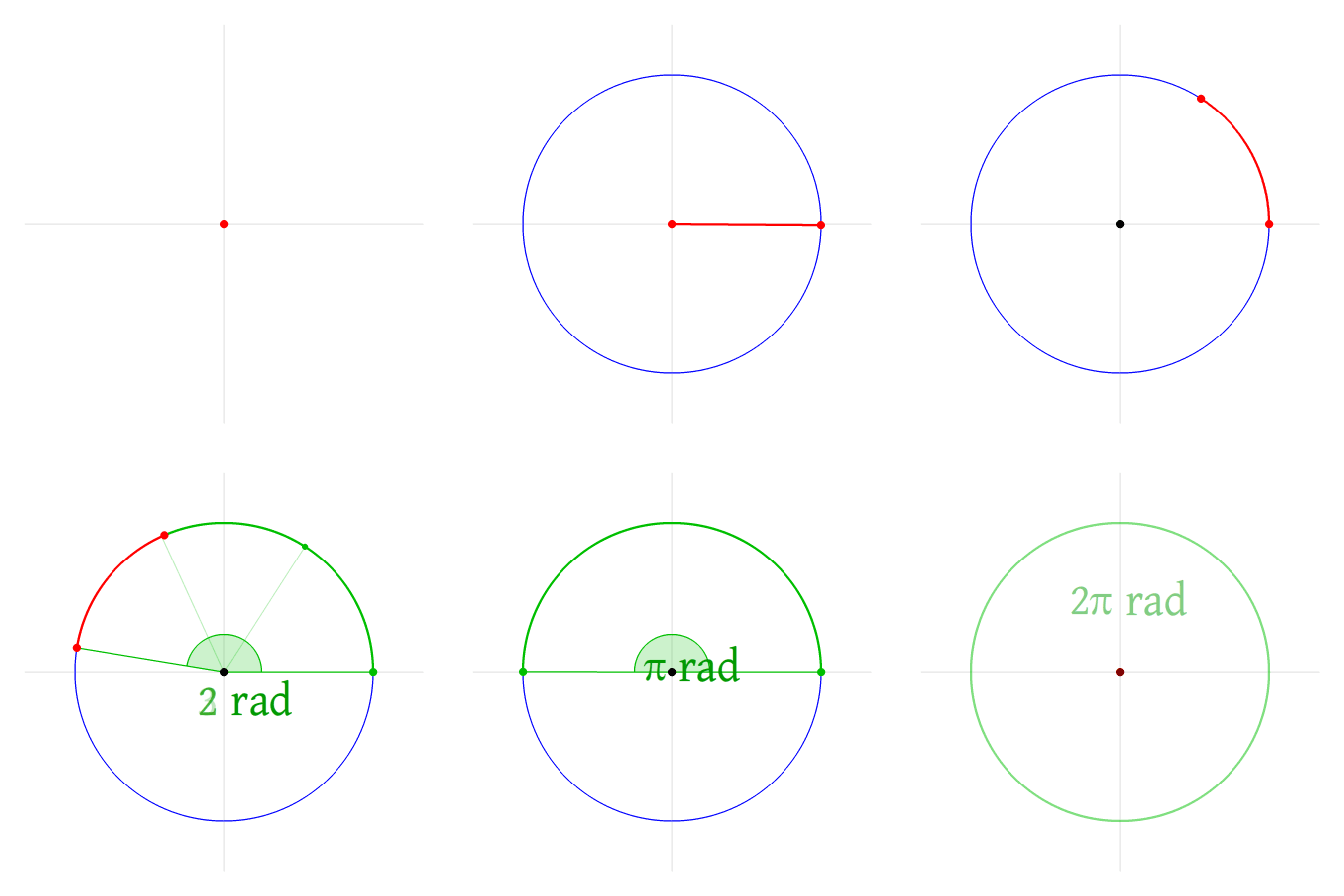
this other system uses a unit called a radien
which you'll notice is really really close to the word radius
the definition of a radien is that if you take the radius of a circle and lay it out on the circumference of the circle
it'll sweep out some angle
and that angle is 1 radien
there are 2pi radiens in a circle
so if I take the length of a radius
r
and multiply that by 2 pi
i'll have swept out a full circle
which makes sense, because the circumference of a circle is 2pi*r
take some time to read out what I wrote and if you're still confused lemme know
idle bloom
well more exactly
the angle swept out by laying 1 radius on the circumference is 1 radien
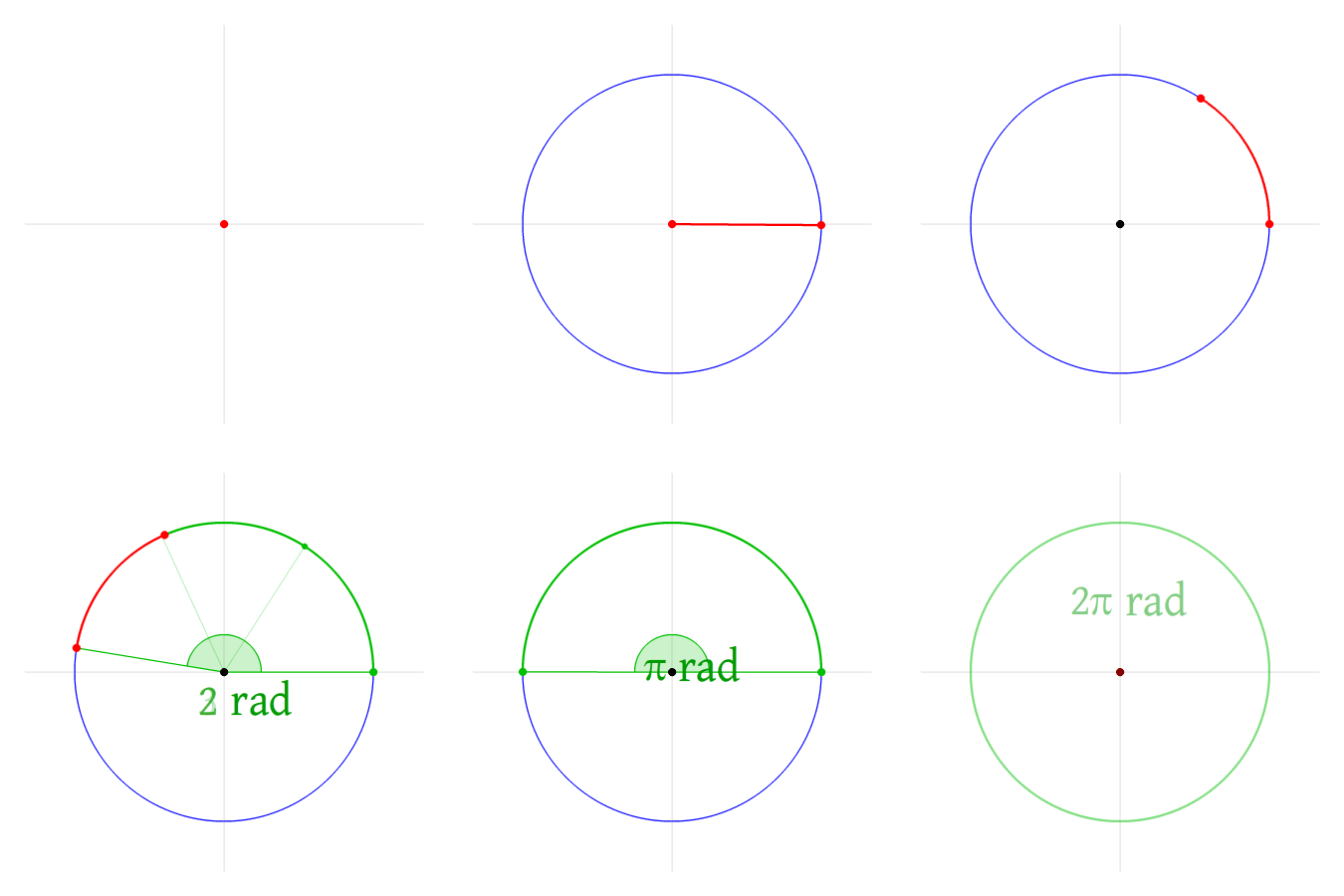 idle bloom
pi radiens is half a circle yes
rain oracle
Pi radiens
rain oracle
man thank you very much
idle bloom
both of them are angle measurements
rain oracle
And you too @dark sparrow
verbal summit
Can someone help on how’d I go about doing this
I want to say so far this is right
silent plank
b,c are wrong
verbal summit
Is b 35 and c 145
silent plank
same methods as what you were doing before
the horizontal bars are extra thick but just treat like every other line
silent plank
° yes
verbal summit
And than 70 for o
silent plank
yeh
verbal summit
Is it n 60 k 70
 drowsy walrus
yeah
drowsy walrus
B and C are incorrect
verbal summit
Than how would I get it if I don’t do 180-39
verbal summit
So 94
silent plank
yeh
drowsy walrus
Vertical angles
silent plank
why did you erase those 48°s
drowsy walrus
actually y is supp to 132
silent plank
same idea as the other parts you've just completed
verbal summit
48 didn’t seem right
drowsy walrus
why not?
silent plank
^
silent plank
Y isn't 132
drowsy walrus
Yes
verbal summit
And 180-85=a?
drowsy walrus
where did you get 85
verbal summit
180-47-48
drowsy walrus
also, if you know that alternate interior angles are congruent and corresponding angles are congruent, you’re pretty much done
verbal summit
Is it 132?
silent plank
is 'what' 132?
drowsy walrus
yep
verbal summit
Well there’s a d and it’s out of place I think it’s 21
silent plank
where?
verbal summit
silent plank
c is still wrong
verbal summit
How
drowsy walrus
b and d are wrong as well
silent plank
b and d are right
verbal summit
Is it 86
drowsy walrus
yea
silent plank
be careful with which lines are actually parallel when applying the alt angles theorem
verbal summit
So what about d
silent plank
D = 94° is fine
verbal summit
D not b
silent plank
B = 94° is also fine
verbal summit
So is d 94
verbal summit
How’s it 94
drowsy walrus
all angles in a triangle add to 180
silent plank
alternate angles on parallel lines.
also ^
if you calculated E first
and all those should be consistent
silent plank
the ones in the centre area?
verbal summit
Ya
silent plank
well firstly r is wrong
be careful with which lines are actually parallel when applying the alt angles theorem
verbal summit
68 r
silent plank
yes
verbal summit
So what about p it’s on a line with 5 which don’t make sense
verbal summit
The p is on a line with 5
drowsy walrus
5 other angles?
silent plank
thats an s
verbal summit
O...
silent plank
you need to find that angle too
silent plank
yeh
 deep pewter
$sphere: (x-1)^2+(y-2)^2+(z+1)^2=9 \ curve: l(t)=(1+t,2+t^2,3+3t^2), \quad t\inℝ$
how do I find the shortest distance from the sphere surface to the curve?
somber coyoteBOT
Squik:
 high phoenix
Does anyone know shortcuts for the problem
Cos(x+pi/4)-Cos(x-pi/4)
I’m looking for things that I can cancel instead of having to do two product to sum formulas
silent plank
did you mean sum to product?
you should only need to do it once
(also quite simple to apply angle sum identities, which is where those formulae are derived from)
high phoenix
What are angle sum identities? Like double angle and half angle identities?
high phoenix
Isn’t that Sin(a+b) = Sin(a)Cos(b)+Cos(a)Sin(b)?
silent plank
lower case, but yes
that is an angle sum identity, or similar name (compound angles)
high phoenix
Yea, are there any shortcuts for those, so I don’t have to do the whole formula?
I would imagine that there is a shortened version of those
silent plank
the 'shortcut' for that specific question would be applying the
sum to product identity directly
high phoenix
How exactly is that done?
silent plank
high phoenix
Whoah, that’s wack
somber coyoteBOT
ramonov:
high phoenix
Ah, I gotcha. I solved it but it took a lot of legwork
 tall flower

 drowsy walrus
just send your problem
upper karma
@drowsy walrus ya able to help me out?
wind heart
How would I find 2-6, 10, and 12-14 ( I don’t understand the work)
Like, how am I supposed to know which side to set the side equal to?
(For some of them)
upper karma
Can any of ya'll help me on how to do this?
drowsy walrus
if another question has been posted, please use one of the channels under math help
@wind heart just across the two transversals. the other lines are parallel, so use the line-splitter theorem
wind heart
Like
For 10
I’m kinda confused why it’s not
5/6 = 9/7.5
Like why are the 5 and six flopped
It’s weird
drowsy walrus
Be careful
Keep in mind that if you set the proportion up from bottom line to top line, you set that other proportion the same way; bottom to top
drowsy walrus
10 on the screenshot is correct
drowsy walrus
the other doesn’t matter, just as long as the corresponding parts are the same
wind heart
So like
For 2-6
Each side is congruent right
Like
How does number 3 make any sense
drowsy walrus
2-6 is correct, yes
well, you can look at it from different ways by moving the proportion around
drowsy walrus
$\frac{CD}{FB}=\frac{GD}{GB}$ can be rearranged to become $\frac{CD}{GD}=\frac{FB}{GB}$ or any way that helps you see it
somber coyoteBOT
xItzDia:
wind heart
That’s really weird
drowsy walrus
if you cross multiply, the products should all match the original
but look at it from across, not up and down
Notice that CD and GD line up and FB and GB line up
wind heart
Look at everything from across?
drowsy walrus
yes
drowsy walrus
Kk
drowsy walrus
You set them up right
Just cross-multiply
and solve like you would for any other variable
wind heart
Hmmmm
 mossy shoal
@wind heart
if u get confused about tf does parallel lines mean
Think back to slope
y = mx
wind heart
Oh I see
mossy shoal
If u have 2 slopes
m1
m2
Theyre parallel if theyre equal
wind heart
That’s a different way of putting it
mossy shoal
Jst make sure u consistent with how u comparing proportions
Or u gon goof and get wrong answer
wind heart
Thanks
upper karma
Question guys
This is a physics problem but uses trig
It’s a calculation for acceleration down a slope so a=(5/7)(g)(sin(theta))
So why the 5/7 part?
mossy shoal
F = ma 
we cant say shit unless we see free body diagram
or know more about problem
Like forces in every dir
starting from rest or wat
upper karma
Ah. I guess that’s why we were spoon fed that equation lol
We were doing an experiment on acceleration of a marble down a slope. It’s just the 2nd lab so far
I’m guessing the 5/7 has to do with friction and mass maybe? Like a friction coefficient?
languid ingot
The park has the shape of a quadrilateral. Three sides measure 50, 60, and 70. The angle between two sides of 50 and 60 is 127 degrees. The angle between 60 and 70 is 132 degrees. How can I find the fourth side's side and the size of the quadrilateral?
I found it nvm
lofty scaffold
Hey
Can someone see if I'm right?
$\frac{1}{\cos\alpha}$ is reciprocal of the cosine\
$\cos^{-1}$ OR $\arccos$ is inverse of the cosine
marble topaz
arccos and 1/cos are not the same thing
marble topaz
No
lofty scaffold
WTF
marble topaz
Oh no I see
lofty scaffold
How
marble topaz
Mathematical inverse and notational here are two different things
Cos to the negative 1 (1/cos) is actually the function secant
arccos and secant are not the same thing
The normal notation of cos^-1 is just a conventional quirk
lofty scaffold
Rokabe told me when we say cos-1 we never mean secant
 weak shoal
Yes he's not wrong
weak shoal
But if you have: $\cos^n(x)$, that's the same thing as $(\cos(x))^n$
somber coyoteBOT
Abhijeet Vats:
 grim halo
but the second one isn't the correct notation right?
weak shoal
And 'reciprocal of the cosine'
marble topaz
Second one is totally valid
weak shoal
Second one is correct.
grim halo
really, I got marked off for doing it
weak shoal
Anyways, people tend to use arccos
grim halo
guess its just a teacher quirk
weak shoal
Cos it's less confusing
marble topaz
Cos
weak shoal
Tell your teacher to suck a dick
marble topaz
Hehe
somber coyoteBOT
PristineWolf:
weak shoal
Yes that works
weak shoal
Keep in mind that restrictions need to be made such that the inverse actually exists
marble topaz
Yep, 1/cos spits out a ratio
cos^-1 spits out an angle
lofty scaffold
And the 2nd is when we will use inverse of cosine to get the angle
marble topaz
Exactly
lofty scaffold
I think I got it
grim halo
in precalc I had to graph arccos, sad times 😦
weak shoal
Keep in mind that the angle interpretation is limiting
weak shoal
These are just functions with specific definitions
marble topaz
Maybe I should stop talking
lofty scaffold
For this year teacher said only actute angles no 0° no 90°
weak shoal
Nah bandana lol, i'll let you take this one
lofty scaffold
So don't sweat on me
grim halo
i think thats because you get to those in algebra 2
marble topaz
Ah, so you won't even be worrying about the domains of the inverse trig functions
grim halo
i still get confused on that
lofty scaffold
@weary drift why did you overcomplicate it to me 1st year trig and I still have no clue what domains / images are. Will probs study 'em later the summer
marble topaz
Thank their periodicity for that one
lofty scaffold
Thanks rokabe tho <3
weak shoal
Don't worry, perspiring on you is the last thing I'd want to do 😄
marble topaz
Pff
lofty scaffold
Like intervals?
grim halo
kinda
lofty scaffold
Nvm
weak shoal
He didn't overcomplicate anything. He just said the truth as it is.
lofty scaffold
But 9th grader brain
marble topaz
They're exactly like intervals
lofty scaffold
Too tiny
grim halo
I had to graph arccos and I got marked off for "wrong work"
marble topaz
A function is defined on the interval x=whatever
weak shoal
Forget it. Understanding domains and codomains requires a bit of work with sets.
grim halo
she literally taught us to use a midline but we get marked off for it
weak shoal
So forget about it for now. Once you reach the topic of functions, then worry about it.
marble topaz
Oh wait vats is this pre-precalc stuff?
grim halo
?
marble topaz
Shoot sorry, okay I'll drop the functiony talk
grim halo
oh, that's more algebra 2