#geometry-and-trigonometry
1 messages · Page 250 of 1
 rich wolf
angle bisectors are not perpendicular bisectors
rich wolf
perpendicular bisectors are lines perpendicular to the sides that bisect the SIDES
 wind heart
So in incenters, the sides are not bisected
Thus, the outside sides are not congruent?
Like, m
Like,*
Segment AB wouldn’t be congruent
Like you wouldn’t be able to know
What half of it was
If they gave you a half
Is that right?
rich wolf
yes
 gray ginkgo
I don't understand the cos^2-1 part, is it to rationalize the denominator? I got lost here lol
 silent plank
no one should understand it because the "2-1" is complete trash
 dusty coral
In the given figure, PQRS is a quadrilateral S = 80deg, R = 110 deg. OP and OQ are bisectors of angle SPQ and angle RQP. Find POQ.
silent plank
what have you tried?
rich wolf
@dusty coral is it just a quadrilateral or a specific type
can't tell from the image but looks like a trapezoid
silent plank
(assume its scalene)
dusty coral
wdym assuyme scalene
silent plank
in response to AMD.
probably bad wording,
don't assume anything about it
but anyway, what have you tried?
(if you've tried nothing and have completely no idea then say so instead of making me wait)
👻
dusty coral
huh
oh my cousin asked me to help him in this
and i didnt get it
thats the exact wording of the question
silent plank
how much geometry do you know?
angle sums of polygons, definition of bisection, basic algebra should be enough to solve this
and maybe get them to come here too
 tacit karma
@dusty coral Lets name the angle bisectors x for angles SPO and OPQ, and y for angles RQO and OQP. Also, name angle POQ, z.
The sum of all angles in a quadrilateral is 360, so 2x+2y+80+110=360
solving for x+y, we get that x+y=85
Setting up an equation for the sum of all angles in triangle POQ, we get that x+y+z=180.
By subsitution, 85+z=180, and z=95.
Therefore, angle POQ is 95 degrees.
If I get the name of the angles wrong, I thought the O looked like a Q in the picture.
 eager kraken
how do i find the S arc length of a circle from a radius and radian per minute?
 dark sparrow
what
eager kraken
like how do i find linear speed, angular speed, anything from radians per minute
i can solve for when there is just 2 variables of S=r(t)
but I have no clue how to find theta when they give me a rate like radians/degrees per minute
A wheel rotates at 4 radians per second. The wheel has a 30 in radius. To the nearest foot per minute, what is the linear speed of a point on the rim?
I was told to do 30(4)/sec
but does this give me 120 rad/sec or 120 in/sec?
eager kraken
i get that problem now, i just plug in via v=rw
got 600ft/min
but now i'm confused on this next problem
2 pulleys of diameters 9 and 3 meters are connected by belt. The larger pulley rotates at 47 times per minute. Find the angular speed of the smaller pulley
(convert from 47rpm to rad/min) 47rev/min * (2pi rad/rev) = 94pi rad/min
v = wr = 94pi rad/min * 4.5 = 423pi rad/min
^^^ is the angular speed of the larger pulley correct?
423pi rad = 1.5pi rad * x
x = 282pi rad/min
ik this is wrong but idk where it is wrong (please ping me)
 fervent garden
im sorry if this is a simple question but when finding a unknown angle, what does sin-1(3/5) actually do?
i understand how to do the formula but i like knowing what it actually does
dark sparrow
$\sin^{-1}(3/5)$ is by definition the angle between $-\frac\pi2$ and $+\frac\pi2$ whose sine is $\frac35$
 somber coyoteBOT
Ann:
 desert pond
not sure if this is the right spot
but I want the red line to be perpendicular to the blue
what would the equation be for red? I know blue is (0,1,0)
 twin prawn
How about (1,0,0)
desert pond
@twin prawn mm i know that's one, but what if i wanted the line to start at x=0.5 as opposed to the origin for it to be perpendicular
 tropic stirrup
wouldn't (0, 1, 0) be the unit vector j
 thick sonnet
In 3d, your lines will either be parallel, skew, coincide, or intersect once. To be perpendicular, the two lines MUST intersect. Once you know where they collide, you need to check if the two lines are perpendicular using the dot product formula. If you are looking for the equation of THE perpendicular line, you are asking the wrong question. There are infinitely many solutions. If you happen to find a line perpendicular to blue, you'll notice you can revolve the red line around the blue line and still be perpendicular. If you are looking for ANY perdendicular line, make a line that intersects with the blue line, but does not coincide, take the cross product of both lines and you will have a valid red line, that is perdendicular to both of the other lines. If you want to continue this topic, a better fit is probably #linear-algebra , although I'm not 100% sure. Hope this helps :) @desert pond
 gentle dome
Would it make sense if I said 365 degrees is congruent to 5 degrees?
Or they are completely distinct angle measures?
rich wolf
@gentle dome yes you can say they are congruent
 upper karma
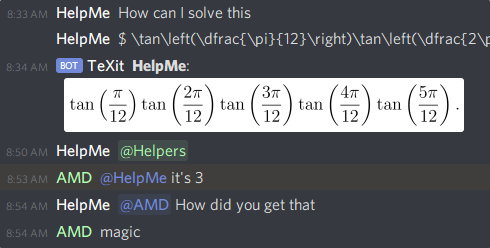
How can I solve this
$ \tan\left(\dfrac{\pi}{12}\right)\tan\left(\dfrac{2\pi}{12}\right)\tan\left(\dfrac{3\pi}{12}\right)\tan\left(\dfrac{4\pi}{12}\right)\tan\left(\dfrac{5\pi}{12}\right).$
somber coyoteBOT
HelpMe:
upper karma
<@&286206848099549185>
rich wolf
@upper karma it's 3
upper karma
@rich wolf How did you get that
rich wolf
magic
upper karma
???
,w \tan\left(\dfrac{\pi}{12}\right)\tan\left(\dfrac{2\pi}{12}\right)\tan\left(\dfrac{3\pi}{12}\right)\tan\left(\dfrac{4\pi}{12}\right)\tan\left(\dfrac{5\pi}{12}\right)
somber coyoteBOT
Requested by HelpMe#8715
 rich wolf
i was close
upper karma
No you weren't?
silent plank
angle sum identities or other
 twin bobcat
do you know how to compute tan(pi/12)?
upper karma
No I am supposed to use some kind of identities like ramonov said
But I don't know how
@silent plank How do I do that
twin bobcat
ohhhh!!!! I see the trick now
silent plank
tan(x) = sin(x)/cos(x)
upper karma
So
That's just the definition of tan
I don't know how to use it to solve it quicker
twin bobcat
there are some useful relationships between tan(x) and cot(x)
upper karma
Like
silent plank
just anything with both tan and cot in it
silent plank
tan(x) * cot(x) = ?
upper karma
1
silent plank
cot(x) = tan( ? - x )
upper karma
Not sure
silent plank
draw a triangle and it should be pretty intuitive
silent plank
yes.
also note that the 3 tans in the middle have special angles
upper karma
They have pi/4 = 1 and pi/3 = sqrt(3) and pi/6 = sqrt(3)/3
silent plank
missing the tan()
upper karma
Tan of those angles I mean
silent plank
and what do you get when you multiply those 3 together?
upper karma
1/3
silent plank
that won't get you 1/3
somber coyoteBOT
ramonov:
upper karma
Now what
upper karma
tan(pi/2 - x) = cot x
silent plank
pi/2 - x = 5pi/12
x = ?
upper karma
pi/12
silent plank
hence
tan(5pi/12) = cot(?)
upper karma
cot(pi/12)
somber coyoteBOT
ramonov:
 surreal roost
How do I do this?
 fringe crater
Tan(66 degrees) * 5 miles = Length BC
You are looking for the relationship between AB and BC
It's a right triangle, so you can think of AB as the adjacent side and BC as the opposite, and since Tangent = Opp / Adj for a given angle, multiplying Adj * (Opp / Adj) = Opp, which is BC
 cobalt turtle
darn it, i actually knew something for once and you beat me to the punch
 mellow sedge
Having trouble solving for x here. Its proportions in triangles
Number 8 specifically
cobalt turtle
try setting the sides that are proportinal to one another equal to each other in a ratio form
i would write it out with the bot but i have no idea how to use it
mellow sedge
The problem is, when I set it up, I always end up with an exponent, and I dont believe that's what I am looking for
upper karma
I have a question
upper karma
what is the projection rule
cobalt turtle
this is a hella late response and might not even be usefull but remember the big triangle is (x)+(x-2) for one side and (x+4)+(9) for the other, while the small is just x and x+4
upper karma
Why are you complaining about exponents?
It’s okay to have an exponent as long as x isn’t negative
 idle bloom
I think he means that he's getting exponents but that's clearly not on the right path
 hardy bay
$$\frac{9}{x-2}=\frac{x+4}{x}\rightarrow 9x=(x-2)(x+4)→ x^2-7x-8=0$$
somber coyoteBOT
jnkena:
hardy bay
It must be pq=-8 p+q=7, so p=-1 and q=8, i.e. x=-1 or x=8
gray ginkgo
having trouble the conversion here, ik it's .20 instead of the 12` but i don't know how to convert the answers
upper karma
can someone explain why cos(pi/2 - theta) and sin(pi/2 - theta) work the way they do?
hardy bay
How do they work?
upper karma
<@&286206848099549185>
 obsidian moon
try drawing a right-angled triangle
let one of the angles be 90, let the other be theta and the third be 90-theta
then try finding the cos and sin for both theta and 90-theta
upper karma
@obsidian moon yeah i know about that, but what if the triangle has an angle larger than 90 degrees so its not a right triangle?
helpers you here?
rich wolf
@upper karma think about it
It is the same as ordinary sin and cos but starting at pi/2
And going the negative direction
Instead of starting at 0 and going counter- clockwise you start at pi/2 and go clockwise
upper karma
ok but what does that say
rich wolf
Look at the values of those functions for specific values of theta
Like when theta is 0 vs when theta is 2pi
You will come to see that those two functions are actually just much simpler functions
It is an identity
rich wolf
Literally what i just said
Instead of starting at 0 and going counter- clockwise you start at pi/2 and go clockwise
upper karma
yeah what now
rich wolf
Look at the values of those functions for specific values of theta
rich wolf
Just do it lol
upper karma
but that's not a proof??
rich wolf
If you can prove that two functions have the same y value for a given x value at every possible value of x, then they are the same function
upper karma
yeah and i can't do that by just plugging in random values
since there are infinitely many?
rich wolf
Thats how you find the function to compare it to
obsidian moon
you'll notice that there's similar triangles going on
when you create a triangle at both theta and 90-theta
my bad, congruent triangles*
rich wolf
Then you can test the equality by setting the function you have and the function you think it is equal to against each other, and if it forms an always true statement (like 1=1) then it is true
upper karma
thanks @obsidian moon
obsidian moon
@rich wolf that's a very bad proof of why it happens, thats just checking that it happens
upper karma
yeah i agree that was my point
rich wolf
You run into the same problem with your method
You must test every single angle and triangle to "prove" it
obsidian moon
it's only testing it in four quadrants
there are also other algebraic proofs
but assuming ur just learning cos(90-theta) and sin(90-theta), this is the best explanation
upper karma
yeah i agree that explanation is good, i just found it incomplete
since you know, obtuse triangles
obsidian moon
yeah so you can redo it for angles like 210
and 330
or something like that
and that'll prove it for all angles
 dire rampart
what have you tried
 surreal bolt
nice problem
 buoyant idol
i tried changing it to 1/sec(x)
but i dont get what cos^2(X) means
wait is it the same as 2cos(x)?
 weary drift
$\cos^2(x)$ is another way to write $(\cos(x))^2$
somber coyoteBOT
RokettoJanpu:
dark sparrow
don't confuse confusing math with confusing notation
buoyant idol
but confusing confusing notations with confusing math is just confusing confusing math
wait how would i solve that problem?
dark sparrow
...factor the num and denom lol
would you be able to simplify the algebraic expression $\frac{1-t^2}{t-t^2}$?
somber coyoteBOT
Ann:
dark sparrow
i suppose so
 ember ermine
instructions in spanish but it just says find the result in terms of x, how is this done?
dire rampart
what have you tried
ember ermine
i dont know what they are referring to, like the ABC with the ^ above it neither what does it mean to equal to 90
dire rampart
have you drawn the triangle?
that just means angle ABC
so the angle formed by the sides AB and BC
ember ermine
is that just saying theres a right angle?
dire rampart
yea
ember ermine
and with BCA does that mean the other 2 angles are just thetas?
dire rampart
theta and alpha
ember ermine
so if i just draw a right triangle, the one at the bottom right would be theta and the top would be alpha?
 worthy lichen
Hi I know this is very dumb, but what's the difference between a πrad and a rad? I know in one of those π is multiplying but I am stuck
worthy lichen
why is pi multiplied
tacit karma
You are given a sheet of paper with a surface area of 1 unit. Assuming that you can form any 3-d shape using that sheet of paper, what 3-d object should you form the paper into to lend the greatest volume?
rich wolf
@tacit karma the paper stuff is all extraneous information
it's just asking this
what 3d shape has the greatest volume relative to its surface area
tacit karma
ye
rich wolf
@tacit karma you can kind of draw an analogy to 2d space
2d surface area is perimeter
2d volume is area
tacit karma
how does that help?
rich wolf
Think about it: if you have 1 meter of yarn, how can you make a shape such that it has the maximum area
tacit karma
ummm
rich wolf
Such a shape must have a special property
That every point on the yarn is equidistant from the center
I pretty much just gave you the answer there but idk how else to explain it
tacit karma
i have to prove it
i know it's a sphere because of a pattern
but...
like
i don't know why??
rich wolf
That every point on the sphere is equidistant from the center
tacit karma
.-.
nvm
imma just read the explanation on the internet
Oof
When did calculus get involved in this
 marble topaz
There's no calc involved in this
rich wolf
Lmao
 raven summit
 quiet mason
i think the small triangle(with the side 5) containing angle alpha and the other small triangle opposite to it(also with a side 5) are congruent (AAS)
 queen python
 visual mist
how do i do this
 thorn talon
What have you tried
visual mist
idk how to do it
visual mist
m is gradient??
quiet mason
yes
so y9u have to get it in the form y=mx+c
m is the gradient
ax+by=c means by=-ax+c
and y=(-a/b)x+c/b
m=-a/b in this case
 earnest acorn
b (the one I circled)
silent plank
,rotate
somber coyoteBOT
 forest jackal
I have question
f(x) = cos(90° - 180° / x) * x
what is this formula used to solve
or what will this solve

@halcyon coyote
@lavish drift

 lavish drift
 tacit karma
@earnest acorn just use Pythagoras theorem
earnest acorn
@tacit karma but how
 void owl
When I'm dealing with radians, how will I know what the radian is? Where does a person learn that pi/4 is sqrt(2)/2 ?
And how does that translate into being 45 degrees? I mean I know that pi radians is 180 and 180/4 is 45 but ... ohhh
I get the second part, but I still don't know how I'm supposed to know it's sqrt(2)/2
void owl
cos pi/4 is
silent plank
ratios for special angles
which can be derived from
equilateral and right isosceles triangles
void owl
Am I going to be able to use a calculator in my college trig course?
silent plank
depends on the questions
if you're dealing with special angles, you shouldn't (even if you have access to one)
but for non special angles/ratios you may be asked for approximations which will require a calc
void owl
Where can I learn this kind of information? I'm following this video (3rd in the basic trig series) https://www.youtube.com/watch?v=znR9tW4AiZI

Using Trigonometric functions to solve the sides of a right triangle
And it hasn't been mentioned before
silent plank
what hasn't been mentioned?
void owl
The special angles
Like, have no idea how I would know cos(pi/4) would be equal to sqrt(2)/2
silent plank
not mentioned in parts 1 and 2?
void owl
No
silent plank
usually they would give you a table with those angles
try deriving it from a right isosceles triangle
using cos(A) = opp/hyp and pythagoras
void owl
a^2+b^2=c^2 yeah?
 woven ocean
😦
my question has been ignored

so this is what it feels like being rejected
i understand so many aspects of life now
maybe i should give up on math and start the philospical path
void owl
Have you tried khan academy?
woven ocean
😦
upper karma
#linear-algebra @woven ocean
upper karma
it involves matrices
upper karma
is this high school geometry?
woven ocean
Yes
upper karma
what textbook
upper karma
oh
upper karma
you live in holland?
woven ocean
No belgium
But i think i found a better way to solve it
So its fine 🙂
Its just sad that i dont know how to do this particular one
|x+2 y-7 z-3|
|2. -7 3 |
|1 0 2 |
Will give the same result
woven ocean
Yeah
But gauss has multiple i thought
Do u mean n(n+1)\2
Or his laws on complex variables
 odd cairn
jesus died for our sin(53) = 53/x
silent plank
let x be height of hill
and y be horizontal distance
 radiant venture
mhm
silent plank
and use the appropriate trig function(s)
silent plank
use that to help find the horizontal distance in terms of x
silent plank
actually scratch that
realised there was a much better way
consider applying the sin rule to the white triangle
@radiant venture
odd cairn
um where is the cotangent button on a calculator
silent plank
there isn't one on most calcs
silent plank
on mine its represented by the $x^{-1}$ button
somber coyoteBOT
ramonov:
silent plank
or you could do: $1\divisionsymbol \tan(\theta)$
silent plank
or you could do: $1\divisionsymbol \tan(angle)$
somber coyoteBOT
ramonov:
odd cairn
oh it worked thank u
gray ginkgo
I got lost here, ik I need to use the law of cosines somewhere but I'm just so confused
void owl
When you get the function of an angle, we'll call it x (example Cos(x) = a/h) the answer is in radians- correct?
void owl
Okay, so the output of a trig function is a ratio?
marble topaz
Yep!
void owl
Okay, simple enough.. I get it... But I don't "get" it. I don't see the relations- so far they're just like SOH CAH TOA.. I know how to do that to solve what they want, but I don't really- visualize it?
marble topaz
Think about the sine of 30 degrees for instance
It's 1/2, right?
Literally the opposite side, 1, over the hypotenuse, 2
No matter how you stretch or scale that triangle, if that 30 degree angle is there that sine will always be that ratio of 1/2
Does that make more sense?
Later in the semester, you will graph these thingies called "sinusoidal functions" where the application of sine/cosine/etc as functions will make more sense
void owl
Okay, I get that.. It's a ratio of the size of the triangle?
void owl
So trig functions express the ratio of the triangle?
marble topaz
Specifically, they relate the angles of some triangle to those ratios
But yeah it sounds like you've got the right idea
void owl
Okay cool
If I give you a problem, could you tell me the concepts I need to learn in order to solve it?
marble topaz
Yep!
void owl
marble topaz
Although, really you should be following along with whatever your teacher has been covering.
If something doesn't make sense it's probably in your notes
Oh for this one the solution is right there. Is there something about it you don't understand?
void owl
So.. here's the thing. Trig is required for my degree, I start this fall- I just wanted to get a head start
marble topaz
Ahhh I see
void owl
Trig is really the only thing that I can see myself having a problem with
marble topaz
So for this problem they start with some super big angle and find something coterminal, which essentially means an angle with an equivalent terminal side (if you don't know what initial/terminal sides are lemme know)
void owl
Consider me absolutely new to trigonometry and geometry
marble topaz
For these sorts of problems, you want to have a strong familiarity with the unit circle and degrees-radians
void owl
Okay, so I'll check online lessons on the unit circle then
void owl
I just know that across the x axis, the 180degree arc is pi
void owl
and points on that arc can be expressed in radians.. like 25 percent of 180 being 45, or pi/4 rad
But That's about all I know about the unit circle
marble topaz
Exactly
So go ahead and do some practice sheets with it, make yourself comfortable with the different properties
void owl
Okay so any coterminal angle to say 45 degrees.. would be all angles of 45degrees+360degrees?
wait, lemme draw it
Like this?
If I'm interpreting this correctly, as long as the angle measurement starts at the initial and ends at the terminal, the angles are coterminal.
 coral basin
that is correct @void owl
 cedar hedge
dark sparrow
cedar hedge
dark sparrow
what have you tried and where are you stuck
 tardy junco
If b1 and b2 are the directions of two skew lines, how do you find the direction of b1 x B2 (cross product)?
The vector of cross product of two vectors is supposed to be perpendicular to the plane containing the two vectors. But here the skew lines arent on the same plane at all
Please mention me @tardy junco if you reply
upper karma
@glad falcon Making a solution
 glad falcon
I think
is it meant to be
2 < 1.85 -0.95cos ...
like that?
would i be right??
@upper karma
somber coyoteBOT
Solvable Quintic:
$2=1.85+0.95\cos\frac{\pi}{6}t$
 dry bough
c = 2,025
?
somber coyoteBOT
Ann:
 fringe dirge
just find all of the shaded area + the middle circle
and then subtract out the middle circle
Find the area of sector AEBF in the left circle
and then subtract out the area of triangle AEF
Well you know all the lengths
 novel olive
Do the bases of a prism need to be equilateral?
As in, could a make a prism with a trapezoid as it's base?
 woven wigeon
confused on how to start this
dark sparrow
do you know what it means for a number to be a root of a function
 fleet path
This is fun problem NOT for HW. Ping me if you have an answer. I have an answer but would like some peer review 😅
 gritty sail
@fleet path ||3/5||
fleet path
@gritty sail I agree I got that as well
gritty sail
how did u do it?
i dont think i did it the right way
cuz my way was hella long and bad
fleet path
I used
Pythagorean theorem
Congruence of triangles proof
Represting unknown length with variables
It took me a good 45 mins to realize that was all I needed
marble topaz
Oh that's a fun problem
fleet path
That's what I did
Yeah these problems look deceptively hard but all you need are the fundamentals
marble topaz
There are way quicker ways to do that
fleet path
My work had a step that was kinda unnecessary after I consulted with someone else
Nah I didnt need quadratics for it
Just squaring and square root calculations from Pythagorean theorem
@marble topaz did you also get ||0.6||
marble topaz
I haven't done it myself but that answer makes sense
eager kraken
Does anyone know why my calculator shows X (sub 1 T) and Y (sub 1 T) in the Y= menu screen?
it's also not graphing when i plug equations in the screen
marble topaz
I forget exactly what that mode is called, but you can reset it by going
2nd-->+-->7-->1-->2 to reset your calculator
eager kraken
defaults & ram or just defaults?
marble topaz
Either one should work
Also that screen you were on is (I think?) For linear regressions or some other statistics plotting tool
marble topaz
Yw
It it does you can always reset
Check mode too if it happens again, maybe you misclicked when converting between radians and degrees or something like that
eager kraken
yeah that's pretty likely
rich wolf
@eager kraken dude you dont have to reset
Just do mode
Then function
The T is for parametric eqs
marble topaz
@rich wolf I figured it was something ez, thanks for stepping in
 faint cove
Distance of origin to the plane is d(x, y, z) = sqrt(x²+y²+z²), minimizing it will result in the perpendicular distance. However, the minimum of that will be the same as the minimum of the function f(x, y, z) = x²+y²+z², so we can just use this. Let g(x, y, z) = 2x-3y+4z, to constraint f to g, then ∇f = λ∇g (Lagrange multiplier). So we'll get 2x = 2λ, 2y = -3λ, 2z = 4λ, and from the question 2x-3y+4z=6. Solving for x, y, and z in terms of λ and substituting it to the final equation, we'll get 2λ-3(-1.5λ)+4(2λ) = 6, giving λ=12/29, hence, substituting it to x, y, and z, you''ll get (x, y, z) = (12/29, -18/29, 24/29)
faint cove
g is from the question, however it is generalized as a multivariable function g(x, y, z) instead of the level curve at 6
faint cove
means when 2x-3y+4z=6
tardy junco
@faint cove why are we constraining f to g? Because g will give the perpendicular distance?
And by the way I don't know what is a Lagrange multiplier. But I take it that what you wrote is parametric form of a line..?
Btw I'm pre-university. 
Please mention me when you reply Kelfran. And thanks.
faint cove
So basically the ∇f is the partial differentiation of f in x, y, and z (also the same for ∇g). You can put this into vector form, (∂f/∂x, ∂f/∂y, ∂f/∂z). Now observe that if u differentiate f(x, y, z) = k with respect to x, you will get (∂f/∂x)(dx/dx) + (∂f/∂y)(dy/dx) + (∂f/∂z)(dz/dx) = 0 by chain rule, getting you ∇f •(1, dy/dx, dz/dx) = 0. You can see that (1, dy/dx, dz/dx) is a vector tangent to the level surface f(x, y, z) = k, because moving 1 unit in the x direction gets you the slope dy/dx and the slope dz/dx, hence because ∇f •(1, dy/dx, dz/dx) = 0, ∇f is a vector that is normal to the function (perpendicular to tangent). Now for f(x, y, z), the ∇f will vary at different values of x, y, and z. So, how would you constraint f by g? Well when f touches g at a point x, y, z, f will have a vector (∂f/∂x, ∂f/∂y, ∂f/∂z) that is normal at that point, and g will also have a normal (∂g/∂x, ∂g/∂y, ∂g/∂z) at that point. The vectors aren't the same value tho, so we need a constant λ, which is called the Lagrange multiplier to multiply any one of them, because they're just a multiple of each other, since vectors in the same direction
@tardy junco
tardy junco
What is level surface
By the way I don't know multicariable calculus either but I will try to understand what you're saying because you typed a lot and spent a lot of time. And I appreciate that
And why derivative wrt x of the (upside down triangle)f is zero
Okay this is very complex for me. I'm sorry 
faint cove
differentiating k by x = 0 because k is a constant
faint cove
For functions with just one input, f(x), it will have different level points when f(x) = k (k∈R). For functions with two inputs f(x, y), it will have different level curves when f(x, y)=k, you can see here why it's "level" because it just means the corresponding level curve when the Z axis equals k. For three inputs f(x,y,z) it will have different level surfaces when f(x, y, z)=k
Try visualizing it, let's say f(x) = x^2, so at f(x)=k and k=1, the level points are (-1, 1) and (1, 1). Now try two inputs, z = f(x, y) = x^2 + y^2, if you make f(x, y) = k and k = 1, you will get x^2+y^2=1, which means at z=1, the graph has a circle shape with radius 1 if u see it from above, projecting it down to the x-y plane, so in general the graph will look like x^2+y^2=k at different levels of z, you can see that the graph would look like circles getting larger and larger from 0, 0 up to infinity (up the z axis), or basically rotated parabola. Now for f(x, y, z) = x^2 + y^2 + z^2, making f(x, y, z)=k will result in different level surfaces of x^2 + y^2 + z^2 = k, so the graph changes at different levels of f(x, y, z) in the "4th axis"
upper karma
The pilot is flying at an altitude of 4 km. He has an angle of depression of 18.3° to the airport.
How much further does the plane have to travel to reach the airport?
am i suppose to use sine to solve this?
twin prawn
The question is ambiguous  reaching the airport at the same altitude or at ground level?
faint cove
y e s
upper karma
How would I find one of the three altitudes of any triangle computationally?
I know all of the sides
I wanna find that point d and length x
Computationally as in no handwise tools
 strong notch
tacit karma
strong notch
tacit karma
NA , and ND are equal to 5x
draw x so that it is the midpoint of
AD
NX is 3x by symmetry
triangle ANX has sides 3x, 4x, and 5x
tan^-1(4x/3x)
you get 53.13
since this is only one triangle
you have to double it
and you can figure that yourself
 warm frigate
Any tips on learning verifying identities
 proper hawk
 dry mirage
 storm rover
In class we had to find a formula for the centroid of a triangle and show and derivation and such. I've done some research into this and found that all the methods used to show it uses some different theorems that we haven't learned yet. So is there a way to find the formula for centroid coordinates algebraically, so with some variable vertex value. And finding the median intersection. If so, what might that look like? I've been trying to do it and it seems as if I'm writing a bunch of variables and getting no where
 pastel anvil
AB=x BC=2x BD = 4x
All the triangles are similar (u should be able to determine this) and the sides are in proportion
AG/AD = AF/AC
substituting, 190/7x = AF/3x
AF=570/7
AF/AE = AC/AB
substituting, 570÷7/AE = 3x/x
AE = 190/7
AF-AE=380/7
AF-AE=EF
 austere knot
https://prnt.sc/r4ws36
I need help how to turn into a equation

I see the amplitude is 5
and it is a cos graph cause of the bowl line
I also see that it crosses the x-axis at 1.5 and 4.5
I got the 5cos(????)
Figured it out
^
glad falcon
need help solvign this
thorn talon
Hmmm
glad falcon
@thorn talon ...
glad falcon
no i am not llol. I am getting different answer from different people.
making sure if I am right
11:41 right?
@dark sparrow
dark sparrow
11:41:49.2 to be exact
 formal hamlet
How do I figure out the value of 3 Tan 180?
tan=y/x
so therefore 0/-1 (3) ?
0*3=0 ?
 keen aspen
formal hamlet
keen aspen
formal hamlet
thank you.
csc 270=(0,-1) x,y
so then r=\sqrt 0 ^2+-1^2 ?
because csc=r/y right?
 faint orchid
Hi, would anyone be able to help me with this? I know the main diagonal is 10cm from intuition but i'm trying to figure out the other
Are there any formulas for kites I should know?
 woven stag
How'd you find 7? Where are the angles?
I get 3; it's because the 13 is the length of long side (10) plus half the short length (3).
 glad falcon
@dark sparrow What steps have you took?
faint cove
I got 12:34:36.18 pm to 15:00
glad falcon
i plotted the graph
and then shifted it.
and then solved for the 6 hours.
ya idk what I am doing 🤦
dark sparrow
i graphed it
glad falcon
Yes..
i mean i can do it on desmos obvs.
but without using electronic stuff online
dark sparrow
glad falcon
Ya i can do that. but like how do you solve
Hmm : ((
literally spent like 3 hours on this problem 🤦♂️
Man i suck.
wait i checked and it seems like im right?
because does it need to be .
from 2pi/2.08 to 2pi/1.08
as its 6 hours?
from 9 to 3
faint cove
1.75 - 0.91 sin(0.52t) > 2, 3 ≤ t ≤ 9
sin(0.52t) < -0.25/0.91, 3 ≤ t ≤ 9
Because -0.25/0.91 is negative, the arcsin() is defined in the 3rd and 4th quadrant:
For QIII:
0.52t > π+arcsin(0.25/0.91)+2πn, n ∈ Z, 3 ≤ t ≤ 9 (Switch sign because sin(-0.25/0.91) should've been negative)
t > 6.57672 + 12.08305n, n ∈ Z, 3 ≤ t ≤ 9
for t to be defined, 6.57672 + 12.08305n ≥ 3 -> n ≥ -0.296011, n ∈ Z
hence, for minimum t, n=0:
6.57672 < t ≤ 9
12:34:36.18 - 15:00
For QIV:
0.52t < arcsin(-0.25/0.91)+2πn, n ∈ Z, 3 ≤ t ≤ 9
t < -0.5352+12.08305n, n ∈ Z, 3 ≤ t ≤ 9
For t to be defined, -0.5352+12.08305n ≤ 9 -> n ≤ 0.789139, n ∈ Z
hence, for maximum t, n=0:
3 ≤ t < -0.5352
No solution
 stark ferry
quiet mason
stark ferry
quiet mason
yes
square both sides
you can use your calculator for sqrt12
13*
,w calculate sqrt(13)
somber coyoteBOT
 Requested by NoaH#5497
dark sparrow
Requested by NoaH#5497
dark sparrow
$2\sqrt{13} + \sqrt{17} = \sqrt{x}$?
somber coyoteBOT
Ann:
somber coyoteBOT
Ann:
idle bloom
Teachers want students to simplify 😔
So you gotta expand it as much as possible and combine like terms
It's stupid but I guess it's good to know how to do that
glad falcon
@faint cove THank you but I don't understand this part
sorry I am very new to this .
austere knot
https://prnt.sc/r5byfm
Not sure where to start on this question
Any help would be nice
 upper karma
Basically the rate of change over a greater area than at one point
upper karma
@austere knot
idle bloom
if you haven't learned calculus yet (I'll presume you haven't)
the average rate of change of a function over an interval is the slope of the line connecting the two end points of the interval
 umbral sparrow
does anyone have recommendations for trigonometry textbooks / lecture series at high school level?
basically for someone around 16
marble topaz
I keep recommending Khan academy to peeps but they do a good job building up from simple right triangle trig to more difficult stuff
umbral sparrow
eh from my experience khanacademy isn't very helpful for learning concepts, but it's great for revising stuff you already know / using it for extra practice problems
faint cove
@glad falcon so there’s this angle arcsin(-25/91), you need to find where it is the same in all quadrants to find all the possible cases. The first case would be the simple arcsin(-25/91) which lies on the 4th quadrant because arcsin(-25/91) > -π/2 (meaning if you visualize it, it hasn’t passed to the 3rd quadrant). Now just add 2πn at the end (n is an integer), to say that this arcsin(-25/91) will be the same if I add 360 degrees everytime. For the second case, we have the 3rd quadrant because we know arcsin(-25/91) is negative, so now, the easy way to do this is imagine the angle -π [180 degrees clockwise], then subtract the angle arcsin(-25/91) [arcsin(-25/91) radians anti-clockwise], you will get -π-arcsin(-25/91)+2πn. My way of visualizing it was by knowing that arcsin(-x) = -arcsin(x). So, from π [180 degrees anticlockwise] then I add this angle -arcsin(-25/91) = arcsin(25/91) to it (same thing). We switch signs because in the normal QIV test, it’s gonna be “<“ (clockwise), we need to limit it by switching sign to “>” (anti-clockwise).
wind heart
How do I do 12? It’s “find x and the indicated measure”
I just copied the teachers work btw so I don’t understand it
somber coyoteBOT
Mi0:
wind heart
Nope I’m not at all
I’ve heard of sin, but never learned it
I’ll probably learn that at the end of the school yeah
upper karma
so since the triangles are similar you can set their sides up proportionally so that you can solve for missing sides
wind heart
I know how to find x, but not u
y*
I don’t know where y came from, but it’s just there
wind heart
Ohhhh wait a sec
upper karma
$\frac{20.7}{y} = \frac{15}{11.25}
wind heart
Alright let’s see
somber coyoteBOT
Mi0:
Compile Error! Click the  reaction for details. (You may edit your message)
upper karma
no that only works with right triangles
wind heart
Oh
upper karma
solve for y in that equation above instead
wind heart
never knew triangles had privileges
Let’s see
Oh I see
Also question
When you uhhhhh
Complete the proportion
Can you also do
20.7/y = 10/7.5 ?
Or can you only use 15/11.25 as the other fraction because it is the scale factor
Also, I got 15.525 but my teacher got 15.25 for y
upper karma
well you can but if you make a mistake then this answer will be wrong as well
Its fine though, just less mistake
wind heart
Hmmm ok
upper karma
i got that answer too
wind heart
15.525?
wind heart
Alright one more question
For 27 & 28, why would the perimeter be in the denominator?
I mean like
Why would the small triangle count as the numerator and the large as the denomenator?
It just doesn’t make sense to me
faint cove
<deleted to remove confusion>
 spiral niche
I'm pretty sure the larger triangle should be in the denominator...
wind heart
My teacher said it was large/small
spiral niche
It's all about the ratio
faint cove
Oh right I didn’t read the question
spiral niche
if you do large/small then change the ratio to 4/2
wind heart
Oh
spiral niche
the larger has to be on the same side as the larger number in the ratio
like of top or bottom
faint cove
Yeah
 digital gulch
Cool
 prisma spruce
I got absolutely no clue how to approach any of those
Are there any theorems for this?
prisma spruce
I could do that, but how would I find the radius then?
pastel anvil
uhh
fucken
the other bit of the radius that doesn't have a measure
that's r-5
draw from the center another rradius to the vertex of the base of the isoscles triangle
that's r
and then use half the base as the other side
For the last one AB is a radius
Radiii of same circles are equal so AB=AD
of course if u draw radii then remeber that radio are congruent
faint cove
Circles and triangles are best friends
prisma spruce
Thxx
 crisp phoenix
guya
guys
i really need help with these 3 problems ive been stuck for 2 hours and dont know how to do this 😢
hello?
spiral niche
@crisp phoenix what are the problems?
crisp phoenix
spiral niche
Do you remember your 30/60/90 triangle rules?
crisp phoenix
h = 2 x s and l = 3 x s
crisp phoenix
yeah i just started trig its super ez so far
spiral niche
So what are the rules? Tell me
crisp phoenix
h = 2 x s and l = 3 x s
spiral niche
what is 's'?
spiral niche
ok
so real quick, l is actually the square root of 3 times s
$\sqrt{3} * s
idk how to use the latex bot lol
so if h = 4, what is x?
weary drift
$s\sqrt3$
somber coyoteBOT
RokettoJanpu:
crisp phoenix
oh
so i figured out 30 60 90, ill study more thanks for helping
the hypotenuse is 2 times the shorter leg so
crisp phoenix
so its 2
crisp phoenix
ok i may need help in the future so
spiral niche
👍
 dense sky
Yo can someone help me with my homework
spiral niche
sure, what's your question?
upper karma
upper karma
Is that edgenuity? @upper karma
All answers are on google. I’ve seen many test answers of edgenuity tasks on google
I myself have used edgenuity before
upper karma
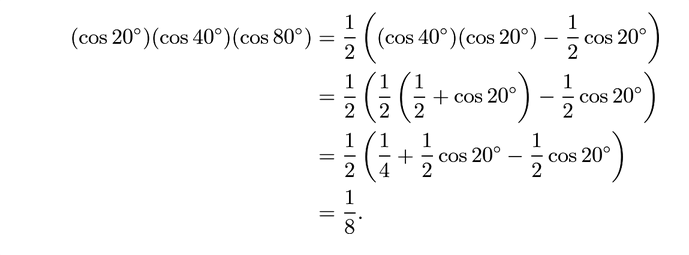
https://i.imgur.com/YXpvBr1.png how did they get the right hand side of line #1?
 dark sparrow

upper karma
@dark sparrow you know how?
dark sparrow
i'm trying to figure it out but i'm honestly a bit at a loss
upper karma
ah, you are new to trigonometry
dark sparrow
i'm not
upper karma
it's ok
dark sparrow
just this one thing in particular is weirding me out
faint cove
Perhaps...
2cos(α)cos(β) = cos(α+β)+cos(α-β)
dark sparrow
i'd appreciate not being condescended to
okay yeah cos(40°)cos(80°) = 1/2 (cos(40°) + cos(120°))
dark sparrow
cos(120°) = -1/2 that's why
upper karma
ok
but they kept the lhs of the rhs inside the parentheses in product form
I thought you couldn't do that?
dark sparrow
there's an extra factor of cos(20°)
which was left alone
nothing was done to it
except to bring it inside the parentheses
upper karma
yeah why can they bring it inside the parentheses
dark sparrow
do you disagree with $$\cos(20^\circ)\cdot \frac12(\cos(40^\circ) + \cos(120^\circ)) = \frac12(\cos(40^\circ)\cos(20^\circ) + \cos(120^\circ)\cos(20^\circ))$$
upper karma
4120?
faint cove
420 no scope
somber coyoteBOT
Ann:
dark sparrow
typo on my end
upper karma
np ok yeah i agree with that
dark sparrow
yeah that's what they did
upper karma
$\frac{\sin 10^\circ + \sin 20^\circ + \sin 30^\circ + \sin 40^\circ + \sin 50^\circ + \sin 60^\circ + \sin 70^\circ + \sin 80^\circ}{\cos 5^\circ \cos 10^\circ \cos 20^\circ}$
somber coyoteBOT
polynomial:
upper karma
how can i evaluate this?
faint cove
lmao
upper karma
if i use that same thing on the denominator as above, i have 1/2(cos 5 sqrt(3)/2 + 1/2(cos 15 + cos 5))
this just makes me stuck
faint cove
Well you can use
sin(α)+sin(β) = 2sin((α+β)/2)cos((α+β)/2)
dark sparrow
you can also use the double angle identity for sine repeatedly and get that the denom is sin(40°)/(8sin(5°)) ig
dark sparrow
sin(2t) = 2sin(t)cos(t) lol
upper karma
lol
dark sparrow
focusing only on the denom, all angles in degrees:
cos(5)cos(10)cos(20) = 8sin(5)cos(5)cos(10)cos(20)/(8sin(5)) = 4sin(10)cos(10)cos(20)/(8sin(5)) = 2sin(20)cos(20)/(8sin(5)) = sin(40)/(8sin(5))
i'm not sure if this will be of any use tho
upper karma
so what will
dark sparrow
hang on i think i found sth
so you have $\frac{8\sin(5)}{\sin(40)} \sum_{k=1}^8 \sin(10k)$
somber coyoteBOT
Ann:
dark sparrow
again all angles in degrees for convenience
2sin(5)sin(10k) = cos(10k-5) - cos(10k+5)
so this becomes $\frac{4}{\sin(40)} \sum_{k=1}^8 (\cos(10k-5)-\cos(10k+5))$
somber coyoteBOT
Ann:
dark sparrow
the sum is
cos(5)-cos(15)+cos(15)-cos(25)+...+cos(75)-cos(85)
all but two terms cancel out leaving cos(5)-cos(85)
cos(5)-sin(5) = sqrt(2)cos(5 + 45) = sqrt(2)cos(50) = sqrt(2)sin(40)
so 4/sin(40) times that will just be 4sqrt(2)
dark sparrow
cos(85)=sin(5) lol
dark sparrow
if you think "lol" actually represents a laugh and didn't become not much more than an interjection i have bad news for you
anyway w/e
 ?
dark sparrow
?
dark sparrow
perhaps, given the right context
i'd rather you didn't police my use of language like this >_<
anyway do you understand why cos(85) = sin(5)
upper karma
yeah because its a reflection over y = x right
dark sparrow
it's a cofunction identity
faint cove
S = sin(10°)+sin(20°)+sin(30°) + ⋯ + sin(80°)
S⋅sin(5°) = sin(10°)sin(5°) + sin(20°)sin(5°) + sin(30°)sin(5°) + ⋯ + sin(80°)sin(5°)
2S⋅sin(5°) = cos(5°)-cos(15°)+cos(15°)-cos(25°)+cos(25°)-cos(30°)+⋯+cos(75°)-cos(85°)
Telescoping!
2S⋅sin(5°) = cos(5°)-cos(85°)
2S⋅sin(5°) = -2sin(45°)sin(-40°)
S = √2/2 * sin(40°)/sin(5°)
dark sparrow
i mean if you absolutely insist?? i guess?? feels a bit weird to call it that tho, even in the context of the unit circle
dark sparrow
cos(90°-x) = sin(x)??
thorn talon
Draw a triangle tbh
dark sparrow
^
upper karma
@thorn talon Ok 1 sec
upper karma


 dark sparrow
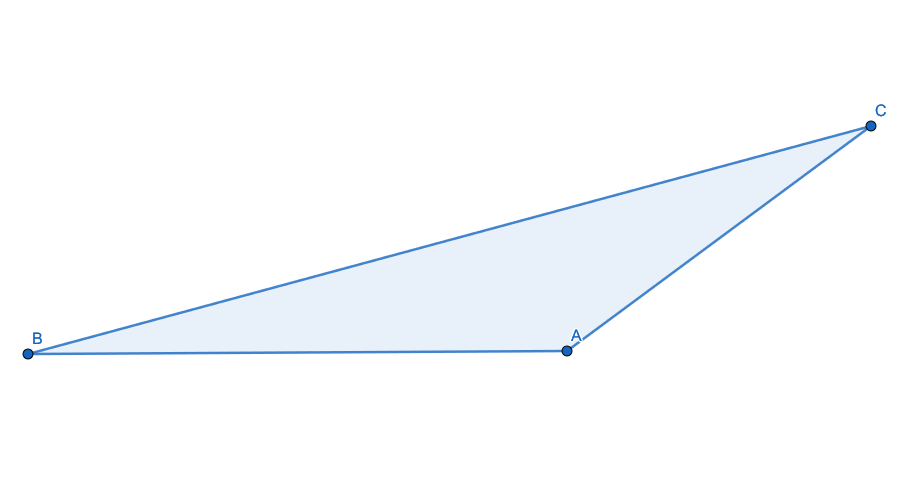
no, a RIGHT triangle
upper karma
you sure about that tho
dark sparrow
no, a RIGHT triangle
dark sparrow
what are you asking if i'm sure about
thorn talon
I mean
upper karma
that triangle explanation ain't good tho
dark sparrow
are you asking whether i'm sure that if one of the acute angles in a right triangle is x then the other is 90°-x?
upper karma
@dark sparrow no i'm asking if youre sure that what you say is true
because you can definitely draw like a 140 degree angle on the unit circle
dark sparrow
okay if you wanna be difficult then
cos(90°-x) = cos(90°) cos(x) + sin(90°) sin(x)
thorn talon
140 degrees just means a right triangle with a 40 degree angle in quadrant 2
upper karma
@dark sparrow i mean its not like i disagree w/ you
dark sparrow
...
upper karma
i'm just saying if you disagree with the y = x explanation
then you need to give a better one
but you aren't doing that
so
upper karma
"i mean if you absolutely insist?? i guess??"
doesnt sound like you are really agreeing w/ me tho
not really?
 rich arch
I see no sign of disagreement in her words tbh
upper karma
yea like i said that its not a complete disagreement
but saying "i mean if you absolutely insist?? i guess??" doesnt really entail agreement either
 buoyant hinge
Not sure if if this is the right channel for this... Trying to reconcile what a math book says pertaining to converting volume.
The question is, given 4 cylinders of the same size, 6ft radius, 32ft tall. How many bushels can the cylinders hold combined. A bushel is 2150.42in^3.
They give this:
3.14 x 6 x 6 x 32 x 4 = 14469.12ft^3
- 14469 x 12 x 12 x 12 = 25,002,639.36in
- 25,002,639.36 x 1/2150.42 x 1/2150.42 x 1/2150.42 = 3875.62
Question about 1) This equates to 25,002,639.36in^3 correct?
And 2) I can't make this reconcile, but that's what they show.
For 2), if you divide the first number by 2150.42, you get the correct answer, 11,626.86
Am I missing something?
And hello, good to be here, 🙂