#geometry-and-trigonometry
1 messages · Page 248 of 1
 eager kraken
 rich wolf
what are you doing with that exponent
eager kraken
(i would tell by if the units of the numbers are in the degree rather than the pi symbols?)
eager kraken
Well to find sin(t)=0.66862229
I just did the sin^-1 (0.66862229)
rich wolf
degrees usually have the degree symbol and radians are naked numbers
rich wolf
ok
your algebra is wrong i'm guessing
sec(t)=1.5625809
1/cos(t)=1.5625809
1=1.5625809*cos(t)
1/1.5625809=cos(t)
t=cos^-1(1/1.5625809)
 twin swan
sinx(2cosx+1)=0
can anyone help me with this????
all i know is to distribute
but after that idk
like its 2cosxsinx+sinx = 0
 thorn talon
it's almost certainly in your best interest to not expand
it's in fully factored = 0 form
eager kraken
I dont understand where I am going wrong with this, when i solve side p using the sin function, the answer is .0049516885
I could be wrong but i don't think it's possible to have this right triangle if side p was that short
thorn talon
you are right
eager kraken
I found n from doing tan(50.3)=n/129
eager kraken
wait
I just tried p = 129/cos(36.7) and it resulted in 160.8928893
why didn't the sin work tho?
 silent plank
what were you doing when using sin
eager kraken
sin(50.3)/155.381251
silent plank
wrong setup
eager kraken
my angle M is also wrong
silent plank
sin(50.3) = n/p
→ p = ?
eager kraken
n/sin
silent plank
also, yeh you used the wrong angle for cos
silent plank
by convention, the
lowercase side is opposite the capital angle
i.e side a is opposite angle A
etc
eager kraken
im sure glad my teachers never told me that
 rigid siren
why does cos (2x) cause a horizontal shrink
Ik it shrinks the period
but why
logically
thorn talon
You're doubling the argument
It's essentially going twice as fast to complete a period
 merry rapids
Can anyone help me with this question. I am tasked with finding the length of the unknown side, x, however I can't seem to answer it. I believe it's 21 x cos47 but I am getting the answer, 14.32, whereas the actual answer is 30.79
Thanks
 idle bloom
You've done your multiplication and solving for x wrong
Remember Cos(theta) = Adjacent/Hypotenuse
Not Hypotenuse/Adjacent
merry rapids
So how would i rectify it?
merry rapids
What do you mean?
 hardy socket
can some one help me with these
i know theorems n postulates but my brain just can comorehend how
idle bloom
Cos(theta) = Adjacent / hypotenuse. So plug in the values you know
merry rapids
cos=21/x
merry rapids
Wouldn't that be 21 x cos47?
idle bloom
No
merry rapids
Then I'm not sure, could you explain please?
idle bloom
also don't forget your 
Cos(47) = 21/x
so I multiply by x
x * cos(47) = 21
Then how do I get x by itself
merry rapids
Divide cos47 = 21?
idle bloom
Divide both sides by what?
merry rapids
x? I'm having a brain fart
idle bloom
You have
x * cos(47) = 21
You want x by itself
So what do you divide both sides by to get x by itself
merry rapids
cos47 = 21
idle bloom
You can't divide by an equation
merry rapids
Sorry my bad, cos47
idle bloom
Ok good
merry rapids
Thanks for the help!
 marble mesa
 somber coyoteBOT
Pa_u_los:
 twin prawn
law of cosines
eager kraken
Is the answer for
sin(t)=sqrt3/2
60 degrees?
And/or is there only one answer for the problem?
Yea
But an acceptable answer for a trig class would be 60
Neat thanks
 eager pendant
try extending a few lines
 upper karma
@eager pendant do you know how to solve it yourself?
eager pendant
yeah
upper karma
im looking at the solution rn but I still cfan't undestand it
what did you get as an answer?
silent plank
which angles?
 wind heart
Triangle ABC and EDC
silent plank
what did you actually mean by
considered by Alt Int. Or by Vertical?
wind heart
Like
In number 6
It shows 2 perpendicular angles
But it’s also a Vertical angle
And you’re supposed to classify what the triangles are congruent by
Oh wait I’m in idiot
It’s the SAS SSS ASA stuff isn’t it
silent plank
yes
wind heart
ok thanks lol
 cobalt turtle
,rotate
somber coyoteBOT
upper karma
👀
 storm rover
I have a problem, "ABCD is a parallelogram, express vector BD in terms of vectors AD and BC"
Not picture or anything
 quiet mason
do you know the triangle law of vector addition
storm rover
no we havent learned that yet
nvm i think i got it
would it be AD-BC)
and that quanitity is divided by two
somber coyoteBOT
Pa_u_los:
marble mesa
marble mesa
@silent plank Why should I divide by two? The law of cosines is $c^2 = b^2 + c^2 - b \cdot c \cos C$
somber coyoteBOT
Pa_u_los:
marble mesa
oh my god... Thank s
somber coyoteBOT
ramonov:
marble mesa
silent plank
wtf
marble mesa
how can I do that?
is the first thing it appears on the internet
dumb google AI search
silent plank
i seriously doubt that
also don't round your sqrt(8656) to 93
it will make your calculations for the angle less accurate
silent plank
maths is fun shows the correct formula
marble mesa
yeah, I will click in the first website instead of seeing the first image
 smoky plover
 warped olive
,rotate
somber coyoteBOT
somber coyoteBOT
WhipStreak23:
somber coyoteBOT
WhipStreak23:
 brave gust
ok got it
brave gust
yea i got it 🙂
brave gust
@upper karma Thanks!
marble mesa
how can I say that de part that is not in black is 20 cm^3
the total volume is \approx 160.146
cm^3
upper karma
Theorem 8.6 states that if a quadrilateral is a parallelogram, then its diagonals bisect each other. Write a two-column proof of Theorem 8.6
upper karma
What's the difference between cos and cos^-1? When would I need to use cos^-1 instead of cos?
wind heart
<@&286206848099549185>
upper karma
yes
 river forge
yes
wind heart
Oh ok
 balmy pelican
@upper karma cos takes an angle and gives you a ratio, cos^-1 takes a ratio and gives you an angle
marble mesa
@upper karma $\text{you would need to use cos^-1 to know what's the value of the angle given. i.e.}$ $ 1.55684829 = \cos C$$\text{; then you would have to do} $\cos^{-1} 1.55684829$ \text{which will give you a value meaning your angle}
the thing is that I don't know why that is like that. Ping a helper for solving your question
eager kraken
How do I find the lengths of side h and x with this data?
The two formula i have been told are
tan(29)=h/x+10
tan(52)=h/x
thorn talon
Sure
eager kraken
and then to just plug it in, but when i do that and solve the variables cancel out
thorn talon
What's your working out after?
eager kraken
so i plug em in like
tan(29)=xtan(52)/x+10
maybe im just doing the math wrong from there
thorn talon
How'd you get that?
You can multiply through the first equation by x + 10
And the second by x right?
eager kraken
plugging xtan(52) into tan(29)=h/x+10 as the h
eager kraken
10tan(29)=-xtan(29)+xtan(52)
if this is the right direction, i am not sure where to go from here
Can i solve this with similar triangles?
eager kraken
but i dont have x or h
 tacit karma
no
just
(10+x)^2+h^2=(c1)^2
and plug it in to one of the trigonometric functions
it won't cancel out
eager kraken
is there a way if i can check whether or not a side length is correct?
I kind worked it out a different way and got 5.543090515
10tan(29)+ (h/tan(52))tan(29)=h
 sleek vine
@eager kraken have you learned the sine law?
eager kraken
barely
sleek vine
what do you mean barely?
like, has it been covered in class and you're not sure how it works, or you've never heard of it?
eager kraken
i've heard it mentioned, but looking through my noted we didn't learn it at all
so could i just do (sin(23)/10)=(sin(128)/c1)
to solve for c1?
sleek vine
yes that's how i would approach it
and the same works for c2
i'm trying to figure out how they expect you to solve it without the sine law though
eager kraken
This is an example from the book
must not be using law of sines because the question is just looking for the lengths of x and h
eager kraken
This one is seemingly easier but I cant figure out the length of x
c=18.27804155 y=14.59749304
(ping me)
 high bough
@eager kraken what have you tried
upper karma
if only we knew the length of h
 summer condor
Hi guys. Can you help me with some tips which can help me with it?
no, i'm not
ok
somber coyoteBOT
WhipStreak23:
summer condor
no, i don't
summer condor
Thank you
upper karma
how do i calculate the S and P of a triangle
eager kraken
@high bough I tried the law of sines as well as the other method of just plugging things in to get that c value, from which I used the pythagorean theorem to get y
 summer spire
@upper karma what do those letters mean?
summer spire
can't help if we don't know what the question means ¯_(ツ)_/¯
summer spire
rotation of what?
upper karma
hold oN
SURFACE AND SCOPE
im just gonna google it
or in other words browse the net
summer spire
@upper karma you could always make flashcards
or maybe just do a lot of trig problems
but I don't know of a "least boring" way to memorize that kind of stuff directly
 copper moss
Hola
Could a french person explain this sentence (in french or english) to me please? Ignore the red
"s'ils dirigent des droites des droites orthogonales"?
It it saying that two vectors are orthogonal if lines parallel to them are orthogonal?
 autumn sky
heya guys
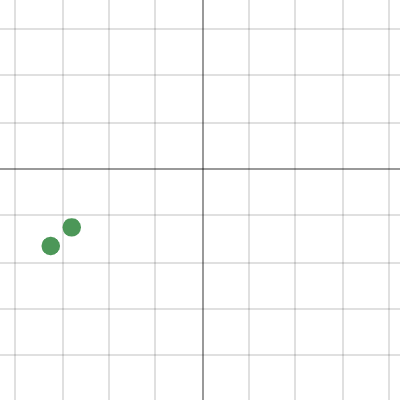
Desmos
I need to make a line between those points
and also extend that line infinitely
the thing is that I can't figure out how to
Wait, nvm I just did
 surreal roost
Huh?
thorn talon
🤔
 limpid tinsel

 turbid lily

upper karma
how many right triangles are there @surreal roost
surreal roost
2
upper karma
take a deeper look
 knotty merlin
....
rich wolf
They are similar triangles
Which means their sides are in proportion to each other
Which means you must use segment BD to solve
Give it a variable name like y
 gritty sail
Yes it's 70
surreal roost
Well I did the other one, and I started this one. I got that the answer is the square root of 320, but I need to simplify it which should be the easy part, but apparently its not.
knotty merlin
Just use surds
surreal roost
?
upper karma
it looks like you might be able to make a system of equations
surreal roost
🙃
 tidal ridge
this is prob reallhy simple
but
how to find alpha angle?
we're given mic1 at [0,2] and mic2 at [0,0]
so i use sin(alpha)=d/2 and cos(alpha)=d/adj
also sin^2()+cos^() of alpha result in d^2+adj^2 = 4
which doesnt help too much either..
am i missing an identity?
tidal ridge
how to find d value?
was thinking could split mic2 angle to 45deg
but that seems wrong?

 white silo
@cosmic juniper still need help?
 cosmic juniper
Nah
white silo
Ok
 rigid saffron
I need to compare the distance between two points in 3D-space, p_1 and p_2 to some origin in the most efficient way possible. When calculating the distance to a specific origin I obviously don't have to take the square root, but what about squaring each value. If i simply take the absolute value and omit the squaring and square-root in the distance formula will I get a correct comparison?
|p_1.x-origin_x| + |p_1.y-origin_y| + |p_1.z-origin_z|
 queen python
idle bloom
queen python
idle bloom
When the bridges are closed, it spans the whole distance across
So find the length of each bridge using trig (45-45-90 triangles)
silent plank
since it's asking for exact answer,
you shouldn't be putting cos(45°) into your calculator
(generally you shouldn't be putting that in unless they're specifically asking for a decimal approximation)
twin prawn
@queen python  you basically get your answer for free if you know how to construct sqrt(6) given a unit line segment
upper karma
can someone help me with this problem....... If sin(θ) =-3/5, and θ is in quadrant IV then find, cos(θ), tan(θ), csc(θ), sec(θ), cot(θ)
because i dont get this at all 💀
silent plank
draw a (right) triangle in quadrant 4 where sin(θ) =-3/5
silent plank
pythag
upper karma
so its x^2 + (-3)^2 = 5^2
x^2 + 9 = 25
x^2 = 16
idk how to find the cos or tan or the others tho...
silent plank
can you show the triangle you drew?
upper karma
silent plank
nope, that's not quite right
rich wolf
Very nice drawing
upper karma
isn't opposite / hypotenuse
rich wolf
Sure
Wait
You should actually know this to be a special sort of right triangle
If you use pythagorean theorem you will see why
silent plank
sides need to be labelled correctly first
rich wolf
True lol
eager kraken
Do I pretty much have to memorize the pythagorean identities?
thorn talon
I mean
You need to know one
Which follows from well
The Pythagorean theorem
The rest you can derive easily
eager kraken
If I am finding the 6 trig functions derived from a line when the only values given are an equation for a line, should I just pick a point on the line to find the trig values?
Otherwise I am not sure how to find the 6 trig values from an equation of a line
 zealous sierra
hi! does someone know what’s the best way to solve this? i only have to use tan, and you don’t have to show me calculations because that would take a lot of your time, but just a push in the right direction would be great! :)
summer spire
just start finding the values of missing parts
eventually you'll come up with enough info to find D
you can start with finding AB and AF
every little bit will help
 gloomy frigate
I have a question related to the transformation of position and rotation of objects on a 3d grid. Would this be a good place to ask?
Well, the problem is this: I have a bookshelf with items contained on the shelves. If the bookshelf is moved and rotated, what formula can I use to transform the position and rotation of the items on the shelves?
summer spire
I'm guessing you'd have to find each item's offset from whatever the point of rotation of the shelf is and rotate around that, if it's a simple rotate or translate, at least
but if you're talking a bookshelf tumbling down stairs and keeping track of each item, you'd likely need a physics engine at that point
 jagged holly

can someone help me solve this problem i figured out what sin was but i cant figure out cos
 marble topaz
Draw yourself a lil unit circle and a diagram
You've already got two sides out of three, you should be able to find the other stuff just fine
 olive solstice
Can anyone help me with math?
quiet mason
@upper karma is a god at geo and can help you
 mint bronze
I dont understand how to convert degrees to radians, my math book has an explanation but their explanation is extremely generic, can I get some help with this?
 devout harbor
You can just use ratio method, or that's what I call it.
I always use this instead of just memorizing
mint bronze
@devout harbor I dont understand it.
This is what they are showing and explaining and I don't understand or see the pattern of steps that they took. there is nothing else to explain it either
mint bronze
I'm gonna try to read this back, just let me know if I'm wrong or something. 360degrees = 2pi rad, 45degrees = pi rad, 360 * pi = 2pi (45), pi = 90pi/360. At this point you would simplifiy it?
 vague pagoda
how is 45 degrees = pi rad
mint bronze
the 45degrees is what the problem is, to convert to pi rad
mint bronze
Okay Thank you.
mint bronze
It was hard for me to see lol
vague pagoda
yeah was for me too
mint bronze
x makes more sense though
devout harbor
Yeah because we don't know it, so we keep it x
mint bronze
Thanks @devout harbor for the image, it helped
devout harbor
np
 median crown
tf is that drawing
upper karma
Lol
summer spire
is quadrilateral connected to that square also a square?
median crown
it has 4 equal sides
so it must be a rhombus
but one of those angles is 90 degrees
so the middle quadrilateral must also be a square too
rich wolf
This shape is badly drawn
 formal hamlet
Which scientific calculator do you guys prefer for Trig?
Casio 115-es plus, Casio 991-ex, or TI-36X pro ?
can you guys help me with B) please. I dont understand the relationships correclty and on the right Im trying to find a correct way to list relationships
Which is correct? top or bottom?
silent plank
your tables are a bit unclear
are those supposed to be the ratio of sides opposite those angles?
 winged zinc
@formal hamlet
You are attempting to solve for x and y
Because you have two unknowns, you require two equations
What two equations do you think you could use?
formal hamlet
yes the tables are ratios. The bottom is correct I was told
So therefore 16/2=8
90 degrees=2x
so therefore x=8
plug in 8 square root 3=Y for 60 degrees
winged zinc
Erh, unless I made a mistake, I think y=8 and x = 8sqrt3.
formal hamlet
Yeah youre right
winged zinc
And that logically makes sense as the angle opposite side y is les than the angle opposite side x
hence y should be less than x
formal hamlet
Right right. That's correct. Thank you
winged zinc
All good
formal hamlet
the way the angle is oriented is tripping me up a little. gotta be more attentive
winged zinc
I solved it by creating two equations. $$x^2+y^2=16^2$$ and then the sine rule with $$\frac{x}{sin(60)}=\frac{y}{sin(30)}$$.
somber coyoteBOT
Lachlan:
winged zinc
From there it is just a matter of substituting in values
formal hamlet
nice thank you.
winged zinc
There are a number of ways you can solve it
But do what ever works and makes sense for you.
formal hamlet
well its nice to see other ways to solve it and pick the best one. it also helps to understand the relationships better even if I go with a particular method
thanks again
winged zinc
Granted you can just solve it with trig identities
so sin(theta)=O/H
That can get you there
Likely the easiest
formal hamlet
what is O and H in this problem?
winged zinc
Well, choose some angle in the triangle (preferably not the 90 degrees) and O is the side opposite this angle, and H is the hypotenuse.
So for example, sin(30)=y/16
so y=16 sin(30)
formal hamlet
pretty sick bro thank you
winged zinc
You ever heard of the saying SOHCAHTOA?
formal hamlet
definitely not
winged zinc
Haha
It is an acronym for trig ratios
Sin(theta)=opposite/hypotenuse
Cos(theta)=adjacent/hypotenuse
Tan(theta)=opposite/adjacent
formal hamlet
perfect. Im saving that.
winged zinc
Adjacent is the side which is next to the angle but not the hypotenuse.
formal hamlet
noted
winged zinc
I you don't mind me asking, what year level are you in? (feel free to not reply)
formal hamlet
Im a second semester sophomore at university. I was a business major, but changed to computer science which requires a higher level math accomplishment
winged zinc
Ohh nice
formal hamlet
yeah definitely more challenging but Im up for it
this is my first time in Trig. I'm gunning for an A.
formal hamlet
thank you I will. Ill friend you rn
somber coyoteBOT
DeadEye:
formal hamlet
Ignore This^, I cant delete it
 green roost
Can anyone quickly clear somthing up for me? Is sin4X=2sin2X? That seems logical to me but the question seems to be worth too many Mark's for it to be as simple as that (I calculated sin2X in the previous question)
devout harbor
Is the question asking you to solve for x where sin4x=2sin2x?
Because sin4x=2sin2xcos2x in general.
green roost
No I was asking if my assumption that sin4X=2sin2X, I've just to find the exact value of sin4X given that cosX=4/5 but that's fine I know what I'm doing now
 tardy comet
Does a diagonal split an angle in 2 identical pieces inside a parallelogram
upper karma
can someone explain how to find the measure of angle B?
marble topaz
What part of it is confusing?
upper karma
idk honestly I think if I just go back and practice more with sin and sin^-1 I'll understand it
so I guess I'll just have to do that to be ready for law of sines
upper karma
ok thanks
upper karma
Yo
If you have a cosine equation and the number in front of x is pi, then would the period be 2pi/pi = 2?
median crown
yes
 small mauve
Hi
upper karma
What math class do you have
upper karma
Oh your in university cool what’s ur major
small mauve
math and cs
upper karma
I just started trig this semester. My professor isn't doing the best job explaining trig identities to me, is there a resource that anyone knows of with videos or tutorials that could help me?
Right now, just having trouble verifying identities.
I'm looking for a good book to learn proof-based Geometry/Trigonometry, anyone would recommend any?
 weak shoal
@upper karma Well, the proofs are available online if you search hard enough
You could just see the proof of one or two of those identities. Then, use those proofs as the basis for proving all the others.
@upper karma I’d recommend Trigonometry by Gelfand and Coordinate Geometry by Eisenhart

 thorn talon

 tall flower
Hey all can someone help me with a trig problem?
thorn talon
🤔
tall flower
okay here: if "tan a = 0.1327" find "cot a"
 fallen cedar
1/tan(a) = cot(a)
fallen cedar
np
upper karma
how do I calculate the projection of a leg on a right triangle
i already calculated that the shorter leg is 30 units
 topaz hearth
Can anyone explain what is going on here? i dont understand how to rearrange like this.
upper karma
@topaz hearth They're just doing abc = (a)bc = a(b)c = a(bc) = ab(c) = (abc)
Parentheses don't matter in multiplication at all
topaz hearth
Thanks!
vague pagoda
@daring python use sin and cos to find out them
 daring python
Yeah, only brushed over trig last semester and now I'm expected to know its ins and outs. I just need a simple explanation of how to do so.
upper karma
What does your book or notes say
upper karma
@daring python are you aware of the unit circle?
daring python
@upper karma Loosely, but not really.
 lament brook
I finished the question and the answer is cos = - sqrt of 37/37 and the csc is 37sqrt37/6. It simply looks extremely wrong. I can show my work if needed. Not sure if im overthinking things or not
lament brook
yes
devout harbor
Draw a triangle.
Think of -6 as 6 for now.
Find the remaining side using pythg theorem.
lament brook
root 37
lament brook
yes
devout harbor
Now cos(theta) = 1/sqrt(37), so sec(theta) = sqrt(37).
sec(theta) = sqrt(37) can also be written as 37/sqrt(37)
lament brook
ohh
devout harbor
I messed up my coding. Anyways.
$\sqrt(a) = \sqrt(a) \cdot \frac{\sqrt(a)}{\sqrt(a)} = \frac{a}{\sqrt(a)}$
somber coyoteBOT
Sup?:
devout harbor
Given that a is not equal to 0 and in the example above, sqrt(37) is definitely not equal to 0.
So we can do this and we have sec(theta) = 37/sqrt(37).
Anyways now.
Do you know in which quadrants sin/cos/tan functions are positive or negative?
devout harbor
Yes, so since cos is negative, sec is also negative.
lament brook
yeah
devout harbor
So we have sec(theta) = -sqrt(37) = -37/sqrt(37).
Sin is positive so cosec is also positive so that remains the same.
And that's it.
devout harbor
np
 pliant karma
so uh
could i get some help with a geometry question
:^)
In triangles GHI and RST, ∠G ≅ ∠R, ∠H ≅ ∠S, and segment GI ≅ segment RT. Is this information sufficient to prove triangles GHI and RST congruent through SSS? Explain your answer.
 drowsy walrus
no
You’re given angles congruent
and one segment
and you can’t do the reflexive property because none of the triangles share an endpoint
it helps to draw out and mark what’s congruent

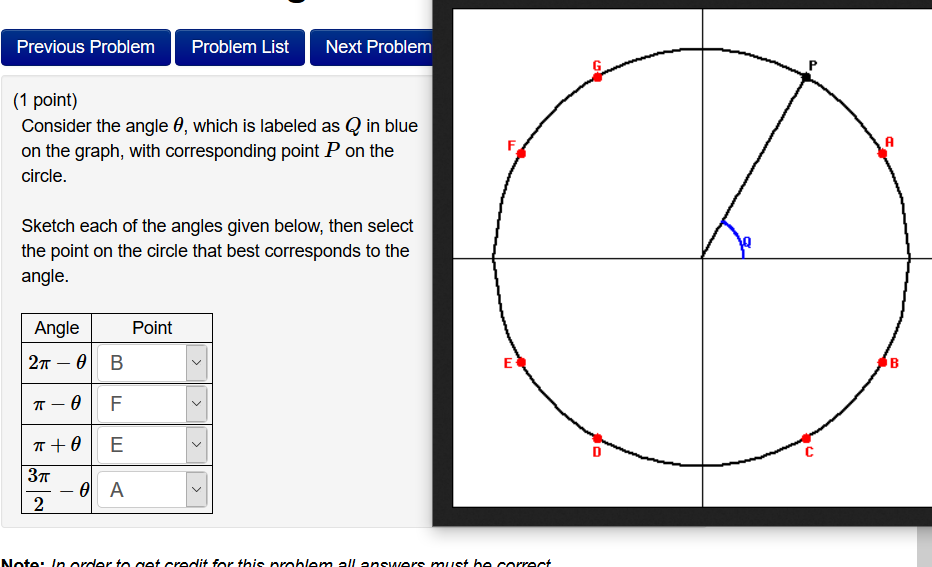
 tribal urchin
hm
damn
well u know it's in quadrant 4
quad 1 = ALL +
quad 2 = SIN +
quad 3 = TAN +
quad 4 = COS +
*including their variants like sin and csc
u gotta draw a triangle i think and sin = opp/hyp and u know it's -1/2
 native summit
for the first problem, where on the unit circle is $sin(\alpha)=-\frac{1}{2}$
somber coyoteBOT
Arc1llusion:
native summit
In the 4th quadrant
daring python
???
thorn talon
🤔
 oblique tiger
rich wolf
oblique tiger
rich wolf
Does the altitude of an isosceles triangle bisect the angle
daring python
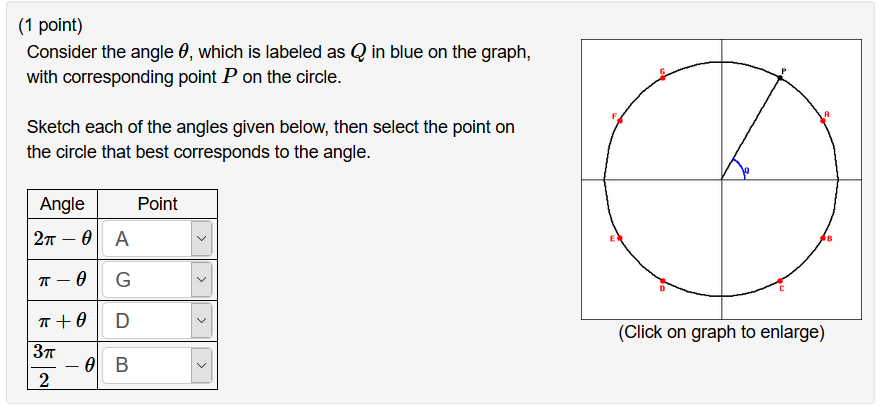 thorn talon
🤔
I mean
The logic is valid
But
Might want to look closer at the circle
I think it's a reasonable assumption that each point is equally spaced apart in terms of angles
So instead of going forwards by two points
Go backwards by two points
upper karma
So I’m reviewing my test answers and I want to know how tf does this work?
Every answer I came up with doesn’t make sense
 potent steppe
 stark snow
a) The real projective space $\mathbb{R}P^n$ is the space of lines through the origin in $\mathbb{R}^n+1$. What does $\mathbb{R}P^1$ look like?
b) The canonical line bundle over the real projective space is constructed by attaching, to each point of $\mathbb{R}P^n$, the line that it represents. What does the bundle over $\mathbb{R}P^1$ look like?
So, by drawing a diagram, it was obvious to me that $\mathbb{R}P^1$ looked like a circle, $S^1$, touching the origin once and extending however far I liked. However I am having a slight degree of trouble understanding part b intuitively. I thought that since a line looked like $\mathbb{R}$, I could understand the line bundle as looking like $S^1 \times \mathbb{R}^1$, which would just be a cylinder. However, this wasn't right
somber coyoteBOT
Daniel Cann:
devout harbor
@potent steppe You can find the distance BD using formula of distance between two points, draw a triangle and use cosine rule. I think..
 fringe dirge
@stark snow This is more suited for #point-set-topology
stark snow
@fringe dirge Oh, okay I'll put it there
 noble coral
 cedar yew
upper karma
cedar yew
upper karma
you could use cosine
to find the angle of MFP
then you would know the angle of MPF
then since you know 12 and 10, you can find MP
but there might be an easier way I dont know of
 sturdy bay
I've got a doubt
consider a pair of lines ax^2+2hxy+by^2+2gx+2fy+c=0
then, to find their point of intersection, you take the partial derivative of the equation wrt to x, set it to zero and do the same for y
which gives you two linear equations in x and y which can be solved to obtain the intersection points
How is this working?? Where is the partial derivative even coming into picture here??
 south junco
Can someone help me in questions a
winged zinc
@south junco, what do you need?
sturdy bay
Could someone help me with my doubt earlier?
twin prawn
Why would you write a pair of lines like that
sturdy bay
huh
A homogenous equation. wont it represent a pair of lines?
by pair of lines.. I meant you take two line equations and you multiply them.
as in (a1x+b1y+c1)(a2x+b2y+c2)=0
twin prawn
I'm lost as to why you would want to solve the intersection point of two lines using partial derivatives in the first place
What's the motive behind it?
sturdy bay
I only know that doing that weird ritual of partial derivatives will give us the intersection point
and thats why I wanted to know how things are working out
sturdy bay
the weird thing I observed about this is.. the resulting two linear equations that we get after taking the partial derivatives aren't even the actual pair of lines
as far as I noticed.. they are just two lines having the same intersection point
twin prawn
Can you show a worked example?
 slim needle
Does someone know how to do this?
(find perimeter and area of the colored part)
I see there is an "internal" arc and "external" arc
slim needle
No one?
 cinder portal
find the area of the big ice cream cone, and subtract small ice cream cone done
ur answer will be a bit nasty
silent plank
consider drawing in the centre and constructing radii to those points of intersection
slim needle
@cinder portal hahahah nice answer. But what do you mean when you say "small ice cream"?
@silent plank I don't get it. A drawing?
silent plank
slim needle
Wait. This is an equilateral triangle, which can be "divided" into an isosceles triangle and two right triangles
But how would I apply the formula? 1/2×alpha×r^2
devout harbor
That's the formula for area of a sector and alpha is supposed to be the angle in the sector.
slim needle
Exactly @devout harbor
silent plank
you should know you angles and the radii and boom
slim needle
But what's the angle of the two right triangles? Should I use pi/2?
silent plank
right triangles were used to find the radii of the big circle
they aren't used when finding the area of your sectors
slim needle
I'm not understanding... I'll have to ask the teacher
slim needle
The radius? Why?
silent plank
because the radius is essential for finding area's of sectors and arc length
and as you just stated you need to apply
A_sector = 1/2×alpha×r^2
silent plank
there are 2 radii involved
one is for the the arc which is 6
and there other is for the circle as indicated by my 3 red lines
slim needle
Uhm, ok
silent plank
slim needle
Ok
silent plank
the blue sector + 2 isosceles triangles would be your "big ice cream cone"
the green sector would be your "small ice cream cone"
silent plank
silent plank
were you able to find the radius?
slim needle
Is it L/sqrt3?
silent plank
simplify it
slim needle
2*sqrt3
slim needle
🤔
silent plank
several ways to get it:
circle theorems, properties of equilateral triangles, other
slim needle
Ok, tell me
silent plank
angle at the centre is twice the angle at the circumference
silent plank
yes
slim needle
Ok, I found the perimeter
silent plank
also those 2 triangles are congruent and would also have angles of 120°
silent plank
the blue sector + 2 isosceles triangles would be your "big ice cream cone"
the green sector would be your "small ice cream cone"
blue - green would give you the desired area
silent plank
you need to convert the angle to radians
slim needle
Yes of coursr
silent plank
which you should've also done for the perimeter otherwise you wouldn't reach the answer provided
silent plank
the angle and radius for that are given
angle of 60° = pi/3
radius of 6
(which you should've also used when calculating the perimeter)
slim needle
@silent plank so, do I have to do for both 1/2 × pi/3 × 36?
silent plank
wdym by do both?
slim needle
?
silent plank
whoops mistread that
wdym by
do I have to do for both
1/2 × pi/3 × 36 gives the area of the green sector
as mentioned earlier, you also need to find the areas of those 2 triangles
silent plank
(trig formula for) area of a triangle
silent plank
i mean you could split your isosceles into right triangles
or you can apply
(trig formula for) area of a triangle
direclty
i.e. Area = 1/2 ab * sin(C)
slim needle
Oh true, the two triangles are isosceles, not right
Well, how can I find the height?
silent plank
the whole point of the trig formula is that you don't need the height/altitude
only 2 sides and the angle between them
which you have
slim needle
We haven't done the area with sine and cosine yet
silent plank
strange
ok, then split it into right triangles and find the height using basic trig
and/or pythag (w/ properties of special triangles)
silent plank
i mean you should've made some of these calculations already when you found that radius to be 2sqrt(3)
slim needle
Sqrt [(2*sqrt3)^2 - 3^2] @silent plank
silent plank
simplfiy it
slim needle
Sqrt3
slim needle
3*sqrt3 is the area of the triangle
But if the height is in common...
I got 3*sqrt3 doing (6 * sqrt3) / 2
@silent plank
slim needle
Now, to find the area of the sector I do 1/2 * pi/3 * 6
silent plank
6^2
slim needle
And I get 6pi as area
slim needle
The blue one is 1/2 * 2pi/3 * (2*sqrt3)^2?
silent plank
which simplifies to:
slim needle
4pi
silent plank
yes
and as mentioned earlier,
desired area = blue sector + area of triangles - green sector
slim needle
6*sqrt3
silent plank
yes, you'll get
6sqrt(3) - 2pi
which is equivalent to the answer provided
 odd cairn
how do i make a parabola out of an equation
in this example it turns the equation directly into a graph, but how do you do that
 olive glacier
Given tanΘ = 3/2 ; and Θ is a reflex . Work out the value of sinΘ #can someone give me a solution. Thanks.
odd cairn
<@&286206848099549185>
wind heart
<@&286206848099549185>
summer spire
@odd cairn I'm not sure what you mean. Are you asking how to graph an equation?
odd cairn
yes
summer spire
plot f(0), f(1), f(-1), f(2), etc?
so for the example, to find the y value at x=0, you substitute 0 for x:
$$-1/160^2 + 1$$
$$-1/160 + 1$$
$$0 + 1$$
$$1$$
then you fill in the point (0,1) and move on to the next x value
somber coyoteBOT
Googol30:
summer spire
that's the most reliable way, yes
odd cairn
ok got it
wind heart
Uh
I guess I’ll go for a second and last attempt

CN anybody explain me this
Can*
I’m kind of confused about it
 fallow edge
@dire rampart I meant cube
fallow edge
Shouldn't the plane intersect the vertice of the square at the origin and the vertice opposite it
 dire rampart
oh I thought u meant every single vertex lmao
what are the coordinates of G?
doesnt seem like it intersects it to me
fallow edge
<@&268886789983436800> ban @placid basin
 stuck torrent
Why the aggression?
 twin heron

fallow edge
Thanks
stuck torrent
Guess we’ll never know
 trail minnow
we're attracting so many smoothbrains today
rich wolf
smoothbrain is a nice insult
but i don't see why you have to ban that individual
what did he do
 copper valve

 fallow edge
@dire rampart isn't the vector normal to the plane ax+by+cz=d (a,b,c)?
dire rampart
yes
if you want to know whether it lies on the plane or not just sub it into the plane equation
fallow edge
Sure, but isn't the vector normal to the plane intersecting the two points in question the vector (-1,-1,sqrt(3))?
Oh. it isnt
Nvm
dire rampart
not quite sure what u mean
 unborn jacinth
so @dire rampart its always the same power as the sin and cos?
oh yeah that makes sense
basic algebra
otherwise the fraction wouldn't equal the same thing right
@dire rampart
somber coyoteBOT
IAmJon:
unborn jacinth
oh yeah that makes sense
but then @fallow edge what if the sin and cos powers were different
you wouldn't be able to say its tan right
unless they're the same
fallow edge
If there's a sine over a cosine, you can "factor out" a tangent, but a sine or cosine might remain as well
fallow edge
@dire rampart if (a,b,c) were orthogonal to the plane, you could still write the equation of ax+by+cz=d with it
 spark stag
$\frac{\sin^{3}(x)}{\cos^7(x)} = \frac{\sin^3(x)}{\cos^3(x)} \cdot \frac{1}{\cos^4(x)} = \frac{\tan^3(x)}{\cos^4(x)}$
fallow edge
So if (-1,-1,sqrt(3)) were orthogonal to the plane, you could use those coefficients
somber coyoteBOT
Namington:
spark stag
just as an example @unborn jacinth
this example is pretty contrived admittedly, but those are the sort of algebraic things you can look for
upper karma
guys I need help
https://cdn.discordapp.com/attachments/387447700234174464/674817172337590309/image.png
I have no idea where to start. I think I shoudl start by finding the two big triangles and using sas to prove they are similar


the triangles cad and bca
actually I can prove they are congruent but I don't know where to go from there
anyone have an idea?
I have no clue how to get to triangle tes and ver
tacit karma
TEA~VEC
 surreal ingot
Does anyone know how to find x graphing point for -3sin(pie/3 ×-3pie)
I got beginning point 9 and ending point 15
twin prawn
Did you just write pie instead of pi
🥧
Also I'm very confused about your question, first of all what do you mean by "x graphing point"?
upper karma
Hello
 carmine sundial
do the diagonals of a rectangle bisect opposite angles?
 manic lance
thorn talon
manic lance
thorn talon
🤔
lament brook
Just curious, if I get the value for -2/sqrt 13 for a sin value let’s say, and since the bottom tells me the radius do I still have to simplify?
I’m not sure if it will mess up like what’s the y value or whatnot
lament brook
Uh I didn’t do it yet but basically move the radical up
But not sure if it will mess up my answer or not
lament brook
It’s optional?
lament brook
Ig but not sure if teacher will take points off for having a radical in the dome
Dom
lament brook
Kk thanks!
lament brook
I think this is what I’m suppose to do. Just wanna make sure
thorn talon
Seems fine I guess
upper karma
Can someone explain the whole cos(x) = cos(-x) and sin(-x) = -sin(x) thing? I am retarded
 umbral snow
Not much to explain, you just said it yourself
upper karma
Thanks...
umbral snow
These are two facts:
sin(-x) = -sin(x)
cos(-x) = cos(x)
upper karma
Yeah but why
umbral snow
Remember that EVERYTHING sin and cos is determined from the unit circle
upper karma
So
umbral snow
Make sure you're comfortable with the unit circle to determine trig stuff
umbral snow
So let's say you wanted to compute sin(-π/6). You'd start at the x-axis, then go π/6 radians clockwise
upper karma
Yes
umbral snow
Whatever the y-value of your terminal arm is, that's sin(-π/6)
If you're smart about it though, you'll realize that you could instead go counterclockwise, then you'll have the right value, but wrong sign
That is, if you can calculate sin(π/6), there's a quick step to finding sin(-π/6)
upper karma
Ok but why does it hold for all x
umbral snow
Here's a bit more of a proof. You agree with the summation formula, right? That is:
sin(x + y) = sin(x)cos(y) + cos(x)sin(y)
umbral snow
Welp you'll learn that one soon lol
Then forget that one for now you'll learn it in school
umbral snow
Basically, if you rotate by an angle θ, flip the circle over the x-axis
That would be the same as rotating backwards by an angle θ
umbral snow
sin(θ) is the rotation by an angle θ
-sin(θ) is that rotation, but then a flip over the x-axis
sin(-θ) is a backwards rotation by θ
By my comment just before, -sin(θ) = sin(-θ)
umbral snow
Okay, similar idea. Rotate an angle by θ. Flip the circle over the x-axis. That's the exact same as rotating backwards by θ
Now, when you flip over the x-axis, this turns sin(θ) into -sin(θ). That's why sin(-θ) = -sin(θ)
In the cos case, when you flip over the x-axis, this doesn't change cos(θ). So, doing this whole thing again, shows cos(-θ) = cos(θ)
umbral snow
Remember that cos(θ) represents the x-value of the terminal arm after rotation by θ
Flipping the circle over the x-axis doesn't change the x-value of the arm
It's very hard to get this across without pictures lol
upper karma
Can you get pictures or no
umbral snow