#geometry-and-trigonometry
1 messages · Page 247 of 1
 wind heart
 thorn talon
What about it?
 upper karma
@austere creek Notice that it factors as $x^2 - 9 = (x-3)(x+3)$, $x \in \mathbb{R}$
 austere creek
How did you get that man
 somber coyoteBOT
all night:
@cat_the_dweeb Notice that it factors as $x^2 - 9 = (x-3)(x+3)$, $x \in \mathbb{R}$
```Compile error! Output:
! Missing $ inserted.
<inserted text>
$
l.54 @cat_
the_dweeb Notice that it factors as $x^2 - 9 = (x-3)(x+3)$, $x \in...
I've inserted a begin-math/end-math symbol since I think
you left one out. Proceed, with fingers crossed.
LaTeX Font Info: Calculating math sizes for size <14> on input line 54.
LaTeX Font Info: Try loading font information for U+msa on input line 54.
(/usr/local/texlive/2018/texmf-dist/tex/latex/amsfonts/umsa.fd
Where is the latex mistake..
thorn talon
@austere creek what factoring techniques do you know?
Do you know the difference of two squares?
austere creek
Ok but uhhhh I’m doing an error analysis and I’m struggling
upper karma
$(a-b)^n = (a-b)(a^{n-1}+a^{n-2}b+a^{n-3}b^2+...+b^{n-1}$
somber coyoteBOT
all night:
thorn talon
That seems a lot less useful than just applying the difference of squares
upper karma
The difference of squares comes from this, @thorn talon
thorn talon
????
You can easily prove the difference of squares without that
So no, it doesn't
austere creek

upper karma
Ok, whatever
austere creek
I just wanna understand this how did you get that answer
upper karma
@austere creek Multiply out $(a-b)(a+b)$
somber coyoteBOT
all night:
Compile Error! Click the  reaction for details. (You may edit your message)
upper karma
Oh, it's your name that causes the latex error..
austere creek
but there is no b
upper karma
$\sqrt{9} = 3$
somber coyoteBOT
all night:
upper karma
$3 \cdot 3 = 9$
somber coyoteBOT
all night:
austere creek
Oh right
upper karma
So if you multiply 3 by 3 in $(a-b)(a+b) = a^2-b^2$
somber coyoteBOT
all night:
upper karma
You will get $-b^2, or -3^2 = -9$
somber coyoteBOT
all night:
thorn talon
Not really
upper karma
No..
austere creek

upper karma
$(a-b)(a+b)$
somber coyoteBOT
all night:
upper karma
Is equivalent to $a^2-b^2$
somber coyoteBOT
all night:
upper karma
Where $b=3$, in this case, because $\sqrt{9} = 3$
somber coyoteBOT
all night:
austere creek
I was out four days because I had surgery and I came back to work I’m struggling over
This is the original problem
But since this is a error analysis that answer is wrong
austere creek
Solve the original problem and described the error
thorn talon
I see
I mean
Factoring is one way to solve
Probably what I would have done
Or you could just like add 9 to both sides and square root
You probably should know both methods though
austere creek
The -3
thorn talon
Yes
austere creek
I already put that on
thorn talon
🤔
austere creek
After the picture
austere creek
Ok I have another one I worked out but I got it wrong
thorn talon
Some people do x = sqrt(9) => x = +-3
Which is less correct
But yours is good
What is it?
austere creek
austere creek
I can multiply everything else by the negative to get rid of it
austere creek
Also whoops the 24 was post to be neg not pos sorry
thorn talon
That's alright
austere creek
Well it’s pos now since I multiplied it by beg
austere creek
Ye
thorn talon
Can you factor this?
austere creek
Wait a second
-6 and -4
I feel stupid
Since there’s a plus at the end that means both symbols are the same
austere creek
_> x=4 x=6
thorn talon
Yep
thorn talon
What's the full question even
austere creek
thorn talon
Solve 2x + 3 = 0
austere creek
I would have to multiply the 3 by 2
austere creek
Wait what uhhh idk
 dusk wolf
Anyone able to assist?
 dark sparrow
nobody can assist you with anything until you post a question
dark sparrow
which part is giving you trouble
dusk wolf
Honestly the whoel thing.
dark sparrow
uhh yeah sure
dusk wolf
going to delete problem and repost in prealg-algebra
somber coyoteBOT
upper karma
how do I set this up in a proportion to solve for x? The main part I need help with is setting up the missing side.
so it would be 9/x = 6/10-x , and then I just solve it, is that right?
 sleek vine
yes
upper karma
So once you cross multiply then it would become 6x = 90-9x right?
 eager kraken
Can I write the 4 in place of the theta when calculating this or how would I find the cot from the tan theta = 4?
thorn talon
What's the relation between cot and tan?
eager kraken
tan theta = 1 / cot theta
eager kraken
correct
thorn talon
But you know what tan(t) is
eager kraken
so it is
cot(t) = 1 / tan(4)
thorn talon
No
eager kraken
cot(t) = 1/4
thorn talon
Yes
eager kraken
it just gets to confusing me when theta is there
cause like for this other problem I am not sure what to plug in where,
finding csc(t) given the cot(t) = -1/2
I believe i would use the identity
1+cot^2(t) = csc^2(t)
wait it would just be
1 + (-1/2)^2 = csc^2(t)
eager kraken
what do you mean?
thorn talon
Keep solving for csc(t)
eager kraken
like choosing what quandrant it is in?
eager kraken
well in this case I am not actually too sure
thorn talon
Would you agree that taking reciprocals don't affect the sign changes for the quadrants?
eager kraken
yea
thorn talon
So cot is negative where tan is negative right?
And similarly, csc is negative where sin is negative
eager kraken
ok
is that just a relation those pairs share or does it have anything to do with cot = 1/tan
thorn talon
You can apply this to your trig functions
eager kraken
i did have one other question that is a different area of trig here
eager kraken
This is the question, I got 4380, as my answer from multiplying 73 by 60
thorn talon
Did I do something stupid
eager kraken
oh?
eager kraken
so 4380/360
thorn talon
I think I said something stupid
dark sparrow
4280?
eager kraken
dark sparrow
but you said 4280 just now
dark sparrow
okay
eager kraken
@thorn talon the answer to that problem ended up being
just not positive
oh cause it said in the 4th quandrant
oof
 tardy junco
Why are there two different formulas depending on the product of x and y?
Why are there two different formulas depending on the product of x and y?
And why that restriction on product of x and y in all the the formulae
tardy junco
Mention me @tardy junco if you reply thx
 austere knot
https://prnt.sc/qrw4lo
For some reason it is not coming to me
 dark sparrow
if the question asked for the length of the entire circle, would you be able to answer
austere knot
I’ve gotten this so far
dark sparrow
,rcw
somber coyoteBOT
dark sparrow
so... you have correctly found the answer as 7 * 2π/9 yards
now you just need to follow the problem's instructions on how to format it
and input accordingly
austere knot
So with 4 pi / 18 I just simplify it?
dark sparrow
no, you plug the whole thing into your calculator because the problem asks for the answer ROUNDED TO THREE DECIMAL PLACES
austere knot
you would do a^2+b^2=c^2
wind heart
oh
Let’s see
Yeah I did that
But I got 6.5
Which is a decimal
I don’t know things with decimals are right or not
wind heart
That’s weird
Because like
I thought you take half of the triangle and not the full one
austere knot
Well it gives you MQ = 20
then it gives you QO = 26.8
so you have to find the hypotensuse
So then you are looking for MO
austere knot
Number 5 says to find the measurement for MO
austere knot
Yes it is
austere knot
that im not sure
wind heart
Ok
 quick perch
How to find area of a triangle with vertices A(-1,2,3) B(3,0,2) C(1,4,5) ?
quick perch
Nope
thorn talon
Never done vectors?
quick perch
I want just to see an example
thorn talon
What do you want to see?
quick perch
The method for solving applied
wind heart
I’m still very confused about this
 thick gulch
 limpid snow
Heron's formula
Find the distance between each vertex, plug em in to $Area=\sqrt{S(S-A)(S-B)(S-C)}$ Where $S$ is the Semi Perimeter: $S=\frac{A+B+C}{2}$.
somber coyoteBOT
Intel Core i7-8700:
limpid snow
Alternatively if you wanted to take the vector approach it's half the cross product of two vectors of that triangle.
 weary drift
half the cross product norm
thorn talon
It's not
upper karma
yea iut is
 silent plank
"angle P " is ambiguous
silent plank
angle P could potentially refer to angles:
QPS, QPR or RPS
also, angleQ = angleRPS isn't being used in the proof
you can conclude the angles are equal after proving congruency
thorn talon
No
 unborn jacinth
why not
thorn talon
Check out the graph
thorn talon
But it's the ratio of sine and cosine
thorn talon
tan(x) = sin(x)/cos(x) right?
unborn jacinth
yeah
unborn jacinth
like the graph?
thorn talon
What can you simplify them as
unborn jacinth
yeah
thorn talon
That doesn't prove anything
But it should give some insight into how the ratio
Can result in a shorter period
 regal void
given a square abcd with a point p that is distance one away from vertex A, distance one away from vertex B and distance one away from the side CD. Calculate the area of the triangle APB
just a fun (albeit simple) geo problem I thought you guys might like
 native thicket
hi guys why is Sin pie/6 = 1/2
upper karma
draw a circle
native thicket
ok
upper karma
make it 1 inch radius
dark sparrow
pi, not pie.
native thicket
Sorry
native thicket
Ok done
upper karma
ok, that line should be 1 inch long
upper karma
now go half way along that line, and draw a perpendicular line from it to the edge of the circle
does that make sense?
native thicket
ok
dark sparrow
maurice i think that'll make a π/3 angle, not π/6
upper karma
nope
now draw
a line parallel to that one
which passes thru the center of the circle
native thicket
ok got it
upper karma
ok
the last 2 lines u drew
there is a part of the edge of the circle
which reaches between those 2 lines
native thicket
Yes
native thicket
wow
upper karma
to be clear this is the part you should be looking at
dark sparrow
that last thing
why the fuck appeal to god
seriously that's just
no
big yikes
native thicket
I wish we had good teachers in our village. 😡
native thicket
they tell us to by heart such things
dark sparrow
just draw an equilateral triangle with side length 2 and split it in half, you'll get two triangles with angles π/6, π/3 and π/2
whose sides will be 1, sqrt(3) and 2
native thicket
Ok
dark sparrow
okay let me draw that on paper to make it more clear
native thicket
thanks a lot bro
upper karma
the green portion
has a length of pi/6
if the circle has a radius of 1
nevermind my haphazard color scheme
native thicket
So when the angle rotates pi/6 the length of that arc is 1/2?
dark sparrow
upper karma
nope, the length of the arc is always exactly the angle in radians times the radius of the circle
dark sparrow
here
somber coyoteBOT
Carter:
native thicket
Ok got it
dark sparrow
i think my picture may be more intuitive
as it doesn't rely on any "god ordained it to be that way" talk
upper karma
well then you've got to explain who ordained the sine function
dark sparrow
that π/3 angle is π/3, aka 60 degrees, because it's in an equilateral triangle
native thicket
Yeah
dark sparrow
what do you mean "ordained the sine function"
upper karma
my expression was only euphemism! the same sentiment applies here
dark sparrow
no???
upper karma
some degree of hand-waviness must be given unless you express precisely what is going on
dark sparrow
i can and will express precisely what is going on
upper karma
you've just relegated the waving from a circle's geometry to the sine function
which is all well and good
i encourage as much
dark sparrow
sin = opp/hyp lmao
upper karma
but it doesn't remove the sentiment
dark sparrow
you're trying to make me overthink it
dark sparrow
there is no such sentiment
upper karma
"you must describe all parts of the system to demystify it"
dark sparrow
literally the definition of sin as far as geometry is concerned
upper karma
sure
dark sparrow
that ratio is what we call sine
native thicket
Please don't fight
upper karma
but it is not a workable definition
dark sparrow
that's all there is to it
upper karma
you have relied on the same mystery
dark sparrow
you're not suggesting that i whip out the calculus definition of it are you
that would be asinine
pun not intended
what mystery have i relied on
upper karma
no, you are!
the same one I did! the natural relation between the angle and the ratio of side lengths
upper karma
exact congruence, indeed
dark sparrow
so why all the stink
dark sparrow
over my rightful refusal to go all "gOd OrDaInEd iT tO bE tHiS wAy"
native thicket
God created everything
dark sparrow
god doesn't exist, as far as i am concerned
upper karma
did god ordain that as well
dark sparrow
oh my god
dark sparrow
can we end this discussion now
dark sparrow
this is going south really quickly
upper karma
im loving the puns
native thicket
But we don't know who created everthing yet as well
native thicket
😃
I added you both as friends, please accept my request..
@dark sparrow I can't send you a friend request why?
It says error
dark sparrow
don't know
native thicket
Ok
upper karma
how would I set up this proportion
 quiet mason
are EF and RQ parallel
upper karma
@quiet mason we dont know that they are parralel
@dark sparrow do you mind helping me with this if you have the time?
I do not know how to set up the proportion for this problem
dark sparrow
there is not enough information to solve this problem
E can be displaced as far as you want along PQ without altering any of the values explicitly fixed in the diagram, thereby making EP arbitrarily long
upper karma
well
its supposed to be 42/18 = 28/x
but idk how they know angle R is congruent to angle F
without imagining rotating the figure themselves
but the figures are so similar what if i make a mistake?
dark sparrow
ok wait
you yourself said EF and RQ were not known to be parallel
are you given any angle equalities to work with?
besides angle RPQ = angle EPF, which are equal by virtue of being vertical angles
 amber gull
@dark sparrow all of them
 ivory vortex
can someone help me with a BUNCH of trig
ivory vortex
ok i got 50% on both of my trig tests despite me studying my hardest for them
and that was like 2 months ago
im only reviewing the tests because thats all the time i have before my exam in 4 hours
so i wont know the answers to some rly easy questions
ok first
$$sec(\frac{2\pi}{3}+x)=2$$
somber coyoteBOT
Voyager:
somber coyoteBOT
Ann:
 knotty merlin
ya
dark sparrow
are you able to solve this equation for x
somber coyoteBOT
 Requested by Ann#0413
knotty merlin
Requested by Ann#0413
knotty merlin
i think his mistake was
cos(pi/3)=1/2
therefore we now know
pi/3=2pi/3+x
this is of course only 1 solution
dark sparrow
cos(60 radians) isn't 1/2
cos(60 radians) isn't 1/2
cos(60 radians) isn't 1/2
cos(60 radians) isn't 1/2
cos(60 radians) isn't 1/2
cos(60 radians) isn't 1/2
ivory vortex
idk man its just how ive been doing things
knotty merlin
guys
ivory vortex
im not used to using radians
knotty merlin
whats the conversion rate from radians to gradians
dark sparrow
radians to gradians
who the FUCK uses gradians anymore
i mean... if you insist
how many grads are there in a full circle and how many radians
knotty merlin
i was joking ann
dark sparrow
you can get the conversion factor yourself from there
do not joke with me when i'm on a caffeine high
knotty merlin
,w cos(2pi/3 - pi)
somber coyoteBOT
 Requested by 7teen cant write punchlines#3535
ivory vortex
Requested by 7teen cant write punchlines#3535
ivory vortex
$$\cos(\tfrac{2\pi}{3} + x) = \frac12$$
somber coyoteBOT
Voyager:
dark sparrow
no you draw a unit circle
knotty merlin
,w x^2+y^2=1
dark sparrow
don't ever just take arccos blindly
ivory vortex
why
dark sparrow
because arccos isn't the true inverse of cos and arccos(cos(x)) is very often not equal to x
knotty merlin
doesnt it return the principle branch when given a non principle branch answer?
ivory vortex
how do i plot it on a unit circle,,,
dark sparrow
here lemme show
comme ça
$\cos\paren{\frac{2\pi}{3} + x} = \frac12 \ \frac{2\pi}{3} + x = \pm\frac{\pi}{3} + 2k\pi \ x = -\frac{2\pi}{3} \pm \frac{\pi}{3} + 2k\pi$ \ \ Solution: $\curly{2k\pi + \frac{t\pi}{3} \big| k \in \bZ; t = -3, -1}$
somber coyoteBOT
Ann:
knotty merlin
ann is that a screencap of geogebra?
ivory vortex
wtf
dark sparrow
desmos
knotty merlin
because
dark sparrow
k is an integer parameter
knotty merlin
pi/3 = 60 degrees
ivory vortex
yes of that last part
dark sparrow
so
ivory vortex
ive literally never used this k thing
dark sparrow
what
somber coyoteBOT
Ann:
 jesus fuck
knotty merlin
jesus fuck
knotty merlin
oh my lord
dark sparrow
are you telling me you've never had exercises of the form "solve <trigonometric equation> over the entire number line"
knotty merlin
k refers to any integer
ivory vortex
well ive never had it referred to as k
ivory vortex
i havent used any of those letters in trig
dark sparrow
what matters, and what i admittedly didn't spell out, is that it's an integer-valued parameter
and
you
haven't answered my question
so please answer my question
are you telling me you've never had exercises of the form "solve <trigonometric equation> over the entire number line"
please answer my question
ivory vortex
idek
dark sparrow
ok
ivory vortex
yep guess so
dark sparrow
let me put this more directly
have you ever gotten any exercises which said, "here's a trig equation. find all real solutions to it"
as opposed to "find all solutions to this equation that are in [0,2pi]" or something along those lines
yes or no.
dark sparrow
can you post the question plus EXACTLY what you're told to do, including ALL INSTRUCTIONS
ivory vortex
my original question?
dark sparrow
yes
ivory vortex
that is it
dark sparrow
exactly as it was stated
please
take a screenshot
or a pciture
i want to see it
in its original form
dark sparrow
please
is it
this hard
to take
a picture
or a screenshot
is that too much to ask
please
ivory vortex
my phone is dead and itll take 10 minutes to charge and take a picture
dude
im sorry but i just think i'll be better off studying on my own
thanks for the help but i guess i'm just too unable to even understand
tardy junco
Why are there two different formulas depending on the product of x and y?
And why are there restrictions on product of x and y?
Mention me @tardy junco if you reply. Thx
dark sparrow
it comes down to the fact that arctan's range is (-π/2, π/2) but the sum of two arctans can be outside that range in general
and you have arctan(x) + arctan(y) ∈ (-π/2, π/2) if and only if xy < 1
tardy junco
How did you deduce that XY < 1 btw
@dark sparrow
dark sparrow
well, arctan(x)+arctan(y) = ±π/2 iff xy = 1
tardy junco
If it's greater than 1 why do you add pi?
dark sparrow
tan is π-periodic, but arctan((x+y)/(1-xy)) ∈ (-π/2, π/2); for x, y > 0 and xy > 1, arctan(x) + arctan(y) > π/2
tardy junco
So arctan would be less than -pi/2.
That means arctan must have argument that is negative and greater than
Idk
dark sparrow
So arctan would be less than -pi/2.
no?
dark sparrow
x and y, not X and Y
tardy junco
Yeah sorry my phone corrected it
I meant that we were adding pi because arctan comes to be below -pi/2
But why is it less than -pi/2?
dark sparrow
why is what less than -π/2??
tardy junco
Yeah how to reason that out
dark sparrow
why is what less than -π/2??
tardy junco
Arctan when xy greater than 1
dark sparrow
arctan is NEVER less than -π/2
dark sparrow
tan is π-periodic, but arctan((x+y)/(1-xy)) ∈ (-π/2, π/2); for x, y > 0 and xy > 1, arctan(x) + arctan(y) > π/2
tardy junco
I meant th sum of arctan is less than -pi/2
That's why we're adding pi right
So it's in the range again
tardy junco
K
dark sparrow
apologies for my messy handwriting
i hope it is legible
arctan((x+y)/(1-xy)) is too low
tardy junco
Yeah I got it. So subtracting pi to get it into principal branch
 sudden locust
Today I posted a Geometry Problem that some of you guys might find interesting! https://youtu.be/f4LtTli6kI0 Can you solve it? How? 🤓

In this video, we are going to solve a pretty hard and tricky geometry problem. This math puzzle is taken from brilliant.org. They post a lot of awesome math problems and puzzles on their twitter as well as their website.
TITLE: Can You Solve This TRICKY Geometry Problem? ...
 near tusk
@knotty merlin yes, cos(x) = cos(x+2pi)=cos(x+2pik) as long as k is an interger
quiet mason
lol some guy posted this somewhere and its actually nice
its from the sat
you guys might try
 rich wolf
@quiet mason drawn to scale?
quiet mason
no
knotty merlin
..
 rare isle
Also, fuck kites
knotty merlin
HOW ON EARTH IS IT A RHOMBUS
rare isle
Bruh
knotty merlin
its sides arent equal
knotty merlin
but i believe ur wrong
knotty merlin
its not a rhombus
rich wolf
Rhombi have equal sides
rare isle
Oh shit
rich wolf
Lmao
rare isle
Maybe
knotty merlin
oh my god
rare isle
My math is fucking
knotty merlin
i thought i was going crazy
rare isle
Rusty
Maybe Ive been doing too much integration
Alright, I am gonna agree that it's a tough question
Also like I was thinking it wrong, all rhombuses are kites but all kites are not rhombuses
I feel like I never passed 8th grade being unable to solve this stupid question
 vague pagoda
quiet mason
vague pagoda
quiet mason
if theta>=60,the third side is >=10
but 5+5<=third side
which disobeys triangle ineq
thus option 1
 tawdry pivot
Seems impossible to determine $\theta$
somber coyoteBOT
EpicGuy4227:
tawdry pivot
$\varphi$ can't be less than $\theta$
somber coyoteBOT
EpicGuy4227:
tawdry pivot
I'm saying none of the answers are valid
Even if we ignored $\varphi<\theta$, "determine $\theta$" is ill-posed since $\theta$ cannot be determined
somber coyoteBOT
EpicGuy4227:
tawdry pivot
better would be to write "Which one of the following values can $\theta$ take?"
somber coyoteBOT
EpicGuy4227:
 dusty badge
this isnt really a hard q, its just idk if this estimation is even accurate
https://www.ventusky.com/?p=16.1;145.6;4&l=rain-3h&t=20191007/2100
Weather Forecast Maps
The color and numbers on the map indicate the amount of rainfall in 3 hours (in inches). The map does not show longitude or latitude, but if you click on the map, the location coordinate pops up. The numbers are plotted approximately every 3 degrees in longitude and every 1.5 degrees in latitude.
By counting the 3-hour rainfall that is 0.05 inch or greater, roughly estimate the total rain that fell over this area in 3 hours in the unit of m3. (You can discount the rainfall greater than 0.05 inch but far away from the storm.) Hint: 1.5 degrees of latitude = 167 km. This is not an exact math — describe how you made this estimation.
so the way i did it is: The storm, if made into a square is roughly 5 numbers horizontally and 8 numbers vertically.5 horizontal * 1.5 = 7.5 latitude 8 vertical * 3 = 24 longitude7.5*24 = 180 units square180 167 = 30,060 km^2 is the rough affected area.30,060 km^2 = 30,060000000m^20.05inches = 0.00127m (0.05 inches is the 'average' rainfall level in the area).30,0600000000.00127 = 38,176,200m^3 of rainfall fell in those three hours.
does that seem roughly correct

Live wind, rain and temperature maps, detailed forecast for your place, data from the best weather forecast models such as GFS, ICON, GEM
again, its not rlly hard it sjust i want to make sure this estimation makes sense
rich wolf
Is the maximal area that can be enclosed by a given perimeter of rectangular fence always a square
Like for example if i have 200 meters of fence that means 2x+2y=200 so x+y=100 so you maximize x(100-x) and you take the vertex of that which is -b/(2a) and so you get 50(100-50)=2500 as the maximal area
Is that always true
rich wolf
How
thorn talon
P = 2x + 2y
A = xy
do some work
and you can prove x = y in order to achieve maximum
rich wolf
So the same thing but with letters
thorn talon
yes
rich wolf
Lol
dusty badge
@upper karma could u help me out
upper karma
with what
dusty badge
the question i posted
upper karma
i don't follow the question or the answer
 sturdy ledge
Can somebody make problems involving the properties of parallelograms, trapezoids, and kites please?I have a test on monday coming up and i wanna practice by having someone make problems for me to solve. Go easy on me tho im just a freshmen lol.
upper karma
Hello I am just curious
How do you calculate the dihedral angle of this figure
Not flexing I just want to know how to do it
Why does the dihedral angle happen to be:
Pi-arctan(2) [degrees]
 umbral snow
Between which two faces?
umbral snow
I see what you mean
 weak shoal
$\pi$
somber coyoteBOT
Abhijeet Vats:
silent plank

 grim cairn
well technically i dont really know anything but i really have difficulties with 1 2 8
knotty merlin
@grim cairn what have u tried for q1
grim cairn
nothing i dont even understand what that B symbol is
silent plank
$\beta$ is just a variable
somber coyoteBOT
ramonov:
knotty merlin
...
silent plank
wdym by do?
silent plank
no, you don't do sin(4/9)
knotty merlin
theres an identity
silent plank
4/9 is the ratio when you take the sin of B
i.e as the question stated
sin(B) = 4/9
knotty merlin
idk how to hint at it tbh
weary drift
it pains me that the hw lacks 
knotty merlin
no ur not
grim cairn
nah im giving up
grim cairn
can I plug this in my calculator?
grim cairn
how tho
silent plank
read the hint
silent plank
technically yes
grim cairn
a2 + b2 = c2?
silent plank
but specifically that theorem using the trig functions
sin and cos
knotty merlin
note: Never say a2 instead of $a^{2}$
somber coyoteBOT
7teen20nine:
silent plank
as it is explicitly stated:
$$\sin^2(\theta) + \cos^2(\theta) = 1$$
somber coyoteBOT
ramonov:
silent plank
that is one of the most important/common identities you need to use in trig
grim cairn
oh it equals 1 lol
silent plank
i mentioned that the question was bad earlier because there's more than one possible value for
cos(B)
and it implied there was only 1
grim cairn
ok
silent plank
as for questions 2 and 8,
do you know what radians are?
grim cairn
radians are the opposite of degrees
silent plank
no! not opposte
very very very ... very bad word
grim cairn
its a thing that is used instead of degrees on the unit circle
knotty merlin
theyre like
weary drift
so where do gradians fit in?
grim cairn
they fit on the unit circle
grim cairn
i think i fit perfectly in a dumpster
silent plank
google the definition of a radian
grim cairn
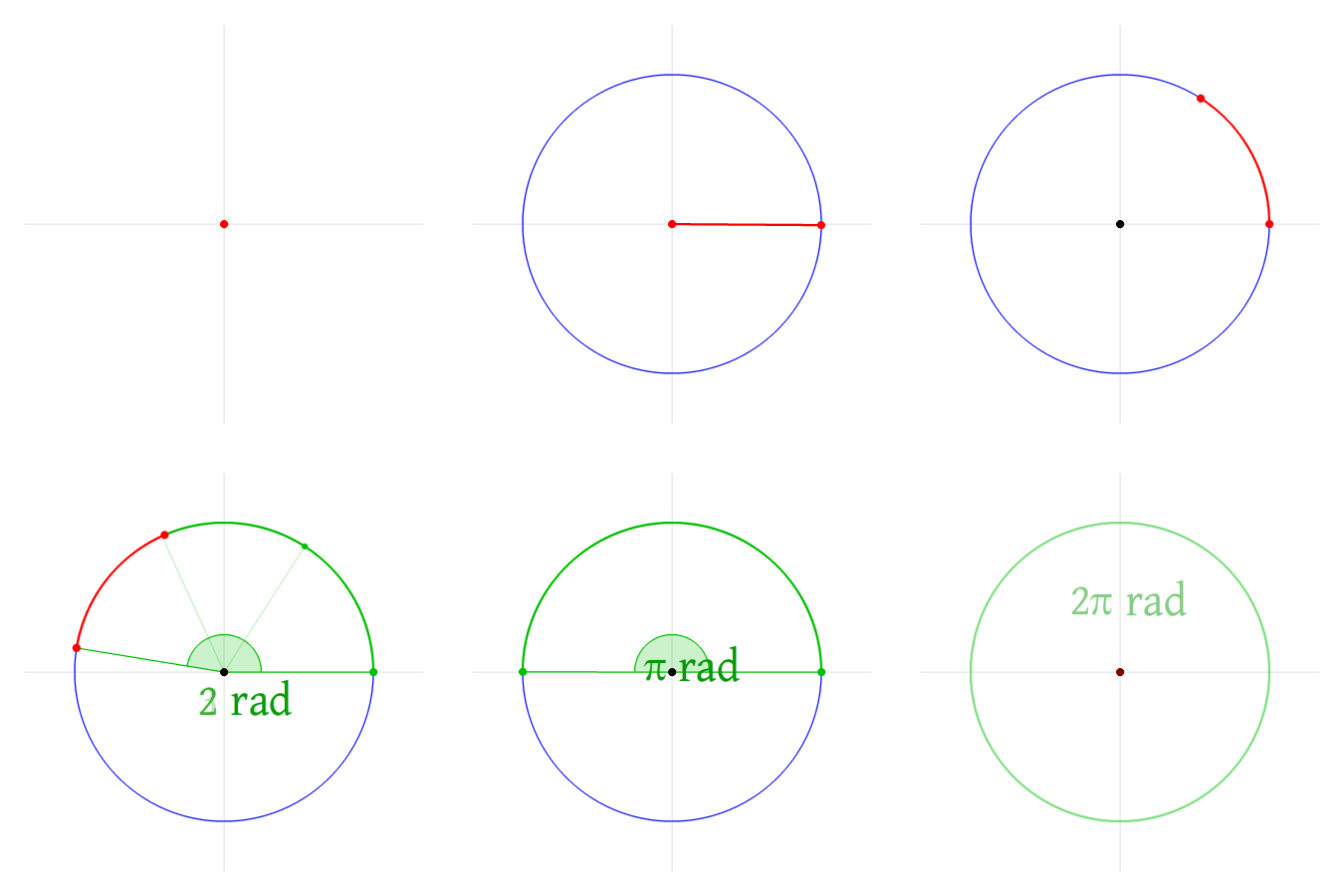
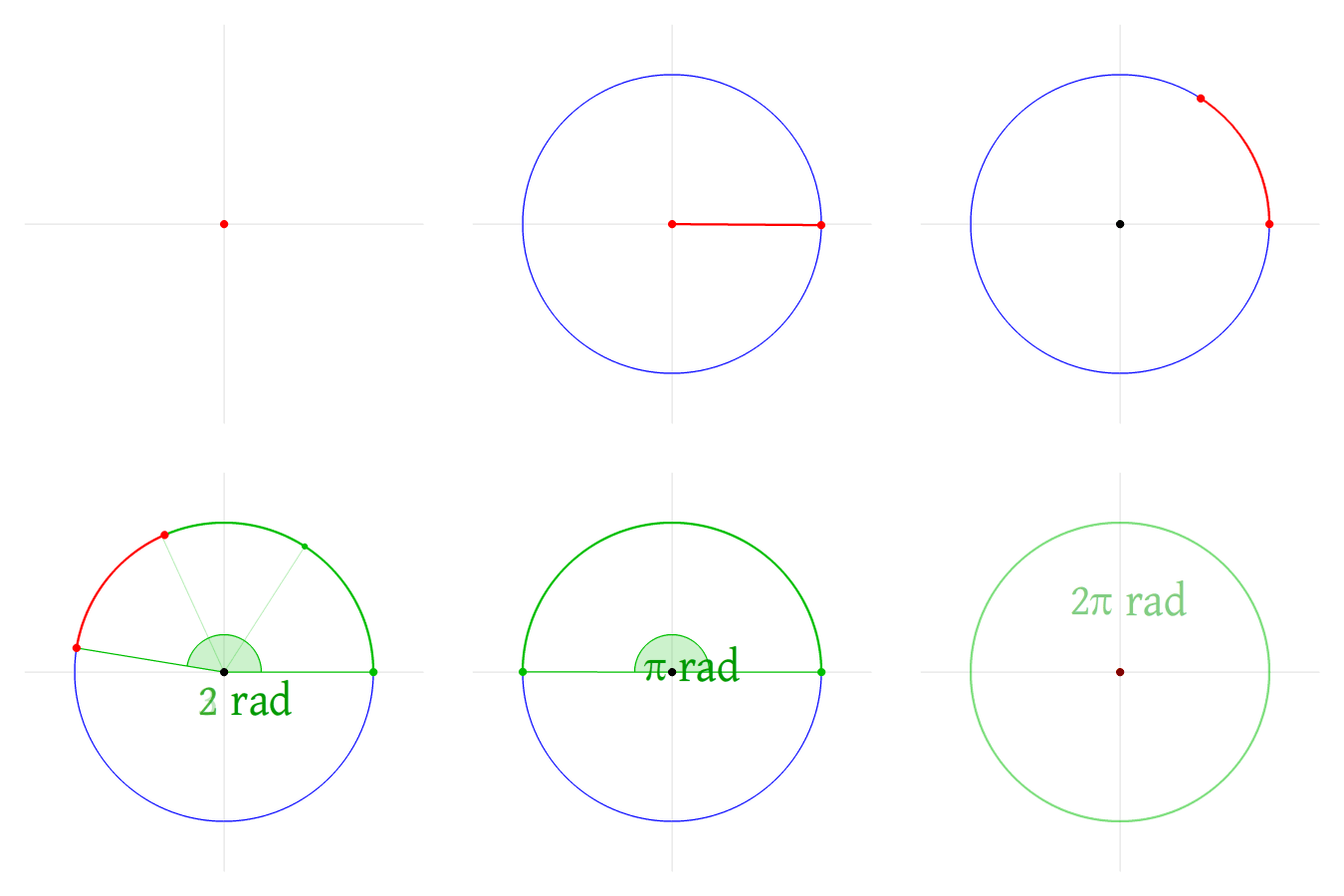
The radian is a unit of measure for angles used mainly in trigonometry. It is used instead of degrees. Whereas a full circle is 360 degrees, a full circle is just over 6 radians. A full circle has 2π radians (Roughly 6.28) As seen in the figure above, a radian is defined by an arc of a circle.
dark sparrow
1 radian is the angle subtended by a circular arc whose length equals its radius.
that's the best definition imo
 hot sable
hey can someone solve me this problem sin(30+13,90) I've been trying to find an answer but i cant do it
Also could anyone explain me the way of doing it
I would be grateful
hot sable
I used angle sum identities but after that i totally blocked
I get into sin30° * cos13,90° + cos30° * sin13,90°
Then i transform it into => 1/2*cos13,90° + √3/2 *sin,13,90°
And I don't know what to do after that
silent plank
what does the question ask for?
decimal approximation?
hot sable
Ah it is from an old exam
silent plank
plug cos(13.9°) and sin(13.9°) into a calculator
hot sable
It requires an answer
silent plank
to get their values
 silent plank
oh fk me
dark sparrow
...it's none of these 
silent plank
13 * 90°
dark sparrow
wtf
hot sable
The answer is https://gyazo.com/abe28148ca5e7570fa1dc1ca8ac4740d

 silent plank
dots can be used for multiplication, but the formatting is very bad
silent plank
$\sin(30^{\circ} + 13 \cdot 90^{\circ} ) $
somber coyoteBOT
ramonov:
silent plank
can you solve it if it's written properly like that?
hot sable
Me?
silent plank
yes
hot sable
I tried to solve it like that dude
i don't know how to transform sin,13,90° or cos13,90°
silent plank
not comma or decimal point
13*90
as i just stated
$\sin( x + k \cdot 360\deg) = \sin(x)$
somber coyoteBOT
ramonov:
hot sable
Oh I see now
silent plank
where k is an integer
hot sable
yes
 floral harbor
This question is sort of based with the pythagorean theorem so, is there any possible value of x such that the square root of (2x^2) is in the set of natural numbers? If not why not?
Btw this is related to the isoceles right angled triangles.
silent plank
does x need to be a natural number?
hot sable
@silent plank Tried the way you told me still cannot do it
silent plank
what did you try after i gave that hint
hot sable
well i found how much is 13*90° which is =1170/360 so i find where i find that sin belongs in the 3rd graph
but i'm not even sure it's the right thing
hot sable
What do you mean
silent plank
which part?
hot sable
12*90° + 1 *90°?
somber coyoteBOT
ramonov:
hot sable
so it would get to sin(120°) since 12*90 is equal to = 1080° and is not needed?
silent plank
"not needed" is a bad way to put it
sin(120° + 1080°) = sin(120°)
though you didn't really need to actually multiply the whole thing
12*90 = 3 * 360
silent plank
np
 blazing panther
How to memeoewiae unit circle
floral harbor
@silent plank yes.
rich wolf
@blazing panther think about it in terms of turns
that is, fractions of 2 pi
like 270 degrees is 3/4 of a circle
so it is 3/4 * 2 pi
6pi/4
=3pi/2
also one of the reasons tau is superior to pi
 faint orchid
we don't speak of tau here
 analog pumice
It is actually illegal to use it in the US
rich wolf
$e^{i\tau}=1$
somber coyoteBOT
AMD:
weary drift
lovely
rich wolf
If $e^{i\tau}=1$ and $e^{0}=1$ , then $e^{i\tau}=e^{0}$, implying $i\tau=0$
somber coyoteBOT
AMD:
 eternal crag
since i=sqrt-1 is imaginary it's clearly "nothing" in reality and hence it's 0, so math checks out still
 limber anchor
So I actually have 3 questions but I think I should just start off with one, so I have all the values for the other angles but I’m unsure how that relates to B or A
limber anchor
Ahh a pentagon and I just got it
rich wolf
use ur brain
limber anchor
i’m sorry
rich wolf
lol no don't be i'm just saying
limber anchor
You don’t think you could help me with the other problems in a moment could you?
rich wolf
sure
limber anchor
Alright thank you give me one second
rich wolf
been awhile since freshman geo lmao but i'll try
limber anchor
Alright so for this one I’m not really sure how I’m supposed to get the interior angles
I know the interior plus the exterior equals 180 but I don’t have a set number for either
rich wolf
what kind of shape is it
limber anchor
A trapezoid right?
rich wolf
also it's not a trapezoid
limber anchor
ah
limber anchor
ahhh that’s right
rich wolf
the sum of the interior angles of a quadrilateral polygon = 360 degrees
limber anchor
so if i added them all up i would get 360, but how am i supposed to get their measures
rich wolf
180-externalangle1 + 180-externalangle2 + 180-externalangle3 + 180-externalangle4=360
do you see what i did there
and why it makes sense
you can express each interior angle as 180 minus the exterior angle
limber anchor
ohhh alright
rich wolf
and that should give you a linear equation in x
then you can find the value of x and plug it in
limber anchor
And I would separate them like (180 - External Angle) + (180 - External Angle) right?
rich wolf
addition is commutative
i personally would set it up like this
720 - (sum of external angles) = 360
because 720=180*4
limber anchor
And I would combine the like terms from the external angles and the 720?
rich wolf
combine the like terms of the sum of the external angles
limber anchor
ahh alright
limber anchor
So now I have 720 - 12x + 60 = 360
rich wolf
wrong
limber anchor
Why?
rich wolf
720-(12x+60)=360
limber anchor
Oh, so now what do I do?
rich wolf
actually my bad i'm stupid you were right
addition is commutative
so yeah it means the same thing
combine like terms
rich wolf
you can also just say that the sum of external angles = 360
you got that 12x+60=360
solve that
limber anchor
Oh alright
So 25 is my answer
Alright now I just need one more problem but I believe I’m gonna try it on my own
rich wolf
👍
limber anchor
Thanks for the help
eager kraken
How do I find sec (t) =1.5625809?
sec(t) = 1/cos(t)
but when I type 1/cos^1 (1.5625809) into my calculator it gives an error
rich wolf
rad or deg