#geometry-and-trigonometry
1 messages · Page 243 of 1
 upper karma
 weak shoal
Draw a picture of the scenario
upper karma
200pi seems too much.
weak shoal
And highlight the distance that needs to be calculated
weak shoal
Sure
upper karma
Something kinda like that and get from A to B going all about the semicircles.
From A to B diameter is 100
weak shoal
Well okay, what's the radius of each semicircle?
Have you attempted to calculate that?
Also, draw a bigger and nicer diagram
That can make the difference
weak shoal
No, like I said, draw bigger and better picture first
 burnt plinth
@upper karma that picture is awful but do u mean linesegment AB is 100 units long?
burnt plinth
ok well draw line segment AB
upper karma
I got 50 pi
burnt plinth
🤔 doesnt quite sound right to me
consider drawing line segment AB first of all
you know the 4 semicircles are congruent, so you really only need to find the length of traveling along one of them and multiply by 4 if that makes sense

ill redraw the problem in ms paint and u tell me if i drew it properly
upper karma
Does the location of the semi circles really matter? As long as they all touch like that but ok.
Well I did I tried to do L = 180/360 * 2(pi)50
And got 50pi but is that just one
burnt plinth
ok im struggling with paint
well firstly i would label the mid point between A and B
you want to find a relation between that line segment and the circles
well, you know you can find the length of the semicircle as 1/2 * the circumference, so that's 1/2 * 2 pi * r which is pi * r
so now you just need to relate the radius to the length of the segment AB
well, you know segment AB so if you label its midpoint C
consider the top left semi circle
you know AC is length 50
so how do you relate AC to some important property of the circle?
hint: what do you know about the triangles formed by the diameters of the circle and segment AC
looking at ur formula, it looks like you didnt get the radius of the circle correctly
upper karma
Oh ya I just used the whole diameter
So you need the radius of one of the semi circles?
Is the diameter of one of them 25?
upper karma
Because there are 4 semicircles and the total is 100. So 100/4?
burnt plinth
no you cant just divide like that because the diameters dont add up to 100
upper karma
Oh ok.
burnt plinth
you need to consider the triangles that are formed
there are very nice properties with right triangles you can use
draw and label some numbers on the triangle
upper karma
Ok
upper karma
so, I'm looking for the packing efficiency in 9-dimensions
I know I know its not proven yet
I don't need the EXACT perfect percentage
I'd like a close approximation
I was thinking of trying to do this the hard way, of tyring to squeeze spheres of the same radius into a finite volume randomly
What branch of mathematics does the topic of packing efficiency in higher dimensions fall under?
 summer spire
Wikipedia lists it as discrete geometry
 tribal rose
On Paul's Math notes, I dont see a Trig section, only a review in Calculus 1 ?
What should I be looking at? The algebra section doesnt have much trig
 devout harbor
you can try examsolutions
 dark sparrow
precalc?
tribal rose
I just finished algebra, taking trig in spring, then its calc 1 in fall 2020
Idk what I should be looking at. I dont think Paul covers much trig?
tribal rose
Yeah its precalc ?
dark sparrow
precalc should have trig
upper karma
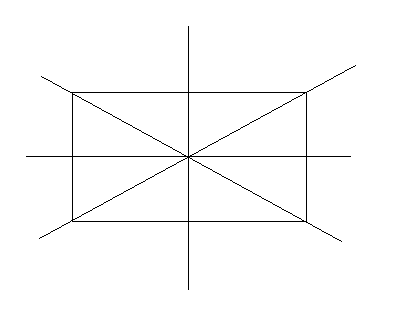
How many lines of symmetry does a rectangle that is not a square have? https://i.imgur.com/ikH7pAM.png
 white cradle
@upper karma how many do you think?
upper karma
@white cradle I don't know. I am just stupid.
white cradle
no, am genuinely asking you how many you think
that way we can fix whatever doubt you have
upper karma
I don't even know. That's just what intuitively feels right.
white cradle
alright
here's an easy way
if the line is a line of symmetry
it divides the figure into two halves
and both halves would look identical
this is just another way of seeing that reflection results in the same figure
so now try to find out which of the four lines you've drawn are lines of symmetry
dark sparrow
it divides the figure into two halves
and both halves would look identical
not quite
white cradle
well ig identical is a bit vague
i honestly don't know how else to explain this
after all that we've already tried the other day
white cradle
we can't just tell you the answer
what's the point if you won't be able to figure it on your own
what happens when you have to find for some other figure and we're not there to tell you
white cradle
I mean you still don't know what a line of symmetry is
how about watching some videos on it?
visualizing might help much better than explaining could
atleast for this case
 white cradle
is it?
upper karma
Why not?
white cradle
reason
white cradle
well, yes it is A rectangle still
but is it the SAME rectangle?
after reflection is it still oriented the same?
can you draw on the same image
the reflected rectangle
that might help us out
white cradle
alright sure
ABCD is the original rectangle
BD is the reflection axis
DECF is roughly the reflected rectangle
upper karma
Wait, what just happened?
I'm reflecting the "right triangle"
But you kind of rotated it instead?
white cradle
you reflect every point on the rectangle
about that line
essentially ig you could see reflection as a 180 deg rotation
upper karma
But if you have a line going through the diagonal like that on a piece of paper. You could fold it in like the diagonal, and unfold it
It would be the same on both sides, no?
white cradle
would it perfectly overlap?
white cradle
why not
dark sparrow
well
white cradle
atleast in 2D
white cradle
:(
dark sparrow
if you talk about 3D space
upper karma
Wait, you are right...
white cradle
fuck
dark sparrow
then you could see it as rotating the entire plane 180° around that axis
upper karma
What is going on?
dark sparrow
but that's unnecessarily overcomplicated
upper karma
@white cradle In your picture, what is E and F supposed to be?
Like what were they before?
white cradle
they weren't there before the reflection
they're the new vertices formed after reflection
white cradle
well not particularly
upper karma
Damn I should've done this with a piece of paper earlier..
upper karma
Well ok, but how do I know for which shapes it works and where it works and when it doesn't?
Like when I draw the hypotenuse in that rectangle, both pieces look even
white cradle
yes but, say you reflect one of those right triangles about that diagonal
you wouldn't get the reflected image to superimpose on the other right triangle
like reflecting figures is easy
for each point you just draw a point on the other side of the line, at the same distance as the original point was from that line
do that for a few points of the figure and you'll have an idea whether it's symmetric or not
upper karma
I don't think it's working for me
One sec
@white cradle https://i.imgur.com/UE9vVFq.png
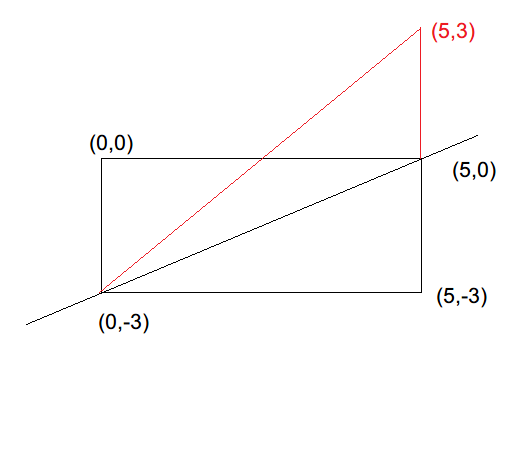
I'm messing it up..
How should I plot the points @white cradle
upper karma
Yeah how?
white cradle
draw a line from the point to the diagonal
white cradle
extend that line to the other side till it's roughly twice the length it was
shortest distance @upper karma
drop a perpendicular
upper karma
From where?
white cradle
from whatever point you want to reflect on the diagonal
white cradle
draw a line from that point to the diagonal such that it is perpendicular to the diagonal
just roughly, you don't need the exact points
draw on paper by hand
upper karma
Ok
So I draw the perpendicular to the diagonal from the corner or some other point
And then I extend the perpendicular straight so it's twice the length of one perpendicular?
upper karma
What's a reflection point sorry?
white cradle
you can do it for any point
upper karma
And it's past the "other" side of the rectangle
white cradle
yup
upper karma
Does that mean it isn't a line of symmetry?
white cradle
yes!
upper karma
Nice
Ok, so how do I finish the reflection now? Like I have this: https://i.imgur.com/bkFNWtL.png
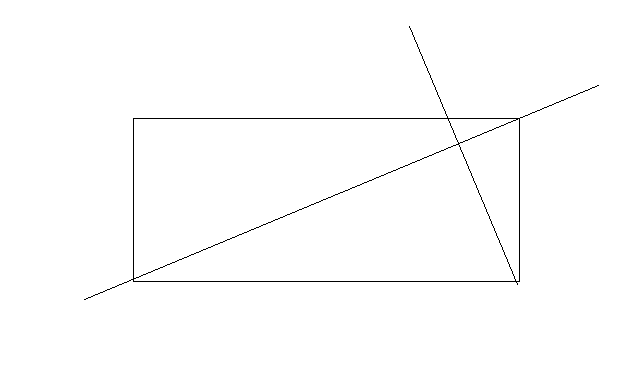 white cradle
on the other hand, if all of the points after reflection fall on the "other" side of the figure, it's a line of symm
find the reflection of the vertex of the other half rectangle also
upper karma
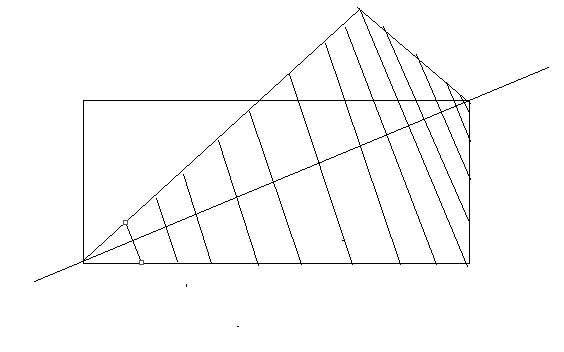
Do I keep drawing lines like this?
white cradle
well it's not the best way but it's the only one I've managed to make you understand
 upper karma
Do I have to?
white cradle
rectangle **
upper karma
Doesn't this guarantee it's not a line of symmetry
white cradle
yes it does
upper karma
Because the other side is past the left side of the rectangle
white cradle
yup
white cradle
👍
upper karma
Just so you know, if someone else asks this and they don't instantly get it, tell them to get a piece of paper and do it. And afterwards you can tell them to reflect it for any figure, they can simply draw the perpendiculars and extend them onwards
I think it's a very good explanation
white cradle
mm hm it didn't strike to me earlier
but indeed, it's the best possible explanation
upper karma
Probably because it's obvious to you
white cradle
yeah..
upper karma
Mathematically speaking, the image when we reflect point A over line m is the point A' such that m is the perpendicular bisector of AA'. In other words, if we folded our paper along line m, A and A' would coincide.
A over line m is the point A' such that m is the perpendicular bisector of AA'
white cradle
yeas
upper karma
😦
To be honest I feel like a graphic would've been nice there
I read it but I think it didn't "absorb"
white cradle
you were arrogant tho, ngl
upper karma
Nah, I was just frustrated.. Sorry..
 white cradle
yeah
upper karma
Nice
tribal rose
"How many lines of symmetry does a rectangle that is not a square have? https://i.imgur.com/ikH7pAM.png"
So back to this, I dont understand how to answer thequestion? I see how you drew up a reflection
The answer is 2 ?
What is this called? I want to look it up

 polar sable
6
tribal rose
Thanks
 restive nymph
so I need to find the remaining trigonometric ratios for this, I believe the hypotenuse is the square root of 10, and the sin and csc are both negative but what about the rest?
 thick bloom
if you draw a triangle with angle beta that had 1 opposite beta and 3 adjacent to beta you should be able to get all the ratios just by looking at the triangle, using sohcahtoa, and using the CAST rule for the unit circle
restive nymph
this is what I think
sin is 3 divided by the square root of 10
cos is 1 divided by the square root of 10
tan is 1/3
cot is 3 of course
sec is the square root of 10
csc is the square root of 10 devided by 3
is that true?
I am not really sure how to know whether they are positive or negative is the problem
 silent plank
unit circle.
you are told that pi < B < 2pi
cot B is also positive,
which quadrant is B in?
restive nymph
oh it's the 4th one!
thank you so much
because cot b would be negative if it was in the third quadrant
silent plank
uh, are you sure?
silent plank
yes
restive nymph
since tan there is positive
alright, just messed up a little bit but yeah
so only tan and cot are positive and the rest is negative
silent plank
yeh
 tardy junco
I didn't follow how they did this step.
(it's a trig simplification step).
What trig identitity did they use?
Please ping me if you answer (I'm going offline)
tardy junco
Hmm product of sin and sin?
 tawdry pivot
$\sin a\sin b=\frac12(\cos(a-b)-\cos(a+b))$
tardy junco
Oh gosh you're right. That makes sense why there is a half
 somber coyoteBOT
EpicGuy4227:
tardy junco
Thx epicguy
tardy junco
K thx both of you.
weak shoal
You can easily prove it from basic ideas but you never remember stuff like this lol
tardy junco
That's so true
weak shoal
I mean, it’s good to prove it once in your life i guess
tawdry pivot
the only ones I remember are sin(a+b), sin(2a), cos(a+b), cos(2a) cuz I use them the most. I derive all the other ones when needed
weak shoal
Yea
 gritty sail
those other formulas are hard to remember
weak shoal
That's why you never remember them
gritty sail
just big brain it
weak shoal
You prove them at least once in your life and then you forget about them till you gotta derive them
white cradle
yeah
 silk crown
lol I have like 50 formulas in trig memorised on a huge chart I have hanging around
 quiet mason
wth
 sly marlin
Let me see how many trig formulas are reasonable to memorise (Not counting hyperbolic sine/cosine...)
sin^2+cos^2=1, and we can divide that by sin^2 and cos^2 to get 2 more identities (3)
sin(a+b), cos(a+b), tan(a+b) + changing to a-b + deriving csc, sec, cot from there (3 to 12)
double angle/half angle (4?)
product to sum / sum to product (5?)
R-formula (not really a formula, more of a concept)
De Moivre's (1?)
That's just 25 to 30.
weak shoal
just 25 to 30
 robust socket
$y=\frac{(x^2+\pi^2)(1-\sqrt{\sin(x)-1}}{(x^2-\pi^2)(1+\sqrt(\cos(x)+1)}$
somber coyoteBOT
Umma.Gumma:
robust socket
I've got to find the domain of this stuff here
I would proceed with a check on the denominator(which looks rather daunting) and the square roots
is that correct or should I consider something else?
weak shoal
What do you think?
robust socket
well I' not sure that's why I'm asking
:D
tbh I sense there is something going on related to those two parentheses before the sq roots
weak shoal
Well, there are a bunch of square roots as well. Might wanna consider those
robust socket
yep, I considered those above, second sentence
robust socket
I'd appreciate if someone could evaluate that domain, I'd be interesting in see how you proceed
 idle bloom
No one is gonna do it for you but people could help you
 umbral snow
You really only need sin(a ± b) and cos(a ± b). If your teacher is really mean enough to force you to memorize tan or sec sum identities, you can get them from sin and cos
Double or half can be easily obtained by doing sin(x + x)
robust socket
Thanks Kaynex, I'm not absolutely sure what do you mean with a and b here
thing is, I'm not seeing which identities we are talking about here
umbral snow
a and b just being labels for variables. Could replace them with x and y
Oh sry I was talking about the earlier convo
Oh IC you want that domain
Anything under a square root has to be positive, and anything in the denominator can't be 0
robust socket
yeah that's pretty clear, the thing is, how do I check that denominator
that product is rather nasty
weak shoal
Determine all the points of discontinuity. You have x = pi, x = -pi and so on
umbral snow
You just have to check both factors:
x² - π² = 0
1 + √[cos(x) + 1] = 0
As if either of them are 0, the denominator is 0
robust socket
great, the second factor is an irrational eq but what about the first one?
somber coyoteBOT
Spamakin🎷:
idle bloom
that should be one of things you learn to recognize instantly
robust socket
right thank you
 sage lodge
How do I convert between cartesian and spherical coordinates? I wrote these two short methods but they aren't functional https://cdn.discordapp.com/attachments/564666592282148864/657820049599496202/unknown.png (in my case xz plane is pan and y plane is tilt)

or rather I think cartesianToPolar works but not polarToCartesian
I can give some input/output examples
upper karma
ah, 3d polar
is the formula for cartesian -> spherical not $ r = \sqrt{x^2 + y^2 + z^2}, \phi = \arctan \frac{y}{x}, \theta = \arccos \frac{z}{r}$?
somber coyoteBOT
Sun:
upper karma
Mispoke ^, deleted.
oh, your polartocart doesn't work
not the other one
one sec
polar.mag = ?
I think you typod a cos instead of a sin for the x coord in polartocart
sage lodge
thanks ill try to make those changes
quiet mason
changs
sage lodge

sage lodge
might be both lines. Just realized I'm taking the sin of the yangle. If the yangle is 0, it will give me 0 for my x and z components which doesn't make any sense.
upper karma
@sage lodge $x = r\sin \theta \cos \psi, y = r \sin \theta \sin \psi, z = r \cos \theta$
somber coyoteBOT
Sun:
upper karma
$\theta \in [0, \pi], \psi \in [0, 2\pi)$
somber coyoteBOT
Sun:
upper karma
r = radius, $\theta$ inclination, $\psi$ azimuth.
somber coyoteBOT
Sun:
sage lodge
Ok I tried that, and it seems like its working now except if i convert a vector to polar, and the polar vector right back to cartesian, the Z value will be negative (with some magnitude)
upper karma
@sage lodge make sure you have your variables correct
upper karma
Hey, does anyone know how to do proofs involving parallel lines?
dark sparrow
i'm gonna say yes even though that's quite a vague criterion
upper karma
no need to worry, they're just doing a survey
 onyx basin
why does sin(-x) flip sin(x), but cos(-x) is the same as cos(x)
 weary drift
You can try showing this yourself by rewriting sin & cos using complex exponentials
dark sparrow
lmao
do you really think someone going in this channel even knows what a complex number is
weary drift
Worth a try imo 
onyx basin
not gonna lie i dont know what a complex exponential is
i know what a complex number is but not a complex exponential
anyways there's gotta be some logic behind it tho right
dark sparrow
ever seen the unit circle?
onyx basin
yep
 elder surge
yep
dark sparrow
yeah ok so like
elder surge
If you're stumped with what complex exponentials are, go watch 3Blue1Brown's video about e^i*pi
dark sparrow
going from θ to -θ is flipping across the x-axis
onyx basin
for sin yea
dark sparrow
no i mean like
onyx basin
o my bad
dark sparrow
every angle corresponds to a point on the circle itself
onyx basin
yeah
onyx basin
ok so ive been thinking
cos0 = 1
is that why
because you can't really do cos0 = -1
since cos0 will only have one answer
dark sparrow
it'd be a bit obtuse to call that alone the reason
onyx basin
yea
but i can't really think of another reason
so im just gonna stick with that one for now to satisfy me
though there's gotta be some deeper logic behind it
elder surge
why would you make cos(0) be equal to -1?
cos(x) is the distance between a point on the unit circle with an angle of x radians to the point [0,0] and the y axis. so cos(0) is 1.
upper karma
,w calculate cos(0)
somber coyoteBOT
 Requested by Sun#3606
sage lodge
Requested by Sun#3606
sage lodge
@upper karma i tried using a different formula. now the xz is proper sign but the y is negated ;/
sage lodge
ok
for Cartesian to Polar I'm using $ r = \sqrt{x^2 + y^2 + z^2}, \phi = \arctan \frac{z}{x}, \theta = \arctan \frac{sqrt{x^2 + z^2}}{y}$?
somber coyoteBOT
SpeedDart:
sage lodge
oh well the sqrt didnt work
In the system I'm using the z and the y is flip flopped. This may be the source of the confusion I'm having but unfortunately a requirement for what I'm working on
somber coyoteBOT
Sun:
sage lodge
i'm pretty sure it's a math issue and not a logic issue so i thought i might as well just put it as a formula ;p
upper karma
i'm assuming radius r, inclination θ, azimuth φ
sage lodge
previously had that. if i use that, the z and x values will be negated instead
upper karma
ok, so
using your formulae
if you can take an input
convert it to spherical
then convert it back to cartesian
then your formulae are correct
and it's logical
so try that by hand, if it doesn't work, type it up on pseudocode. you'll probably find your error while typing it
sage lodge
i'lll try it by hand then
upper karma
make sure you're using the right tan function
sage lodge
i get the same issue by hand. x is negated (although only the x value rather than x and z)
upper karma
then fix ur formulae
I've given you correct ones (from wikipedia, so at least 50% correct)
upper karma
Hello. I stumbled upon this geometric problem. I've resolved it, but by employing a rather complex approach. Apparently there's an easier method to tackle it. Could anybody give me a hand?
Find the relationship between the square's perimeter and the circle's circumference.
The leftmost intersection cuts the circle in half.
 undone shuttle
There are no information about right intersection points?
Information about anything related to the circle
silent plank
can you tell us your method first?
@upper karma
 rancid verge
can someone explain this please
silent plank
7-8 lines of work isn't too bad
 clear haven
@rancid verge are u familiar with transformations of sine/ cosine function
rancid verge
sorta
upper karma
@silent plank Yep, but I feel there's an approach that doesn't involve the law of sines or even the Pythagoras theorem.
clear haven
what do you know so far then @rancid verge
rancid verge
know how to get the amplitude
clear haven
cool
rancid verge
that doing cos (2pi) makes more cycles
clear haven
yeah that's ur frequency thing
rancid verge
but the question has time on the x-axis
clear haven
yes
rancid verge
and I'm used to pi on the x-axis
clear haven
wdym
rancid verge
well after 2 pi we have a cyle
cycle
for a sin or cos graph
and thats usually on the x-axis
rancid verge
hmm i guess
clear haven
time can take on the value 2pi and cause a cosine or sine to make a full period
just imagine time as just
the independent variable
just like "x" is
rancid verge
ok
clear haven
"x" and "t" are just
names
for that sort of thing
anyway
so from wat u know so far
silent plank
@upper karma
did someone actually confirm there was an easier way?
also your first line should be b=
and you should use side length s instead of 1 to be more rigourous.
clear haven
what's the amplitude of the graph
rancid verge
3
rancid verge
so the frequency is 1.5
rancid verge
so answer A
rancid verge
so B?
 lusty reef
Yea, it's B
clear haven
sorta
to get the frequency
you take 2pi / the coefficient of the x thing
well first really ya gotta do a bit of factoring
since the answer choices u have are not in the form of Acos(B(x-C))
rancid verge
what is the coefficient of the x thing
clear haven
B
upper karma
I came up with an easier solution, which does not involve angles.
silent plank
I just realised that too
upper karma
weak shoal
7/5 = 35/25
onyx basin
@elder surge little late, but i didn't say cos0 = -1, i was saying that cos0 cannot equal -1
clear haven

i dunno what crazy ass identity i need to figure out how to get this to happen
they are equal when i desmos both
so that's ok
but
weak shoal
???
clear haven
beyond just making the 1-cos(theta) a 2sin^2(theta/2) i dunno wat else i can do
yeah i know right
weak shoal
Okay here's thing
Have you tried simplifying the denominator?
$\cos((n+1)x) - \cos(nx) = \cos(nx +x) - \cos(nx) = \cos(nx)\cos(x) - \sin(nx)\sin(x) - \cos(nx) = \cos(nx)( \cos(x) -1) -\sin(nx)\sin(x)$
Then, start simplifying
Wtf
clear haven
oh right i can do stuff with the n+1 stuff
somber coyoteBOT
Abhijeet Vats:
 weak shoal
Okay yea, then start simplifying using half angle identities
Same thing with the denominator
clear haven
ty
weak shoal
Have there been any conditions placed on what theta can be
 golden sail
No
weak shoal
Show the exact problem
weak shoal
Oof i don't see any restrictions on theta.
 devout shell
Convert degrees to radians
You got the (3/2, π/3)
And then 300 degrees is the same as -60 degrees
golden sail
Where 3/2 from
devout shell
1.5 = 3/2
golden sail
Ok
devout shell
You have it correct
golden sail
J see
weak shoal
Well, 300 degrees is not the same as -60 degrees but they do give the same value when used as inputs in cos(theta)
devout shell
Should have said coterminal then
golden sail
Thanks guys @weak shoal @devout shell
 golden sail
silk crown
golden sail
silk crown
I think the angle in [0, 2π] is what is asked when no range is there for the angle
HS textbooks aren't always very explicit lol
dark sparrow
this is polar
silk crown
Isn't the problem just to find a point
oh wait
nvm
still the "most likely" way is probably the way
for like most problems
 copper moss
Question: I know how to calculate a scalar product, but I'm confused as to what it represents. So the product of scalars u and v would be the image below, but what does that mean?
 eternal crag
the dot product of u and v is the product of their length times the cosine of angle between then
copper moss
Yes I know, but what is the dot product for? is it for solving for the angle?
eternal crag
well, for one, dot product tells you if u and v are perpendicular to each other
copper moss
if uxv is 0
eternal crag
cross product is a different thing
if u X v = 0 then u and v are parallel
and yes you can solve for the angle if you want from the formula
eternal crag
glad i can help

 swift moth
I know they're equal, I just wanna understand the logic behind it
weak shoal
Begin by labelling all the points where two lines intersect in your diagram
Then, use that as a way of referring to your angles
It makes it easy
weak shoal
Okay what the fuck is that thing in the middle lol
swift moth
wait, I know why they are equal now
a P
an attempt at a P
then you can use the fact that when two lines intersect opposite angles are equal
so there is another angle a
swift moth
and then, if you have a line between connecting two parallel lines you know the alternate angles will be equal
hence a=a=a=a
swift moth
I guess it'll be clearer if I label my angles properly
or letters
CAB = PCD = BQC = PBQ
Q is the point where the dashed red line and the blue line intersect
weak shoal
Do you know, for certain, that lines DB and AC intersect at right angles?
swift moth
yes
weak shoal
Aight then?
 civic nexus
Hey guys, how do I tell if a negative sin function is in quadrant 3 or 4?
a part of my question has a function sin inverse (-12/13) and im not sure if it is in quadrant 3 or 4
silent plank
specifically, what is the question asking for?
civic nexus
is it better if i type it out or take a picture?
silent plank
picture
civic nexus
oops thats a shitty picture
but its the one above "Show that tan"
basically i needed to let both functions be A and B then expand tan(a+B)
but when im doing the special triangle for sin inverse (-12/13) im not sure if the tan value should be positive or negative 12/5
silent plank
do you have a better pic?
silent plank
i derped for a sec,
recall the range of arccos and arcsin
civic nexus
does arccos mean cos^-1?
silent plank
yes
civic nexus
-pi/2 to pi/2
silent plank
for arcsin, yes
civic nexus
cos is 0 to pi
silent plank
which means if the ratio of sin is negative, then the angle from arcsin is in quadrant:
silent plank
-pi/2 to pi/2 cover which quadrants?
civic nexus
1 and 3
silent plank
no
civic nexus
oh wait its 1 and 4
silent plank
yes
civic nexus
so the range of arcsin covers quadrant 1 and 4, therfore when sin is negative it is in quad 4?
silent plank
yes
well the result of the arcsin will be in quad 4 to be specific (if the ratio from sin was neg)
civic nexus
wouldnt it be in quad 1 if it is positive?
silent plank
yeh, i mean for this question
civic nexus
oh ok, thanks a lot!! ill think about the theory by myself
civic nexus
Can someone help me with question 9
I'm not sure how to work with 3 tan functions and how to prove something is pi/2 since there is no solution for tan(pi/2)
weak shoal
Well, i suggest taking the tangent of the left-hand side
Then, use identities
But before that, first let:
$\alpha = \tan^{-1} (\frac{1}{2})$
$\beta = \tan^{-1} (\frac{2}{5})$
$\gamma = \tan^{-1} (\frac{8}{9})$
somber coyoteBOT
Abhijeet Vats:
weak shoal
Then, work in terms of the variables & get a formula for the tangent of the left-hand side
civic nexus
Yea thats what I thought as well, but I'm not sure how to form a formula with 3 variables
and also if I form a tangent with the left side, i would get tan (pi/2) for the right which is unsolvable
silent plank
argh
weak shoal
Haha lmao, get some practise with it
civic nexus
Im not sure how to solve the part with pi/2
silent plank
you can probs apply a different trig function
weak shoal
$\tan(\alpha + \beta) = \frac{\tan(\alpha) + \tan(\beta)}{1-\tan(\alpha)\tan(\beta)}$
somber coyoteBOT
Abhijeet Vats:
weak shoal
^Start with that sort of thing. Then, go from there.
civic nexus
Yea but i get stuck when i get to tan (pi/2)
silent plank
try applying sin or cos instead of tan
weak shoal
Noice
silent plank
you may also need to briefly explain how
arctan(1/2) + arctan(2/5) + arctan(8/9) is within (0, pi)
civic nexus
i dont understand that part, i assume it has something to do with the range of arccos?
silent plank
yeh, eg.
sin(a) = sin(pi/2) doesn't necessarily mean that a = pi/2
arctan could actually be used here.
since (arctan(1/2) + arctan(2/5)) is in [0,pi/2)
(arctan(1/2) + arctan(2/5)) = arctan ( tan (arctan(1/2) + arctan(2/5)) = arctan(9/8)
then your LHS becomes
arctan(9/8) + arctan(8/9)
which is pi/2 from the properties of a right triangle
civic nexus
Woah I need a bit of time to digest that lol
I think I'll leave that for the future haha, probably going out of my syllabus rn
silent plank
was there any part of that you didn't understand?
civic nexus
Yea, way too many LOL
4 parts to be exact
but i dont wanna trouble you with that, I think im good for now
thanks a lot!
weak shoal
What
 sterile hinge
exactly I dont get it either
weak shoal
So how can we answer the question if we don’t know what any of that is
Perhaps google?
sterile hinge
alright man sorry to bother you
weak shoal
Nah you didn’t
sterile hinge
🙂
 fringe crater
I think you're talking about the focus of a parabola
weak shoal
Of course
4py = x^2
It’s, however, better for him to do some research on his own first and figure things out before asking questions here
upper karma
Can someone help be with this cosine function transformation question, ive never heard of the letter terminology. A cosine function has been vertically stretched by a dilation factor of 45, reflected by the x-axis, horizontally stretched by a dilation factor of 10 and translated up by 33 units. Determine the values of the parameters a, k, d, and c
 rich wolf
@upper karma what is the parent function
upper karma
f(x)=cosx
rich wolf
Now what do you do to that function to carry out those transformations
upper karma
it should be f(x)=acos(bx+c)+d
 late frost
can someone help me find length of blue line in terms of radius R
upper karma
help find != "give answer"
rich wolf
What is the factorial of "help find" and why is it equal to "give answer"
weak shoal
^I think he was joking lmao
white cradle
lmao
weak shoal
Anyways, there's a solution by trigonometry. You can find the length of half the blue line:
$L = R\sin(45) = \frac{R}{\sqrt{2}}$
You need twice the length of that, so we have:
$2L = \frac{2R}{\sqrt{2}} = \sqrt{2} R$
somber coyoteBOT
Abhijeet Vats:
weak shoal
Because the angles have been given explicitly.
white cradle
use trig for unequal angles / non 90° sum
white cradle
yes i am nd u better listen to me >:(
rich wolf
I just realized that trigonometry is trigon-metry which means the measurement of 3 sided polygons
I thought it was just one of those random words with no meaning
Like algebra
Idk that was kind of random but it literally just made sense to me
upper karma
actually I think the etymology is "corner angle measurement"
upper karma
yknow what, actually, makes a lot of sense. I considered breaking it down into tri - -gon, .eg.: corner angle
wait
huh
wow, sin/cosin also have cool etymologies
very neat
rich wolf
@upper karma what is it
upper karma
sine alledgedly comes partially from the word "bowstring", tangent from "to touch", and secant from "to cut"



 upper karma
"complementi sinus", "the sine of the complement"
weak shoal
No
Look very carefully at the circle
If you pay attention, you can see that the arc subtending the blue line, as well as the two radii, look like a bow. Then, the blue line looks like a bowstring
civic nexus
Can someone explain to me why the domain of arccos x^2 is -1<x<1?
weak shoal
Well, what do you think?
civic nexus
i know the domain of arccos is -1<= x <= 1
but i cannot square root -1
so somehow that changes <= to <
but i dont really know why
weak shoal
There are no square roots here, though
weak shoal

weak shoal
Well, okay, here's the thing:
-1 =< x^2 =< 1.
However, x^2 >= 0 for all real x. So, we have:
x^2 =< 1 => x^2-1 =< 0 => (x-1)(x+1) =< 0 => -1 =< x =< 1.
So, actually, the domain is just any value of x from -1 to 1.
weak shoal
Yea
You can draw the graph out as well. If you don't want to do that, I guess you can use something called desmos
I've not used it but i've heard it's decent
civic nexus
oh never mind, the domain couldnt be 1 or -1 because the denominator was square root (1-x^4)
i was confused why it couldn't be 1 or -1
thanks!
weak shoal
What
 thorn talon
🤔
weak shoal
Re-draw your diagram and make it bigger
Start labelling stuff
Okay
What have you tried?
Well, what did you try that was relevant to the problem?
Well, there are right triangles all over the place
What can you do with them?
civic nexus
Can someone help me with this
The answer is (1, pi/3 ) , (-1 , 2pi/3)
i dont know why is y = pi/3 instead of square root 3
and also why does the triangle start from x=0?
civic nexus
wut
civic nexus
the normal of the curve forms an angle with the x axis
so i formed a triangle with the axis and the curve
the angle is given in the question, which is pi/3
 distant sonnet
Yeah and
It’s symmetrical so there is another point
Also you don’t know it’s square root of 3
Could be any multiple of it
And we don’t know that the triangle starts at x=0
Just solve square root of 4-x^2=cos pi/3
I mean tan
Then u get -1 and 1
Plug
Done
civic nexus
how did you get square root of 4-x^2=tan pi/3?
civic nexus
what does finding the derivative tell us tho
the gradient?
and why is the derivative = tan pi/3?
distant sonnet
Have you learnt calculus
civic nexus
yea
distant sonnet
Does this question require the use of it
civic nexus
i guess? not very sure
distant sonnet
I’m
Um
Yes
Tan(pi/3) is just the gradient of the normal
We know the gradient of the tangent
Then use the fact that their product is -1
distant sonnet
No
tardy junco
Okay then can it be proved that a = b? If so, then how to prove that?
dark sparrow
well, can it?
dark sparrow
what do you think
tardy junco
It just feels like a = b. But idk
dark sparrow
well then try to prove it
tardy junco
Can you give me a hint?
distant sonnet
Um
tardy junco
Two of its sides are equal
dark sparrow
pan don't spoil
distant sonnet
It’s quite obvious tbh
tardy junco
Isosceles
tardy junco
That two angles must be equal because the length of a triangle is proportional to its opposite angle?
The second statement is right?
That the length of a side is proportional to its opposite angle?
distant sonnet
No
tardy junco
Gosh I've forgotten everything in geometry. Then what is the relation between a side and its opposite angle?
dark sparrow
there's a thing called the law of sines but it's a bit of a nuke here
tardy junco
I've heard it before
dark sparrow
can you prove that in an isosceles triangle, the two angles at the base must be the same?
tardy junco
Hmmm
dark sparrow
you don't NEED to
you never NEED to do anything
but if you think it will help then go for it.
tardy junco
So there is more than one way to do it without law of sines?
tardy junco
If you draw a line from vertex O that is perpendicular to the base. Is the base split exactly on half?
dark sparrow
i don't know, is it?
tardy junco
Hmm
dark sparrow
maybe it is, maybe it's not; maybe you can prove it either way
tardy junco
How to prove that it splits the base in half?
dark sparrow
or maybe it will be more straightforward to draw another line entirely! who knows
tardy junco
If it splits the base in half then we get two congruent triangles so then those angles would be equal.
But does it split the bade in half? Idk how to prove that or know when a line splits the base in half
It's called an altitude right?
dark sparrow
the line you suggested is an altitude.
but if you want the base split in half, then why not draw the line that does just that, i.e. the median?
tardy junco
Oh wait it doesn't need to be an altitude does it
It just needs to bisect the angle at O
I need to go offline now.
Thanks a lot Ann and Pan Pan for helping me. 😁
white cradle
@late frost can you label all the points
white cradle
you missed a point
white cradle
kk
now
IG=EG-EI
and HF=KJ=IG (since all redangles are equal)
and you can find EG and EI by rsin(angle) in the respective triangles
late frost
So I can get EG but how do I get EI? idk what EH is
white cradle
you know ED though
late frost
oh ok ok ok
late frost
thx sir
white cradle
np
late frost
@white cradle So is it R cos (22.5 deg) - R cos (45 deg)?
white cradle
yes
white cradle
aight
late frost
If I were to take the area of the rectangle that the blue line is in, would it be (R cos(22.5) - R cos(45)) * 2Rsin(22.5)?
rectangle HFJK
white cradle
@late frost yeah
late frost
My message was deleted, was it against the rules
weak shoal
Which message?
late frost
I asked something about the area of rectangle HFKJ above
weak shoal
Strange, indeed
civic nexus
how do i find the range of y = x * arcsin x?
 dire rampart
whatd u try
civic nexus
ive no idea, normally it is a number, but this time its x
logically speaking it is x* -pi/2 <= x <= x* pi/2?
dire rampart
sure
but theres only certain values that x can take
since ur domain is restricted by arcsin
dire rampart
ehh I guess it was their of trying to think of it
civic nexus
so how do i solve it then? i'm not sure how to find range with x
late frost
I can see it now
late frost
same thing has happened
I cant see any of messages where we talked about me not seeing the message
¯_(ツ)_/¯
late frost
@white cradle But anyways, I was wondering if we infinitely sum up the areas of all of the rectangles in that direction, can we write that as the infinite series
sigma from n=1 to infinity of (2R * sin(90/2n)) * [R cos (90/2n) - R cos (90/n)]
Like if we continue these blue rectangles infinitely by halving the angle each time, is the infinite series for the total area I have above correct?
late frost
o yea
white cradle
and 2^(n-1) instead of n
late frost
i only looked at first two terms
white cradle
oh lol
late frost
The rectangles get a little small for me to do it any fuurther
Sigma n=1 to inf of 2R sin(90/2^n) * (R cos(90/2^n) - R cos (2^(n-1))
Is that correct?
@white cradle
white cradle
oh no lmao
late frost
Lol what
white cradle
yeah you're on your own now