#geometry-and-trigonometry
1 messages · Page 242 of 1
 gritty siren
there's no r in this, there's no need to introduce one
 signal hornet
Ok, I wil go from theta then
 frosty egret
@signal hornet you dont need to find theta
just use trig identities
such as cos^2 + sin^2 = 1
 dark sparrow
honestly idk i'd have gone with 2cos^2(2θ) - 1
and wouldn't be surprised if that was the next step
signal hornet
It is the next step
dark sparrow
yeah, you can go straight from $\cos(4\theta)$ to $2\cos^2(2\theta) - 1$
 somber coyoteBOT
Ann:
dark sparrow
there's a wholly different way to solve this which i find more elegant
signal hornet
I did one method ealier
dark sparrow
using the sum-to-product formula $$\cos(u) + \cos(v) = 2 \cos\paren{\frac{u+v}{2}} \cos\paren{\frac{u-v}{2}}$$
somber coyoteBOT
Ann:
signal hornet
Never heard of that identity, Never been taught it
dark sparrow
weird bc it's useful sometimes
signal hornet
Yeah, I imagine there are a ton
also we only lecture 2hrs a week
kinda screwed by design
 vivid wraith
can you find the degree measure of angle(BAD) and angle(BCE)?
also the measure of angle(ABC)
vivid wraith
how about angles(BAD) and (BCE)?
if you dont know, try searching up angles on regular pentagons
 novel flax
is it 90
novel flax
ok thanks i got it
vivid wraith
welcom
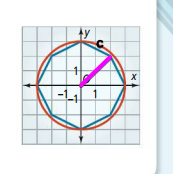
 upper karma
id say its easier to work with it being comprised of 2 45 45 90 triangles but i guess that works too
how might you know one of the lengths of those?
 icy knoll
1/2 bh? by counting the notches on the x and y axis?
upper karma
the side lengths are directly related to the radius/diameter of the circle in some way
what is the circle radius?
icy knoll
oh like (pi)r squared?
icy knoll
radius is 3?
upper karma
yes
upper karma
you dont need the diameter but you could use that instead
and do it another way
but lets roll with radius
icy knoll
okay
icy knoll
well both are 3
upper karma
yes
so cant you find the hypotenuse? its a 45 45 90 triangle
and what is the hypotenuse of that triangle, in terms of what it is on the square
icy knoll
so wouldn't it be like leg times square root 2?
icy knoll
yeah I can see that, but what's confusing me is the square as a whole. Like I understand the triangle but I for some reason can't wrap my head around finding the whole square
upper karma
what do you mean? finding the perimeter and area?
icy knoll
yeah, I think it's the graph. I don't know why I'm having trouble. So I just use 3 square root 2 for the hyp and then plug in?
sorry
upper karma
the square is pretty independent of the circle at this point
for finding the area and perimeter
this is all you have to worry about
 vague pagoda
Yes
Now u can calc the ratio when u find out the answer
And other stuff that u need
icy knoll
okay i see it now. and is it a similar process for the octagon below?
vague pagoda
Yeah ig
icy knoll
Okay thank you guys. Sorry for making it difficult, I was having initial trouble understanding it.
upper karma
how are you going to do the octagon one btw? the best way i see isnt exactly a similar process
icy knoll
split a side into a triangle, if that works
upper karma
split how?
upper karma
https://i.imgur.com/T0Ss0ts.png like this and solve for c?
 upper karma
how do you plan on solving for c?
icy knoll
well, the length of both legs should be 3 right?
upper karma
i think that gives you one 45 45 90 if you do that but not much info on c
well you can try to work it out
lemme know what you get
icy knoll
well, I tried adjacent/hypotenuse which would be cos90=x/3 or 3 times cos90=0 but that's obv not the answer, so i'm a little stuck
upper karma
im not sure where you got that
icy knoll
cause I know the length of the hypotenuse which is 3 and an angle of 90 degrees when i split it
unless I do 3cos60 which is 1.5
60 degrees being the angle adjacent to the hypotenuse and base
upper karma
how can you both split something and still have a hypotenuse of 3 somewhere in this problem
icy knoll
that original triangle I drew a bisector through, and i got a right triangle with the Y axis acting as the hypotenuse, which has a length of 3
upper karma
i cant tell what you mean
upper karma
what are you going to do with it now?
icy knoll
I tried using the adjacent over hypotenuse and got 1.5 for the supposed base at C, which means the whole base is 3?
 rich carbon
Can’t figure out how to evaluate this.
I tried finding a reference angle with no success
upper karma
tan and tan^-1 are inverse processes
rich carbon
Yeah
rich carbon
Well $f(f^{-1}(x))$ is not equal to $x$ in this case.
somber coyoteBOT
Matt_:
rich carbon
upper karma
hm these work funny when the values are not in the usually accepted domain of arctan
upper karma
actually
rich carbon
That is in the range of arc tan
rich carbon
So
upper karma
they just work funny outside of pi/2
rich carbon
Ahhhh
upper karma
or any other multiple of pi (the period of arctan)
rich carbon
Ohhh
upper karma
Yeah I think that'll work great.
rich carbon
So now I have 3pi/8 which is in the range
upper karma
Wait does arctan have a period?
Aren't inverse trigonometric functions like, non-periodic or some shit?
upper karma
arcsin and arccos dont
rich carbon
I’ll figure it out thanks for the help though
upper karma
but arctan kinda does
upper karma
reducing it to 3pi/8 works for some reason
not exactly sure why tho
Oh wait.
It makes sense because tan is periodic.
arctan is the non-periodic one.
We just need to find a coterminal angle of 27pi/8 in the domain of (-pi/2;pi/2) and get it (I think??)
Because that's the restricted domain of tan used for arctan if I recall correctly.
in a graphing calc
arctan(tan(27pi/8)) = arctan(tan(3pi/8) = 3pi/8
Yeah.
Makes sense.
rich carbon
Ya. Got it now
upper karma
Good luck with the rest mate!
signal hornet
I need help figuring out which sign to give to a and b
I found the domain for theta/2, and I think it is relevant when trying to find the sign of a and b. I just don't see how
 dire rampart
a and B?
signal hornet
yes
labeled on the left
problem a and problem b
I got +- sqrt(5)/5 and +- 2
But each answer only has one sign
dire rampart
Eh range is a more suitable word here but sure
No that's the range of sin/cos
Anyway
What values can theta/2 take
signal hornet
pi/4 to pi/2
signal hornet
I
dire rampart
So what does that tell u about the cos and tan of theta/2
signal hornet
also positive
dire rampart
There u go then
signal hornet
But what if theta/2 was from pi/4 to 3pi/4 then how would I figure it out
In my case I got lucky because the domain of theta/2 falls entirely inside of quadrant 1
dire rampart
Then you would need slightly more info
vivid wraith
its sin(3pi/4)
 fringe dirge
@upper karma Please stop this nonsense
signal hornet
@vivid wraith that's what I typed
vivid wraith
your message says "sin of 3pi/2 is -1"
signal hornet
<@&286206848099549185>
upper karma
what is the questions
 upper karma
ok lets see here
thats because when you squared the sqrt(2) you got rid of the negative
so you found an extraneous solution
imagine that the statement was sin(theta)-cos(theta)=sqrt(2)
using your method you wouldve got the same solutions
signal hornet
I follow
upper karma
so 3pi/4 will make the equation equal sqrt(2)
if you plug it in
not negative sqrt(2)
signal hornet
so how do I know which of the solutions is right, without using the calc?
upper karma
well it is possible to find the sin of 3pi/4
its on the unit circle
or at least it makes a special right triangle
sin(3pi/4) is sqrt(2)/2
this might help
pi/4 is 45 degrees
oh thats small
signal hornet
am I supposed to look only at the right triangle?
upper karma
no
signal hornet
I got a unit circle, don't worry
upper karma
ok so that means that you should know what the sin of 3pi/4 is
and cos of 3pi/4
if you subtract the two, you get positive square root of 2
signal hornet
oh
I see now
any way to solve this problem realistically whithout squaring?
ALthough, I think we are supposed ot square
signal hornet
yes
dark sparrow
$\sin(\theta) - \cos(\theta) = \sqrt{2} \sin\paren{\theta - \frac\pi4}$
somber coyoteBOT
Ann:
dark sparrow
¯_(ツ)_/¯
special case of what i believe is sometimes called the "R formula"
if you want a search term
signal hornet
this one @dark sparrow https://brilliant.org/wiki/trigonometric-r-method/ forgive the brilliant link
dark sparrow
yes precisely this
signal hornet
I will bookmark it and look at it again after the final
I don't want to confuse myself
@dark sparrow thanks I appreciate insight into these weird formulas
one day I might use them
 onyx cypress
Could someone walk me through this? Having a lot of trouble
Am I gonna use the values on the trig circle? or leave it as sin(pi) and tan(pi)?
dark sparrow
no and no
well ok
i guess you CAN make use of the values of sin(π) and tan(π)
and in fact you SHOULD because those aren't the kind of values that cannot be simplified
dark sparrow
no
signal hornet
can't you immediately re-write tan(pi + x) as tan(x)?
onyx cypress
Yeah. Then I rewrote it as (sin(x))/(cos(x))
onyx cypress
Like sin(pi-x) = sin(pi)cos(x) - cos(pi)sin(x)?
 silent plank
you can go that route if you want
onyx cypress
Is it also sin(pi-x) = -sin(x)?
silent plank
no
onyx cypress
Ok i better go the other route
onyx cypress
What's the other way if sin(pi-x) = -sin(x) is not good?
silent plank
well first show me your work for
sin(pi-x) = sin(pi)cos(x) - cos(pi)sin(x)
onyx cypress
ok
silent plank
sin(pi) = ?
cos(pi) = ?
onyx cypress
onyx cypress
Hahaha yeah only now do I see it after working it out
silent plank
from the properties of the functions, periods etc...
they should also be in you list of identities
some weird stuff also happened around your tan(x)
onyx cypress
onyx cypress
was it the negatives?
silent plank
tan(a**+**b) = ?
silent plank
yeh. there are negatives that should be there
silent plank
, rotate
somber coyoteBOT
silent plank
it's a bit unclear,
are you doing
-tan(pi + x) OR tan(pi + x) in the top right?
onyx cypress
oh that's -tan(pi+x)
silent plank
I can see the - sign there
also why not just do tan(pi+x) and then distribute the - after
onyx cypress
Oh I didn't think about that
Do both versions work or do I have to distribute the - after
silent plank
if everything is mathematically correct, you will get the same result
tan(pi+x)=tan(x)
-tan(pi+x)=-tan(x)
onyx cypress
Okay
Other than that does everything make mathematical sense?
Am I allowed to multiply both sides by cosx to get rid of it in the denominator
silent plank
not a fan of manipulating both sides like that,
get a common denominator,
subtract the fractions to get the rhs
onyx cypress
I'm not sure how to get a common denominator on the LHS
silent plank
what's the denominator of sin(x)/cos(x)
onyx cypress
Cos(x)
silent plank
what do you need to do to the sin(x) term to get a denominator of cos(x)?
(while keeping its value the same)
onyx cypress
Multiply by 1/cosx?
onyx cypress
Yeah that don't really make sense
silent plank
eg what would you do if it was
1/2 + 1/3
onyx cypress
Like multiply the 2 by 3 and the 3 by 2?
silent plank
👌
onyx cypress
Thank you very much for your help
signal hornet
why am I getting a different answer
I even added pi to get the angle into quadrant 3
signal hornet
so I am right, calc is wrong?
silent plank
both are alright
signal hornet
Ok
silent plank
depends a bit on how they want the angle
signal hornet
didn't say
I'm just using this to convert
I wish they had drawn parantheses though
thanks you ramonov
upper karma
How would you do this question without sine rule or cosine rule?
An aeroplane is flying horizontally directly towards a city at an altitude of 400 metres. At a given time the pilot views the lights of the city at an angle of depression of 1.5 degrees. Two minutes later the angle of depression of the city lights is 5 degrees. Find the speed of the aeroplane in km/hr correct to one decimal.
My textbook included this in a section with angles of elevation and depression, although when I searched this question online, all of the solutions included the sine rule
 quiet mason
why not use elevation and depression
upper karma
Oh no I've tried using the angle of depression and couldn't figure it out, that's why I went online to search it up
quiet mason
what didnt you understand
either post what the book did
or what you couldnt understand
upper karma
The textbook doesn't show any solution besides the actual answer. I understand what the question is asking, however the diagram which I'm setting out seems to lead me to the wrong answer
upper karma
Of how I drew the diagram?
quiet mason
yea
upper karma
6.5 combining the 1.5 and 5 degrees together
I know I've probably done it wrong, however I'm trying to figure out how this problem can be done without the sine rule
quiet mason
see whats an angle of depression
upper karma
The angle between the horizontal and another line that's formed when you look down
silent plank
are you able to use that and redraw the diagram?
upper karma
Use what?
silent plank
that definition
if you stil aren't completely sure, post what you have after drawing
the plane is at an elevation of 400m
the city is at an angle of depression of 1.5°
upper karma
silent plank
can you label where the plane and the city are?
upper karma
silent plank
The angle between the horizontal and another line that's formed when you look down
the line drawn from P to the left is your horizontal line right?
silent plank
yes that's better
and then. you travel a certain distance towards the city and will have a new angle
upper karma
silent plank
no
you are travelling. AWAY from the city in that diagram
you are further from C than when you started
silent plank
in your diagram, the plane flies to the left
upper karma
silent plank
yeh
upper karma
What do I do after this?
silent plank
find the distance the plane travelled. tan will be the most useful here
upper karma
I've tried but got nothing near the answer
silent plank
show your work
upper karma
400/tan1.5+400/tan5
silent plank
why are you adding?
upper karma
Originally I thought it was 400/tan1.5 - 400/tan5 but I think that's incorrect too
silent plank
why did you think that would be incorrect?
upper karma
Because the answer to that doesnt come close
silent plank
also remember this is the distance travelled in 2 minutes
and they want speed in km/hr
upper karma
So change the answer to km and times by 30?
silent plank
yes
upper karma
Ah got it, thanks a lot. I don't really want to come back here that much for answers for questions so would there be any advice you'd be able to give on trig in terms of the more visual stuff like this
Because trig really isn't my thing and I'm just trying to improve
silent plank
learn definitions / how to apply them,
read what the question is asking for
you'll get the hang of it. a lot of people find word problems a pain
upper karma
Aight, thanks for the help. I'll just have to attempt more of these harder kinds of examples.
dire rampart

 silk crown
(cot(t), cos(t))
 rocky niche
What's cot(t)
silk crown
cotangent
dire rampart
1/tangent
dire rampart
@silk crown x=cot(t) y=cos(t)
 weak shoal
You gotta go to GR for the correct proof
silk crown
yes
how do I write that in a single equation
as in, x=sec(t) y=tan(t)
-> x²-y²=1
Can I do something similar here
silk crown
thx
rocky niche
My name is the radius of a black hole
 weary drift
i'd rather you leave the asterisk out, schwarzschild
weary drift
better
rocky niche
Btw i was playing around with isoceles triangles and I came to the conclusion that with only one side or angle ou could find any other side or angle which is obsiously false.
What i did was that i have 2Θ + Θ' = π => Θ'=π-2Θ
And then just apply the generalised pythagorean formula:
c²=r²+r²-2r²cos(π-2Θ)
r²=r²+c²-2rc*cos(Θ)
Which means that if you do an system of equations and know either Θ,r or c you can calculate everything which obsiously fasle :/
weak shoal

rocky niche
I know im a bit lost too xD
 visual mist
So what do u need help with
silent plank
did you actually try solving that system of equations?
rocky niche
I tried putting it in the calculator but it just gave me lots of different values
Sushi i am trying to find my error
silent plank
solving those two equations will get you true statements
they pretty much represent the same thing and won't provide any new information
eg.
c - 2r(cos(Θ)) = 0 → r = c/(2cos(Θ))
c^2 = 2r^2 (1 + cos(2Θ))
c^2 = 2c^2/(4cos^2(Θ)) * 2cos^2(Θ)
c^2 = c^2
rocky niche
Yep that was what i was thinking because theses equations come from the same formula
silent plank
also never heard this referred to as the "generalised pythagorean formula"
this is an application of the cosine rule
silent plank
its a rule that only involves the cosine trig function
chances are: its the cosine rule 😄
silk crown
cosecant=cossecant=1
quiet mason
Wow
 idle bloom
It's an isoceles triangle so if you know one angle you know the other 2 immediately
 brisk spruce
How am I supposed to do this scale factor crap
Does it matter if I do AC/DE or DE/AC
silk crown
@deft ingot how did you figure that out 
 deft ingot
It is always A to B
You cant switch things up for no reason
Triangle ABC ~ Triangle XYZ <=> AB/XY = BC/YZ = AC/XZ
brisk spruce
So it matters if I put AB/DE and AC/DF or DE/AB and DF/AC?
Like i have to commit to a solid pattern right
deft ingot
Yes
brisk spruce
Like I can say DF/AC but I have to commit that format throughout?
deft ingot
Yes
brisk spruce
Ok but like it doesn’t matter which way I start off with right
deft ingot
Yeah
brisk spruce
Okie tyvm
brisk spruce
Ah ty
 winged narwhal
So I have to form a Sinusoidal Equation given a max of 5pi/2, 14 and minimum of 15pi/2,6
I have Y=4sin(Bx) + 10
upper karma
Ngl trig makes me bawl
But I still need to learn it
@brisk spruce
I think we have the same textbook
winged narwhal
<@&286206848099549185>
upper karma
in this case the only thing we need to do is find the period
winged narwhal
Yea
I got the 2pi over B
but idk what to do after that
upper karma
we know that the max and min of a sinusoid are separated by 1/2 the period
that can be seen on a unit circle
since the distance from 1 to -1 is pi radians
the distance between the max and min here is 5pi
so the period is 10pi
2pi/10pi is 1/5
and if you plug these numbers in, you will get your answers
of course this is only 1 of the infinite solutions though
because the distance from 1 to -1 could also be 3pi radians
since 3pi = pi
so it could 3/2 of the period
and then the period would be 2/3 of 5 multiplied by pi
you could keep going
as a general rule, the period is 10pi/(1+2n)
where n is a natural number
but this is more then the question is asking for
winged narwhal
so wait
I literally just count 5pi to 15 pi
or is it more complicated than that and that's just coincidence
upper karma
well not really
but the outcome is the same
you just need to understand that the max and min are seperated by pi radians on the unit circle
and that it would be 1/2 of the period to get from the maximum to the minimum
Can I ask something?
yeah
is it related to this question?
Kinda
So if a pendulum were swinging from one end to the other, and the distance were measured to the vertical
Would the total distance be halved or quartered?
winged narwhal
I could've just doubled 5pi, since max to max is a period
im dummy head
So final answer would be Y= 4sin (10pi) +10
How would I put θ in there though
winged narwhal
so 2pi over old period = new period
winged narwhal
ok
so Y= 4sin (1/5θ) +10
upper karma
yes
the period is 10pi
If this were the case and I had to graph it
Would the amplitude be 50, or 25 if we had to measure the distance to the vertical
Because the distance between the two is the same
But the function wouldn’t tell you on which side the sandbag is hanging?
winged narwhal
Amp is just |Max-min|/2 no?
upper karma
But what does that mean?
winged narwhal
So the dash is your base y- axis right?
upper karma
No
The dash is a vertical line
And the point of the function is to measure the distance from the sandbag to the vertical line
winged narwhal
Then it is your y-axis
left of that is negative, and right, positive
upper karma
But it’s not negative
Because you can’t have negative distance
But the person who is sit next to, disagrees
And says it’s negative
But I don’t understand
Why
winged narwhal
Ok, so on paper its negative
But just count the absolute value of it
so it counts as distance
the negative just means moving left
winged narwhal
-3 = Move left 3
 dusty coral
 signal wyvern
5x - 3y - 5 - 3 = 0
3x + 5y - 8 = 0
how ?? is there a mistake there? dosent make sense to me
weak shoal
Uhh yea that last line doesn't follow from the 2nd last line
I think they just mixed up the coefficients
dark sparrow
comic sans for math formulas? 
 twin prawn
finna write my phd thesis in comic sans
signal hornet
I need help, I don't think I did this one right
signal hornet
<@&286206848099549185>
dire rampart
y is r sintheta not just sin theta
signal hornet
@hybrid jasper because otherwise the hieght would be -52, and Height can't be negative
 hybrid jasper
and for b where it says t = 4 sec wouldn't it be on top of the circle
at 90 degrees
 glad timber
Can I get some help with this
 solar hearth
Draw line hg such that hg is perpendicular to eg
 wind heart
Once the other persons question is andwered, can someone make sue the circled problems are correct and if not explain?
solar hearth
Just a sec gotta eat ill explain later
silent plank
why isn't SSS listed as an option for congruency?
silent plank
solar hearth
Edumecation
glad timber
Thanks @solar hearth
glad timber
I know but I had that wrong
solar hearth
They share angle fgh
glad timber
That’s it
silent plank
pic1 no:8 is a bit ambiguous without seeing the whole question (since there are 3 triangles, two of which are congruent)
pic2: no:8 was left blank
pic3: no:22 what do you know about the two angles at the centre?
solar hearth
Yeah you still stuck?
silent plank
which 8 are you referring to?
wind heart
Number 8 for the first picture
silent plank
as mentioned, its ambiguous what they want since there are more than 2 triangles there
but two of them would be congruent by SSS
solar hearth
Since you have the two triangles find the ratio between to two then apply that to a side you know and eh to find the answer
silent plank
i'm assuming HL is the same as RHS, then yes
wind heart
And would 23 be HL?
silent plank
yeh
wind heart
Hmmmm
2 more questions
22 & 30
Did I do those correctly
For 22 I got none because of 3 congruent sides and congruent set of angles
silent plank
22: no,
30: yes
silent plank
well from that, you can already prove congruency two ways
since you are clearly already given 3 sides, then just state SSS
if SSS wasn't an option then, apply vert-angles and use SAS
either should be fine
solar hearth
Hg/10 = 6/hg may be helpful
silent plank
back to what i stated a few posts ago,
is SSS being omitted as one of the options?
silent plank
what's not?
upper karma
how are you getting 8 for square
silent plank
i'm assuming these are triangles formed from connecting the diagonals?
8 for square seems alright.
how are you getting 8 for rhombus?
the diagonals of the rhombus aren't necessarily equal
well the diagonals do bisect each other
yeh
(so i believe you miscounted those 4 small triangles)
upper karma
this question seems not well defined, are there certain rules to follow?
i think you could make infinitely many isosceles triangles
in a square
w, 4.74 * sqrt 55
,w 4.74*sqrt 55
somber coyoteBOT
 Requested by Acash#3166
silent plank
Requested by Acash#3166
silent plank
it was already established that
triangles formed from connecting the diagonals
silent plank
are you able to find the probability of 0 right triangles?
 dire obsidian
Can someone help w 47
That’s the correct answer for reference
This is what I’ve tried
upper karma
@dire obsidian you can find the dimensions of a rectangle that surrounds the path
and its mostly just right triangle geometry to solve for the rectangle and its diagonal
dire obsidian
lol okay
upper karma
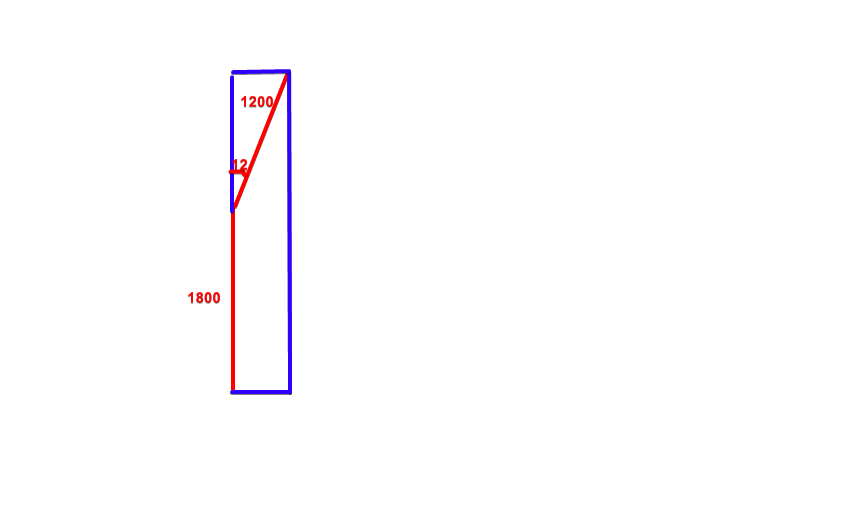
cant you solve for the width and height of this rectangle with this much information
and a diagonal from the bottom left to the top right would be the distance, if you could solve for it
upper karma
well yes thats exactly what i drew but with a rectangle around it
dire obsidian
Could you try doing it
Im@gonna try again
But if you get it, I’m gonna need to compare
upper karma
yes i just worked it out and the answer was correct
 median crown
u sure that's 12 degrees?
dire obsidian
not drawn to scale 😖
median crown
there isn't even a label on it
its just 12
that could be 12 radians
12 feet
idk
upper karma
excuse my sharex drawing
dire obsidian
@upper karma uh yeah im@not getting it
This would be the correct equation set up right
median crown
,rotate
somber coyoteBOT
upper karma
i dont have law of cosines memorized but yea you can probably do that
https://i.imgur.com/gLjMcJx.png but this is what i did
 dire obsidian
I feel like I messed up somewhere in my calculator
upper karma
and solve for x and y with trig
then use the pythagorean theorem to solve for the green diagonal
upper karma
again i unfortunately do not have law of cosines memorized so i dont know if it was set up correctly
dire obsidian
alright thank you for helping tho!
upper karma
my way comes out to the right answer though
just use trig for x and y and throw them onto the second drawing
upper karma
Hey guys
In 3rd picture
If i were to tilt the intersection sp that it is no longer perpendicular to base
Will the intersection points still make up hyperbole?
upper karma
Thanks
silk crown
it wouldn't be of the form x²/a² - y²/b² = 1 after that would it though
 polar sable
About euclidian geometry
Let's consider ABC a right triangle as shown here (using geogebra)
Let's now move C up in the line it belongs to.
Also, this line is perpendicular to (AB) so it can't move
If we move C very far up, its angle starts decreasing till it reaches 0°
Which means that the angle A reaches 90°
So we have got a triangle with two right triangles.
Not even sure if we can call this a triangle and I don't know what is happening here. It's impossible to visualize since the angle C is equal to 0
Can anybody clarify this?
dark sparrow
the further up AB you move your point C, the closer the angle at A will be to 90°
but it will never actually be exactly 90°
dark sparrow
angle ACB will always be greater than 0 because at no point do A, B and C become collinear
 devout vine
<@&286206848099549185> help pls i have no idea and i need this
Median is basically bisector right
So ae is congruent to ad
Nvm


 brave zephyr
Can someone explain to me what Postulate is and how you would use it?
weak shoal
 rigid siren
how do you find the zeroes of a piecewise function
silent plank
find the zeroes of each of the pieces
silk crown
@brave zephyr you should probably search the word up in a dictionary
solar hearth
Parts b) and c)
silk crown
Have you made a diagram
dire rampart
What did u try
 supple kraken
well i know this may be wrong but I tried to do (300cos(31)) - (300cos(23))
and subbed in the difference like this
19sin31 = 9.8 metres
@dire rampart sorry for the ping, im in a hurry cuz class ends in 6 mins
dire rampart
But essentially u wanna find equations for the base of both triangles in terms of h
Add them up
And set them equal to 300
supple kraken
how would I find the base of the triangles
upper karma
What does it mean for a figure to map to itself?
 civic basin
SOH CAH TOA only works for right triangles right?
upper karma
<@&286206848099549185> ?
weak shoal
A figure to map to itself? What do you mean? 'Map' has a very specific meaning
@civic basin I mean, that's just a way to remember the geometric definitions of sines and cosines. But yes, you'd have to draw a right triangle to visualize what soh cah toa is referring to.
civic basin
so non right triangle has no hypotenuse ? that info only applies to right triangle?
weak shoal
I mean, you could draw any random triangle and draw extra lines such that it consists of right-triangles. Then, you could define a 'hypotenuse' for each of those right triangles. The hypotenuse, really, is just a label given to the longest side of the right triangle.
weak shoal
Surely there must have been some motivation for your question?
upper karma
@weak shoal If a figure maps to itself under a reflection over a certain line, that line is called a line of symmetry of the figure.
 white cradle
domain = range ig
dark sparrow

upper karma
@dark sparrow ?
dark sparrow
nvm
uh
no, i'm gonna keep my thonk. i don't know what you mean. but you should probably give some context
where did you see talk of "figures mapping to themselves" exactly
upper karma
That's the formal definition of a line of symmetry of some figure.
My book.
That's the full sentence.
dark sparrow
can you show the sentence
upper karma
@dark sparrow
dark sparrow
ok so
white cradle
so if you define a mapping to reflect points about a line, and it maps all the points in the domain to the domain set itself
dark sparrow
what that means is that if you reflect your shape across that line, you get the same thing as the original
white cradle
that's what I got from it^
upper karma
@dark sparrow I know what that means. I'm asking about the mapping?
dark sparrow
the mapping would be reflection
white cradle
you can get an expression for reflection by some simple 2d coordinate geo
dark sparrow
i.e. it's a function defined on the plane which sends every point to its reflection across your axis.
upper karma
But what does "figure maps to itself" mean?
dark sparrow
it means that if you apply the reflection map to your shape (i.e. to its every point), you get the same thing as you started with.
white cradle
domain = range imo
dark sparrow
no
white cradle
why not
dark sparrow
"the figure maps to itself" means that if you apply your map (be it a reflection or something else) to your shape (i.e. to its every point), you get the same thing as you started with.
dark sparrow
the domain is the entire plane, flynn
median crown

white cradle
in which case youre only reflecting the points in that figure
dark sparrow
you're considering the image of a figure under a map defined on the whole plane.
white cradle
oh kk
upper karma
@dark sparrow But do you get the same thing? Like the shape is congruent to the original one
But the location is completely different
white cradle
no
it needs to be the exact figure
like reflecting about the diagonal of the square
same figure, same location
dark sparrow
it needs to be that exact figure in the exact same location in order for the line to be a line of symmetry.
upper karma
How can something be reflected and be in the exact same location?
Then it wouldn't be reflected?
weak shoal
It can
If it's on the line of symmetry, it can undergo a reflection and be in the exact same location
upper karma
I'm talking about the image of the figure that's now reflected
So if figure A is reflected over l, then let it's reflection be A'
A' is not in the same location as A
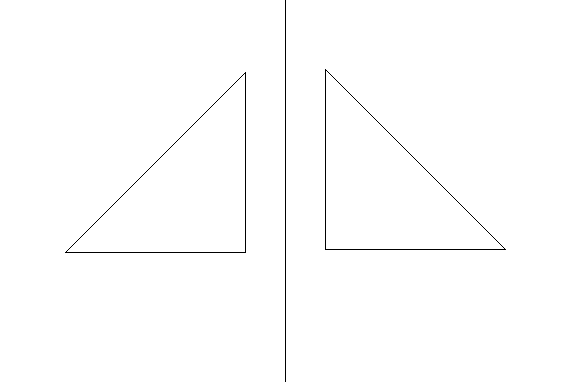 upper karma
What do you mean that's not a line of symmetry???
@dark sparrow Can you clarify what he is saying?
white cradle
it's only a line of symmetry if after reflection you get the same figure at the same location with the same orientation
as if you've done nothing at all to the figure
dark sparrow
if your figure is the union of these two triangles
then that line is a line of symmetry for it
white cradle
for example draw a line perpendicular to the hypotenuse passing through the third vertex
now reflect it
upper karma
Yes, it's one of those triangles
Let the triangle on the left be A
Let the triangle on the right be A'
How is the line between A and A' not the line of symmetry?
Because FlynnXD is saying it's not.
dark sparrow
the line is not a line of symmetry for A nor a line of symmetry for A'
reflecting A across it does not give you A back
white cradle
listen to this
for example draw a line perpendicular to the hypotenuse passing through the third vertex
upper karma
@dark sparrow Can you reflect A and show how it would be?
white cradle
now reflect it
upper karma
In my example?
dark sparrow
reflecting A gives A'
white cradle
^
white cradle
what even
dark sparrow
what's the problem
upper karma
???
white cradle
is your question
white cradle
yes it isn't
dark sparrow
yes??? it's not a line of symmetry for either one of those triangles??? what's the problem???
white cradle
you're taking both triangles together as a single figure???
or just one triangle seperately as a figure
upper karma
So then draw a line of symmetry?
white cradle
I fucking told you, you're not reading my messages
for example draw a line perpendicular to the hypotenuse passing through the third vertex
white cradle
ok by all means go ahead
upper karma
I did
white cradle
but its not a line of symmetry then
upper karma
You are saying it's wrong
dark sparrow
upper karma
Why is it not symmetric???
dark sparrow
it's not perfect but this is a line of symmetry for A
white cradle
LINE OF SYMMETRY DOESN'T MEAN IT'S SYMMETRIC
dark sparrow
best i can do with my finger on a phone screen
white cradle
It means you get the same figure
the EXACT SAME FIGURE
you dont get two different figures like this
upper karma
How are they different?
white cradle
after reflection it seems as if you haven't changed the figure AT ALL
only then that line is a line of symmetry
here it's obvious you've made a reflection since the figure literally translates to the other side of the line
upper karma
How can I make a line of symmetry?
dark sparrow
i just drew you one
white cradle
it's the only line of symmetry that triangle has
upper karma
Yes, but that's through the hypotenuse
white cradle
yes
dark sparrow
SO WHAT
upper karma
I want it to be one of the sides?
white cradle
you can't just draw a random line and MAKE IT a line of symmetry
you're not understanding what this means lmao
upper karma
Then explain
dark sparrow
LINES OF SYMMETRY ARE THINGS INHERENT TO THE SHAPE
white cradle
@upper karma what do you think a line of symmetry is?
upper karma
Ok
white cradle
after reflection the figure must remain the same place, same location, same orientation
Read what I'm saying now closely
AFTER REFLECTION, it must seem as if you've actually done NOTHING to the figure
that is when it's a line of reflection
upper karma
So then this is not correct, right?
upper karma
It's from the book
white cradle
not a line of symmetry
upper karma
A'B'C' is the image of ABC upon reflecting over k
white cradle
yes it is the image
weak shoal
Okay, there's no reason for you to call someone a donkey
white cradle
THE LINE IS NOT A LINE OF SYMMETRY
weak shoal
Especially when they're attempting to help you
dark sparrow
because the reflection of ABC across it, which is A'B'C', DOES NOT COINCIDE WITH ABC.
white cradle
and don't you fucking blame your inability to explain your doubt on me, alright?
dark sparrow
the reflection of ABC across k, which is A'B'C', DOES NOT COINCIDE WITH ABC.
dark sparrow
it's a line!
white cradle
it's just some line of reflection
dark sparrow
that happens NOT TO BE A LINE OF SYMMETRY FOR ABC!!!
dark sparrow
NO
upper karma
..
white cradle
the right triangle is a reflection of the left triangle
the line in the middle is the LINE of reflection
dark sparrow
A' is the reflection of A across that line
white cradle
that is all
upper karma
Ok
So when they say
If a figure maps to itself under a reflection over a certain line
They mean that for example
white cradle
which
upper karma
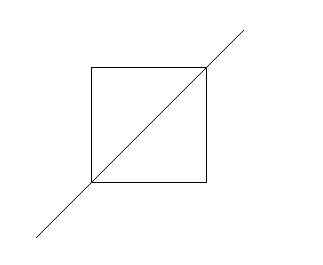
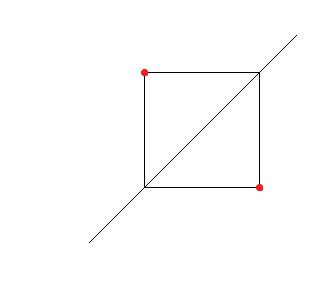


 dark sparrow
no they're mapped to each other
white cradle
the top red point is mapped to the bottom one and the bottom one maps to the top
dark sparrow
not to themselves
white cradle
they just map to some other point lying on the same figure
they don't map to themselves
dark sparrow
if every point is mapped to itself, you're not doing a reflection at all
upper karma
Ok
dark sparrow
every point is mapped to itself only when your map is the identity map
aka the do-nothing map
white cradle
yeah you'd get that if you reflect twice
upper karma
Ok, thanks @white cradle @dark sparrow
white cradle
maybe next time don't resort to name calling people because you're unable to understand..
upper karma
If 4 congruent semicircles are connected only at then end of them and from A to B the diameter is 100 what is the distance from A to B by only traveling on the semicircles?
 shy cape
Am I tthe only person that hates proofs?
upper karma
Probably not but they are kinda cool.
shy cape
I really hate them 😦
Like I guess I can do them but I dislike them a lot. I got a 93 on my geometry midterm weird flex but okay
upper karma
I just took a final and that was one of the problems above. I got 50 pi