#geometry-and-trigonometry
1 messages · Page 238 of 1
 fossil lotus
Which side/angle do each of the values correspond to?
(Genuinely asking because I can't tell)
 upper karma
🙂
fossil lotus
Is PQRS a parallelogram?
upper karma
Ur right
Wait
But that would make sense right
If x is equal
Wait no
What did you get?
fossil lotus
You're looking for the measure of angle RSP, right?
upper karma
Yea
fossil lotus
From the drawing it's clearly less than 176 degrees
upper karma
Yea
fossil lotus
I got 125
fossil lotus
5
fossil lotus
I plugged it into 17x+3 and then added 37
fossil lotus
Np, glad I could help
 silk crown
If I have a point (h,k), and I know that $h^2 = \frac{a^2(ma+b)}{ma-b}$ and $k^2 = \frac{b^2(ma+b)}{ma-b}$, how will I write the equation for the locus of the point?
 somber coyoteBOT
CoolShot:
 dark sparrow
??
silk crown
I know how the x value of the point varies(h) and I know how the y value of the point varies(k)
How can I write a single equation which would describe how it varies in x and y
dark sparrow
i
ok first off
why tf did you not write x and y
instead of h and k
second, which one of a, b and m is your parameter
silk crown
m is my parameter, and I did say that the point was (h,k) lol
silk crown
Ok but how would I solve the problem lol
<@&286206848099549185> hey could I get some help with this
silk crown
Welp
silk crown
is it that hard of a problem why is no one responding 
upper karma
Do the diagonals of a parallelogram always bisect angles
dark sparrow
no
 fast spindle
2x/(2x+5)=32
How to solve this example?
fast spindle
@smoky mountain what do you mean?
 smoky mountain
@fast spindle
dark sparrow
the problem as written is an algebra problem
fast spindle
I am asking about ratio things in geometry
dark sparrow
whatever geometry problem you started with, you reduced it to algebra.
fast spindle
Why I have to show a drawing to try it is a geometry and someone answered to help me
dark sparrow
...
 karmic swallow
 solid thorn
 robust socket
,, 2sin^2x=1
somber coyoteBOT
Umma.Gumma:
robust socket
hi, I would appreciate some hints to solve this
first thing that comes to my mind is
fast spindle
I am really bad at math lol
robust socket
,, sin^2x = \frac{1}{2}
somber coyoteBOT
Umma.Gumma:
robust socket
I've found a couple or roots but apparently there are 4 of them
according to a solution book I'm using
what would be the best course here?
 silent plank
what were the solutions you got?
robust socket
,, \frac{\pi}{4} + 2k\pi and \frac{7}{4}\pi+2k\pi
somber coyoteBOT
Umma.Gumma:
silent plank
sin is positive in 2 quadrants
sin is negative in 2 quadrants
smoky mountain
sin(x) = +sqrt(2)/2 and -sqrt(2)/2
robust socket
ah, the fact that it is squared compels me to check both cases I guess?
smoky mountain
so there'll be 4 angles with those sin values
silent plank
well you sorta did half and half
you found the gen solution for sin(x) = 1/sqrt(2) in quadrant 1
and the gen solution for sin(x) = - 1/sqrt(2) in quadrant 4
robust socket
it's getting clearer
so basically if I stumble upon something like this
the way to tackle is treating it as if it were a second degree equation by all means
,, sin(x)=+-\frac{\sqrt{2}}{2}
somber coyoteBOT
Umma.Gumma:
smoky mountain
and then find all x values where that is true
robust socket
great, thanks a lot
silent plank
didn't you have the +- when you did it the first time?
since you had a solution in quadrant 4?
robust socket
I had a solution in quadrant 4 because I actually made a mistake
,, 2\pi-\alpha \ instead \ of \ \pi-\alpha
is what I did
also, need to know how to put bloody spaces in latex

somber coyoteBOT
Umma.Gumma:
silent plank
$(2\pi-\alpha)$ instead of $(\pi-\alpha)$
somber coyoteBOT
ramonov:
robust socket
even better
silent plank
using $ signs instead of ,, lets you split text up more easily
did you mix it up with where cos was positive?
robust socket
yes I guess I got distracted somehow
I solved other eq with squared cos and tan now
it's clear
thank you
silent plank
how did you arrive at that?
silent plank
be more specific
upper karma
 glacial bane
he's right
it's a point, not specifically on the x or y
i would recommend drawing a graph for this one if you can't do it
it's a much simpler way and you'd understand it faster
upper karma
was the y = -4x + 5 the correct equation?
silent plank
no
glacial bane
no
upper karma
can you tell me what is
glacial bane
uhhh
silent plank
if you're using the point slope form
substitue the gradient and the point into the equation to find b
glacial bane
i can tell you how to do it
silent plank
alternatively,
you should be using the point-gradient formula
upper karma
i have done it before if i know the answer i can remember the way i done it before
i have never heard of that
silent plank
y- y_1 = m(x-x_1)
glacial bane
i dont think im right and i havent done this in ages
upper karma
what is that
silent plank
that would be the point-gradient or point-slope formula, depending on where you are from
upper karma
yeah thats what i was asking, is y = -4x - 5 the correct equation of the straight line
glacial bane
carticatToday at 23:45
was the y = -4x + 5 the correct equation?***
silent plank
no
glacial bane
i mean, you didnt say it
upper karma
jaumn there is only 1 i could be reffering to if u look at the question
glacial bane
i said y=-4x-5
upper karma
y = mx + b is the equation u need to use for it
glacial bane
you said y=-4x+5
upper karma
then im obviously talking about the equation you need to find out
upper karma
why minus?
silent plank
no those are both wrong
silent plank
if its wrong it cant fit the statement
 silent plank
lets go back to your intended method
y = mx + b
substitute your gradient: m = -4
and your point: (x,y) = (-3,5) into the equation
silent plank
||yes||
glacial bane
hmmmm
ok just realised I did the calculation wrong in my head
@upper karma give me another one
I'm actually high or I'm right
@silent plank
is it
y=mx+c
y=-4x+c
y=-4(-3)+5
y=-7
haven't studied this topic forever
silent plank
||y=-4x-7 was rihgt||
glacial bane
but was the working out right?
silent plank
not the way you just did it
glacial bane
yup it's a coincidence
glacial bane
no i didnt help
i just gave you the answer with the wrong working out
so I didn't help you in anyways in the long-term
upper karma
i always remembered those with having 2 points instead of 1
glacial bane
yeah same
silent plank
its the same idea with two points
upper karma
so i am confused with the y intercept
glacial bane
it is, you gotta find the midpoint of the two points
and do the same thing as a 1 point
silent plank
there are 3 forms
two-point
point-gradient/slope
gradient/slope intercept
 sinful marten
Oh boy trying understand cosine in non-right triangles at 1am
silent plank
if you are given a point and the gradient, it is preferable that you use the point-slope form
silent plank
not the ideal example there. since the point IS actually the y intercept for that one
glacial bane
i guess so
 vivid wraith
you could just do the x-coordinate times the gradient and subtract it to the y-coordinate to find the y-intercept. Because you are given the gradient, you can write it in y=mx+b form
silent plank
you mean subtract it from the y coord?
glacial bane
y - y1 = m(x- x1)
y-5 =-4(x-(-3))
y-5 = -4(x+3)
y-5 = -4x-12
y = -4x-7
@upper karma
hope that helps
if you want a simpler equation:
y = m(x-x1)+y1
vivid wraith
yea subtract*
vivid wraith
bye!
upper karma
"let P = (a,b) be a point on the ray which forms one side of A... such that P lies on the circle of radius 1
So this means a = cos(A) and b = sin(A)
P' = (a',b') is the rotation of P by π/2. Which means a' = cos(A + π/2) and b' = sin(A + π/2).
Diagramatically, you can also see that b' = a, by looking at the distance of Q from the origin. i.e. sin(A + π/2) = cos(A), which is where the first formula comes from.
"
what angle are htey referring to
the cos(A+ pi/2)
is it the angle I circled?
 proper scaffold
can someone lead me through the theorems of solving this in a two column proof?
upper karma
What's the sqrt format of 0.707106781 + 0.707106781?
what do you mean sqrt format?
square root
what do you mean square root format

sqrt of i
Can you send a photo of the question?
in your book or somethin
If it's too hard, then nevermind
thanks for actually helping, but.
I literally have no idea what you're lookin for

 upper karma
how are the operations defined by this matrix meant to be interpreted?
i am unfamiliar with rotation matricies but need to know how to rotate points
what are the operations to rotate point (x,y,z) around the x, y, and z axes?
dark sparrow
multiply the column vector [x; y; z] by these from the left
upper karma
are they then added together?
dark sparrow
what
upper karma
i dont know what to do with this
dark sparrow
to rotate a vector $\mathbf{x} = \begin{bmatrix} x \ y \ z\end{bmatrix}$ around the $x$-axis by an angle of $\theta$, you compute the matrix product $R_x(\theta)\mathbf{x}$
somber coyoteBOT
Ann:
upper karma
ok listen
idk how to use matricies
i just want to know the operations required to rotate a point
ik that for the standard cartesian xy plane, there is this set of operations you can do to rotate a point
what are these operations to rotate
dark sparrow
okay, i can write out the matrix products explicitly if you want
upper karma
yes please
dark sparrow
R_x(θ) (x, y, z) = (x, y cos(θ) - z sin(θ), z cos(θ) + y sin(θ))
R_y(θ) (x, y, z) = (x cos(θ) + z sin(θ), y, z cos(θ) - x sin(θ))
R_z(θ) (x, y, z) = (x cos(θ) - y sin(θ), y cos(θ) + x sin(θ), z)
upper karma
@proper scaffold hi , it’s your tutor from yesterday , consider posting this in one of the question channels
upper karma
Hey, so I'm studying Geometry of Space from a book, and in one example it shows how get the coefficients and the equation of a flat determined by 3 points. Thing is you have to make a system of equations , and there are 3 equations and 4 variables, and the way the book solves it doesn't make sense. Any idea?
 quartz edge
Hmm if you could translate it maybe that would help
I can't see why they divided everything by d. Seems like a bad idea since we don't know what d is
But you could always solve for a variable in terms of the other three and substitute it into the equations so you only have three variables
@upper karma
upper karma
Could you elaborate on that last part?
I'll translate it
Find te equation of the plane determined by the points A, B and C
Every plane is determined by 3 non-aligned points. Since A, B and C belong to the plane, their coordinates have to verify the equation of said plane: ax + by + cz + d = 0
We can reduce the system of 4 variables to one equivalent to 3 variables, by dividing each equation for d =/= 0. In case in which d = 0 we can divide the equations with any other coefficient.
Considering a'= a/d', b'= b/d' and c'= c/d', the previous system is (the system with the 1s), and the solution is a'= 3. b'= 2 and c'= 1
The equation of the plane is 3x + 2y + z + 1 = 0
That's what it says
 vague berry
Ans: 60/13 what’s the most efficient setup of the problem
Please ping me I love math
upper karma
@vague berry okay, so
It’s saying that DE is perpendicular to AC
Which implies there’s a 90 degree angle
vague berry
Hello
robust socket
$ sin(x) \ = \ sin(2x) $
somber coyoteBOT
Umma.Gumma:
robust socket
hi, I'm not sure how to solve this, would appreciate any hints
 weary drift
$\sin(2x)\equiv 2\sin(x)\cos(x)$
somber coyoteBOT
RokettoJanpu:
robust socket
yeah I'd like to solve this without recurring to the duplication formulas
the hint the book is giving me is to use associate and/or complementary angles
no success so far tho
 umbral snow
Indeed, if you can solve this, I think you'll derive that trig formula
No, you won't nvm
 cloud merlin

idk how sin of x can be sin of 2x
but like i can help you derive the formula for like sin of (a plusb)
unless it's like 0
upper karma
well that's a solution
 gritty sail
just think about a unit circle
and when sine is equal
so 0 is a solutio yes and all 2pi multiples
also you know that sin(180-x)=sin(x)
so
180-x=2x ==> x=60
gritty sail
If you have a right triangle
And you draw a line from the right angle to the hypotenuse so that the line cuts the hypotenuse into 2 parts
If the line is the same length as one of the parts
Is it the same as the other one as well?
smoky mountain
it doesn't mean it's equal to both parts
it's only equal to both parts of the hypotenuse if the triangle is a 45-45-90 triangle
gritty sail
That's not true try a 3-4-5 triangle
smoky mountain
well
by "draw a line from the right angle to the hypotenuse so that the line cuts the hypotenuse into 2 parts"
it can only be equal to both if it splits the line splits the hypotenuse in half
gritty sail
Nvm
When it spits the hypotenuse in half the line that splits it is also the same length
Easy to prove
smoky mountain
which is only true if, for a right triangle, it's a 45-45-90 triangle
gritty sail
Nope
The line doesn't have to create a right angle
Buddy I literally j proved it it's rly ez to prove
I think u misunderstood my q it's all good m8
smoky mountain
you sure?
silk crown
@gritty sail do you know what a centroid is
smoky mountain
@silk crown it's essentially the center of mass, if you were to think of an object in 3d
silk crown
no I'm just asking him
silk crown
If he "proved" that, let him try to figure out the centroid of the triangle he proved it on
upper karma
https://cdn.discordapp.com/attachments/326138757474680852/647260732555264048/downloadfile.png
Hi, I'm assisting a student in Geometry but it's been years since I've had to work with two-column proofs. Can anyone assist us in this problem? It should be a trivial one. My guess is that it should involve demonstrating that AB and DC are proportional, that angle ACB is equal to angle E, and that angle A is equal to angle D, or something along those lines?

@proper scaffold
cloud merlin
Look at the lines on the left side and the hypotenuse
They are parallel
If those two lines are proportional to the triangle then the third always has to be
upper karma
does gimbal lock occur with rotation matricies?
proper scaffold
hello @upper karma
upper karma
Can someone please help me with that?
 random glacier
<@&286206848099549185>
 wooden compass
I would like resources to help me study and learn geometry in highschool
 sudden locust
This is, in my opinion, the most intuitive way of proving the pythagorean theorem! https://youtu.be/BmUjXSP5-3o What your favourite proof? 🤓

In this video, we are going to take a look at a Pythagorean theorem proof, or Pythagoras theorem proof. This will be done visually by using squares. Geometry...
 sour totem
@wooden compass Kahn all the way
 vagrant steeple
can anybody tell me how to get theta?
i tried doing arctan(b/a) here
vivid wraith
for c> the range for ceta is between 0 and 2pi, your anwer is negative
vagrant steeple
so then convert it to pi radians after adding 360
silent plank
you angle will depend on the quadrant
vivid wraith
^
silent plank
which quadrant is -5 + i in?
vagrant steeple
i've no idea
silent plank
arctan ( 1/5) will give you the reference angle
and then do the proper angle conversion
plot it on the complex plane if you don't know
silent plank
same for b), if you didn't figure that one out yet
silent plank
in the complex plane they are the
Real and Im axes instead of x and y
upper karma
what is the correct order in which to rotate a 3d point?
is it yaw, pitch, roll?
i think so
each one rotate around a different axis
yaw is z, pitch is y, roll is x
correct
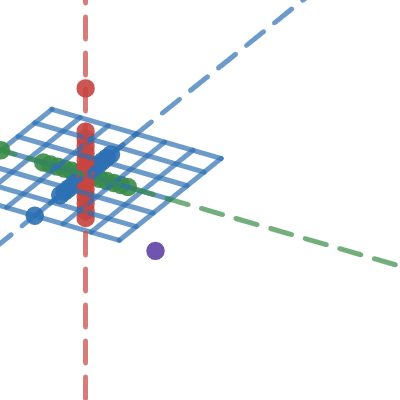
Desmos Graphing Calculator
i discovered a 2d rotation formula a while ago
finally got it to work for 3 dimensions
interesting.
goddamnit
it suffers from gimbal lock
upper karma
How can gimbal lock be solved
 oblique tiger
nvm im dumb
 mighty narwhal
Use quarternions 🤡
robust socket
,, 2cos(2x)-\sqrt{2}=0
somber coyoteBOT
Umma.Gumma:
robust socket
I've got a doubt on this one
the two solutions I am getting are:
,, \frac{\pi}{8}+k\pi \ and \ \frac{7}{8}\pi+k\pi
somber coyoteBOT
Umma.Gumma:
somber coyoteBOT
Umma.Gumma:
robust socket
where alpha is the angle of interest
the solution of this one should be + and - 25°+k180°
only the first one seems to be correct then, what am I doing wrong here?
mighty narwhal
What is 2π-π/8?
robust socket
yeah I know, but if I try to convert 7/8 to degrees I get 157.5°
robust socket
15/8pi
robust socket
I'm not following how do you get to 2pi-pi/8
somber coyoteBOT
DarK:
mighty narwhal
2alpha is pi/4
Alpha alone is pi/8
Alternatively
Cos(x) is even
So if Alpha is a solution, -alpha will also be a solution
So you got the first solution a.k.a π/8
So -π/8 is the other one
Now add +2kπ and you got all solutions
robust socket
yeah but I really wanted to get through that 2pi-alpha thing
mighty narwhal
Well it works that way too
2π-π/8+2kπ =-π/8+2nπ
I can just "remove" that 2π because it has a period of 2π
$2\pi-\alpha+2k\pi=2\pi-\alpha+2(n-1)\pi=\cancel{2\pi}-\alpha+2n\pi\cancel{-2\pi}$
somber coyoteBOT
DarK:
mighty narwhal
I just shifted the k to be 1 less
robust socket
do you mind if I go step by step, that part only?
for the sake of clarity, we start from:
,, 2cos(2x)-\sqrt{2}=0
somber coyoteBOT
Umma.Gumma:
mighty narwhal
You can put $ around it to latex inline
somber coyoteBOT
Umma.Gumma:
somber coyoteBOT
Umma.Gumma:
mighty narwhal
You forgot the π after 7
robust socket
right
somber coyoteBOT
Umma.Gumma:
robust socket
now I would expect this to be -22,5°+k180°
but it's not
therefore something is clearly wrong I guess
mighty narwhal
,w 7π/8 to degree
somber coyoteBOT
 Requested by DarK#2404
mighty narwhal
Requested by DarK#2404
mighty narwhal
,w 157.5-180
somber coyoteBOT
Requested by DarK#2404
mighty narwhal
There
robust socket
can I say fok me?
mighty narwhal
Yea
But also, I dont recommend that 2pi-alpha stuff
It gets the period shifted which will result in this
Just do -alpha
π/8+kπ is one solution
So -π/8+kπ is the other
robust socket
yes, well thanks very enlightening
still, I'm not completely grasping the 157.5-180 thing
what exactly happens there
in terms of period
mighty narwhal
Its the same as your method, but yours shifts the period
So you have to shift back if you need is as a negative number
Well
The period is 180°
robust socket
yep
mighty narwhal
So you can just substract 180°
robust socket
as simple as that
somber coyoteBOT
DarK:
mighty narwhal
K is any integer, and n-1 is still any integer
So I can just shift the period like that^
mighty narwhal
Your welcome
silk crown
Can i use integration to get the area of the ellipse x²/a²+y²/b²=1?
 gritty siren
Sure, there's no problem with that
 fringe dirge
Well yes okay
 unkempt jay
are you asking how to do so?
gritty siren
I think $\int_0^{|a|}\sqrt{b^2-\frac{b^2}{a^2}x^2}\d x$ is very doable
somber coyoteBOT
Tuong:
silk crown
basically I'll do y=something and int y dx right
gritty siren
on the upper half of your ellipse, you have
y=sqrt(b²-b²x²/a²)
silk crown
Alright thanks I'll try it out
gritty siren
that integral above is 1 quarter of the area
silk crown
If I'm not wrong, if I change the lower limit to -a I should get one half of the area, right?
gritty siren
Yes
silk crown
I can basically use this approach for any curve right
silk crown
Hmm why is that so?
fringe dirge
I mean, sometimes you just get things you can't integrate
Try finding an antiderivative for e^{-x^2}
dark sparrow

silk crown
Any second-degree conic can be integrated though right
gritty siren
You're limited by several things, for example if you exclusively work with Riemann integrals, you can only hope to integrate Riemann-integrable functions
then you can allow more stuff by introducing improper Riemann integrals...
and then there's still no guarantee of finding a nice formula
silk crown
I'm a lowly highschooler I won't be using those anytime soon lol
gritty siren
haha x')
silk crown
I used calculus to prove the area of a circle wow
I'm sure there are probably uhh
Simpler methods but
calculus is lit
 rare isle
I don't know why I am confused over this one but how do I write the general solution
For cos2x= -cosx
What do I do with the negative sign??
silent plank
consider doing an angle shift
alternatively you can also write cos(2x) in terms of cos(x) and solve a quadratic
rare isle
I mean I can, but I wanna do it by general solutions
silent plank
i mean the general solution just involves adding 2kpi
what happens when you shift cos by pi?
silent plank
you should get 2 sets of solutions for this
robust socket
,, sin\frac{x}{3}=0
somber coyoteBOT
Umma.Gumma:
robust socket
I'm having quite a hard time on this trivial one
in particular I don't get how the result is k540°
I get k1080°
gritty siren
if you look at the circle, you can see that sin(t)=0 of and only of t is in πZ
so sin(x/3)=0 if and only if x/3 is in πZ
i.e. if and only if x is in 3πZ
and 3π is 540°
robust socket
ty
silk crown
well, is there a way you can write arccos(1/4) in terms of arctan?
fossil lotus
arccos(1/4)-pi can be simplified
silk crown
You're not gonna get the answer without trying it, mate
fossil lotus
Think about how cos(x-pi)=-cos(x)
silk crown
Try harder then
fossil lotus
Uh not quite
It’s not cos(x-pi)=cos(x)
Wait
Maybe I was thinking about this the wrong way
Ah
I was thinking you should simplify arccos(1/4)-pi to arccos(-1/4), but that would give you the same result
fossil lotus
Yeah, think about the unit circle
silk crown
||the Pythagorean theorem will help||
fossil lotus
Do you understand how sin, cos, and tan correspond to the unit circle?
And what arccos means?
silk crown
If an angle is arccos(1/4), what is the cos of that angle?
indeed
and what is cos?
well
in a right angled triangle
if you take an angle, what do you define the cosine of that angle as?
You know it's a ratio of some sides, right?
Which two sides is it a ratio of
I mean what is the very first definition of cosine you learnt?
indeed
Now draw a triangle with adj/hyp = 1/4
And figure out its other side somehow
mmhm
np
it's pretty common to switch the function using which you write the angle, it's useful
np np
 cold tiger
Heyooo
Ok so basically, I have to verify trig identities but idk what to do. Like I have the trig cheat sheet pdf, but idk what identities to use and when to use them.
silk crown
what do you mean
cold tiger
So you know how in verifying trig identities, you gotta use multiple to make one side the same as the other side?
Idk how to do that. Like I’m never sure if I use them correctly or not.
silk crown
What multiple
I mean you basically just practice lol, you will see general trends in how you solve the problems and how to approach one
Having a formula sheet but not knowing how to use it won't help
upper karma
How do you call this in english?
its supposed to be cube sliced using 3 points on edges
dark sparrow
cross-section
upper karma
what should i type in google in order to find instructions on how to construct the shape?
is this at least the correct channel for this question?
dark sparrow
yes it is
robust socket
got a question on this equation (lower half of the picture)
the second result I get should be, according to the solutions, -11.25°+k90°
which happens to be the 22.5°-33.75°
I'm not quite understanding what is going on here, I am pretty sure I did everything good
 celest crag
Hi all this is my first question here. I'm trying to work through Moise/Downs Geometry and the absolute first question has me sort of stumped. It goes like this "Imagine a suspension bridge 400 ft long. on a hot day the bridge surface expnds lengthwise by two feet. The bridge surface remains rigid, except that it rises at the exact middle so that cars have to go up and over a hump. Each half is now 2001 feet long. How far above its normal position does the bridge rise?" It says the problem can be solved with the pythagorean theorem -- but I'm confused by that because we only are given the length of the bottom short side and not the other short side or the hypotenuse? Thanks very much for helping!
 cerulean parcel
 supple badger
 zinc crow
your basically given the answers for 3a
vivid wraith
try HG instead as the numerator for the second fraction
 formal raptor
Trigonometry help?
 fringe crater
What have you tried so far?
Think about the amplitude, vertical shift, and period of the graphed function. Each of these are given to you within that graph
Amplitude is the difference between your maximum and minimum, divided by 2. Period is how long it takes you to go from one minimum to the next minimum, and equals 2pik, where you have sin (kx). Hope that helps
 hollow harness
Amplitude is the difference between your maximum and minimum
i wouldnt exactly phrase it that way, as by that definition the amplitudes of sin and cos are both 2
fringe crater
Ah whoops, I meant to add in a divide by 2. So you want to take the difference and then divide by 2. Good catch!
hollow harness
👍
although i personally prefer defining it as the vertical stretch of the original function kek
fringe crater
That's a good definition too
 icy acorn
Guys help i need help with this HW
"Proof that the triangle created by the tangent to a hyperbole and the asymptote has a constant area" theres no data given on this one just that, i know it has something to do with getting an area with a determinant
 split otter
"Without the use of a calculator, find the exact value of the expression: csc 37° sec 53° - tan 53° cot 37°." Not sure where to start. May I get a tiny hint?
Ah wait, I think I got it. I'm dumb. I can use the cofunction identities to get sec² 53° - tan² 53°, which according to the Pythagorean identity, is 1, right?
dark sparrow
yes
 wild hamlet
Hm
proper scaffold
@mossy vine can you help me with this problem? https://cdn.discordapp.com/attachments/326138757474680852/647260732555264048/downloadfile.png
 mossy vine
no I'm busy sorry
silent plank
what have you tried?
proper scaffold
yes but I have to make sure it correct
silent plank
what did you do?
proper scaffold
i did
- Angle E = Angle ACB
- Because AB||DC, Angle ABC = Angle DCE
Both triangles are therefore similar
or I need something to reword it because my teacher needs a two column proof with theorems and postulates
silent plank
be more specific about the rules you are applying
proper scaffold
if I can't be more then i may not know how to do it
silent plank
e.g for 1
the statement is, angE = angACB
the reason is "given"
for 2,
the statement is
Angle ABC = Angle DCE
however the reason is insufficient. just "parallel lines" by itself isn't enough justification to state that 2 angles are equal
you need to state the exact property related to parallel lines
silent plank
do you know the terms
alternate, vertical, corresponding, co-interior, complementary, supplementary
proper scaffold
yes
silent plank
and which one would angABC and angDCE be?
proper scaffold
corresponding
silent plank
yes. and that is exactly what you would need to state
proper scaffold
oh ok i see
silent plank
they are equal because they are corresponding angles on parallel lines
and for 3.
you also need to be more specific about the reasoning
i.e. and how you came to that conclusion
robust socket
I am expected to get -11,25° as second result here, instead I get 78.75°
can someone explain me how I should change approach?
78.75° is not completely wrong: 78.75°-90° actually is -11.25°
<@&286206848099549185>
gritty sail
Not understanding what u did in ur second one
robust socket
,, f(x)=[2\pi-g(x)]+2k\pi
somber coyoteBOT
Umma.Gumma:
robust socket
that's what I did there
gritty sail
k is any integer so it should be the same thing
robust socket
thing is, I sistematically get this issue in equations including cos
so I wonder if I'm doing anything 'out of the book'
can anyone confirm this is correct/wrong please?
 civic sphinx
<@&286206848099549185>
vivid wraith
im not sure if this is right but you could call one side of the triangle x and find the other side in terms of x, you could then use triangle inequality to find the minimum value of the side, giving the maximum altitude.
 dire obsidian
hi
apologies if im interrupting something
Im doing trig rn in alg.2
and these are what u would call quadrantal angles correct?
and say if I was told to find all six trignometric functions for the angle: 330º
i would use the fourth quadrant?
dire obsidian
ah ok
vivid wraith
whatever angle they ask for, use the quadrant where the angle is in
dang my grammar sucks
vivid wraith
yes that would be the fastest way
dire obsidian
ah i see
vivid wraith
or just get a calc :))
dire obsidian
ty!
idk why
but i just get confused as to which is the θ angle
cause ik i did some problems earlier
and 60 was the θ angle at some point
vivid wraith
just go counter clockwise and you should be fine
dire obsidian
like if it was in quadrant 3
vivid wraith
if it is in quadrant 3, add 180 degrees
dire obsidian
your y value would have to be xroot3
vivid wraith
yep thats right
dire obsidian
it was this problem. i figured it out
but i was just a bit confused
so 60 would be the reference angle correct?
and so does that mean the reference angle is considered the θ angle?
which helps me find which value is y,x,r
oof
i mightve just drawn the triangle wrong
or is it like that
wild hamlet
You should draw the circle that indicates the start and end lines that you take the angle through
For better clarification
Your 60 and 30 are switched anyway
wild hamlet
Both
They are both wrong
I can't accurately know where you mean 30 and 60 to be
You need to draw the angles and not just the numbers
dire obsidian
@wild hamlet something like that?
lol sorry if its wrong
im not the best when it comes to bringing out the things i envision in my head onto paper or a drawing
vivid wraith
@dire obsidian what angle are you trying to draw
from your picture it seems like you are drawing 240, but your angles make it 330
silent plank
that looks alright
try make that 240 look less like 270
 unkempt stag
Hey guys I have this one problem and Its really confusing, how do I find the permitted and area of a trapezoid with Numbers that are square roots
 scenic geyser
split otter
scenic geyser
split otter
I'm guessing they meant perimeter?
split otter
Can you give an example?
unkempt stag
So it's asking me to find the permiter and area of a trapezoid (it has missing sides but I've gotten them) and I'm trying to find the perimeter but It's difficult bc the height is a radical square root
split otter
You can still do it. Can you show the working thus far?
unkempt stag
Want me to send a pic?
split otter
Sure.
split otter
So your perimeter would be P = 8 + 11 + 13 + 4√6, right?
unkempt stag
Yes but how would I add in the 4root 6
split otter
You just leave it as P = 32 + 4√6?
unkempt stag
Oh ok thank you
split otter
Did your teacher specify to obtain an approximate decimal? If not, that's fine.
unkempt stag
No, he told us to use that type of radical thingy lol it's confusing too I'm not even sure if that's the right height tho too
unkempt stag
Alright dude thank you so much I've been struggling with this for like a half hour
split otter
No worries.
silent plank
do you notice anything special about the triangles?
silent plank
do some angle chasing
unkempt stag
Angle chasing?
silent plank
which angle would angCAD equal to?
unkempt stag
DCB? They look somewhat similar
silent plank
is that a guess?
unkempt stag
No lol am I wrong?
unkempt stag
Oh ok
silent plank
now your triangles both have a right angle and another equal angle
the remaining angle would also be equal
what does that tell you about them?
 plucky jacinth
i need some help with this. Solve for x and y given triangle J K L approximately equal to triangle M N P, JK=12, LJ=5, PM=2x-3, m angle L equals 67, m angle K equals y plus 4 and m angle N equals 2 y minus 15.
<@&286206848099549185>
silent plank
!15m
dark sparrow
"approximately equal"
silent plank
anyway, have you drawn a diagram yet?
plucky jacinth
ya
silent plank
where are you stuck?
were you able to find K?
silent plank
wdym? what's your K?
 cobalt path
Hi I am a little confused on SAS for triangles
silent plank
what trig rule do you think is appropriate here?
silent plank
uh what? how are you getting x = 4?
plucky jacinth
silent plank
the triangle JKL is unique,
and from that the value of y is fixed
plucky jacinth
i got what it is now
silent plank
y is part of angle K.
and you will need to determine that first
silent plank
the inclusion of the JK=12 and 67° makes the question a little inaccurate
what's your issue with the SAS rule?
dark sparrow
no you didn't
sin(β) cannot be sqrt(3) no matter how much you wish it was
sqrt(3) is greater than 1
sin(β) is always between -1 and 1 for all β
sqrt(3) is greater than 1
sin(β) is always between -1 and 1 for all β
well you know what sin(β)/cos(β) is
and you also should know that sin^2(β) + cos^2(β) = 1
and since you know what quadrant β is in, you also know the signs of cos(β) and sin(β)
do you not see that sin^2(β) + cos^2(β) = 1 is true always?
regardless of what else you might know about β?
you can write sin^2(β) as tan^2(β)cos^2(β)
then solve for cos(β)
sin(β) = (sin(β)/cos(β))*cos(β)
sin(β) = tan(β)cos(β)
does this need explaining
tan^2(β)cos^2(β) + cos^2(β) = 1
4cos^2(β) = 1
cos^2(β) = 1/4
all that work for such a small part of the problem
i'm trying to get you both to stop overthinking and to not be so clueless when it comes to basic trigonometric facts
was that a sarcastic remark
i was being 100% serious
 dire rampart

 queen python

dark sparrow
they probably want you to leave it at that
maybe write it as -arctan(1/2) instead of arctan(-1/2)
but that's it
 heady eagle
Hey, can someone help me with math? :3
dark sparrow
don't ask to ask...
just ask
i.e. post your question
and someone should come and help you
heady eagle
ooo okay thanks 😄
dark sparrow
so what did you need help with
gritty sail
is there really no information other than a picture?
 shell pendant
How do I calculate the sides of triangle if I have all the degrees of it and the area?
 median crown
Well
You’ll probably have to pull off
Some sort of
idk proportion
of sorts
But the method I thought of uses some tougher algebra
let me see if I can pull it off
upper karma
$\cos{a}=b^2+c^2-2bc$
$\text{Area}=\frac{1}{2}bc\sin{a}$
upper karma
And say area is 4 and θ is 6
(b-c)^2=sin(6)
8/bc=cos(6)
Then one can work out b,c
median crown
Yeah that works
Mine is probably the same amount of work
mine just set a coefficient of proportion x, and then 3 sides that form a triangle simile to the one you haven
And then you just solve for x, the coefficient of proportion using Heron’s formula
And then solve for the sides
dark sparrow
are you asked to prove $\sin(\theta + k\pi) = (-1)^k \sin(\theta)$ for $k \in \bZ$?
somber coyoteBOT
Ann:
dark sparrow
uh
i see you wrote $\sin(\theta)\cos(k\pi) + \cos(\theta)\sin(k\pi) = (-1)^k \sin(\theta)$
somber coyoteBOT
Ann:
dark sparrow
i don't understand what you're confused about
 signal hornet
either side needs to look like the other
dark sparrow
$\sin(k\pi) = 0$ and $\cos(k\pi) = (-1)^k$...
somber coyoteBOT
Ann:
somber coyoteBOT
Jason_Bjorn:
signal hornet
That is what I got now, I see how this is always true
but I wonder if there is more work to do
so they look the same
dark sparrow
do you accept that $\cos(k\pi) = (-1)^k$ for all $k \in \bZ$
somber coyoteBOT
Ann:
signal hornet
yes
dark sparrow
do you accept that $\sin(k\pi) = 0$ for all $k \in \bZ$
somber coyoteBOT
Ann:
signal hornet
yes
dark sparrow
then no there is no more work to be done
signal hornet
thanks @dark sparrow
I don't understand how the author got these domains
cos is only postive on the right side
and sin is only positive on the top half
did the author flip the domains?
silent plank
those are the range of arccos and arcsin
signal hornet
Do you mean range of arccos and arccsin? @silent plank
silent plank
whoops yeh
signal hornet
ok
I will use that
so cos = x/r
and sin is y/r
why do both equations below say that 1 is the hypotenuse (r) ?
silent plank
they're applying
sin^2(x) + cos^2(x) = 1
silent plank
its pretty much the same thing
you recognise that sin^2(x) + cos^2(x) = 1 is an identity right?
signal hornet
yes
silent plank
and rearranging the equation
sin^2(x) = 1 - cos^2(x)
signal hornet
yes
silent plank
and then take the square root
silent plank
in the question, everything is positive, we ignore the negative solution
we'll application of that identity should be simple enough that it shouldn't require an explanation
signal hornet
I'll try to use it on my problems
signal hornet
...
gonna stick with the triangle method
why the different brackets?
I know what they mean with domain and range
but this isn't like that
why not just use bigger round parentheses?
upper karma
Can gimbal lock be solved like this?
Say you want to rotate around Z by 45 degrees.
You take the gimbal, and rotate it 45 degrees, the plane included.
Once that rotation is completed, you remove the plane in its current orientation, reset the gimbal, and then re-insert the plane now rotated by 45 degrees relative to the gimbal to the center.
You then perform the other rotations like this, avoiding the stacking of rotations which leads to gimbal lock.
Is this a solution to it?
Can someone help me out, i get 1.37m squared but textbook says 1.08m squared
@proven belfry
i just saw that ur a helper and i already used my helper
upper karma
NVM
coolshot
i found the answer
i am sorry mono, i used the helper tag already and the helper said he is going to bed
Someone pls answer my question
Does performing the rotations individually affect the characteristics of the rotations?
silk crown
what
silk crown
bruh not really
upper karma
Perform each rotation individually, as opposed to subsequently
Thus avoiding gimbal lock
Rotations wouldn’t be stacked
There’s no significant defined order because only one rotation is ever performed at a time
Would this affect the outcome of the rotations
I don’t think that it would but testing it out would take too long on desmos
 tardy junco
Where have I gone wrong? What's the reason?
1 - sinx is definitely not always zero. 
dark sparrow
$\sqrt{t^2}$ is in general not always equal to $t$
somber coyoteBOT
Ann:
tardy junco
I had to integrate root(1-sinx). They hadn't given the domain. If I did it by completing the square then I would get root t squared.
So should I not complete the square for such problems?
The answer didn't have mod or anything
@dark sparrow
tardy junco
I forgot
I don't have the book with me right now
I might be able to figure it out. Gimme one min.
2*root(1 - sinx) I believe.
They multiples and divided by root(1-sinx)
The numerator root cos squared x they took as cosx (so is doing this wrong?)
@dark sparrow
dark sparrow
uh
tardy junco
Why is math so confusing 😭
Should I.. Assume that x>=0 for whatever reason?
Pls @mention me if you reply to me
.
But how would you convert sin(x/2) - cos(x/2) to root(1-sinx).
It could be either root(1 - sinx) or - root(1-sinx).
What to do?
Is it + in one interval and - in another interval like modulus?
sudden locust
You have probably heard about the "Pythagorean Theorem, but did you know it applies for semicircles aswell?"
https://youtu.be/Ir3MUW_VkgQ

I think most of you guys are familiar with the Pythagorean Theorem. But im not quite sure you are familiar with the theorem but with semicircles? Join the co...
 quiet mason

 tardy junco
@quiet mason umgh yeah that's the square root I was using..?
If had used -root() it would have come up to x = x.
Thanks coolshot
@silk crown so what would sin(x/2) - cos(x/2) be equal to?
 minor coral
Hello I need some help with half-angle identities
hollow harness
silk crown
cos(a-b)=cos(a)cos(b)+sin(a)sin(b) how would I prove this?
 uncut nova
Hi.
I have such equation.
sin(x+pi/6)+cos(x)=3/2
Can i split left side to
sin(x+pi/6)+cos(x)=1 + 1/2
and then find those x'es that way?
(sin(x+pi/6) = 1 and cos(x) = 1/2) or (sin(x+pi/6) = 1/2 and cos(x) = 1)
???
dark sparrow
no you can't
uncut nova
@dark sparrow Can you explain why? This method gives me correct answer though
dark sparrow
why split it as 1 + 1/2 and not, say, 3/4 + 3/4? or 5/6 + 2/3? or 8/7 + 5/14?
you made a completely arbitrary choice
and just happened to get lucky
 vast dune
@silk crown Ive recently seen this proof