#geometry-and-trigonometry
1 messages · Page 237 of 1
 formal raptor
 silent plank
yes the angle sum of the 2 acute angles is 90
and how would you determine whether the angle you have is the larger one or smaller one?
and how would you find the other angle
formal raptor
But I’m supposed to be finding the bigger one tho so like how the heck would I figure that out
Heck
silent plank
yes the angle sum of the 2 acute angles is 90
a + b = 90
and if you can find a, b = ?
(alternatively, use the other trig ratio)
formal raptor
So if I find the smaller one I just need to subtract it from 90 and that’s the answer?
 upper karma
Cosx -sinx =1 Find x. I got 0,2pi, but I am unable to get the rest of the solution
Please help
 umbral snow
Square both sides @upper karma
 exotic pewter
Are people allowed to asked questions here or is this a chat only to discuss geo/trig?
 devout shell
you can ask
exotic pewter
o ok
I have a question on geometry, is the special segments for this triangle an altitude or a perpendicular bisector?
they seem like a perpendicular bisector, but I looked up examples and I haven't seen one go to the middle in a 90 degrees angle
I don't know if it's trying to fake it out with a trick question or I'm over-thinking it
<@&286206848099549185>
 void moat
Perpendicular is a 90 degree angle
This seems to me as perpendicular because it has a 90
It’s not a right angled triangle though
exotic pewter
so it's a perpendicular bisector?
void moat
Let me look at an altitude one
void moat
exotic pewter
hmmm...
exotic pewter
it's still a right at angle?
void moat
What
void moat
Well the line I drew was a median
It’s definitely an altitude btw
That’s the answer
Perpendicular would be like this
exotic pewter
it looks like a mash between perpendicular and altitude so it threw me off
thank you for your help : )
void moat
No problem
Perpendicular the line would be the other way
Like on the picture you showed me
void moat
No problem
exotic pewter
bye
void moat
And if you want a confirmation you can ask another person in this server
I am just giving you my answer but it could be incorrect!
 tender iron
Would lines a and b be parallel
 weary drift
how can you find out?
 long sapphire
i mean even from just looking a and b don't look parallel to me
but i assume that you're not supposed to simply go by eye
void moat
You need to find slope or something
void moat
Not good to do that
tender iron
cause its due in half an hour
void moat
What if you don’t get good
tender iron
and i really need help with this one
there are check answer buttons
and i get two tried
tries*
tender iron
I solved it after pondering the question. and getting help
 minor wren
The markings between angle ABD and angle DBC make BD congruent to BD by the reflexive property, so there are 3 isosceles triangles here, right?
 dark sparrow
BD is congruent to itself by the reflexive property anyway, regardless of any angle markings
can you name the three triangles in that picture that you think are isosceles?
minor wren
I know for sure that triangle ADC is an isosceles triangle, but I'm not certain if the angle markings make triangle ADB and DBC isosceles or not.
dark sparrow
in triangle ADB, are any two of the three angles known to be equal
minor wren
No, I see what you're saying
The triangles ABD and BDC are congruent to each other, but aren't isosceles.
dark sparrow
exactly
minor wren
Thanks
 queen python
Proof unit eh
 wet ice
Can anyone help me plug in something in a calculator that has sin cos and tan because I don’t have calculator 🙂
dark sparrow
use wolfram alpha
 copper moss
Can someone tell me what the two lines mean? I'm currently reviewing vectors
copper moss
oh ok, so the length of both is equal to the length of one times the length of the other? ._.
 sullen ferry
it means that a magnitude of scalar times vector equals this scalar times magnitude of the vector
that might've sounded clunky but idk how to explain
copper moss
wat
copper moss
Oh I think I get it now. The lesson is basically saying that if the number is positive, the vector and the vector times the number are in the same direction.
umbral snow
It's exactly as written. You can always do this:
|λu| = λ|u|
For any scalar λ
How scalars interact with magnitudes
upper karma
Anybody know how to do this?
 twin yoke
hey can i get help on an identifying trig question
 light tulip
How do you solve to find one of each of the bases (b1 and b2) without knowing the area?
upper karma
@upper karma Hint: ADF, BDE, and EFC are all similar to ABC
And they are scaled by a factor of 1/2
From there the problem should be easier
I still don’t understand it
 junior frost
anyone understand how they got that?
 sharp relic
consider the pythagorean theorem @junior frost
junior frost
Which right triangle should I be looking at? @sharp relic
sharp relic
look at the answer given and try to see how the pythagorean theorem may be related
oh wait
lol
yea see how you can make right triangles in there
cut all of em up into right triangles n give some names to the sides
 undone mist
Hi all!
 keen aspen
hi
 ivory vortex
how do i factor -2 from pi/3 to find the phase shift
i get -2pi/3 but the answer is -pi/6
dark sparrow
π/3 = (-2) * (π/3)/(-2)
dark sparrow
that's the point
but you wanted to factor out a (-2)
so i multiplied and divided by it
ivory vortex
how is the answer pi/6 then
dark sparrow
(π/3)/(-2) = -π/6
ivory vortex
doesnt that equal -2pi/3 ?
dark sparrow
no, it does not. dividing by -2 is not the same as multiplying by -2.
ivory vortex
ohh i get it
i was trying to do this
but i thought -2 was the d value
so i multiplied it wih the numerator
wait
isnt it like this??
ivory vortex
what is lhs
dark sparrow
i'm not talking about the variables
i'm talking about the fraction bars
the middlemost one should have been longer
$\frac{;\frac{a}{b};}{;\frac{c}{d};}$
 somber coyoteBOT
Ann:
dark sparrow
and second, no, (a/b)/(c/d) is not (ac)/(bd)
it's (ad)/(bc), in fact.
but what i had isn't of the form (a/b)/(c/d).
dark sparrow
ok fine, but -2 isn't in the denominator of the inner fraction
ivory vortex
ok i think i get it now
but now this is confusing me
why are they multiplying a with c
shouldnt they multiply c with b
dark sparrow
why would they be multiplying c with b
this is $\frac{a}{b/c}$, not $\frac{a/b}{c}$.
somber coyoteBOT
Ann:
 woeful obsidian
(a/b)/(c/d) = a/b ÷ c/d = a/b * d/c = ad/bc
And in your example a is actually a/1 to make it simple
So (2/1)/(30/4) = 2/1÷30/4 = 2/1 * 4/30 = (2 *4)/(1 *30)
Division is multiplying by the recriprocal ( I jacked up that spelling 😂)
And idk if this was even being asked, I just saw the end of the convo
 turbid rain
hi
i have a line given by 2 endpoints
x1, y1, x2, y2
lets say i have a number=5
how can i get the coordinates of polygon around the line with given number margin?
dark sparrow
the coordinates of what?
dark sparrow
what am i looking at
 hasty flicker
right
regular tetrahedron with sides x
and there is a centre point from which lines of length 1 go to each vertex of the tetrahedron
Here is how I found x using the equation for the volume of a tetrahedron
dark sparrow
law of cos
hasty flicker
but I got an angle of ~105.07 degrees
dark sparrow
cos(theta) = (1^2 + 1^2 - x^2)/(2*1*1)
hasty flicker
Whereas the bond angle in CH4(methane), which I am told is a perfect tetrahedron, is 109.5
why the discrepancy?
 turbid rain
@dark sparrow let me draw what i mean
dark sparrow
yes please do
junior frost
What is the minimum value of f(x) = 3sin(2x) + 2cos(2x)?
upper karma
@junior frost first differentiate that function
then find the critical number by f'(x)=0
do you know how to do that?
junior frost
Yeah. I was wondering if there is any way to do this without calculus? This is from a competition that doesn't require calculus @upper karma
junior frost
Oh I guess cauchy Schwartz inequality works. Any other ways anyone can think of?
 flint osprey
@junior frost you can convert A*cos(x) + B*sin(x) into the form C*cos(x - x_0)
the minimum will then be -|C|
 narrow storm
is the volume formula of a parallelepiped the same as a rectangular prism?
somber coyoteBOT
 Requested by Lionel#5497
 quiet mason
a cube is a square prism if somwthing like that exists
but cuboid is the correct thing for rectangular prism
so yeah the volumes are same
as they are the same thing
considering a prism is a cuboid of glass
junior frost
@flint osprey how would you do that? I can't seem to combine that into one cosine
flint osprey
@junior frost one way is to expand cos(x - x_0) = cos(x)*cos(x_0) + sin(x)*sin(x_0)
flint osprey
another cute way is to note that y = C*cos(x - x_0) solves y'' + y = 0 but the general solution of this equation is y = A*cos x + B*sin x
 old bramble
 quaint sinew
is the sum of exterior angles of any polygon 360?
 wind heart
Would y = 3/2x - 1 be the correct answer for this
“Through the given point that is parallel to the line” - the question continued
 twin prawn
Does (2, 1) lay on that line?
 balmy roost
twin prawn
balmy roost
twin prawn
I'd first try and simplify that equation
upper karma
@wind heart you can graph the function in geogebra and check if P(2, 1) lay on that line
 woven loom
Easiest way to get angle pheta?
 upper karma
Theta I assume
weary drift
,rotate
somber coyoteBOT
weary drift
looks like phi to me
upper karma
Life begins where Pi meets Phi
 sudden locust
I think most of you guys have heard of the Pythagorean Theorem. But do you know that it applies for different shapes? https://youtu.be/Ir3MUW_VkgQ In this video, I explain why it applies to semi-circles! 😊

I think most of you guys are familiar with the Pythagorean Theorem. But im not quite sure you are familiar with the theorem but with semicircles? Join the co...
upper karma
i mean, yes since the area of a circle is the area of a square of side r multiplied by a constant
flint osprey
if you do it with triangles you get a ridiculously short and cute proof of pythagoras
 woeful locust
im searching for proofs of sin(alpha) = b/c (proof that the ratio is always same with same angle)
queen python
how do i prove that ASS doesnt work in words

@sudden locust do you know how i can say ASS doesnt work with words
do i say because we dont know fg=fe
upper karma
Could somebody explain why 8x+9 doesn’t not equal 5x-24
Like if the two lines are parallel, they would be intersecting at the same angle on the same line right
silent plank
can you clarify what you mean by
they would be intersecting at the same angle on the same line right?
what's the name of the parallel lines theorem you are trying to apply here?
upper karma
Oh wait these would not equal each other because these are not corresponding angles
These are consecutive interior angles correct?
Meaning that they add to 180?
silent plank
yes
upper karma
How do I do this problem? Segment BD is the shortest in one triangle but the longest in another
upper karma
@summer spire wdym absolute length
 summer spire
"shortest in one triangle but the longest in another" doesn't impact the list
upper karma
How would I find absolute length
summer spire
do you know your trigonometric rules?
upper karma
I’m in geometry
silent plank
BD is the shortest in one triangle but the longest in another
so it'd be the 3rd longest or (3rd shortest) out of the 5 sides.
upper karma
But 80 degrees is the largest
Could you explain your reasoning behind that @silent plank
silent plank
BD is the longest side in triangle BCD right?
summer spire
that's the largest angle, sure. But large angle doesn't necessarily mean the longest side of both triangles
upper karma
Yes BD is the longest in BCD
silent plank
which means its greater than 2 sides : BC and CD right?
upper karma
Yes
silent plank
and as you said yourself,
its also the shortest side in triangle ABD. which means its less than AB and AD
upper karma
Ohhh
So should I just look at it from the point of view of the different triangles?
So do the shorter ones first
upper karma
See that BD is the longest in that triangle but shortest in the other
@umbral snow yea but the angle was 80 degrees in one triangle
But that same side was 30 degrees in another
umbral snow
So that's the largest side of that triangle
 chrome ice
this is a basic question sorry but can a glide reflection have multiple reflections
or no
quiet mason
1:triangle inequality
2:and if you have two angles in a triangle A and B such that A<B
the side opp to A is lesser in magnitude than the one opp. to B
now give it a shot
upper karma
Ok tysm
upper karma
@quiet mason I have a question
So when I do 15>20-x I get part of the answer
But when I do 15< 12+x I get something incorrect
Why is that?
Are we meant to go from least to greatest?
@silent plank could you help me with this please?
silent plank
you need to find the intersections of your inequalities
the first one will get you x>5
the second one will get you x>3
the common intersections of these is x>5
the next step is the apply the triangle inequality
upper karma
@silent plank sry for being a bother again but what is common intersections?
silent plank
values that satisfy both inequalities
upper karma
So is it just guess and check?
upper karma
Oh so the one without overlap is the one we should use?
I also have a question regarding centroids
I’m having trouble calculating things
silent plank
wdym without the overlap?
upper karma
So you said if we drew x>3 and x>5, x>3 overlaps x>5 therefore the correct one is c>5
Is that right?
silent plank
they overlap each other
upper karma
So how do we decide which one to use?
silent plank
did you do the next step with the triangle inequality?
upper karma
@silent plank 5<x<11.5
silent plank
mmmk. that looks ok.
dunno what you meant by
x>5 + 15 < 20-x
though
silent plank
surely you mean > right?
upper karma
Triangle inequality theorem
Yea my ba
Bad
Do you mind answering a question about centroids for me?
silent plank
possibly
upper karma
So say for example we have this triangle:
And say for example that AE is 12
I know that AP is 8 because it’s 2/3 and PE is 1/3
But let’s say I only had the measure of AP which is 8
How would I find the measure of PE
upper karma
Ohhh
So I would divide AP by two to get PE?
And if I only have PE, I would multiply by two to get AP?
dark sparrow
sure
dark sparrow
does what always work out like that
dark sparrow
i mean
(2/3)/2 is literally equal to 1/3
and (1/3)*2 is literally equal to 2/3
so i guess yes???
dark sparrow
yes
 thin tartan
Can someone explain how this is done?
dark sparrow
,rotate -90
somber coyoteBOT
thin tartan
I know all the sides i just dont understand why it isnt 5/4
dark sparrow
well for one thing
5/4 is greater than 1
how can the cosine of anything be greater than 1?
(spoiler alert: it CAN'T)
thin tartan
but adjacent/hypo -> 5/4 how am i supposed to change that
dark sparrow
are you sure the adjacent leg is 5
how can a leg of a triangle be longer than its hypotenuse?
thin tartan
i used pythag theorem and got 5 for that leg. idk how else i would go about that
dark sparrow
can you show your work
like, all of it
and exactly how you used the pythagorean theorem
thin tartan
one sec i think i saw my mistake
i think that leg is just sqrt(7)
idk what i was doing b4
woeful locust
are there proofs that the ratio of given triangle sides remain the same if a particular angle remains the same? (the basic principle of trigo functions)
summer spire
in a right triangle?
 subtle spear
Guys, I have a quick question, how does one go about memorizing the unit circle?
silent plank
you don't really need to memorise the whole circle.
learn the special angles in quadrant 1
reference angles
memorise when each function is positive: ASTC
 tawdry pivot
fun fact: if you memorise all the points on the circle, then your head will implode from all the information
upper karma
how do i rotate a point by theta?
weary drift
multiply by a rotation matrix
 upper karma
thanks
weary drift
no prob
 velvet shard
So idk if this is obvious, but I'm not sure how to find the area of this figure. I know the coords of A, B and length of |AB|. I also know the angel of v
silent plank
the diagram is a little unclear.
what is happening around BC. is the figure on the circumference?
(i'm assuming the red line is a tangent indicating that AB is the diameter?)
velvet shard
|AB| is diameter, and yes the figure is a little bit unclear put should just be seen as |AB| -> |BC| -> |CA| where |CB| is an arc part of the circle
I'm not native so I hope you understand what I'm trying to say lol
silent plank
velvet shard
yes
silent plank
draw a line from the centre(O) to C
 tiny grail
@velvet shard introduce center of the circle O, find triangle OAC and sector OCB separately
silent plank
^
tiny grail
LOL sorry i didnt see u were tryna guide him through it mb
silent plank
dw
velvet shard
how do i go about including the curved part of triangle OCB? can I cut it off and use this formula or is there a formula i can use that includes it
tiny grail
@velvet shard use area of the circle
velvet shard
oh ofc lol, tysm^^
 vague pagoda
graph those
 maiden rain
@vague pagoda I know tan = sin/cos
@vague pagoda what's arctan equals to?
sin/cos as well ?
maiden rain
So cos/sin ?
vague pagoda
no its not
maiden rain
I'm not asking about cotangent... I want to know what's arctan equal to?
opposite/adjacent ?
or adjacent/opposite?
maiden rain
ok thanks
 olive glacier
How is this done (boxed)
sudden locust
@queen python Hmm sorry for late answer, Its easy to show visually, much harder to describe in words
im afraid
"The last side can be rotated to make different size angles"
dark sparrow
tan(C/2) = sin(C)/(1 + cos(C))
dark sparrow
it doesn't
but you now have an expression for tan(C/2) in terms of sin(C) and cos(C)
upper karma
what are the proper rotation matricies for yaw, pitch, and roll?
woeful obsidian
Hey pre-cal is dead so I'm gonna ask here, can I have some guidance on the next step here? I was thinking of factoring, but I don't think that's it.
umbral snow
@woeful obsidian
For factoring to work EVER, you need one side to be equal to 0
Once that's done, factoring is the right move
woeful obsidian
That's what I did, pulled cos to the left then reacted l took out a cos
1-cos(cos-1)-1
I think that's what I did my notebook is in the room
No that's not what I had, sorry I'll have to look in a bit
I'm out with my kids right now
woeful obsidian
I'm pretty sure that's what I did before, but. I'm not sure it's right
I tried to do -cos^3+0cos^2 -cos+1 to factor, but I don't think that's correct
dark sparrow
$\sin^2(x) \cos^2(x) \neq 1 - \cos^3(x)$
somber coyoteBOT
Ann:
umbral snow
There was no cos²(x) in the original question
dark sparrow
$\sin^2(x) \cos^2(x) \neq 1 - \cos^2(x) \cdot \cos^2(x)$
somber coyoteBOT
Ann:
dark sparrow
order of operations is a thing, yknow
$\sin^2(x)\cos^2(x) = (1 - \cos^2(x))\cos^2(x)$
somber coyoteBOT
Ann:
 fathom shard
dark sparrow
fathom shard
dark sparrow
angle-chasing
turbid rain
hi
i have a line segment
i.e. x1 y1 and x2 y2 coordinates
and a number m
m is for margin
i need to "enlarge" the area around the line segment with given margin
for example
if m=10, then
the math is easy here:
but if i have a line segment which is under some angle, e.g.
i'm not sure how to calculate the new polygon vertex coordinates
 mighty narwhal
Well, if you want to expand it like in the picture:
You add (or subtract) m to the y, just like the first example
But for the x, you need to add cos(theta)m
Where theta is the slope of the line
If you can't see why:
Look at the left point of the line, and draw a right triangle there. M is the hyp, and the amount you add to x is the bottom leg.
Bottom leg=(cos theta)m, where theta is the angle that the bottom leg makes with m. It is also the angle of the line
turbid rain
okay i get it, but i do care about accuracy. is there some computational geometry technique to do this?
mighty narwhal
Im not sure what you mean by that.
Cos(x)m is the exact form, any inaccuracy is done by actualy calculating cos(x). But the precision most computers/calculators have with trig functions is more than enough for things like this
turbid rain
i had my first classes of computational geometry, and the lecturer said "we must avoid use trigonometric functions and division here" that's why i asked
mighty narwhal
:///
Weird
I dont think you can get the vertex without using trigonometry
Oooooor
Wait a minute
long sapphire
You can get two directions, the normalized form of a-b and the vector perpendicular to it
You can get all four corners via vector addition and subtraction
long sapphire
Shitty drawing but w/e
You have the normalized form of a-b (as a and b are given to you), with that you can determine the positions of the yellow highlights
You can then get another direction, the vector perpendicular to a-b
You can then get the four corners by adding a subtracting that perpendicular vector to the yellow highlighted
turbid rain
what are the a and b?
long sapphire
Ah shit I'm stupid you said no division right
turbid rain
yes, if possible
i know i could use line equation which is with division
if that's what you were suggesting
long sapphire
Yeah I don't know how you're supposed to do this
It's impractical to circumvent tiny magnitudes of inaccuracies especially when dealing with rotations
turbid rain
i've heard about transformation matrix. can that help here?
long sapphire
No since construction of a transformation matrix requires trig
 stark snow
How can I prove that theta is equal to x?
The tangents originate from a point
So the angle where the tangents meet is 90 degrees since they're connected to a radius
silent plank
are you leaving out any information about x?
olive glacier
how is the conclusion of k made?
stark snow
x is just an angle and I have to prove theta is equal to it @silent plank
stark snow
Oh I see
stark snow
Ah yes I forgot to emtnion that was a right angle
How can I prove that they're equal?
Given that that is a right angle
silent plank
angle at the tangent, angle sum of triangle
stark snow
What do you mean?
silent plank
what's the angle the tangent line makes with the radius?
stark snow
90 degrees
silent plank
in the triangle i formed with that green line,
what's the 3rd angle? (at the center, in terms of theta)
stark snow
Excluding x? the one between x and the green line?
stark snow
180 - 90 - theta = y
silent plank
can you simplify that?
quiet mason
()
stark snow
y = 90 - theta
silent plank
and what is y + x?
silent plank
sure
stark snow
THank you very much!!
 median crown
How do you go from (1+cos(a)) to (1+cos(a))^2
median crown
Well
Yes
But we need to keep the fraction the same
if we multiply the bottom by (1+cos(a)) we must also multiply the top by what?
upper karma
1+cos(a)?
median crown
Yes
 wheat briar
Can someone explain me $\sin(\theta)=\sin(180-\theta)$ real quick
somber coyoteBOT
Lecko:
 wise pawn
draw the unit circle and put two right triangles in it with theta and 180-theta as angles then draw the y components

if that's theta then on the left side we went 180 degrees but we go backwards by theta so it's 180-theta, both have the same sine
wise pawn
👌
upper karma
what does this mean?
i just expanded each side to
(sin^2a+cos^2a)(sina+cosa)(sina-cosa)
 dire rampart
Why is the same q written twice lol
upper karma
So do I cancel factors from each side by dividing?
 steep temple
@placid path what paper is that
 gentle dome
dire rampart
gentle dome
dire rampart
@upper karma yea u can cancel the sin^2+cos^2 since that's just 1
 torpid torrent
guys
why does making two perpendicular bisectors work to find a center of rotation
<@&286206848099549185>
please
 fringe crater
Hello. If you want to find the center of rotation, you're looking for the point where all the perpendicular bisectors meet. This image helps:
So when you rotate a shape, you connect the original and rotated points with a line segment (in red), find the midpoints of those line segments, and then construct perpendicular bisectors
Really you want the point where all the bisectors meet, but since lines only meet once, the point where two of them meet is all you need. That will be the point where they all meet.
And the reason is that you rotated this shape about a center of rotation, so the points of your shape as they rotate create concentric circles, varying in size but having their center at the center of rotation. What you're doing by finding the midpoint and then bisecting, is finding the circle whose chord is (Original Point, Rotated Point), and you're doing this for each set of points. The center of the circle whose chord is any two of these points could lie anywhere along a single perpendicular bisector, but when you have two perpendicular bisectors that meet, then you find the only point in space that can serve as a center for both concentric circles, the one containing (Original Point 1, Rotated Point 1) and the one containing (Original Point 2, Rotated Point 2) as chords
torpid torrent
thank you
fringe crater
You're welcome
fringe crater
Hmm, I guess you could just explain what it's doing, like the second half is all you really need. More briefly, we could say that the point of intersection of the perpendicular bisectors serves as a center for all the circles traced by the rotation of the original points to their new positions.
torpid torrent
hmm so like
the point of intersection between two perpendicular bisectors of pre image and image points yields the center of rotation because this point acts as the center of the circle of every point of rotation around the center
hmm idk
can i have some help
idk whwt to do
fringe crater
That sounds good, it depends on how in-depth they want you to go with it. If it's brief you can't really say everything about it. If I had to add anything I would say: the point of intersection between two perpendicular bisectors of the line segments formed by pre image and image points yields the center of rotation because this point acts as the center of the circle traced by every point's rotation around the center
fringe crater
No problem. Good luck. If they let you draw a picture that might help, too
torpid torrent
ye its just rigid motion questions thhe one before was about how 4 vector translations makes a parallelogram
fringe crater
Ah ok
fringe crater
Ah I see, ok. Then a brief explanation like above plus an example would hopefully be alright
torpid torrent
im just gon print out the picture
wheres it from
the picture
so i can cite
@fringe crater
fringe crater
Oh, sorry
I was afk
The picture is from here: https://www.dummies.com/education/math/geometry/find-center-rotation/
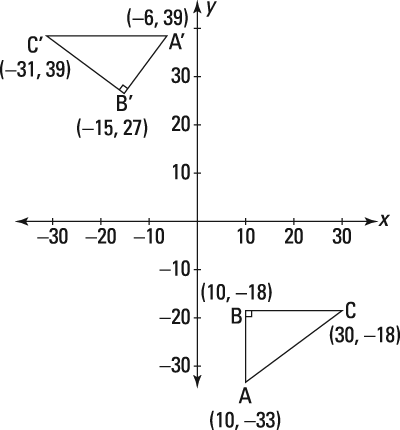
A rotation is a transformation in which the pre-image figure rotates or spins to the location of the image figure. With all rotations, there’s a single fixed point—called the center of rotation—around which everything else rotates. This point can be inside the figure, i...
But I made some marks on it
median crown
Where is the last question?
median crown
ok
 glacial basin
I drew a circle lower than that with a chord of diameter 20 and radius 10
median crown
nice
glacial basin
whatever it is
median crown
ok
glacial basin
I don't know what the question is asking
median crown
Wdym
glacial basin
is it the depth of the water from bottom to surface
median crown
Yes
median crown
no
glacial basin
??
glacial basin
I can't see the big picture of it
median crown
The bowl isn’t actually a sphere
It just takes on the spherical shape
That’s why it says “spherical”
glacial basin
then how am I supposed to know the depth
somber coyoteBOT
 Requested by maleb1964#6739
median crown
Requested by maleb1964#6739
median crown
except the bottom isn’t cut off
glacial basin
???? how is the bowl supposed to stand lmao
median crown
yeah
you could have a stand for it
anyway, it looks like that
so now just find the depth
glacial basin
glacial basin
other depth?
median crown
two possible bowls
glacial basin
so if thats sideways
 median crown
13+8.3 also equals 21.3
glacial basin
o
glacial basin
damn
median crown
put on labels and you’re done
glacial basin
my brain cells are not working until now
did 26-8.3 instead of those
thanks @median crown
I can finally sleep
 languid radish
this is a basic question asked by someone in another server but I've forgotten some of the similarity stuff
can anyone help out?
umbral snow
These are important to recognize
AMB + AMC = 180
The sum of the angles of any triangle is 180
umbral snow
It actually follows that, like you said, these triangles each have two matching angles and are similar
languid radish
but it's only one angle though
How would we know if ABM=ACM
if we do some ABM+60+X=ACM+60+180-X?
umbral snow
AMB + AMC = 180
The sum of the angles of any triangle is 180
You can't know what each angle is, but the opposites have two matching
languid radish
yes it's what I'm using,taking AMB as X and AMC as 180-X
umbral snow
Yeah that should work
languid radish
yeah but idk how I can go to the final answer I'm super slepp deprived and unable to think lol
I'll give it a shot and get back
to you I guess
using this, AMB+2X= ACM+180 but how do I go forward
nevermind
ABM+ACM would be 60 and the above eq. gives us ABM-ACM
2ABM=2(120+2X)
giving ABM= 120+2X and ACM=-(60+2X)
I d k
or x+60+(120+2x)=180 and
but
that'd give x=0 lol
or wait
60-60-2x=180 or -2x=180 giving 2x=-90?
that's wrong too
@umbral snow you there?
fringe crater
There's another way we could do it too, I'm not sure if it's the right way to do it, but it involves graphing a system of equations
And finding where they intersect
languid radish
oh wait the person I'm helping solve this for is only using some similarity stuff
fringe crater
Oh ok
languid radish
but,I'm interested,tell me your method
fringe crater
So let's call Angle ABM "Angle X", and Angle ACM "Angle Y"
Our first equation is X + Y = 60
because MAB + MAC = 120
fringe crater
And in a triangle, the ratio of two side lengths is the ratio of the sines of the angles opposite those sides
So Sin X / Sin Y = 1 / 2, since AB / 2AC
languid radish
sine rule?
fringe crater
Yep, law of sines
Graph those and find where they intersect, and that gives you the angles
fringe crater
Yeah np. Once you got the angles you can use the law of sines and find the other side lengths
fringe crater
Ah ok
languid radish
because it's how the person who asked is supposed to solve
goodbye and thanks for the solution!
fringe crater
You're welcome 🙂
silent plank
i used
total area = area1 + area2
to immediately find x
and then apply cosine rule for BC
 placid path
@steep temple its november 2018 edexcel paper 1 non calc
steep temple
thank you
weary drift
,w plane equation
somber coyoteBOT
 Requested by RokettoJanpu#6002
weary drift
Requested by RokettoJanpu#6002
weary drift
,w sphere equation
somber coyoteBOT
Requested by RokettoJanpu#6002
 soft scarab
thanks
weary drift
Np
soft scarab
and for 2D functions it's usually y=x format, how do you represent 3D function?
z = x+y?
weary drift
First bot search result
soft scarab
and if i take whatever point in 3d and insert it into the plane equation, the sign of the result should tell me if it's on one side or the other, correct?
 tropic bolt
can i break this triangle into two right angled triangles?
i need to solve for <AB
 normal harness
Does anyone know a formula to find the centroid of a triangle that exists in 3D space?
By that I mean there are 3 points that exist in 3D space with X Y Z coordinates. Connecting these points forms some triangle that exists in 3D space. Assuming we know the components for points A, B, and C, is there a formula to find the coordinates of the centroid which we can label as point D?
Nvm figured it out
Just gotta expand this into 3D
tropic bolt
,calc cos(pi)
somber coyoteBOT
Result:
-1
,calc cos(pi-2)
somber coyoteBOT
Result:
0.41614683654714
Is my solution correct
And this is how I solved it
Ah whoops it’s rotated wrong
Here’s the problem
 vagrant steeple
do i just plug this in and it'd be
x = 22^2 + 27^2 -2(22x27)cos(25) ?
dark sparrow
don't use x for multiplication especially when you have a variable called x
but yes that's what it would be
languid radish
yes plug
 idle bloom
@tropic bolt I mean you know the angles have to add up to pi radiens right? So use that sum of angles in a triangle property to find theta
 iron kite
 proven rapids
 smoky mountain
Since the tangent of an angle is the opposite side length / adjacent side length, you can take the inverse tangent of that to find the angle measure.
For A, you'd do tan-1 (16 / 30) and for C, you'd do tan-1 (30 / 16)
 coral zealot
upper karma
coral zealot
upper karma
all the interior angles of a triangle equal 180
and you know that two of the three interior angles are 81 and 31
that means 81+31+v = 180
to find out what the interior angles of a polygon add up to, the formula is: (s-2)180
S is the number of sides you have
dark sparrow
all the interior angles of a triangle equal 180
no, they ADD UP to 180°
no one of them can ever be EQUAL to 180°
@upper karma
dark sparrow
you may note that you just copied precisely the part i did not correct
upper karma
Yea I’m saying that by saying the copied part I mean to say that <1 + <2 + ❤️ in a triangle = 180
< 3*
But my mistake I understand where you are coming from
What I said could have been misinterpreted
dark sparrow
yeah just know that "all the angles" does not automatically mean their sum
 sinful marten
Hello people!
I need help with my homework and I'm really struggling to find alpha in this triangle. I could do the first exercise without any issues but I'm really struggling with this because I'm only allowed to use sin and tan.
https://cdn.discordapp.com/attachments/172645867570987008/646661443361439757/56dea9373372b_353bb3239d41c9f6097b1c7dc10daf0fd7d76215.png
b = 9.7cm
c = 12.5cm
gamma = 90°
I need to find a, alpha and beta

I don't want the exact solution but only help on how do go on about it
According to a friend we're allowed to use the Pythagorean theorem
Which isn't stated in the exercise and I couldn't ask the teacher
So I just calculate a and then alpha and beta using arctan right?
If anyone could tell me if I did it correctly that would be greatly appreciated https://btw.i-use-ar.ch/i/ssfaj9g6.png
 silent plank
beta is wrong
you used the wrong variable
you had arctan(b/a) but you used c/a
silent plank
a and alpha look alright
silent plank
your question a) looks weird
sinful marten
why?
To get the hypotenuse I used a formula off the internet that seemed right
It's basically the same reformation of how I got b in exercise c)
tan(alpha) = a/b -> b = a/tan(alpha
silent plank
recalculate alpha
these are all right triangle questions right?
alpha + beta should be 90°
sinful marten
still the same result for me
yea they are
oh nvm
I had 49 and not 45
Was a typo rip
silent plank
which would also affect c
silent plank
i meant c in q a)
 silk crown
If I pick a point on the asymptote of an hyperbola, where will the two tangents that I draw from there touch the hyperbola?
At two different branches or two points at a single branch
fringe crater
Hello CoolShot, if I'm reading your question correctly, a point on the asymptote of a hyperbola is never on the hyperbola, because the hyperbola will never reach its asymptote
silk crown
Yeah
But I can draw tangents to the hyperbola from it, right
Here, I have drawn two tangents from the point (1,4) which are tangent to the curve at the two different branches
Here, I do it from (1,0) and both are tangent to the curve at the same branch
And I know that I can divide the plane into four "sections" based on the asymptotes which will determine if the tangents touch the curve at both branches or just one
But what happens when my point is on the asymptote
fringe crater
Hmm, that's an interesting question. Thinking about it, I think your tangents should touch the curve at only one branch, and that you'll only be able to draw one tangent line, unless your point lies at the intersection of the asymptotes, where you won't be able to draw any tangent lines. I could be wrong here though, so we'll see if someone else can weigh in on it too.
That's my thinking ^
wind heart
I found C, which is .99 but I don’t know how to implement it into an equation
dark sparrow
what's C
wind heart
The rate of change
dark sparrow
of what
wind heart
Of the minute of call thingy
somber coyoteBOT
Result:
4.94
,calc 4.94/5
somber coyoteBOT
Result:
0.988
the \textbf{cost per minute} is $0.988, not $0.99
somber coyoteBOT
Ann:
dark sparrow
also @wind heart this isn't really the right channel for this
wind heart
Oh
wind heart
Yeah I’m doing geometry but I guess were doing a different thing
upper karma
I got 10/35
dark sparrow
,calc 10/35
somber coyoteBOT
Result:
0.28571428571429
33%, then
dark sparrow
still a pretty yikes result
upper karma
The whole class did shit
dark sparrow
what was the top grade
upper karma
So the teacher said don’t worry cuz he’s dropping the test
The top was like a 70 percent
dark sparrow
and what was the test on
dark sparrow
m
yeah there's like a handful that are useful to know and find uses in stuff outside trig questions but those "prove this identity: (jumble of trig) = (jumble of trig)" questions can be a bit of a mess to untangle
just wondering, do you go to the gym often
there's an analogy i wanna make but i wanna make sure it gets my point across
basically these "prove this identity" questions are like the math equivalent of weight lifting in a way
upper karma
@dark sparrow I play soccer
And I have a job
Like when tf am I gonna use trig identities in life
So useless
dark sparrow
,,, right, are you in college or sth
dark sparrow
i'm gonna guess retail or food
upper karma
?
dark sparrow
aight nvm
upper karma
Lol wut
dark sparrow
forget it
anyway
hhf
kinda tired of people doing the "when am i gonna use X in real life"
dark sparrow
do you make the same sort of complaint in English class with Shakespeare
dark sparrow
how
upper karma
Because English is the language we speak
We must speak it properly it’s common sense
In the real world
Identities you’ll never use in life guaranteed
Functions and graphs yes
@dark sparrow
upper karma
@upper karma life is useless
 odd rock
Yes Mr trump
 storm crown
Plenty of people can communicate well in English without ever having read Shakespeare, so the purpose of reading literature isn’t to teach you English.
It’s the analysis and critical thinking skills you learn by analyzing literature, and the cultural experience you get
Similar with teaching math
 stone carbon
i don't know how "advanced" my question is because it's not related to a class at all. i need a function to do something for me in 3d space to scale bones for a video game's character creation system. it's a bit of a doozy to explain the premise so i've drawn a picture if anyone wants to tackle it... basically, the rotation affects the axis and makes scaling incorrect. i need a formula that takes an angle of rotation and gives me the scaling on both x and y. should be using sin and cos https://gyazo.com/7e4435ff825c56f1f9b68fb7326acd82


 upper karma
Whoa
stone carbon
i missed a rather important detail here. with bones they're in a hierarchy so the first scale affects both bones... the blue portion only affects the 2nd bone
upper karma
lol it’s twice as fat
stone carbon
the point is to undo the scaling from the first when you get to the 2nd... so the first would be 2x but the 2nd needs to be .5 to change it back again
right, because the scale happens in the parent's local space, it makes something bent at a 90 degree angle twice as fat instead of twice as tall
upper karma
It ate too much McDonald’s
stone carbon
then when you go to scale the new one, the rotation angle needs to be considered, scaling the x .5 would undo this change, scaling y .5 just makes it even worse
upper karma
Too much Big Macs haha
Poor guy
How much Mickey d’s did u feed that thing lmaoo
@stone carbon
stone carbon
0%
upper karma
Wow
So he just was born like that I guess
Low metabolism for the poor guy
@stone carbon
 gritty sail
$2$
somber coyoteBOT
Jbao:
 wanton valve
can someone please do these questions for me
the ones with answers in them as well so I can double check it all
silent plank
what's the angle sum of consecutive interior angles on parallel lines? @wanton valve
wanton valve
adds to 180 degrees @silent plank
@silent plank i mainly do not understand number 11
 final veldt
wait isnt that giving you AC nvm thats 13
silent plank
did you fix the errors in 2 and 5
 vivid wraith
so the two diagonals of a rhombus are perpendicular, giving you 12y = 90. we get y = 15/2. because we know that the diagonals of a rhombus bisect the opposite angle, we get that angle BCD is 2(4y-1) or 58. We also know that opposite angles of a rhombus are equal so we get angle BAD is 58
wanton valve
@vivid wraith thanks
smoky mountain
180 degrees = pi radians
upper karma
ye i know
i am asking why it equals -1
or why they both equal -1
i get why cos 0 = 1
smoky mountain
180 degrees just faces the opposite direction as 0
so if you think of an xy coordinate plane, where the center is at (0, 0), 180 degrees is in the negative x half
upper karma
i was looking at the wrong angle the whole time