#geometry-and-trigonometry
1 messages · Page 236 of 1
 vague berry
 upper karma
measure of M and Y
 keen aspen
Ya
keen aspen
Mhm
upper karma
Ohh thank you so much!
keen aspen
Np
upper karma
So all I have to do is change what I know to the same variable?
keen aspen
Yep
upper karma
Oh Tysm
keen aspen
Working with 1 variable makes it very easy, establish a relation between one to another
Np, I'm heading off to sleep
Goodnight
upper karma
Night
 signal hornet
hi
Apparently 2pi/3 is also a solution
But I don't see where or how I missed it
signal hornet
couldn't go to sleep without one more math problem 😉 ?
signal hornet
rest well
keen aspen
Thanks catch ya later
signal hornet
cya
signal hornet
All I got is x = theta - 1
I know one trig propery kinda related to this
1 + tan^2(x) = sec^2(x)
but I don't see how that can help me here
signal hornet
just a substitution
 dark sparrow
uh
signal hornet
in the property one it's just and angle
dark sparrow
why would you do that
 umbral snow
That's tan(θ) - 1
dark sparrow
this is not $\tan(\theta - 1)$
 somber coyoteBOT
Ann:
signal hornet
oh
dark sparrow
see, this is why you should always put parentheses!!!
signal hornet
Yeah, good point
I did put them though
just in the wrong place
Yeah, that didn't make it anymore clear
still have no clue where to start
now I can't even substitute anything
dark sparrow
you don't need to
look at your equation
it says that the product of two things is equal to zero
signal hornet
one of these or both have to be 0
dark sparrow
well
yes
are you able to solve the equations tan(θ)-1 = 0 and sec(θ)-1=0 in isolation
dark sparrow
should it?
dark sparrow
well then.
signal hornet
thanks @dark sparrow
 obtuse tapir
30-xroot3/2 * 2/x
@vague berry
By inverse I mean reciprocal
multiplicative inverse
Illustrated definition of Multiplicative Inverse: Another name for Reciprocal. What you multiply by a number to get 1 Example: 8 times (18) 1 In other...
and then
x and x would cancel
and 2 and 2 would also cancel
leaving you with 30-root3
which is not equal to 30/16
 manic crown
I doubt a statement in my textbook.
*If two co-terminal angle $\theta$ and $\alpha$ and $0^{\circ}\leq \alpha \leq{360}^{\circ}$
somber coyoteBOT
Raftaar:
manic crown
then $\sin(\alpha)=\sin(\theta)$
somber coyoteBOT
Raftaar:
 silent plank
what's your definition of co-terminal angles?
manic crown
The angles with different amount of rotation but same position Initial and terminal ray
silent plank
what's making you doubt that statement?
silent plank
well the position is the same
the relative angle is the same,
quadrant is the same,
manic crown
If the intial and termnial rays coincide then the tri f are equal
silent plank
if $\theta$ and $\alpha$ are co-terminal then:
$\theta = \alpha + 2k \pi$ where $k$ is an integer
somber coyoteBOT
ramonov:
manic crown
$sin{360n+p}^{\circ}=sin(p),n\in {\bZ}$
somber coyoteBOT
Raftaar:
dark sparrow
$\sin(p + 360^\circ) = \sin(p)$
somber coyoteBOT
Ann:
dark sparrow
@manic crown
manic crown
yes
somber coyoteBOT
Raftaar:
Compile Error! Click the  reaction for details. (You may edit your message)
dark sparrow
$\sin(p + 360n^\circ) = \sin(p), n \in \bZ$
somber coyoteBOT
Ann:
upper karma
I understand an Isosceles triangle is a triangle with two equal sides
But would those triangles have four sides
dark sparrow
what triangles
upper karma
In the image above
upper karma
ACd
So it’s asking for isosceles triangles right
But in the first answer, it takes the two sides on the bottom, which are congruent
If those are the two congruent sides, then the two other sides would make that four
dark sparrow
why do you think ACD has four sides
can you name the four line segments that you think are its sides
upper karma
DC DA C to the mid point A to the mid point
When it says triangle
I ssume that the segments become CA, DC, DA
But then it wouldn’t be an isosceles triangle
dark sparrow
the sides of ACD are CA, DC and DA, yes.
and yes it would be isosceles. AD = AC.
letting the midpoint be O... CO and AO are not sides of ACD.
upper karma
Ok
obtuse tapir
couldnt you just prove all these triangles equal
upper karma
How do you know AD=AC?
obtuse tapir
*congruent
obtuse tapir
AD=DC
upper karma
I don’t understand how AD=DC
obtuse tapir
Congruency
dark sparrow
AD=AC by pythagoras
obtuse tapir
There are 2 sides equal
upper karma
But it’s not a right triangle
dark sparrow
@upper karma ADO and CDO are right triangles.
i'm applying the Pythagorean theorem to those.
obtuse tapir
You could use the congruency criterias
upper karma
How do you know ADO is a right triangle
Is it because perpendicular lines create four right angles?
obtuse tapir
Linear pair my dude
upper karma
Ohhhh
dark sparrow
@upper karma well, yes
obtuse tapir
the sum angle AOD and AOB is 180
upper karma
So then if that’s the case
dark sparrow
if any of the four angles created by a pair of intersecting lines is right
then so are the other three
upper karma
That means DC and DA are the congruent sides tho right?
obtuse tapir
yes
dark sparrow
congratulations you just repeated what i said earlier
obtuse tapir
Side-Angle-Side
upper karma
U said AD=AC by Pythagorean’s
obtuse tapir
You will achieve the same result
If you take one of the side as x and other as y
root x^2+y^2 will be the hypotenuse
and since all the x and ys are equal in all triangles
or
you could use
SAS criteria for congruency
upper karma
I’m just gonna stick to the linear pair way
obtuse tapir
what?
upper karma
Congruency
obtuse tapir
ahh
upper karma
Proving all of them are congruent
obtuse tapir
Its the same thing
using pythagoras theorem is more intuitive
just that
BCD, ADB, ADC, ABC
upper karma
What is the base angles congruence theorem
 fringe crater
@upper karma that's the theorem that says if two sides of a triangle are congruent, the angles opposite those two sides are also congruent
fringe crater
Yes
 sudden locust
@fringe crater Look whos here! Hey buddy! 😊
fringe crater
Hey, how's it going?
sudden locust
Its going good, made a video about dimensions today!
What your next video going to be about?
upper karma
 pure rain
<@&286206848099549185>
 summer spire
are you happy with the order in your screenshot? What are you having trouble with?
fringe crater
@sudden locust that sounds cool, I'll check it out later. My next video is going to be about a math olympiad geometry problem
signal hornet
Hello
I don't understand step 5
the identity calls for a squared cos, the problem only has a cos to the 1st power
so how does that identity even apply?
umbral snow
Do you see how the identity was used, first of all?
umbral snow
There's a sin² in the equation. Replace it with 1 - cos²
signal hornet
that's genius
umbral snow
Lel glad it clicked. Yeah they didn't explain that very well
signal hornet
THank you
umbral snow
They just want everything in terms of cos, and you can always convert between sin² and cos² easily
 dawn drum
why dont you use symbolab or something
upper karma
uhhh @signal hornet are u in a test or quiz right now? Or just trying to learn how to use calculator for a test or quiz
signal hornet
Learn
 wet ice
 queen python
 maiden rain
@dark sparrow Yeah I solved it in a weird way, I just solve it by drawing a graph and a triangle and the answer is (b) I think..
dark sparrow
a triangle is exactly how you're supposed to do it anyway
maiden rain
It's not possible to do it algebraically ?
dark sparrow
what do you mean algebraically
manic crown
If $x \to {\frac{\pi}{2}}^{+}$ then $\tan{x} \to \infty$ or $-\infty$
somber coyoteBOT
Raftaar:
manic crown
??
keen aspen
Lol np
 gritty siren
upper karma
gritty siren
upper karma
Bruh epic troller
upper karma
Any ideas on how to do Question 6? I have two unknowns I'm completely lost
This is where i got to pretty much
I've tried everything
upper karma
L?
keen aspen
The slant height
keen aspen
Yeah
upper karma
keen aspen
So set both equal to each other
upper karma
Set my old l formula and my new one equal to eachother?
keen aspen
Csa/pir=sqrt(h^2+r^2)
keen aspen
3.6
keen aspen
Where did the pi r go
upper karma
oops i forgot tto
i forgot tto erite it
there
ok
so should i deal wjth the sqrt first
upper karma
keen aspen
(90.5/(pir))^2=90.5^2/(pi^2r^2)
upper karma
$(\frac{90.5}{\pi r})^2 = \frac{90.5^2}{\pi^2 r^2}$
somber coyoteBOT
Nemesis:
upper karma
This?
upper karma
so undo what i just did
keen aspen
Are you able to vc
upper karma
Ehh okay but i cant talk
keen aspen
Ok
upper karma
Yea
Everything on the left move to the right
But wont that eliminate the equals sign
Ohhhh
Okay
So expand it?
And you can just make it 1 fraction
yes
i expanded the bottom
No but it expands out because we dont know r
Shit
Ok
Yeah its a 10 i rounded
keen aspen
,wolf 8190.25/pi^2
somber coyoteBOT
 Requested by PJS#5494
upper karma
Requested by PJS#5494
upper karma
829.8r^2?
oh
so i replace the square fraction
with the new fractioj
ok
it was a negative
so
my fraction will be negative right
But i thought it turned to r^4
No it was a plus, the r^2 is a seperate term
keen aspen
r^2(12.96+r^2)
upper karma
r^2 = x?
so i just write r^2 = x
done
yea
Yeah ill just use the formila
ok
im gonna wipe my board
this is messy
ok so
does that look right
ok ill get two answers though
so the positive value
is the answer
yep ok so
yes
right so now i have r
i can solve the original problem
ok lets see how this goes now
another board wipe
@keen aspen
Thank you so much
That was awesome
silent plank
,rotate 90
somber coyoteBOT
silent plank
mmm, by standard form they mean vertex form right?
factorise (-1) out,
complete the square and then redistribute
upper karma
😅 I have to be honest. I have no idea what that means.
silent plank
were you able to do #4?
upper karma
To be honest I'd not know if I should divide by 6 or just do x(6-x)
silent plank
well x(6-x) is equivalent to 6x - x^2
but it doesn't seem to be what the question wants
they seem to want you to write it in the form
f(x) = a(x-h) + k
upper karma
does that form have a name?
silent plank
vertex form
upper karma
ahhhhh
silent plank
the form presented is actually standard, some places call vertex form standard which can make it mega confusing
 leaden belfry
I'm planning a comms network in Kerbal Space Program, and I want to know the distance between the satellites in the constellation because they have a limited antenna range. What's the easiest way to get that distance? https://puu.sh/EBEui/e2e6e3055b.png

Equatorial radius of the planet is 700,000m
The pic is slightly misleading because it shows the resonant orbit, but the satellites are in a circular orbit of 250,000m
leaden belfry
If anyone's interested the answer is 2π(radius of planet + orbital altitude) / (number of sats)
dark sparrow
exactly the same as the other five... via a unit circle
 ivory vortex
im not given one
ivory vortex
how
dark sparrow
do you not know what a circle looks like
...i mean ok fine you found the reference angle
is cos(π/4) something you are able to evaluate
ivory vortex
https://cdn.discordapp.com/attachments/490315911044136961/641873708415320076/Surdsintrigonometry.png

i was told to use these triangles
pi/4 is 45 degrees
and it's cos so it's 1/sqrt(2)
but that's not the answer
silent plank
what quadrant is 5pi/4 in?
ivory vortex
3
silent plank
is cos positive or negative in that quadrant?
ivory vortex
negative
silent plank
are you able to determine the answer from that?
ivory vortex
umm idk
silent plank
the reference angle was pi/4
the reference ratio is cos(pi/4) = 1/sqrt(2)
the sign of that will change depending on where your angle is
ivory vortex
but the answer is -sqrt(2)/2
silent plank
rationalise the denominator
dark sparrow
sqrt(2)/2 is the same thing as 1/sqrt(2).
ivory vortex
how
dark sparrow
$\frac{1}{\sqrt{2}} = \frac{\sqrt{2}}{\sqrt{2} \cdot \sqrt{2}} = \frac{\sqrt{2}}{2}$
somber coyoteBOT
Ann:
dark sparrow
@ivory vortex
ivory vortex
how did you get the numbers in the middle expression
i forgot everything about radicals
ivory vortex
oh i see
how come when you multiply two of the same radicals they lose the square root
dark sparrow
...
do you know what a square root is
$(\sqrt{x})^2 = x$ is literally the definition
somber coyoteBOT
Ann:
ivory vortex
ohh
why is it preferred to be written like that
sqrt(2)/2
and not 1/sqrt(2)
can you not have radicals in the denominator
ivory vortex
oh i see
 tepid vine
i dont understand my math question
There is a 1440-cubic foot rectangular prism. The prism has a square cross-section and height 10 ft. What are its length and width?
dark sparrow
what don't you understand about your question
tepid vine
the use of "rectangular prism"
we're doing a square and cube root unit
im assuming its a cube but im not sure
also its worded strangely
not entirely sure what its asking
tepid vine
right
dark sparrow
do you know how to find the volume of a box
tepid vine
yes
dark sparrow
so how do you find the volume of a box
tepid vine
length•width•height
dark sparrow
\* so discord doesn't eat your asterisks
but yes
so the height is 10 ft and the volume is 1440 ft^3, so this means length * width = ?
tepid vine
🗿
tepid vine
no
dark sparrow
$lwh = 1440 \ h = 10 \ lw \cdot 10 = 1440 \ lw = ; ?$
somber coyoteBOT
Ann:
dark sparrow
...
tepid vine
lw = 144
dark sparrow
you've jumped way ahead.
but yes, lw = 144, and since the base is a square we have l = w
tepid vine
sweet bro thanks for the help
ok but what was this mention of a cross section
i think that confused me some too
why not just give me height i dont understand
dark sparrow
don't call me bro
tepid vine
why
dark sparrow
i am uncomfortable with that term for multiple reasons
also you were given the height
tepid vine
in the same sentence as the unnecessary use of cross-section
dark sparrow
so what
tepid vine
why cross-section
im not dissecting an animal
im finding lengths of a rectangular prism
dark sparrow
maybe to make you THINK a bit
tepid vine
this textbook mad wack
dark sparrow
which i know you're one of those people who don't like that much
but it's quite a necessary skill
don't you find
dark sparrow
i'm not a dude.
dark sparrow
i thought it was obvious but i guess i don't speak neurotypical after all
tepid vine
interesting
i'll let it slide just this once
just figured out the square cross section part too, nice
manic crown
$4\sin^{2}{\theta}-2(\sqrt{3}+1)\sin{\theta}+\sqrt{3}=0\ implies \sin{\theta}=\frac{\sqrt{3}}{2},\frac{1}{2}\ \implies \theta =(2\pi+\frac{\pi}{6}),(2\pi +\frac{pi}{3})$
somber coyoteBOT
Raftaar:
manic crown
$\theta $ in radians
somber coyoteBOT
Raftaar:
manic crown
can someone tell if the above is correvt
dark sparrow
,w 4t^2 - 2(sqrt(3)+1)t + sqrt(3) = 0
somber coyoteBOT
 Requested by Ann#0413
manic crown
Requested by Ann#0413
manic crown
,w 4sin^2x - 2(sqrt(3)+1)sinx + sqrt(3) = 0
somber coyoteBOT
 Requested by Raftaar#1096
dark sparrow
Requested by Raftaar#1096
dark sparrow
$\theta = \frac{m\pi}{3} + 2k\pi, , k \in \bZ, m \in {1, 2, 4 ,5}$
somber coyoteBOT
Ann:


 ivory vortex
how do you do f
theta should be between 3pi/2 and 2pi
i found the value for all the trig ratios and got -0.17, -0.17, and 0.17
i think i get the answer by subtracting 0.17 from 2pi but i'm not sure why
how come i didnt straight up get the answer when solving the trig ratio
dark sparrow
arcsin and arctan give you a value between -pi/2 and pi/2
arccos gives you a value between 0 and pi
ivory vortex
do the ratios not give values greater than pi
dark sparrow
??
ivory vortex
why do i not get a value between between 3pi/2 and 2pi
considering thats where the point is
 devout harbor
you dont get that from the calculator, you have to do it yourself
find the angle of the triangle thats formed with the x axis, and then subtract that from 360
ivory vortex
do i not get it from the calculator because the ratios cant give values greater than pi (or 180 degrees)
devout harbor
dont depend on the calculator, think yourself
did you get the angle of the triangle forming with the x-axis?
ivory vortex
well no
what exactly do the ratios give?
is it the angle to a point, but the angle is always less than 180 degrees
like that
ivory vortex
ohh i see
devout harbor
so find theta
ivory vortex
so it really cant be greater than 180
devout harbor
We need to go anti clock wise, otherwise the clock wise angle gives us negative.
Yes, it will be less than 180.
devout harbor
np
sudden locust
Just made a video of a proof of the Pythygorean Theorem. Would really appreciete any kind of feedback from you guys. Hope you will have a great Thursday! 😊👍https://youtu.be/BmUjXSP5-3o

In this video, we are going to take a look at a Pythagorean theorem proof, or Pythagoras theorem proof. This will be done visually by using squares. Geometry...
 sly marlin
and here I'm still wondering what sort of syllabus and target audience you are targeting
 wind crypt
Cool video!
sudden locust
Thanks! 🙂 @wind crypt
 idle bloom
@sly marlin he's targeting people who are taking ACT and SAT tests
sly marlin
hmm maybe I'll see based on that
maiden rain
Why the range of Arcsin =
It should be from -infty to +infty
Yeah..
It is a one to one function..
Please read my quesiton.
dark sparrow
arcsin isn't multivalued
maiden rain
The domain of sin = -infty, +infty
dark sparrow
yes but arcsin isn't the true inverse of sin
maiden rain
so the range of arcsin should be the domain of sin.
dark sparrow
no
sin doesn't have a true inverse
sin is not invertible if considered on the entire real number line
maiden rain
Sin is like x^3 ?
 fringe dirge
Here, if I ask you for arcsin(0) what do you think this is
maiden rain
0
fringe dirge
Why
Why isn't it 2pi?
Or pi?
You have that sin(pi) = 0
And sin(2pi) = 0
And sin (-pi) = 0
Why'd you pick 0 when there are so many other options
maiden rain
well it's 0 in a Real numbers graph..
dark sparrow
what's a "real numbers graph"
maiden rain
In the Radian graph it's different..
dark sparrow
what's a "radian graph"
why shouldn't arcsin(0) be 19π
sin(19π) = 0 after all
so why shouldn't 19π = arcsin(0)?
fringe dirge
If you want degrees, sin(360 degrees) = 0
So why isn't arcsin(0) equal to 360 degrees?
maiden rain
Well, 0 is infinity.
dark sparrow
big brain moment
maiden rain
xD
dark sparrow
but actually you're making no sense
maiden rain
So can I say that the domain of sin is -pi/2 , and , pi/2 ?
dark sparrow
no you can't
the domain of sin isn't {-π/2, π/2} and it is not [-π/2, π/2] either.
but arcsin is not the true inverse of sin.
arcsin is the inverse of the RESTRICTION of sin to [-π/2, π/2].
maiden rain
Oh
wow amazing!!
Now it make sense !!
You're good thanks for explaining that @dark sparrow
maiden rain
I need an explanation here, Apparently the answer is -infty...
the thing that confuses me is that there is no (x) values beyond pi/2 so how am I supposed to approach it from the right?
 mint sandal
tan is defined on the whole unit circle except (0, +- 1)
maiden rain
That's not true, it has 2 vertical asymptotes at -pi/2 and pi/2
mint sandal
yeah you just paraphrased what I just said
(0,+-1) are points on the unit circle
which can be parametrized by an angle as +-pi/2
dark sparrow
@maiden rain are you claiming tan(x) is undefined for x >= π/2?
because that would be very wrong
maiden rain
Look I made a drawing, Tan(x) has 2 vertical asymptotes at -pi/2 and pi/2 ... SO look at the blue arrow I'm trying to approach it from an undefined area that doesn't make any sense to me. how am I supposed to approach it from the right?
So in my opinion, I think this should be "Doesn't exist" ^
dark sparrow
the domain of tan is not (-pi/2, pi/2)
it is not the case that tan(x) is undefined whenever |x| >= π/2.
maiden rain
Ok so the limit of 1/x when x approaches 0 from the left = -infty , an example of that would be x=-0.00001
Can you give me an example of the limit of tan(x) when x approaches pi/2 from the right ?
"what's so close to pi/2 from the right "
dark sparrow
π/2 + something small and positive, evidently
maiden rain
Great, I was thinking of tan as a restricted function..
upper karma
How do I prove this
 shell imp
Can someone please explain this?
dark sparrow
,rotate -90
somber coyoteBOT
silent plank
structures a bit weird.
its a combination of:
difference of 2 squares
double angle identity for \cos
sin^2(x) + cos^2(x) = 1
do you understand all those concepts?
shell imp
To an extent, yes. I just don’t understand how those connect and like how you piece it together
somber coyoteBOT
ramonov:
silent plank
wdym by piece them together?
if you want to write cos^4(x) - sin^4(x) in an alternate/simplified form,
the difference of squares would be a good place to start.
and then think about what you can use after that
 median crown
$(cos^2(x)-sin^2(x))^2= cos^4(x)-sin^4(x)$
somber coyoteBOT
maleb1964:
median crown

devout harbor
lol
devout harbor
@shell imp You piece it together by looking at what angle you want. Since we had cos(2x), so we know we have to simplify it and make something that equals cos(2x) or in other words, find its double angle identity.
median crown
I’m not sure about this drawing

It looks sketch
No pun intended
The drawing doesn’t agree with itself
Is anyone else seeing this?
Wtf
I see a 3 4 5 triangle for the entire thing, meaning the whole drawing is a right triangle
But when I cut a the whole thing into a similar triangle with the leg of length 12 becoming a leg of length 6, I am supposed to get a smaller triangle with leg length 6, 8, 10
the funny thing is 10 is supposed to make up the entire hypotenuse of that triangle
?
Wtf
silent plank
hmm
median crown
Lmao who did this
@upper karma uhh if you made this drawing you should check your stuff
If it’s from a book or an assignment and you didn’t make it then idk bro
Ooooof
ok
But is it from a book?
Oooof
Maybe you drew it wrong
You should post the problem
silent plank
diagram just isn't to scale
make that middle shape look less like a square and more like a rectangle
silent plank
the vertical line won't be to the vertex but somewhere on the side
silent plank
median crown

silent plank
and then solve using similar triangles
 scarlet halo
is it possible to create a equation for a parabola with a x intercept and a point ?
 crude pelican
Doing a geometry Problem where i need to find x here
I'm setting up with proportionality by doing AB over BE = BC over CD
I keep getting a decimal and i'm expecting a whole number for the result
but why would i do x+60? and what makes this different from other questions? is it because its like a combined triangle sort of, instead of it being mirrored
yeah
oh that makes alot of sense
right
Thank you
scarlet halo
is this right ? https://media.discordapp.net/attachments/536995777981972491/642177251986636810/642177162501292042.png?width=630&height=473

 thorn linden
 formal raptor
This is extremely confusing to me and I can’t get any farther than the part where I need to find the hypotenuse BUT I CANT FIND THE HYPOTENUSE pls help
formal raptor
It’s taught to me like cos = adjacent/ hypotenuse
ivory vortex
yep it's the same thing
then uhh
doing
arccos (-7 / sqrt(61) = principle angle
then you have to find the related acute angle from that
not quite sure how to do that so you get a radical tho

 vagrant steeple
finds the hypotenuse
ivory vortex
well you can just put it in your calculator and not worry about it
but if you really want to know
(2sqrt(3))^2
the square removes the square root of the 3
and squares the 2
so you get 12 as your final answer
as you're left with 4*3
 mellow lava
hi
can someone please help me with this problem
im revising for exams and i cant find a solution
how did they get those answers?
 mighty narwhal
Hmm
The first thing you should see is that
C+d=a+b=1/2
You can rearrange A and B to get half of the square
So A+B=1/2, so C+D is also =1/2
A and B are also equal, so both are 1/4
You can see that C is the half of a quarter-square, so 1/2*1/4=1/8
And because C+D=1/2, D must be 3/8
tepid vine
i concur
 cloud merlin
leaden belfry
cloud merlin
leaden belfry
Please excuse my bad paint skills... this is a 2D diagram of a 3D problem. I have a satellite around a body with radius R, and a dish on the satellite with a projection cone of θ. The satellite has an altitude of D.
I already know R and θ, and I want to know what value of D is required for the cone of projection to cover the whole sphere. Any help appreciated, thanks.
 sly marlin
it's a 2D problem, isn't it?
Try extending the lines from the satellite until it goes past the sphere
@leaden belfry
How should the rays interact with the sphere?
leaden belfry
@sly marlin So I've solved the 2D problem, what I want to know is if the solution to the 2D problem translates into 3D
Intuitively I think it does, but I know cones can be unintuitive, so I just want to be sure
sly marlin
well this is a cross-section, isn't it?
Here we are assuming the cone points directly at the sphere
leaden belfry
i.e. does the cone covering 50% of that circle (with the other half being occluded) translate directly to one hemisphere of coverage in 3D
And the cone does point directly at the centre of the sphere
Yes, it's a cross-section
sly marlin
what do you mean "covering 50% of that circle?"
leaden belfry
The area inside the cone will contain some portion of the circumference of the circle, but since it cannot penetrate the circle (or the sphere) in reality, the other side occludes the projection
So the maximum you can actually cover is 50%
Only the side facing the satellite has line of sight with it
sly marlin
So your answer for this question is?
idk if it's correct, from what I interpret it looks like a slightly better than fair chance of being correct
leaden belfry
Actually... I think I made an assumption and an error, but I will show you...
I figured I could use pythag to solve the 2D problem

Obviously this is a terrible diagram but I think the problem is still there
leaden belfry
Yeah
sly marlin
draw a line segment from there to the centre
sly marlin
What information do you have?
leaden belfry
I know theta and I know R
Sorry, theta is the angle next to the red dot
Thanks for your help by the way, my math is super rusty and I know I'm making basic mistakes
sly marlin
Any other angles?
leaden belfry
The angle at the origin of the sphere/orbit is 90
sly marlin
maybe that triangle with that angle shouldn't be used
you have an expression for one side, but that's all
maybe use another triangle?
leaden belfry
Not quite sure what you mean, here's what I have https://puu.sh/ECvSx/2750911c7b.png
 sly marlin
look at the tangency point
leaden belfry
Sure
sly marlin
what angle is there?
do you have enough information for any triangle in your diagram?
leaden belfry
I think I can work out the angle that's directly above 90 degrees using trig
But I'm not sure how to do that, it's been a long time 😄
leaden belfry
There's right angles at the tangent point and one at the origin
Maybe I should give some context, I'm an adult (not a student) and this is a personal project, so I don't have a trig book in front of me or anything
This is memory from like 13 years ago
Aren't there three right triangles here? There's the big one containing the other two, which has a right angle at the origin, then that's divided into two triangles which have their right angles at the tangent point
leaden belfry
The one containing the angle theta
Okay, you've given me something to work with, thanks... I'll do some googling on trig and see if I can figure it out
Thanks for your patience
sly marlin
there are 2 triangles containing theta
sudden locust
https://youtu.be/Ah7lP4Rhwoo In this video, we are going to take a look at dimensions. Hope you can get some value out of it, and if not, any feedback is really apprecieted! Hope you have an awesome weekend guys! 😊👍

In this video, we are going to take a look at the three geometry dimensions we have in real life. We are going to talk about dots, lines, plane figures, soli...
sly marlin
let's take a look
 chrome sinew
Why is Benedict Cumberbatch in the thumbnail?
sly marlin
idk, probably just their style
putting a hypercube model without mentioning it in the video too lol
upper karma
@sudden locust Yet another great video. )) Keep it up!
sudden locust
@chrome sinew Its Cuberbatch when hes playing Alan Turing (The Imitation Game)
Great movie!
@upper karma Thanks buddy ❤
chrome sinew
I know. I have watched that movie. It is the best biographical movie I've ever seen. Love it. But I said that because B. Cumberbatch is not a mathematician himself ;-) never mind @sudden locust
His acting is so good people take him as real the real person 
The Theory of everything and American Sniper came out the same year otherwise he probably could have won the oscar
dark sparrow
that's not a zero with a line through it
that's a greek letter
specifically, theta
$\theta$
somber coyoteBOT
Ann:
sudden locust
@chrome sinew One of my favourites aswell! Awesome movie... Only seen it once, so I should rewatch it sometime soon!
upper karma
ok thanks
 ornate tusk
how would i find the exact value of acos(-1/3) by hand
 buoyant spruce
keen aspen
buoyant spruce
keen aspen
@buoyant spruce what do all the angles add up to in a triangle
buoyant spruce
180
buoyant spruce
ok thank you
sly marlin
Either there's extra information or that problem has no solution
 night karma
D
 fossil lotus
There are three similar triangles in that diagram @upper karma
upper karma
oh i see what you mean
fossil lotus
You got it?
 languid radish
I mean
The question says:
“Solve sin x > x1/2 or find the domain of 1/sqrt(1+2sin x)
The textbook says draw the graph from -pi/2 to 3pi/2
I don’t get why this and why not 0 to 2pi
@median crown
fossil lotus
What does your textbook say about how to solve trigonometric inequalities
languid radish
It brings it up only in one solved example
So I’m a bit confused
It’s explanation is only half a line
“Draw a graph”
That’s literally it
@fossil lotus
fossil lotus
Hm
Based on that, I'm guessing they want you to figure out when sin(x) = -1/2, and then look at the graph of sin(x) to determine in what intervals sin(x) is greater than -1/2
languid radish
Yes I did solve sin x= -1/2
That gives n*pi + (-1)^n 7pi/6
I found some YT videos but I’d rather take the help of discord
fossil lotus
What are you having trouble with then
languid radish
With what?
The problem,or the videos?
I solved for n*pi + (-1)^n 7pi/6
x > n*pi + (-1)^n 7pi/6
fossil lotus
What's your question
languid radish
Solve for sin x> -1/2
fossil lotus
Brb
languid radish
OR:Find the domain of 1/sqrt(1+2 sin x)
languid radish
Anyone there?
fossil lotus
@languid radish Since the example in your textbook mentioned drawing a graph, I think that’s what you have to do
You know where sin(x) = -1/2
So between any two points where sin(x) = -1/2, y is either going to be greater than or less than -1/2
And you can figure out which one it is by looking at the graph of y=sin(x)
fossil lotus
Probably
I mean, you could just test points
Or look at the derivative and see whether the function is increasing or decreasing at the points where y=-1/2
I’ve never had to do inequalities involving trigonometric functions though so idk what the normal way to solve them is
fossil lotus
Np
formal raptor
trig help?
silent plank
where are you stuck?
formal raptor
Trig is just extremely confusing
I just need help putting the problem together and solving it
silent plank
have you attempted to draw a diagram?
wind crypt
This. Diagrams are really useful for trigonometry word problems.
languid radish
How do we solve:
Find the period of f(x)= sin(x+cos x)
dark sparrow
what have you tried so far
languid radish
sin(x+t + cos(x+t) ) = sin(x + cos x)
I have no idea how to proceed
I feel so dum dum
If x=0?
dark sparrow
well remember that you want this to hold for all x
languid radish
Yeah
dark sparrow
so t + cos(t) = 1 + 2kπ or t + cos(t) + 1 = π + 2kπ
yknow it looks like sin(x + cos(x)) should be 2π-periodic.
just from eyeballing.
maybe its period is smaller
languid radish
oh yeah I forgot about this thing for some reason
How’re you getting it from just eyeballing lol
dark sparrow
i mean
it looks like it should be 2pi-periodic
like
cos is
and so's sin
so maybe
and yknow if you plug it in
you get that it works
upper karma
I need help
Trigonometry problem
Trigonometry function
Its in Portuguese tho
It wants me to calculate the fundamental period of the function
Hope I translated that correctly
G(x) = sen(3x+(pi symbol)/4)
How do I calculate the fundamental period from that
I know I gotta use the 3 somewhere
And I know that the function repeats itself at 2pi
Please ping me if you know the answer
upper karma
@upper karma i assume you mean sin?
and to find the period of the function you should use this: iirc
you know that b is 3
Oh my god thank you
Just in time
Youre a life saver
no problem
median crown
No problem
 inland canyon
hello, i have a vector problem which i haven't been able to solve for about 2 hours, perhaps someone could help. https://i.imgur.com/qAaGxgA.png
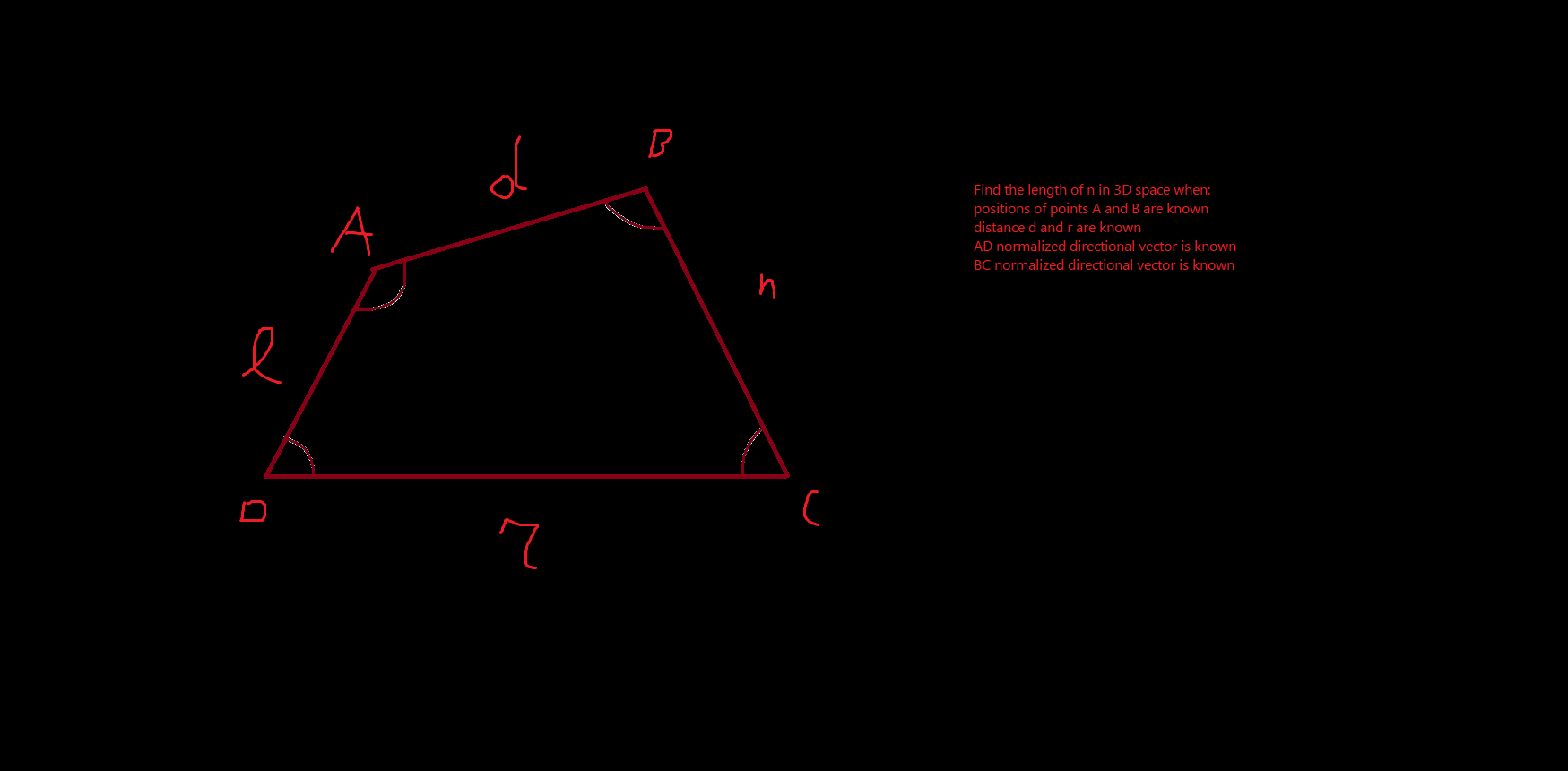


 errant nebula
Can anyone help me with proofs (starting geometry)
 dusky tiger
can anyone help me with Proving Angles Congruent?
 devout shell
we have to see the givens first
formal raptor
Anyone able to help with some trig
dark sparrow

formal raptor
I have this question
dark sparrow
uh huh...
silent plank
where are you stuck?
formal raptor
I’m not sure how I’m supposed to find the larger acute angle. Like it’s really confusing to me
silent plank
do you understand what the larger acute angle is?
can you find the smaller acute angle?
(in a right triangle)
||a right triangle has a right angle and 2 acute angles||
||the larger acute angle is the larger of the two acute angles||
formal raptor
Yea I understand that and I’ve solved a smaller acute angle problem before
Is that how I would solve this one?
silent plank
what's the angle sum of a triangle?
what's the angle sum of the 2 acute angles?
formal raptor
I think it’s 180?