#geometry-and-trigonometry
1 messages · Page 228 of 1
 weary drift
 surreal roost
I don't get it shouldn't it be 2.83?
 grand shard
hello i have question, how do i calculate the middle point of a circle?
the size of the circle is 35x35 (width: 35, height: 35)
 worthy root

worthy root
pi*35^2
 dark sparrow
@surreal roost 2.83 is not "rounded to the nearest tenth"
 dreamy finch
@surreal roost nearest tenth = nearest multiple of 1/10, ie, 0.1
 upper karma
What's your question
worthy root
https://cdn.discordapp.com/attachments/326138757474680852/623192804398596120/20190916_215121.jpg @upper karma

<@&286206848099549185> i reposted it it more than am hpur. Help me . 2*
upper karma
Wtf is c
worthy root
Wot ? @mighty gull
 mighty gull
draw it out
upper karma
Yea
worthy root
Wait
upper karma
Literally
worthy root
I got it
upper karma
Drawl the angle
worthy root
Its 45-45-90 triangle
mighty gull
you just pinged helper
worthy root
I worked for an hour .
upper karma
Bro draw the angle
worthy root
Surfing on internet for answer
worthy root
Yes . Doing
I am etting
49(pi-\sqrt{2}/4
Thats weong acc to my text
Also people on internet say (49(pi-2)/4 is correct

God(if u exist bless him) .
 south pebble
can someone help me solve this?
im getting an answer thats not making sense at all
 somber coyoteBOT
Result:
0.06
,calc 0.06*9.81
somber coyoteBOT
Result:
0.5886
arcsin right?
worthy root
Yes
south pebble
yes i did all that and im still not getting the right answer
somber coyoteBOT
 Requested by Krishna#4971
south pebble
Requested by Krishna#4971
south pebble
then divide by 2?
somber coyoteBOT
Result:
0.314663
Wdym by not getting right answer
somber coyoteBOT
Requested by Krishna#4971
worthy root
Then use peridicty identities
@south pebble
Do you know the peridoicty identities?
south pebble
err, not really no
strange, i converted the answer to degrees using (180/pi)
and its still not right..
south pebble
are those also known as trig identities?
weary drift
do you recall how to name a plane?
 wind heart
it needs three points that are not on the same line
so wait would it be like
Plane C D A
weary drift
there you go
wind heart
oh cool
worthy root
Show that the minute hand of clock gains 5°30" on the hour hand in one minute .
Is thera a mistake in the problem?
dark sparrow
yeah should be 5°30'
worthy root
Really man this textbook has hell.lot of mistakes
dark sparrow
not 5°30"
somber coyoteBOT
Wolfram Alpha doesn't understand your query!
Perhaps try rephrasing your question?
Display results online and refine query
Requested by Krishna#4971
worthy root
dark sparrow
1/3600
worthy root
Yes was just confirming
dark sparrow
,w convert 1 second to hours
somber coyoteBOT
 Requested by Ann#0413
worthy root
Requested by Ann#0413
worthy root
🤔
1hr=60mins 1min=60sec
1hr=3600secs
I find the distance traveelid in 30sec
That is
36km/hr*30/3600hr
3/10
So i plugh this in arc lemght formula
3/10=x
The angle is just 18'
But the textbook shows something else
Woops
I have to convert in degree
Careless Krishna 
,calc 3/10*(180*7/22)
somber coyoteBOT
Result:
17.181818181818
,calc 180*7
somber coyoteBOT
Result:
1260
,calc 0.18*60
somber coyoteBOT
Result:
10.8
Ann how i convert this recurring decimal radiam to degree
I mean i have to do it till mimute and seconds
,w convert 3/10radian into degress
worthy root
,w convert (3/10)radian into degress
somber coyoteBOT
Requested by Krishna#4971
worthy root
They roumd thay off
 vagrant karma
I need help
vagrant karma
Lemme see what I can do I’ll prob give you the wrong answer lmao
 severe mortar
delightful
vagrant karma
 primal lynx
y=x-3
severe mortar
🥺
 silent plank
how big is the angle BAC?
silent plank
given the bearings to B and C from A, you have enough info to find angleBAC
severe mortar
200-140
silent plank
are you able to find BC now?
severe mortar
Yes thanks
 latent wave
Hello, I'm new to Trigonometry, and I have a few simple questions: 1) How do I differentiate the graphs of Sine and Cosine visually? 2) When writing the equation of a Sine or Cosine function when only a graph is given, how do I know if it has been reflected?
silent plank
what have you tried?
silent plank
distance formula?
 stray spire
could anyone help me with geometry ?
this is the task -the lengths of the edges of the square are in the ratio 1: 2: 3. Prove that the surface of its slope is 9 times larger than the surface of its base
upper karma
Not sure what to do
the only way I can think of is using the law of sines to find the height! good luck : )
SOHCAHTOA
oh right there is that too haha. yeah pretty much similar
Would it be sine=72/12
Since Sine = opp/hyp
sin(angle) = opp/hyp
Wdym by Angel?
oops
My bad
How do I use it to find length
Do I need to use inverse of sin
yep!
wait
And how do I do that?
actually no haha
Ah shit
sin(72) = x/12
Why?
I am so confused rn
so for the triangle you have. the hyp=12 and the angle is 72. we are trying to find the height (opp)
Right
just direct plugging in sin(angle) = opp/hyp
sin(72) = opp/12
Ihhh
Makes sense
: )
So then I need to rearrange
Or not?
yes, what do you think the answer is?
11.41
I did 12sin(72)=x
yep!
Calculator says 11.41 (1.d.p)
Yes!!
Thank you so much
you're very welcome
Then
I do height
Times base
So 11.41x16?
correct
Yes
Thank you
My retarded Spanish maths teacher can’t even tell me this
Honestly, people like you are revolutionising the art of teaching mathematics
haha thanks! I'd love to bring you to say that to the people I tutor xD
Lmao lol
May I ask for assistance for another question please?
Or would that be too much?
go for it, if it's under geo-trig post it here, if not just mention me in the appropriate channel
I did some work on this one
But I need help on figuring out perpendicular height
you're almost done. you have a similar problem to the previous one: 7.2 is the adj, and you want the opposite. try drawing the triangle AVM in 2 dimensions, and you will definitely see it better. you have 2 known values and trying to find a third
Not sure what the other value is
so the angle is 58°, and the side length (adjacent) of the angle is 7.2cm, and we are trying to find VM (opposite), which trig uses that information?
I can’t see 58
I only see 68
sorry 68. I'm blind
Would we use Cos
COH
CAH*
not quite, give me a moment
SOG
SOH*
Sin
Try now
Further hint
It’s not Sin?
COS
CAH
Nope! You have Adj, and you are trying to find VM, Opp
Adjacent/hyp
Yes but, VM isn’t hyp
AV is hyp
Yes
That’s what I thought
Wait, how do you use SOHCAHTOA
Is it by what values there are
On specific positions
On a triangle?
Yes! So
Sin is Opp/Hyp
Cos is Adj/Hyp
Tan is Opp/Adj
Which value do we have in our triangle? And which value do we want to find??
Cos
We only have hyp and adj
So cos
Which is adj/hyp
 wet portal
yes
upper karma
Wait why?
I am so confused
I was told
Haha it’s ok. So h is VM
Right
And that’s the opposite
Yes
Yep, and you have an angle and the adjacent
Yes
Which one uses those 3
Wdym?
Which trig uses an angle, the adjacent, and the opposite?
Tan?
Yesh
But tan
Is opp/adj
Yep
How is angle involved
It belongs to the triangle. If you look at the given information. It says VAM measures 68°
And you already found that AC is 14.4, half of it is AM, which is 7.2
Makes sense now? : )
But I could use 7.2
As adj
Why is angle important to me?
So you can find the height. Which you need to find the volume
So what would tan equation look like
Tan(angle) = opp/adj
Assuming
We needed to work out the angle
And not height
What would be equation
Tan
though we do have the angle, it's 68°, given from the question
our goal is to find VM, the opposite
What would be the general equation
To find height
Not angle
I mean angle
Not height
there is nothing you need to do to find the angle, since it's already given as 68°
Okay
wet portal
if assuming u needed to find it
upper karma
So I got 7.2/tan(68)
wet portal
it would depend on things that you knew about the triangle
upper karma
Yes
wet portal
how would you solve that
upper karma
You need to rearrange
upper karma
7.2tan(68)=x
wet portal
yes
wet portal
yeah, it happens
upper karma
Thanks though
wet portal
i remember the time when i was studying sin,cos,tan and i was super tilted
wet portal
yes
wet portal
yes
upper karma
👍
Thank you guys
For everything
Damn
anytime
I still have a few questions to do
Is that okay?
Please tell me if it’s too much of your time
wet portal
yeah
upper karma
Oh sorry lol
I made one annotation to this question
I'm fine with as many questions as you want to ask, as long as you attempt them first
I’ve tried to see if there are a few triangle theorems
They didn’t work
I just made one statement
Saying it could be perpendicular
But I am probably wrong
Because I do know
This one triangle theory
Where one side doubles
Like this
So I did 45x2
Yeah I am not so sure on the SAS, SSS, ASS system
I know what they stand for
But I don’t know how to implement them in the answers I make
Basically, I don’t know how to use that system
I just know they mean side,angle side etc
that's fine. 2 triangles would be congruent under 3 conditions: SSS, SAS, ASA
Only 3?
yep
No more no less?
nope
So how I do I know which one is which
In other words, which one do I know is the correct one for this question?
it depends really... I don't think there is a 100% way to tell, but most of the time if you are given an angle then you are using either SAS or ASA. Again, I never thought of which one to use, I just kept going until I satisfied one of them
Hm okay
for example, start by writing 10s all over the sides of the squares and you are basically almost done
On the question?
if you are allowed yes, or on a separate paper
so now you have 2 identical pairs of sides of the triangles
I am so confused
Oh lord
lol that's ok
Why do I need to put 10s?
because they are squares
and squares have the same side lengths
ABCD and AEFG
so you have 8 side lengths of 10cm
So where do I put 10s
On sides of square?
yeah, does that make sense though?
Yes
Because all sides are the same
On a square
yep haha, okay
But I why you putting all over the squares?
so that you can see now the triangles
they both have 2 sides of 10s
This okay?
yep
So now what do I do,
okay let's think... we are at the point of S_S, where we just need to prove either the last side is identical, or the angle in between the sides is identical, does this make sense?
Where did you get the 2 Ss?
From*
look are the triangles again, each has 2 sides with 10 cm
alright, so back to what I said, you either need SAS or SSS, but here, finding the last side to be the same can be quite challenging if at all possible. The question gives us an angle of 45°, and that's a good sign. Do you think you can finish it from here?
Hmm
Not sure
Why is 45*a good sign?
because it can be used to find the angles of the triangles that are in between the sides
Okay
And how would I do that?
Would I use the triangle theorem
Where the bottom part of triangle doubles
nope... much easier than that
try and see which angles you are trying to say are the same
The 2 bottom ones
not quite. you want the angle between the 10s of each triangle
which ones are those? can you name them using letters?
ABC and ACF,
?*
AGF*
@upper karma
those are the angles of the squares though... the angles we need to prove are the same are BAE and GAD
those are the angles which are in between the 2 pairs of sides that are identical, can you see it?
Yes I can
What do we do with them
find those angles! : )
then tell me what you find out
Red line represent 2 angles
yep! those are 90°
What is?
EAG and DAB
so draw a little square (90°) on each
and now find BAE and GAD
Why is it 90*
Oh because they are on a square!!!
😂 👍
So wdym
By find BAE and GAD
the angle measures! what are they
90*
 harsh panther
Hey,try highlighting the triangles you are looking to prove for themselves in some colour it may help with the imagination
upper karma
Would BAR
BAE
Be 90+45?
@upper karma
YES!! and GAD?
should also be 90+45
So 135
yep... so now you can tell they are congruent using SAS
can you see it? does it make sense
Oh because the 2 angles in the 2 other angles I am trying to prove are equal angles?
nooo you proved 2 sides are the same
Right
that's what the 10cm everywhere are for
Right
and then you are proving the angle between the 10cm pairs is the same as the other triangle
which turned out to be 135°
In the exams
Can I just draw on diagram
To get marks
vagrant karma
I have no idea what to do or where to start
Please help
I still need help on this and it’s due tomorrow
silent plank
how do you find the distance between two points?
weary drift
that'll get you the coords of the midpoint, plus you're missing parentheses
vagrant karma
but it’s the square root of (x2-x1)^2+(y2-y1)^2
GIRL IDEK HOW I GOT INTO HONORS GEOMETRY LOLLL
weary drift
that looks better
somber coyoteBOT
RokettoJanpu:
$d = \sqrt{(x_2-x_1)^2+(y_2-y_1)^2}$
you recalled the correct equation for the distance. i just typed it out in latex to confirm this is what you're talking about
weary drift
isn't that hw site supposed to tell you if your answers are right?
weary drift
looks good
 sly marlin
Isn't TRL an acute angle?
weary drift
@vagrant karma actually i don't know what "not an angle" means
somber coyoteBOT
Element118:
sly marlin
$\angle 45$ is totally not an angle too
somber coyoteBOT
Element118:
sly marlin
And maybe involving nonexistent points, so for your diagram,
$\angle ABC$ is not an angle in the diagram
somber coyoteBOT
Element118:
vagrant karma
@sly marlin trl is not an angle, bc it goes to the vertex then back.
 dusty sleet
anyone here that could help me with differentials?
 crude pelican
I checked the resources but i can't exactly find what i'm looking for in Geometry, Can anyone link me to a resource that may help me study? I'm doing Long-distance Formula with Shapes, finding Area & Perimeter and what not.
Sorry if it's not clear enough, I'll add more context if required.
 astral cedar
<@&286206848099549185> m angle = 50 and m angle sgh = 120, prove angle fgh=170
how to do
 zenith ember
Please read #❓how-to-get-help
 scarlet halo
can i get some help ?
 spark stag
are you familiar with sine/cosine/tangent? maybe the acronym "SOH CAH TOA"?
scarlet halo
like legnth/since(angle)
spark stag
...what?
scarlet halo
i guess not then
We did ratios today where y/x is the ratio and it should equal the side legnths ratio
spark stag
yeah, you cant do these without trigonometric functions
scarlet halo
so u cant do it with the ratio based off an angle ?
it shows me the answer but i dont get where they got it from
silent plank
who wrote the approx 5/1?
scarlet halo
the book
silent plank
was the answer also from the book?
scarlet halo
yes
silent plank
nfi why they gave the approximation like that
if they didn't plan on approximating the answer
scarlet halo
so u dont get it ?
silent plank
but yeh to get the answer you'd need the trig ratio for tan
scarlet halo
So u dont understand the way they got the answer
silent plank
i do.
tan(theta) = opp/adj
scarlet halo
can u explain how to do it ?
silent plank
have you leaned any trig at all?
scarlet halo
i dont belive so
silent plank
i'll provide enough to get you through the question
in a right triangle tan(angle) will give you the ratio of the opposite/adjacent sides
upper karma
anyone down to help me with reflections and translations
silent plank
to make calculations less tedious we are going to use theta which was calculated from 90-79 = 11 degrees
what is the length of the side opposite theta?
scarlet halo
is it just tan( 11 ) ?
silent plank
tan(11) will be the ratio
but you need to know the sides involved
so which side would be opposite theta (the side that theta isn't touching)
scarlet halo
x ?
silent plank
yeh
and which side would be adjacent to theta?
(the side that theta is touching that isn't the hypotenuse)
scarlet halo
x/95 ?
silent plank
yep
scarlet halo
so tan(11) = x/95 ?
silent plank
yeh
and then solve for x and use a calculator
hmm, it seems they rounded incorrectly
 quiet mason
,w tan 11
somber coyoteBOT
 Requested by Lionel#5497
quiet mason
Requested by Lionel#5497
quiet mason
,w cot 11
somber coyoteBOT
Requested by Lionel#5497
quiet mason
theyre right
scarlet halo
for some reason tan(11) *95 is -21465 on my calcuator
silent plank
||18.466... rounds to 18.47 not 18.46||
quiet mason
tan 11 radians is -225
scarlet halo
um do u know how to change that is it in mode ?
O nevermind i got it
thanks
for this one is the answer 173.26 ?
quiet mason
,w cot22*70
somber coyoteBOT
Requested by Lionel#5497
scarlet halo
thanks for all the help
upper karma
can anyone help me with translations and reflections
Sure.
Like the entire concept of it?
like homework
lol
Oh.
Send problem.
Okay let's look at from A to B first.
What x movements and what y movements does it take?
im not sure
what ya mean
like a rgid motion?
Yes.
It is a translation after all.
so i need
to find
bdc
?
You just need to find the horizontal movement and vertical movement from a to b...?
oo my b
i get it lol
👍
wait hold up
was i suppoed to do that
upper karma
@upper karma No.
From A to B.
It moves 2 horizontally and 3 vertically.
Wherever you got -5 and 1 there's no such thing.
So... if translations are marked by $T_{(x,y)}$
somber coyoteBOT
leviosa:
dusty sleet
use the graph below to find wich interval changes the smallest on avg
is this just y2-y1/x2-x1?
dark sparrow

dusty sleet
whats that
dark sparrow
you forgot parentheses
dusty sleet
oh sorry
dark sparrow
you didn't mean $y_2 - \frac{y_1}{x_2} - x_1$, did you?
somber coyoteBOT
Ann:
dark sparrow
(y_B - y_A)/(x_B - x_A)
dusty sleet
allright, well is that all? all there is to differentials
how ever it is called in english
dusty sleet
okay thanks !
worthy root
Thats is called slope? @dark sparrow
dark sparrow
it's the slope of a line going through two points sure
worthy root
Yes.
 rigid wharf
Which statement accurately describes how to perform a 180° rotation of point A (−2, 3) around the origin?
A- Create a circle with the origin as its center and a radius of the origin and point A, then locate a point on the circle that is 180° from point A.
B- Create a circle with point A as its center and a radius of the origin and point A, then locate a point on the circle that is 180° from point A.
C- Create a line parallel to the x‒axis from point A, and locate a point on the perpendicular line that is equidistant to the distance between the y-axis and A.
D- Create a line perpendicular to the y-axis from point A, and locate a point on the perpendicular line that is equidistant to the distance between the y-axis and A.
zenith ember
Which one do you think it is?
 novel flax
A
 rancid mantle
.
- A car whose speed is 20 m/s passes a stationary motorcycle which immediately gives chase with a
constant acceleration of 2.4 m/s2
help plz
silent plank
this is neither geo nor trig nor a question
 sudden locust
If anyone want a deeper understanding of The Vertical Angles Theorem this might help: https://youtu.be/YDbfSTHXzLE 🥰

Welcome to part 1 of my Vertical Angles Theorem Mini Series. In this video, we are going to take a look at the proof, which shows why vertical angles are equ...
 jagged lantern
Can someone help me with something?
I have a question that asks "Prove the following trig identities: tanY cosY = sinY"
i don't know how to
if anyone can help please ping me 😄
harsh panther
Tell me what is sinY/cosY
For a right angled triangle where h represents the height of the side opposite to angle Y and b is the adjacent side while H is hypotenuse
Then tell me what tan Y is.
@jagged lantern
 coarse bronze
stop advertising smh @sudden locust
upper karma
@sudden locust Imagine having anime music as your intro. Cool video ig.
novel flax
if you have a triangle with sides a b and c how do you find the area of the triangle
silent plank
have you ever heard of heron's?
 median crown
@upper karma you can use heron's or law of cosines
you should probably use heron's
a, b, and c are the side lengths
silent plank
(s is called the semi-perimeter)
 hard lotus
I have been stuck on this problem for a very long time. I have to prove they intersect and i just don't get what to do, I've asked friends who also try and fail and I even looked it up once after just having given up and I just don't get it.
Given a hexagon ABCDEF inscribed in a circle with AB = BC, CD = DE, EF = FA, show that AD, BE, and CF are concurrent.
gotta use i think inscribed angles and such to prove it but I'm just not getting it
can someone help please
i just feel stupid...
scarlet halo
is the answer to this 69.21 ?
 tepid bone
Need help with Q3 please, been stuck on it for half an hour now 
dark sparrow
,rotate -90
somber coyoteBOT
 jagged sandal
dark sparrow
jagged sandal
dark sparrow
oh what the fuck
what part of "don't post the same problem across multiple channels" do people not understand
dark sparrow
@upper karma what have you tried so far
upper karma
Yeah here is my approach
The thing is in the video using a different approach a solution has been shown with answer as around 32.6 (approx.) while by using my very simple reasoning i am getting 32.8 , is my approach to the problem correct ?
Here s the link to the video
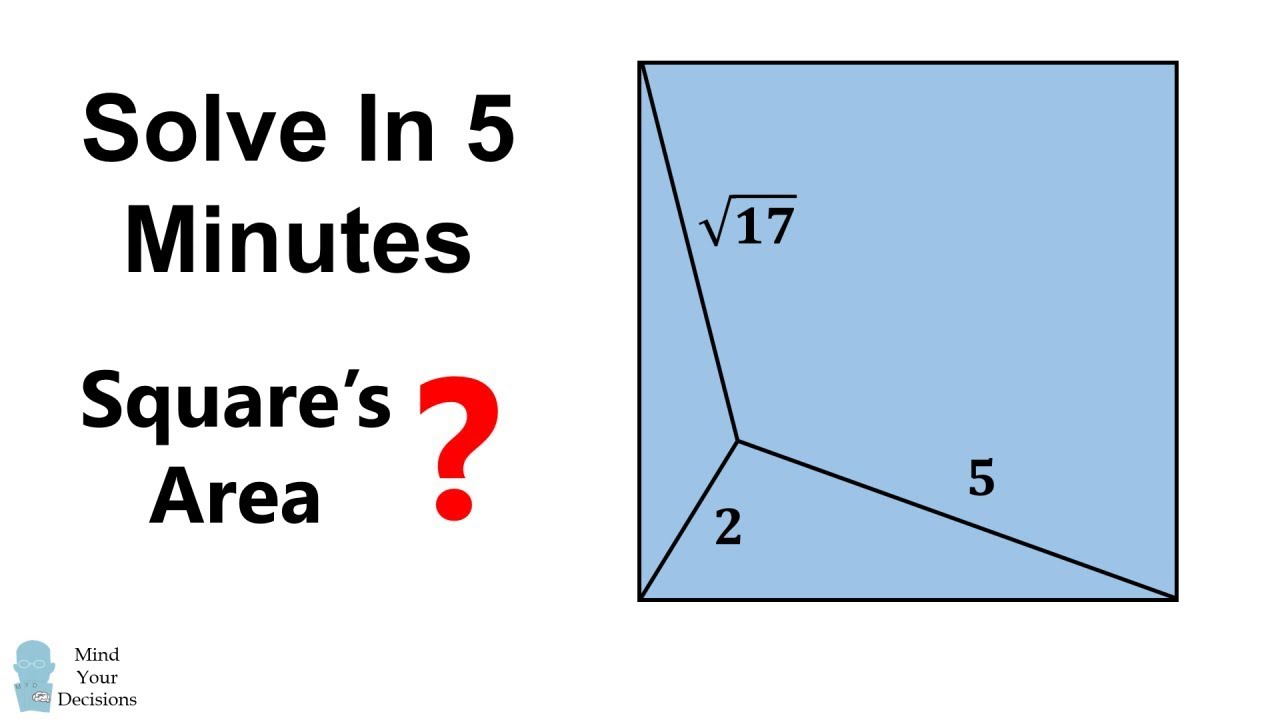
This is a tricky geometry problem with an elegant solution! Sources Adapted from past SEAMO problem (emailed to me) Cut The Knot similar problem https://www....
upper karma
Yes , but is it not clear ?
dark sparrow
your three barely registers as such
anyway
this uh
this would make the vertical leg of that triangle sqrt(22)
upper karma
Ha ha i wonder you remember or not you helped in a permutation and combination a month ago and gave the same remarks about my handwriting
upper karma
Yes i recognised my mistake
I assumed the values , got lucky and therefore got a right answer
There are other combinations which would result into sqrt 17 but my foolish self failed to understand that
Thanks for help tho.
dark sparrow
and this all goes against your figure being a square
bc 4 + sqrt(3) is not 1 + sqrt(22)
upper karma
Yes , in excitement i kind of messed up the whole thing , but how did you do those marking so quick ? You have an apple pencil or stylus kind of thing ?
Oh wait those are typed
My bad
hard lotus
i love how my question was just ignored
sly marlin
@hard lotus shall we go through it?
can't seem to find it, mind posting again?
okay this
hard lotus
yeah
sly marlin
Oh, the concurrency point is a centre of triangle ACE
Proof is literally about 5 lines at most
Focus on triangle ACE
What are lines AD, CF and BE?
sly marlin
no, what are they
hard lotus
and i think they are same length?
sly marlin
Not necessarily
hard lotus
they are angle bisectors?
sly marlin
How do you show that?
hard lotus
show they are angle bisectors?
hard lotus
they bisect angle B angle F and angle D
but how do i prove they are bisecting them
i mean i think they bisect those angles
sly marlin
focus on triangle ACE
well, you can find the angles based on the chord of the circle
@hard lotus
hard lotus
ok
 night dew
Hello, I'm trying to understand what my notes are  , i wrote that to check if something is linearly dependant, we can use this theorem:
somber coyoteBOT
Alaanor:
night dew
however, I also noted that we can use his contraposed version:
but I can't understand what does the second one implies
somber coyoteBOT
Alaanor:
spark stag
if vectors $\vec{a}_1, \vec{a}_2, \vec{a}_3$ are linearly independent, then $\lambda_1 \vec{a}_1 + \lambda_2 \vec{a}_2 + \lambda_3 \vec{a}_3 = 0$ if and only if all the scalars are 0 (i.e. $\lambda_1 = \lambda_2 = \lambda_3 = 0$)
somber coyoteBOT
Namington:
night dew
omg yes, i'm dumb
spark stag
if they're linearly dependent, then there exist some scalars not all equal to 0 such that $\lambda_1 \vec{a}_1 + \lambda_2 \vec{a}_2 + \lambda_3 \vec{a}_3 = 0$
somber coyoteBOT
Namington:
spark stag
so if you can show that those scalars exist and are not all zero
you've proven linear dependence
night dew
awesome ! thanks
spark stag
(this is usually done by just giving the scalars)
night dew
Problem: Be ABC a triangle, let I, J, K being defined as $\vec{AI} = {1\over 3}\vec{AB}, \vec{CJ} = {1\over 3}\vec{CA}, \vec{CK} = {1\over 3}\vec{BC}$. Show that I, J, K are aligned.
somber coyoteBOT
Alaanor:
night dew
So I'd check if IJK are colinear by proving by example $\vec{IK} = \lambda\vec{IJ}$
somber coyoteBOT
Alaanor:
night dew
but idk how I should actually prove that, how can I find lambda ? I'm not asking for a complete solution, just which way I should take, how should I approach this.
night dew
Haven't got that far in the theory, I'm at uni since 1 week only. Learned vector this week.  there must be an another way to prove it
but this indeed look like this case
sly marlin
Project onto an arbitrary vector
no, not that
Well you can check that two vectors are parallel
so you probably can use that to prove that the 3 points are collinear
night dew
which is $\vec{IK} = \lambda\vec{IJ}$
somber coyoteBOT
Alaanor:
night dew
mhhh in the corrected exercices they compare IJ to JK and prove that it is equals

I mean yes but I would never know that without drawing the situation
sudden locust
Pythagorean Theorem 🕊️ But with semicircles... I put a lot of effort in to this one and think many of you guys will genuinely find it interesting... 🥰 Hope you have a wonderful day. 🐛https://youtu.be/Ir3MUW_VkgQ

I think most of you guys are familiar with the Pythagorean Theorem. But im not quite sure you are familiar with the theorem but with semicircles? Join the co...
 dark sparrow
yes, $(a \sin(C))^2 = a^2 \sin^2(C)$
somber coyoteBOT
Ann:
dark sparrow
$(xy)^2 = x^2y^2$
somber coyoteBOT
Ann:
dark sparrow
I just know there are some rules about inverse trig functions and so on
:?
somber coyoteBOT
euler/fermat:
dark sparrow
cos^-1 is an awful notation that should never be used because cos doesn't have a true inverse
upper karma
<@&286206848099549185> what is section formulae?
upper karma
@dark sparrow what should be used? arccos?
dark sparrow
yes
upper karma
Why so? I think its common knowledge on the restriction of the domain
dark sparrow
i've seen it misused one too many times
dark sparrow
what is the "section formula"
dark sparrow
extended law of sines?
what... is that meant to be
oh the circumcircle radius thing
...honestly there's no good answer whether that's "3rd grade" or not
why does it matter
like... idk, i wouldn't say trig itself is a thing that could be meaningfully taught as early as 3rd grade
you're not seriously suggesting giving a problem like that to 9 y/os are you

i mean
i guess a smart 9 y/o could have the necessary algebra background i guess
but this all sounds a bit... out there to me
 flint pelican
Dude that problem is insane I can’t even do that and you want to give that to a 3rd grader
Kids these days are so smart
Guys for this I can see now that 12^2 144 so if we double the force since they are inversely related that means that we need to divide 144 by 2 I think so 72
But the problem factors 72 into 6 square root of 2 and I’m not sure why
flint pelican
<@&286206848099549185>
 lunar crow
 flint pelican
Yes this is a question from an act practice test
mighty gull
so the just want the radial angle right
have you heard of inscribed angle theorem
@upper karma
mighty gull
can you apply inscribed angle theorem here
upper karma
i only had 2 opportunity to check if the answer was correct so idk if my answer was correct
and i wanted to know
mighty gull
95 and 85 arent answers
mighty gull
yeah. dw its fine, we all miss things like this all the time
upper karma
haha
i was trying to figure out the left and right angles from the center of the circle
and i didn't even see that the 40
mighty gull
its fine
flint pelican
primal lynx
well if ur asking about the first one
choice k is the choice that makes the least sense
bc it says varies inversely with the square of the distance
so farther away less powerful
k is the only choice thats further
but if you were to write an expression with proportionality constant say k
you can write the inverse square as like 1/d^2 is equal to k 1/r^2
but k is 2 right
bc twice as strong
and d is already 12
then you get j
flint pelican
Yeah the answer is j but like
This is what I said earlier
Guys for this I can see now that 12^2 144 so if we double the force since they are inversely related that means that we need to divide 144 by 2 I think so 72
But the problem factors 72 into 6 square root of 2 and I’m not sure why
spark stag
they're not inversely related
there's an inverse relation with the square of the distance
so suppose the distance is 2, then $F \propto \frac{1}{d^2} = \frac{1}{2^2}$
somber coyoteBOT
Namington:
spark stag
in this case, we have $F$ and we want $2F$
somber coyoteBOT
Namington:
spark stag
we know $F \propto \frac{1}{d^2}$, so how do we double F?
somber coyoteBOT
Namington:
spark stag
so you're saying that it needs to get farther away for the magnet to get stronger?
what we're trying to do is change the distance
144 represents the distance squared
not the distance
you're right that we want the distance squared to be 72
flint pelican
Ooooooooooooooooooooooooooooo
spark stag
so what does the distance have to be?
flint pelican
The square root of 72
flint pelican
Because 72 would be the distance squared
Yeah then I see that factors to 6 square root of 2
Thank you
somber coyoteBOT
Result:
0.0069444444444444
,calc 1/((6sqrt(2))^2)
somber coyoteBOT
Result:
0.013888888888889
,calc 0.13888888 / 2
somber coyoteBOT
Result:
0.06944444
Result:
0.00694444
lol
median crown
Flip everything upside down
nice dude
spilled your gfuel
ye u did it right
except
your scale labels are wrong
you put pi/2<pi/4
yeah
yeah
you have pi/3 on the left side of the y axis too
wtf
why
you should fix your handwriting
the handwriting litearlly makes it look like a 3
sure
 solid nexus
hi can someone help me?
sly marlin
 @solid nexus
 delicate lake
Am I supposed to use sin, cos or tan?
 wise pawn
do you know SOH CAH TOA?
silent plank
which one do you think it is and why?
delicate lake
This trade school is giving me trig questions and I've never even took the class.
Trying to teach myself through online videos
Trying to find hypotenuse.. so i use Tan? @silent plank
silent plank
no
what is the ratio of tan(x)?
do a quick search and/or use the mnemonic shown above
delicate lake
This is above my pay grade. I have TI-84 Plus calculator but not every experienced with it
silent plank
what i'm asking has nothing to do with a calculator
delicate lake
My notes to help me solve the problem. Idk the answer to your question
I'm literally trying to teach myself
delicate lake
Opposite/Adjacent
silent plank
would that be appropriate here?
delicate lake
Oh no.. lol but there is no 2 sides given.
silent plank
which side is given relative to the angle?
 umbral snow
c isn't given, but pretend it is for now
delicate lake
Adjacent and Hypotenuse so i use COS
silent plank
yes
silent plank
well to be more specific, adj is given, hyp is unknown so you use cos
delicate lake
.883 is the answer
silent plank
no
delicate lake
Rip
silent plank
can the hypotenuse be shorter than the other sides?
you must've done something wrong in your calculattions
what equation did you start with?
delicate lake
umbral snow
You're getting ahead of yourself. What's your cos equation?
delicate lake
Adjacent divided by hypotenuse but hypotenuse isn't given
 graceful hemlock
Is it in radians or degree mode LOL
silent plank
cos(28 deg) = adj/hyp = ?
umbral snow
That's okay! Write it out anyway
silent plank
what is the adjacent side?
delicate lake
1.5
silent plank
what is the hypotenuse represented by?
delicate lake
C
silent plank
what is adj/hyp
delicate lake
1.5/C
silent plank
and what will cos(28 deg) be?
silent plank
that wasn't what i asked for but you found the expression for C
be careful with rounding
technically the value they provided is wrong. but i think that's what they want you to choose.
delicate lake
I will re-read this convo for future simliar problems.
"which side is given relative to the angle?" Helps me decide which function to use.
But i do see where I was confused.
silent plank
,w 1.5/cos(28 deg) 4 decimal places
somber coyoteBOT
 Requested by ramonov#0921
silent plank
Requested by ramonov#0921
silent plank
based on the options it seems that they rounded before dividing
which you shouldn't do
,w 1.5/0.883 4 decimal places
somber coyoteBOT
Requested by ramonov#0921
silent plank
as mentioned above, it seems they want you to pick 1.6988, but the "correct" value rounded to 4dp would be 1.6989
delicate lake
Hypotenuse & opposite given so I would use SIN.
SIN (39) =.62932
.62932 × 30 = 18.88
quiet mason
👌
novel flax
sin x = opp/hyp
sin 39 deg = 1.375 / c
c * sin 39 deg = 1.375
c = 1.375 / (sin 39 deg)
c = 2.1849
you are correct @delicate lake
flint pelican
Lost in 55 and 56
For 56 isn’t the 5 the radius so 5 squared is 25 and then the height is 12 since this is a 51213 triangle so that’s 25pi*12=942.478 and divided by 3=314
So that’s 100pi but that isn’t the answer the answer is j
And for 55 what I guessed was that since 2 angles are 60 that must mean the other 2 are 120
So I multiplied 4 by 2 to get 8 since 60*2=120