#geometry-and-trigonometry
1 messages · Page 226 of 1
 spark stag
 buoyant idol
is this the same for the others?
 devout shell
So the reciprocal of opp/adj will give you?
buoyant idol
adj/opp lmao
spark stag
yep.
devout shell
Yes
buoyant idol
so cot is just cos/sin?
devout shell
It is the same process for the others as well
spark stag
yes, essentially
devout shell
Yes
buoyant idol
and cos/sin is adj/hyp/opp/hyp
devout shell
Yes
spark stag
which simplifies to adj/opp, but yes.
devout shell
No
buoyant idol
oh ye
spark stag
(i'm assuming some brackets there)
devout shell
You messed up with your math there
buoyant idol
so cot is basically adj/opp
devout shell
Yes...please we already told you that, what makes you so unsure of that?
devout shell
Yes
buoyant idol
j wna make sure
devout shell
If there’s one thing left to teach you, it’s to be confident in the math. Given the definitions and all, you just apply what you know and what you get is correct. Aside from some mess up on the fraction simplification, all we told you is correct. No need to confirm all the fine points. That’s for you to do so you gain confidence lol.
buoyant idol
lmao okok
i make shit ton of careless mistakes tho soooo ykno.....
anyways is there anything else abt trig that i should know abt similar to things like inverse functions
things that can mess up trig
devout shell
A website with all trig functions listed would be best to test your math. We’ll give you the concepts here, but we aren’t really ones to check every single answer for you.
buoyant idol

In mathematics, the trigonometric functions (also called circular functions, angle functions or goniometric functions) are real functions which relate an angle of a right-angled triangle to ratios of two side lengths. They are widely used in all sciences that are related to g...
WIKIPEDIA lmao
devout shell
If it has all equivalent forms of the trig functions listed, then might as well use it
Wiki has become a pretty good source of info for general stuff. I haven’t found obviously fake info on it ever.
buoyant idol
oh thats reassuring lmao
 flint pelican
flint pelican
flint pelican
<@&286206848099549185>
 fringe dirge
What's your question

 olive solar
same
flint pelican
Here I’ll take another pic sorry
 flint pelican
fringe dirge
flint pelican
fringe dirge
It tells you how to do it
flint pelican
Uh is that better or still nah
fringe dirge
What are you confused about there
flint pelican
Ik but I don’t understand I get the 20 by 15 but idk where 18 came from
We are trying to find the area in the white box right but idk what the area of the black part is
.....
flint pelican
I’m sorry I’m still confused could you dumb it down for me
fringe dirge
Think about it
Draw a picture on some grid paper
Or just make your own grid lines
 tropic turret
Think about overlaps. We already count the corner squares by doing 15 on the sides. If we did 20 at the top and bottom, wouldn't we stack extra tiles on the corners?
 weary drift
You first find the area of the base, which is shaped like a triangle, then multiply the base by the height of the prism
weary drift
They’re rotating the triangle around side AB
If you can imagine what cone that generates, side AC is the radius of the cone
and AB is the height
flint pelican
How do I imagine this like is this triangle standing on top of side ac
weary drift
Side AC will draw out the base of the cone, and the cone will sit on top of this base, sure
weary drift
Np
 finite frost
Any advice with this never seen it before just came up wondering if anyone knows a good way to go about it
 tropic shard
I'm guessing like:
Then to say that sin(α)=sin(β) I'd then use the first condition they gave, that cos(α) = tan(β) and do the same step over and notice the connection.
finite frost
Thanks appreciate the help
 nimble rain
weary drift
nimble rain
weary drift
1 revolution (think 1 whole circle) = 2pi radians
pi rad = half circle, pi/2 = quarter circle, pi/4 = eighth of a circle
 dark sparrow
wdym "read radians"
spark stag
in other words, $\pi$ rad $= 180^{\circ}$
 somber coyoteBOT
Namington:
spark stag
do you have a more specific question?
 flat geyser
i need to make sure im not going crazy
can someone add these up for me
add the two waves
this is what i get
flat geyser
so what i sent is right?
flat geyser
nah what i said was defo right
also this:
i dont understanding what im being asked
 quiet mason
reposting in diff channels
aight but i guess they just want you to represent c in terms of $\alpha$
somber coyoteBOT
Lionel:
flat geyser
Sorry I forgot about the question channel
And didn’t want to delete from here
So I just had to change the base to alpha
Ok ty
 silent plank
or use another variable so you don't confuse it with a.
quiet mason
@silent plank nah dude read the question
flat geyser
Turns out what Lionel said isn’t accepted either :/
Doesn’t matter it’s not like I don’t understand
Question just badly worded
flat geyser
It just lets you input an answer
silent plank
you entered (45,45) for (x1,y1)
similar error for (x2,y2)
the entry layout is horrible
flint pelican
silent plank
what have you tried?
 frozen bluff
silent plank
frozen bluff
silent plank
what have you tried?
frozen bluff
 balmy pelican
what have you tried?
^
fringe dirge
Nah fam
fringe dirge
"what have you tried?"
fringe dirge
And why are you doing this?
weary drift
thats racist
we do tend to discriminate against those who don't try much and only ask for answers
weary drift
:>
weary drift
did you answer "why are you doing this?"
silent plank
what were you trying to achieve in each part of your calculations?
balmy pelican
I can't even understand their calculations
balmy pelican
good and how did you find out?
weary drift

balmy pelican
ok...
frozen bluff
why the door?
fringe dirge
Lmao this guy's a moron
fringe dirge
There's literally nothing wrong with being gay
frozen bluff
yes there is
fringe dirge
<@&268886789983436800>
 twin heron
not here squidy boy
frozen bluff
actually everyone has there own opinion i dont like gay people and i think something is wrong with them "Fredom Of Speech"
i cant get arrested for saying gays arent ment to be
@twin heron
twin heron
this isn't the place buddy
frozen bluff
lmfao
fringe dirge
@frozen bluff You have no idea what freedom of speech means buddy
frozen bluff
bro thats discord
 umbral snow
The worst part is the light theme
 small raptor
@fringe dirge Usually from their parents.
 frosty steppe
@umbral snow
umbral snow
Yep that's awful
quiet mason
😂
 next saffron
lol i have to put my disc light theme cause if its dark my screen starts to do dim even though brightness is max
 stuck torrent
Do three non colinear points in 2D uniquely define a circle?
umbral snow
Yes, since
(x - a)² + (y - b)² = r²
Has three unknowns
 sly marlin
Well, since the points are not collinear, there are 2 non-parallel perpendicular bisectors. The centre of the circle lies on the intersection.
stuck torrent
yes
That's how you construct the circle using those three points using straight edge and compass, but I still don't see uniqueness. 🤔
maybe this is enough for uniqueness since my geom is shit
dark sparrow
what other point could it possibly be
sly marlin
if you can construct it, then it is unique
stuck torrent
🤔 ok
sly marlin
(of course, your construction must only construct one point)
this construction only constructs one point
 buoyant mirage
I have the equation and radius of a sphere in R3, how do I find where it intersects the yz plane?
fringe dirge
What do you know about points on the yz plane?
fringe dirge
correct
buoyant mirage
Awesome, thanks
Now there's another question. I have the center of a sphere, and I need to find a radius so that the sphere touches the yz plane. How do I solve that?
fringe dirge
By touches I assume you mean just touches at one point?
buoyant mirage
I assume, yeah
fringe dirge
Well what do you think you'd do?
sly marlin
so, where is the tangency point on the plane?
buoyant mirage
Set the radius to 0, set x 0 and solve?
sly marlin
well, can you figure out what radius you need now?
buoyant mirage
Not sure. I don't have the problem in front of me, sorry ^^"
sly marlin
well, say the point is (x, y, z), can you find the radius in terms of x, y, z?
buoyant mirage
I think so. It would have to be the point where x is 0
And then I could solve that for the radius
buoyant mirage
The radius is x, right?
buoyant mirage
|x|
sly marlin
yeah
buoyant mirage
Alright. Thanks. I never really did geometry so I really appreciate the help
flint pelican
I’m lost
Why is the height 4c isn’t that the hypotenuse because it looks like line y=4x goes up diagonally and how do you know what line x=c is
 scenic glade
(diagram not drawn to scale / no scale provided)
spark stag
yes, the line y = 4x goes up diagonally
where does that intersect the line x = c?
well, if we have y = 4x, and x = c, then it intersects when y = 4c
so the y value where the lines intersect - ie, the height of the triangle - is 4c.
then, the answer key shows you how to find the value of c
 wanton berry
i know the identities of sin(x)cos(y) but in this case I have sin(x)cos(x)
i have no idea what to do with that
 mellow flicker
@lapis pewter
 lapis pewter
If the measure of an angle is 38 find the measure of its complement
mellow flicker
Ok
lapis pewter
I keep getting different answers
mellow flicker
So an angle and it’s compliment add to 90
lapis pewter
Yes
lapis pewter
I do I have the notes
mellow flicker
So what to add to 38 to equal 90
 upper karma
lol
mellow flicker
XD
upper karma
90-38 though
lapis pewter
Ur telling me it’s 52
lapis pewter
Alright coach
Why this so confusing
I’m about to fail my class and there’s a test Tuesday
About to read a whole book on geometry
 coral solar
sly marlin
coral solar
sly marlin
It says "Be careful of the first one though..."
@coral solar
because they rounded the values to get the classes
coral solar
Ohhhh I finally see it thank you
sly marlin
sec theta
dark sparrow
everything except sec(θ)
sly marlin
how does sec relate to sin and cos?
don't think of the triangle anymore for this
triangle is useful when you know the angle is from 0 to pi/2
when it's outside, the sign would be a problem
dark sparrow
yes
dark sparrow
what do you think
devout shell
Don’t be aggressive like that please, and never say that word here again, you know which one I’m referring to @mossy marlin
upper karma
God bless the unit circle in pins
upper karma
can someone help me with this
It's time to put it all together! Now that you know how to construct, it's your turn to create your own construction. Using your compass and straightedge, complete the steps below.
Draw a line segment and copy it to the right of the original segment. Explain your steps and justify each step used.
Bisect the original line segment from problem one.
Draw an angle and copy it to the right of the original angle. Explain your steps and justify each step used.
Bisect the original angle from problem three.
coral solar
How do I do 10a? Because it only has one angle and one value stated for the hypotenuse
silent plank
what information can you get from
D is the midpoint of AC?
coral solar
That AC is 2x
silent plank
and what information can you get from that?
silent plank
how sure are you about whether they're equal?
coral solar
It says Bc is 2x that’s why
silent plank
but do you know why its 2x?
coral solar
But I still don’t know how to work out x
Because d is the midpoint and ac and bc are equal
silent plank
why are ac and bc equal?
silent plank
ok.
you have 2 sides in terms of x
a known angle
and a known side opposite that angle
what do you think can be applied here to find x?
coral solar
Sine rule?
Wait no because it’s not asking for the angle
Ohh
I have to do sine
Twice?
silent plank
what rule involves 3 sides and an angle?
coral solar
First to get the angle then I take it away from 180 then I do the sine rule again to get the side?
Cosine
But I don’t know what angle B is so I need to do the sine rule?
silent plank
the known angle and side are opposite each other,
you already have all the information you need to find x.
coral solar
But if I have those then I don’t need to work it out
silent plank
you're trying to find the value of x
x and 2x will be your other 2 sides
what is the cosine rule?
coral solar
silent plank
sqrt(14) and 120 deg are opposite each other, so which variables are they?
silent plank
after substituting in the values
you'll have an equation in x
then just solve for x
coral solar
Thank you
 ocean junco
Hi! I had to do statements for my geometry homework and I’m afraid that it just doesn’t make sense to me. If someone could explain, that would be ever so helpful.
umbral snow
That's logic, not geometry lol
upper karma
if x implies y and y implies z then x implies z
umbral snow
If A, then B
If B, then C
Naturally, you can also conclude that if A, then C
That make sense?
upper karma
dumb thing without context for learning geometry if you ask me
umbral snow
Maybe for learning proof basics
upper karma
could at least make something that correlates
weary drift
special triangles may help
tropic shard
$$4 \sec{\Big( \frac{π}{4} \Big)} + 7 \cot{\Big( \frac{π}{6} \Big) } = \frac{4}{\cos{( 45^{\circ} )}} + 7 \frac{\cos{( 30 ^{\circ} )}}{\sin{( 30 ^{\circ} )}}$$
silent plank
the calculations seem to have been done for \cos and \tan
instead of \sec and \cot
tropic shard
?
weary drift
^{\circ}
somber coyoteBOT
HenryCastle:
tropic shard
Neat.
dark sparrow
@upper karma if you're able to evaluate sec(π/4) and cot(π/6) individually, then you're able to evaluate 4sec(π/4) + 7cot(π/6).
upper karma
How do I define [tanx] ?
tropic shard
Pardon?
tropic shard
So like this?
upper karma
Holy moly
tropic shard
where ceil(tan(x)) ≡ ⌈tan(x)⌉
upper karma
Yep
tropic shard
Looks cool.
tropic shard
Range is from negative infinity to infinity, domain is-
yeah
wait
good question, what'd be the range of a floor/ceiling function..
tropic shard
I used Desmos
upper karma
But how do I plot it without a software?
tropic shard
Are you really being asked to do that? This doesn't seem to be something someone could do without software. Atleast no where with accuracy.
Idk how to do set builders, but a guess would be {y | y ∈ (-∞, ∞) ∧ y ∈ ℤ, 0}
upper karma
Yeah we are asked to do that
Basically it's a calculus question
A part of it is [tanx]
tropic shard
What'd I'd do is plot the vertical asymptopes of y=tan(x), graph y=tan(x), then tick mark the y-axis. After all that, I'd start plotting the graph y=⌈tan(x)⌉ by eye.
tropic shard
Because the function is increasing at a faster rate as you get closer to a vertical asymptope
upper karma
So I have to keep in mind that too?
tropic shard
Yep. The steeper the slope of the graph, the smaller the step should be.
upper karma
Ooof
tropic shard
It isn't too important the size, but I'd make sure to not make something where y=5 have a bigger step than where y=0.
upper karma
Should I dm you the question?
tropic shard
Y'know, cause the steps should be getting more and more smaller the higher/lower it is from the x-axis.
Sure.
upper karma
I sent
 hot iris
Would anyone know how the concept of surface area is extended in linear algebra? All I can find online is formulas for highschool stuff
dark sparrow
$\frac{3}{\sqrt{3}} = \sqrt{3}$
somber coyoteBOT
Ann:
 violet nest
=tex \frac{6}{3^{\frac{1}{2}}} = \frac{6}{3^{\frac{1}{2}}} \cdot \frac{3^{\frac{1}{2}}}{3^{\frac{1}{2}}}
oh
$\frac{6}{3^{\frac{1}{2}}} = \frac{6}{3^{\frac{1}{2}}} \cdot \frac{3^{\frac{1}{2}}}{3^{\frac{1}{2}}}$
dark sparrow
there's a diff bot here
somber coyoteBOT
AbdullahTrees:
 narrow storm
changing the denominator to a 3 so as not to include a rational number i the denominator
violet nest
@narrow storm honestly next time ping people when you are really stuck
narrow storm
lol i thought i was stuck
i was on it for like 8 mins then i decided to search up the exact question
didnt think it would yeild anything but it did
sorry bruh bruh
 grim condor
Write an abosolute value equation with solution x = 3.5 or -2.5.
grim condor
okay. got it
 wild flame
I took trig last year but I forgot how to do this: "If cos(theta) = 5/13, what is tan(theta)?"
How would I approach this?
 mortal mason
umbral snow
mortal mason
umbral snow
Make a triangle where cosθ = adjacent/hypotenuse = 5/13
umbral snow
Lol, glad it was that easy
silent plank
are you given the domain of theta?
silent plank
Q56?
flint pelican
Yes questions 56 and the answer is J
silent plank
what's the formula for the area of a triangle?
flint pelican
Bh/2
silent plank
do you know any other formulas for area that involve
2 sides and the angle in between?
flint pelican
I don’t think so
silent plank
are you familiar with
Area = (1/2) ab sinC
flint pelican
No
I’ve never done this in school yet
But if you could give me a link to learn it on khan I could get it maybe so ab is the sidelength?
silent plank
C is the angle between the sides a and b
silent plank
you don't need to know what they are
silent plank
using the formula what would be the area of triangle1 in terms of x,y
(don't bother calculating sin70)
flint pelican
1/2 ab sin(110)
silent plank
*xy
flint pelican
Sorry yes xy instead of ab
silent plank
what's the relation between sin(70) and sin(110)?
flint pelican
Am I allowed to use a calculator lol
silent plank
if you know your trig you don't need to
flint pelican
I haven’t taken trig yet so I don’t know it well
Oh shoot they are the same
So the area is the same too since we are multiplying by the same things
Thank you
 south junco
How do I even start
weary drift
did you try anything?
south junco
no cause the teacher didnt even talk about it
weary drift

weary drift
@south junco you got 14 right
south junco
ok cool
coral solar
how do i find the intersections of lines for (y=4x-9 and y=2x+3) because the x isnt on it's own
south junco
i dont know how to find it but i think i have the answer
probably right
but its worth a shot so here
coral solar
the answer is 6,15
weary drift
@south junco nothing special about writing down linear pairs, you just gotta know what they are
coral solar
i just need to know how to work it out for that type of question
south junco
i know what they are but dont know how to right them on paper
weary drift
like if for example angle A and angle B are linear pairs
you literally write this
$\angle A \text{ and }\angle B \text{ are a linear pair}$
somber coyoteBOT
RokettoJanpu:
coral solar
i know how to work it out if the x has 1 in front of it but this doesnt 😦
spark stag
,rotate
somber coyoteBOT
weary drift
@coral solar do you know anything about the point where those two lines intersect?
coral solar
that the point is 6,15
weary drift
no, nothing specific
in general if two lines intersect, what do you know about the point where they meet?
coral solar
perpendicular
weary drift
are the lines always perpendicular if they intersect?
coral solar
parallel*
weary drift
if they're parallel do they intersect?
weary drift
cross product takes in 2 vectors and outputs 1 vector O.o
 radiant nimbus
Maybe I'm not understanding
weary drift
unless you got something like A x (B x C)
radiant nimbus
So I know cross product gives a vector
but you need cross product to get area right?
weary drift
hold on a sec, what does your hw look like?
radiant nimbus
the length of the cross product gives length of a parralelogram
er
area of parralelogram
buuut
it wants the area of a parralelopiped
lol
er
volume ugh i suck at typing
weary drift
oh, parallelepiped
radiant nimbus
weary drift
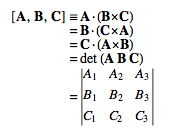
you're looking for the triple scalar product then
radiant nimbus
that sounds familiar but I don't have it in my notes 😦
weary drift
$A \cdot (B \times C)$
somber coyoteBOT
RokettoJanpu:
radiant nimbus
so cross product of B and C and dot product of A and resultant vector?
 radiant nimbus
I've been doing matrix for cross product lol, but I couldn't figure out how to do a matrix for 3 vectors
@weary drift do I stop at A*(BXC) or do I get magnitude of the whole thing?
weary drift
wdym
weary drift
base area is indeed |BxC|
radiant nimbus

for dot product if I have a vector U = 2i+3j and V= -9i-4j+3k.... K would be 0 x 3 right?
 neat vigil
Hi guys, im trying to solve this one for a while, but i don't know what to do.
"For the right triangle ABC, a = 5 and r = 1. Find sin and cos values of each angle."
silent plank
was there a diagram?
where is the right angle located?
what is r?
neat vigil
@upper karma yes, that's it
south junco
I think I’m wrong
What would be the answer to this problem be?
I got x=7 8/9 and y=5/17
 spiral path
x = 21 and y = 8
spiral path
on a straight line, the angle is 180 deg
so,
( 10x - 61 ) + ( x + 10 ) = 180
and
( 18y + 5 ) + ( x + 10 ) = 180
Solve them, and you will get x and y
south junco
Ok thx
 fleet knot
@spiral path when do you take trigonometry
spiral path
I didn't get the question
fleet knot
What year
spiral path
you mean in which grade?
spiral path
For Indians, it's at 8th grade(IIT). Normally, it is included in 10th grade
spiral path
you don't have trig in 10th?
south junco
im in 8th and have geo
south junco
yeha
im advanced
i go to a high school
but in middle school
i have to take a bus
The question is name a linear pair
I don’t know exactly what to write
 junior harbor
EKF and HKG
spiral path
where's example 1?
In a unit circle, sin thetha = the value of y component
so for (a), sin (0) = 0 as y component/co-ordinate is 0
similarly the rest
for (b) , the angle is 90 deg / (pi/2) rad , which is on y-axis, so sin(pi/2) = 1 , similarly the rest
junior harbor
Yup
 limber mango
Someone help me
dark sparrow
can you not zoom out
so that the entire polygon can be seen at once
maybe this will make the problem easier to do too
limber mango
I can’t zoom out. Sorry.
But the polygon is a nonagon
And the last answer choice is 56 degrees
dark sparrow
a 360 degree rotation will leave ANY shape unchanged.
limber mango
Ah
dark sparrow
this nonagon can be rotated by a much smaller angle.
limber mango
Thanks
dark sparrow
i didn't supply any information whatsoever
somber coyoteBOT
euler/fermat:
dark sparrow
are [these] supposed to denote area
can you show your diagram
i don't have anything to draw with atm
i'll get back to you in like 20 mins hopefully
upper karma
@upper karma as for why the altitude to the hypotenuse is 2.4 in a 3-4-5 triangle, it's just inverse pythagoras theorem
coral solar
hi how do i solve 6b
i found x = 4/3
when i did 6-4/3 i got the answer but then when i divided it by 3 i got a wrong answer
the answer is 14/3 but i dont know how to get it
silent plank
where is 10b...?
coral solar
6b*** sorry
silent plank
why did you want to divide it by 3?
silent plank
well you found the x-intercepts to be
(4/3, 0) and (6, 0)
6 - 4/3 is already the distance between the 2 intercepts
and you need to do anything else
coral solar
it's asking for the x intercepts
silent plank
which you found by plugging y=0
after you got those values, you don't need the equations/lines anymore
find the distance between the x-intercepts*
silent plank
where's the calculation of the x intercept for the 2nd line?
coral solar
6/3=2
silent plank
no, that would be the y intercept
i may have misunderstood you earlier, i thought you already found the value of the 2nd intercept by yourself
what's the value of y for the x-intercept?
silent plank
and then what will your x be in
3y + x = 6
coral solar
2
silent plank
what's the value of y for the x-intercept?
(where it intercepts with the x axis)
what value did you set y to for the first line?
hmm,
it seems that you havent done a) yet?
coral solar
y is 0
silent plank
ok, and what will x be when y=0 in the second equation?
coral solar
4/3
silent plank
6a): sketch on the same diagram, the lines
if that was done you should already have this info
in your second equation
coral solar
i already did that
coral solar
silent plank
that's your first equation, i'm asking about the 2ND equation
coral solar
both of the equations are on that graph
it asked me to sketch it on the same diagram
0,-4 is y=3x-4 and -4 is the y-intercept
silent plank
that equation matches to lower line on the graph
but the sketch for the 2nd equation is wrong
and i'm going to ask again,
what is x when y=0 for 3y + x = 6?
silent plank
still no
coral solar
-2
silent plank
3(0) + 3 = 6
0 + 3 = 6?
coral solar
3
silent plank
that's better
silent plank
now that you have the correct x-intercept does that clarify things
coral solar
yes omg now i get it thank you
coral solar
i'll label it now thank you
 steel hawk
Can anyone help me with this please
 kindred dock
whats the maximum arc length a circle can have?
weary drift
have you given this any thought yourself?
kindred dock
it cant be 360
isnt it just infinitely big then?
because the radius can be any size so
weary drift
360 what
i assume you're talking about 360 degrees, but since when were degrees used to calculate arc length?
kindred dock
no?
weary drift
not. at. all
kindred dock
i didnt even say that but ight
 silent plank
the radius term was calculated incorrectly
silent plank
why is
(2 - (-5))^2 = -23?
that's way off
firstly, it came out negative
did you do
2 - 5^2 = 2 - 25 = -23?
 snow socket
so it would be 49 right
silent plank
yes
snow socket
so like it says put it in an equation it would sqrt of 85
silent plank
the question above has the form
(x-a)^2 + (y-b)^2 = r^2
snow socket
yeah it says put it in equation form
silent plank
so you would be using r^2 here
 queen river
I have Geometry class tomorrow and I'm nervous someone help
 tranquil pilot
with what?
snow socket
ohh okay got it
 tawny merlin
OK so
i have a problem
so arc lenght and radius should be in what unit exactly
to find the angle
silent plank
the same unit
 grave fulcrum
So what do you recommend I do?
Ig, I'll repost problem
@dark sparrow
Are you still there?
Just tryin not to lose ya
dark sparrow
repost the problem
dark sparrow
dark sparrow
would you?
grave fulcrum
that's my guess
dark sparrow
why don't you act on it
there's nothing in the problem telling you explicitly to do this or that
dark sparrow
you can and are expected to find sin(25°), cos(25°) or tan(25°), whichever one you may end up needing, using a calculator.
grave fulcrum
I'm still confused on how
dark sparrow
how what
somber coyoteBOT
euler/fermat:
dark sparrow
sly marlin
hmm
oh yeah
@upper karma what did you try?
Any results you found?
(hint: diagram totally not to scale)
dark sparrow
well i DID try to make the right angle at least appear right
sly marlin
yeah, but AB is shorter than BC in your diagram
@upper karma Hint: Draw a diagram to scale
somber coyoteBOT
euler/fermat:
sly marlin
Cool
The next step would have something to do with that right angle, since you haven't used it yet
@upper karma So, any ideas?
hmm
remember that right triangles can be inscribed in semicircles
@upper karma
well, you might need to construct more points
to relate the area of ABC with ACD
Well, they do not
necessarily
The easiest way to relate areas is to try to subtract copies of the first shape from the second shape
Looks good
you constructed the important point
done some trigonometry?
What's O?
yeah
oh you guessed that the 4 triangles have the same area
can you prove it?
idk what you managed to find
and how did you define the constructed point?
yeah, the pink extension
yeah it is, but can you prove it?
haha you just stated why z=x earlier
well
O is the circumcenter of triangle ACD
and when I connected OC, I saw that it was parallel to AB
and that told me that z = x
It's just inside here
Okay, but you want to show z=x
you know why
but you just haven't put 2 and 2 together
okay, and then you want to show that OC is parallel to AB
that follows from z=x
Well, notice what shape AOCB is
you have z=x
what shape is AOCB?
(based on the properties of the shape you found)
I thought you already had it?
O is circumcenter -> z=x, because they are both radii of the same circle
directly
ah, I see what you mean
So, notice AOC and ABC
what can you say about them
yeah, and?
and?
so...?
yeah
erm
you mean AOC=ABC?
wait, ACO and ACB
cool, yeah also works out
didn't think of that
nah, I just don't see how they motivate this lol
yours is perfectly motivatable
plotting midpoints opposite right angles is well known
dark sparrow
such solutions are always polished
silent plank
heh , i don't remember being told the name of that theorem
 lavish umbra
So i have triangle
A right triangle
And I plot a point into a space insid the triangle
Anywhere in it
Then what you do is you add up all the distances from the dot to each side
And this sum is always constant
How can I prove this mathmaticly
upper karma
Suppose 5 cos x + 12 cos y = 13. The maximum possible value of 5 sin x + 12 sin y is
How do i approach this problem
I know the solution but it feels vague
sly marlin
@lavish umbra False, are you sure you don't have an equilateral triangle?
@upper karma R-formula?
upper karma
@sly marlin What R formula?
upper karma
Yeah so it is gonna be R formula, but how is it to be applied here?
On the sum of sines?
Or derive a relationship between the two
And if we are doing that then why?
@sly marlin
sly marlin
because it is easier to analyse the a trigonometric function than the sum of two trigonometric functions
 tranquil drum
arctan is inverse tangent and cotangent right?
 gritty siren
arctan is the inverse of the restriction of tan on ] -π/2, π/2 [
the cotangent is something different
for any real x, arctan(x) is the unique real number strictly between -π/2 and π/2 such that tan(arctan(x))=x
for any real x such that sin(x)≠0, cot(x) = cos(x)/sin(x)
tranquil drum
kk
silent plank
what have you tried?
sly marlin
@wide ferry what equations can you form out of the problem?
 wide ferry
ohhhh
upper karma
And you have a known entity, 117.
wide ferry
thanks so its 6x+44 + -10+65 = 117
upper karma
👍
sly marlin
nope
upper karma
It is smh.
wide ferry
ok thanks
upper karma
@sly marlin Wait how is it not.
sly marlin
you are missing the x in -10x
wide ferry
oh
upper karma
Bruh moment.
 dim python
hey there, anyone know if theres a way to solve for surface area of overlapping circles?
I'm familiar with http://mathworld.wolfram.com/Circle-CircleIntersection.html but for the case where the radius is larger than the centroid distance of the other circle i don't think it works.
(solved scroll down to video)
 primal hull
dim python
primal hull
dim python
thank you, i don't see anywhere that claims the wolfram solution doesn't work, but i feel likt it would't the approach i'm using right now is more arc sine than arc cos which maybe is why the above fails?
i'm thinking maybe something like the below would solve it for the case where the smaller radius triangle around the angles needs to be added? not sure if this makes sense entirely?

 subtle gate
For all shaded points this must apply: |y|<3 AND |x|<5 @snow socket
See the problem?
dim python
For anyone curious. the wolfram answer works but you have to retain the sign when subtracting out the triangle area for the smaller one. ie. when the smaller one's center starts behind x (white line), its triangle area you subtract from the circle area must be negative, to add it in instead of subtracting.
upper karma
does anyone else take geometry?
spark stag
nope, you are the only person to ever take geometry in your life
sly marlin
@pearl geode Just ask
 minor goblet
Hi.
I have this question
Enter the expression asin(x)+15 , where asin(x) is the inverse sine function. Alternatively, you may enter the inverse sine function in either of the following forms, which are also accepted: arcsin(x) or sin−1(x).
minor goblet
I dont get what it is asking? But that is the question. Is it to write the expression of asinx + 15 in inverse sine form?
Oh i think i get it, I believe it equals arcsin(x) + 15
Or asin^-1 + 15
Well apparently the answer is Sin^-1 + 15 lol
minor goblet
Lol no sorry
sly marlin
screenshot/picture?

 silent plank
its a horrible question
a by itself should never be used to represent an inverse function
 obsidian moon
yeah i dont know many people who use asin lol
silent plank
if it IS written like that,
a's just treated as a variable
quiet mason
lol a sine function
flint pelican
Guys what is the difference between e and a isn’t the square root of x^2= x since that is x^2/2 =x^1
sly marlin
e and a?
oh
you did not take a picture of the option labels
@flint pelican what are you asking?
sly marlin
and if it is an argument about $\sqrt{a^2+b^2}=a+b$, plug in some nonzero numbers
somber coyoteBOT
Element118:
flint pelican
Wait wait I don’t even need to I can see why it doesn’t work because you need to square them both first then add then square root can’t square square root and then add thank you I got got got got it
flint pelican
Guys for this one ik the 2 angles around 120= 60 but is the reason they are both congruent is because the angle that hits a light=same as reflected
The light hits the point where the angle is 120 and then reflects back up
Idk how to explain it
 keen aspen
Depending on the surface, the light will bounce off of the surface at the same angle it came in
So assuming that this is the case for this surface, your understanding is correct
flint pelican
Alright
Also for this one I still struggle with it I’ve done it at least 3 times before could you explain which step I messed up on
flint pelican
Wait but I thought I was supposed to divide by 2 twice
Like first b/2 to get radius and the.n square it
And do b^2/4 *pi all over 2
silent plank
and you should only divide by that 2 once
flint pelican
Oh you divide the answer by 2? Like first you multiply the top then divide by 2?
silent plank
whichever way you look at it, you only divide once
flint pelican
Alright thank you
silent plank
otherwise for some ridiculousness,
(1 * 1 * 1 * 1 .... * 1)/2 would be ...
gritty siren
congrats
flint pelican
Alright
weary drift
Draw some triangles to find out
gritty siren
weary drift
In that example you’ve constructed a triangle using the reference angle instead of the actual angle. You use this triangle as normal, but then remember to adjust the result of cos and sin according to which quadrant you’re in
dark sparrow
convention
same reason the y axis goes bottom to top rather than top to bottom
except that there do exist contexts where it makes sense to have the y axis run the other way
in image processing, the y axis is inverted, so as to make the top left corner the origin
 unkempt magnet
hi, can someone help w this problem
a right triangle has two legs with one leg measuring x and another leg measuring x+8. if the perimeter of the triangle is 4x, find the length of each side
upper karma
Okay.
Now the total perimiter is 4x.
Can you find the 3rd side?
Using that information?
unkempt magnet
4x-2x+8 right
somber coyoteBOT
leviosa:
upper karma
Makes sense?
unkempt magnet
yup
upper karma
Simple enough?
unkempt magnet
yeah
upper karma
K.
upper karma
I'm trying to visualize trigonometry by watching this video: https://youtu.be/LGBNYjC5jdU
At 14:21, why is the height increasing? Does theta mean height? I'm so confused. I understood everything until I got to that part.
 spark stag
do you mean the physical height of the angle/lines above the plane?
they're doing that to visualize what a sine/cosine wave looks like
yes, the height corresponds to theta (the angle)
upper karma
ugh I'm trying to make sense of this
at 11:38, why isn't the height increasing then?
I'm thinking of the circle as being a flat thing, but is it supposed to be standing up?
spark stag
the thing they do with increasing height at 14:21
is just a visualization tool
to demonstrate how sine/cosine waves look
11:38 visualizes a changing angle as a change on the unit circle
this is the "common" visualization
but at 14 minutes
they want to show you graphs of how sine/cosine change as the angle does
the thing is, if we just use the unit circle
we only get 1 value of theta at a given point in time
in order to graph changing values of theta
we need to, well, change theta
they choose to make theta's axis the height axis