#geometry-and-trigonometry
1 messages · Page 225 of 1
 small raptor
 weary drift
(-2-0)^2 is not -4
 signal locust
positive 4?
small raptor
Correct.
signal locust
oh and then that would be positive 144?
small raptor
Indeed.
I mean, you still get an ugly number under the radical, but it'll be a real number
signal locust
and then i need to convert that to a decimal so i can round it? if thats the right number
small raptor
That is the exact answer, yeah. You can approximate by putting it into the calculator, and rounding.
small raptor
Depends on the direction. If it says hundredth, then it'll be 12.17
weary drift
,w sqrt((-2-0)^2+(-3-9)^2)
signal locust
ooh i thought so
 somber coyoteBOT
 Requested by RokettoJanpu#6002
signal locust
Requested by RokettoJanpu#6002
signal locust
so my final answer then is 12.17?
weary drift
if it requires rounding to 2 decimal places then yes
signal locust
i finally got it thanks so much :p
small raptor
Just keep practicing to really engrain it. Before you know it, you'll be solving problems about boats in a river going east, while the river is flowing north.
weary drift
or solving a wave equation in 2d space
signal locust
math has never been my forte lol this is only the third lesson and i am already struggling
small raptor
The trick of math is practice.
You now became familiar with the distance formula. Keep putting it to practice.
weary drift
practice, plus come on this discord more often if you need further help
signal locust
i do have one more question im a little confused on, its like this but with a graph
small raptor
Doesn't hurt to graph it too. But that may be hard to think about without knowing vectors. 🤔
signal locust
small raptor
Same concept. Just apply the distance formula.
signal locust
would i just take the x,y of the 2 points then use the formula?
small raptor
Correct.
signal locust
alright awesome thank you!
small raptor
If you want a way to visualize what you're doing @signal locust
weary drift
are my eyes bleeding a bit?
small raptor
Yes.
signal locust
thanks, i'm slowly understanding lol
signal locust
ive seriously been stuck on this question all day, its the only one i need left to get right on this last assignment and ive tried everything, isnt the formula x+4=1.4x? but i cant seem to get it right
weary drift
you set up the equation right, you just gotta know how to "isolate" x
signal locust
ive been trying to solve it over and over and i cant get it
idk how im supposed to get x alone in that equation
weary drift
you can subtract a certain value from both sides of the equation to get ride of x from one side
signal locust
the way i was doing it was subtracting 4 and bringing it to the other side
somber coyoteBOT
RokettoJanpu:
weary drift
you still have x's on both sides... what can you do to make x show up only on one side?
signal locust
subtract the x on the right?
weary drift
remember, what you do to one side, you also have to do to the other side
 steady umbra
X = 10
steady umbra
signal locust
ohh i think i tried doing it that way and i didnt get it right
yeah i got that answer before and it wasnt right i think? i can try reentering it
steady umbra
signal locust
oh yeah 10 was the right answer
idk how i got it wrong then bc i got 10 before lol
thanks for the help! im finally done lol
steady umbra
Glad to help @signal locust
signal locust
(:
 dark sparrow
what ways do you know of, in general, to prove two lines are parallel?
is there any info you could gather here that would let you employ any of them?
 sly marlin
So what does that tell you?
dark sparrow
i don't know
can you
if yes, then do it
if not, then what's stopping you?
ok
what's making you doubt
dark sparrow
i was under the impression that he was hesitant as to whether he could apply it at all
sly marlin
@upper karma what happens when you apply it?
Which triangles specifically?
Then you are done?
 coarse bronze
how would i go about memorizing some of the more complex identities
mainly these https://gyazo.com/f9bdb07ea03d95e3c1156bf65555ab81

 flint osprey
by understanding why they're true
coarse bronze
besides school itself where would i go to learn why
 teal sonnet
need help solving 
weary drift
have you tried getting cot(x) by itself? (and maybe if you go one step further you can turn cot(x) into another trig function that's easier for you to manually take the inverse of)
teal sonnet
ok so I would makie cot^2(x)=1/3?
weary drift
that's a step in the right direction
teal sonnet
and then make it sec^2(x) -1 = 1/3
weary drift
ok, sure
teal sonnet
what would I do with the ^2?
turn it into a quadratic and plug it into the quad formula or no
weary drift
$sec^{2}(x) = (sec(x))^2$
somber coyoteBOT
RokettoJanpu:
weary drift
do you know how to undo the 2 in the exponent?
weary drift
inverse of what?
teal sonnet
of $sec^{2}(x)
somber coyoteBOT
RokettoJanpu:
weary drift
get sec^2(x) by itself first
teal sonnet
ok umm so sec^2(x)=4/3 ?
 quick anvil
@coarse bronze I have found Coursera courses to be an approachable system to use. Some of the courses are truly excellent for explaining the why.
coarse bronze
ok thank you
quick anvil
Also, whenever possible find a relevant 3blue1brown YouTube video.
teal sonnet
ok so i got sec(x) = sqrt(4/3)
quick anvil
They show animations while also explaining the "why" of things.
teal sonnet
and then i took the inverse of
1/ cos(sqrt(4/3))
weary drift
@teal sonnet what does thr right side simplify to? the sqrt(4/3)
coarse bronze
i asked before he posted it so
weary drift
you got the fraction 4/3
you're taking the square root of the fraction
take the square root of both the top and bottom
teal sonnet
oh i see
so 2/sqrt(2)
sorry
i mean 2/sqrt(3_
)
and then now I can get that value in radians
for sec
im getting a domain error
did i make a mistake?
ok nvm i think i got it. I just took the reciprocal of 2/sqrt(3) which is sqrt(3)/2 and then I took the cos inverse of it. which got me to 30 degrees
weary drift
do you know what 1/sec is?
teal sonnet
ok thank you. can you keep going to see if my work was correct 
because i think its asking for more rads than just pi/6
weary drift
yes
between 0 and 2pi
what other angles if you plug into cosine will get you sqrt(3)/2?
teal sonnet
umm does this involve using reference angles?
I'm very confused on this part
i tried 5pi/6 and that is neg
sqrt(3)/2
weary drift
@teal sonnet ya you can think with ref angles if that helps
You just need to find other angles x where cos(x) = sqrt(3)/2
teal sonnet
11pi/6?
are there any more?
that is all i got
11pi/6 and pi/6 within the range [0, 2pi]
ahh
i forgot about all students take calc
ok since it is cos pos
it should either be quadrant one and four
teal sonnet
ok thank you so much
 fringe dirge
By finding out what corresponding angles are and what consecutive interior angles are and etc
 devout shell
Starting with definitions is what you do. From there the question guides you as to what to look for.
devout shell
Doesn’t need to be parallel lines, though parallel lines accentuate the point they want to make.
Again, read the given definition, and decide for yourself what angle(s) meet the condition(s) of the definition.
 upper karma
ok
steady umbra
O sry
 silent plank
what's your definition of the orthocentre?
what was your concern about the 1st image?
(the representation in the 2nd is wrong btw)
what is an altitude?
in 1) which lines are the altitudes?
 quiet mason
not all perpendicular lines to a side are known as altitudes of the triangle
the ones originating from the vertices are
silent plank
pink line doesn't involve a vertex
extend the left leg downwards and draw a perp line from the bottom right corner for the 3rd altitude
do you still have an issue understanding the orthocentre in 1)?
silent plank
^
dark sparrow
wdym

In geometry, an altitude of a triangle is a line segment through a vertex and perpendicular to (i.e., forming a right angle with) a line containing the base (the side opposite the vertex). This line containing the opposite side is called the extended base of the altitude. The...
be grateful i didn't hit you with a lmgtfy link as i otherwise might have
don't get what
what do you not get
idk maybe a problem can somehow involve two altitudes intersecting ¯_(ツ)_/¯
you seem to want some sort of instant gratification in the form of a problem which admits an exceptionally elegant solution that makes use of the orthocenter
i don't have any of that
in right triangles, it coincides with the right-angle vertex
i mean yeah it kinda is counterintuitive that the orthocenter can end up outside its triangle
but then
so can the circumcenter
which in fact also happens iff the triangle is acute obtuse (derp)
silent plank
*orthocentre is inside in acute
outside in obtuse
dark sparrow
er
yeah sorry that was a mixup
@upper karma you're confusing the circumCENTER and the circumCIRCLE
the circumcircle is what you're describing
the circumcenter is its center
uh
what's the question
uh
...
i don't feel like i can answer that in any constructive way at all sorry
silent plank
they'll have a common side?
dark sparrow
almost nothing, save for angles ADE and FDB being equal
ED and DB happen to lie on the same straight line but they're not known to be equal
...
silent plank
ABH is not a right triangle so it won't be H.
which lines are its altitudes?
yes (but not the ortho of ABH)
BH isn't perpendicular to AH and hence neither AH or BH are altitudes
looks a bit better,
but look at the diagram on the left.
you already have the altitudes of ABH there
silent plank
note that your drawing on the right somewhat resembles the one you already have
dark sparrow
AC maybe?
so is it AC or is it something else
what's making you doubt that AC is perp to BH
@upper karma
ngl it makes me wonder how you didn't see that
that symbol
silent plank
that is also on the diagram
when the altitudes are extended, where do they meet?
the altitudes that meet at H are from triangleABC
which are your altitudes for ABH
do they or don't they?
silent plank
which means your orthocentre would be:
 midnight hearth
Hi guys
I'm not very good at maths but i'm trying to code something in C#
And it involves trigonometry i think
Basicly, i have two vectors
Let's say VectorA = (1,0) and VectorB = (0,1)
What i want is the vector between these two vectors such as it would have the same lenght as the previous ones
I know it would be (0.707..., 0.707...)
But now if i have two vectors wich are VectorA(1,0) VectorB(0,3)
How can i find that?
 formal bolt
Oh on the ellipse
We can parametrize it
Let's say you have V_A=(a,0) and V_B=(0,b)
Then the ellipse is given by
(a*cos(t), b*sin(t))
So we need to solve for t now such that we get the point on the diagonal
b/a = b/a tg(t) -> tg(t)=1
You're point is
(a sqrt(2)/2, b sqrt(2)/2)
midnight hearth
Thank-you 😄 I might take a moment to understand that :p
midnight hearth
Oh no, it's just that i really really suck. I'm an infographics and had really low level of maths at school, and now i'm getting into game developement and i'm a long way from catching up 😄
formal bolt
So it's as if all the plane was transformed by
x->ax and y->ay
That's why your point is
(sqrt(2),sqrt(2)) -> (asqrt(2),bsqrt(2))
midnight hearth
I don't rly understand what is t
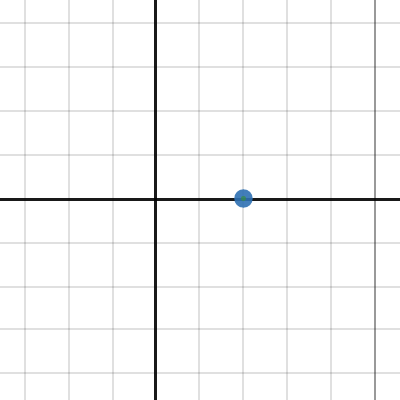 formal bolt
you're welcome, if you need some other graph just let me know!
midnight hearth
One thing i might ask is... Where to start to learn all this?
Considering my math level is... quite far
formal bolt
You could probably start from trigonometry
coarse bronze
would anyone mind explaining to me how these particular identities are true https://gyazo.com/567f6be9d34a3d1f1f685fbc11cc1b05

i am struggling to memorize the identities but maybe itd be easier if i understood how they worked
coarse bronze
<@&286206848099549185>
coarse bronze
idk but since theyre related my guess is that some of them can be derived from others
 trail minnow
do you know the proof that sin(a + b) = sin(a)cos(b) + cos(a)sin(b)
coarse bronze
ive seen that identity yes
coarse bronze
o
trail minnow
ye
coarse bronze
yes
somber coyoteBOT
hegel:
trail minnow
applying our formula
somber coyoteBOT
hegel:
trail minnow
does this make sense?
coarse bronze
yes it makes sense
trail minnow
do you understand this formula?
coarse bronze
i dont understand it but i memorized it since its one of the simpler ones
trail minnow
uh
okay the proof is a bit annoying so I guess that's okay for now
so we can basically just do the same thing
somber coyoteBOT
hegel:
trail minnow
and we can simplify this further
trail minnow
oh fucc
that's supposed to be cos^2(theta) - sin^2(theta)
wait nvm im literally stupid
i forgot what I actually wrote like 12 seconds ago
coarse bronze
hmmmm ok
 coarse bronze
i dont see why all of those identities are necessary tbh
trail minnow
because often that's a nicer representation of cos(2x) than the cos^2 - sin^2
like its just useful to know
coarse bronze
what about 2cos^2 - 1
trail minnow
why do we have it?
coarse bronze
no how to get there
somber coyoteBOT
hegel:
coarse bronze
yes
trail minnow
so $\sin^2 (\theta) = 1 - \cos^2 (\theta)$
somber coyoteBOT
hegel:
coarse bronze
yes
 fallow edge
just complete the substitution with cosine instead of sine
somber coyoteBOT
hegel:
trail minnow
that's a pretty general rule
in most cases when someone goes from an equation involving sin to an equation involving cos (or vice versa)
its Pythagorean identity
coarse bronze
hmm that one sort of confuses me but oh well
trail minnow
ok back
coarse bronze
wb
trail minnow
uh for those
just rewrite theta as 2 * theta/2
and apply double angle identities
i think

coarse bronze
oh ok
trail minnow
ye
somber coyoteBOT
hegel:
trail minnow
stop
no
anyway
this can be rewritten as $2\sin^2 \left(\frac{\theta}{2} \right) = 1 - \cos(\theta)$
then you just sqrt both sides
wait oops im stupid
somber coyoteBOT
hegel:
coarse bronze
u mean divide both sides by 2
 stuck torrent
Wait, what is cos(θ)? I’ve only learned cos(θ ?
trail minnow
you divide by 2 and get $\sin^2 \left(\frac{\theta}{2} \right) = \frac{1 - \cos(\theta)}{2}$
somber coyoteBOT
hegel:
trail minnow
this makes sense so far right?
coarse bronze
i think but i never knew that u could divide the inside of the () by 2 to get 2sin^2
trail minnow
you can't
i messed up writing original formula
actually i'll rewrite
$\cos(2 \theta) = 1 - 2\sin^2 (\theta)$
somber coyoteBOT
hegel:
trail minnow
right
coarse bronze
o
trail minnow
so we just do a nice trick and do $\theta = \frac{\theta _1}{2}$
somber coyoteBOT
hegel:
trail minnow
and get $\cos(2 \cdot \frac{\theta_1}{2}) = 1 - 2\sin^2(\frac{\theta_1}{2})$
somber coyoteBOT
hegel:
coarse bronze
ok that makes sense
trail minnow
so we can simplify this to $\cos(\theta_1) = 1 - 2\sin^2 \left(\frac{\theta_1}{2}\right)$
somber coyoteBOT
hegel:
trail minnow
and from here we simply rearrange our equation
$2\sin^2 \left(\frac{\theta_1}{2}\right) = 1 - \cos(\theta_1)$
somber coyoteBOT
hegel:
trail minnow
so here we just divide by 2
$\sin^2 \left(\frac{\theta_1}{2}\right) = \frac{1 - \cos(\theta_1)}{2}$
somber coyoteBOT
hegel:
 coarse bronze
yes
trail minnow
yep
coarse bronze
i just need to remember all the double angle ones to derive these
trail minnow
yes
coarse bronze
but then i remember the double angle ones by deriving from other ones
trail minnow
really you can just remember sin(a + b) = sin(a)cos(b) + sin(b)cos(a)
and cos(a + b) = cos(a)cos(b) - sin(a)sin(b)
for the half angle formula for cos you do the same thing
coarse bronze
ok ty for helping me
 mighty gull
cos(a+b)= sin(pi/2 - (a+b) )= sin((pi/2-a)-b), so no need to remember both tbh
trail minnow
but this time write $\cos(2 \cdot \frac{\theta}{2}) = 1 - 2\cos^2 \left(\frac{\theta}{2} \right)$
somber coyoteBOT
hegel:
 restive wren
somber coyoteBOT
restive wren
somber coyoteBOT
187:
upper karma
,help
somber coyoteBOT
A brief description and guide on how to use me was sent to your DMs! Please use ,list to see a list of all my commands, and ,help cmd to get detailed help on a command!
 limber whale
I know this is an easy question
But how do I solve
What is the side of a square whose diagonal is a?
Also: Find the area of an equalateial triangle if the side is a
silent plank
what have you tried?
limber whale
@silent plank for the first, I have no clue
for the second, I tried splitting the base in half and finding the area
silent plank
they're both doable using pythagoras
they can also be done using trig but i don't think you've learned that yet
limber whale
I have not done trigonometry yetg
limber whale
@silent plank I'm still having trouble
silent plank
let the side length of the square be 's' and the diagonal be 'a'
what's your equation when applying pythagoras?
limber whale
,tex $b^2 = (1/2a)^2 - a^2
somber coyoteBOT
dscrdjm:
Compile Error! Click the  reaction for details. (You may edit your message)
limber whale
@silent plank
upper karma
We have 7x+30 + 9x + 42 = 104
silent plank
are you using b as the side or the diagonal
limber whale
Oh sorry that is the one for question two
for question one I get
,tex sqrt(a^2-a^2)
somber coyoteBOT
dscrdjm:
Compile Error! Click the reaction for details. (You may edit your message)
silent plank
type it out normally
limber whale
sqrt(a^2-a^2)
silent plank
howd you get that? that's 0
limber whale
I know
silent plank
whats the formula for pythagoras?
limber whale
a^2 + b^2 = c^2
silent plank
lets use d for the diagonal and s for side lengths
so we don't get mixed up
substitute those into the formula
limber whale
s^2 = d^2 - a^2
silent plank
what are the properties of a square?
 frozen bluff
idk tbh
im a sophmore 2nd week of school idk this ;-;
All four sides are congruent. Opposite sides are parallel. The diagonals bisect each other at right angles.
silent plank
you are able to substitute both edges for s
frozen bluff
there u mean that?
silent plank
that was aimed at dsc
frozen bluff
silent plank
you weren't supposed to move an s^2 to the other side
what is that shape squidward?
silent plank
nope, 87 deg angle. clearly not a square
silent plank
same applies ^
silent plank
yeh
 upper cosmos
isnt it just 87
silent plank
yeh. but it seems that was guessed without proper justification
upper cosmos
opposite sides are congruent so opposite angles have to be as well
limber whale
Wouldn't the other angles be 93
also @silent plank I thought you saidthat both edges are s
silent plank
yes.
so you would have
s^2 + s^2 = d^2
limber whale
Okay
silent plank
simplify and write s in terms of d
frozen bluff
IT IS 87 I GOT IT CORRECT u know me
silent plank
that would be the other way around,
d in terms of s
(your s^2 terms can be added together)
limber whale
sqrt(1/2(2s))?
upper cosmos
what r u trying to solve
silent plank
side length of square in terms of diagonal
limber whale
@silent plank
silent plank
from
s^2 + s^2 = d^2
2*s^2 = d^2
how would you continue to isolate 's'
limber whale
,tex \sqrt{(d^2)/2)}
somber coyoteBOT
dscrdjm:
Compile Error! Click the reaction for details. (You may edit your message)
silent plank
use dollar signs on the edges instead of .tex
limber whale
$\sqrt{(d*2)/2)}$
somber coyoteBOT
dscrdjm:
limber whale
@silent plank is the simplification d over sqrt(2)
silent plank
it was still correct before but now its wrong
limber whale
Is there a way to do fractions? and is there a menu for all this?
silent plank
just type normally and learn tex later
upper cosmos
yes
silent plank
do you know how to rationalise that?
people don't like radicals in the denominator
somber coyoteBOT
MineClipper:
somber coyoteBOT
dscrdjm:
upper cosmos
no
limber whale
I remember how to rationalize now
upper cosmos
the d wouldnt be squared
actually thats technically right
just u need to rationalize it still
limber whale
$S = \frac{{2}d}{2}$
somber coyoteBOT
dscrdjm:
limber whale
@upper cosmos
somber coyoteBOT
MineClipper:
limber whale
okay wait
upper cosmos
u want me to work it with u?
limber whale
so you multiply it by two
upper cosmos
no
limber whale
to make the denom ration
upper cosmos
let me do my work and take a pic
somber coyoteBOT
dscrdjm:
limber whale
Yeah
somber coyoteBOT
dscrdjm:
silent plank
s=
upper cosmos
$S=\frac{D\sqrt2}{2}$
somber coyoteBOT
MineClipper:
silent plank
or x if you prefer
limber whale
It says the answer is $1/2\sqrt{2a}$
somber coyoteBOT
dscrdjm:
upper cosmos
s^2 + s^2 = d^2
2*s^2 = d^2
this is the orginal?
upper cosmos
so its $A^2 + B^2 = C^2 right?$
somber coyoteBOT
MineClipper:
upper cosmos
its a square right?
limber whale
yes
upper cosmos
and we r tryign to find the diagnol
limber whale
No the side
silent plank
question says diagonal is a
limber whale
fromthe diagnoal
somber coyoteBOT
MineClipper:
upper cosmos
and diagnol is a?
limber whale
Yes
silent plank
can you show a pic of the answer?
not sure if you texed it properly
limber whale
upper cosmos
yeah
limber whale
It is?
somber coyoteBOT
MineClipper:
silent plank
sqrt doesn't extend to the a
so its just a * sqrt(2)/2
limber whale
Oh yeah because youcan move it in cuz the commutative property
Oh wait, so @silent plank is the answer in the book wrong?
silent plank
its the same
silent plank
they just wrote it in a different order/format
upper cosmos
the book as the sqrt of 2 multiplied by a
upper cosmos
👍
upper cosmos
what is it?
limber whale
Whats the area of an equalitateral triangle if a side equals a
silent plank
formula for area of a triangle?
limber whale
a = 1/2hb
upper cosmos
no
upper cosmos
$A=\frac{\sqrt{3}}{4}a^2$
somber coyoteBOT
MineClipper:
upper cosmos
little a is side length
upper cosmos
oh my b
limber whale
Yeah I mean (1/2b * h
silent plank
parentheses should be around the (1/2)
somber coyoteBOT
dscrdjm:
silent plank
or even use \frac12 if you're using tex
upper cosmos
$A = \frac{1}{2}hb$
somber coyoteBOT
MineClipper:
silent plank
you know the base which is a
how would you find the height?
silent plank
what lengths are you using?
silent plank
and the other length of your right triangle?
limber whale
other length is 1/2a
silent plank
pls parentheses or just write a/2 for that
somber coyoteBOT
dscrdjm:
Compile Error! Click the reaction for details. (You may edit your message)
somber coyoteBOT
Whoever:
$h = \sqrt{a^2 - \left(\frac{a}{2}\right)^2} $
This?
limber whale
Yeah
Thank you
SO then you multiply it by the base and you get @silent plank
$A = {a}\sqrt{a^2 - \left(\frac{a}{2}\right)^2} $
somber coyoteBOT
dscrdjm:
silent plank
and then simplify the root
somber coyoteBOT
dscrdjm:
upper cosmos
u lost me when explaining all this
so i cant help at all
@limber whale did u end up getting it
 cinder portal
could just find the area of the whole thing
then subtract small traingles
basically shoelace
coarse bronze
if it makes it easier for you there should be 4 right triangles and 1 rectangle that you subtract from the entire grid
cinder portal
don't assume anything, only use what you know
if i was u, i'd subtract 3 triangles and like 1 trapezoid
or 4 triangles + 1 rectangle works
 tawdry pivot
do you see that QR=RS?
upper karma
combine like terms?
sorry im not v good at math
ohhhh okay yea i remember doing this
okay thank you 😃
This should probably be in algebra but it on my geometry paper so why not put it here...
if EB = 4y - 12 and ED = y + 17, find the value of Y.
oh thats easy
im doing that now
wait no i thought of the other one
thats kinda like what i needed help with
yea I completely forgot how to do it
like I did it in school the other day no problem
but like
im just blanking rn for some reason
yea
ok
ok thanks
 radiant nimbus
Ok if I have a unit vector AB = i+7j-2k and B = (8,3,6) how can I find A?
weary drift
unit vector AB = i+7j-2k
Doesn’t seem to be a unit vector, its magnitude isn’t 1. So instead the vector we have is just the vector from A to B.
If you also know point B and if you remember how to find the vector from one point to another, how can you find A?
radiant nimbus
hmm
@weary drift to a vector AB from A -> B I would subtract the A values from the B values. So do I just Add AB and B to get A?
like i Know that if A (x1,y1,z1) and B (x2,y2,z2) I would do (x2-x1,y2-y1,z2-z1)
weary drift
Ya that’s how you’d find vector AB... but your conclusion as to how to find A isn’t quite right
radiant nimbus
could you tell me the rule/process to find A or point me in the right direction? I don't want an answer, just wanna know how to do it.
if it's not B + AB... then maybe it's AB - B? I dunno.
weary drift
So as you said already, you’d find the difference of A and B’s components to find vector AB (let’s call the vector U), so...
B - A = U
Rearrange to isolate A:
B = U + A
A = B - U
radiant nimbus
hmm that's the associative property right?
weary drift
Didn’t apply associative property anywhere
radiant nimbus
jk jk <.<;
ok I got it wrong  in this case is i 0 or 1?
like if it's i+2j+3k is it <1,2,3>?
weary drift
Ya
radiant nimbus
hmmm how did I get it wrong then 
weary drift
Show us your work and we’ll see
silent plank
start by constructing the centre O
and lines OE and OF
what are the properties of the incircle?
the perimeter isn't needed to find the angle here
what are special about the points D,E,F?
dark sparrow
i remember giving you some hints on this matter...
silent plank
wasn't this already explained a few days ago
dark sparrow
to elaborate: what little you do know about FOK and EOK will be sufficient to find EDF
triangles DOE and DOF both come from a class of triangles with a special name
and keep in mind that D, E and F are all points on a circle with center O
i'm running a bit dry here
i feel like i've done almost everything short of just spoiling the solution
which involved carefully dancing around the invocation of a circle theorem you're "not supposed to" use...
and that's what we are doing
so what do you know about isosceles triangles
I mean obviously the base angles are equal
ok great
give me some pairs of equal angles in your diagram then
no
look
triangle DOE is isosceles
with DO=OE
this means that angle ___ = angle ___
fill in the blanks
...no?
cmon
you're overthinking again
how did C even get involved
I???
there isn't even a point called I on the diagram??????
...oh. you're calling the center of the circle I instead of O.
...
be consistent, please
and call it O, like you did in your first response
anyway yes
angle ODE = angle OED
mark those off on your diagram
now
triangle DOF is isosceles with DO=OF
this means that angle ___ = angle ___
ok
great
now
consider angles ODE, OED and EOK
what can you say about these
no
not necessarily
as in it might happen but it's such a niche special case that it's not worth considering at all
ok
good
now
consider angles FOK, FDO and OFD
what can you say about those
okay good
so now
given that angle ODE = angle OED, and EOK = ODE + OED
can you express ODE in terms of EOK
then what is ODE in terms of EOK
ok great
now
analogously to what you just did
express ODF in terms of FOK
 buoyant idol
fok is my bios teachers name
dark sparrow
ok @buoyant idol thank you for injecting this completely irrelevant detail into this conversation
buoyant idol
lmao
dark sparrow
ok great
now
what is ODF + ODE
no
ODF + ODE is not FOK
geometrically, what angle is literally the sum of those two angles
no, that's not what i'm asking you
look at those two angles, ODF and ODE
when you put them together
what angle do you get
don't overthink it
exactly!
and now you can express it in terms of FOK and EOK.
and, surprise, you know their sum!
is WHAT not 54 degrees
silent plank
you can try to prove that yourself
dark sparrow
is this unrelated to what we were doing
dark sparrow
ok fine
fine
fine
fine
fine
fine
if you didn't want to go along with my solution then why didn't you say that right away
are you asking me why two tangents to the same circle originating from the same point are the same length
bc you are most certainly capable of proving that yourself
i don't know what the fuck you're gonna use
and i'm too busy trying to not lose my mind to care
 fleet wolf
yes you can use congruent triangles
 vale bobcat
hoho, I learned how to convert a decimal into a fraction, kono Dio da!
 balmy pelican
lmao
 stiff bolt
guys when you want the exact value of cos, and you have cos(3pi/4 + 4pi/3) then you add first and then find the value right?
You cant take cos 3pi/4 and cos 4pi/3 and then add the values
that's cheating correct?
dark sparrow
it's not "cheating", it just doesn't work. $\cos(x+y) \neq \cos(x) + \cos(y)$ in general.
somber coyoteBOT
Ann:
stiff bolt
No you didn't cause I told you to use it dingus, and it still doesn't work
dark sparrow
,w cos(4π/3 + 3π/4)
somber coyoteBOT
 Requested by Ann#0413
dark sparrow
Requested by Ann#0413
dark sparrow
checks out
 vague light
Thank you
stiff bolt
No I dont wanna hear it, it's a singular case where it works
In general compound angle 60-45 should be used
vague light
Dude
Instead of using the sum
I just use the two angles in the sum
Cause it’s easier
Than 25pi/12
dark sparrow
this is not geometry
weary drift
looks like #proofs-and-logic ?
 finite frost
Wouldn’t this been just Pythagorean theorem backwards? Its been too long sense I’ve done this mess
weary drift
still use pythagorean theorem, yes
finite frost
It’s a backwards version though, yes?
weary drift
in a sense, yes
finite frost
Sense it’s provided with c^2
weary drift
where c is the length of the hypotensure, ya, i guess you're "working backward" to find the length of one of the legs
finite frost
So like b^2= c^2-a^2
What I’ve been messing with just feels weird bc it comes out with radicals
weary drift
if c = hypotensure, a = length of BC, b = AC, then ya you got it set up right
,w sqrt(40^2-12^2)
somber coyoteBOT
Requested by RokettoJanpu#6002
weary drift
you got it
weary drift
np man
formal bolt
Have you tried something?
formal bolt
I see, there is a formula for the area of a circle
formal bolt
Try to search it on google
 queen river
Hey. I am new to this server and my math needs to improve and I was wondering if anyone would help me.
 river gull
What grade level
river gull
@frozen bluff it’s 4 x Pi
river gull
okayy
queen river
I start school next Tuesday and I start Geometry math 2nd trimester 2nd period
Can we still be friends
fleet wolf
triangle EHG has area $\frac{1}{2}\cdot EG\cdot JG$
somber coyoteBOT
rockpaperscissors:
 eager pendant
small raptor
eager pendant
small raptor
The person does that all the time. I stopped caring what problem they have at this point.
 worthy root

 steep reef
∫dxdθ
 somber coyoteBOT
 Requested by Krishna(stop listening rap)#4971
 jagged lantern
Hey, i have a question
What's the most absurd SOHCAHTOA/Trig fact you have ever heard
weary drift
some people use tg for tangent and ctg for cotangent
 umbral snow
Some people use sen for sin
dark sparrow
sen for sin is because "sin" means "without" in Spanish and Portuguese iirc
steep reef
Thas not geo
dark sparrow
trigonometry fits in this channel, @steep reef.
jagged lantern
@umbral snow @dark sparrow I really like that fact lol
 nocturne musk
quiet mason
nocturne musk
quiet mason
if some line is divided into two at the midpoint or any point on the line
the length of the line=sum of the lengths of the points into which it is divided
 wide ferry
 olive solar
don't just give the answer please, pride
upper karma
Ok. Sorry bout that
olive solar
do you know what the distance formula is
olive solar
uh
upper karma
,rotate -90
somber coyoteBOT
upper karma
A triangle can not be evaluated for only 1 lenght and 1 angle
no such theorem exists
to my knowledge
 tender igloo
Ok
tawdry pivot
,rotate
somber coyoteBOT
upper cosmos
what r u solving for?
worthy root
Which problem @upper karma
buoyant idol
whats sec and csc?
buoyant idol
@devout shell is it possible if u list out all these strange things
if u can, no need if ur busy...:/
devout shell
There are six trigonometric functions
The three you are most familiar with are some, cosine, and tangent
buoyant idol
ye
devout shell
Those are written as sin(x), cos(x), and tan(x) respectively
In terms of the sides of the triangle:
sin(x)=opp/hyp
cos(x)=adj/hyp
tan(x)=opp/adj=sin(x)/cos(x)
buoyant idol
oh wow tan(x) is sin/cos didnt know lmao
devout shell
The remaining three trig functions:
Cosecant, csc(x)
Secant, sec(x)
Cotangent, cot(x)
Are the reciprocals of sine, cosine, and tangent respectively
buoyant idol
wait whats cot?
devout shell
Now we know that:
csc(x)=1/sin(x)
sec(x)=1/cos(x)
cot(x)=1/tan(x)=cos(x)/sin(x)
buoyant idol
ah okok thx
devout shell
You should prove that tan(x)=sine/cosine
buoyant idol
yeye the hyp cancels each other out
devout shell
Very good
devout shell
There is an inverse for cotangent, though I forget what the interval for the inverse function is
devout shell
Given some value of cotangent, provided it is in the interval, you can use the inverse function to recover the angle measure
buoyant idol
wait can u get cotangent in terms of hyp,opp,adj?
like cot = hyp/opp or smth (its probs not correct but im asking if u can do this lmao)
 spark stag
well, $\tan \theta = \frac{\sin \theta}{\cos \theta}$, and $\cot \theta = \frac{1}{\tan \theta}$
somber coyoteBOT
Namington:
buoyant idol
ah okok