#geometry-and-trigonometry
1 messages · Page 215 of 1
 upper karma
 tawdry pivot
how is Barry breaking the rules? unless there exist take home math exams for some reason
upper karma
No asking for help during exams
 spark stag
It literally says "final exam"
On the bottom left
Probably smuggled in a phone or smthn
upper karma
Anyways
Can someone help with 822?
I tried this but didnt go well
I have one small mistake in my attempt i think
come on
the exam is over
bruh
tawdry pivot
let $\alpha=\beta=\gamma=90^\circ?$
 somber coyoteBOT
EpicGuy4227:
upper karma
I just took the paper wih me
Next time say that the exam is over
ok
So we don't assume that you broke the rules
You caused confusion here
how on earth do you think I can get the paper without taking the exam lol
tawdry pivot
@upper karma
upper karma
?
tawdry pivot
did you read what I said?
tawdry pivot
and I have shown that the equality doesn't hold
upper karma
Please explain how
 vagrant elk
Well, it doesn't hold since i have a sneaking suspicion there's a requirement that alpha, beta, gamma be angles in a triangle
upper karma
Still dont understand
tawdry pivot
are you tying to prove that the equality holds for all alpha, beta and gamma?
upper karma
Alfa beta gamma are in a triangle
Their sum is 180
And i still dont get why doesnt the equality hold up
And how did you come to that conclusion
Just by looking at my equation
tawdry pivot
because I thought we were proving for all alpha, beta, gamma, because you didn't say they were in a triangle
upper karma
Oh
Sry in hs assignments, we all assume alfa beta gamma are in a triangle
Since all our assignments are based on angles in a triangle
Im sending it again so you dont have to scroll
When I try to do this with my calculator with
alpha = 8 (not degrees)
Beta = 12
Gamma = 14
Left side is -0.53 and the right one is 0.55
So it's a mistake with the assignment
And you can't prove equality
tawdry pivot
8+12+14=34? don't you need the angles to add to 180 degrees?
vagrant elk
^
tawdry pivot
managed to get it. I set $\gamma=180-\alpha-\beta$ and the equation becomes $\sin\alpha+\sin\beta-\sin(\alpha+\beta)=4\sin\frac\alpha2\sin\frac\beta2\sin(\frac\alpha2+\frac\beta2)$
somber coyoteBOT
EpicGuy4227:
tawdry pivot
then I used double angle formula for sin and $\cos\theta=1-2\sin^2\frac\theta2$ on the LHS, and angle addition formula for sin on the RHS
@upper karma
somber coyoteBOT
EpicGuy4227:
 peak mesa
How to get the opposite side by adjacent and angle?
 peak mesa
I want to use in progamming but i want to put the size of the opposite side by ajdacent and angle
Math.tan(angle) * img.getHeight();
 dark sparrow
well you can multiply both sides by adjacent
peak mesa
i'm doing this but the values aren't correct
dark sparrow
to get opposite = adjacent * tan(angle)
can you show a picture of what you're doing?
tawdry pivot
are you using the right units for angle
dark sparrow
ok but can you show the angle you're using
peak mesa
right now i'm using 45
dark sparrow
to make sure that what you're saying is the adjacent side actually is the adjacent
i don't care for its value
i want to see where it's located
dark sparrow
no, i don't care for the value of the angle
i want to see, geometrically, where it's supposed to be
on the image
tawdry pivot
Math.tan(x) gives the tan(x) where x is in radians
dark sparrow
also that might be another issue yes
well
try having your program print Math.tan(45) to the screen
dark sparrow
ok let's deal with the radian vs degree issue first
peak mesa
dark sparrow
ok
so that means your tan function accepts input in radians
as one would expect, anyway
because if it were degrees, you'd get 1.0
peak mesa
ok
dark sparrow
so you should replace that 45 with π/4
peak mesa
i have Math.toRadians
dark sparrow
or that, sure
dark sparrow
ok the first question is why is it getting printed so many times
dark sparrow
and second... you're multiplying it by a length in pixels so the result is also going to be in pixels
right
peak mesa
yes
dark sparrow
you may as well round to the nearest integer while you're at it
dark sparrow
however i'm kinda shooting in the dark here
peak mesa
45 degrees should give a lower value
dark sparrow
since i don't yet have a picture in mind of what you're trying to do
like
do you have a sketch or something
because that'd probably make stuff clearer
as of now it's kinda hit or miss
peak mesa
I'm trying to make a test, conver a flat image to a 3d format
But I am trying from an idea that came to me
dark sparrow
wdym by "convert a flat image to a 3d format"
can you like... at least hand-draw what you want the result to be
peak mesa
ok wait
The idea may seem a bit sneaky but it's the following, I have an image, that image after going through a function will come out 3d-looking from the angle I insert. What I want to do is take the amount of pixels from the opposite side that I have to remove in the image to be able to give a 3d look
i dont have a example.. i still haven't finished
like that
peak mesa
i want to convert a 2d image to 3d image
 mighty narwhal
You want to view a 2d image from an angle
peak mesa
yes
mighty narwhal
Take a piece of paper
mighty narwhal
Take a piece of paper
If you look at it from and angle it is the same as rotating it
peak mesa
But where can this help me?
mighty narwhal
Well
Rotate the paper
You are seeing less of it
Delete some of the lines when rotating
The amount you need to delete increases by the angle of rotation
peak mesa
yes..
but what i want is get the opposite site by adjacent and angle
but this dont work
mighty narwhal
oppoite side by adjacent ang angle?
peak mesa
and*
 mighty narwhal
What is the expected output?
mighty narwhal
Also
peak mesa
The value on the right is lower than the value on the left
peak mesa
It may be another value that does not fit the same
mighty narwhal
by size you mean width or height?
peak mesa
yes
As you can see the orange side is bigger than the green side
and that's what I want, understand?
mighty narwhal
Okay let me think

Something really isnt adding up
The output should be less, as you said
Why is is greater
what are the outputs when a=20deg?

peak mesa
mighty narwhal
Erm this makes sense
peak mesa
mighty narwhal
This also makes sense
peak mesa
goes up too fast
mighty narwhal
?
peak mesa
at 45 degrees should give about half of 256
mighty narwhal
No
tan 45 is 1
If you have a right triangle with angle 45
it is the half of a square
the two legs are equal
peak mesa
yes
but
but look at the difference
ignore de size of adjacent xD
opposite face is less by what? by angle..
mighty narwhal
The 20deg output is the half of the 40deg output
Almost the half
It makes sense
I understand that it looks weird
But it works out?
peak mesa
nope
mighty narwhal
Scale the two triangles so that the bottom leg is the same size
peak mesa
mighty narwhal
Erm yes
mighty narwhal
Yes?
mighty narwhal
NowBro
peak mesa
size of opposite side
mighty narwhal
The upper triangle should have angle B = 40
you are making it 30
we calculated it with 40
:C
peak mesa
same thing
look at angle of B
40º
but
look at the opposite face
its bigger than the other
mighty narwhal
ofc its bigger
It should be bigger, by the math
your code says its bigger
I dont understand the problem
peak mesa
Yes and I want to get this side from angle B
mighty narwhal
,calc 93/215
somber coyoteBOT
Result:
0.43255813953488
oh wait
mighty narwhal
Look at the two images
The side is a little shorten than the half
IT WORK OUT
Your code works
:C
mighty narwhal
Oh deer .-.
mighty narwhal
hyp=cos angle * adjacent
peak mesa
Thank you anyway, I had not remembered this problem
mighty narwhal
Your welcome
peak mesa
I'll try later
mighty narwhal
And good luck with your code!
peak mesa
Thks
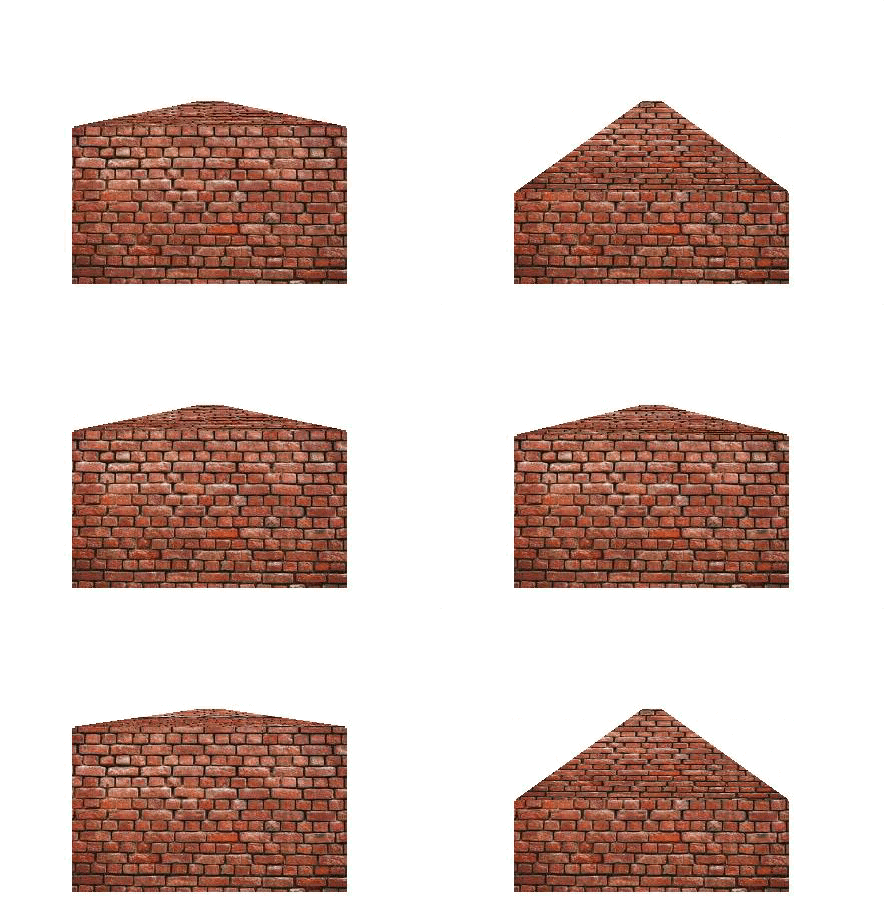 peak mesa
:v
mighty narwhal
Well umm
The top triangle is correct
if the top is the fix point and we rotate it towards us
mighty narwhal
Well
Its half-way done in one direction
then you can just do another iteration in another direction
you get the point
 drowsy estuary
Hello there, is someone can help me with perspective depth ?
Actually i try to find the mathemathical formula to find the distance between (IO, LP, JN, KM) to make my figure look like a cube, not a rectangle
peak mesa
sqrt(LxL+PxP)
@drowsy estuary
drowsy estuary
ah sorry, i'm not understanding. or maybe i haven't provide enough information. at the begining i only 1 square (IJKL) and the W point. and with amthemathics (or geometry) i must find where to place the distant square (ONMP). So by emample, let's say i have a square (IJKL) of 1 meter of each side & the W point is at 2 Meter height from K and 1 meter on the right of K... at this point i dunno where to place O,N,M,P to get a cube (or maybe i haven't understand your formula =/ )
 foggy nimbus
hello
can someone here help me with my geometry work
it's graphs and such
would be great if you could
thanks
drowsy estuary
ah! i think i found the solution. i just need to one angle by 2. by example, if i divied the angle (ILW) by2 and draw a line, it should go straight to O and my guess is that it respect the Cube proportion ^^;
i mean to be more precise, the line that i draw start from L and cut the IW line. That's giving me O. and then from O i just need to draw straight line to get my ONMP square to form a perfect cube (and not a rectangle)
from here, using Sinus Cosinus tangent should do the job 😃
thanks for your interest, have a nice day everyone
 devout shell
JKM and m4 form what kind of angle?
foggy nimbus
To answer that: Not sure. I'm terrible at Geometry.
devout shell
I encourage you to put a piece of paper on the screen and just trace those angles out
you see what you get and then I think you'll see what I mean
foggy nimbus
Alright
I have a few other questions, hopefully it isn't considered spam if I keep asking here
devout shell
did you get the answer to the previous one?
foggy nimbus
I'm still working on that one
devout shell
do that one first, then we can move on
 quiet mason
prove that length of arc of a circle=radius of circle*angle described by arc
devout shell
which formula in particular do we need to prove?
S = r * θ formula?
or the proportion one?
quiet mason
yea s=r*theta
 astral patio
Hi guys. Does this look right? <@&286206848099549185>
 minor arch

Can anyone explain to me why for the sin/cos, we're using POQ.
But tan/sec, we're using triangle VOR?
I get the logic behind the calculation. not getting the logic behind changing the triangle.
 fringe dirge
It's just so one of the sides has length 1
Like try using tan on the POQ triangle, neither of the sides in the ratio will have length 1
minor arch
Oh I see.
 pulsar dirge
What does question 8 mean
dark sparrow
you are asked for the lowest solution of 4sin(3θ) + 2 = 0 in the interval [2π, 3π]
upper karma
Can anyone help me out w/ this?
The exercise asks for <Y, but how?
oh
wait
🤔
X = 180-123 = 57
Z = 180 - 97 = 83
Y = 40????
😮
@upper karma ;#
yes
@upper karma ok, also help
Doesn't one postulate say that the sum of the 3 exterior angles = 180?
But that clearly isn't true here? It's 123+97?
dark sparrow

 upper karma
360
upper karma
Yeah 😛
vagrant elk
because for your three angles X,Y,Z
you have the exteriors, leaving 3*180 - (X + Y + Z)
which you should know the right side is 180
2*180 = 360
boom done
upper karma
Nice.
I have read before it was 360, but I saw a Reddit post saying 180, so I was confusion.
@vagrant elk exterior angles need not be > 90, right?
upper karma
😮
Word.
Yeah, because if <X = 110, its exterior angle is 80
which is, as a matter of fact
let me check
,ask 80 < 90
somber coyoteBOT
 Requested by rudy#0446
upper karma
Requested by rudy#0446
upper karma
It happens to be less than 90.
 worldly junco
sup
 manic osprey
4sin^(3)xcosx+4cos ^(3)xsin x=0 which is the real answer: πk/2 or πk? My friend showed me how can you get that but I say because the equation is homogenic, its πk
somber coyoteBOT
Ann:
manic osprey
yes
dark sparrow
this can be factored to $4 \sin(x) \cos(x) (\sin^2(x) + \cos^2(x) ) = 0$
somber coyoteBOT
Ann:
dark sparrow
and in turn to $2 \sin(2x) = 0$
somber coyoteBOT
Ann:
dark sparrow
so yeah $2x = k\pi$ so the sol is $x = \frac12 \pi k$
somber coyoteBOT
Ann:
 twin shard
im not sure how to do d
i have 4(xy) + x^2
thats for surface area
for volume i have the formula its 16000/x + x^2
im not sure how to get the formula for surface area
dark sparrow
what do you mean by "normal area"
dark sparrow
what do you mean by the "area" (as opposed to surface area) of a box, then
dark sparrow
and no, the volume is not 16000/x + x^2, it's 4000.
you're literally told it's 4000.
dark sparrow
no, it is not
twin shard
oh
do you know how to find the formula for the surface area?
because i dont know how to do it than
ahhh
its 2lh + 2lw + lw
there fore it would be 2xh + 3x^2
so sa/h = 2x + 3x^2?
im not sure if thats in terms of x
fuck idk how to do it
 craggy night
"Assuming alpha = -3pi..."
The answer section says the result is -2, but no matter what I try it's always 1/0
Can somebody please confirm I'm not insane
 jaunty plume
definitely not -2
dark sparrow
the denominator is not 0
craggy night
thanks
dark sparrow
wait crap
😂
i thought sin(-3pi) = 1 😂
brain is not running at full capacity today
jaunty plume

mighty narwhal
You have a regular hexagon with each sides colored to be a different colors
I rotate your hexagone (always by 60deg) to the left twice, then I flip it along the vertical axid
I then rotate it again to the right 5 times, I flip it again, then I rotate it to the right 1 more time
Your task is to figure out how you can get to the current state of the hexagon from the start with the least amount of transformatinos
transformations*
 subtle gate
wait, what you do to the hexagon is given, or what exactly do you mean by transfromations?
dark sparrow
wdym by rotating "left" and "right"
cw and ccw respectively?
or the other way around
 fair wigeon
my iq is hexagone
mighty narwhal
left is ccw
right is cw
Transformation is either a rotation or a flip along the vertical axis
subtle gate
wait
 narrow sleet
Reflection?
subtle gate
so are we working with your transformations, or do we need to choose them ourselves?
mighty narwhal
with my transformations
rotating cw and ccw
And mirroring against the vertical axis
subtle gate
each side has a diffrent color?
mighty narwhal
So like
Simplify the following steps:
rotate 2 times ccw, mirror, rotate 5 cw, mirror, rotate 1 cw
Each side (edge) has a unique color
So every state of the hexagon is unique
narrow sleet
Is there a front and a back face?
narrow sleet
Ok
subtle gate
||you just leave the hexagon if i didn't miscalculate if you want to replicate the effect||
subtle gate
||The transformations you described leads the hexagon to it's starting point, so if we want to save on transformations, you just do nothing (at least from what i can get, i am gonna put this into geogebra for a sec)||
mighty narwhal
||Noooo... you rotate two times ccw||
subtle gate
|| start - +2ccw -> 2ccw - mirror -> 2cw - +5cw -> 7cw = 1 cw (since 6 rotations are 360°) - mirror -> 1ccw - +1 cw -> 0 what is wrong with this?||
mighty narwhal
2ccw mirror 5cw mirror 1 ccw
if you mirror, rotate, mirror again
The mirroring will be gone but the rotations are in the other direction
So it becomes 2 ccw 5ccw 1ccw
=2ccw 6ccw
6ccw becomes e (identity)
You are left with 2ccw
subtle gate
you typed the last thing wrong from where i worked with
if i just change my last step to the one you said, it actually is ||2cww||
||start - +2ccw -> 2ccw - mirror -> 2cw - +5cw -> 7cw = 1 cw (since 6 rotations are 360°) - mirror -> 1ccw - +1 ccw -> 2ccw||
mighty narwhal
Why is my step wrong tho
If you mirror, rotate 5cw, mirror again
you are rotating 5ccw
2ccw 5ccw 1ccw
2ccw 6ccw
2ccw
subtle gate
i am agreeing with your outcome tho?
mighty narwhal
Yay
I did make rules for how you can manipulate them
with the help of abstract algebra
mighty narwhal
the last two rules is about how you can switch the order of mirroring and rotating,
So you can always get them next to each other and they will kill each other
Yea
But like after you understand it you can do it almost instantly
r^-2 f r^5 f r^1
r^-2 r^-5 ff r^-1
r^{-2-5-1}=r^-8=r^-2
subtle gate
okay i modeled it in geogebra
subtle gate
yep it all works out
mighty narwhal
Yey
I also thought my friend who is like a normal math student in 9th grade
She could understand it can now use it ._.
I am also teaching her calculus lol xD
 buoyant oasis
subtle gate
buoyant oasis
subtle gate
i mean you can kinda teach it yourself at that point
mighty narwhal
Well I did teach it myself in the begining of 8th grade
I mean the very basics
Then someone recently taught me integration by parts and stuff like this
 violet tartan
I need some help on this worksheet, my teacher doesnt really teach people and the final on this
 mental wharf
if you have 2 lines from the center of a circle to the circle, then what is their length
violet tartan
They are equal
subtle gate
unless you have any side, you cannot determine a...
mental wharf
yeah, so the triangle is isosceles
subtle gate
you need a radius and an angle and you only have the angle to solve for the arc
violet tartan
Alright
 covert orchid
hey guys, i'm looking for some trig and geometry books (for someone who has already some knowledge in these areas but wants to go a bit deeper) can you guys give me any recommendations?
fringe dirge
There are some nice aops books on the topics
They're geared towards more competitive math students, but they have nice information
covert orchid
aops?
fringe dirge

LMGTFY
tawdry pivot
thought about doing that lol
 mighty onyx
Topic 4 ques 2
 rustic dagger
Pretty cool
Forgot the rotate command and the note thingy is blocking some of the question
dark sparrow
,rotate -90
somber coyoteBOT
somber coyoteBOT
rustic dagger
Mabye b?
Idk acually
I guess find the angle of elevation when reaching the pillar and go from there?
 hasty mesa
@mighty onyx you must be from a familiar place
mighty onyx
?
hasty mesa
those are prev. year jee papers aren't they??
hasty mesa
are you preparing for Jee??
hasty mesa
lol I used to ask jee questions here once upon a time now you continue
 novel pecan
I'm trying to find the angle between the base edge and one of the other two in a tetrahedron. I keep getting pi/3 no matter what values I use for the edges. Does someone know why this is wrong?
 hallow token
spark stag
hallow token
spark stag
so we know the entire angle JWL = 87 degrees
so, when we add the two smaller angles together
we get 87 degrees
in other words, (2x+24) + (3x-12) = 87
can you solve for x?
hallow token
 hallow token
Got it its 36
fringe dirge
could you split the interval in half?
spark stag
what would those intervals be?
dark sparrow

what would their endpoints be
surely they're not all 2?
draw a number line on which you split [0, 12] into 6 parts
 olive sinew
I did the number line and everything but nothing kicks in yet
Can you show me an example please
fringe dirge
take a picture of your number line
olive sinew
-.-
fringe dirge
You're not labeling the numbers correctly at all
How does the interval go from 2 to 2?
The very last number on the right side should be a 12 since you're ending at 12
First of all, Ann's not a guy
upper karma
Nvm— apparently, the question was worded in a way that tou can arbitrarily set the degree;c
 barren ibex
tawdry pivot
barren ibex
tawdry pivot
we can readily see that you can just cut off overlapping ham and place them over uncovered bread. if we were trying to get the least number of cuts then it'd be interesting
 left rose
Does anyone know some resources that could lead me to figuring out the points on this irregular shape? The instructions say to use a ruler and protractor.
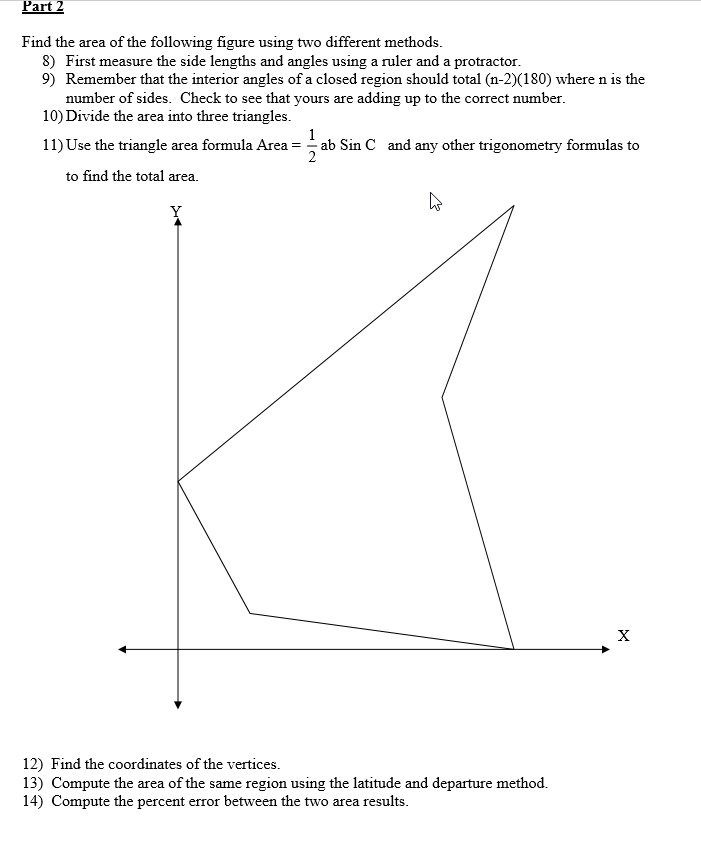 fringe dirge
Just measure the x coordinate and the y coordinate of each point separately
@left rose
left rose
Not sure how to. Here is an example from the class.

@fringe dirge
Not sure if there is some correlation. Or just measure in cm or something. So lost. haha
fringe dirge
it doesn't really matter what you measure with
left rose
Ah, okay. It just flipped my brain upside down with the numbers being so huge.
left rose
@fringe dirge just to make sure. I can just do cm to measure?
 lime flame
 cinder portal
Two things
KE is equal to EI
and angle EKA is equal to angle EIT
knowing that KE and EI are the same, that means the ARCS KE and EI are the same
by the inscribed angle theorem i think? angle A and angle T are congruent them
since angle EKA and angle EIT are the same, that means the chords are also the same AK and IT by some theorem i forgot
and then u have some triangle theorem
and shows they are congruent
ASS? AAS? i forgot o god
dark sparrow
@upper karma that isn't even a rhombus
 elfin scarab
Hello,
here's a really easy highschool-level geometry-related problem for you... So, my textbook has this question:
The centre of a circle drawn around a triangle lies on one of the sides of the triangle. Prove that the triangle is right-angled.
Now, after thinking about this for some while and using the assistance of some geometry programs, I've come to the conclusion that the triangle does not need to be right-angled, therefore making the whole question false.
Have I reached the correct conclusion? Is there a way to prove this?
My refutation is as follows:
The circle drawn around a triangle is defined by the fact that the distance to all the corners of the triangle is the same from the centre of the circle. (The radius) Therefore we can just construct a right-angled triangle, draw a circle around it and then just change the position of the point at the right angle so that it keeps the same distance to the centre, still keeping the hypotenuse and the circle in place but disrupting the right angle. The centre of the circle still lies on one of the sides of the triangle. (The hypotenuse)
 glad quarry
elfin scarab
glad quarry
elfin scarab
But yeah, isn't the radius more fitting there?
glad quarry
The diameter always subtend 90 at the circumference at the circle
It's a very basic property of circles
elfin scarab
Okay, and?
elfin scarab
Okay, but doesn't my refutation still hold?
glad quarry
I don't think so because when you change the position of the point on the circle it's angle still remains 90 we have done a general proof the point 'A' could be any point on the circle
elfin scarab
Aaaaah wait
Well okay I didn't really get that explanation but now it seems logical 😄
glad quarry
elfin scarab
Yeah, I got it now. Thanks 😃
glad quarry
You're welcome.
elfin scarab
It's interesting though how the constant need to translate blurs the actual meaning of the text so well...
 nocturne tapir
Circular theorems lmao
I'm getting flashbacks of highschool
oh my god
The alternate segment theorem
 frail rock
Is it proper to say that congruent shapes are kinda like perfect replications in a way?
 lusty quest
how would i find the radian of this? it doesnt even give me degrees to work with
devout shell
is there like a radius or something given?
lusty quest
no, this is the whole question
if theres a degree, id figure it out
it looks like a 60 degree
 hard gale
they just want you to eyeball it ig
yea looks like pi/3 rad or something
ie approx 1
lusty quest
its not pi/3
hard gale
approximations of approximations wow
lusty quest
it said im wrong
 gritty siren
lusty quest
gritty siren
lusty quest
i honestly hate pearson
 bright parrot
is this the discworld definition of pi?
devout shell
said use 3 as pi lol
 barren notch
why is it when finding area of a circle in terms of the diameter you divide by 4?
astral patio
Anyone able to confirm this please?
dark sparrow
is the character i circled meant to be a 7?
also, what interval were you asked to solve over?
@astral patio
astral patio
Yes, 7. 0 < pi < 2pi
dark sparrow
then why do you have 2pi listed as a solution?
 radiant nacelle
Should I learn trigonometry through the unit circle method or the right angle method or does it matter
 ebon spear
Id say unit circle tends to be more useful in my experience but the right angle method is pretty good if you need to remember certain values of sin and cos
radiant nacelle
Ah okay, thanks 😃 i remember sohcahtoa from highschool, is that from the right angle approach?
ebon spear
Sohcahtoa relates very strongly to that approach yea
The circle is kind of a big extension of the right angle approach
radiant nacelle
Ahh okay I see, I’m in a precalc and trig class for the summer and it seems like we’re just going to be doing the right angle approach and was just wondering if I should study up on the unit circle method beforehand
Or afterwards or smth
ebon spear
I imagine it'd be taught in class, with a good amount of time spent on it. The right-angle method just quickly gives certain useful points on the unit circle
radiant nacelle
Ah gotcha, alright thanks for your help 👌
 ornate lodge
Is it always true that the longer base of an isosceles trapezoid inscribed in a circle is the circle's diameter?
ornate lodge
I had a problem where the side edges and the top edge are the same length, and the base edge is double that. Does it always work in that case?
dark sparrow
yes because then your trapezoid is forced to be half of a regular hexagon
 pallid narwhal
could someone give a full walkthrough of this? teacher gave no explanation and I'm fully lost
spark stag
we can model the motions of the satellites through sinusoidal functions
can you construct the sine (or cosine) functions for both satellites?
dark sparrow
,rotate -90
somber coyoteBOT
 urban oxide
sorry
dark sparrow
so what's giving you trouble
urban oxide
idk how to start
 night karma
With?
night karma
Mhm.. probably someone here who can help. I've never seen '1g' or 'tg' in my books before 😂
somber coyoteBOT
upper karma
lol
urban oxide
thank you
upper karma
is that romanian
upper karma
i have seen a couple of assignments from romanian people
urban oxide
oh
 fervent raft
@upper karma you can use log rules to expand that
remeber that $\tan\theta = \frac{\sin\theta}{\cos\theta}$
somber coyoteBOT
agentnola:
devout shell
solving right triangles using logs, old technique
upper karma
sigh
devout shell
no one uses that anymore
upper karma
first of all that wasn't my question
upper karma
second of all tan 45 is just 1 so log(tan 45) is 0
upper karma

mighty narwhal
,calc arcsin(2)
somber coyoteBOT
The following error occured while calculating:
Error: (intermediate value)(intermediate value)(intermediate value) is not a function
mighty narwhal

somber coyoteBOT
Result:
1.5707963267949 - 1.3169578969248i
somber coyoteBOT
Result:
1.5707963267949 - 1.3169578969248i
,calc sin(1.5707963267949 - 1.3169578969248i)
somber coyoteBOT
Result:
2
god i didn't see the i at the end
mighty narwhal
Person who learned that the output of sine is in [-1;1]:
Impossible
hard gale
was like wtf that thing is full rarted
 polar mason
Can anyone give me a tricky trigonometry question (11th grade)?
fringe dirge
Idk what exactly you're looking for but
Show that $\cos(\sin^{-1}(x)) = \sqrt{1 - x^2}$
somber coyoteBOT
Zopherus:
devout shell

fringe dirge
@polar mason
fringe dirge
is that the stuff you're looking for
 fringe dirge
a sum?
fringe dirge
Try this one
polar mason
Okay
fringe dirge
Calculate the sum $\tan^2\left(\frac{\pi}{16}\right) + \tan^2\left(\frac{2\pi}{16}\right) + \tan^2\left(\frac{3\pi}{16}\right) + \tan^2\left(\frac{4\pi}{16}\right) + \tan^2\left(\frac{5\pi}{16}\right) + \tan^2\left(\frac{6\pi}{16}\right) + \tan^2\left(\frac{7\pi}{16}\right) $
somber coyoteBOT
Zopherus:
fringe dirge
This one's a toughie though
fringe dirge
Just tough, not really long
 gusty crater
Oww
polar mason
Okay
polar mason
Ty @fringe dirge
fringe dirge
np
devout shell
drawing the triangle is one way
devout shell
and I think from that idea you can see what to do
devout shell
perfect
mighty narwhal
I thought of substituting on the right side like you would do at integration and simplify and get something?
devout shell
oh man lol
mighty narwhal
:/ I am dump
devout shell
matter of trying out all sorts of problems
mighty narwhal
What grade are you in 
devout shell
going to be junior in college
mighty narwhal
doesnt know about american school system grades so pretty much clueless
devout shell
third year student at university
mighty narwhal
Oh thanks!
Good luck with that
fringe dirge
The algebraic way to do it is to use the fact that \cos^2(x) + \sin^2(x) = 1
somber coyoteBOT
DarK:
fringe dirge
Think about \cos^2(\arcsin(x))
somber coyoteBOT
DarK:
mighty narwhal
.-.? I just squared them
fringe dirge
Think about \cos^2(\arcsin(x))
somber coyoteBOT
DarK:
gusty crater
What's Ptolemy's theorem...can anyone explain?
somber coyoteBOT
DarK:
mighty narwhal
Which is ofc true for all x between 0 and 1
mighty narwhal
Why
fringe dirge
i literally gave you counterexamples to what you said
how can you still think what you said is right
mighty narwhal
Please just give me 5 minutes :-:
A=b+2kpi
Or
A=pi-b+2kpi
With the second possibility your counter example is countered
fringe dirge
Yeah but you literally didn't say that
mighty narwhal
Did u give me time to say that ;-;
But nevermind
You can just take asin() of both sides
And take dont forget that sin(pi-x)=sin(x)
So you have 2*2=4 possible equations
And 2 solitions?
lusty quest
if this is an acute angle, then how would you know which angle to put in?
 trail minnow
you have to remember that $\sin a = \cos b$ if $a$ and $b$ are complementary
somber coyoteBOT
hegel:
trail minnow
so what they are asking is to find some value of a where a and (a + 40) are complementary
so you can say that $a + (a + 40)$ is going to equal 90
somber coyoteBOT
hegel:
trail minnow
and therefore just solve for a
 oak hearth


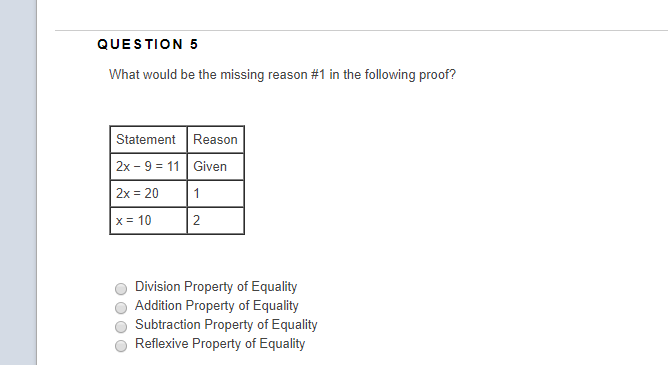
 split compass
yeah i got it now
 dry phoenix
Hi guys. I need some help with analytic geometry.
I have tangent y=6x-2√37 and a circle equation x^2 + y^2 = 4.
I need to find coordinates of the point where they collide. I tried just implementing tangent equation into circle equation but it gets retarded with numbers. Any other way?
devout shell
More like tedious with the numbers, but that’s what I would have done initially. Then the thing is choosing the correct x value.
Unless you get a zero discriminant
Then there’s only one value for x
 surreal bolt
er are you sure it is a tangent?
The circle is centered at the origin so all points have a tangent with slope = -x/y
y = 6x - 2root(37) ... means the slope is 6 for the tangent
6 = -x/y or y = -x/6 and x^2 + y^2 = 4
 dreamy hollow
I have 3 points in 2-D (a, b and c), in order, what does this equation do? Does it have a name? Thanks
calculation = a.x*b.y + b.x*c.y + c.x*a.y - a.y*b.x - b.y*c.x - c.y*a.x;


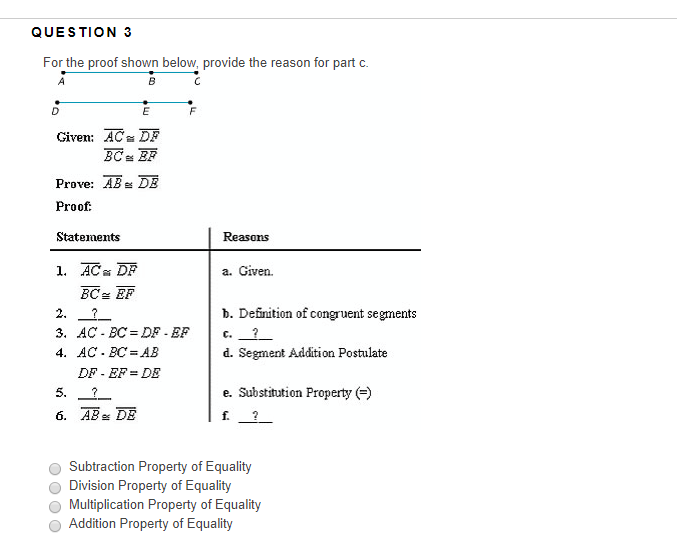
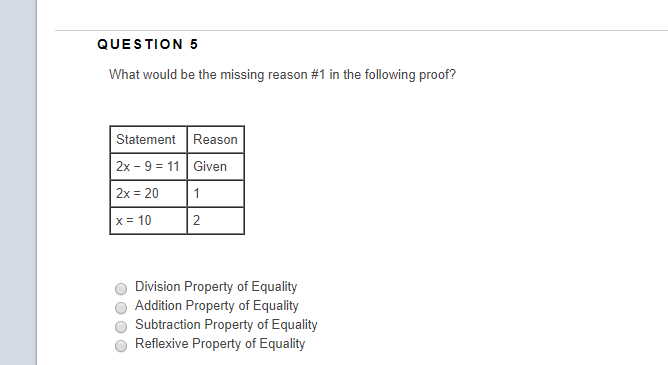 frail rock
I got both of these correct. I understand how I got Part A correct but for Part B I just guessed. I'm not sure why Part B is correct though.
frail rock
oh
 fossil ledge
It’s still a circle, but the diameter increases to 10
frail rock
i kinda get it
fossil ledge
Diagrams are op op for geometry and trig questions
fossil ledge
Diagrams are half the battle, you only get better by practice, and no worries :)!
covert orchid
hey guys, is there any book that you'd recommend to learn trigonometry ?
olive sinew
how can i find both measures for a, when i dont even have enough information ? any suggestions ? hints?
 elder aspen
Well there's 27 of them and they're equally distributed over 360 degrees, no?
olive sinew
yes, but i still dont get it, the way i see it is like a whole pizza with 27 seven equal slices with where theta = 2pi or 360dg
should i divide 360 by 27 ?
covert orchid
can someone explain me why both circles measure pi/4 for 45 degrees?
 mystic shadow
the blue dotted line represents 45 degrees from the x or y axis
picture them as extending forever
you can draw a circle around the origin of any size radius but that doesn't change the blue dotted lines
upper karma
If u have a triangle like this, is the number on the outside always larger? The 3 in this case?.. sorry for the tard question xd
tawdry pivot
,rotate
somber coyoteBOT
upper karma
Oh I see, thank you very much for your help!
tawdry pivot
wait you could just read the "solve" part
upper karma
I Didn't quite understand it, but now I understand it. Thanks!
tawdry pivot
np
covert orchid
About my photo, but why is it like that? that what i don't understand but myabe it has to do with 's = angle * r' ?
 zenith ember
It's a -ratio-
The arc length gets bigger as the radius gets bigger, but the ratio stays the same.
covert orchid
oh proportionality ?
zenith ember
That's what the image says.
upper karma
Just a quick question, why is measure 5 and 3 in part A not less than measure 8? And in part B why is measure 4 greater than measure 2? I though they were corresponding which would mean they’re congruent right?..
spark stag
they're using t' to indicate the reference angle
which is the smallest angle an arc makes with the x axis
do you have a more specific question?
covert orchid
yeah, i mean why is that useful
oh i get
it basically helps me to get an angle like the one in Quadrant I even i have one like the one in quadrant IV
right?
spark stag
essentially.
the sine of an angle is the same as the sine of its reference angle, except the sign might be different (- instead of +)
same with cosine/tangent.
covert orchid
reference angle t' ?
spark stag
?
covert orchid
i was asking what is the reference angle, is it t or t'?
somber coyoteBOT
Namington:
 gentle fog
Can somebody help me figure this out? I have no idea how to solve this
spark stag
so, we know cos(3theta) = -1. what angles make cosine = -1?
gentle fog
pi
spark stag
right, are there any others?
gentle fog
Well the cosine is the X value (and this is based off of the unit circle) so I don't think so
spark stag
well, theta has to be in the unit circle
but our angle is given by 3theta
if theta is between 0 and 2pi
what is 3*theta between?
gentle fog
0 and 6pi?
gentle fog
pi, 3pi, 5pi?
spark stag
right
so we know that the stuff in the cosine
3theta
equals pi, 3pi, or 5pi
so set up our equations:
3theta = pi
3theta = 3pi
3theta = 5pi
solve for theta
gentle fog
So the answer would be pi/3, pi, and 5pi/3 right?
somber coyoteBOT
Result:
-1
,calc cos(3*pi)
somber coyoteBOT
Result:
-1
,calc cos(3*5pi/3)
somber coyoteBOT
Result:
-1
Oh my god thank you so much. It's the same process for like other trig functions (considering sin and cos, no reciprocal functions)?
spark stag
yeah essentially
if you want you can think of it as
substituting x = 3theta
then the interval 0 <= theta < 2pi
x=3theta, so theta = x/3
substitute in
0 <= x/3 < 2pi
and solve for x
0 <= x < 6pi
this is the symbolic interpretation of what we were doing.
its not really necessary to think about it like that, if you can "visualize" it
but it might be helpful
gentle fog
Alright, thank you so much lol
dry phoenix
Hi
I need number of whole number solutions for this inequation in the interval [0,8]
i dont know how to implement this interval in this problem
When i start doing this inequation, i get that 3pi/4 < x < pi/4
but i dont know what to do after that
 supple abyss