#geometry-and-trigonometry
1 messages · Page 212 of 1
 honest bay
well yeah
first you need to prove that the triangles are similar
we have angle A in common
and angle DEA is equal to CBA
because DE and CB are parallel and AB acts like a secant
is everything clear?
@remote radish ?
 remote radish
@honest bay I guessss
honest bay
we have two angels in common so the third is also in common
so the two triangles are similar
does that makes sense?
remote radish
Ok so that means it would be 7/de?
remote radish
Yea
honest bay
is it all clear now?
remote radish
Yessir
 rustic dagger
Cross multiply
 wooden crypt
Is there a method for memorizing all the important angles for example Cot of 180 or sin of 90
 devout shell
you would really only need to know the ones for sin(x) and cos(x) after that you use the identities to figure them out
tan(x)=sin(x)/cos(x)
sec(x)=1/cos(x)
csc(x)=1/sin(x)
cot(x)=1/tan(x)=cos(x)/sin(x)
wooden crypt
My summer assignment is to remember all 6 trig Identities and special angles
devout shell
like I said if you remember them for sin(x) and cos(x) then you have it all
just use the identities to get the answer
wooden crypt
Ok
 upper karma
Hello someone can help with geometry?
A triangle ABC has a right angle at B. The length of AB is (3x - 2)cm and the length of BC is (x + 1)cm. Find the perimeter when the area is 14cm^2.
 spark stag
Right, so, there's really gonna be two "parts" to this answer
We first need to figure out what x is
The only value we know with certainty is the area
So we'll be using that to find x
upper karma
Nvm fix it forgot tu multiply 3*2 😦
spark stag
Ah.
upper karma
But didnt understand it well
So if u want u can keep explaining it 😃
I used the b*h = area
And then used pitagoram
Me
A right-angled triangle has sides of lenght x, y^2 -1 and y^2 +1, where x and y are integers, and y > x.
(i) Find x in terms of y.
(ii) Find the lengths of the sides in the cases where y=2, 4, and 6.
(iii) Find the values of y, if they exist, for the right-angled triangles with sides. (a) 20,99,101 (b) 20,21,29
Okay I'm lost
How do I find x?
Ok, I dont know how to do it, guess im boosted af
And I have 1 week before the exams xdxd
devout shell
you want the helper role so you can tutor all the questions that come through lol? ask a mod for that
then you won't need to put tutor in the name
upper karma
can you guys help me with any of these?
it says algbra 2 but im pretty sure its trig
well unit circle is I think
 upper karma
was I supposed to ask in the other one im confused
 mossy vine
do you remember the rules for sin/cos/tan
 bitter merlin
Uhh yes
mossy vine
ok so what are they?
mossy vine
mmhmm good
mossy vine
idk what you mean by the command
bitter merlin
Brb
mossy vine
but ok which sides do you have?
mossy vine
the picture's clear for me
bitter merlin
@mossy vine
mossy vine
hi
for this question
work out which sides you have relative to the angle you have
i.e. which of opposite, adjacent andhypotenuse
bitter merlin
Ok
mossy vine
and then you can form an equation in terms of whichever sides it is, and the appropriate trig function
rustic dagger
Hi
 heavy verge
Is my reasoning correct?
 umbral snow
,calc tan(pi/12) - (2 - sqrt(3))
 somber coyoteBOT
Result:
-1.1102230246252e-16
Looks right to me
heavy verge
nice, thanks
upper karma
Can I say that ΑΔ/ΒΓ=ΑΕ/ΝΜ?
 halcyon coyote
yes
upper karma
Thank you
 fleet lake
<@&286206848099549185>
 plucky marlin
use the hint
35
its the number that comes after 34
the rest is pretty apparent
 dark sparrow
@fleet lake what do you mean by "analytic"
plucky marlin
complex differentiable? 
dark sparrow
no
definitely not
don't even bring this up
it's going to cause unnecessary confusion
plucky marlin

fleet lake
I mean I want to solve this using graph @dark sparrow
dark sparrow
okay
fleet lake
I can draw you picture if you want
dark sparrow
place the base of the short pole at the origin, and the base of the tall pole 12 feet to its left, at (-12, 0)
the tips of the poles will be at (0, 11) and (-12, 14)
fleet lake
Slope is -1/4
dark sparrow
the line connecting the tips will have equation y = -1/4 x + 11
fleet lake
Ok so what to next @dark sparrow
To do*
I got the answer it's 44 ft
Using the slope
Thanks for your efforts
Ann
 copper valve
hmmm i am big geometry noob, but for the second one (q14) i think id wanna show that OC is parallel to AP
copper valve
Oop
 forest hazel
<@&286206848099549185>
devout shell
Why do it in pen lol?
forest hazel
@devout shell it's dead like my soul
qwq
<@&286206848099549185>
Sorry but it's real urgent
And I'm just left with the first question now
 fringe dirge
Why is S in this problem?
forest hazel
No idea
Does it help with anything
I got 3 angles of the same size but I don't know how to continue from there
fringe dirge
Well how do you show that two lines are parallel?
forest hazel
Well this but none of the angles can be shown to be alternating or corresponding somehow
Oh wait
Do I use similar triangles
fringe dirge
That works yes
 tardy fossil
fellas
I have some qualms with the quirks of arcsin
algebraing around, I get $\sin 2x = -\dfrac{\sqrt{3}}{2}$
somber coyoteBOT
Stract:
tardy fossil
but here's the thing
if I arcsin both sides, we know that $-\dfrac{\pi}{2} \leq \arcsin x \leq \dfrac{\pi}{2}$
somber coyoteBOT
Stract:
tardy fossil
so naturally I get -pi/3 as my arcsin and therefore x=-pi/6
so that x is my reference angle
so I get, for solutions, x=5pi/6 and 11pi/6
how am I supposed to get 4pi/3 and 5pi/3 as answers (which they are) by definition/restriction of arcsin
tardy fossil
Yes I know that 4pi/3 also has a sin of -sqrt(3)/2
dark sparrow
and get ALL solutions to the equation. and then pick out the ones that fall between 0 and 2pi.
tardy fossil
but why does arcsin fail here?
I'm trying to see why this discrepancy exists
like, it feels less-right just pulling angles off the unit circle and then saying the argument of the sin is equal to that
it feels more proper to use arcsin
dark sparrow
because arcsin(sin(x)) = x doesn't work if x is not between -pi/2 and pi/2 that's why
"proper" my ass
tardy fossil
so I should just stick to the more intuitive method of checking against the unit circle?
I tried to involve arcsin because it seemed valid but I guess not
 brisk lake
Can someone help me
heavy verge
Is there a way I can get rid of those ugly radicals inside radicals? Also I don't understand what to do in part c
somber coyoteBOT
CaptainLightning:
heavy verge
yes, I was thinking about that however notice the question says to start by deriving an expression for tan^2(pi/12)
umbral snow
Check if
2 + √3 = (a + b√3)²
For some a and b
heavy verge
@umbral snow what is that for?
umbral snow
If that is the case, then √[2 + √3] simplifies
heavy verge

umbral snow
Here, let's do it together.
2 + √3 = (a + b√3)²
2 + √3 = a² + 3b² + 2ab√3
a² + 3b² = 2
2ab = 1
 supple abyss
try ^2 maybe
umbral snow
,w solve
a^2 + 3b^2 = 2
2ab = 1
somber coyoteBOT
 Requested by Kaynex#7520
supple abyss
Requested by Kaynex#7520
supple abyss

umbral snow
Sick, I'll take it.
2 + √3 = (1/√2 + √3/√2)²
heavy verge
that's cool
umbral snow
Therefore cos(π/12) = (1 + √3)/2√2
umbral snow
If that is simpler or not, up to you lel
heavy verge
definitely not simpler, just "prettier"
supple abyss
well for part (c) you can write
$\tan\left(\frac{\pi}{12}\right)=\frac{\sqrt{2-\sqrt{3}}}{\sqrt{2+\sqrt{3}}}$
somber coyoteBOT
CaptainLightning:
heavy verge
just dividing the sin by the cos?
heavy verge
ok that's the part I don't get, the tan²(pi/12) part
what am I supposed to do with that
supple abyss
it'll remove the outer radicals
after doing that I expect you'll want to rationalise the denominator
heavy verge
but isn't just $\tan\left(\frac{\pi}{12}\right)=\frac{\sqrt{2-\sqrt{3}}}{\sqrt{2+\sqrt{3}}}$
the answer?
somber coyoteBOT
bug:
supple abyss
yes
heavy verge
but you said "and then consider tan²(pi/12) as it said"
supple abyss
what you want to do will depend on what you got in (a)
is that what you got in (a)?
heavy verge
I got \tan\left(\frac{\pi}{12}\right)=2-\sqrt{3}
\tan\left(\frac{\pi}{12}\right)=2-\sqrt{3}
supple abyss
ok so show $\frac{\sqrt{2-\sqrt{3}}}{\sqrt{2+\sqrt{3}}}=2-\sqrt{3}$
somber coyoteBOT
CaptainLightning:
 mint sandal
heavy verge
mint sandal
heavy verge
@mint sandal good approach, did it and showed they're equal
however I'm not totally sure, I think the question means something else by "deriving" and the tan^2 thing
supple abyss
what I meant is
$\left (\frac{\sqrt{2-\sqrt{3}}}{\sqrt{2+\sqrt{3}}}\right)^2\= \frac{2-\sqrt{3}}{2+\sqrt{3}} \= \frac{7-4\sqrt{3}}{1}\= (2-\sqrt{3})^2$
somber coyoteBOT
CaptainLightning:
supple abyss
and then as they're both positive and have the same square they must be equal
that's likely what they were suggesting
although it's just conjugating with extra steps so a bit unnecessary 
 floral magnet
what would a 3d polyhedron made up of triangles be called?
deltahedron isnt quite what im looking for, thats equilateral triangles
and geodesic polyhedron isnt quite right either
those are convex
upper karma

So, I have tried drawing an altitude from Z to line YX, but it does not appear to help in solving this triangle.
devout shell
are we allowed law of cosines?
upper karma
Yes.
devout shell
we can knock this one out then. so if we just find angle ZYX then the angle in question is what?
devout shell
no problem lol
bitter merlin
@devout shell
devout shell
yea?
bitter merlin
I need help
devout shell
you have to post something
bitter merlin
Question 6 every second question
Question 7 i need to do all
Can you help me do a few exp?
And maybe for the rest i just send my working out and yeah
devout shell
you know what sine, cosine, and tangent are?
bitter merlin
Yep
devout shell
ok very good
 vagrant elk
seems mostly like just finding arcsin, arccos etc
vagrant elk
basically just pressing sin-1 and cos-1 in your calculator
bitter merlin
Yes
 fresh wind
Just need to know SOH CAH TOA
devout shell
inverse functions are the sin^-1 cos^-1 and tan^-1 buttons
bitter merlin
How do I do question 6B?
devout shell
let me see then
vagrant elk
just do sin-1 of 1/3 basically
devout shell
then you have x=sin^-1(1/3)
bitter merlin
As I said before amph
Idk how lmo
Can someone if possible write it on a sheet of paper and show it to me?
vagrant elk
try using the sin-1 key on your calculator
devout shell
I can't teach you how to type on a calculator
devout shell
your book even has a calculator symbol meaning that it should be done with one lol
devout shell
you use the correct inverse trig funtion
the choice is based on whether you have opposite, adjacent, or hypotenuse given
then you take inverse to get angle
like 7a
you have adjacent side and hypotenuse
so use?
devout shell
use which trig function?
fleet lake
Can anyone explain me why the solution is correct ?
spark stag
when we have straight lines, there are three options for how many times they intersect:
- if they're both parallel, and not the same line, they never intersect
- if they're both parallel, and are the same line, then they intersect at every point (ie, an infinite amount of times)
- if they're not parallel, they intersect once
so, we compare the three lines to each other
the first and second line are parallel and not the same, so 0
the first and third line are not parallel, so 1
the second and third line are not parallel, so 1
add it together: 0 + 1 + 1 = 2
 obsidian sierra
I came up with a formula for the area of any regular polygon given the number of sides n and side-length x
i know it's nothing but thought i'd share here
 dire rampart
epic
obsidian sierra
ok
dire rampart
what if it's a circle 
obsidian sierra
maybe if n goes to infinity
and x goes towards 0 or somethin'
i'm just a 2nd semester fetus i don't know
 fiery cargo
I'm trying to help my daughter understand why she got a problem wrong on geometry homework.
The question is:
The right rectangular prism below is made up of 8 cubes. Each cube has an edge length of 1/2 inch. What is the volume of this prism?
Her answer was:
one cube = 1/2 * 1/2 * 1/2 = 1/8 cu in
8 cubes = 8 * 1/8 cu in = 1 cu in
Could someone point out where the mistake is? I tried in HELP and they thought it looked ok
 mystic shadow
Fun fact: the people answering at #❓how-to-get-help are the same people who are gonna look at this channel
Don't post the same question in multiple channels
fiery cargo
in theory yes, in reality not so much
 hidden moon
devout shell
hidden moon
devout shell
this cat picture, yes lol
 sharp fern

i understand tan beta = slope, and that when x approaches pi/2, tan approaches infinity
but im not following how they graph the phase shift
spark stag
the phase shift is the horizontal translation
(well, its additive inverse)
yes?
do you know how to find a function's horizontal translation?
sharp fern
when a number is added or subtracted to the x value?
spark stag
well, almost
but we have to factor out our b value
in this case, we have 2tan(3x + pi)
so we factor out the 3
2tan(3(x + pi/3))
thus, our translation is pi/3 units left
so our phase shift is -pi/3
your guide phrased this in a slightly different way:
it said "solve bx - c = 0"
so, if b = 3 and c = pi
thats bx - pi = 0
or x = pi/3
sharp fern
ooh that makes a lot more sense, thank you
 keen glen
upper karma
keen glen
upper karma
In the cuboid, the diagonals of the side walls coming from the same vertex form the angle alpha = 60 degrees and each of them has the length d = sqrt(5). Calculate the area and volume of this cuboid
upper karma
Hi, got a question
The graph of y = 5^x is transformed by a stretch in the y-direction, scale factor 5
State the equation of the transformed graph.
How i resolve this?
I tried but dunno how to do it
spark stag
its stretched by a factor of 5 in the y
that means, for each point
you multiplied the y value by 5
how can you reflect this in the function?
upper karma
so the answer is y= 5 * 5^x
dark sparrow
yes
upper karma
aswell
the gradient formula is m=y2-y1/x2-x1
How do i differentiate the points of x1,y1 and x2,y2?
I saw many videos and they don't explain it
 cinder portal
you mean slope?
upper karma
the points
cinder portal
what are you trying to do?
upper karma
trying to know how to correctly put in the equation y2-y1 and x2-x1
like if u see in the img u can see he named x1,y,1 and x2,y2 but i'm trying to understand why he did it
he didn't explain it
cinder portal
sounds like you're trying to find slope
upper karma
dunno what's slope
cinder portal
or in other words, how steep the graph is
slope is defined by how much your y changes based on how much your x changes
dark sparrow
slope == gradient
upper karma
yep
dark sparrow
@upper karma if you're asking about which point should be (x_1, y_1) and which one should be (x_2, y_2)
cinder portal
o rly? i always thought gradient was used more in higher level maths as in multi vari
dark sparrow
it doesn't matter
cinder portal
back on track, yup, two points, how your y changes divided by how much x changes
change is usually denoted as delta
that small triangle
cinder portal
think of a mountain
if you're on one point of the mountain
and another point on the mountain
gradient, or slope, measures how steep that mountain is
the larger the value, the steeper it is
the smaller the value, the less steeper it is
upper karma
by value u mean point between a and b?
cinder portal
value as in the slope value
when you take delta y divided by delta x
delta y divided by delta x, or (y2 - y1)/(x2-x1) gives you a numerical value
cinder portal
lets do an example shall we?
upper karma
like what u need to go from a to b
cinder portal
the gradient just measures how steep things are
thats about it
don't think too much about it
cinder portal
for now, just know, that the gradient just measures how steep it is between two points, (x1,y1) and (x2,y2)
upper karma
the pending
cinder portal
what is pending?
cinder portal
sorry i use like different math vocabulary, so might have to be a bit more descriptive LOL
cinder portal
no problem
cinder portal
ahhh i c i c
upper karma
I understand it, thx
cinder portal
np 👍
upper karma
2x+5y=7
what would be the gradient
i did y = (7-2x)/5
should i deduce that the gradient is -2/5
devout shell
correct
cinder portal
given an equation of the line, if you solve for slope-intercept form
devout shell
you did find it though
cinder portal
you would always get an equation in the form of $y = mx + b$
in this case, m = -2/5, so you should be fine
somber coyoteBOT
MemesPlease:
cinder portal
b is 7/5
upper karma
and mx is -2/5
cinder portal
be careful with division
 steady lily
when you accidentally say cos instead of cosine: forgive me god for I have sinned
ha
ha
ha
crickets
devout shell
,rotate
somber coyoteBOT
devout shell
period is: $\frac{2\pi}{b}$
somber coyoteBOT
⚡Amphy⚡:
devout shell
general formula for sine function is A * sin(bx+c)
so in this problem you see that b is?
vagrant elk
b is $\pi/2$
somber coyoteBOT
Darkrifts:
vagrant elk
since n is the same type of thing as x since they're the variable
upper karma
oh i see
vagrant elk
yeah
upper karma
thx ❤
vagrant elk
it's the constant part
devout shell
I thought you were going to get tripped up with n vs x lol
it's just a variable lol
vagrant elk
Yeah
upper karma
though was other thing mb
upper karma
okay so i tried and tried to solve it but i didnt got the 4
devout shell
$\frac{2\pi}{\frac{\pi}{2}} = 2\pi \cdot \frac{2}{\pi}=4$
somber coyoteBOT
⚡Amphy⚡:
upper karma
Oh i see thx
 patent ibex
How do you find an angle in which a projectile should be released
I have a radius of 3.3
And my target is (8.7, 2.6)
devout shell
$x=e^{y-4}$ Solve for y
somber coyoteBOT
⚡Amphy⚡:
devout shell
that will give the inverse of f(x)
upper karma
so i can inverse y and x
and say
y=e^(x-4)
and then e = ln so i can say ln y= x-4
devout shell
what are you doing now?
you started with y=e^(x-4)
to get the inverse, change the places of x and y and then solve for y
x=e^(y-4)
now solve that for y
upper karma
i change it no?
devout shell
we already swapped the places of the variables
don't swap again, because that would be useless
upper karma
hmm okay
devout shell
solve x=e^(y-4) for y, that's all you need to do to get the inverse
devout shell
that is the correct inverse funtion
upper karma
so then i can say
devout shell
domain for this is the domain of ln(x)
upper karma
f^-1 (x) = 4 + ln x
devout shell
yes
upper karma
show that dy/dx = -3/4 * 2^(2t)
anyway gonna go to sleep better, i studied for almost 8 hours and I'm really tired...
When i wake up would keep asking ❤ thx 4 your time cat cat ❤ I appreciate it
devout shell
I ain't going to wake up to answer questions all day, there are things I need to do as well 
though you should be able to answer that one above from formula in your book
 stoic wraith
Anyone have any nice resources to quickly learn how to find the length of a circle's arc based on the radius and a subtended angle? I'm taking trig this summer and it's compressed into 10 weeks so I'm having a bit of trouble keeping up. Gotta learn this stuff fast.
cinder portal
mmmm a picture would help, based on what's given
there are a bunch of circle theorems, and i need an example to show you a specific circle/arc theorem
dark sparrow
if you measure your angles in radians, then arc length = radius * central angle
stoic wraith
@cinder portal
That's the example problem I'm presented with at the moment.
I tried converting the angle to radians but came out with a wonky answer which was apparently far from correct.
I did what Ann suggested with the central angle's value in radians but when multiplied by the radius my answer was not marked correct by the system.
cinder portal
Oh, for this problem, I would probably just multiply the circumference of the circle with the fraction of the angle out of 360 degrees
does that make sense?
lets say I have a circle. The circumference would just be 2pir right? if you wanted, for example, an arc that was half the circumference, then it would be (1/2)2pi*r
stoic wraith
As in the fraction of the angle that 75 degrees is? 75/360 reduced?
stoic wraith
Sure.
cinder portal
and multiply it with the circumference
and then you get the arc, which is really just a fraction of the circumference
stoic wraith
How would I go about determining the circumference from the radius? I've totally forgotten the formula for that.
cinder portal
$Circumference = 2 * \pi * r$
somber coyoteBOT
MemesPlease:
stoic wraith
Thanks a ton @cinder portal I'll let you know how it goes.
cinder portal
np
dark sparrow
75° = 5pi/12
stoic wraith
13.08996939 Thanks so much @dark sparrow and @cinder portal You're lifesavers.
cinder portal
👍
 rancid mantle
hmmmmm
how do i solve
{-x + 4y =8 , 2x-7y=-5
it says " find the inverse matrix using the system on liner equations
 rustic cairn
How do Solve this
rustic cairn
Yes
rustic cairn
Than what’s z
rustic dagger
It’s an angle inside the circle right
So the formula for it is the 2 arcs vertical to the angle added divided by 2 is Z
104+100 divided by 2 is z @rustic cairn
rustic cairn
Thank you
rustic dagger
Np
 zealous trail
 lilac wraith
It's just pythag
 shut crest
Is there any use for the orthocenter of a triangle?
 bright parrot
drawing things
this is just a bet of mine based off of one talk i sat in at the the jmm but there's probably a use for folding strange things considering how many ways there are to divide planes into triangles
and then you can have several colinear points on a single plane based on how you folded from knowing that kind of geometry info about a triangle
but that are not on a line on when the plane is unfolded
other random bet, there's probably a fun way to get optimal walks on graphs based on the triangles on planes
probably even more fun on a toric
but "use" is as in useful? ask an engineer?
shut crest
Huh
shut crest
Graphics?
bright parrot
you can probably average shapes and pixels that way
and in a "nice" way
that's just art intuition though. pixels are squares, they are less "natural" than triangles. being able to average across triangles would be "nicer" than average across squares
looking for use in math might be too much sometimes. look for "oh hey that looks neat"
shut crest
I guess that true, I just find it weird that they teach so much usless stuff in scyiil
bright parrot
it's not useless, YOU just haven't learned the use yet
finding the orthocenter of a triangle means you can find the centroid
which means on some object with the same thickness and even density across it you can find the center of gravity
so say the human shoulder, it's a triangle, you can average human shoulders and perhaps build an artificial shoulder
or build padding for a shoulder
patella is also triangular but more like a little tetrahedron
but that's four triangular faces, all with an orthocenter, maybe a little skew, you can find the centers and weight bearing properties
lots of stability is about having three points of contact, triangles are important in the the physical world
being able to find critical points of triangles means you can find when things might tip over or crack
shut crest
I'm abit confused
bright parrot
which part
shut crest
Well firstly you can find the centriod alone, and it'd easyire then the orthocenter, so why would you use the orthocenter?
bright parrot
shut crest
Oh neat
bright parrot
it's really hard to say what part o fmath will be useful
there's something my advisor was working on that couldn't even be done in the 1850s because we didnt' have computers capable of doing polynomial shit in a reasonable amount of time
shut crest
So the ortho center is the part with the smallest distence from eachside
bright parrot
but now he can code it in C
lilac wraith
Knowing properties of special points in a triangle can massively simplify and give different perspectives and insight on certain problems.
As do most abstract concepts in math.
bright parrot
no one thought "oh hey fields" and went "and thus quanta"
but the math of it existed before the discovery of atoms
shut crest
So what is a triangle plane?
dark sparrow
you're getting... cos(Y) = 121?!
how are you getting that the cosine of an angle is greater than 1
cinder portal
$c^2 = a^2 + b^2 - 2(a)(b)cos(C)$
somber coyoteBOT
MemesPlease:
dark sparrow
\cos
cinder portal
ah thank you
somber coyoteBOT
MemesPlease:
cinder portal
you should NOT be getting cosY = 121
oh boi
solve for cosY first
let me know what you get
do algebra
would you like me to walk you through it?
okey
dark sparrow
solve for cos(Y)
that's EXACTLY what @cinder portal told you to do
$121 = 181 - 180 \cos(Y)$
somber coyoteBOT
Ann:
cinder portal
Let me know what you got when you solve for cos(Y)
i.e. $\cos{Y} = value$
somber coyoteBOT
MemesPlease:
cinder portal
what the
vagrant elk
bruh what
cinder portal
still shouldnt get that value
vagrant elk
i'm still dumbfounded as to what you did
cinder portal
ok shall we walk through this together?
nooOOOOO
Ok im going to run through the math with you
$121 = 181 - 180 \cos(Y)$
somber coyoteBOT
MemesPlease:
cinder portal
this is our starting point
right?
oh
uhhh
whats cos(Y) ?
not Y, cos(Y)
wanna make sure you did your algebra correctly
ok 60/180 is right
cos(Y) = 0.3333333
where r u getting 0.9999?
is ur calculator in degrees or radians
what did it spit out?
o nothing
if its in degrees, u good
vagrant elk
wait why would you do cos of 1/3?
cinder portal
wait shit no
cos(Y) = 60/180
have you worked with inverse trigonometry functions?
vagrant elk
cinder portal
what you're really trying to solve for is Y
we know cos(Y) = 1/3
how would you solve for Y?
Y = arccos(1/3) correct
vagrant elk
cos^-1 of 1/3 yes
spark stag
you can think of this as
taking the inverse cos of both sides
inverse cos "undoes" cos
so they "cancel" so to speak on the left side
leaving you with y = arccos(1/3)
(or cos^-1(1/3) if you prefer that notation)
cinder portal
same thing as inverse cos
spark stag
$\arccos{x} = \cos^{-1} x$
somber coyoteBOT
Namington:
spark stag
just alternate notation
 woeful acorn
What are the hyperbolic versions of the trig functions for?
spark stag
well, obviously in hyperbolas
but they'll also come up as solutions to certain classes of problems, such as certain integrals
as $\dv{x} \text{arsinh}(x) = \frac{1}{\sqrt{x^2 + 1}}$, for example
woeful acorn
I mean what in hyperbolas
somber coyoteBOT
Namington:
spark stag
well, they're analogous to the unit circle in that
if you draw an arm with a certain angle
then the y coordinate of that angle's intercept with the unit hyperbola
will be sinh(that angle)
woeful acorn
Oh
spark stag
and the x coordinate will be cosh(that angle)
woeful acorn
So it's like replacing the derivation of the trig functions with a hyperbola
dark sparrow
it's not an angle @spark stag
spark stag
where "regular" trig deals with circles, hyperbolic trig deals with hyperbola
woeful acorn
Yea, that's what I meant
woeful acorn
Oh okay
spark stag
between the arm and the hyperbola
woeful acorn
How do you graph a hyperbola
somber coyoteBOT
 Requested by Namington#1983
spark stag
Requested by Namington#1983
spark stag
...thats a shitty plot
one sec
like such
note that a hyperbola is comparable to a circle in that
in a circle, x^2 + y^2 = r^2
and in a hyperbola, x^2 - y^2 = c^2
woeful acorn
What is c
spark stag
length from the origin to the closest point
woeful acorn
Thats pretty cool
spark stag
c is just some arbitrary constant
(i should've used some other one, though, as c often refers to the focal point)
woeful acorn
So I just accidentally graphed an ellipse by multiplying one of the coordinates by -z
In an ellipse, what number determines the distance between the foci
woeful acorn
Thanks
upper karma
anyone get this
fringe dirge
Try to factor both the top and the bottom of the fraction
fringe dirge
How were you able to just remove the bottom of the fraction?
dark sparrow

upper karma
i was just simplfuing the top
but the step i got to would be that over the sin(sin-cos)
shut crest
Is there any tricks to simplify complex trig things
cinder portal
got an example?
shut crest
This is one
cinder portal
uhhh
what the
cursed image, this is just as bad as @devout shell stupid riemann sum
shut crest
What's wrong with it?
devout shell
at least it keeps exact values
and do not insult Reimann
you only hate it because you ||can't do it||
cinder portal
😦
devout shell
gottem
upper karma
i'm crying what is that
Did ur teacher assign some long assignment
Guys when is a trig function neither odd or even
shut crest
I'm doing it for fun.
upper karma
oh
shut crest
Working on finding all the circles centers, it's less complex then it looks, but I need to simpify
upper karma
@cinder portal @shut crest when is a trig function neither odd nor even
upper karma
like odd and even functions
cinder portal
the parent functions, are all either odd or even, but if you start messing around with them like sin(x+1), then it becomes neither even or odd
cinder portal
shud be neither
cinder portal
if you're unsure
do the standard odd even function check method
plug in -x, and see what you get kinda deal
f(-x) = f(x) even function
f(-x) = -f(x) odd function
zealous trail
looking for help on my hw anyone around?
cinder portal

 river vale
dark sparrow
river vale
dark sparrow
$\sin(u) \sin(v) = \frac12(\cos(u-v) - \cos(u+v))$
somber coyoteBOT
Ann:
mystic shadow
Euler's identity on one of them and fourier transform
Just kidding it's product to sum identity
Which you can derive a couple ways, been doing fourier series/transforms so that's how I recognized it at first
woeful acorn
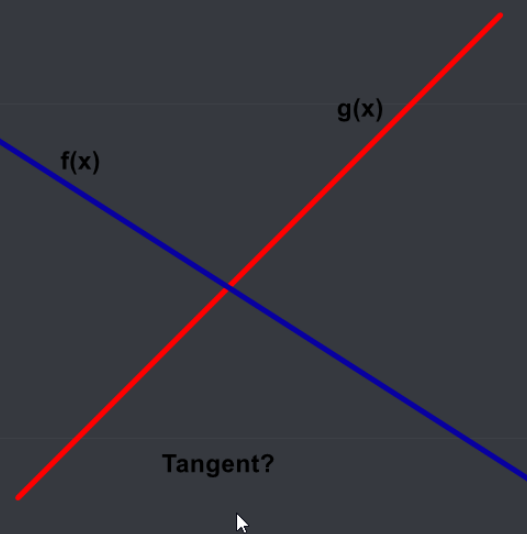
Are two lines with different slopes considered tangent to each other?
 hard blaze
I'd say no, but as I'm not an english native speaker, I'd wait so else point of view ^^
woeful acorn
@hard blaze https://i.imgur.com/w4RtZ6A.png
 woeful acorn
Okay
hard blaze
They are secant
hard blaze
Or french definition isn't the same than English one, or it's a bit more different than this
And it would by the way mean that 2 lines can't get secants
hard blaze
Yeah, don't worry, I understood this
But in France it's a bit different
In France, what u showed me are two secent lines
hard blaze
And those, are two tangent curves (french definition)
woeful acorn
Those are also tangent in english
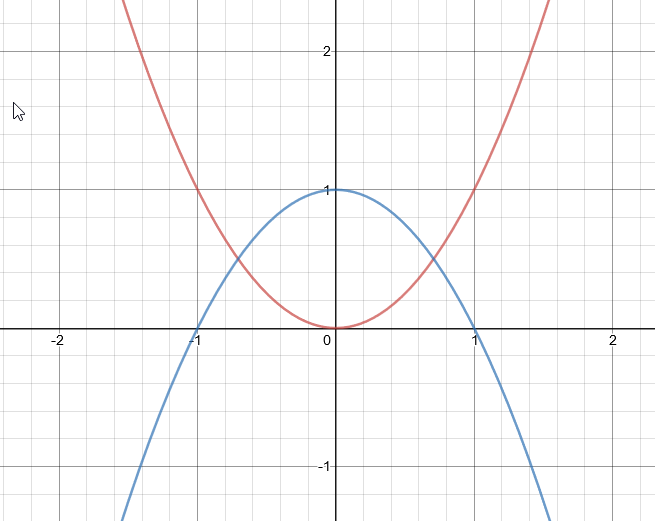 hard blaze
And, to me that's the difference
woeful acorn
This is tangent https://i.imgur.com/9gtPwLV.png
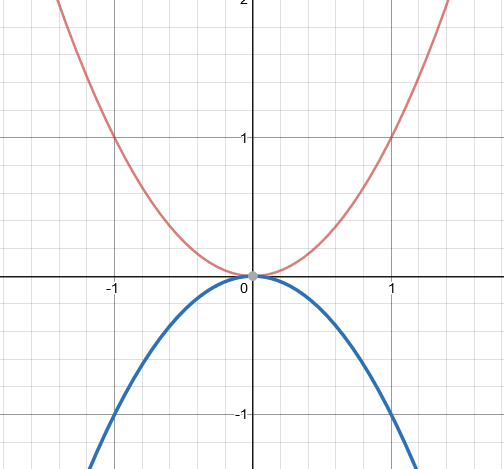 woeful acorn
I agree with that
That's true in english
These two lines touch at one point https://i.imgur.com/NHkNcTv.png
 hard blaze
The thing is, tangent means they just "touch each other", while secant means they are "crossing" each other.
Like a hug and a pal-supplice stuff, u see ?
(Relating to the French domain)
woeful acorn
Okay so this is rooted in my misunderstanding of the definition
And I like that analogy lol
woeful acorn
Nope, thanks.
hard blaze
U're welcome !
woeful acorn
@hard blaze Actually, do you know about derivatives
hard blaze
I know a bit yeah, depending of what u need, but if you need help, just switch to the good channel, I'm following you in it ^^
 minor arch
Is it possible to find out if there are 0,1 or 2 triangles using law of cosines?
dark sparrow
context?
shut crest
You need the angles and sides of a triangle for the law of Cosines, so using it to determen the number of triangles dosn't really make scene
Unless it's like a math problem dealing with how many possible triagles thee are
minor arch
TY. I asked because I had a problem where the only possible solution was using law of cosines.
and it asked me how many triangles could be formed.
I just assumed 1 and was right.
shut crest
Interesting
minor arch
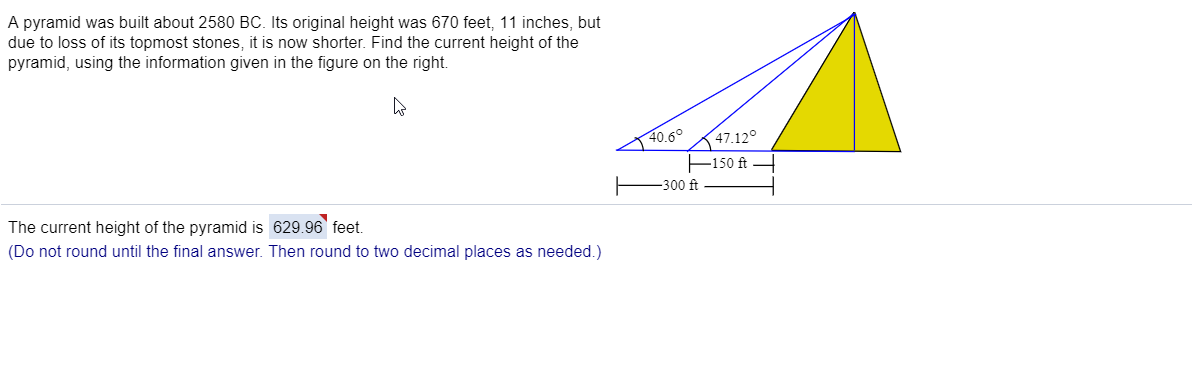
I keep getting this fucking question wrong.
Can someone give me some guidance?
this chapter so far has covered law of sin and cosign. So I imagine of one those two are instrumental in solving the problem.
But when I search online, solutions seem to involve the use of tan
dark sparrow
h cot(40.6°) - h cot(47.12°) = 150
minor arch
Wow. That's so odd to me that a chapter revolving around sin and cosign would need cot/tan to be solved.
I'll examine that and try again.
minor arch
that too.
 idle bloom
I mean
Sine and cosine are the 2 "basics" and everything else can be written in terms of sine and cosine
upper karma
Anybody wanna help?
I need someone to explain how to do this, I'm not looking for answers I just want to know how to do it
devout shell
If AB is a diameter, then the inscribed triangle is a right triangle
Knowing that, parts a,b, and c should be easy enough
Let me get this THM for part d
upper karma
I'm doomed
It's hard when you don't have degrees for B I know a circle adds to 360 degrees but
Wait DB makes up a right triangle right? @devout shell
 olive solar
it's a right triangle, yeah
because AB is a diameter, it has arc angle of 180, meaning the inscribed angle of C is half of that
(1/2)180 -> 90 degrees
upper karma
Alright well we're getting somewhere
olive solar
you can find AB, with pythagorean, and radius is just half of AB because AB is the diameter, you can find ABC using sin properties, and you can find AC using ABC
upper karma
Alrighty, what about this one, I just need to know what to use, Tangent? Cosine or Law of Sines?
shut crest
13 or 14?
upper karma
13
shut crest
Is there a diagram to?
shut crest
The last on is 55.8505360638
upper karma
I was talking about A on 13
olive solar
can you post the image again but rotated
upper karma
olive solar
,rotate 270
somber coyoteBOT
olive solar
@upper karma is there anything you notice about AB
upper karma
Well they talk about AB = 5 when it's not m
olive solar
right but
it passes through the center of the circle
what does that tell you about it 
upper karma
That it bisected the circle and that one side = 180
upper karma
60?
olive solar
sorry, angle D
it was a little hard to see
find angle ADB
given what you know of arc measures and the inscribed angles
upper karma
Hmm, I feel like I'm getting an idea
olive solar
 upper karma
So I would want to be 28 degrees in there?
olive solar
?
upper karma
I'm looking at problem A
upper karma
76?
upper karma
180-28x1÷2
olive solar
???
oh
wait one moment

okay so
you seem to be doing a different approach than what i expected
but that's fine
if you know the other arc measures you can indeed just find the arc measure of AD
so, given that the total for a circle would be 360
you can remove 180 immediately, representing the left half of the circle
after which, you would have to convert angle x to an arc measure
and subtract that from the remainder
$(360 -180) - 2*(28) = mAD$
somber coyoteBOT
G6PD-efficient:
Compile Error! Click the  reaction for details. (You may edit your message)
upper karma
That's the answer?
olive solar
yeah
upper karma
So it was minus 2?
upper karma
So 124
upper karma
Next one has the sides and wants me to find the area of c
upper karma
Don't you just need to find the area I mean, the legs are already given
Yeah I found 20
8x5
---- = 20
2
I am just gonna stop here
olive solar
do you remember what vertical angles are?
 prime jasper
ye maybe
olive solar
it's using vertical/reflex angles paired with the idea of supplementary angles
prime jasper
whats that?
 elfin heath
Which question? 8?
prime jasper
ye
idk too much terminology
btw this isnt my math homework this is just some recapping just saying it so i aint breaking rules
olive solar
er, you're actually allowed to ask for help on math homework lol
just not on exams/quizzes
prime jasper
i thought that was one of the rules
elfin heath
h and i are 180° - 166° = 14°, since angles on a straight line add up to 180°. g would be 166° because of vertically opposite angles.
olive solar
-
Do not ask for help on tests. Any violation of this will lead to appropriate action being taken at mod discretion.
-
When asking for help, do not insist on getting just the answer; we are here to help you learn, not cheat. Likewise, if you are providing help to others, try your best to explain and elaborate instead of simply giving away the answer.
prime jasper
oh i see
@elfin heath btw thanks i just looked at the answer
i will need to remember that
wow i just worked out the second one and got it correct
yeet better write it down
shut crest
Can you use sohcahtoa to simpify trigfuncions? Like sin(x)/cos(x) = (o/h)/(a/h) = o/h ?
olive solar
well
 fossil lotus
Yes
fossil lotus
Oh I didn’t even look at what they wrote
But yeah
sin/cos = tan and cos/sin = cot
olive solar
(just in case you haven't heard of the term before, cot -> cotangent = 1/tan)
shut crest
there are so may trig funchions
 vernal tusk
there's really only two
if you want to be as minimalistic and loose as possible (which is a nice thing when dealing with high schoolers usually)
cos is just shifted sin
and tan is just sin over shifted sin
then sec is just 1/shifted sin
cosec is just 1/sin
cotan is just (shifted sin)/sin
and don't you dare say haversin or i will hurt you
shut crest
But it can be usfull to use the other ones to males a shorter equation
vernal tusk
oh of course
i just like taking the mindset of "you only need to know like one thing"
it's june, so people are cramming for exams
i like to teach "know this and just derive or remember everything else related to it", and "derive everything"
i dont remember how asin(bx+c) + d works, for example
ik d is the midline
i think c is shift, yeah
b is probably period
a is probably amplitude
i guess i do remember then lol
but i had no clue as i started the final test on trig on khan academy
i just played with my calculator
(ik thats not a derivation at all, but for test yeeting it is)
 forest niche


