#geometry-and-trigonometry
1 messages · Page 207 of 1
 dark sparrow
 somber coyoteBOT
Ann:
dark sparrow
from here, they multiplied both sides by 2
do you understand how that line was arrived at? (you should, unless you lied in response to my previous question)
@oak minnow
 oak minnow
yea
im reading
what do you mean by (you should, unless you lied in response to my previous question)
dark sparrow
i mean exactly what i said
dark sparrow
i asked you to point out the first thing you do not understand. if what you pointed at really is the first thing you don't understand, then it must be the case that you understand everything that came before it.
dark sparrow
$\frac{\theta}{2} = \frac{\pi}{3} \ 2 \cdot \frac{\theta}{2} = 2 \cdot \frac{\pi}{3}$
somber coyoteBOT
Ann:
dark sparrow
that's why
oak minnow
but where did 3 come from in the first place
dark sparrow
... you should've said you didn't understand how the text arrived at θ/2 = π/3 ffs
dark sparrow
ok finally we're getting somewhere, at least we're in the clear as to what needs explaining.
okay so the line just before that is $\cos(\theta/2) = \frac{10}{20}$
somber coyoteBOT
Ann:
dark sparrow
in other words, $\cos(\theta/2) = \frac12$
somber coyoteBOT
Ann:
oak minnow
yeah 10/20 reduces to 1/2
dark sparrow
so
what angle has 1/2 as its cosine?
it's one of those "easy" angles whose sin and cos values have simple-ish expressions
dark sparrow
if you name this angle in degrees you'll need to convert it to radians afterwards
also, if you're doing it in degrees, make it abundantly clear you're doing that
i.e. put the degree symbol
oak minnow
can i times it by 180/pi
dark sparrow
you can't "times" it, because "times" is not a verb
oak minnow
multiply
dark sparrow
if you're asking whether you can multiply your angle by 180/pi, then of course you can! nothing is stopping you. you can also multiply it by 10, by -5sqrt(37) or by 58.2234.
which is to say, you can do anything you want to anything as long as you know what the result will mean in your context
oak minnow
no what i meant was can multiply that 180/pi to get my answer
dark sparrow
will multiplying your angle in degrees by 180/pi give you the same angle but in radians?
oak minnow
i hope so
because i dont know how to convert to radians
ok going back to your question
o what angle has 1/2 as its cosine? it's one of those "easy" angles whose sin and cos values have simple-ish expressions
dark sparrow
180 degrees = pi radians
oak minnow
ah im confused
dark sparrow
okay before we go back to the text
we need to clear up your confusion regarding radians
are you still here?
dark sparrow
ok
oak minnow
if 7 is my radius
oak minnow
and 6 is the chord length
dark sparrow
okay no
oak minnow
in the example its cos(theta/2)=10/20
dark sparrow
ok what the hell
you're going to confuse both yourself and me here
are you trying to sidetrack the conversation to another problem, unrelated to what we were discussing just now?
oak minnow
no its completely related to this
did you not see my question i posted
I want to know how to do it
dark sparrow
do you want me to just give you a formula and nothing else
oak minnow
formula would he nice but i also want to know how to do it,
dark sparrow
how does knowing how to do it differ from knowing the formula?
knowing a formula implies knowing how to apply it and what each variable involved in it represents
oak minnow
ok go on tell me what to do and not do with this problem
dark sparrow
honestly no i've just about had it with your inability to respond to simple requests
i don't want to help you and have no real obligation to
 upper karma
@dark sparrow was wondering if you could help me...
I put the answer D, but it's C...the thing is
if A = CD/2
then the ratios should be the same, since they're similar
why isn't ED = 5/2?
dark sparrow
$AD = \frac12CD$, but the scaling factor between triangles $AED$ and $ABC$ is not $\frac12$, because $AD \neq \frac12 AC$
somber coyoteBOT
Ann:
 dark sparrow
that is correct
 minor arch
Im shocked you actually read what I was trying to type.
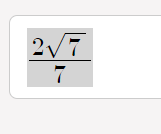
But yeah. Is it odd then that when I input it into the calculator, the value that's given is different from the value of csc?
Or do the different trigonometric functions always supposed to different numerical values?
...
Dumb question.
Of course not.
I was losing my mind for nothing. Obviously they wont have the same value when switched.
dark sparrow
what?
 hallow smelt
I don't dispute that if you do the additive formula for sin over cosine you get cot
but when I use the tan subtraction formula I get tan(x)/1
0-Tan(x)/ 1+0
hallow smelt
oh wait ya its undefined
dark sparrow
at best tan(π/2) is unsigned infinity
hallow smelt
okay thanks that explains it
guess you don't actually have to memorize the tangent additive and subtraction formula
if you can just sin cosin it
dark sparrow
you don't have to, but they are handy occasionally
 slate pewter
i can know the radius and the diameter
becuse the circumfrnce is 60
so the raidus is 10
becuse 10 * 2 is 20
20 * 3 is 60
in the quistion they said list took the PI is 3
not 3.14159
and becuse we can know the radius
we can know all the area
we can make it
the radius is 10
10 sqared is 100
100 * 3 is 300
but i dont know how to do the rest
 copper valve
since a circle has 360°, and a right angle is 1/4 of 360°, the area of this region will be 1/4 of the area of a circle with the same radius
oh woops
thought it was right
it's 120°
but same procedure
slate pewter
if it right angle its easy
slate pewter
= 3
copper valve
what's the formula for area of a circle
slate pewter
Pi X sqared
copper valve
what's X
slate pewter
yes
i did say it wrong
but i know how to find the area
of the circle
for a given radius or diameter
copper valve
what's the radius here
copper valve
right
copper valve
what are you multiplying for
slate pewter
nothing
copper valve
ok
copper valve
then yeah
copper valve
yea
slate pewter
the area of all the circle is 300
you said
120 from 360
is 1/3
do you say is the area also need to be
300 1/3
copper valve
yes
copper valve
yea
 copper valve
np
slate pewter
thank you see ya
 viral needle
This is wholesome :D
viral needle
Good luck with any others @slate pewter 
 devout shell
what command gives that?
devout shell

viral needle

slate pewter
devout shell
upper karma
Related acute angles are always positive
They refer to the angle formed by the terminal side and the x-axis
@craggy ridge
 craggy ridge
ohhh okay thank u!
 cloud void
Simple and easiest way to calculate TG without a calculator?
 warm forge
- a triangle, if the numbers are simple
- maclaurin series expansion
 sleek imp
They defined s as x+y then plugged into the equation with s expanded out with t and got the values
 waxen vale
Could someone help.
Im aware I have to use 1/2absinC
So I rearranged the formula to 1/2 ab sin 110 = 85
But it's an isosceles triangle so I dunno how it works
devout shell
This is actually a nice way to apply some geometry
So if this triangle is isosceles, what is true about the angles at the triangles base?
@waxen vale
Law of Sines: $\frac{A}{\sin(A)}=\frac{B}{\sin(B)}=\frac{C}{\sin(C)}$
somber coyoteBOT
⚡Amphy⚡:
waxen vale
They would be equal, so both being 35
devout shell
Let's look at AC and AB, you can apply the law of sines here since you know the angles and what else so you know about AC and AB?
wait huh...that tells us nothing lol
waxen vale
yeah
devout shell
take a new approach
so we are given the area
so drop a line segment from point A, that will split the triangle in half
waxen vale
I tried that
devout shell
huh, let me think a bit more about this then lol
waxen vale
Oh wait
I think I got it
You do 1/2 * a * a * sin (110) = 85
a = b since it's an isosceles
so you'd get a^2 = 170/sin(110)
Anyway, thanks for taking your time to help.
devout shell
that's good then lol
 raw prism
<@&286206848099549185> can someone please do number 2. I tried it many times but can’t seem to get the right answer
devout shell
,rotate
 waxen gorge
,rotate 90
somber coyoteBOT
devout shell
what identities have you applied so far?
raw prism
got to sin 2x/cos 2x = tan2x
devout shell
upon first glance the 3cos(2x) will cancel
raw prism
but it equals out to 3tan2x -3
i think i got it
tan 2x = 3
but i still cant do the second part to it
devout shell
you can use the trig ratios to figure out angles and then can use those angles to find the length of AC and AD, then x=AC-AD
 empty trout
@devout shell Cant I just used the pythagorean theory to find line AD then I use it again to find line AC then I just subtract
devout shell
HAHA you're right lol
please use that method then
Sometimes I don't see the easier method lol
devout shell
you can use Law of Sine and Cosines to solve this
upper karma
I have a question regarding vertices, vectors, and graphics
How would I take a position and size vector and find all of the vertices necessary to make a rectangular prism?
I've heard of this, but I'm not completely sure it's the solution:
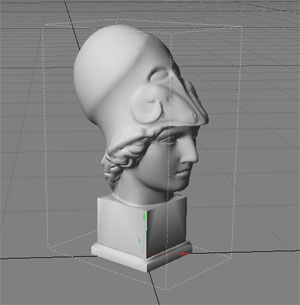
In computer graphics and computational geometry, a bounding volume for a set of objects is a closed volume that completely contains the union of the objects in the set. Bounding volumes are used to improve the efficiency of geometrical operations by using simple volumes to co...
 heady juniper
How does one solve Sin(apple) = Sin(potato)
i think there was a general method
where you considered if it was in the same quadrant
or different quadrant
and u added some kpi or 2kpi to it
but ive forgotten what that mehod was
 dire rampart
apple =potatoe +2kpi
 plucky marlin

dark sparrow
nope that's not a complete description
sin(x) = sin(y) iff x = y + 2kπ OR x + y = (2k+1)π
dark sparrow
not really? they could've just as easily factored out say 1/8 instead
 dire rampart
oh yea tru
hallow smelt
is there a reason they don't just stop at -.322+Pi(K) and find a positive angle?
because for Tan(X)= - Root 3 they just stopped at -Pi/2 + Pi(K)
 muted sparrow
Is anyone aware of an algorithm for classifying a volume formed by set operations of simple primitives (half-spaces, quadrics) as bounded/unbounded?
dire rampart
@knotty matrix stick to one channel
 knotty matrix
sorry
upper karma
I need help verifying the identities
 valid pike
 rain charm
@upper karma
 surreal bolt
In a 2D coordinate plane, the point (x, y) is part of a lattice L iff x and y are both integers. Pick any three points A, B, and C in the lattice L. Show it is impossible for angle ABC to have a measure of 30 degrees nor a measure of 72 degrees. Show further that the cos^2 (mABC) must be rational (thus again proving 72 degrees cannot be the measure of angle ABC).
... for fun if anyone is interested. 😃
dark sparrow
the second thing you ask to show is trivial
dark sparrow
$\cos(\angle ABC) = \frac{AB^2 + BC^2 - AC^2}{2 \cdot AB \cdot BC}$
somber coyoteBOT
Ann:
dark sparrow
AB, BC and AC are each the square root of an integer
surreal bolt
okay fair enough. You're using law of cosines basically?
dark sparrow
that is exactly what i am using
dark sparrow
to prove that no triangle with vertices in Z^2 can have 30° as an angle it suffices to show the stronger statement that no triangle with vertices in Q^2 can have 30° as an angle
surreal bolt
Hmm is that well-known already?
dark sparrow
it's not hard to prove
surreal bolt
OK and well a similar problem:
Let the XY-plane be tiled / tessellated with equilateral triangles. Let L be the set of all vertices. Pick any three points A, B, and C in L. Show it is impossible for angle ABC to have a measure of 45 degrees.
That's all I have today.
dark sparrow
right
this is most easily done by identifying the plane with C
so that the lattice becomes the set of all numbers of the form $a + b \omega$, where $a, b \in \bbZ$ and $\omega = \exp(2i\pi/3)$
somber coyoteBOT
Ann:
dark sparrow
actually this has a name
the eisenstein integers
if one can show no number in L has pi/4 as its argument, then the required result follows
surreal bolt
Ah cool. I have not heard of that.
I used ... geometry and trig.
Would your solution be considered "complex analysis" or just geometry using the complex plane?
dark sparrow
it's not complex analysis by any measure
surreal bolt
But yeah. ABC dilated about point B by a factor of 2 will land A', B' and C' all on a rectangular grid of 1 by root(3). And some work with a general angle with a bit of law of cosines solves it nicely.
wikipedia-ing Eisenstein's integers.
Thank you.
dark sparrow
what's holding you up here?
 mortal socket
ez
 young hemlock
uh
dark sparrow
@mortal socket please don't give out the answer.
young hemlock
i dont know how to find the perimeter and area of this specific shape
mortal socket
get the perimeter of the rectangle
dark sparrow
this shape has been broken into three pieces for you
mortal socket
and get the permiter of half circle
dark sparrow
and its perimeter into four
mortal socket
it got law
young hemlock
into 4?
dark sparrow
yes
dark sparrow
mortal socket
it is 2 pi r /2
dark sparrow
yes, do it piece by piece.
young hemlock
ok
mortal socket
yah
dark sparrow
that's how you find the perimeter and area of any shape that can be broken down into simpler pieces.
young hemlock
@dark sparrow so if i want to find the perimeter of the semi circle on the right i do pi times 8 plus 2 times 8 right
young hemlock
so how would i calculate the semicircle on the right
dark sparrow
if i asked you to find the circumference of a full circle of diameter 8 cm, would you be able to do it?
young hemlock
yes
dark sparrow
okay
so what about a semicircle of diameter 8 cm, what is the length of its arc?
@young hemlock
young hemlock
uh
young hemlock
half times pi times 8 plus 8
dark sparrow
no!
no! i asked you for just the arc, but you keep including the diameter!
but the diameter isn't part of your shape's border!
young hemlock
pi times r
young hemlock
oh
dark sparrow
you kept including that +8
young hemlock
You said break it up into pieces
dark sparrow
the diameter of that semicircle is not part of the border of the whole shape.
young hemlock
But I'm finding a seperate shape
dark sparrow
okay look
for AREA, it's fine to imagine like cutting your shape up into pieces
but for PERIMETER, you'll want to cut only the border
because the perimeter of a shape is the length of its border
young hemlock
I see
dark sparrow
this should be common sense
 vast garnet
Consider the triangle ABC where $AC = 110$, $BC = 102$, $\angle ACB = 60$.
Note that segment AC is parallel to the north. What is the bearing of A from B?
\begin{align*}
&AB^2 = 110^2 + 102^2 - 2\times 110 \times 102 \times \cos(60) \implies AB = 106.2261737991\
&\frac{\sin(\angle CAB)}{102} = \frac{\sin(60)}{106.2261737991} \implies \angle CAB = 56.26044354
\end{align*}
Thus, the bearing of A from B is
$$360 - (180 - CAB) = 236.26044354$$
Could someone tell me if this is correct pls?
somber coyoteBOT
CabbageGuy:
 heady thunder
How do i calculate the Points A and B, when P and alpha is given?
 flint compass
Why is b=2pi/period? I’ve seen how you derive it, but why is it like that?
flint compass
<@&286206848099549185>
somber coyoteBOT
Starly:
upper karma
Because b is some constant that is multiplied by input x, that means when b > 1, the period will be less than 2*pi
You could say that the period is inversely proportional to constant b
flint compass
But what could the ratio be thought of? When b=2pi/period then could it be though of as 2pi is one revolution and the period of how long it takes?
 gritty flare
I think it would be that modification of input a squishes a function
Thus lessening the period
,w graph x^2 and 4x^2
somber coyoteBOT
 Requested by Solarkoid#3482
gritty flare
Requested by Solarkoid#3482
gritty flare
You see 4x^2 is (2x)^2 which is x multiplied by 2 so f(2x)
And is a little squished
flint compass
I still don't understand it. I'm not really looking for a complex Why is the period 2pi/b?
explanation. Just some way to visualize it or think about it
I think it would be best if I could think of B as a ratio. I've been trying to think of it as 1 revolution of the circle per period but then when I try to think of period as P=2pi/B I can't seem to wrap my head around what type of ratio it could be though as.
<@&286206848099549185>
 umbral snow
e^(it) has a period of 2π. This is of course because
e^(it) = cos(t) + isin(t)
@flint compass
Or are you just talking about the period of sin(bt)?
flint compass
@umbral snow, Sine.
umbral snow
sin(t) has a period of 2π
sin(t/b) is a horizontal stretch by b, multiplying the period
So sin(t/b) has a period 2πb
flint compass
Why does sin(t/b) stretch the period?
I mean I understand that dividing t/b makes it longer but I don't really understand why that happens.
umbral snow
You have to plug in a number that is twice as large, in order to get sin(t/2) to get to the same place as sin(t)
sin(4/2) = sin(2)
So getting to t = 2 in sin(t)
Is getting to t = 4 in sin(t/2)
flint compass
Is there another way to think about the period? Like 2pi/B where 2pi is one revolution and B is something?
 upper moat
So I have 2 problems of a certain “genre” that I can’t solve for the life of me.....
How would I solve these, and all problems of their kind in general?
-
Given a set of coordinates (x_1, y_1) to (x_n, y_n), at which coordinates should you place 2 “node” points such that the sum of the squared distances of each point 1 to n to the nearest node point is minimized? then, what is this minimized sum?
-
Given a set of coordinates like above (with y-coordinates all > 0), and m “node” points with m < n, place all node points on the line y = 0. Each point 1 to n and its nearest node point defines the diagonal corners of a rectangle. What is the minimum sum of all the rectangles?
Sorry if that was kinda unclear - ping me and I’ll clarify anything
Computation is allowed for these problems
upper karma
Heya
Trying to solve this but, honestly, don't know where to begin
The topic being circles and lines secants and tangents.
Perhaps something like.. (360 / 2) - 118 = (-11x+7)
 acoustic vector
Central angle and the degree a sector is are the same
so label the central angle of -11x + 7 as c degrees
c and 118 make a straight angle
so 118 + c = 180
c = 62
So then -11x + 7 = 62
-11x = 55
x = -5
 devout shell
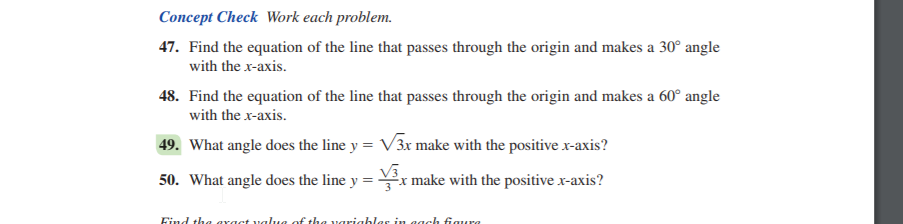
Thinking back to the unit circle and the relationships the exist with x,y and sine and cosine, what is the exact value of sin(30)? cos(30)? and how is that related to x and y?
minor arch
I haven't actually made it to the unit circle yet. Guess its just odd placement.
Unit Circle is in chap 6.
this is chapter 5.
I do know the values of sin(30 tho. and cos(3)
devout shell
oh...well you know about how x=rcos(theta) and y=rsin(theta)?
ok that is very good then
minor arch
sin(30) = 1/2
cos(30) = root(3)/2
devout shell
so on a circle of radius 1, x=cos(30) and y=sin(30) from the relationship I just told you
so now you have a coordinate that is on that line
$(\frac{\sqrt{3}}{2}, \frac{1}{2})$ is a point on that line
somber coyoteBOT
⚡Amphy⚡:
devout shell
the problem also says the line passes through the origin
so can you see how to find a line with this info?
somber coyoteBOT
Atomix:
Compile Error! Click the  reaction for details. (You may edit your message)
devout shell
you used } instead of ) at the end
 supple abyss
$\frac{1}{2}$
somber coyoteBOT
CaptainLightning:
devout shell
yes, so then m= what?
devout shell
so the line's equation is...
minor arch
That kinda makes sense.
I sorta get it, but I'll come backk to this question when I'm done with unit circles.
devout shell
$y=\frac{\sqrt{3}}{3}x$
somber coyoteBOT
⚡Amphy⚡:
devout shell
I mean I personally would have written it as $y=\frac{x}{\sqrt{3}}$ to reduce the clutter
minor arch
or rather, the 60 degree angle that forms.
somber coyoteBOT
⚡Amphy⚡:
devout shell
yes, that is the same idea you can use for angles that you know that exact values for
minor arch
Yeah. I don't like to rationalize it unless its required for a problem. makes using the identities
a pain in the ass
since I sometimes forget the rationalization changes the outcomes.
devout shell
Well, what is sin(60)?
mortal socket
how did we know the sin, cos, tan of the 90
mortal socket
tan 90 isn't possible
but i don't understand yet
can you send a picture of drawin or explanation @plucky marlin
mortal socket
this is the legendary unit circle
plucky marlin
it sure is
mortal socket

 steady sleet
$\sin(\hphantom00^\circ)=\frac{\sqrt0}2=\cos(90^\circ)$\~\$\sin(30^\circ)=\frac{\sqrt1}2=\cos(60^\circ)$\~\$\sin(45^\circ)=\frac{\sqrt2}2=\cos(45^\circ)$\~\$\sin(60^\circ)=\frac{\sqrt3}2=\cos(30^\circ)$\~\$\sin(90^\circ)=\frac{\sqrt4}2=\cos(\hphantom00^\circ)$
@dark sparrow berhaps pin this and unit circle
somber coyoteBOT
SAckalope:
dark sparrow
plucky marlin
 idle bloom
Oh that's an cool pattern
viral needle
upper karma
upper karma
Hello
I have a stupid question.
Say you have 2 points AB.
You connect them, forming a line segment
It just so happens, those two points are on opposite ends of a circle
Does that mean that AB can be
both a diameter
and an arc
?
flint compass
If Asin(x) can be visualized as A changing the circle’s size then what can sin(Bx) be visualized as?
 astral hornet
Well, b is the frequency 
flint compass
So could it be visualized with a circle?
 warm crane
upper karma
warm crane
upper karma
Is the secant technically a chord in the parts inside the circle?
 sinful nexus
@upper karma If you think about it geometrically... Think of the graph of f(x)=cos(x)... One of the points it intersects the x-axis at is pi/2 (90 degrees).
Another way to think about it is with the unit circle... When the angle from the x-axis is 90 degrees and you let (x, y) be (cos(x), sin(x)), then at 90 degrees, the x-coordinate (cos(x)) is 0.
I hope that makes sense.
upper karma
I am having trouble understanding how to graph tan and cot
y=tan4x
my period is pi/4 right?
Have really hard trig related question in #help-5 thank you for any help.
sinful nexus
@upper karma EDITED: Correct, f(x)=tan(x) has a period of pi. So g(x)=tan(4x) has a period of pi/4 because you can fit tan(4x) four times over the same period (pi) as tan(x). So a period of pi/4 compresses tan(x) by a factor of 4.
I hope that makes sense. Sorry I'm on mobile and don't know how to use the TeX bot yet >.<
@upper karma No worries, I'm glad you understand!
@upper karma Sorry I can't look at it atm as I'm at work, hopefully someone else can help :)
minor arch
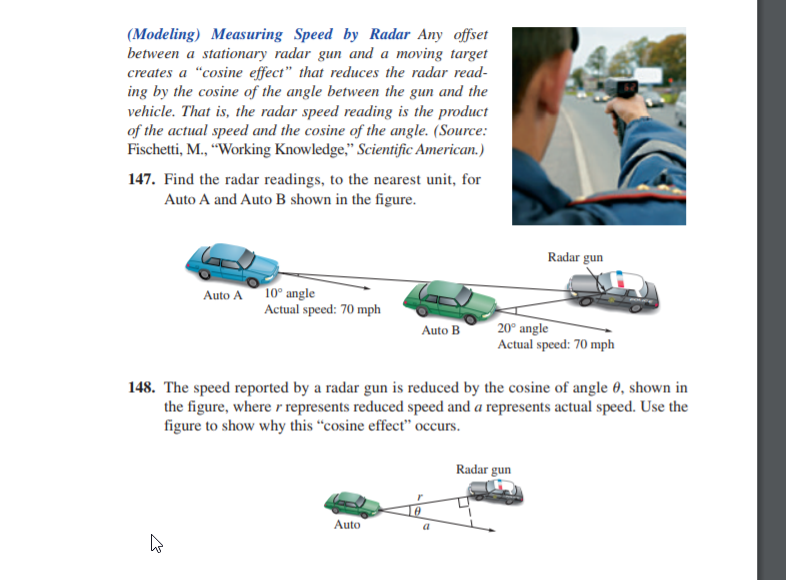
Can anyone explain to me why#148? I imagine that the answer is that the larger the cosign, means the less deduction there will be from the product?
But I know that has to be wrong. It's too simple of an answer.
 dark sparrow
repost your q
upper karma
in here?
!TRIG!
Hello, sorry this question is kind of hard.
Given the conic section: 5x^2 + 6xy + 5y^2 - 8 = 0
A) Discriminant: ellipse -64
B)Angle of rotation: 45 or pi/4
C)equations for x' and y'
x=x'cos(pi/4)-y'sin(pi/4)
y=y'sin(pi/4)+ycos'(pi/4)
D) Now I need the standard equation which I will attach where I'm stuck.
 upper karma
nvm
 plucky solar
does anybody have any ideas for proving this:
sin(2*alpha) + sin(2*beta) + sin(2*gamma) = 4*sin(alpha)*sin(beta)*sin(gamma)
alpha, beta and gamma are angles in a triangle ( so alpha + beta + gamma = 180deg )
plucky solar
finally figured it out
dire rampart
epic
upper karma
lol
Why can't one just...sum 6+2
Which would give the diameter
and divide by 2...
 gaunt vine
plucky marlin
gaunt vine
plucky marlin

dark sparrow
@upper karma because you do not know whether that horizontal line is a diameter
 steep mantle
dark sparrow
steep mantle
dark sparrow
needs more context. in general the solutions of sin(x) = 0 are x = kπ where k runs over the integers
umbral snow
Likely looking for the first non-zero solution?
 covert rune
@upper karma How do you know 6+2 is the diameter?
covert rune
Length of C is unknown though
Visual references aren't supposed to be measured for reference, you need to do the math
dark sparrow
context?
 neon void
yep
dark sparrow
3 elements, great
then C can be found using the law of sines, which applies to any triangle
neon void
ok even when its non 90 degree
so this is my situation atm
i found arcsin(3/4) or something
 pulsar delta
@everyone can someone help me take my math test
dire rampart

 floral stratus
and u shouldnot do @ everyone for tht
 daring burrow
How do you prove that the graph of a linear equation is a line? (using high school maths)
 dark sparrow
you need a definition for straight line then lol
daring burrow
i meant mathematically
a straight line is a series of points in any one direction and the opposite direction ig..
 iron nest
I believe a straight line is a line with fixed gradient?
In which case, since the derivative of any linear function is a constant, which is fixed, it is a straight line?
dark sparrow
oh god no
plucky marlin

 astral totem
 mossy vine
upper karma
mossy vine
upper karma
@upper karma oh, cool
Do you know of a theorem which is; 4r^2 = a^2 + ... + d^2
It works with that specific case
@upper karma no hahaha it works here
So like
so for example
Set y to be below c
Then y, by point theorem, is said to be y(3) = 6(12)
so y = 4
And a theorem says
4r^2 = 2^2 + 6^2 + 3^2 + 4^2
4 + 36 + 9 + 16
,calc 4+36+9+16
somber coyoteBOT
Result:
65
,calc 65/4
somber coyoteBOT
Result:
16.25
,calc sqrt(16.25)
somber coyoteBOT
Result:
4.0311288741493
And 4.03 is the radius of the circle
🤔 unit
wdym
unit youtube bruhhhhh
oh
10months in and I'm learning the radius of a circle
😂 😂 😂 😂
thats what we are doing school wise
lol
its a theorem but Ive not been able to find it
youtube power bruh
 eternal flare
ow do I know when to change cos^2 x-sin^2 x to cos2x, and vise versa?
How do I know when to multiple by conjugate?
How do I know when to change the '2' in a 2-sin^2 x to get to 2sin^2 x + 2cos^2 x - 2sin^2 x to get 2cos^2 x?
I know the simple steps like change them all to sin/cos, factor, etc. But how do I know when to do these other things?
How do I know when to use what when I solve trig ids
eternal flare
I really have no idea
My teacher didn't explain, she just said do it
She said it was to make a 1-cosx in the denominator to a 1-cos^2 x to then change to a sin^2 x
dark sparrow
can you show the problem this is from
eternal flare
It's from a variety of problems, but mainly this
They're my friend's
In the first question right side, he changed 3 to 3sin^2x+3cos^2x and -sin^2x to 1-cos^2x
When and how do I know when to do stuff like that
dark sparrow
honestly there is no One Rule
 acoustic peak
I have a quadratic formula and I need to find it's vertex.
I've forgotten how parabolas work..
$$2x^{2}+16x$$
somber coyoteBOT
Deceive:
 compact shuttle
Vertex of a quadratic formula (y=ax^2+bx+c) is at x=-b/(2a)
In this case a=2 and b=16
umbral snow
@acoustic peak
You can also factor it as
2x(x + 8)
It has a root at x = 0, and a root at x = -8, so the vertex is in the middle at x = -4
acoustic peak
Don't you mean 2x(x+16)?
umbral snow
Sorry, all better now
umbral snow
What happened?
umbral snow
Plug x = -4 into y = 2x² + 16x
acoustic peak
Oh yeah
I don't know why I have an issue with that
Remembering that I can plug it in
umbral snow
You can also do all of this by completing the square, which is worth knowing
acoustic peak
Completing the square?
umbral snow
You can write
2x² + 16x = 2(x + 4)² - 32
That vertex form tells where the vertex is, at (-4, 32)
acoustic peak
Hmm..
I get where the 32 comes from, but not why it's negative.
Nor why it's subtracted from the quadratic equation.
somber coyoteBOT
Result:
-32
@acoustic peak
Factored it
2x(x + 8)
2(x - 0)(x - (-8))
Root at 0, root at -8
acoustic peak
That's some next level factoring.
 delicate perch
hey everyone!
i'm probably an idiot for not knowing how to do this
but can someone help me with this?
just ping me, i'll be here
devout shell
@delicate perch do you know where the center is?
devout shell
radius?
delicate perch
isn't the radius 2?
devout shell
yes, because the radius is the length from the center of the circle to any point on the circle
can you show me the options you can choose from for a and b?
devout shell
oh man lol
delicate perch
haha
devout shell
let's work through this then
delicate perch
alright sounds good
devout shell
so there are two options really
we have the extreme point at 7 and then there's the center which is at 5
delicate perch
yes
devout shell
the value of a...well we see that we have a point x
that point x is actually the sum of two smaller distances
can you see what those distances are?
delicate perch
?
devout shell
try this, so drop a vertical line from point x to the x axis
delicate perch
i don't think i can do that on the software
devout shell
just imagine it in your head
delicate perch
okay
devout shell
so we have this line that is x away from (0,0)
delicate perch
yes
devout shell
if you drop a vertical line from the center point you see that it is how far away from (0,0)?
delicate perch
yes
delicate perch
5 units, correct? because it falls on the x-axis
delicate perch
smaller
devout shell
so how much more do we need to add to 5 to get to the distance x?
you should be able to see it now, how much more horizontal distance does it take to get from 5 to x?
delicate perch
x-5? that's one of the answers
delicate perch
yes
devout shell
you can see how we got that?
delicate perch
ahh
yes
thank you
ik that this is probably a pretty simple problem but i got intimidated as soon as i looked at it
devout shell
that is right though, but you see why that would be correct?
delicate perch
i think so
because if we take a horizontal line from the center, we arrive at the point (0,7).
delicate perch
oh
that's great
for the pythagorean theorem i'm assuming it would be (x-5)² + (y-7)² = 2²
devout shell
it would be that
delicate perch
okay! thank you so much
devout shell
notice that's actually the equation for the circle
delicate perch
it was probably a waste of time for you considering the simplicity of the problem, but looking at the answer choices startled me
yes, i do see that
upper karma
anyone can help?
upper karma
Never mind the crappy grammar
The source of translation isn't exactly that proficient lmao.
dire rampart
do they mean which expression equals 3 when u plug in 72 for.theta?
somber coyoteBOT
 Requested by the one n only#7133
dire rampart
Requested by the one n only#7133
dire rampart
now just plug in and check which one gives u what u need
 bitter onyx
can anyone help me with a trig problem?
struggling on it a lot
Use the sum and difference identities to evaluate exactly. Find 2 angles that add or subtract to yield the given angle. Then use cos(A+B) or cos(A-B)
cos105°
 spark stag
alright, so
there are some common angles which you should know the cosine of
like cos30°, cos45°, cos90°, etc.
can you think of a way to add two "common angles" together to get 105°?
(or subtract)
bitter onyx
i mean cos60+cos45 no?
spark stag
right
well, no
cos(105) = cos(60+45)
but thats not the same thing as cos(60) + cos(45)
do you know the cosine sum identity?
 chrome fiber
what have you tried
 lime flame
treated as a trapezoid with a hole
then as a rectangle then took out the square and triangle
how do u justify this?
chrome fiber
bad quality
lime flame
Assume angles are right and all sides are equal
r is the ratio of the area and perieter
Idk how to solve it
chrome fiber
its not 1?
since all side lengths are 1 you can easily find the area of the figure by adding the number of small squares
and perimeter is fairly simple as well
lime flame
Is there a faster method though?
As opposed to just simply counting the perimter and area
 solemn holly
Can someone give me a hand with how am i suposed to calculate "transformation with a rotation angle of 45°"?
dark sparrow
it's a rotation by 45°
dark sparrow
@solemn holly if the rotation were about the origin, would you be able to calculate that
 cloud merlin
Ok I think I got it
Let me quickly check it
Ok so in degree mode this is the formula
dark sparrow

cloud merlin
I think in the end you multiple by the original y over x
Yea that’s it I’m pretty sure
Ok this is the full one
Again all of these work with 45 degrees but you can change it
Remember if you are using a calculator you have to use degrees
devout shell
You used 45 rad? Lol
devout shell
Nah, just use gradians instead
solemn holly
@dark sparrow probably not; this isn't something teached in schools here but it's needed for a scholarship i'm interested
I tried to look on Khan Academy video but i simply didn't understand it
And what i found on the internet where a bunch of formulas
So i'm asking here for help, including links to study
@cloud merlin i really appreciate your help
If it's best for you, you can send me a link for a material instead of explaining it all the way, i won't mind
And, thanks
cloud merlin
Who knows
solemn holly
With a two dimensional surface, if we take (2, 1) as the center point and consider
a transformation with a rotation angle of 45◦, then point (3, 3) is transformed
into point ?
Is going on
Btw
Why the sin-¹?
supple abyss
arcsin
solemn holly
The rotation angle of 45 can be either clockwise or counterclockwise. The distance from (2,1) to the point of transformation must be the same as the distance from (2,1) to (3,3) which is easily found to be 5^½ If we move (2,1) to (0,0) and (3,3) t...
I found this
"The line from (0,0) to (1,2) has a slope of 2. The angle made with the x-axis is tan^-1 (2)."
What is "a slope of 2"?
Sorry, math isn't my forte and english isn't my first language
dark sparrow
what is your first language
solemn holly
Portuguese
cloud merlin
Ok quick question
Would you say that 2.8 is close to 3?
Cuz if it you do then this is probably the formula
devout shell
,rotate
cloud merlin
Yea
somber coyoteBOT
spark stag
@solemn holly i believe its called declive in portuguese?
cloud merlin
Cuz then you get the side length
spark stag
its a value that represents how fast an output changes as an input does
for example, for the line y=3x+1, the slope is 3
dark sparrow
$x' = x \cos(\theta) - y \sin(\theta) \ y' = y \sin(\theta) + x \cos(\theta)$
somber coyoteBOT
Ann:
cloud merlin
I have homework to do so I’ll be back later
dark sparrow
this is for rotations around the origin
spark stag
for $y = \frac{-1}{2} x + 9$, the slope is $\frac{-1}{2}$
somber coyoteBOT
Namington:
spark stag
yes im a bot
devout shell
Texit is a bot
supple abyss
is what a bot
spark stag
beep boop
cloud merlin
xD
solemn holly
@spark stag ohhh, thanks, that helped a lot
devout shell
beep boop
devout shell
you already showed us the formula on the white board though
cloud merlin
Do you guys understand?
solemn holly
Well, i'll have to study acrsin
cloud merlin
I don’t even know if it works fully though
devout shell
no because I don't even know what the original equation is lol
solemn holly
Because i've never seen it before
cloud merlin
Oh well study it it’s cool
solemn holly
And did you deduct the formula?
cloud merlin
Are you talking about inverse sin cos and tan?
Yea I did
Deduct means make right?
solemn holly
Yes
cloud merlin
Ok
cloud merlin
Thanks but like I said idk of it works fully
Cuz it gives you like 2.89 or something but it should be 3
cloud merlin
Anyways gtg do some hw
cloud merlin
but whats the question?
like for example is it giving you a cordinate?
wait is the center point of rotation 2,1?
solemn holly
Yes, the center point of rotation is 2,1
With a two dimensional surface, if we take (2, 1) as the center point and consider
a transformation with a rotation angle of 45◦, then point (3, 3) is transformed
into point ________.
The question is "wich point will (3,3) be after the 45° rotation?"
cloud merlin
yea it should be transformed to 2.8 then something
im pretty sure
or 2.9
2.9 is y
x is 1.683
wait how does the other calculation work?
ans im pretty sure that x cant be more than 3
cloud merlin
yea because 2 plus the square root of 2 to the power of 2 and 1 is 3
meaning anything to the side of it is less
and 45 is less
 hollow crow
K. Thanks
hallow smelt
whats the point of polar coordinates?
dark sparrow
some things, particularly those having to do with circles or ellipses or highly symmetric curves, admit easier or more generalizable descriptions in polar than in cartesian
 gilded acorn
So I had this question on a test and i didn't notice the arc congruence. So I tried to solve using law of cosines
(The part on the bottom is what I solved first to find the radius)
I can't find any errors, but the answer is 31, not 36.39. Am I doing something wrong or is the question just unsolvable this way?
umbral snow
@gilded acorn
What is the question?
gilded acorn
@umbral snow Finding the length of AB
 serene viper
Question:
How can the terminal arm of *theta* lie on two different quadrants?
I checked the answer for the question, and the answer was quadrant 2 & 3. The given angle was cos(theta) = -5/12
somber coyoteBOT
Nichterwitz:
solemn holly
With a two dimensional surface, if we take (2, 1) as the center point and consider
a transformation with a rotation angle of 45◦, then point (3, 3) is transformed
into point __.
I used the point (2,1) as if it was (0,0) and (3,3) as if was (1,2) wich (using the formula) gave me a result
how do i transform that result in to the one it would be if done with the original points? or did i simply messed up?
The correct answer is that but with a
"2 - (what i found) on the x" and "1 + (what i found) in the y"
can someone please give me a help with this mess?
 keen aspen
upper karma
keen aspen
upper karma



Can someone explain to me how they are arriving at those answers? When I attempt to simplify the complex fraction inside the square root, it comes out to sqrt(3/5)/2, not any where close to their answers...
 gritty siren
cos(2t) = 1-2sin²(t)
 vocal swift
hey guys
If I have a circle and 2 points on it
is it certain that the perpendicular line from the radius to the line between these 2 points will bisect the distance?
upper karma
its trivial
vocal swift
somber coyoteBOT
nydyгd:
upper karma
since both are radii
vocal swift
yeah
upper karma
and also OP is the common side
vocal swift
yeah?
upper karma
and its perpendicular to the chord
So by the SAS test of congruency we have...
$AP$ = $PB$
somber coyoteBOT
nydyгd:
upper karma

vocal swift
wait an isosceles triangle vertex bisector is perpendicular to the facing edge right?
vocal swift
no
upper karma
thats the given condition
vocal swift
I am trying to prove this condition
upper karma
read the question you asked a minute earlier
upper karma
no probs
vocal swift
if it bisects the chord then it is perpendicular and vice versa
upper karma
so the triangles are congruent and your theorem is proved
upper karma
Geometry is so hard smh
 robust breach
A contractor needs to put carpet in the hallway of a house, the diagram of the house is below. All of the sides of the figure are 4 feet long, except for the two longer sides that are each 8 feet long. All angles in the figure are right angles. What is the area of the hallway?
would it be 56?
dark sparrow
56? how'd you get that?
robust breach
I did this last night and its a day late so I cant really tell you how, I probably was really stupid and added the sides all up.
dark sparrow
that will not get you the area