#geometry-and-trigonometry
1 messages · Page 206 of 1
 zealous egret
well it would be b.a divided by the magnitude of a?
if you're looking for the scalar value
 upper karma
now do the same for C_A and (B+C)_A
and use that B_A + C_A = (B+C)_A
what do you get if you subtitute all
zealous egret
so I don't look at the vector proj
zealous egret
I look at the magnitude of the projection
zealous egret
ahh
I was thinking of the projections in terms of
let's say b onto a
(b.a^)a^
sorry for the wrong notation
upper karma
this is a bit problematic with negative values tho
zealous egret
but you know what I mean
upper karma
sure
zealous egret
and what law do I have to state that a.b = b.a
even though it's like common sense
is there a formal term for it
 dark sparrow
symmetry of the dot product
zealous egret
it feels like I've just repeated what it's asked me to show though
ah thanks @dark sparrow
and thanks a lot @upper karma
upper karma
well sure, it requires you to know about projections
zealous egret
is that answering the question though?
idk just feels wrong since it's like rewriting what they just asked me to prove
But I'm just a noob, what would I know 😄
zealous egret
it's not really presented as a formal question
just an optional exercise
like "discuss the results alpha = whatever" type of things listed at the bottom
upper karma
the first line is wrong
between those huge brackets
should be a dot
then the first to second line is just distributivity
zealous egret
The first -> second line is just the way you can manipulate summations, right?
upper karma
yes, but it relies on knowing the dot product is distributive
write it out in full if you don't see it
you just pull the sums out of the dot
zealous egret
Hmm I'm actually a little confused about how the summation works
if you had something like
∑n∑m
n=1 to 3
and m = 1 to 4
can that also be simplified as above?
upper karma
is that a product? You should write your brakcets better
zealous egret
yup, sorry
 astral hornet
hint: think of the pythagorean thoreom
 gilded ore
@astral hornet Im aware that i need 90 degrees to use the pythagorean theorem but i dont understand how this helps us since we are doing the v angle
well a^2+b^2=c^2
astral hornet
in (sinv)^2 + (cosv)^2 = 1 replace sinv and cosv with the actual ratio based on the triangle
astral hornet
move c^2 over
 hard gale
$aaaaaaaaaaaa$
 somber coyoteBOT
emeric75:
somber coyoteBOT
emeric75:
gilded ore
$sin^2 + cos^2 = \frac{a^2+b^2}{c^2} = 1$
somber coyoteBOT
Phil:
gilded ore
yeet
astral hornet
after you move c^2 over you get a^2+b^2=c^2, so substitute the value of c^2 into (a^2+b^2)/c^2=1 and you end up with 1=1
gilded ore
what about for v = <0,90>
I understand
this can only be applied from values between 1 and 89 due to the pythagoras theorem only being usable on triangles with 90 degrees
upper karma
Hey I'm confused about the dumbest question ever in trigonometry
why does this happen
my textbook here says "prove the following identities" and it says this 1/(1 + tan(x)) + 1/(1 - tan(x)) is congruent to tan(2x)/tan(x)
why would they use congruent instead of equal to?
please @ my when you're here. Thanks
 slim goblet
hi
slim goblet
no lol, im here to ask my own
sorry
this is gonna look very basic but i dont get how to solve this problem, i found the answer by guessing (x=28 not 35, but i have to find the length of that entire line)
upper karma
umm that's not my question
why did they use "congruent to" instead of "equal to"
lmao I can solve it but I'm confuesed by that
confused*
also @slim goblet
you see that tangent line
slim goblet
yea
 dire rampart
oh my bad I misread
upper karma
what angle does that make?
dire rampart
I guess it's just another way of saying "it's the same thing but written differently:
slim goblet
oh thats what you mean
yea, its 90 degrees
i thought you meant what angle does it create when it connects to the darker line
slim goblet
idk, the radius equals x but idk how i would solve it from; 21^2+x^2=(x+7)^2
upper karma
have you learned quadratics yet?
upper karma
$21^2+x^2=(x+7)^2$
somber coyoteBOT
🅱мерть - единственная константа:
slim goblet
to yea
upper karma
what would you get?
somber coyoteBOT
Smig has 2 dads:
slim goblet
more?
upper karma
yes
slim goblet
a girl in my class solved it with the pythag theorem
upper karma
$x^2 + 14x + 48$
somber coyoteBOT
🅱мерть - единственная константа:
upper karma
is the expanded form
slim goblet
oh
upper karma
49*
slim goblet
yea
somber coyoteBOT
🅱мерть - единственная константа:
upper karma
you probably can lmao
slim goblet
yea
but that gets me 28.07 something, would you know how to solve it with the pythag theorem?
because that got them a clean number (28)
slim goblet
damn, alright
 thick magnet
I’m in algebra II right now
thick magnet
I think that’s next year
thick magnet
In my school I think it’s combined with precalc
Could you briefly explain
If not, it’s fine
upper karma
sin = opp/hyp cos = adj/hyp, tan = opp/adj
those are all the things you need for the question
wait
@slim goblet
come back!
slim goblet
yuh
slim goblet
for example?
slim goblet
oh lol, im in geometry one
somber coyoteBOT
🅱мерть - единственная константа:
upper karma
I love latex
slim goblet
in this case what is a,b,c and d
slim goblet
okay, is AB the 7 ft one, bc the dark long one, cd the dotted long one and AD the dotted short one?
upper karma
no AB is not 7 ft
slim goblet
this?
upper karma
?
 vagrant elk
questionable
slim goblet
$AC=X^2, AB=Y^2, and B*C=Z^2$
somber coyoteBOT
Smig has 2 dads:
slim goblet
okay
upper karma
you see how AB is tangent
slim goblet
yea
vagrant elk
oh boy circle theorems
upper karma
$AB^2 = AC * CD$
somber coyoteBOT
🅱мерть - единственная константа:
 vagrant elk
t b h
slim goblet
so 21^2=7*x
vagrant elk
ye
slim goblet
63
upper karma
I got 63
slim goblet
thats very wrong
upper karma
are you sure the answer is 28?
upper karma
I trust in my circle theorems
slim goblet
i dont
vagrant elk
I mean, what dost thou mean "you can check it"
slim goblet
try $21^2+28^2$
somber coyoteBOT
Smig has 2 dads:
upper karma
where tf did you get 28
vagrant elk
same
slim goblet
thats the radius
vagrant elk
You don't have the radius, so you shouldn't have 28 I think
slim goblet
its not lol
upper karma
says your etacher
vagrant elk
I mean, do you have something which says the correct answer?
vagrant elk
hmm
slim goblet
this is tonights homework
upper karma
you can't use pythagorean theorem
vagrant elk
brb gonna actually look at the problem
upper karma
you can't even use trig
slim goblet
plus multiple people . got 28
slim goblet
why cant i use pythag? i have a right triangle with 2 sides
vagrant elk
Yeah no you can't use 28 @slim goblet
28 gives you the distance from that point connected to the 7 and the point connected to the 28
slim goblet
yea
vagrant elk
Which isn't the radius
slim goblet
what?
vagrant elk
slim goblet
yea
vagrant elk
You can't find the radius by pythagorean theorem
slim goblet
my teacher said that the point in the middle is the center
yea but thats how im checking it
not how i solved it
vagrant elk
How'd you solve it?
slim goblet
quadratics
vagrant elk
How so
slim goblet
@upper karma actually did that with me
upper karma
I was just going along with ya
vagrant elk
What you should solve for is $x^2 + 21^2 = (x+7)^2$
upper karma
how did you even get that quadratic equation
somber coyoteBOT
Darkrifts:
vagrant elk
maybe if I can read the paper right
upper karma
?
upper karma
how did you even get that quadratic equation
slim goblet
using pythag
upper karma
oh shit
slim goblet
thats what pythag would be in this situation
upper karma
yeah you can do that but I prefer not doing quadratics
vagrant elk
Anyhow, what would solving that give you anyway?
slim goblet
28.07 i think
upper karma
ask one of the <@&286206848099549185>
slim goblet
$x^2+21^2=x^2+14x+49$
somber coyoteBOT
Smig has 2 dads:
vagrant elk
Funnily enough it looks to me like 28
slim goblet
hah
vagrant elk
h m m
slim goblet
your circle thing was wrong
upper karma
my circle theorems are not wrong
slim goblet

vagrant elk
Either that or misapplied
*or misremembered
I don't memorize circle theorems because lmfao circles
slim goblet
probably a good thing i didnt trust something i didnt know
just remember to fear the unknown
upper karma
you trusted Darkrifts though
slim goblet
yea but he doesnt use stupid font affects so he is more trustworthy
upper karma
using font effects are irrelevant
vagrant elk
they are in fact not irrelevant, just not very relevant
slim goblet
yea but intellectuals dont need font affects to communicate their thoughts
vagrant elk
I'm busy looking up the theorems for circles because I've never needed them
and to see if that one shows up
does it have a fancy name
 vagrant elk
I see the problem
You misapplied it Vmert
it's to an exterior point
we need the circle
This doesn't look like the center to me
Theorem's right, wrong application
q e d
slim goblet
YOURE SMART
upper karma
oh shit the 90 degrees only applies when tangent touches the radius
slim goblet
YEA
vagrant elk
ke
"YOURE SMART"
i had to look this basic ass theorem up lmfao
and I had to be told what it was
vagrant elk
It took me hours to prove that if I can break apart any two objects, I can break apart 3
you aren't that bad
 keen aspen
what question
 minor arch
Can someone help me understand the logic for the range of Trigonometric Functions? It's easy enough to memorize, but I think it'll serve me better if I have a full understanding of the subject matter.
how did they get it so that:
-1 <= y/r <= 1
???
r = distance. and the distance, I thought, was always a positive.
vagrant elk
@minor arch in this case, r is the distance found by the pythagorean theorem and, while it is always positive, y is not
minor arch
Ah. So the -1 comes from divided the pythagorem theorem by the distance? @vagrant elk
minor arch
Ahhhh. Okay, makes sense now.
Perfect sense actually. since y can't be greater than r.
ty.
 soft condor
hey can i post pics in here
 vagrant elk
Well, I'd start by finding the radius of that circle
and good ol pythagoras shows up to steal every other theorem's thunder
soft condor
im sorry i dont wanna sound mean or harsh but can you please give me the answer
 molten kayak
there is no better way to guarantee that someone doesn't just give you the answer than saying what you just said
vagrant elk
wow ok
minor arch
Giving the answer just ensures you won't learn. Find the radius, first, and check here to see if you actually got the correct radius.
molten kayak
looks good
 thorn sorrel
not 100% sure if this is the right channel, but if anyone could help me that would be great.
how do i rotate an image 90 degrees clockwise about a point that isnt the origin?
for example, how do i rotate the point (4,7) 90 degrees clockwise about the point (4,1)
vagrant elk
Well, for this specific case, you can use graph paper if that's your preferred method and visually do it, but uh
They have the same x coordinate, so you know they end on the same y coordinate
The point is 6 units away from (4,1), so it stays that far away
and you should end up with (10, 1) i believe if I'm doing it right in my head
You know you could just use translations and move the points you're rotating around to the origin, find where your important points land, then move it back
thorn sorrel
i know i can but my teacher forces us to rotate them :/
what if they werent on the same x coordinate?
like what if im rotating (7,6) by the point (4,1) 90 degrees clockwise
vagrant elk
then you translate to the origin, rotate it, and then move it back before anybody notices
or, since this clearly isn't super advanced geometry, use graph paper
thorn sorrel
im kind of dumb, i know how to rotate 180 degrees but not 90 degrees
what are the steps to rotating 90 degrees by the origin then
vagrant elk
smh
so, rotating 90 clockwise you can do $(x, y) \mapsto (y, -x)$ if I remember correctly
somber coyoteBOT
Darkrifts:
thorn sorrel
ok i got it, thanks
vagrant elk
If you want, you can include the translation in that definition by doing something like
including the translations, then applying that rotation and bundling it up at once
 harsh urchin
 upper karma
Yes mam
 devout shell
use this theroem
Let me get the image really quickly
this one is the relevant formula:
upper karma
$36=16+4x$
somber coyoteBOT
Meliodas:
upper karma
 devout shell
confused or something about it?
upper karma
Yes, how are they distributing here, and canceling the cos(theta).
If that makes sense.
devout shell
can we see original expression
upper karma
The original expression: tan^2(theta)cos(2theta)
devout shell
$\tan^{2}(\theta)\cos(2\theta)$
somber coyoteBOT
⚡Amphy⚡:
upper karma
Correct.
devout shell
have to look up identities, ew lol
reduce it how though?
a certain expression they wanted?
dark sparrow
rewrite cos(2θ) as 2cos^2(θ) - 1
upper karma
They wanted it reduced to the answer above. I attempted to use the 3rd ford of cos(2theta) = 2cos^2(theta)-1, but when multiplying it out, I'm only left with, sin^2(theta), not tan^2 trailing behind.
form*
dark sparrow
you would get tan^2(θ)(2cos^2(θ) - 1)
= 2tan^2(θ)cos^2(θ) - tan^2(θ)
@upper karma
upper karma
Thank you.
 oak minnow
how do I do these type of questions?
devout shell
you know any equations for this?
oak minnow
I haven't done these questions yet
I dont know how to ;/
all i know is that it has something to do with pi
devout shell
you can do this by converting degrees to radians so then arc length is equal to r * angle
or if you want to use degrees, you will need to do a proportion to solve it
 ember condor
Oooh an active person
Sorry for off topic but can i get help in #prealg-and-algebra
devout shell
you have to post it first lol
dark sparrow
@oak minnow do you know what an arc is?
if you know what an arc is, then it should be quite obvious for you how to do the question
oak minnow
a circle
dark sparrow
no, an arc is not a circle.
dark sparrow
no
 idle portal
is it? :o
devout shell
arc a rounded line segment
oak minnow
its the edge of a circle itsn't?
ember condor
Yeah sorta
ember condor
An arc is part of the CIRCUMFERENCE
dark sparrow
okay so like
let me ask you another, hopefully simpler question
what is the length of a 180° arc of a circle with radius 10 cm?
(remember that a full circle is 360°)
oak minnow
yeah i guessed it sorry
dark sparrow
also, why don't you think instead of going "oh i haven't done this before"
a 180° arc is exactly half of a circle.
oak minnow
yeah
dark sparrow
are you able to find the circumference of the whole circle?
oak minnow
because you said a full circle is 360
dark sparrow
are you able to find the circumference of the whole circle?
dark sparrow
what do you think pi is?
oak minnow
pi is the ratio of the diameter to its circumference of a circle
dark sparrow
no, that's the wrong way around
it's the ratio of the circumference to the diameter.
$C = \pi D$
somber coyoteBOT
Ann:
dark sparrow
so now, do you know how the diameter relates to the radius?
it should be obvious if you know what the diameter and radius are and have the appropriate mental image in mind
oak minnow
circumference = pi x diameter
dark sparrow
that is true, but no, that is not what i am asking you right now.
oak minnow
what did u ask
dark sparrow
why don't you read it once more?
idle portal
'so now, do you know how the diameter relates to the radius?'
dark sparrow
here's a circle, with a radius and a diameter drawn inside
can you tell me which is which?
dark sparrow
yes, so now, with this picture in mind, how does the diameter relate to the radius?
oak minnow
erm
dark sparrow
it doesn't take an expert to recognize the relationship, both because it is crystal clear from the picture and because it is not particularly complicated per se
dark sparrow
that is true but it is irrelevant to what i am asking you right now
dark sparrow
okay, let me put it this way: how do the lengths of the diameter and the radius relate?
if you know the radius of a circle, is it possible to know its diameter? and conversely, if you know the diameter, is it possible to know the radius?
oak minnow
noz
no
because the radius
this isn't helping
i asked how to do these type of questions
dark sparrow
patience, my friend.
we'll get to your original question in a few minutes.
i want to help you reason and know why things work the way they do. if all you know is how to apply formulas, then you're little more than a meat calculator.
anyway, what you said is false. it is very much possible to find the radius from the diameter and vice versa.
somber coyoteBOT
Fuhrer1:
oak minnow
with this
dark sparrow
no, we are not talking about the circumference right now.
we are talking about just the radius and diameter for now.
here's that picture i sent before, cropped for convenience.
notice how the green diameter passes through the center (the black point)
the center cuts the diameter into two segments.
oak minnow
yes ok
dark sparrow
and each of those two segments is a what?
oak minnow
diameter
dark sparrow
no
oak minnow
radius
dark sparrow
yes, each of those is a radius
the center cuts the diameter into two radii.
do you see it now?
oak minnow
i think so
idle portal
:o
dark sparrow
as an equation, this would be D = 2r. but i want you to NOT memorize that.
oak minnow
why not
dark sparrow
because you now know exactly why the diameter of a circle is double its radius
(and the radius is thus half the diameter)
oak minnow
yeah\
dark sparrow
and it should make perfect sense to you, thus obviating the need for memorization.
so with that in mind, we can now return to talking about the circumference
$C = \pi D$
somber coyoteBOT
Ann:
dark sparrow
we had this
with what we said above in mind, we can rewrite this as follows:
$C = 2\pi R$
somber coyoteBOT
Ann:
oak minnow
the border
dark sparrow
also, quick note:
"circle" refers specifically to the curve, as shown on the left. the inside of a circle is called a disk, as shown on the right. though this might be less common at your level. but the distinction between the two needs to be made.
anyway
what i want you to do now is to find the length of a 120° arc of a circle with radius 20 ft.
again, remember that a full circle is 360°.
you now know everything that is needed to do this.
dark sparrow
don't use any formulae!
idle portal
t!cookie Ann#8192
 loud cedarBOT
🍪 | Vulcan213, please mention a valid user!
oak minnow
i dont know man
idle portal
:(
dark sparrow
okay
dark sparrow
almost.
ember condor
divide 120 by 360
dark sparrow
the circumference is 2 * 20pi.
oak minnow
what
dark sparrow
also don't use x for multiplication
ember condor
The ratio of the ARC to the CIRCUMFERENCE (2rpi) is the same as the ANGLE to 360.
dark sparrow
i said the radius is 20 ft.
oak minnow
120 * 20pi/180
dark sparrow
sure. that works.
i would have preferred if you wrote $\frac13 \cdot 2 \cdot 20\pi$, but your answer is correct.
somber coyoteBOT
Ann:
oak minnow
why 1/3
ember condor
Props to you for asking for help
dark sparrow
because a 120° arc is exactly 1/3 of a full circle
ember condor
120/360=1/3
dark sparrow
^
ember condor
Put the angle over 360, and multiply that by the circumference
oak minnow
we times it by 2 because
dark sparrow
because the circumference of a circle is 2πr.
ember condor
The diameter is 2 times the radius
dark sparrow
or that.
ember condor
Pi is the ratio of the DIAMETER to the circumference, not the radius.
idle portal
wot, no
dark sparrow
other way around.
ember condor
I know
dark sparrow
one radius, two radii
ember condor
That's why i said radius-es and not radiuses
oak minnow
2 radius
ember condor
Per my last message i know that
oak minnow
ember condor
hmm
oak minnow
so back to this
ember condor
Yep
oak minnow
would it be
ember condor
the Angle, you have
oak minnow
105/360
oak minnow
2/24
dark sparrow
huh?
oak minnow
2/24 *2 * 8pi
idle portal
magic
ember condor
that's my line
dark sparrow
$\frac{105}{360} \cdot 2 \cdot 25\pi$
somber coyoteBOT
Ann:
ember condor
I think that was just arith
 frigid wasp
anyone know how to find the radius of circle centre q?
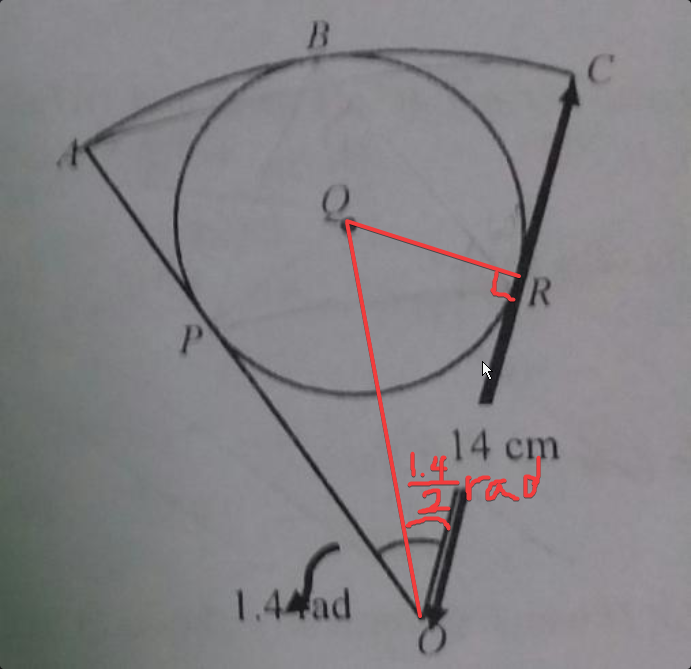
 jaunty horizon
ik
you want to get the length of the opposite side and you already have the angle and the adjacent side
What do you use? sin cos or tan?
frigid wasp
how do u have the adj
14 is the radius of the big circle
but tan
@jaunty horizon
 stoic wraith
Hey guys, practicing for my final exam, I'm having a bit of trouble grasping trig. I'm trying to find the length of a side of a right triangle given the length of the adjacent side. In this case, the hypotenuse. I assumed that I need to set the cosine equal to the adjacent side's length over some variable to represent the hypotenuse's length, but i can't figure out how to get that variable alone now. Any ideas? I think I might have just fried my brain lol.
upper karma
@stoic wraith
You have hypotenuse.
You have a degree.
$ \cos{x} = \frac{adjacent}{hypotenuse}$
somber coyoteBOT
rudy:
upper karma
where x is a degree.
Now
This is a fraction = to a fraction
Just cross multiply
cos x * hypotenuse = adjacent
stoic wraith
Am I able to send images in this channel? I am reading your messages by the way.
upper karma
Yes, send an image
stoic wraith
This is what I'm working with, for exam practice. I'm being asked to find the length of x. https://www.sebz.xyz/i/firefox_April_25_2019_EminentIggypops.png
 stoic wraith
I thought i was cosine, right? Adjacent over hypotenuse?
somber coyoteBOT
rudy:
stoic wraith
Precisely, that's what I've got on my notes here.
upper karma
,w cos(38) in degrees
somber coyoteBOT
 Requested by rudy#0446
upper karma
Requested by rudy#0446
upper karma
gusssing ur using degrees
stoic wraith
Yes, it wants my answer in degrees, good guess. 😃
upper karma
You have, $54.72h = 20$
somber coyoteBOT
rudy:
stoic wraith
But in practice, to find that, would I divide both sides by twenty first?
upper karma
,w 20/54.72
somber coyoteBOT
Requested by rudy#0446
upper karma
What do you mean?
upper karma
Oh, no. You want to solve for the hypotenuse
stoic wraith
But anyway, from that point, without the help of wolfram or anything of that sort, just using a TI-84.
upper karma
So, cos(38)h=20
upper karma
h = 25.380 or so
upper karma
gl, trig is one of the most beautiful of maths
stoic wraith
thank you
 stoic seal
hello
can someone help me with an equation trigonometry
cos^2 x+1=sinx+2,x ϵ [0,2π]
im stuck
someone please
stoic seal
hello
 slow charm
cos²x-1=-sin²x
 willow shoal
can someone help me with math I have this assignment I need to get done ASAP so I can get a class next year its geometry and I dont understand the lesson, but if you can break it down and tell me the equation i'll be really thankful
devout shell
Post it
willow shoal
theres 4
devout shell
post it in a question channel down below then
willow shoal
any?
devout shell
yea
willow shoal
Alright I posted in a or whatever
slow charm
Alpha
oak minnow
how do I find the chord length of this
devout shell
oak minnow
i thought it was 2rsin(0/2)
devout shell
you can do it using radian measure as well
but is said degrees so I posted this formula
oak minnow
yea
ok
arc measure is my final answer for a right
what would the circumference be
oak minnow
30cm
devout shell
circumference is 2pi * r...
dark sparrow
DON'T USE ZERO FOR THETA WOW
oak minnow
THEN WHAT DO I USE?
 vague pagoda
Theta ofc
dark sparrow
if you can't type θ then at least write theta
oak minnow
@devout shell
 supple abyss
Ø 
devout shell
explain how you got that proportion
oak minnow
which proportion
devout shell
the one you are asking me about
devout shell
the right hand side should be a ratio of the arc length to circumference to circle
the units are cm
oak minnow
idk
devout shell
the units are given to you in the problem and they are cm, then you gave me a proportion with no unknowns and you want to solve for something? Solve what though
devout shell
it's x/360 = 50/188.5, so solve that for x
oak minnow
wait so were not meant to imply the answer for a in x
 dark sparrow
"radius of the chord length" makes no sense
you're asked for the angle made by that chord
 dark sparrow
well do you know how to get the chord length from the angle and radius?
i.e. if you have a chord subtending an angle of θ in a circle of radius r, are you able to find its length?
dark sparrow
no! no! no! no! no!
forget about the problem for a moment!
i asked you a question!
if you have a chord subtending an angle of θ in a circle of radius r, then are you able to find its length?
this has nothing to do directly with the problem you posted
but i want to make sure you have that down before attempting the reverse
oak minnow
yes, i think i know how to find it
oak minnow
centeral angle/360 = arc length/2pi*r
dark sparrow
that's... not...
DO YOU EVEN READ THE MESSAGES I SEND
BECAUSE IT SURE AS HELL SEEMS TO ME THAT YOU DON'T
oak minnow
jesus no need to yell
keen aspen
:AngeryAnn:
dark sparrow
you do realize it's really fucking frustrating when this happens, right
when i'm trying to help and you do your best to NOT COOPERATE
devout shell
I've given up for the night as well
 flint compass
I used to think that a period of a sine function was a ratio between 2pi and the number of revolutions it makes. But I realized that it couldn’t be divided by the number of revolutions because a normal sine function’s period is 2pi/2pi with only one revolution (not 2pi revolutions) so what does x in 2pi/x represent?
dark sparrow
revelations? 
flint compass
What do you mean by that?
dark sparrow
are you sure you didn't mean "revolutions" or something
i am having trouble parsing your question
dark sparrow
But I realized that this didn’t make sense to what does x in 2pi/x represent?
this does not parse
 steady sleet
Parse = does not make sense, it is an incoherent sentence
And they quoted the entire part that does not make sense

flint compass
I edited the question.
flint compass
I’ll just rephrase my question. Is the period a ratio?
 past mantle


 flint compass
So is the period just number of oscillations in one revolution?
dark sparrow
no, the period is the amount of time it takes your sinusoid to complete one cycle
 winged saddle
yo i dont rly understand why there is 2 solutions
isnt there just 20x=0+2pi n
why is there also 20x= pi+2pin
ok nvm
i need to think more
because sin a = sin(180-a)
k IM DUMB
 olive solar
so you want to invert the equation $A = \frac12s^2$
somber coyoteBOT
collouarfloride-a brown stain:
 wet moth
switch sides?
then multiply both sides 2 i think
2 x 1/2 s = s^2 and A becomes 2A
@olive solar
wet moth
so the answer is C?
somber coyoteBOT
collouarfloride-a brown stain:
olive solar
now what would you do from here to get rid of the exponent on s^2
wet moth
s = sqrt of 2A?
olive solar
yes
wet moth
thank you
olive solar
👍
wet moth
brain's not working today sorry for the trouble
olive solar
np
devout shell
what theorem did you use to get your answer?
perfect, and you followed the procedure and you got the correct answer lol
12.00 if you want to put decimal places
there are probably other problems where you have to round
but this one, was nice to you lol
they try to get you like that lol
upper karma
i need help
devout shell
post it
upper karma
if u have x,y and lets say u have 6 and -2 which sides do they go
devout shell
you describing a triangle or something? please show a problem
you mean like: y=mx+b?
and you have a point (6,-2)?
upper karma
the last part yea, im trying to help my friend with math but i never remember which side of the coordinates they go in its like f(x) = 2x -6 for example
devout shell
do you know what f(x) means?
upper karma
no
devout shell
it just means, where ever you seen an x in this equation, plug in the input value there
for example f(1) means, where ever there is a x in my equation, put in a value of 1 for x
like if f(x)=2x-6, then f(1)=(2 * 1) - 6
upper karma
ohhhhhh
devout shell
so as a quick check, if f(x)=2x+x^2, what is f(3)?
devout shell
just write but don't simplify so that I can see if you got it right
upper karma
whats the ^
devout shell
means exponent, but that's not very important to know about
just show me what f(3) looks like
upper karma
f(x)= 2 * 3 + 3^2
upper karma
that makes sense
do you think you could help my friend as well if i make a group
because sometimes i struggle myself
devout shell
he not in this discord?
devout shell
are you familiar with the terminology: variable, input, and output?
upper karma
not sure, english isnt my first language and I had it all in finnish
devout shell
oh man lel
upper karma
yep
devout shell
but invite your friend to this server so he can DM without having to send me a friend request
upper karma
okay
devout shell
ah gosh, you need to be friends to make group DM lol
devout shell
but you want to know about (x,y) stuff?
devout shell
haha, nice
upper karma
yeah
when i had geometry in school I did the graph the opposite way
I got half point and the teacher asked if I was left handed 
devout shell
just invite him over then and I'll let him read the stuff I told you first then I can explain the original question
devout shell
you both learn lol
upper karma
yeah
devout shell
it's a slow day today anyways, so I have time to sit around for a while and do this
tell him to go to #help-1 and ping me there
upper karma
sweet
oh okay
thank you my dude
he has to wait 10 mins to be able to talk btw and Im still not sure if u have a graph which side of the graph the numbers are meant to be, are they always on the same side? @devout shell
devout shell
how well can you read English?
upper karma
i can understand it pretty well but school subjects are out of my league in english like complicated stuff
upper karma
thanks
for me i just get confused sometimes with like the side
so its why it makes it also harder for me to help
devout shell
they explain the standard way to draw it
I'm left handed as well but it never really was a problem to draw stuff oriented to the right lol
devout shell
it's just a standard convention you will have to get used to then
 hollow hamlet
uh
devout shell
just scroll up a bit
hollow hamlet
What all do I need to read?
devout shell
from when your friend first sent a message to now
looks like a lot but should only take like 10 minutes max to read
hollow hamlet
Nonsense
It should take 2 minutes max
maybe 3
4 at the very most
Anyway..
what am I looking for
when reading this
devout shell
just start here at this message and read because I go over what f(x) means
devout shell
have you referred to your math book at all for help?
dark sparrow
@oak minnow are you still here?
 spiral lintel
How do you solve the area of two overlapping circles with radius 4 and they go through each other's centers
dark sparrow
implying this problem admits a clear-cut classification of any kind
honestly play around with it
experiment
 umbral snow
But then is it really a hexagon?
dark sparrow
why wouldn't it be?
dark sparrow
would you consider this to not be a hexagon?
umbral snow
Well then I'm a Kaynebegon
oak minnow
@dark sparrow yes, im here
dark sparrow
okay, good.
from the textbook screenshot you posted, what is the first sentence you do not understand?
oak minnow
i dont know how they got 2pi/3