#geometry-and-trigonometry
1 messages · Page 205 of 1
 upper karma
Several rectangles are drawn on a plane surface in such a way that their intersecting lines form 18,769 areas not further subdivided. What is the minimum number of rectangles that must be drawn to form the described pattern?
you can do it with less than 100 rectangles
but i cant find the pattern
a little help, guys?
 dark sparrow
wow oof
upper karma
i can do it with 10 times less rectangles than areas
but thats the best i got so far
 oak minnow
how do I do
dark sparrow
what is holding you up here?
we aren't going to just do this for you, yknow
and most importantly, you have once again posted multiple problems with no indication of which one you are stuck on!
dark sparrow
to fuhrer1
upper karma
can anyone help me with mine?
everytime i post a problem on this server no one helps
 coarse stag
Fuhrer1, use the law of sines. Then I think it'll be clear.
 patent kite
Law of cosines
 clear haven
lol
upper karma
Yeah, ok let's use the formula
clear haven
and squaring the entire quantity 3r itself
 somber coyoteBOT
rudy:
clear haven

upper karma
So ez
upper karma
Why does it seem hard
clear haven
dunno
upper karma
Because you don't understand the: 3 times larger
clear haven
maybe question wos intimidate 👻
clear haven

upper karma
Huhhh
two positives make a negative?
Extraneous solution????
extraneous solution != negative
 vernal void

clear haven
 vernal void

 frigid wasp
You know how sinh, cosh and tanh have definitions involving e^x etc., do "normal" trig functions have that too?
dark sparrow
yeah, but you need to go into the complex numbers to get it
$\cos(x) = \frac{e^{ix} + e^{-ix}}{2} \ \sin(x) = \frac{e^{ix} - e^{-ix}}{2i}$
somber coyoteBOT
Ann:
somber coyoteBOT
Ann:
dark sparrow
mh well the thing is
usually euler's identity isn't considered a definition
rather, the exponential function is defined (via its taylor series), and then cos and sin are defined from it like i wrote above
and euler's identity just follows
 storm hatch
Is that all of the given information?
storm hatch
Does it tell you that BC = AC, BC = ½ AB or C is the midpoint of AB?
 gray saddle
Nope
storm hatch
Does it mention anything about C at all?
gray saddle
No just that h2 is the half circle of cb
storm hatch
So you can't exactly establish that BC is the radius of h1.
gray saddle
Bc?
storm hatch
I think I just suck at Geometry. Could you send the whole question, with the text?
gray saddle
K ill translate it
Let C be a point on the line AB. About AB and CB semicircles h1 and h2 are built on the same side. The circle k3 touches h1 from the inside,
h2 from the outside and also the line AB.
If the radii of h2 and k3 are both 3cm , how big is the radius of h1?
storm hatch
I'm sorry, man. I don't know.
I know BC = 6 units, but since you can't prove AC = CB, then you can't assume that the radius of h1 = 6 units, unless I'm missing something obvious.
gray saddle
Oh im stupid
frigid wasp
@gray saddle is that from the ukmt intermediate Olympiad? I had a similar question when I did that
gray saddle
Why? How should this help?
 real mulch
the center of h1 (O) lies on AB, let's denote the distance BO with x;
then we can write an equation for x using the fact that x is equal to the distance between O and the furthest point of k3 (from O)
@gray saddle
 plucky marlin

i was able to draw a plane that goes thru both BC and EH
@lime flame can u draw planes thru the other lines
 upper karma
hey i need help with a question. can anyone DM me?
this is the problem i need help with
upper karma
nvm i got it right
dark sparrow
can you enlighten me as to what "rounded distance" is meant to be, then
bc i've never seen that term before
and can't seem to decipher it in context
dark sparrow
ok what's holding you up
upper karma
literally
everything @dark sparrow
lol
I know its a similar triangle
ok im done
dark sparrow
BEF and ECD but yes
........ok wait
on second glance this problem appears to be ill-posed.
dark sparrow
the wording's fine, it's just that i feel like it might not be enough info
upper karma
^/s btw
upper karma
why is $$\sin{\theta} = \sin{-\pi - \theta}?
somber coyoteBOT
taven:
Compile Error! Click the  reaction for details. (You may edit your message)
upper karma
ughh
dark sparrow

$\sin(-\pi-\theta) = \sin(2\pi - \pi - \theta) = \sin(\pi - \theta) = \sin(\theta)$
somber coyoteBOT
Ann:
taven:
Compile Error! Click the reaction for details. (You may edit your message)
somber coyoteBOT
Ann:
upper karma
oh wait i get it now since $sin(\pi - \theta) = sin(\theta)$
somber coyoteBOT
taven:
upper karma
thanks
 fair vine
fair vine
fair vine
I found AB, OM, OP, OM, AP but I cant find any way to get AN or anything near N
fair vine
Ok yes
dark sparrow
and you also know that ON = m*OB for some constant m
fair vine
Yes
dark sparrow
try going off of that
dark sparrow
sure
dark sparrow
what did you try
somber coyoteBOT
wassa:
Compile Error! Click the reaction for details. (You may edit your message)
fair vine
$$\frac{2b-5a}{7m}
somber coyoteBOT
wassa:
Compile Error! Click the reaction for details. (You may edit your message)
fair vine
then i found that ON = b/k
and if we go the other way using ON
AN = b/k - a
$$\frac{2b-5a}{7m}=b-ka
somber coyoteBOT
wassa:
Compile Error! Click the reaction for details. (You may edit your message)
fair vine
this is probably wrong idk what to do from here :?
dark sparrow
okay so like
$AN = -\frac57k a + \frac27k b \ ON = \left( 1 - \frac57k\right)a + \frac27 k b = mb$
somber coyoteBOT
Ann:
dark sparrow
since a and b aren't parallel, the only way the last equality can be true is if $1 - \frac57k = 0$
somber coyoteBOT
Ann:
upper karma
uwu what's the problem you're working on?
fair vine
Scroll up i made a copy of it
 fair vine
Yes
fair vine
Yes
 lime flame
 bleak rivet
Im trying this question here but im stuck part way though
I started by using the vertex form: Y = a (x - h)^2 + k
Then I subbed in the numbers:
300 = a(2100)^2
and am stuck with 1 / 14700 = a
Answer is allegedly:
so I figured I was on the right track
bleak rivet
so whats the process of rearranging to that?
 umbral snow
Multiply by 14700
 solar shale
<@&286206848099549185>
solar shale
I sent the wrong one
If you don’t mind just write out all the steps I’m kind of busy so I can check out later
upper karma
upper karma
owo
thats cool @upper karma
Some of my classmates think I'm weird keepiong whiteboard markers and shit on me. They call me the second professor when we do study sessions and I do powerpoints and use the whiteboard a lot
 acoustic fiber
What exactly are sin theta and cos theta? can anyone explain me in simple terms?
 proven dome
um, they’re ratios of the sides of a right triangle @acoustic fiber
so sin θ is the ratio opp/hyp
and cos θ is adj/hyp
dark sparrow
that works for θ between 0 and 90° ofc
acoustic fiber
cool man thanks
dark sparrow
you don't need the sine rule here.
or are you explicitly asked to use it somehow?
@oak minnow
hello?
 hallow smelt
how come they want me to use the law of cosines and the quadratic instead of just using the law of sines?
 dark sparrow
@hallow smelt either way is possible
hallow smelt
but if i use the law of sines i get possible triangles if i use the law of cosines no real answers
im confued
plucky marlin
y wud someone use cosine rule
dark sparrow
@hallow smelt show work?
hallow smelt
ok
I have a page of these
where they want to see the quadratic
wait guess the law of sines doesnt work for that triangle I thought it did maybe it was another
hallow smelt
I hate the quadratic... even my chem prof hates it. No pH or pKa etc where we have to use it
plucky marlin
,w solve for x in 50^2 = 65^2 + x^2 - 265x*cos(55)
somber coyoteBOT
 Requested by soap#7503
plucky marlin
Requested by soap#7503
plucky marlin
well fak 
dark sparrow
plucky marlin
well even sine rule gives you sin(B) = 1.06489 > 1
ayy voila
no real B can satisfy this relation
🍻
hallow smelt
do you guys know how to use the solver function on a ti-84
to solve the quadratics?
plucky marlin
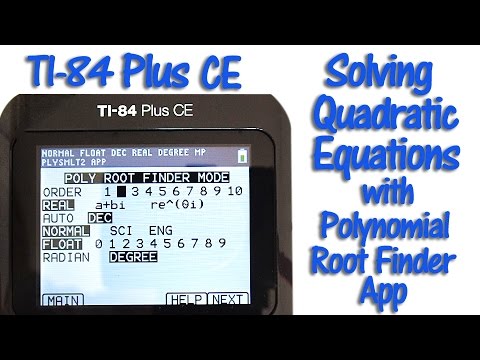
How to Solve Quadratic Equations with the Polynomial Root Finder App on the TI 84 Plus CE Graphing Calculator If you are thinking about joining the military,...
upper karma
welcome to the next generation of laziness
plucky marlin
 hallow smelt
so two directions means 45 degrees?
plucky marlin
well yeah
dark sparrow
NE is at 45° angles to north and east @hallow smelt
dark sparrow
attach this diagram to a mirror image of itself so that it becomes 3 circles inscribed in a larger circle
gray saddle
That's what I did
 vital frost
Would like help
 upbeat shore
Basically, just get the volume of both the roll and the hole inside. Subtract the hole's volume from the roll's and then you have the volume (which I'm assuming is the thickness) of the actual roll. Volume for cylinders is V=Bh
(B=area of the base)
Someone please correct me if I'm wrong. Also sorry for being bad at explaining it as I'm usually the one getting helped.
umbral snow
Break everything into rectangles
Find the lengths and heights of those rectangles
Use area formula
 forest niche
I know but the bottom rectangle doesn’t make sense
How do I find the length?
Or width*
vital frost
uh
oak minnow
Can someone link me a good tutorial that explains and shows how to find the points and magnitude using the geometry?
dark sparrow
,w define vague
somber coyoteBOT
 Requested by Ann#8192
oak minnow
Requested by Ann#8192
oak minnow
,w define bitchy
somber coyoteBOT
 Requested by Fuhrer1#6111
 supple abyss
oak minnow
You know how some questions have "Find ABC, ACB and BC"
Thats what I mean
I don't know what their called properly
Questions like those
I need to practice them
How do I find AY
I found AX
dark sparrow
give that unnamed intersection point a name
say, Z
and consider triangle ABZ
there are some angles you can compute here w/o much trouble
oak minnow
What do you mean by intersection?
oak minnow
Oh so you mean the center?
dark sparrow
it'd be a bit of a misnomer to call that point the "center" of anything, since there is no shape it could be the actual center of
but i am referring to the intersection point of AY and BX
oak minnow
Yeah, thats what I was also referring to
So do I solve for A and B to get the intersection Z
dark sparrow
that last sentence of yours is meaningless. try again.
oak minnow
Ok... so I presume not
oak minnow
those angles
dark sparrow
- each of these vertices has more than one angle at it.
- you are already given all the relevant angles both at A and at B.
like, they're right there in the diagram
oak minnow
Welp, you confused me
dark sparrow
alright, let's back up

here's the diagram, so that i don't have to scroll up for it
oak minnow
good
dark sparrow
you say you found AX, right?
oak minnow
aye
dark sparrow
how did you find it?
don't tell me the actual value of AX, for i do not care about it. i care only about how you got there.
oak minnow
We know that A is 32
oak minnow
ok then how
dark sparrow
might you have meant that angle ZAB is 32°?
carry on. you were describing the work you did to find AX.
dark sparrow
no
i did not say that what you said is wrong.
i merely said that what you said is meaningless (as written).
oak minnow
meaningless
dark sparrow
do not put words in my mouth.
dark sparrow
no
it is not
"meaningless" and "false" are definitely NOT synonyms.
here is an example of a false sentence: "Two plus two equals five."
and here is an example of a meaningless sentence: "Godfg wkejrl fhadfu sjsfj rgwkl."
oak minnow
oof, but why are you using dots everytime
dark sparrow
what?
oak minnow
full stops
in every sentence
it makes it look like that you're some kind of grammar nazi (hence my name)
dark sparrow
i'm not a grammar nazi
oak minnow
coincidentally
dark sparrow
not being a grammar nazi does not mean abolishing punctuation and spelling in their entirety, though
oak minnow
yes but people know the meaning of what they say anyways
dark sparrow
anyway, i don't know why you're bringing this up now
dark sparrow
i don't know why you're bringing up my typing style
especially when it has nothing to do with the geometry problem at hand or my clarification to you that "false" is not at all the same as "meaningless", and my yet-unexpressed astonishment at how one could possibly conflate the two
oak minnow
uhh forget it,
dark sparrow
let me just get the diagram again...
now describe to me, once more: how did you get the length of AX?
oak minnow
first off i'm not sure if the answer I got is correct but here is what I did:
to find AX I did
50sin(32°)/sin(88°)
dark sparrow
and what is your logic behind that?
oak minnow
A is 32° and X is 88°?
dark sparrow
...
dark sparrow
as you wish
oak minnow
ty for your much valuable time madam
 dire rampart
upper karma
lol
 sleek pendant
hey can you send me a really dificult geometry problem
dire rampart
what kind of geometry
 vague pagoda
I have a exam on geometry next Thursday
sleek pendant
sth with shapes
dark sparrow
that covers basically all of geometry tho
sleek pendant
well even better , please sb send me a really hard problem , i want a problem that my teahcer wont be able to solve , because she always says she is too good and stuff like that
sleek pendant
nice thanks a lot
proven dome
@upper karma split the figure into three shapes first, then find the other side length of the triangle with the side AB
solar shale
For Area of Circle it says = 64 pi I’m curious as where the 64 comes from?
vague pagoda
Area of a circle is not 64pi??
solar shale
Well look in pic it says Acitcle=64 pi
I just want to know where the 64 came from only way I got 64 was by adding 16+16+16+16
solar shale
Wait but it doesn’t say on the pic and the answer is right?
solar shale
Find area of shaded region
vague pagoda
O
solar shale
I mostly understand it just have trouble seeing where the 64 came from
vague pagoda
Yeah should be right
solar shale
Wait so the 64 comes from where tho?
I assumed 16 is half the circle so 32 is the whole thing and there are 2 circles so 32+32=64 not sure tho
solar shale
Oh ok tnx 👍🏼
vague pagoda
No problem
 blissful cedar
dark sparrow
blissful cedar
dark sparrow
chem?
 vast garnet
for an arbitrary equilateral triangle, what's the maximum distance between two points
 surreal bolt
side of the equilateral triangle?
In triangle ABC, the circle containing arc BC and centered at A can be drawn.
Clearly the triangle is within the circular arc drawn. Thus the points in the triangle must be at most AB or AC (they're equal) away from point A.
The farthest away IS in fact AB away (i.e. point B). Rinse and repeat for the circle center at B, and then at C.
vast garnet
Doesn't this show that the points farthest away from the vertex of an equilateral triangle are just the other vertices?
How does this apply for arbitrary points...
 last lichen
 cunning cosmos
dark sparrow
cunning cosmos
dark sparrow
all good @cunning cosmos
oak minnow
how do I do c
dark sparrow
what have you tried so far and where are you stuck?
what do you think you can use to solve 3(c)?
dark sparrow
well why don't you try that then?
oak minnow
I have but im getting wrong outcomes,
oak minnow
How am I supposed to show you
my phone is getting fixed
all I have is a digital textbook
dark sparrow
idk type it out or something?
oak minnow
ok but you might not understand it very well
dark sparrow
i will ask you to clarify whatever i am unable to parse
oak minnow
dark sparrow
careful there.
the reason you're getting the wrong answer is bc you're mixing up the notations
oak minnow
oh yeah
dark sparrow
the sides that go in the denominator are those that are adjacent to the angle.
the side that appears with a minus sign in the numerator is the one opposite the angle.
as a sanity check, the formula should remain unchanged if the values of the two sides adjacent to the angle are swapped.
so following the notation set out in the problem
$\cos(\angle ABC) = \frac{c^2 + a^2 - b^2}{2ac}$
somber coyoteBOT
Ann:
oak minnow
ok, so if I wanted to solve for lets say angle ACB will the formula remain unchanged
nvm, i figured it out
 zealous bough
Anyone know why I got this wrong? I can’t find triangle B
real mulch
Is that 7cm given?
Also, you cannot say that the angles on the right are 45 and 45 degrees
Because they arent
The area of a trapezoid is (a+c)*h/2, where a and c are the parallel sides, and h is the height
zealous bough
I got triangle A right
I assumed triangle A = triangle B
And found the area
Which I guess is wrong?
7 cm was given
So would I do (4+4) * 7/2? @real mulch
real mulch
No, because the bottom side is not 4 units long
zealous bough
So how do I find this stuff
Oh it’s 4+3+3?
Because the triangle on the right = 3
real mulch
The triangle on the left is half a square, therefore its bottom side is 7 units long
zealous bough
So 4+3+7? That’s the total bottom?
real mulch
It seems to me, but I'm probably wrong because there are no radicals here, but the statement talks about them...
zealous bough
Yeah you don’t need to use radicals that’s only for extra I think
umbral snow
@zealous bough
I don't believe you got triangle A right. The base is 7, so the area is 7×7/2
Triangle B has a base of 3, height of 7. It has area 3×7/2. You got the right triangle correct
vast garnet
if I show that in an equilateral triangle, the farthest distance from a given point must be a vertex, then can I fairly assume that the maximum distance between two points in said triangle is the length of the side
pls ping me for the answer
 fierce snow
Been stuck here for like 30mins
I some how got the answer to be 53° for alpha but it was pure luck and idk how to actually do it
dire rampart
no, perp distance is 2m
fierce snow
oh right xD
dire rampart

dire rampart
fierce snow
This is gonna keep me awake 💔😭
vernal void
idk
 dense tundra
could anyone give me a good website on how to find the foci and vertex of an ellipse and hyperbola by just having the equation or just having only the foci or just having only the vertex and ping me please? i have to go to class now
dark sparrow
you'll have to translate from turkish 😛
 slate pewter
the translate = the shape in the right his radius is 12
what is the MN long
pi eqaul to 3
dark sparrow
i think the problem is just asking to approximate pi as 3? idk
whatever. doesn't matter
you know how to find the circumference of a circle given its radius, right? @slate pewter
slate pewter
yes you multıplı the radıus by 2 and after that by pi
one moment i need to do a think
wait me a little bit
back
Right i know @dark sparrow
dark sparrow
okay yes alright
MN isn't a full circle but it is an arc of a circle
and its angle is 110°
so it is equal to 110/360 of a full circle
dark sparrow
well, 22 is the correct answer, even though i can't understand your work whatsoever
real mulch
I think (s)he's saying that 110/360 = x/72
slate pewter
yes multiply the 110*72 = 7920
and divide both sides by 360
for making 360 decepere
and you get x in the left by it self and 22 in the right
this is how i d id d it
dark sparrow
is that a long way of saying you calculated $\frac{110}{360} \cdot 72$
somber coyoteBOT
Ann:
slate pewter
i dont know (:
hhhhhhhhhhhh
but the way i did it is better
for me
becuse to divide 110/360=0.305555556
0.305555556*72=22
so i dont know the way i did it is better to my
but thanks
real mulch
you did the same thing
slate pewter
the shape in the side O1 and O2 the center point there are tow circle given [O1,A] = 4cm and [O1,A] [O1,B ] is right angle of what we see what is the space in the wihte area
pi = 3
i did think about it a little bit but there are a thing wich its not working i know how to find area of a circle
and they given you the radius = to
4
so 44=16 16pi = 48
this is all the space
its right angle so its 1/4
48/4 = 12
the next circle
dark sparrow
when you write your work like this, it sure is easy to get completely lost!
slate pewter
but
oh for some reasson the messege depered
the next circle is the diameter of 4 so 4/2 = 2 * 2 = 4 4 * pi = 12 but its the half so / 2 and its 6
but
6 + 12 is 18
there no answer 18
so i am confused
dark sparrow
as am i, since i am completely unable to follow your work
the language barrier does not help this
slate pewter
one moment i will translate it
dark sparrow
i was referring to what you wrote here. it's in english, but it's hard to understand.
slate pewter
your right my english is not perfect

hmmm
what ever forget i dont care i need to go
thanks you for evry thing
see ya
upper karma
@slate pewter, I recommend you to use the @somber coyote bot!
somber coyoteBOT
Ita:
upper karma
I dont know what you are trying to say, but it can help you a little bit

 vernal void
plucky marlin

 dreamy hollow
Given two parallel segments with same x-intercept (they share same line equation), how to tell if and how much they overlap? Thanks
 devout shell
They infinitely overlap each other?
dreamy hollow
Maybe overlap's not the right term? Basically the "points" on the line the segments "share"
devout shell
Share all points is what it seems to be
Like same x intercept and they are parallel, so I at least think they have to be the same line
dreamy hollow
Oh, I should have described the two segments as "collinear" it appears, but need to know if either segments' end points "includes" the others (overlap i guess)
dreamy hollow
looks like this may have the answer: https://stackoverflow.com/questions/22456517/algorithm-for-finding-the-segment-overlapping-two-collinear-segments

Stack Overflow
UPDATES
My original implementation in C#
My final implementation in C#, based on the answers I got.
Given the following conditions, how can I programatically find the overlapping segment between ...
hallow smelt
Trying to prove that Sin(x) / Sin(x)+Cos(x) = Tan(x) / 1 + Tan(x)
 gritty siren
$\frac{\sin(x)}{\sin(x)+\cos(x)} =\frac{\tan(x)}{1+\tan(x)}$
somber coyoteBOT
Tuong:
gritty siren
this?
hallow smelt
ya
gritty siren
just divide numerator and denominator by cos(x)
dark sparrow
also use parentheses next time
dire rampart
 cold gorge
why when trying to get the value of the hypotenuse we do a^2 - B^2 = c^2 but the actual thing is a^2 + B^2 = c^2
somber coyoteBOT
rudy:
dreamy hollow
How would I calculate the minimum rotation (2D) needed to make two vectors parallel? E.g v(0, 1) and v(0, -1) are parallel and the right answer would be 0, not PI. Thanks
real mulch
you could use their dot product
arccos(dot_product) is the angle between the two vectors
dreamy hollow
Thanks, but doesn't that give Pi for the example vectors I gave? The maximum value for my reqs would be 1/2 Pi, since if an angle > 1/2 Pi could be measure between two vectors, parallelity could be achieved simply by rotating in the opposite direction


 vagrant elk
have you tried using t r i a n g l es
upper karma
I am not sure, what they're asking for here, as I have been working with radian and degree measurements up to this point.
vagrant elk
doesn't matter if it's degrees or radians, you get the same value (so long as you're consistent and using the thing correctly
oak minnow
someone help me w this, how do i find
and how do i label the the parallelogram with abcd
devout shell
I need to second to refresh on how this is done lol
upper karma
devout shell
need to look up theroem for this lol, will be back in a minute or so
devout shell
I really need to review this quickly lol
upper karma
$ c^2 = a^2 + b^2 - 2ab\cos ( C) $
somber coyoteBOT
rudy:
devout shell
darn, even this person knows how to latex
I don't know a thing
but working on X for you
devout shell
@oak minnow are we allowed to use trig to get the answer? In all fairness I'm pretty sure we can get the answer somehow else, but I can't think how right now
devout shell
your problem or his?
devout shell
sure law of cosines will let us get the answer pretty easily but was thinking that maybe they don't want us to not use trig
upper karma
Its impossible to find it w/ trig
devout shell
oh, so now this problem is not too bad then
let's see if I can use LaTeX to write the answer properly lol
$\overrightarrow{AC} = \sqrt{16 + 25 - 40\cos(132)}$
somber coyoteBOT
⚡Amphy⚡:
devout shell
$\overrightarrow{BD} = \sqrt{16 + 25 - 40\cos(48)}$
somber coyoteBOT
⚡Amphy⚡:
devout shell
had to look up the arrow syntax, than failed at writing it a few times and looked at how other people set up the syntax and followed that form lol
oak minnow
if you could please explain how to solve it that would be helpful
devout shell
give it a few minutes as I type it all out lol, it's mainly the copy and pasting of LaTeX that will take up my time
upper karma
He meant 48 @oak minnow
upper karma
OH
devout shell
Please excuse any lack of rigor here. I am also going to ignore the units because I don't want to type that out all the time.
Givens:
$\overrightarrow{AD} = 4$
$\overrightarrow{BC} = 5$
$\measuredangle{ABC} = 48$
From the figure you can see that the opposite sides are going to be the same lengths.
The fact that we have parallel relations is important as we can then find $\measuredangle{ADC}$:
$\measuredangle{ADC} = 180 - 48 = 132$
Now that we have that we can use the law of cosines:
$ c^2 = a^2 + b^2 - 2ab\cos ( C) $
I will find $\overrightarrow{AC}$ and let you find the other diagonal.
We take $\overrightarrow{AC}$ as c, and then a and b will be $\overrightarrow{AB}$ and $\overrightarrow{BC}$. Order won't matter in this case.
Your angle will be angle opposite of $\overrightarrow{AC}$, which is either $\measuredangle{ADC}$ or $\measuredangle{ABC}$, both or which are equal to 132.
Now plug it all into the Law of Cosines to obtain:
$\overrightarrow{AC} = \sqrt{16 + 25 - 40\cos(132)}$
somber coyoteBOT
⚡Amphy⚡:
devout shell
clarification, to make it clear, it won't matter which of the other two legs you take to be a or b. c is the important one that you have to choose correctly
oak minnow
d ok
devout shell
As I had initially stated,I wasn't being rigorous, so the part that maybe be hard to see is how you get the other values for the angles, in which case you will have to look at the THMs provided in your text book pertaining to parallelograms
 devout shell
Pretty sure you realize that you're missing 90 degrees, but to I have to go back and refresh on my geometry THMs, I know those perpendicular diagonals are important
devout shell
I'm trying to figure it out as fast as you are lol
upper karma
can...can...i tag @spark stag
devout shell
I don't know who that person is lol
 vestal crow
Have you learnt about cyclic quadrilaterals?
upper karma
No @vestal crow but I like learning things 😉
Namington is a happy go lucky guy @devout shell
devout shell
I also want to say that it's 110 as well lol
devout shell
something to do with similar triangles?
vestal crow
There are most likely more simpler ways of doing this
But what I found is that the angles in the segments(the 40 and 50 degree are equal) which says that the quadrliateral is cyclic
Which means the other two angles in the other segment are also equal
And yes
It can be done with similar triangles
I just realized
upper karma
I assumed that myself
devout shell
that's what I'm thinking seeing as how the two upper triangles have the same angle measures, making them similar by the Angle Angle similarity postulate, so (excuse the worst logic ever) that would force the other two triangles to be similar so they must also have the same angle measures
upper karma
but
I assumed that but it was just
an assumption
:c
so I didn't think it'd be wise to solve that way
LOL @devout shell yeah
basically that too
seemed like bad logic imo but if it works
it works
;c
devout shell
you can also make proportionality relations between line segments I'm guessing which is a more rigorous way to show that they are indeed similar
but that would take a bit to get the relations correct
just name the middle point A or some other un used letter and work from there
devout shell
I mean the intuition is there (albeit everyone is cringing at it right now)
you can definitely show from similar triangle relations that the left and right triangle will have the same angle measures (eyeballing it also tells you the same thing lol)
upper karma
im in a 3rd world country @devout shell
We never took that in class
albeit...I know how to do it
due to the
trigonometric
relations
devout shell
ok lol, so I don't need to sit down and work out the relations myself 
devout shell
googles how to draw pictures in LaTeX, lol that would take too long, but I'm working on a paper right now and was just doing this a break, how much time do you have left before you need to turn it in? I can work out some relations later on tonight, or someone else can pick it up from here if they wish
upper karma
whats it aboot
devout shell
so that means I can't help you right at this moment, so tell you what, how about you try googling similar triangle stuff and see how far you get
if you need to see why the top and bottom triangles are similar, look up the "angle, angle similarity postulate"
dark sparrow
can you write out your answers somewhere separate
bc i can't understand which parts of what you wrote pertain to what problems
devout shell
I guess
still confused with what the answer should be because I couldn't read the original question in the photo
yea, so you would say that the ratio of the price to area, in other words the price per unit area, is better with the big rug as opposed to the small one
I mean I'm assuming you took the price of each rug and divided it by it's area and found that the big one had a better price per unit area ratio
somber coyoteBOT
Deddy:
devout shell
lol LaTeX goodness
yes, we are saying that the price per unit area of carpet is better when you buy the big rug
 green coral
uhh can I get help for this ?
dark sparrow
oh god, bad tex
green coral
$prove α=2β, sinβ=\frac{1}{\sqrt{5}} and cosα=\frac{3}{5}$ and α,β are acute
somber coyoteBOT
Me:
devout shell
use the definitions of sin(x) and cos(x)?
dark sparrow
you're asked to prove what?
green coral
prove α=2β
dark sparrow
prove α = 2β given sin(β) = 1/sqrt(5), cos(α) = 3/5 and α, β acute?
upper karma
$prove, α = 2β,,sinβ=\frac{1}{\sqrt{5}}, and \cos{α}=\frac{3}{5}$ and α,β are acute
dark sparrow
no
devout shell
well you can start by drawing a triangle that corresponds to $\cos{\alpha} = \dfrac{3}{5}$
somber coyoteBOT
⚡Amphy⚡:
green coral
I drew my two triangles already
somber coyoteBOT
rudy:
upper karma
Looks better now.
devout shell
nice
dark sparrow
Prove $\alpha = 2\beta$ given $\sin(\beta) = \frac{1}{\sqrt{5}}, \cos(\alpha) = \frac35$ and $0 < \alpha, \beta < \pi/2$
upper karma
😐 ann always flexing but ok
somber coyoteBOT
Ann:
dark sparrow
there we go
devout shell
how was this on light theme
dark sparrow
it might help to compute cos(2β).
and use the fact that cos is one-to-one on [0, π]
green coral
uhh haven't done compute cos..
dark sparrow
what
green coral
nvm ahah
dark sparrow
okay if you don't like the word "compute" you can say "find" instead
green coral
oh ok
dark sparrow
are you able to do that
green coral
gimme a minute
oh wait
I got it now
if you find 2β
you can equate the cos on both sides?
or something?
dark sparrow
you don't find 2β, you find cos(2β)
green coral
yea i mean cos2β
green coral
cos(2β) = 3/5 , cos(α)=3/5
dark sparrow
and then, from cos(α) = cos(2β) and the fact that cos is one-to-one on [0, π], you deduce that α = 2β
dark sparrow
of course you can
dark sparrow
what the hell is "Using the t results" supposed to mean
supple abyss
it sounds like there's an equation underneath it
upper karma
@devout shell LOL I also wonder how it was light theme
devout shell
I liked it actually
upper karma
anyone know why BC subtends equal angle at P and Q?
upper karma
@green coral for q4 try doing cos(2x+3x)=cos(90)=0, where x=18 and then solving for sin(x)
nevermind that doesnt work too well
real mulch
Thales's theorem @upper karma
BP and CQ are both altitudes, therefore BPC = 90° and CQB = 90° by the definition of altitude. It follows from those 90° angles that P and Q are on the circle whose diameter is BC (the inverse of Thales's theorem), thus BCPQ is a cyclic quadrilateral. All four points are on a circle.
And QPB = QCB because of the inscribed angle theorem. Both belong to QB chord.
And OQA + OPA = 180, thus we must have QOP + QAP = 180, so opposite angles sum up to 180°, which means that QOPA is a cyclic quadrilateral.
And we can use the inscribed angle theorem again, so QAO = QPO because both angles belong to chord QO in the circle QOPA.
By the transitive property of equality of real numbers, if a1 = a2 and a2 = a3, then a1 = a3.
So QAR = QCR, which means (by the inverse of the inscribed angle theorem) thay QACR points lie on a circle.
By the inscribed angle theorem again, this means that CRA = CQA (both belong to chord CA), and CQA = 90°, which means that CRA = 90°, therefore AR is perpendicular to CB. QED.
upper karma
Oh shoot it took me 5 minutes to get it finally but ur answer was really clear, thanks!
so many cyclic quadrilaterals is confusing my brain alot
hallow smelt
i've got a trig question, but it's more of an algebra question
is there a formula for when we are multiplying something by the conjugate and it has 3 terms instead of two
Can you even foil three terms?
upper karma
yes
you put parentheses around a pair of expressions to turn 3 terms into 2
what they did here was do:
[(1+cos x) - (sin x)] * [(1+cos x) + (sin x)]
hallow smelt
I didn't know you could do that. does it matter what you grouped? also is there a name for that
 formal harness
Just a general question - I was wondering what trig I should know for calculus - do I need to know all the basic identities and their derivations?
formal harness
k thanks - was wondering If I could get off easy
upper karma
$\cos mx \cos nx = \frac{1}{2} \br{ \cos((m+n)x) + \cos((m-n)x)}$
stuff like this
oop
formal harness
thanks a lot
somber coyoteBOT
 plucky marlin
use sine rule to get BC and then the area is $\frac12 \cdot 7 \cdot BC \cdot \sin(100)$
somber coyoteBOT
soap:
oak minnow
thnks
plucky marlin


 loud cedarBOT

In trigonometry, the law of sines, sine law, sine formula, or sine rule is an equation relating the lengths of the sides of a triangle (any shape) to the sines of its angles. According to the law,
        a

          si...
yeah i dont get what they have said, too complex
plucky marlin
if that's your triangle then
somber coyoteBOT
soap:
plucky marlin
u can prove it fairly easily
 oak minnow
h
plucky marlin
use cosine rule
oak minnow
t!wiki cosine rule
loud cedarBOT

In trigonometry, the law of cosines (also known as the cosine formula or cosine rule) relates the lengths of the sides of a triangle to the cosine of one of its angles. Using notation as in Fig. 1, the law of cosines states
      c

...
$7^2 + BC^2 - 2\cdot 7 \cdot BC \cos(100) = 9^2 $
somber coyoteBOT
soap:
plucky marlin
i just gave you the equation ?
oak minnow
k but what is BC
oak minnow
yeah mostly
dark sparrow
so what's stopping you from solving this equation for BC, then?
oak minnow
maybe because i dont know how to ?
dark sparrow
you just said you know how to solve quadratic equations
oak minnow
this one
dark sparrow
it serves no purpose to lie about knowing what you can and can't do
oak minnow
dark sparrow
$BC^2 + (-14\cos(100))BC + (7^2 - 9^2) = 0$
somber coyoteBOT
Ann:
 fleet lake
$x=\frac{-b\pm
D}{2a}$
somber coyoteBOT
Krishna_2492003:
dark sparrow
@fleet lake i appreciate your effort, but i'd prefer if i handled this on my own
@oak minnow are you unable to solve this equation, using the quadratic formula you just sent - assuming you know its context?
$BC^2 + (-14\cos(100))BC + (7^2 - 9^2) = 0$
somber coyoteBOT
Ann:
oak minnow
ill be back later, need to do my bio
dark sparrow
...as you say
upper karma
Did they ever come back?
 winged saddle
🅱
dark sparrow
@upper karma evidently, they did not
 woeful mural
Someone plz help
I need to solve this for tmr mourning
Been trying to do it all day
Only have 3 more boys left
Hours*
devout shell
I’ll have time later if no one responds in a few hours
woeful mural
Cool
How do you even try to approach this question?
It’s so complicated
Solved another question! Completely different just want to know if it is right
devout shell
I’ll get to that later as well
devout shell
I could later, have school still so will get to it when I can
woeful mural
Ok thanks
upper karma
Hi guys. This is a question from a recent pracrice test I had. I wanted to know if this would be 90-45=45?
Close up of the circle.
The question goes: The angle BAC is incribed in the circle, and BC is the diameter. What is the measure of ABC?
oh wair
angles subtended by the diameter are 90 rite
devout shell
Triangle whose hypotenuse is a diameter is a right triangle, correct
upper karma
@devout shell ur a high level cutesickle
which is like a popsicle
but made out of cuteness
🤔
yeah
 idle portal
:o
woeful mural
How do I solve the first 2 questions
 harsh urchin
How do i set up a diagram for a question like this? like do i split the right angle triangle in half? and put some sides to represent the time and then convert the time into distance? https://i.imgur.com/B9z6LE9.png



 rain charm
@harsh urchin |/imagine the straight line goes from the guy to the plane at the start. Then the slanted line goes from the same guy to the plane 2 minutes later
 zealous egret
Hi, could someone help me out with this? We are meant to use projections to prove this
zealous egret
I've been trying to understand it using this, but I don't fully understand

Mathematics Stack Exchange
I know that one can prove that the dot product, as defined "algebraically", is distributive. However, to show the algebraic formula for the dot product, one needs to use the distributive property i...
zealous egret
just projections
and I mean I'm just revising for an exam on the 29th but I thought it's good for my understanding
upper karma
so first, what is the relation between projections and the dot product?
 cloud meteor
because if you can use rectangles it's the easiest thing ever xD
zealous egret
well, I understand that the vector projection of suppose vector a onto b = dot product of a and b hat times the b hat
cloud meteor
zealous egret
Sorry idk how to type maths here
cloud meteor
I don't understand what you mean by projections
like geometrical projections onto a plane?
cloud meteor
a
upper karma
the line generated by a
cloud meteor
that makes sense
upper karma
can you draw it at least
zealous egret
yeah ofc
upper karma
draw a line a
draw vectors b and c
which are projected on the line generated by a
and when b and c are added they are "placed one after the other"
it should be clear from the drawing
cloud meteor
I can think of a million ways except projection like
zealous egret
so this is the diagram I've drawn
upper karma
right
zealous egret
on paper
upper karma
now relate B_A, C_A and (B+C)_A to the dot product
zealous egret
Right so am I meant to think of the magnitude of the projections or the vector projections
upper karma
use that (B+C)_A = B_A + C_A to deduce the statement for the dot product
upper karma
what is ||B_A|| in terms of the dot product?