#geometry-and-trigonometry
1 messages · Page 203 of 1
 dull ice
Look at it this way
88° is proportional to 44 length
What angle would be proportional to 62
62 is greater than 44
But 44 gives nearly 90° angle
So 62 would give greater than 90
Much greater
And 88 plus whatever that would be, would be over 180
So no triangles exist
dull ice
Ok
 oblique bough
o_O
dull ice
In any problem, if you get sinC= >1
No solution
Or sin any angle
But double check your math whenever you get that
oblique bough
im pretty sure i used law of sine correctly in that photo right?
 granite atlas
Didnt know where else to ask this extremely basic question.
Q) Does a rectangle HAVE to be 1x2 in dimensions? So next would be 2x4... 4x8 etc
Or does a 1x10 still count a rectangle
 dark sparrow
no, a rectangle does not have to be 1 by 2
it just has to have right angles, as its name suggests
so yes, it can be 1 by 10
 frozen kraken
If I have a helix wrapped around a cylinder, why does the helix angle change if I reduce the circumference of the cylinder but maintain the length along the x axis?
 faint solstice
any germans here? got a task i need to solve
 mint token
here is my geometry question: when labelling a quadrilateral ABCD, do you label it clockwise or counterclockwise if it's not specified
 astral hornet
doesnt matter as long as the letters are in consecutive order
 inner lantern
Heres how we do it
Normal people: rectangle ABCD
Genius: rectangle alpha beta gamma zeta
GOD: rectangle A_1 A_2 A_3 A_4
 dark sparrow
?
dark sparrow
xi tbh
dark sparrow
they still pronounce it psee
inner lantern
Ill just pronounce it "pssst"

 twin prawn
What happens when x = 0?
 snow socket
not so sure
snow socket
wouldnt it also be 0
twin prawn
Look at the graph. Does the function value ever become 0?
snow socket
no
twin prawn
Not quite
sin(0) = 0, so your formula would yield 1, and not 2, like we just concluded
It doesn't have to do with what number you multiply sin with (also called amplitude), in fact, that's the part you had correct
snow socket
im confused
: P
its a problem thats not gonna be on my test but she put it in my homework
 dark sparrow
we'd rather you'd have shown your work instead of just hitting us with an answer
also, i'm really suspecting this is from an ongoing test
 halcyon coyote
looks like one of those online tests tbh 
 upper karma
V = r² π h + 1/2 · 4/3 r³ π
 upper karma
because Im tryna get this hw done
lmfao
i got work today
im falling behind bc my teachers don't care about me
dark sparrow
,calc (22/7) * 8^2 * 172 + (2/3) * (22/7) * 8^3
 somber coyoteBOT
Result:
35669.333333333
22/7 
upper karma
fudge
dark sparrow
he was told to use 22/7 for pi
upper karma
^
 dark sparrow
...volume of cone minus volume of gum ball?
 pure warren
I suppose this counts as geometry, this popped up and I cannot for the love of me figure out how to solve it
I know the formula but I just don't know how to apply it to this problem
 teal axle
mint token
teal axle
mint token
I got 8, from similar triangles ADC and ABE
 narrow jewel
Hello
Can someone tell me how you'ed go about truning a basic Right angle equations awnser into one of the awnsers it gives
it's 45/36
but my only awnsers are : 4/3, 5/3, 5/4, 3/5
dark sparrow
how did you get 45/36?
that is definitely not the cosine of anything, since it's greater than 1
but in any case you should reduce the fraction
also, answer*
narrow jewel
I Was doin fine untill the awnsers changed, Cos is top over bottom
but it appers they want me to do something more
dark sparrow
"top over bottom"?
dark sparrow
sin = opposite/hypotenuse
cos = adjacent/hypotenuse
tan = opposite/adjacent
commonly known with the mnemonic "SOH CAH TOA"
dark sparrow
"top over bottom" says exactly nothing
cos = adjacent/hypotenuse.
what is the length of the side adjacent to angle X?
dark sparrow
no, the side with length 36 is not adjacent to X.
the side with length 36 is opposite X.
dark sparrow
which $\neq$ witch
somber coyoteBOT
Ann:
dark sparrow
yes, 27 is the adjacent side and 45 is the hypotenuse.
narrow jewel
yes and angle X is 45
narrow jewel
Ahh my bad sorry man, ive been doin this for too long
The cosin is wasn't 45/36?
well if X was both adjacent & hypotenuse
then i guess they are the cosin
narrow jewel
is this right?
dark sparrow
adjacent = XY = 27
hypotenuse = XZ = 45
cos(X) = adjacent/hypotenuse = 27/45
yes that's what the mnemonic stands for.
narrow jewel
Okie im seeing it, but 27/45 isn't an option
dark sparrow
are you not able to reduce the fraction
narrow jewel
Well i've never done that before, do you mean simplify it by dividing by 5?
Doing that I got 5/9
dark sparrow
what do you mean you've never done that before. how are you doing trigonometry having never worked with fractions?
also, 27 is not divisible by 5.
divide by 9, not by 5.
narrow jewel
I know it was exactly 5.4
Can you go though the process and how me how you'd do it?
It might ring ma bell
Ooof
I probably know what it is but forgot it along the way up here
but hey it's clear what i gotta do now, i have a lead
So thanks for your time
Unless i reduce the fraction and there are more steps afterwords, i yi yi
dark sparrow
27/45 = 3/5.
dark sparrow
,rotate 90
somber coyoteBOT
 hallow smelt
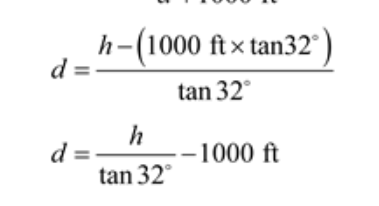
can anyone explain how this factors? its a trig problem https://imgur.com/nuZh3UA
 spark stag
do you mean how to get from the first line to the second?
$\frac{h-1000\cdot\tan{32}}{\tan{32}} = \frac{h}{\tan{32}} - \frac{1000 \cdot \tan{32}}{\tan{32}}$
somber coyoteBOT
Namington:
spark stag
do you see what we can do from there?
hallow smelt
ya thanks
hallow smelt
can anyone explain this https://imgur.com/nVQ9hwD
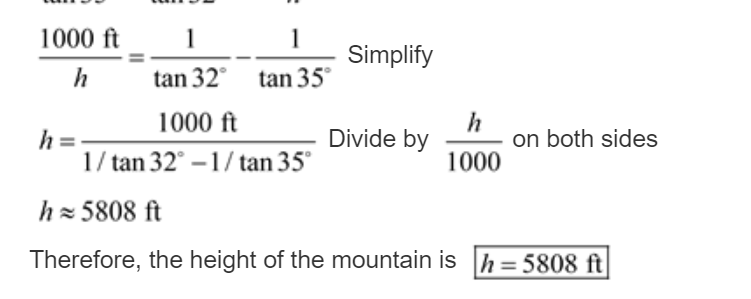
wouldn't dividing everything by h/100 leave the left side equal to 1
 cold plaza
h divide by h/1000 is same thing as h multiplied by 1000/h, which gives 1000 @hallow smelt
hallow smelt
@cold plaza I dont understand how we go from line 1 to line 2
line 1 being 1000ft/H = 1/tan32 - 1/tan35
cold plaza
take the reciprocal of both sides
u get h/1000 = 1/(1/tan32 - 1/tan35), then multiply by 1000
hallow smelt
why are they doing that though
cold plaza
to solve for h
hallow smelt
H/1000 = tan32 - tan35 right?
cold plaza
no u cant flip it like that
it would be that if the RHS was 1/(tan32 - tan35)
but its 1/tan32 - 1/tan35, which is completely different
(try turning it into a single fraction to see for urself)
hallow smelt
@cold plaza sorry im just not understanding this LOL
are you able to write it out maybe and post a picture?
if you have the time I'm not understanding
cold plaza
imagine the first line was h/1000 = 1/(tan32-tan35). after flipping, what do u get?
,, \frac{1000}{h} = \frac{1}{tan(32) - tan(35)}
somber coyoteBOT
layovah:
cold plaza
if that were the first line, then after taking reciprocal of both sides, u'd end up with (h/1000) = tan32 - tan35 (what ur saying)
but thats not the first line. in this case we have smthn different
hallow smelt
wouldnt taking the reciprocal of 1/tan32 and 1/tan35 wind up the same?
cold plaza
,, \frac{1}{tan(32)} - \frac{1}{tan(35)}
somber coyoteBOT
layovah:
cold plaza
is not the same as
dark sparrow
\tan
cold plaza
,, \frac{1}{tan(32)- tan(35)}
somber coyoteBOT
layovah:
hallow smelt
what is the recip suppose to be then?
somber coyoteBOT
layovah:
cold plaza
which is what they're writing in the second line
cold plaza
np
hallow smelt
so you cant just cross multiply on line 1
tan32 * 1000 and tan 35*1000
to be clear
hallow smelt
LOL
remembers how I failed to understand the recip
clarifies
thanks alot though
cold plaza
np
upper karma
just curious
if i have a cylinder but the height goes above the normal top (like the circle on top) and instead goes all the way up to a sort of 'arch', is there anything different i'd need to do there?
this is for finding SA and volume
spark stag
i have trouble visualizing what you're saying
do you mean its bent like an arch?
do you mean it caps off with some shape other than a circle (eg a dome)?
dark sparrow
@upper karma got a picture?
upper karma
Unfortunately not. But let me try and draw one
kinda badly drawn but

the arch extends upwards
it just cuts off
@dark sparrow
upper karma
Yeah
dark sparrow
...well then there you have it don't you
you've got a cylinder with a hemisphere stuck on top
hallow smelt
so you can only SocCahToa right angles?
 keen aspen
yes
hallow smelt
oh dam did not tell us that
keen aspen
since its not right angle you have to use law of cosines or sines
with the information given, you can find y and x with the law of sines
keen aspen
I dont know what you mean by that
keen aspen
epic
hallow smelt
can i assume that on the other side of the dotted red line at the bottom
is another 90 degree angle
keen aspen
other side?
hallow smelt
the H dotted red line
you see how one side is 90 degrees
can i assume the other is also 90
keen aspen
tyes
hallow smelt
thanks
I should try and find some time to retake geometry
do you see a simple way of solving this?
I already solved it correctly, but i did SohCahToa
and it was along process..
frozen kraken
180-35 is 145
So first angle is 3
Then with 1000 feet you can find the side of that triangle
If 1000 feet equals 3 degrees difference, then d is 11666.6667
Well I guess that’s of angle of h/d is 90
 vernal tusk
i don't have a question, but i did something neat that one of you might find cool
had a geometry quiz where it asked to find the equations of all the tangent lines of a circle
like, every y =
which is impossible, because there's infinite
and the teacher said nvm only do 4
but i thought it meant a general rule, so i did one before erasinf
wasn't actually right, but i fixed and completed it this morning
 fleet wolf
you can find the slope of the tangent line at every point on the circle
vernal tusk
y = ((h-x1)/sqrt(r^2-(x1-h)^2))(x-x1)+k+sqrt(r^2-(x1-h)^2), then you just negate both sqrts to get the negative
yeah, that's what i did
fleet wolf
then use where it meets the circle to find y intercept
vernal tusk
exactly
i'm not asking a question, again
i solved it
it works
just thought it was interesting
fleet wolf
ok
vernal tusk
used slope and point slope form
 supple abyss
it's good that you're having fun
 frigid wasp
i havent learned about hyperbolic functions but it tanh(x) =
hallow smelt
When I plot the function 400sincos that shit looks crazy as fuck and not like this picture
why does theirs not look insane
spark stag
@hallow smelt window settings?
also make sure you're in radians
if you're graphing in radians, on the interval [0,pi/2] with range [0,300] it should look the same
as such
supple abyss
this might just be my eyes being fucked up
but their pictures does't look symmetrical to me 
spark stag
ah yeah, good point
fsr it also goes above y=200
i think it was hand-drawn
still looks the right general shape though
hallow smelt
Oh shit how did you decide to use range 0 to 300?
I wasnt using desmos was using my ti-84
spark stag
trial and error works, or you can reason
at pi/4, both sin and cos have the same value: 1/sqrt(2)
multiply those together and you get 1/2
hallow smelt
is there a way to get the ti-84 to give me pie/4 as a value instead of decimals?
spark stag
so you need to have, at least 1/2*400
which is 200
so i overshot that a bit to 300
again, early estimates arent always perfect; use trial and error
no, the 84 won't give exact values when you trace a graph, im afraid
but you can find the y coordinate (200) and reverse-engineer it
200 = 400sin(theta)cos(theta) =>
1/2 = sin(theta)cos(theta)
which you might notice works if theta = pi/4
although whenever you get a weird decimal in a trig problem, its probably worth a quick check to see if it's pi/2, pi/4, 1/sqrt(2), etc
hallow smelt
ya that makes sense
the whole point of this is so I can get the dimensions of a cross section
is everything i colored a cross section?
 timid dagger
hallow smelt
timid dagger
hallow smelt
can you cut ABE in half to make a 90 degree angle and cut 2m to 1?
 flint compass
I was watching a video titled: Sine & cosine identities: periodicity on Khan Academy. In the video, he draws a right angle triangle in a unit circle and then makes another one by adding pi/2 radians to the angle theta. He then says how Cos theta = Sin(theta+pi/2) . I don't understand how the purple line is equal to Sin(theta+pi/2)
upper karma
Given area of rhombus and the angles how do u find the side lengths?
flint compass
@supple abyss I can't read the first drawing and I don't understand what the second drawing proves.
flint compass
How’s it equal to sin of theta plus Pi/2 tho? I still don’t get why it works out that way.
flint compass
Right but they’re both theta not theta + Pi/2. How does that relate?
supple abyss
the blue angles is pi/2 -theta because it's on a straight line with pi/2+theta
making the blue angle pi-(pi/2+theta)=pi/2-theta
the yellow lines are both of length 1 as they are radii of the circle
and the red angles are both pi/2 as they are right angles
this is enough for the triangles to be congruent by Angle Angle Side
flint compass
What do you mean by “the blue angles is Pi/2 - theta because it’s in a straight line with Pi/2 + theta?
flint compass
Ok, so then how does that make the line sin( theta + Pi/2)?
Wouldn’t it be sin(Pi/2-theta)?
Oh, I get it
supple abyss
well it's actually both
 vagrant elk
well, it kinda uses how sin x is periodic
If you were to plug that number into your calculator, you'd see it ends up right about 2/3. Just looking at a graph for a sine wave, you see it's symmetrical around the theta = 90* line (if you consider just from theta = 0 to 180) and it uses that symmetry to go backwards across in a sense
hallow smelt
so how do i easily find the 138.2 answer?
vagrant elk
you use sin ^-1 as provided by your calculator
and then 180-that because it's symmetrical you just do that to "work backwards"
vagrant elk
Cosine doesn't have the same symmetry
since it starts at one and goes to -1 in that same interval
hallow smelt
so then sine and csc are the only ones who are going to have two values 0-180
or 0 to pie
vagrant elk
Cos definitely doesn't have the same niceness
vagrant elk
not as far as I can see at first glance other than to introduce them all
hallow smelt
sometimes they do random stuff and i have no idea why
let me see if i can find an example from earlier today that confused the shit out of me
dark sparrow
mb because they consider cot^-1(s/50) to be less intimidating than tan^-1(50/s)
vagrant elk
i don't get it
supple abyss
ye
dark sparrow
proportionality constant
supple abyss

supple abyss
although the k makes the 8000 redundant 
hallow smelt
so K and 8000 are the same thing?
hallow smelt
oh
ya so then it does matter
this is what im taking away from this whenever I see the keyword proportional there is a constant there
supple abyss
ye
hallow smelt
I just went through thermodynamics in chem a shit ton of proptionalities
I dont think we signified there being constants in them
like Delta E = Delta T but no constant there
supple abyss
$\Delta E∝\Delta T$ or $\Delta E = k\Delta T, k \in \mathbb{R}$
somber coyoteBOT
CaptainLightning:
hallow smelt
the mcdelta t thing?
supple abyss
ye
hallow smelt
i hope this is not fake news
or im gonna sound dumb as shit on monday
-_-
hahaa
thank you though good to know
dark sparrow
is it possible to have two triangles with the same side lengths but different angles?
upper karma
I need halp
Help*
You'd know the answer if you knew what a rigid transformation was. Google it.
im slow with alot
Alot isn't a word.
hallow smelt
21 savage said it was
upper karma
 dire rampart
sin^2-1=-(1-sin^2)=-(cos^2)
hallow smelt
oh dam I knew it was going to be something obvious like that fuck
1-sin^2 = cos^2 not sin^2 - 1....
thanks
 raw prism
<@&286206848099549185> could I get some help with question 9
dark sparrow
what's that pencil-drawn squiggle on top meant to be
dark sparrow
well what have you tried so far for that one?
 split raven
How can I simplify sin(270 + A)?
dire rampart
sin(270+A)=sin(180+A+90)=-sin(A+90)=-cos(A)
 honest bay
$\frac{cos(2a)+cos(2b)}{sin(a)+cos(b)} = 2cos(b) - 2sin(a)$
somber coyoteBOT
mohad12211:
somber coyoteBOT
mohad12211:
honest bay
I tried this but i am stuck now
honest bay
$cos^2(a)-sin^2(a)+cos^2(b)-sin^2(b)$
somber coyoteBOT
mohad12211:
honest bay
then
dire rampart
ok then?
honest bay
$1-sin^2(a)-sin^2(a)+cos^2(b)-1+cos^2(b)$
dire rampart
somber coyoteBOT
mohad12211:
dire rampart
I'm not even sure the original thing is true
dire rampart
,w is ((cos(2x)+cos(2y))/(sinx+cosx) equal to 2cosy-2sinx
honest bay
lol
halcyon coyote

honest bay
$-2sin^2(a)+2cos^2(b)$
somber coyoteBOT
mohad12211:
honest bay
$\frac{-2(cos^2(b)-sin^2(a))}{sin(a)+cos(b)}$
somber coyoteBOT
mohad12211:
honest bay
should be like this
honest bay
Ohhhh
honest bay
well it is solved now
dire rampart
no what u have is -2(cosb-sina)
honest bay
yeah
dire rampart
oh u factored wrong
dire rampart
rip
dark sparrow
$\cos$, not $cos$
somber coyoteBOT
Ann:
dark sparrow

dire rampart

 golden arrow
Hi I'm trying to solve for alpha in the equation I have just sent, I feel like I've come up with a solution but the values arent checking out, can anyone help?
 carmine pasture
000hubibibhiuhiuh
 knotty falcon
I may be misreading it but 7 is just simply divided by t
And the other two are just rearranging the equations
C= 5/9(F-32) becomes $9C/5 = F-32$
somber coyoteBOT
Jimbo:
knotty falcon
And then you add the 32 to both sides and then you can write the equation as
oof, sorry I'm new to this. xD
somber coyoteBOT
Jimbo:
 raw wren
Anyone here good at verifying identities? I’m desperate
raw wren
I’m in college :(
 umbral snow
@raw wren
Or college!
Feel free to post it I was kidding. In the future just ask, don't expect people to prompt you.
raw wren
Oh I’m stupid lol thank you
Okay I’m stuck on the first question. I know the answer but I’m confused on the steps. It’s verifying identities
supple abyss
use $\sin^2\theta + \cos^2\theta \equiv 1$
somber coyoteBOT
CaptainLightning:
raw wren
When do I use that formula? I tried working on the right side first
supple abyss
use it on the left
raw wren
Okay thank you
supple abyss
np
spark stag
Why do you use \equiv
 eager mesa
identity
spark stag

eager mesa
what you solving
eager mesa
cant be determined i think
angle FDE
can vary depending on lengths FE
even when angle DFE is 126
think about it if point E is close to F, the angle FDE will be very small
E goes to very far, angle FDE will be bigger
same goes for angle FED i thnk
 slate pewter
i think its like this
becuse FDE
is cute it by the half
so its need to be the other angle is will be equal to it
so i think its like this
 solemn harbor
Geometry is fascinating, I mean, at least the very basic Euclidean plane geometry course that I took. But surprisingly simple things are tedious to prove.
Not as fascinating as abstract algebra though.
 lofty scaffold
upper karma
lofty scaffold
upper karma
Stop breaking rules 
Geometry is fun
Without geometry we'd likely have no calculus and then we'd be boned
Don't remember what an orthocenter is tho
upper karma


So, this might be a dumb question, but up to this point, I have been factoring to find the correct phase shift, but when I factor this equation I get 1/2(4x-pi) not pi/4, am I factoring incorrectly?
spark stag
why would you factor out 1/2?
you want the coefficient on the x to be 1
pi is a constant, it can be whatever
upper karma
I see, thank you.
 swift thistle
whats the logic of ?
dire rampart
24=4 times 6
dire rampart
$\sqrt{24}=\sqrt{4 \cdot 6}=\sqrt{4} \cdot \sqrt{6}=2\sqrt{6}$
somber coyoteBOT
lemon catto:

 limpid basin
You need to explain it in terms of math
 dense tundra
does anyone know how to do this?
i solved for y and got y + 4 = t then i just used x and substituted y + 4 for t in x
upper karma
looks right
unless they want you to solve for y= something
and expanding it would help
dense tundra
yea i got it, i just had to expand it and set it equal to x = (answer)
 heady juniper
Hi all
i am trying to study for my maths exams
and i am in need of circular geometry questions
if anyone has some good ones
please message me
flint compass
Is there a formula to calculate cosine?
 gritty siren
adjacent / hypotenuse?
flint compass
Isn’t that only for a right angle triangle?
When I do cosine of angle 45 how does my calculator know the ratio/correct answer?
gritty siren
ah, outside the context of elementary geometry, there is more stuff
there are algorithms to approximate the values of cosine and other stuff
flint compass
Ok.
gritty siren
t!wiki cordic
 loud cedarBOT
📖 | ** https://en.wikipedia.org/wiki/CORDIC **

CORDIC (for COordinate Rotation DIgital Computer), also known as Volder's algorithm, is a simple and efficient algorithm to calculate hyperbolic and trigonometric functions, typically converging with one digit (or bit) per iteration. CORDIC is therefore also an example of di...
flint compass
Ok, I’m also confused on why cos(x) has less oscillations then cos(4x)
dark sparrow
cos(4x) oscillates four times as fast
 steady sleet

 celest wave
how do i figure out c when i know a and x?
dark sparrow
you know a and x but nothing else?
celest wave
yes
dark sparrow
write out the pythagorean theorem for every right triangle in this problem
see what you can get
celest wave
i cant really do much with it as i only know these two
dark sparrow
no i mean you've got all those other variables to play with
in the picture
do it in terms of those
celest wave
i dont understand what im supposed to do with the unknown variables
 vague pagoda
trig
dark sparrow
express them in terms of known variables, and potentially each other
this can be done trig-free
$\begin{cases} a^2 + b^2 = c^2 \ x^2 + h^2 = b^2 \ h^2 + y^2 = a^2 \ x + y = c \end{cases}$
somber coyoteBOT
Ann:
dark sparrow
@celest wave does this make sense to you
dark sparrow
no
i do not
immediately you can see that you can take the first and second equations and combine them into one: $a^2 + x^2 + h^2 = c^2$
somber coyoteBOT
Ann:
dark sparrow
and since you don't care about b you might as well just forget x^2 + h^2 = b^2
$\begin{cases} a^2 + x^2 + h^2 = c^2 \ h^2 + y^2 = a^2 \ x + y = c \end{cases}$
somber coyoteBOT
Ann:
celest wave
i cant really use any of these yet as i dont know h or y
dark sparrow
yeah, but again, you can eliminate another variable you don't care about
in this case, h
h^2 = a^2 - y^2
$\begin{cases} 2a^2 + x^2 - y^2 = c^2 \ x + y = c \end{cases}$
somber coyoteBOT
Ann:
celest wave
i still dont know what i am supposed to do with this as i dont know y
celest wave
i mean i do care about y as y is needed to figure out c
dark sparrow
you don't care about y in that you don't need to find the value of y
and you can eliminate it
$2a^2 + x^2 - (c-x)^2 = c^2$
somber coyoteBOT
Ann:
dark sparrow
et voilà, an equation in a, x and c only
dark sparrow
over 10000 might be just a little too much
celest wave
those are decimals
dark sparrow
but why do you need to replace a and x with specific values and give me approximate solutions when it's possible to solve for c directly?
dark sparrow
$2a^2 + x^2 - c^2 + 2cx - x^2 = c^2$
somber coyoteBOT
Ann:
dark sparrow
$c^2 - xc - a^2 = 0$
somber coyoteBOT
Ann:
dark sparrow
$c = \frac{x + \sqrt{x^2 + 4a^2}}{2}$
somber coyoteBOT
Ann:
dark sparrow
like that
celest wave
that results in 19.562
dark sparrow
,calc (3 + sqrt(3^2 + 4*9^2))/2
somber coyoteBOT
Result:
10.624143795447
 merry rapids
Is anyone able to help me with this question please? We are meant to find the surface area however I can't seem to do it. The answer is 156cm however I somehow get 149cm doing: (7x3x2)+(4x3x2)+(7x4)+(1/2x7x5x2)+(1/2x4x5x2)
dark sparrow
ok first off don't use x for multiplication
second, 5 m is not the height of any of those triangles
merry rapids
Is 5m the slant height?
dark sparrow
no
merry rapids
The perpendicular height of the pyramid?
dark sparrow
yes
merry rapids
I want slant height right? So would I do Pythagoras (5^2+3.5^2...square root ans = 6.1 ) to get the slant height?
dark sparrow
the pyramid doesn't have a square as its base, and so does not have a single "slant height"
you need to find the height of each one of its triangular faces
merry rapids
Sorry my bad, but wouldn't I still do Pythagoras in order to achieve that?
dark sparrow
i mean yes you'll end up using the pythagorean theorem
merry rapids
Thanks
upper karma
@vital frost
 vital frost
yo
upper karma
You first need to find what t is
upper karma
@vital frost angle b is a right angle because it intercepts a semicircle
So t=8
Then plug 8 into (4t+1)
vital frost
how do u know t =8
upper karma
Because angle b is a right angle
So (7t+1)+(4t+1)+90=180
Then you do the algebra and get t=8
@vital frost
So then you plug 8 into (4t+1) to get 33°
And since the central angle is twice the inscribed angle, the central angle is 66°
vital frost
so 7t+1 would be 57
upper karma
Yes but for the measure of AB you only need 4t+1
Which is 33°
The angle measure of the arc equals the central angle, which is twice the inscribed angle @vital frost
So the angle measure is 66°
vital frost
is that what the question is asking me>
vital frost
Solve for the arc length AB is segment AC is a diameter of the circle measuring 8 yrds
upper karma
We found the angle measure of the arc so now we can calculate arc length
So the radius is 4 yards
vital frost
mhm
vital frost
uh no
upper karma
So you have the measure of arc AB, right?
vital frost
to get this?
vital frost
doesnt say
vital frost
yo
vital frost
ok
upper karma
Notice how LMOP is a quadrilateral?
upper karma
And quads have a total measure of 360°?
vital frost
yes
upper karma
So rays LP and LM are tangent to the circle and segments MO and OP,respectively, are perpendicular to these rays
If an two lines are perpendicular, the angle measures are 90°
So 360-165-90-90 will give you angle L
L is 15°
upper karma
Yes
vital frost
how about the circumscribed angle method
upper karma
Okay
So the measure of a circumscribed angle is supplementary to its arc
So the arc MP=165°
180-165=15
 gloomy python
astral hornet
gloomy python
astral hornet
as per markings all sides are congruent?
if y is the measure of that angle then yes its 45
and 45-45-90 ratio to find one leg
and since all sides are congruent you now have the length of all sides
upper karma
Yeah u use 45-45-90
upper karma
Hello
I'm new.
So, I am currently trying to learn Geometry
Please tell me topics that I might see in Geometry class, 😄

t!yt What is geometry
loud cedarBOT
 dark sparrow
this is triangle
upper karma
yea
dark sparrow
what do you know about the angles in a triangle
upper karma
Hint: 71=X
upper karma
I'm bored
dark sparrow
go shitpost elsewhere
upper karma
it is not shitposting Btw
 eager pendant
which geometry are we talking about
supple abyss
I didn't know the answer was considered a hint
dark sparrow
i don't think i'd be lying if i said 95% of the active population of the server would consider this too trivial to be of any entertainment value whatsoever
upper karma
Capitalize your "I" "smart person" and also add a punctuation mark.
supple abyss
eager pendant
just 95?
dark sparrow
look who's talking, mr/mrs/mx doesn't-use-commas
 mild cargo
this is math server not english grammar server lol
upper karma
*This is a math server not a english grammar server, lol.
dark sparrow
*This is a math server, not an English grammar server, lol.
upper karma
C RAP
dark sparrow
i can outgrammar you just as easily
dark sparrow
if you wanted to flex you should've prepared to get flexed at
gritty siren
is math an actual word ?
eager pendant
maths
upper karma
@dark sparrow *If you wanted to flex, you should've prepared to get flexed at.
dark sparrow
i know how to punctuate Properly™, thank you
this isn't the kind of environment where one would normally put in the effort to do that
upper karma
Well, why did you capitalize the "p"and add a TM
upper karma
ok I am here for geometry I give up
dark sparrow
if you have a geometry problem you're stuck on, post it
upper karma
ok
dark sparrow
instead of, yknow, being a prescriptivist dick
upper karma
ur the dick
dark sparrow
upper karma
well stop yelling
dark sparrow
yelling?
vague pagoda
@upper karma thats just trig and pythagorean theorem
vague pagoda
OH LOL
supple abyss
U wha
vague pagoda
no its not
upper karma
oh wait
upper karma
its 71
 stuck iris
what is going on lmao
vague pagoda
right triangle
upper karma
Its right
dark sparrow
cotton
supple abyss
You literally assumed it was isosceles while doing that
vague pagoda
what
vague pagoda
why
mild cargo
No @supple abyss
vague pagoda
why cant u overcomplicate things
dark sparrow
38 + 71 + x = 180; what more does one need?
mild cargo
You make a right triangle, and then do 180-90-71 to get the final angle, which just happens to be half of the 38 angle
vague pagoda
idk nothing?
hallow smelt
why is tan-1(-20) possible?
doesnt that mean the opposite over adj is a negative? how can distances be negative
 plucky marlin
trigonometric ratios can extend beyond geometric interpretation
it doesnt always have to be "opposite over adjacent"
u can extend the definiton of tan(x) using unit circle
hallow smelt
they wanted me to calculator that out and then do 180-that for the angle
isnt 180 - (-w/e tan-1(20) a positive number over 180?
hallow smelt
the value of tan-1(-20) is -1.5
x180/pi = -87 degrees
wouldnt 180 - (-87degrees) be over 180?
thats what im saying
 hallow smelt
ill ss the solution sec
I get that they even/odd propertied it out right
wouldnt it be 180 - (-tan)
plucky marlin
do you know in which quadrants is tan(x) negative ?
hallow smelt
2/4
plucky marlin
yeah
in this case your theta is between 0 and 180
so only the 2nd quadrant sits in there
hallow smelt
so Q 2
hallow smelt
no man that was really good
wait
but why wasnt it Q4 again?
because starting at 0 we could go negative
and it would be slightly before the -90 degree mark
oh wait
nvm nvm
they restricted it to 0 - 180
plucky marlin
yeah
hallow smelt
this is not the first problem I have done with this thing where they ask for angles between 0-180
I never was picturing the unit circle
good tool thanks


 hallow smelt
can you show me where I went wrong here
thats better
im suppose to solve for solutions from [0, 2pi)
umbral snow
The first one is three quarter circles each with radius 7
umbral snow
Implying they are quarters
 little osprey
lmao
 young hemlock
lol
umbral snow
No. Now you have to have a very large presence here
little osprey
He's joking
young hemlock
so is anyone willing to help or
upper karma
Well he told you 1
3 is a quarter of 6 and a half each of 3 and 12
And 5 is half of 6
little osprey
what?
young hemlock
what
young hemlock
yes
upper karma
little osprey
So to find the arc length what do you need?
little osprey
Wait you're confusing me Kronk
young hemlock
@little osprey theta?
little osprey
Uh yeah, and what is theta?
young hemlock
the angle
little osprey
What is the angle in between the sides of a quarter
young hemlock
90
young hemlock
oh
little osprey
you would replace the theta with 90