#geometry-and-trigonometry
1 messages · Page 202 of 1
 lone nova
This I think @dark sparrow https://cdn.discordapp.com/attachments/279435476757250049/556834281050210334/nratbig.png?

 dark sparrow
i'm familiar with the sine and cosine rules dw
it's just that this problem you posted is a bit tricky since it seems like there's plenty of data but it's hard to get a grasp on
lone nova
alright
@dark sparrow someone atually came up with a solution but I do not understand it
2.sin(150-x).sin(65)=((2+2.cos(x))^.5).sin(85-(x/2))
lone nova
that is all
 upper karma
either im hallucinating or you can do this with just the fact that sum of angles in triangle is 180
lone nova
dark sparrow
sorry, i got other things to worry about rn
lone nova
it is alright, thanks for trying anyway!
 deft umbra
Did I do this problem right?
 inner lantern
oh hi @lone nova
 jade maple
whats the formula for the size of internal angles in regular shapes
_ look at this digon
 astral hornet
180(n-2)/n

 lament bay
<@&286206848099549185>
upper karma
@lament bay
in triangle ABC, let's say the angle at A is α
now what must the angle at B be?
upper karma
suppose you have a right triangle, with a right angle at C, and from C a height dropping onto point D - and you're choosing which point to name A and which to name B
if you say that the left one is A, you get the situation on the drawing you sent
if you say that the right one is A, you STILL get basically the same situation
all the assumptions: right angle at C, at that D is the foot of the height, STILL WORK
so it makes sense that with your new assignment of letters, point a) would still work: so AD * AB = AC²
but if you look at the picture as if B is on the left and A is on the right, and find out what it means, it means the same as DB * AB = BC² in your old way of naming points
so, b) must be true!
upper karma
look at the angles
they both share the angle at B
they both also have another right angle
so the third angle of each has to be equal, and so they are similar
upper karma
to prove b) or c)?
upper karma
take DB * AB = BC² which has to be proven
divide it by BC and by AB to get an equivalent equation
lament bay
uh
upper karma
if DB / BC = BC / AB is true, then b) must be true as well
upper karma
i think so?
ree proof tables
lament bay
what triangles i prove similar for c?
upper karma
i think you'll agree that some triangle you choose has to have AD as one of its sides
lament bay
ok
upper karma
likewise some triangle has to have DB as one of its sides
the three triangles to choose from are ABC, ACD, and BCD
lament bay
CAD=bac?
upper karma
you won't get DB anywhere then
lament bay
idk then
upper karma
which triangle has AD as a side?
lament bay
cad
upper karma
and which has DB?
lament bay
cdb
upper karma
so you've got just one choice left after all
cad ~ cdb is the thing to prove
how to do it? angles
upper karma
just name whichever non-right angle alpha, and from that calculate all the other angles
upper karma
pick whichever you like from angles: dac, acd, bcd, cbd
lament bay
idk 😦
upper karma
it doesn't matter which one you choose
lament bay
dac and acd
upper karma
ok let's go with dac
now acd = 90 - dac
bcd = 90 - acd = 90 - (90 - dac) = dac
that should be enough to prove that the trianglec acd and bcd are similar
upper karma
what is confusing
lament bay
what theorems do i use?
upper karma
??
lament bay
upper karma
you understand that the sum of the 'small' angles in a right triangle is 90 degrees?
upper karma
and this statement is a theorem?
lament bay
yes
upper karma
so what's the problem
lament bay
prove (AD)(DB)=(CD)^2
upper karma
yes yes ok, but what's the problem with using "the sum of the 'small' angles in a right triangle is 90 degrees" as a theorem
upper karma
guess i can't help you with that :/
lament bay
hmm
what did you do for the 2nd step?
or are all the 2 steps the sum of the 'small' angles in a right triangle is 90 degrees
upper karma
bcd and acd give 90 in total because picture
bcd = 90 - acd then
you can substitute for acd after that
upper karma
that's because acd and dac must sum to 90 - look at triangle acd
upper karma
well what about that :/
lament bay
what theorem
upper karma
i have no idea what theorem or what
upper karma
<BCD+<ACD=90 yes?
lament bay
yes i know that
upper karma
so, <BCD=90-<ACD
upper karma
there aren't that many equations to try to see which one will give you c
upper karma
maybe, just maybe, homework isn't 100% asking math discord on what to do
make the proportion yourself
lament bay
idk
upper karma
if it will give you c), yes
lament bay
i think it will give c
 normal chasm
I apologize if this is too obvious, but why do the trig functions look like this?
astral hornet
think back to the unit circle
 wintry hatch
Cosinus and Sinus oscillate because if you look go around the unit circle, you come back at the beginning
lament bay
 lament bay
<@&286206848099549185>
 dry totem
@lament bay, since angle C = 90 degrees, the two triangles created by CD are similar
lament bay
Hmm
upper karma
I’m not sure if we can assume that CD bisects angle C perfectly
dry totem
Hence,
If you can solve that, you'll have your answer.
Those ratios must be the same...
@upper karma . The segment CD is a perpendicular projection.
It creates two similar triangles.
upper karma
x =/= x + 7 though
If they were similar they would have the same ratio between side lengths
If CD is a length of 12 that implies that the side that both triangles share is the same, so the triangles are congruent, but that contradicts itself since they clearly aren’t
dry totem
The triangles may share one side, but one triangle's length is the other triangle's width...
You'd have to imagine the angles... In this case the angle cab=bcd and the angle cbd=acd
And these triangles share a 90°
upper karma
heyyo
so i'm having trouble understanding how to solve this problem
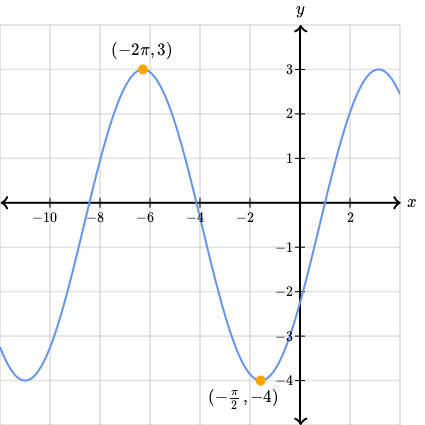
https://cdn.kastatic.org/ka-perseus-graphie/4fef060669261047d838b249057ad15f815e1c0d.png

maximum point is (-2pi, 3) and minimum point is (-pi/2, -4)
as an effect of horizontal streching the cos function of the form
$$h{(x)} = a * cos{(b*x + c)} + d$$
 somber coyoteBOT
taven:
upper karma

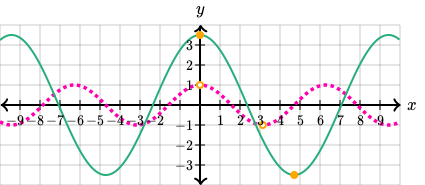
now the max point is at (0, 3.5)
however, the solution to convert the above graph into the previous one is saying
$$3.5 * \cos{(2/3 (x + 2\pi))} - 0.5$$
somber coyoteBOT
taven:
 zenith raptor
From Kisilev's Planimetry
okay, i have a question about this construction
- why point E is necessarily equidistant from A and B
- why DF = FC
to be honest, the entire thing makes next to no sense to me, since there are straight lines connecting the endpoints of the given segments
dark sparrow
(1) E is the midpoint of AB by defn
(2) ditto for F and CD
zenith raptor
my understanding is that the point is to construct a quadrilateral such that E and F are midpoints of the sides not given
we are given segments congruent to two of its sides (so we are given segments AD and BC) and the line EF which connects the midpoints of AB and DC. right? so, when we translate AD and BC, why is it already the case that E and F are midpoints?
oh, should this be in one of #❓how-to-get-help channels?
 gloomy python
How do you find scale factors?
 drowsy walrus
divide
gloomy python
Divide what lol
somber coyoteBOT
xItzDia:
 glad snow
How to squish a square into a circle using matrices
Does such a thing exist or are matrices only for linear things
Maintaining radial ratios
Ie eigenvectors are the infinite set of vectors origination at origin
dark sparrow
matrices represent linear transformations only
 last lichen
so u just remember that?
 halcyon coyote
memorise the unit circle tbh
last lichen
oooo
halcyon coyote
basically for those angles
 sleek perch
x D
last lichen
so i just memorise that and im gucci
halcyon coyote
you have 1/2, 1/2 sqrt(2) and 1/2 sqrt(3)
so its basically like
cos(45) is in the middle -> 1/sqrt(2)
idk this picture is not the best but it does illustrate the idea
last lichen
what about like tan and sin
halcyon coyote
well this is mostly for sin/cos
inner lantern
sin is next to cos
inner lantern
and tan is just sin/cos
last lichen
mmk
sleek perch
mmk
inner lantern
i know you @sleek perch
sleek perch
lol

 half saffron
@last lichen sorry for the late reply but
If you're allowed to use the calculator in the exam
last lichen
yeaaa
half saffron
cuz if you could you could just square the ans
last lichen
hence why im asking
last lichen
reeeee
zenith raptor
@lament bay there are three right triangles in the figure, and three unknowns
lament bay
Ok
astral hornet
Right Triangle with altitude drawn to hyp creates similar triangles
 lusty quest
guys, pi is half of a circle so 2pi is a whole circle
the circumference formula is 2pi * r
what does radius have to do with this?
ok nvm i figured it out
 wary turtle
It's 2r
Since pi equals to the circumference/diameter
That is the relation you may be looking for
wary turtle
You're welcome
gloomy python
can someone help with this question
The distance from atlanta to savannah is 5 3/4 inches on the map. how long would it take to drive from atlanta to savannah if you drove at an average of 65 miles per hour?
 umbral snow
Need a map → size function
upper karma
How do I solve this
I've never learned the formula relating the sides of a quad before
 scenic trench
It’s a ratio
I think you’d need to pair the similar sides and find the ratio.
Then extrapolate x using that ratio and the similar side
lusty quest
you only need 2 sides of each, no?
lusty quest
4/3 = x/27
upper karma
Is my answer correct @dark sparrow
lusty quest
2.7*
lusty quest
yeah
upper karma
kk
dark sparrow
you only need 2 sides of each, no?
is that not exactly what i did lmao
anyway yes it's 3.6
lusty quest
sorry i didnt look
dark sparrow
not possible to do uniquely unless you know the quadrant theta is in (though the two possible values of sin(θ) differ by sign only)
otherwise tho, draw a right triangle
 sharp moon
half saffron
sharp moon
half saffron
Use $\cos(a+b)=\cos(a)\cos(b)-\sin(a)\sin(b)$
and $\sin(a+b)=\sin(a)\cos(a)+\sin(b)\cos(b)$
somber coyoteBOT
Itadakimasu!:
half saffron
@sharp moon
dark sparrow
here's a right triangle
last lichen
Yea
dark sparrow
can you label two of its sides in a way that makes tan(θ) = 2?
(don't overthink it)
last lichen
2/1?
last lichen
Sqr root 5?
last lichen
2 over sqr root 5
dark sparrow
and there you have it
lament bay
 elfin ibex
∆ABC ~∆DAC (AA similarity postulate)
∆ABC~∆DBA (AA similarity postulate)
Therefore
∆DBA~∆ABC (AA postulate)
If you can't solve it from there, I can post another line of the solution
Let x equal DA
x\2 = 8\x
x^2 = 16
x=4
__
Let y = AB
y\2 = 10\y
y^2 = 20
y = √20
Let z = AC
8/4 = z/√20
z = 2√20
I'm not confident in my answers though.. I only covered it briefly on khan academy a week ago.
Might be wrong
The square roots can still be simplified
half saffron
@lament bay okay I solved your question using a relatively simple method
You need to utilise Pythagorus (or however you spell his name) theorem whenever you can and form a set of equations, from there, perform substitution to find your desired lengths
 tender adder
 supple abyss

 blissful cliff
Is it not just 360/14, or am i thinking about this wrong?
blissful cliff
Like for a triangle it would be 120 degrees, and for a square it would be 90 degrees. So the formula is 360/n, where n is the number of sides of the regular polygon
 solar shale
👍🏼
last lichen
Why is it that those two values are used?
last lichen
Ah
last lichen
?
 outer otter
is sin(x + y) the same as sin(x)sin(y)?
dark sparrow
no
outer otter
k
dark sparrow
if it were the case then sin(anything) would be zero lmao
$\sin(x) = \sin(x+0) \overset{?!}= \sin(x)\sin(0) = \sin(x) \cdot 0 = 0$
somber coyoteBOT
Ann:
outer otter
oh
 spark stag
dark sparrow
spark stag
dark sparrow

 upper karma
what
imagine
i see who you are
you are that bangladeshi guy who was named Integration By Depression
 steady sleet

upper karma
lol
 plucky solar
I need to prove this and I'm not sure where to start, any ideas?

 plucky solar
oh sorry
it is the area of a triangle
not a specific type of triangle
well actually, I managed to do it
it always happens when I ask something on here
if i ask something i immediately get the answer myself lol
 lime flame
Can someone explain to me why the answer is A
I didn't know how to do it so i guessed A
and i got it right lol
lime flame
<@&286206848099549185>
lime flame
upper karma
Its derived from this
mg is the magnitude (with a direction) of Fg
Since it's on a slope part of it acts down the slope due to gravity
lime flame
Is this physics?
upper karma
yeah
lime flame
Oh this was on my geometry test so
How can I solve it without basic background knowledge of physics?
 raw prism
<@&286206848099549185> Could someone help me understand how to do this
solar shale
Do I use a^2 + b^2 = hyp^2
raw prism
for BC?
raw prism
use that and then find the angles using basic trig
raw prism
subtrat 100 from eacj side
raw prism
then take sqaure root of each side
solar shale
Wdym
raw prism
allowed to use calculator?
solar shale
Yeah
raw prism
take the square root of 125
raw prism
thats the lenght of the missing side
solar shale
So I’m done correct?
raw prism
depends do you still have to find the angles or no?
solar shale
Just says find measure
raw prism
have u learned trig?
solar shale
Yes
raw prism
ok then I would assume u gotta fine the angles
solar shale
Yup
raw prism
yea so use that on any angle and it should give you the correct angle
solar shale
Ok also
For this question I would use the same thing a^2 + b^2 =c^2 correct? And after use the sohcahtoa
@raw prism
raw prism
yea
solar shale
Ok
raw prism
since u need all sin cos and tan
solar shale
Yeah
raw prism
remember to take the inverse of whatever value u get to find angles
solar shale
Aight
raw prism
Now <@&286206848099549185> can someone help me with this
upper karma
,rotate 270
somber coyoteBOT
raw prism
woah thats convenient
upper karma
Triangle with sides 10,10,12
raw prism
yep
raw prism
I tried using cosine rule but anwser didn't come out right
raw prism
b^2= a^2+c^2 - 2ac * cos B
yea that
i got 53.1 degrees any chance u could do it and check?
upper karma
,w Arccos((144-200)/(-20))
somber coyoteBOT
 Requested by Babowwz#1394
raw prism
Requested by Babowwz#1394
raw prism
i got it right
upper karma
That's radians
raw prism
just need to times 2
upper karma

upper karma
,w 1.689 radiant to degrees
somber coyoteBOT
Requested by Babowwz#1394
raw prism
yea
checked anwers
its 106
i got 53 cause i found half
how about part b though dont know how to do that one
upper karma
Got answers to check?
raw prism
I DO LEMME GET THE ANWSER crap caps
upper karma
raw prism
anwser is 7.2 N
upper karma
,Calc 12cos(53)
somber coyoteBOT
Result:
-11.019393434545
,Calc 12cos(53degrees)
somber coyoteBOT
Result:
7.2217802778246
I need to review resultant angles cuz I suspect is half, but mathematically I suspect its not always
raw prism
well anyway thanks for guiding me
really appreciate it but since i pretty much suck at math i will prob be back here
 plucky marlin
WTF
upper karma
humongous cheese
plucky marlin
did he get banned too ?
steady sleet
dwai
 olive solar
yeah they did
steady sleet

lime flame
You are given a equilateral triangle inscribed in a circle with the center shown. Find the diameter
<@&286206848099549185> Sorry for ping but I need a solution asap
upper karma
lol
find the circumradius of that triangle
and that's quite easy with the law of sines
@lime flame why do you need solution ASAP? 


also don't expect people to give you solution
I need 50$ ASAP
If its graded then you're asking us to help you cheat fren
@lime flame
If you put off Hw and about to go to class rip u too
Either way you roasted
lime flame
Lol :(
 dark sparrow
consider making a picture
 civic monolith
 tropic shard
Nope, when you plugged in 36, you forgot to add 48 to it to give you the side of ΔDFE. (DPQE is a trapezoid).
 cloud meteor
If I have a triangle with side lenghts 2Sqrt(2) 1 and 3
(right triangle)
and theta is opposed to the 1 and the hypotenuse is 3
2 theta*
tropic shard
@cloud meteor What about it?
cloud meteor
Nevermind
 past siren
tropic shard
past siren
tropic shard
Vertical angles*
dark sparrow
these are vertical angles
 lofty scaffold
dark sparrow
lofty scaffold
dark sparrow
no they're just called vertical iirc
somber coyoteBOT
Benjamaster7:
 mint token
I have a question. I was able to prove it by labelling ABCD in a valid way, but the official solution labelled it in a different valid order and thus had a different solution
would it be necessary to prove both cases? the cases are almost the same but have different point names
dark sparrow
what have you tried so far and where are you stuck?
do you have any work to show
it would greatly help me help you
as you say
...
upper karma
hahahahahahahah
olive solar
@dark sparrow you okay?
dark sparrow
someone asked for help and then deleted their own messages
olive solar
o lol
 cold tangle
If <A = 30° and BC = 6, how can I determine AB?
Has to be something w/ the trigonometric functions right?
half saffron
What do you know about sin cos and tan?
 vague pagoda
trig is cool
cold tangle
And how about this one?
AC = BC
AB = 4
Calculate the value of the missing sides
lusty quest
looks like one
lusty quest
howd you figure out the angle?
cold tangle
Yea it is
lusty quest
since its not that, then how would you fing the other angles?
plucky marlin
well if its a right triangle then just use pythagorean theorem
lusty quest
but other 2 sides are unknown
somber coyoteBOT
soap:
plucky marlin
ig u can solve it ?
lusty quest
so x^2 +x^2 = 4^2
plucky marlin
yeah
lusty quest
im on phone, typing slow
plucky marlin
dwai
lusty quest
yes but you still gotta know 2 numbers to solve for the third
vague pagoda
??
lusty quest
yes
lusty quest
so is x^2 +x^2 = 16 the final answer then?
plucky marlin
$2x^2 = 4$
somber coyoteBOT
soap:
plucky marlin

plucky marlin
lmao
vague pagoda
oof now I get it
 vague pagoda
so what is the answer
lusty quest
sqrt 2
vague pagoda
o
lusty quest
wait no, he didnt square the 4
vague pagoda
so 2?
lusty quest
bRuH r u high
lusty quest
mAtH
plucky marlin

 paper frost
What is the orientation of a plane in space when two of the three variables x,y, and z are missing from its scalar equation
plucky marlin
like z = k ?
paper frost
that's what i was thinking but im not really sure
plucky marlin
thats gonna be a plane parallel to both x and y axis and intersects the z axis at k
paper frost
ohhh i get it, thanks!
 covert orchid
how is this correspondence of angles called ? i was doing a trigonometry exercise and i just saw that i needed to know this to solve it
i want to know more about it but i dont know its name haha
somber coyoteBOT
raw prism
there
raw prism
<@&286206848099549185> i'm stuck on the problem above could someone guide me
umbral snow
@raw prism
Q2 There?
raw prism
yes
raw prism
ok
umbral snow
A little messy, but that's splitting everything up
Let's start with the blue. See how I got those angles?
The 60°, 60°, 30° there
raw prism
yea I understaand that
umbral snow
Perfect, let's move onto the red. Do those components make sense?
raw prism
I was taught to draw them this way sticking out from each line is that fine too?
umbral snow
Yeah! Whichever is fine for you. I like my method as it shows the right triangles, and makes the trig clear. Either way, know why the red values work
raw prism
ok
umbral snow
Anyway, we want to add all of the components in the x-direction, to find the net force in the x-direction.
Likewise, we want to add all of the components in the y-direction, to find the net force in the y-direction
Net force in x = 10cos(60) - 10cos(60) + 6cos(30)
raw prism
ok i got that
raw prism
14.32
umbral snow
Yus.
Therefore, the net force on the origin is (5.196, 14.32)
Now, what force should we place on the origin to cancel that out?
raw prism
the same ones in the opposte direction?
umbral snow
The net force, in the opposite direction. Throw (-5.196, -14.32) on there, and the forces will balance out
raw prism
i can just throw it in?
umbral snow
That will be the resultant, as it is the force that keeps anything from moving
raw prism
so the y resultant should be my answer for "in direction of PQ"
raw prism
and for maginitude I just take square of both x and y results, add them and then take square root right?
umbral snow
Yus yus
raw prism
thanks alot
umbral snow
It will be longer than 14.32
raw prism
ye got 15.23
@umbral snow one last question for now. how would I know which angle to use the 30 degrees between the line and the y axis or the 60 degrees between the line and the x axis
tropic shard
If it ain't Supernatural Season 16, Idk why anyone would be that excited.
 dire rampart
@tired current plz dont multi post
 unique patio
<@&286206848099549185>
umbral snow
@unique patio
Not enough info there. I'm thinking α is set for you in the question
umbral snow
That's different. Now I know the body is static
So, the sum of the forces on the seat is 0
Sum of X:
40 = P1sinα + P2sinα
Sum of Y:
50 + 75 = P1cosα + P2cosα
It's easiest to take the moment about the top left.
M = 0 = 0.4P2cos(α)
So there, that's three equations with three unknowns:
sinα(P1 + P2) = 40
cosα(P1 + P2) = 125
0.4P2cosα = 0
@unique patio
umbral snow
Okay, if that's enough! Feel free to ask if you have anything else
 rain charm
I’m given cos(x) = 0.788 how do I find x?
Also in another question I’m given sin(x) = 0.6 how do I find cos(x)
umbral snow
cos(x) = 0.788
x = cos¯¹(0.788)
You can move the cos to the other side, but it's cos¯¹ if you do
umbral snow
The other one is a bit harder. If you think you got it, good luck!
 oblique tiger
does anything weird/special/interesting happen when you do arctan2(x,y) instead of arctan2(y,x)?
somehow my functions are working with the former syntax
i know that's technically not correct though
cloud meteor
That's weird
 torpid perch
Hello. A Question to curve Discussion: Is the average of the two extreme points in a x³ function always the turning point?
umbral snow
Yes, because the average of the roots of a quadratic is always its vertex
@torpid perch
somber coyoteBOT
Itadakimasu!:
 low tusk
I think you’re asking for the average of two roots of the cubic function instead of the two extreme points
Then the answer is clearly no
solar shale
I don’t understand where the 16x comes from
[highlighted]
The answer is correct I just don’t understand where it came from
low tusk
is that $16 \times 192 \tan 22.5 ^\circ$ ?
somber coyoteBOT
Dragon:
low tusk
You divided the polygon into 16 equal parts then computed the area of one part, so in order to calculate the total area, you need to multiply 16 to it
solar shale
Ah I see now tnx so much man 👍🏼
Also
If your not given an apothem and base what would I do
Isn’t it like base times number of sides
Actually nvm i figures it out
low tusk
That’s great 
cold tangle
<B = 60°
AC = 9√3
Find AB
tropic shard
What have you tried so far?
solar shale
The answer to this is correct but I was wondering why the polygon was divided into 16 different parts
Feel free to @me
supple abyss
because this
solar shale
Oh ok so “make it simpler” basically
tropic shard
Yeahh
solar shale
Is the 2 in square root because of the square being split in two?
solar shale
Wait is why is there a square root of 3 in this problem
tropic shard
There's a formula for the 30°, 60°, 90° triangles but you could still use the Pythagorean theorem to find 4√[3]
tropic shard
8²+4²+A²
64=16+A²
48=A²
A=√[48]=√[4²·3]
A=4√[3]
solar shale
I get the reasoning but I don’t understand how would I distinguish special rights triangles
tropic shard
Just gotta memorize that 45°-45°-90°, and 30°-60°-90° are special right* triangles. When memorizing the unit circle, that's where you'd derive those formulas.
solar shale
Ok but like how am I supposed to know if it’s 45-45 or 30-60 if I’m only given a 90 degree angle
tropic shard
Well I'm assuming it's for the normal polygons, in which case you could use the formula:
,, \frac{(n-2)*180}{n}
somber coyoteBOT
𝓗𝑒𝓃𝓇𝓎 𝓒𝒶𝓈𝓉𝓁𝑒:
tropic shard
To find the angle of each corner.
solar shale
👍🏼 Tnx
 jade oracle
hi guys, I just joined this server and have some issues with my hw
I think i'm supposed to put it in uh
I dont know the name but it's in the form of x=(2pi/3)+2(pi)k, k is equal to all integers
And that's where my issue arises, I have no clue how to find the rest of the angles
oh shit didn't read the rules
 dull ice
Maybr
Triangles UVT and RSV are exactly the same?
Obviously cuz same center
RT = RS?
 forest niche
I’m lost what?
dull ice
So you have 2 triangles correct?
forest niche
Yea
dull ice
Is there any more information?
forest niche
No just that
forest niche
17
dull ice
17?
forest niche
Idk how to get it
 slim lynx
Looking for a physicist
dull ice
Degrees?
forest niche
Alright then
dull ice
Np
 acoustic peak
The line y=(x/4)-9 is moved two units to the left and five units upwards in the coordination system. Calculate the moved line's equation
I'm really struggling with the Analytical Geometry that we were given today
upper karma
take two points of the line
then calculate where they will move
actually now that i think about it
you only need one point
since the slope of the line won't change
acoustic peak
Idk why I'm finding this so difficult
upper karma
well some point (x,y) becomes (x-2, y+5) right
acoustic peak
Yeah
upper karma
so take any point that lies on the line
acoustic peak
Should I rewrite the equation as y-5 = (x+2)/4 - 9?
upper karma
(y+5) = (x-2)/5 - 9 you mean
acoustic peak
I don't know why, our books show us that instead of writing +5 if it goes upwards, we're supposed to write -5 to get it back to its original position
y = (x+2)/4 -9 - 5
That works too, right?
upper karma
yes
acoustic peak
Here's where I'm a little confused
X/4 has a denominator of 4
And everything else has a denominator of 1
Should I multiply everything by 4?
upper karma
you could do that
acoustic peak
But then I'd get 4y
upper karma
then divide by 4 after simplifying the right side


 acoustic peak
Idk, that's just how I'm used to writing it.
 solemn harbor
I mean, that many parenthesis are not necessary
acoustic peak
upper karma
difference of squares
solemn harbor
cos 2x
 fossil fern
ya I gotta verify that its cos2c
solemn harbor
whoops shouldnt probably give answer
upper karma
funeris, try plotting
y = x/4 - 1/4
kek
solemn harbor
Remember that (a-b)*(a+b) = a^2 - b^2
See where I am going?
if that is true, then also, (a^2-b^2)*(a^2+b^2) = a^4-b^4
now think what a and b is in your case...
fossil fern
now what
solemn harbor
Don't you remember? sin^2 x + cos^2 x = 1
😃
So that term is eliminated.... you are left with cos^2 x - sin^2 x
solemn harbor
Hmm sin 4x is not 4sin x cos x
2 sin 2x cos 2x
not sure about the first line...
if the line sin 4x - sin 2x is correct, next line could be 2 sin 2x cos 2x - sin 2x, which you could simplify to sin 2x(2 cos 2x - 1) if i didnt make an error 😃
or to 2 sin 2x(cos 2x - 0.5)
fossil fern
yup so I do I get the right side from that bulllllshit
second last line is not =sin2x its -sin2x
solemn harbor
Like I said I'm not sure about the first line, I didn't check that
and not sure if you need to prove in the first assignment that cos^2x - sin^2 x is cos 2x, or is that known. it's not hard to prove though, but anyway
fossil fern
yes first problem is done.
this one is same idea. I have to prove that the left side of first line equals the right side of the 1st line
solemn harbor
But I think that is correct
fossil fern
ya the cos2x first problem was known
I dont get where this ^3 comes from on the right side
solemn harbor
Wait, hmm
Okay I think that is correct
It's just way to substitute trigonometric functions with another
The ^3 thing I mean. Sometimes you want equations with ^3 or something, sometimes with sin 2x, sin 3x, but no exponent... depends on the situation
fossil fern
I just get stuck like I am now. tf do I do after this last line to expand it into the right side so I can say it checks out
supple abyss
I swear you posted this before
 empty trout
thx
upper karma
The length is one inch more than the width, which is one inch more than the height. The volume is 160.875 cubic inches.
i need to find the length, width and height
so would that mean
L+1=W
L+2=H
supple abyss
no
upper karma
oh
upper karma
ok, so we're
160.875 = L x H x W
plug that stuff in
160.875 = L(L+2)(L+1)
is that the right way?
supple abyss
ye
upper karma
ok, heres the part that confuses me, that ends up to be
160.875 = L^3 + 3L^2 + L
can i use the quadratic formal on that or does it have to be done as
160.875 = L(L^2+ 3L+ 1)
dire rampart
@empty trout did u figure it out
olive solar
wait 15 minutes before pinging helpers
upper karma
Oh okay
olive solar
do you know half angle formula
gloomy python
yes pls
dull ice
Ok
gloomy python
is it possible for u to pm me?
dull ice
Yep
gloomy python
thx
dull ice
@oblique bough
 oblique bough
Oof thanks
dull ice
Lol
oblique bough
?
dull ice
ASS
oblique bough
nOni
dull ice
K
U didnt arcsin it
Here is a hint
If u ever get domain error or error of some sort
Then it doesnt exist
In this case
If u ever get sin of an angle equals a value more than one, then there are no triangles, but check your math just in case
oblique bough
omg im dumb lmao, i should use arcsin
dull ice
Yes
U forgot to have sin still there
Sin C equals 1.4
But of you know the unit circle, Sin of any angle will never be greater than 1
oblique bough
oof, ok thanks
dull ice
Any more help?
oblique bough
lemme try this out first
dull ice
K
oblique bough
ok, so i tried it and i still got 1.4
dull ice
Tell me what you did to get 1.4
oblique bough
62/44(sin88)
oblique bough
1.4
oblique bough
sinC=1.4
oblique bough
then i cant solve the triangle?
dull ice
It means