#geometry-and-trigonometry
1 messages · Page 201 of 1
 dark sparrow
 mortal stirrup
yeah
mortal stirrup
ok
dark sparrow
you found its sin and cos correctly
dark sparrow
yup
mortal stirrup
got 28 too
 plucky valve
dark sparrow
plucky valve
dark sparrow
don't double-post.
 twin prawn
Yes
 sick veldt
Okay can you confirm two more?
sorry
forgot I can just ask
I just need these two checked
hello
twin prawn
Last one doesn't seem right
sick veldt
ahh yeah
that one was tricky
I'm not too sure about it
I think its B
maybe
I don't see how A and D are gonna be correct
:/
twin prawn
Why would A not be correct?
sick veldt
cause I don't see why we would do half of 72 for
twin prawn
You should calculate the angles and see for yourself
 lime flame
Can someone help me with a problem
 shadow anvil

 hard gale
@lime flame pong
lime flame
nvm i solved it
 swift lava
$\cos{(90-\theta)}=\sin{\theta}$
 somber coyoteBOT
Eddie:
swift lava
$\cos{(90-\theta)}=\cos{90}cos{\theta}+sin{90}sin{\theta}$
somber coyoteBOT
Eddie:
swift lava
$\cos{90} = 0$
somber coyoteBOT
Eddie:
swift lava
$\sin{90}=1$
somber coyoteBOT
Eddie:
swift lava
so plug those in and you get $\cos{(90-\theta)}=\sin{\theta}$
somber coyoteBOT
Eddie:
 tacit swan
I think I get it
So you're saying, that cos (90-whatever) equals the other complemntary angle, which is sin
swift lava
Right
swift lava
Exactly
tacit swan
I meant as in the angles but yeah
 wind trail
👀hi
 split raven
Could someone please explain to me as to why cos(-A) = cos A?
dark sparrow
cos(A) is the x-coordinate of the point on the unit circle that corresponds to A
 little fulcrum
How would you find the length of y if this is all you have set? No angles either
I was told y should equal 8.25
 fleet wolf
little fulcrum
fleet wolf
little fulcrum
So that would be
3/7 = 6/X => which would mean that X = 2.571
and then
2.571/Y = 7/8 ?
dark sparrow
3/7 = 6/X does not become X = 2.571
little fulcrum
14* sry
So once I got that X = 14, I am unable to do the same with the Y like this
14/Y = 8/5 that would get me 8.75 which doesn't equal 8.25
dark sparrow
who told you y = 8.25
little fulcrum
Apparently it's 8.75, I write like a moron, thank you tho!
 vernal tusk
is that even a real problem? because you have to assume parallelism
i thoughr you can never assume that
wind trail

 upper karma

How are they arriving at theta = 30 degrees?
I am attempting to resolve the complex fraction portion and am not sure what they're doing to cancel out pi...
 umbral snow
π/6 ÷ π
= π/6 × 1/π
= 1/6
@upper karma
upper karma
Thank youuuuuuu.
upper karma
 winged saddle
no understand how the fox's hand can turn from left to right?
upper karma
Literally add the numbers ._.
winged saddle
oh
wait
but can u explain whats going on tho
cuz im not reading the question right or something
upper karma
You have to be 13 to use Discord
winged saddle
oh crap
ok i understand how you add the numbers just how does the fox's hand change??
dafuq
wind trail
Hi guys I’m looking for a good trig book so I can learn on my own ?
I prefer physical
Any recommendations please?
 hallow smelt
I need help graphing sin
hallow smelt
no that doesnt help...
winged saddle
ok
hallow smelt
I want to be able to sketch it
winged saddle
oh
hallow smelt
demos is exact
winged saddle
well u know u can plot points for special angle values
winged saddle
and u can think about the unit circle when you do that because the angle's y coordinate is the sin
hallow smelt
I know what Omega is / Frequency etc.
I need to know how to graph that without it being a mess
winged saddle
daheck is that
anyway
what i would do is for example, when the angle is pi/4, (45°), i would construt a triangle that is 45 45 90 triangle and i would figure out that if it is inscribed in the unit circle the y coordinate is sqrt2/2 and so the value on the graph y = sin(x) would be sqrt2/2
and just keep plotting points like that
hallow smelt
2pi/omega is period omega/pi is frequency , shift is 1/omega*1.4 amp 3.2 thats what i mean. I get all that
winged saddle
remember that a full rotation around the unit circle is 2pi, so the period of the function is 2pi, meaning htat if you have an angle theta, then sin theta= sin(theta+2pi)
ok
oh
then just sketch it lol
hallow smelt
try to sketch it yourself
winged saddle
okie
hallow smelt
thanks
winged saddle
lol just like write a graph and then put poiints ;-;
hallow smelt
-_-
hallow smelt
that is what im talking about
winged saddle
oh
hallow smelt
very hard to do spacing
 midnight socket
@hallow smelt You still here by chance?
midnight socket
:pog:
 stiff topaz
I would start by drawing a line from O to T
 inner lantern
yes
stiff topaz
and work your way from there
stiff topaz
I mean
inner lantern
its the same, right?
stiff topaz
first of all
since T is on the circle
that means OD = OT
that translates to BC on that image I sent
the radius
so the orange line on the image
is TC in your problem
I think
do you have an answer key to check your work with? I don't want to accidentally help you incorrectly
inner lantern
nope
stiff topaz
it would
inner lantern
stiff topaz
but you don't know OB
hallow smelt
@midnight socket whats up
midnight socket
You still stuck on that q?
stiff topaz
but using the method I would use
hallow smelt
i didnt do it good, but i ended up doing a spacing of just 7
and just estimating it
inner lantern
i learn it from khanacademy
stiff topaz
you know that tan(theta) = 6 because TC = 6
stiff topaz
so you could solve for theta
oh
okay then
anyway you would solve for theta using tan(theta)=6
then you can use the triangle ABO that you made
actually
no
you couldn't
those are separate angles
sorry
hallow smelt
-7+7.8then just estimating an extra .8+.8 in-between each increment of 7 @midnight socket did you have a better way?
stiff topaz
you could find an angle for TOC
midnight socket
You could just find the exact, I'll show you hot to di it.
@hallow smelt
just go to #help-3
stiff topaz
you would then know TOA as well because they're complementary
inner lantern
so you want me to work TOC out, right?
stiff topaz
yes
the angle always helps
start there
meanwhile I'll try to work this out myself
btw anyone else feel free to correct me if I'm helping them incorrectly
by the way @inner lantern does that say BT = 4?
stiff topaz
what's that mark next to BT then
inner lantern
i guess its nothing
 stiff topaz
oh good
that means AT is a chord of the circle
a segment such that both endpoints are points on the circle
inner lantern
the answer is 8
inner lantern
how would you even solve for angle B
that is impossible
but we do know the side though except the hypotenuse
weird
stiff topaz
you know lots of information
stiff topaz
it all comes down to the chord
that's how you'll work toward the radius
it's also a part of the isoceles triangle
stiff topaz
i would try to define a system of equations
inner lantern
we need to find the length of the chord though
stiff topaz
yeah
stiff topaz
do you know the formula for length of a chord
inner lantern
no
stiff topaz
it's 2r*sin(theta/2)
where r is the radios
radius*
and theta is the angle between them
we know theta
inner lantern
k
stiff topaz
because remember how we used tan(theta) = 6?
you can find the complementary angle to that
and that gives you AOT
stiff topaz
yeah
inner lantern
so AOT first
stiff topaz
they're complementary angles
inner lantern
so theyre the same
inner lantern
ok
stiff topaz
no they're not the same
stiff topaz
yeah that's the only thing you can solve for
you need that before you can do anything else
finding AOT is the next step
hard gale
just means you can plug any integer n in the formula, and this will get you a sol to your equation
stiff topaz
that's not really relevant to the problem but basically it's saying if you add pi to your answer it doesn't affect the solution
yeah
hard gale
ie 1.40 + pi, 1.40 + 2pi, 1.40 + 47358429pi are solutions for example
stiff topaz
yes
inner lantern
but
hard gale
that 1.40etc.. is in radians btw
stiff topaz
use pi/2
inner lantern
that happened to me once
inner lantern
ohh
stiff topaz
it's already in radians
hard gale
well if you're asked an answer in degrees .......
inner lantern
(yeah the answer is in cm)
hard gale
angle in cm :/
stiff topaz
the final answer is a length of the radius @hard gale
 stiff topaz
that seems like a really small number
hallow smelt
are you guys still working on the same problem?
hallow smelt
LOL
inner lantern
yeah 😢
stiff topaz
it's okay when it comes to math basically everyone is stupid
hallow smelt
were all stupid
stiff topaz
i think
hold on
I'm using desmos to confirm
because i think we screwed up somewhere
hard gale
,calc pi/2 * 1.40
inner lantern
i think so
somber coyoteBOT
Result:
2.1991148575129

inner lantern
hard gale
well you want pi/2 - theta (in radians)
inner lantern
,calc pi/2*1.40564764
somber coyoteBOT
Result:
2.2079861496799
ok what do you mean @hard gale
somber coyoteBOT
Result:
0.1651486867949
???????? @hard gale
hard gale
that's .16 radians
(so what's the questions in fact? that would help me understand what's going on)
inner lantern
the radius
thats what that circle wants (hold on, is this a circle? )
its missing its love
guys i need to sleep now, it is 3am @hard gale @stiff topaz
inner lantern
anyway, i will stay
hard gale
 mk
mk
stiff topaz
rip
inner lantern
stupid bot
stiff topaz
I'll update when i have answers
ok luminuous
I figured out that we've been going about this the wrong way
like I said
I'll solve later
but
I used desmos to check my work
and I discovered that the angle that you got from the inverse tangent
is only true when the radius is 1
since we're solving for the radius
you do indeed need a system of equations
 low tusk
Note that triangle ABP is similar to triangle CDP
low tusk
Ok
Then also note that DP:PB = CP:PA = 5:4
As they are similar triangles so the ratio of their three sides are all the same
 brazen comet
ye
low tusk
Also consider triangle DPA and triangle PAB
brazen comet
r they similar?
low tusk
As they share the same base line and have a common vertex
brazen comet
ok
low tusk
So the ratio of their area is just the ratio of their base
ie Area of triangle ADP:Area of triangle APB = DP:PB
Similarly Area of triangle CPB:Area of triangle BPA = CP:PA
low tusk
Yup
brazen comet
and when u do it to the other side the area is 20
25+16+20+20 = 81
and 81 is correct
low tusk
You got it
brazen comet
mind blown
i'm in algebra 1 learning geometry for mathcounts so i'm not the sharpest at it
upper karma
translation:
If the line PT is drawn in the quadrilateral ABEC, which contains the midpoints of BC and FD, we assume p/q = z/y
anyone have a rough idea of what the fuck this theorem is?
lol
 solar shale
How do Ik when to use a division sign or when not when setting up a cos sin or tan problem Like x=3/tan35 or 3tan35 like how would ik when to set them up / or not
solar shale
I learned how to do it don’t worry about it @supple haven
upper karma
I don’t understand how to solve 9-18
 astral hornet
First find the measures of the interior angles
Then, angles with vertex in center have 1:1 ratio with Arc intercepted
 supple haven
<@&286206848099549185> its been a bit since I asked so I hope im not breaking any rules by pinging y'all
 river forge
you want to add the 3 vectors
river forge
so if you set north as your reference line, you can rewrite the problem as what is the sum of vector (35,45), (8,58), and (12, 79), you can rewrite these from (r, theta) form to (x,y) form, remembering that (rcostheta,rsintheta) is the (x,y) component of an vector written as (r,theta)
so, symbolically, with vectors (a,b) (c,d) (e,f), the sum of the vectors is (a * c * e * cosb * cosd * cosf, a * c * e sinb * sind * sinf)
oh shoot
 oblique forge
I’m very confused on how to graph a sine/cosine equation with a phase shift. I tried looking things up online and it is explained way different than what my teacher taught me.
I don’t understand graphing a sine curve with a phase shift and vertical translation. I get very confused
 wary turtle
Try making a graph out of the function y = sin(x)
x will take over the values of the trigonometric circle, in radians: 0°, π/2, π, 3π/2 and 2π.
So for example, you'll have x = 0°. Then y = sin(0°), thus y = 0.
Its phase shift is zero, in other words, originates from zero
If I have x = π/2, then y = sin(π/2) which is 1, and so on.
The x axis will have the values of the trig circle, and the y axis will have the output values such as y = 1 which corresponds to x = π/2.
Now you trace lines and get the coordinates, and with them, you draw the sin wave
Same goes for cos and tg.
umbral snow
@oblique forge
 tropic shard
I'd suggest you just go on Desmos and type in y=sin(x-2πa)+b, and wiggle the a and b around to get a feel of what's happening.
wary turtle
I think it's better to show simple cases first, so it gets easier to grasp.
oblique forge
Okay, thank you! I appreciate it
tropic shard
Depends, gotta know the other person's learning style.
wary turtle
Knowing it doesn't mean making it hard to understand ¯_(ツ)_/¯
 gloomy zenith
does anyone wanna help me in a call with some geometry i am willing to pay a small fee
 supple abyss
in the interval 0<=x<=2pi it's all values of x except 5pi/4
 narrow sleet
I think the question should be does not hold, instead of hold
 old seal
I checked it in mathway app and its also giving answer,5pi/4
narrow sleet
x = 5pi/4 + 2n pi is only the equation is equal, not more than
dark sparrow
@old seal the problem definitely has a typo. your work is correct
old seal
Yes,u guys are right.I just confirmed from my teacher also and he said the same.Thank you so much
narrow sleet
👍
upper karma
- Recall the definition of altitude. (5x+8)+(5x+2)+90=180. Find x and plug back in.
- Find slope of JK. Then use the negative reciporacle of that and the midpoint of JK to find the equation for the perpendicular bisector of JK in point-slope form.
- Recall the definition of incenter. Because NKX is 90°, we know NP is bisected.
- Recall the definition of centroid. Recall the definition of median. Something's got a relation.
- Recall the definition of orthocenter.
- Recall the definition of circumcenter. Note what's equal to what and use proportions to proceed.
- The angle is bisected as it forms two congruent triangles by SAS. Set the small angles equal and solve for x and plug back in.
- Recall properties of medians and their point of concurrency.
- Recall the definition of altitude. 30+90+ABX=180.
- Use properties of altitudes as above in 9 and 1.
 vague pier
sorry im kind of a slow worker,
for 1 I got 42 degrees
for 2, the slope i got was 1. the midpoint i got was (2,4), te point slope form i got was y-4=-1(x-2)
@upper karma
upper karma
I'm not checking your work.
vague pier
oh alr
 rose goblet
LMAO
 naive gyro
I'm sorry about this dumb question, but i couldn't find a solid answer on google. How do i calculate the center point of a n sides regular polygon? (i need a simple way, doing this for a code)
 wild hamlet
Depends on what variables we have
The simplest way is to take the average of all the points of the polygon which make the edges.
naive gyro
i have only two variables: edges length and number of edfes
wild hamlet
Hm
Length and edges
There are n edges, which means the points are stationed around the center 2pi/n radians from each other.
The edge length is L
L/(2sin(2pi/n)) = radius
If you have 3 points, then you can always find the center. Otherwise you can not determine one
3 or more points
naive gyro
i'm sorry but i think i didn't understand it properly
i can't interact with other points
so i need a "neutral" way to know where the center is, using only the length and edges
so, what you're saying is something like i have to find the triangle inside the polygon, that way i'll find the center?
wild hamlet
Yes
 lost terrace
twin prawn
lost terrace
twin prawn
Draw an auxiliary line segment from the center of the top circle to the tangent point between the circle and the line
You'll see a pair of similar triangles appear
twin prawn
What's R
old seal
Real numbers
twin prawn
Wait 1/sec(x) is just cos(x) isn't it
twin prawn
Though I suppose it's undefined when sec(x) is +/- infinity
I.e. the roots of cos(x)
So pi/2 + k*pi where k can be any integer
In conclusion, you're right
It's cos(x) almost everywhere, except it's undefined at those numbers where cos would equal zero
@old seal Well done!
old seal
ikr
i am literally baffled for 45mins just for this
so this means cosx is not necessarily equal to 1/secx,right?
not everytime i mean
twin prawn
No
twin prawn
Your conclusion is correct
The idea is that when cos(x) = 0, then sec(x) is undefined
Which in turn means that 1/sec(x) is undefined
old seal
yes
I get it what you're saying
but then if someone asks whats domain of 1/secx,what should i tell them?
upper karma
R - points at which the discontinuities occur
dark sparrow
R - {π/2 + kπ | k in Z}
upper karma
oh you were right, just checked
dark sparrow
the function is equal to cos(x) wherever it is defined, fwiw
old seal
but as 1/secx = cosx, and domain of cosx is R
how are they equal?
this is where I am stuck
upper karma
it's only equal when 1/sec x is defined
dark sparrow
1/sec(x) is equal to cos(x) wherever the former is defined
upper karma
take a rational function like:
(x-3)(x-4)/(x-3)
this is equal to the function (x-4) at all points except x=3
old seal
ya
upper karma
lol
twin prawn
🍮
 fleet finch
How does one caracterize the center of the inscribed sphere of a tetrahedron with barycenters ?
I mean without talking of angles'n'stuff
My goal is to generalize in higher dimensions : given a simplex, I need its inscribed hypersphere
 delicate hedge
Hey folks, new to the channel. I have to solve this question but am a little stumped with how to start
umbral snow
That is a tall pole
Using just the bottom triangle, what's the distance from the observer to the mountain?
delicate hedge
In this case, its undefined
so could I represent that with a placeholder variable?
 cyan beacon
So, I don't know if this is the right channel to ask this
By doing P1+(P2-P1)*lambda I find all the points between P2 and P1, with lambda being between 0 and 1
But then I have this formula which is like (P2-P1)*lambda' (derivative of lambda) which should return the speed, am I correct on this?
delicate hedge
little confused on that one, sorry
umbral snow
sin(β) = h/d
d = h/sin(β)
lime flame
@worthy nimbus
Hint: Draw a line to make a triangle with the given height. It will give u a 30:60:90 triangle
After that set a side as x
I'm assuming we are solving for area
lime flame
Do you notice anything or have any ideas
bc imma make sure u learn, not gonna spoonfeed lol
You know the formual 1/2ap = Area?
lime flame
What?
 worthy nimbus
Divide 7√(6
By √(3
Since that side is x√(3
Because of the special right triangle
lime flame
then your basically saying x equals 1 lol
worthy nimbus
Well I'm referring
lime flame
Oh ok
worthy nimbus
Yeah
worthy nimbus
Wait how
lime flame
okay so
If we knew what x whats we would know the area right?
So how can we solve for x, using the 30, 60, 90 triangle
worthy nimbus
Find the bottom since its cut in half
Times it by 2
And I can find that by
Dividing 7√(6/2 by √(3
lime flame
yeah awesome
Oh that's what u said earlier lol my bad
Anyways since u know what half of x is, mutliply whatever u get by two
and plug in the formula
and u get ur answer
worthy nimbus
What should I put in then
lime flame
and 7×√(6 by √(3 isn't the answer btw, it's half of x
lime flame
Wait let me approach a different method
using a easier method
The Pythagorean theorem
So a2 + b2 = c2
We know that a = 0.5x
b = Given Height
c = x
worthy nimbus
Yee yee
lime flame
so 0.25x^2 + 73.5 = x^2
worthy nimbus
Is 7√(6/2)/√(3
The correct to plug it in my calculator
I use a method that uses the area of the triangle
To find the area of the polygon
lime flame
the correct way to plug it in is ((7√(6)/2)/√(3
lime flame
ayayya
lime flame
lol
lime flame
np
worthy nimbus
You're the best teacher
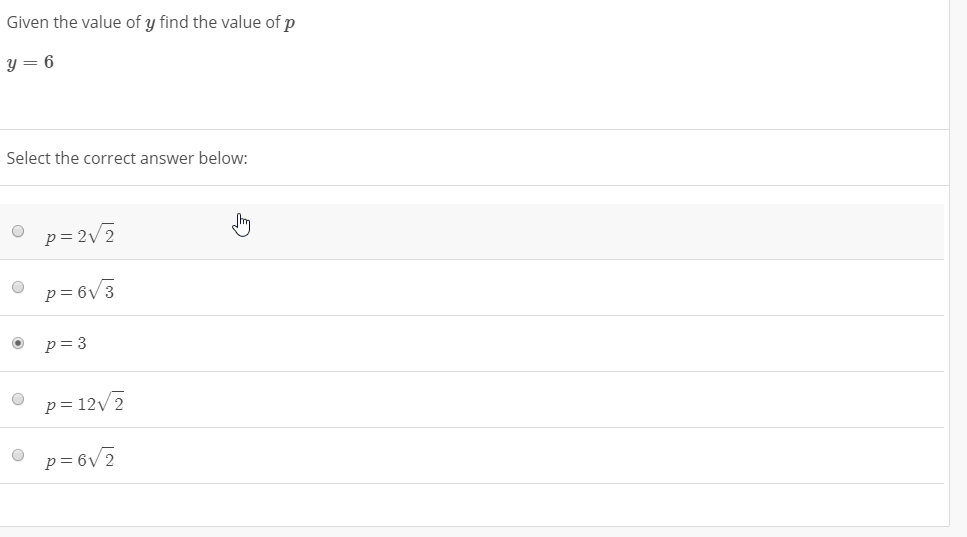
 dim pulsar
upper karma
dim pulsar
upper karma
Nope. No set up. :/
dark sparrow
is nothing else said about y and p?
upper karma
Nope. Maybe it is a broken problem.
 vale inlet
Okay, maybe I'm being dumb here, but what is a "wedge of circles" xD
I've never heard this term before
like, is there a picture of a wedge of 3 circles I can look at?
Is this a wedge of 4 circles (up to homotopy)??
https://upload.wikimedia.org/wikipedia/commons/c/cf/Topological_Rose.png
 dark sparrow
looks like it.
wedge = wedge sum
the wedge sum of two or more pointed spaces is the space you get by joining them at their basepoint
vale inlet
thankies, I posted this in here cause was just wanting to see a picture of a shape xD
sure it's topology, but eh
 foggy beacon
is the reference angle the same as finding the co terminal?
 pseudo pecan
In this channel we can speak about analytic geometry?
 wintry hatch
Probably
 vital frost
Could someone help me with these questions
worthy nimbus
For the first one
You could use pythagorean theorem
Then subtract it by the radius
@vital frost
vital frost
so i did Pythagorean theorem and got 40 @worthy nimbus
worthy nimbus
Subtract the radius from 40
worthy nimbus
Yeah
vital frost
ok how about for the other 2 @worthy nimbus
 stark pumice
I need help with this please. I'm not entirely sure what I'm doing.
stark pumice
okay thanks
 mystic vortex
i need help with finding the answer to this problem:
ln(x+2) + ln(x-12) = 1
how do i get x
upper karma
@mystic vortex u can
lime flame
x equals 12.2
lime flame
u gotta apply the log rule
upper karma
by doing
x^2-10x-24=e
and so we can also sunstitute e @rose goblet
substitute*
with the number 2. balh blah
and just solve
rose goblet
wut
rose goblet
lol
 glad ocean
hey guys is khan academy a good resource to learn algebra II?
for new york state regents exams in the united states
 rain tulip
im not understanding a problem i believe it has to do with Pythagorean ID
 olive solar
khan academy is a decent place for alg 2 i think. paired alongside some studying and practice problesm it's p solid
@rain tulip the problem?
rain tulip
Suppose that 90° < u < 180°. Find the sign of each function value.
sin 2u
the u is suppose to be theta
olive solar
so the range of 2u would be 180 < 2u < 360, right?
rain tulip
im not understanding?
are we just putting in 2u in place of u in the original problem?
rain tulip
yeah for each function
olive solar
so finding the range of 2u would be pretty important, right?
if you multiply u by 2, what is the possible range of it?
rain tulip
2u
olive solar
so what is the sign of sine from the range of 180 to 360?
think of it in terms of quadrants
that would br quadrants 3 and 4
rain tulip
negative?
olive solar
yep
rain tulip
thats it? wow i feel dumb
how about cos(-u)?
is it 90<cos(-u)<180 and the answer is the sign of the cos in Q 3 and 4?
olive solar
cos -u would go into -180<-u<-90 correct?
put that on a positive 360 range and it means it is between 180 and 270
which is quadrant 3
rain tulip
ahhh ok
thank you @olive solar
i struggled with domain and range in algebra and its hurting me more in trig
upper karma
I need help with trig
dark sparrow
 amber raven
You have a good teacher
upper karma
y'all know any good online courses I can take for trig
upper karma
Nope but try this book (recommended in awesome math github page) http://www.mecmath.net/trig/trigbook.pdf
@upper karma
 dreamy hollow
How would I go about taking a simple polygon and sub-dividing it by 'drawing' lines through it? So I draw one line through let's say it's centroid and if it's convex, I'd have two lists of points (can't find this on google)
 sudden gazelle
So I'm getting started on doing geometry constructions using the following tools (the most powerful set I can reasonably think of using):
foldable tracing paper (allows straight edge constructions and more)
colored pencils and eraser
scissors and tape
push pins and string (allows compass constructions and more. when combined with the folding paper, allows neusis constructions)
sand (for measuring volumes)
lamp (for lighting/shadows)
I'm almost a complete beginner at geometry, so I'm looking for any resources on related topics (straight edge + compass constructions. origami math. etc). Can anyone help me out?
i also considered the tools of cymatics, and electronics + iron filings or other magnetic materials. but i don't have the lab equipment to study that
sudden gazelle
I'm searching for a powerful enough set of tools for (at least) solving arbitrary complex polynomial equations either exactly (if Galois allows it) or approximately, using Newton's method.
umbral snow
Sounds like you know your tools already. What are you missing @sudden gazelle?
sudden gazelle
i don't want to have to derive everything from the beginning lol. i just ordered 2 books ("Geometric Construction" and "Origamics"), but i'm looking for online resources. i can't find an online textbook for geometric constructions of any sort
lots of disparate knowledge in lots of places though
intuitively, my tools should be enough to do the complex Newton's Method though (which if done with non-standard analysis proves the fundamental theorem of algebra), so my goal is to get all the necessary operations figured out
pointwise calculation of complex polynomials and their nth-derivatives. division. arbitrary nth-roots
if my tools can calculate those, that will be enough to solve any complex polynomial equation either exactly whenever algebra allows it, and sometimes even when it doesn't, or with an approximation via Newton's Method
sudden gazelle
err... never mind... they're not. 😦 I need to restrict myself to special cases
 rustic cairn
How do i do 11 and 12
twin prawn
Hint: similar triangles
lime flame
How do you know they're similar triangles
twin prawn
They're isosceles with the angle at the lens being the same
upper karma
Do you know the law of cosines?
This doesn't make sense to me can someone help?
Sin and cos have the same Max value of 1
ofc
cos and sin are both bounded in R
and they are bounded above by 1, so cos(x) = pi has no real solution
Sin also would be the answer then?
Oh
I was confused as to why isn't sin also an answer I just realised it isn't in the given choices.
lmao
 lament bay
hmm I don’t know any trigonometry yet @upper karma
upper karma
Oh my bad I misread it's just Pythagorean Theorem.
Split the base in half.
Check that triangle inequality is preserved.
lament bay
Hmm
 wanton prawn
I have a question. Can I ask it here? It's for similar triangles
upper karma

 abstract yew
If someone can help me do some simple arc length, sector area, radian and special right triangle problems please pm
upper karma
hello? @abstract yew
okay let me just show you my solution
you notice that the triangle's angles have 30, 60, and 90 degrees?
right?
 tacit solar
owo
tacit solar
Who’s Cherry? Ew
abstract yew
yes
tacit solar
Ew
abstract yew
for which problem
 abstract yew
so 12sqrt3sqrt3
upper karma
you should be able to find the side lengths
yeah
for the opposite
now find the adjacent
I mean hyp
m'bad
okay did I help?
abstract yew
yes i think i get it
upper karma
okay just do that for all the rest of the questions
abstract yew
thank you
upper karma
the next question also has 30, 60, 90 theorem
abstract yew
Can anyone help me with this
 spiral pawn
@abstract yew i can help
glad ocean
same
so you know that QR is also 7 because QS is and they're both radii
and tangents of a circle are perpendicular to a radius
so just use Pythagorean theorem
7^2 + 24^2 =
625
so QT is 25 and ST is 18 because 25-7=18
 hasty mesa
Alright I am given a point and a Cartesian eqn of a line
And I was asked to find perpendicular distance
Can I first use dr's to find DC's and then with DC's can I substitute in
A formula to find it in one step??
upper karma
whats the point and whats the line
hasty mesa
alpha beta gamma is the point
and the line is
x-x1 / a = y-y1/ b = z-z1 / c
dr of that line is a , b , c
only this info is given
hasty mesa
okay will be waiting
hasty mesa
why do u go to projection?
upper karma
stupid spoiler
It's a projection it just is fren
Distance is the norm of (PQ X u ) / norm of u
hasty mesa
yo pls
upper karma
P is a point on the line
x-x1 / a = y-y1/ b = z-z1 / c
make them parametric and say t=0
no i said projection it's not a projection
idk why i said dat
Distance is norm of PQ cross U
divided by norm of U
upper karma
I haven't learned it that way
Lemme check it
Lemme get a reference on this one cuz not 100% sure about that formula
<@&286206848099549185>
hasty mesa
ya thats why i asked it here
 upper karma
lol
hasty mesa
btw ping me when u get the answer
hasty mesa

 frail hamlet
Guys hey, I'm struggling with a simple geometry question. We have a cylinder with height h and radius r inscribed in a cone with height 30 and radius 10. I must prove that h=3(10-r)
Thank à lot
supple abyss
consider the cross section
frail hamlet
I don't get it
supple abyss
do you know what a cross section is
frail hamlet
Not really
supple abyss
frail hamlet
Thank you
 red leaf
this adds up to 540 right?
 gloomy python
Need help with number 15
oh my bad the number didnt show up
the word problem one
<@&286206848099549185>
upper karma
,rotate 90
somber coyoteBOT
upper karma
,rotate 180
somber coyoteBOT
somber coyoteBOT
Result:
9.0149253731343
Repulica is approx 1/9th
the actual is 9x bigger than replica
@gloomy python
is/of = %/100
151/16.75=x/100
16.75x=15100
,calc 15100/16.75
somber coyoteBOT
Result:
901.49253731343
Thank u🙏🏽
 heady urchin
anyone here who can help me with circles?
upper karma
lol
upper karma
hey
can someone help me with this question?
how would I simplify this?
[csc(-x) + sin(180 -x)]/[sec(180 + x) + cos(360-x)]
$csc^2(180 + \theta)$
somber coyoteBOT
Death Is The Only Constant:
upper karma
what do I do with that identity
upper karma
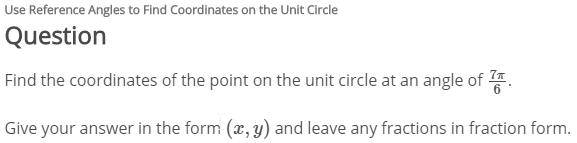
This is probably a dumb question, but right now I have to convert the radians to degrees before I can answer their question, is this a necessary step or should I have memorized these degree measures in radians by now?
umbral snow
Forget degree measurements, learn radian. You'll learn the system faster, and much better, learning it away from degrees. Having to convert from radians to degrees is harder than it needs to be
- radian measure is an easier system
upper karma
Thank you. 😃
upper karma
Hey, I have a question that is way out of my league
I have a problem that I don't really think is solvable, but here goes
I have a quaternion(x/y/z/w) that I need to convert to Euler angles while completely avoiding gimbal lock
I, however, don't need perfect precision - at any one point in the dataset, the axes may avoid singularities by having slight offsets
I'm a complete lemon at math, but from what I understand, doing this in Euler is still impossible even under loose constraints, right?
 zenith raptor
shouldn't it just follow from (6)?
dark sparrow
two col proofs 🤢
upper karma
what did i do wrong?
upper karma
i do not have it.
dark sparrow
how did you obtain the answer you've written, then?
upper karma
metal meath
dark sparrow
?
upper karma
im basically asking for an answer
 mystic bloom
you'll not learn lol
upper karma
could someone teach me how to do it?
 unique flower
So basically I have this qs to find the amplitude and phase shift
I got the amplitude is -1.5 and phase shift is 3pi/4 but amplitude can’t be negative
I did try use -1.5 and 3pi/4 to do the equation and got prove that will be 0
What the real ans then if is not -1.5 and 3pi/4??
This is the working to proof that ans is 1.5 and 3pi/4


 dark sparrow
wow oof this looks tricky
 lone nova
it is indeed