#geometry-and-trigonometry
1 messages · Page 195 of 1
 blazing kelp
yes but we have to follow bodmas right ?
 keen aspen
?
blazing kelp
nvm
keen aspen
Combined numerator
No
Actually this is kinda hard
Im at work right now so maybe one of the Helpers can assist you
<@&286206848099549185>
blazing kelp
<@&286206848099549185> can anyone help me ?
 timber hinge
what
smh
=pup is \frac{2}{\cos\left(x\right)^2}-\frac{1}{\sin\left(x\right)^2}+\frac{2}{\sin\left(x\right)^4} equal to \cot\left(x\right)^4-\sin\left(x\right)^4
did we kill the mathbot as well?
rip
They're not the same
 valid agate
,w is \frac{2}{\cos\left(x\right)^2}-\frac{1}{\sin\left(x\right)^2}+\frac{2}{\sin\left(x\right)^4} equal to \cot\left(x\right)^4-\sin\left(x\right)^4
 somber coyoteBOT
 Requested by Puerøsola#0494
timber hinge
Requested by Puerøsola#0494
timber hinge
@blazing kelp You must've copied it wrong
timber hinge
 guess so?
blazing kelp
was racking my brain whole night
question was wrong all along haha
@timber hinge sorry for troubling you
 brave hill
could someone please explain to me why triangle EMI is a right isosceles triangle
all the solutions kind of assume that so i'm confused
and why is M the midpoint of the diameter arc
of arc EI
brave hill
<@&286206848099549185>
 eager pendant
@brave hill note that AIME is cyclic and AM is bisector of BAC (easy to see if you draw a diagram)
so by properties of cyclic quad, EMI is right isosceles
 shy heath
can anyone help me out iwth a question pls?
im supposed to graph |z-1| < 1 < |z+1|
idk how
z is a complex number
somber coyoteBOT
TendentiousTorturousTopics:
shy heath
i did it
Give a geometric proof (i.e. using the vector analogy) that for any two complex numbers
z1 and z2, |(|z1|-|z2|)| =< |z1+-z2| =< |z1| + |z2|
idk how to do geometric proofs
 warm pine
Try drawing a triangle
 lethal iris
is circle theorem under this topic?
 gray blaze
I believe this belongs here, but if it doesn't I can delete and move my question to the appropriate channel.
Given that m1v1+m2v2 = m1v1f+m2v2f and v1+v1f = v2+v2f
How would I expand this for multiple objects?
IE, m1v1+m2v2+m3v3=m1v1f+m2v2f+m3v3f and ?
brave hill
can someone please explain the '"proper solution" to this problem better
I drew an accurate diagram and my ruler says the centroid square is a little under 2 cm while the entire square was exactly 4 cm
so I got ~ 200 for the area as 14^2
but i feel like i'm missing out on the proper centroid method
or perhaps coordinate bashing with something something homothety at point P which Idk how to do
I mean 200 IS the right answer, i just don't know the PROPER way to do this
 spiral bear
Drawing and finding the area is not really the best way.
I find it easiest way by coordinate plane its simple and won't have to brainatorm much.
But I cannot relate how would diagonals of formed quadrilateral would be related to sides of given square
It is however clear that no matter where the point P is inside the square the result would be same
brave hill
Okayyy so how do I coordinate bash
 manic wharf
can someone solve this: 49^(x-1 =7√7
 upper karma
Can someone also solve this

cause my dumbass is confused
2.1 m^3 of concrete for the first floor, 1.2 for the second
therefore 65(2.1+1.2) = 65*33/10
Are you answering my question? mobius
yes
Thx
lol np
manic wharf
can u answer mine 2 pls
spiral bear
@brave hill then shift coordinate axis by x/3 and y/3. You'll get a square. And it's easy afterwards
brave hill
Omg I'm 16 ttooooo
 jaunty plume
49^(x-1)=7√7
==> 7^(2x-2)=7^(3/2)
==> 2x-2=3/2 @manic wharf
manic wharf
thank u
upper karma
okay back
spiral bear
Zuagaikotsu. got it finally.😅 if you don't like coordinate algebra you can also exploit the fact that vertices of quadrilateral formed would be on the sides of square which made by joining mid points of of the sides on original square.
 cold plaza
Use the formula for the perimeter of a circle in terms of radius
2pir
In this case only half of that is equal to 8 pi
So we have pi * r = 8 pi
r = 8 then
 pure kraken
Is ABC always equilateral?
 thorn talon
assuming that is a straight line from A to bottom right
and B to bottom left
should be
wait
pure kraken
If so, how can I prove it?
jaunty plume
it is true
like you said assuming the straight lines
angle ACB will be 60
and side AB is parallel to the base
thorn talon
is that true though?
that was the other assumption i was gonna make
which makes everything easy
jaunty plume
is what true
thorn talon
how can we prove that?
pure kraken
I see thanks
 plucky marlin
blue line
plucky marlin
straight blue line
 shrewd lintel
💤
 dire rampart
not sure it has a name its just the distance from point P to one of the focii
shrewd lintel
hmm okay thanks
 supple haven
Wtf would sin^2 - cos^2 be?
keen aspen
-cos(2x)
 limpid basin
keen aspen
limpid basin
keen aspen
With lens?
keen aspen
Oh lol close, if the lengths of the major and minor are in terms of sine and cosine :v
Also if it were hyperbolic it would be -1
upper karma
Use the Pythagorean Theorem to find the distance from B to the center and the distance from the center to D.
 vital frost
so i split the kite in half @upper karma
upper karma
vertically, yes
 storm yarrow
Hey guys need help with basic hs trig
That is what my instructions are
I inserted the exact same thing into my calculator but got a different answer, a bit confused as to what i did wrong
 clear haven
r u in degrees or radians
clear haven
go to mode
storm yarrow
Im in degree
clear haven
hmmmMMMMMmmmm
upper karma
LOOOOL 
storm yarrow
Sooo, i go to radians then?
clear haven
ono
clear haven
he's in rad
upper karma
I just tried on my ti 84
storm yarrow
upper karma
You need to go to degree man
clear haven
yeah degree needs to be black
storm yarrow
Ohhhhhh
Okay yeah in degree now, will try it out again
Yeah i got the correct answer now, thanks
clear haven

vital frost
@upper karma ok I got the answers, now for this
upper karma
consecutive, opposite, diagonals, bisects, perpendicular, right, congruent
make sure you know why
vital frost
@upper karma
upper karma
,rotate 90
somber coyoteBOT
upper karma
which part?
vital frost
all
upper karma
Well, you should know basic coordinates
If I move a units to the right from the origin, where do I end up?
The area can be found by using the fact that OR bisects PS and finding the areas of all of the triangles
you can also change the kite into a rectangle by moving its lower half and fitting it
vital frost
hmmm
brave hill
can someone please explain to me how they're able to take the square root of 2a - 1
i understand how to factor the expression into the form they did but I don't understand why the other two intersection points must be +- root 2a-1
keen aspen
x^2-(2a-1)=0
to find its corresponding 0 you move it over and take the sqrt
x^2=2a-1
x=+-sqrt(2a-1)
vital frost
@upper karma alright i got the others, i dont understand c and d
upper karma
I believe such a request is bannable. #rules
I know
just read it
@vital frost you can find the area by adding the areas of the triangles
@vital frost 2c is the length of PS
upper karma
for this one
i know that a is 110
cuz angle subtended by same arc
but how do i find b
OH FUCK
nvm
its 220
angle at a centre
jaunty plume
inscribed angle theorem
upper karma
theorem
jaunty plume
ye
jaunty plume
tan(theta)=x so x is opposite and 1 is adjacent
that makes sqrt(x^2+1) the hypotenuse
@wild inlet
jaunty plume
np
upper karma
Hello, I need some help with this chunky one. To be honest, I have solved way more complex questions, and yet I have been staring at this for 10 minutes.
dire rampart
you want to find the area of it?
upper karma
Yes, without rounding sides apparently
dire rampart
you can uh split it up into diff shapes
triangles and rectangles
for eg drawing a line from the point 3,3 to the point 2,3 forms a triangle
upper karma
True, I got you there
upper karma
1,2?
upper karma
remember the formula for the area of a parallelpiped 😉
 lilac schooner
Woke up in the middle of the night im too tired can somebody confirm or deny ping my pc account so I can see (@thatNickdude#3799)
 winged saddle
 proper citrus
Uhh guys
Is the sum of an exterior angle and an interior angle of a polygon not equal to 360?
 glad ocean
it's equal to 180°
An interior and exterior angle are supplementary angles
@proper citrus
they form a straight angle
It’s 180
proper citrus
What is an exterior angle anyway?
"the angle between a side of a rectilinear figure and an adjacent side extended outward."
I see.
jaunty plume

 light notch
Quick question, how can I find out the value of r in an equation like this?
Because whatever I do, I end up dividing r by r and having no variables
It must be possible, since Wolfram|Alpha is able to give me the answer
 gritty siren
Well you can rearrange the thing into
r=(sin 25°)(13.3+r)
maybe it's easier to work with now
gritty siren
r = (sin 25°)×(13.3+r)
r = (sin 25°)×13.3 + (sin 25°)×r
r - (sin 25°)×r = (sin 25°)×13.3
how about now?
light notch
The only way I can find is to actually calculate (sin 25°)xr, which is around 0.423r, and combine r - 0.423r to (1-0.423)r = ...
That does work
But hmm, that's something I've never had to do before
 hard gale
(you don't even have to get a decimal value for sin 25 to combine)
light notch
Oh?
hard gale
$$r - \sin(25)r = 13.3\sin(25) \iff r(1-\sin(25)) = 13.3\sin(25)$$
somber coyoteBOT
emeric75:
hard gale
i hope you can do the division yourself
light notch
Yeah xD Thanks
hard gale

light notch

 astral hornet
You can use R (reflexive) and the given congruent angles for AA sim
Rus to show 1:2 ratio
Something like that
storm yarrow
Bit confused as to how I will start this, havent done math in a really long time
astral hornet
Trig ratios
 steel hawk
DE = hypotenuse EC= opposite (from the angle) sinx = opposite/hypotenuse
@storm yarrow
storm yarrow
Thats what i ended up getting
steel hawk
Yup 9.7 is correct @storm yarrow
upper karma
Hey
What do I do when I'm trying to see if a coordinate figure has perpendicular angles when one of the lines is vertical

as in this case
steel hawk
When two lines are perpendicular, what does that mean about their gradients. @upper karma
upper karma
they multiply to -1
steel hawk
Yes, so do you know the coordinates of these lines or their equations?
upper karma
Okay look, you can't do that because of htis:
Slope of the first line: -2/0
second: 0
this is implying that -2/0 * 0 = -1
steel hawk
That is very true xD I’m actually an idiot sometimes
steel hawk
What was your thought?
upper karma
well i was just gonna do it without computatioin but then you get that 0/-2 = 0/-1
WAIT
THATS RIGHT
ok im not stupid
steel hawk
Yeah that sounds about right
storm yarrow
How would i start this off?
steel hawk
CB = hypotenuse AB = opposite (to angle x) therefore sinx = AB/CB
steel hawk
No because cosx is adjacent/hypotenuse and the adjacent in this case would be AC
Now do arcsin of 58.46 to get x
storm yarrow
Arcsin?
steel hawk
Arcsin means sin^-1 so inverse
And sorry you already solved it
But 58.46 isn’t equal to sinx it’s just equal to x
So angle x = 58.64
storm yarrow
Ohh okay, my bad, when i said inverse cosine i think i meant arcsin
somber coyoteBOT
A brief description and guide on how to use me was sent to your DMs! Please use ,list to see a list of all my commands, and ,help cmd to get detailed help on a command!
glad ocean
,calc
somber coyoteBOT
Please give me something to evaluate. See help for usage details.
glad ocean
,calc arcsin(15/17.6)
somber coyoteBOT
The following error occured while calculating:
Error: (intermediate value)(intermediate value)(intermediate value) is not a function
glad ocean
,calc arcsin
somber coyoteBOT
The following error occured while calculating:
Error: Undefined symbol arcsin
glad ocean
fuu
steel hawk
Oof
 trail minnow
how do I do steps 4-7?
I don't understand how I'm supposed to subtend those two angles without constructing lines
and if I construct those lines I'm not sure how I'm supposed to get those two perpendicular lines
astral hornet
<@&286206848099549185>
trail minnow
here is a shitty mspaint drawing conveying what I want to understand and also my agony
 jaunty horizon
@astral hornet
manic wharf
Can someone solve for 9a pls
 fair lily
@manic wharf ok. So I guess you know $\sin{2x}=2\sin{x}\cos{x}$?
somber coyoteBOT
inubakari:
 neon stag
How do I find y?
upper karma
Need help
I need help with 2 pages but lets start with question 5. I am not sure how to do it.
Probably looks better this way.
@somber coyote
@astral hornet
astral hornet
there's a relationship between inscribed angles and intercepted arcs
intercepted arc's measure is double the inscribed angle's measure
upper karma
Can you show me how to do it? @astral hornet
Then I will do the next problem on my own.
astral hornet
measure of arc = 2 * measure of angle
arc cd is intercepted by a 36 deg angle
so mCD = 2 * 36 = 72
simple right
astral hornet
arc cd; yes
astral hornet
its already drawn on your worksheet 🤦
upper karma
yeah I mean how you work it out
well can you write your work on papaer will be easy to see
@astral hornet
astral hornet
it's just a simple rule: if an inscribed angle intercepts an arc, the intercepted arc's length is 2x the inscribed angle's measure
upper karma
ok
astral hornet
you just look at your worksheet, know the rule so that you would do 36*2 then you have answer 🤦
upper karma
36 like 36 x 36 and x 2?
astral hornet
no
in the pic, you can clearly see that there's an inscribed angle of 36 intercepting arc cd
so if you're solving for cd, use the rule: the inscribed measure is 36, so intercepted arc must be 36*2
astral hornet
yes
only being honest if you're struggling to accept a rule like that, gl on geometry 😦
astral hornet
since the arc is 72 deg, its length would be 72/360 of circumference
astral hornet
it's not decimal if you write it in terms of pi
upper karma
ok
Cat?
would it be this way?
@astral hornet
circumfrence = 2 x pi x r
you plug in r with 25
and now you get 50 x pi
astral hornet
50pi is circumference
astral hornet
🤦
you already found that arc cd is 72 deg, and you know a circle is 360 deg
so arc cd is 72/360 of the circumference
which means you calculate circumference * 72/360
if you need like 75+ messages to explain one angle-circle relationship, i'm legitimately concerned for you
astral hornet
finally yes 
upper karma
ok x3
done with it
Can you help me with the next problem?
so
cat
@astral hornet
here the next problem
astral hornet
congruent chords intercept congruent arcs
astral hornet
yea ab is
upper karma
Ok ^^
astral hornet
they're similar triangles of 1:3 ratio
 zinc grail
why 1:3?
wait wouldnt it be 1:2
because half of the other triangle
so the ED would be half of BC?
clear haven
length AC is 3 times as much as AD
astral hornet
length of ad is half length of cd means you can fit 2 ad in dc
astral hornet
yup
upper karma
ok
I need help
Solve for the following area. Explain your reasoning give and exact solution. Area of shaded sector =
@astral hornet
astral hornet
find the angle of the shaded portion
upper karma
ok
astral hornet
its that angle out of 360 th of the circle's area
 balmy tusk
is the other angle 240?
balmy tusk
I mean than the angle is just 360 - 240 = 120
so a third
since the total area is 6^2*3.14
balmy tusk
37.68 would be total area
that divided by 3 is 12.56
so area of shaded is roughly 12.56
you understand?
upper karma
umm how you gor the area like that
how u divide it by 3?
idk how you got the decimal
@balmy tusk
upper karma
ok
upper karma
wait
balmy tusk
its 36*pi then
upper karma
pie R Square?
balmy tusk
oh ye typo sry
upper karma
I think you did a error
balmy tusk
so area is = 113
upper karma
ok
upper karma
360 - 240 = 120
upper karma
oh
balmy tusk
37.6 periodicly
upper karma
oh
balmy tusk
for exact idk you can always just write (36*pi)/3 since when dealing with pi you really cant get an exact solution
mayybe?
what is it?
balmy tusk
so you just need to get angle A and C
 lapis night
does sin^2(x) just mean sin(x)^2 ? doesn't f^2(x) usually mean f(f(x))?
clear haven
ok
see
uh
this is called notation abuse
okno
jk
anyway
$sin^{2}(x) = [sin(x)]^2$
somber coyoteBOT
MetalNinja27:
clear haven
i can define the exponentiation/indice operation any way i want if i preface the operation with the defintion
but generally it's the traditional exponent defintion
u'll see that yes sometimes it does mean nesting the function
or that it means to take the ^nth derivative of the function
it just depends
on what context is given
lapis night
okay thanks
 eager star
yooooooo
can yall help me out
with this math problem
In a parallelogram ABCD, the measure of <ABC is 165. Find the measure of <C.
hello?
lapis night
15
 thorny fern
is this allowed or am i only allowed to take out a single 1/2 to make the coefficient 1/32
(am i allowed to factor out 2 halfs from the first line to make it the second line)
thorny fern
<@&286206848099549185>
thorny fern
heyo
upper karma
a * b = ab
a * b /2 = ab/2
or
a/2 * b
so you can take 1/2 from one bit
but the issue here is
if you factor 1/2 from 1
what do you get?
thorny fern
2
upper karma
looks good
thorny fern
thank you so much
upper karma
A point located on a chord of a circle is 8cm from one endpoint of the chord and 7cm from the center of the circle. If the radius of this circle is 13cm long, how long is the chord in cm?
astral hornet
draw the diagram and you should be able to form a couple triangles to assist with that
 chrome quarry
err i'm trying to prove this purely algebraically, but i have no idea what the trick is
same with cos(atan(x))
OH i found it
it's basically from the pythagorean identities, sec²x + tan²x = 1
wew
 opal zenith
guys how do i attempt this question
upper karma
differentiate, then put in t = 5
opal zenith
Is this correct?
upper karma
looks right to me
opal zenith
thanks for helping!
upper karma
if AC=22
find AF and FC
i found that
ABO and DCO are similar
AB/AO=DC/OC
5/AO=1/OC
OC=y
AO=5y
6y=22
y=22/6
AO=5*22/6
OC=22/6
upper karma
lol
jaunty plume
1=2 so UV parallel to ST
because RUS is a straight line
idk the names
sec
corresponding angles
it means 3=4 too
so that proves the smaller triangle and biggee triangle are similar
since they share angles
hmm
wait what's the full question
following cannot be proved?
i see
i can't think of another way to prove it
other than similar triangles

oh right midsegments
RU=1/2 RS
So RV = 1/2 RS and VT = 1/2 RS
so RV = VT
hooray for not learning any of these words
wut
oh right i missed a step
the fact that RU=1/2 RS and that UV parallel to ST means UV is a midsegment
and so on
i guess you would also need to say UV = 1/2 ST first
then finally RV = 1/2 RS
uhh
RT
not RS
mb
that is the midsegment theorem
"A midsegment connecting two sides of a triangle is parallel to the third side and is half as long."
no you don't
you have RU=RS and UV parallel to ST
Oh I see
hmm
But if it's parallel it must join with the midpoint
;^;
yeah idk then
similar triangles makes it easy
glad ocean
|| inturtles ||
exturtles
 median tinsel
can anyone explain this unit circle problem to me
upper karma
@median tinsel what's the question
 ivory berry
it depends on the variables/data you have
if the stuff you're working with is all sides+one angle then cosine rule
if its 2 sides and their opposite angles then sine rule
 glad snow
How to transform a square space into a circle space
I have a (-10,+10)x(-10,+10) plot I want to plot in a circle while preserving relative distance from origin
Circle of radius 10, inscribed in the square
I have a set of points in the square.
Lets say G is a point in the square. When transformed to circle space using the relation EH/EG =EI/EJ we obtain the point H where H represents the point G in circle space.
glad snow
Equations need to be in terms of the x and y components of the vector EG
And not using angles
I have to admit I find handling trigonometry in the different quadrants tricky and really want an elegant solution
Elegance is totally optional but I just like it
 hidden parrot
Hey uh, can anyone help me with a trig question?
If sinx1 + sinx2 + sinx3 +... + sin xn = 1,
sinx1 + 2sinx2 + 3sinx3 + ... + nsinxn = 100,
where x1,x2,x3,....,xn are all unknown variables, what is the minimum positive integer n needed for the equations to be true?
I alr figured out that the answer is 20 via logical deduction, but is there any rigorous solution that n = 20? Thx!
 onyx sigil

This is why they are so good at math.
 glad falcon
 fleet wolf
for line L to be perpendicular to line K, line L has to have as its slope the negative reciprocal of line K’s slope
so line L has an equation like this y=-1/3x+b
we know line L passes through (6,5) so that is a point on the line
5=-1/2+b from which you can deduce b
@glad falcon
fleet wolf
b=11/2
 sleek moat
I have a gamedev project I am working on and I need to be able to convert a set of latitude/longitude coordinates to the x/y position on a 2d globe. https://i.imgur.com/2e0THNY.png
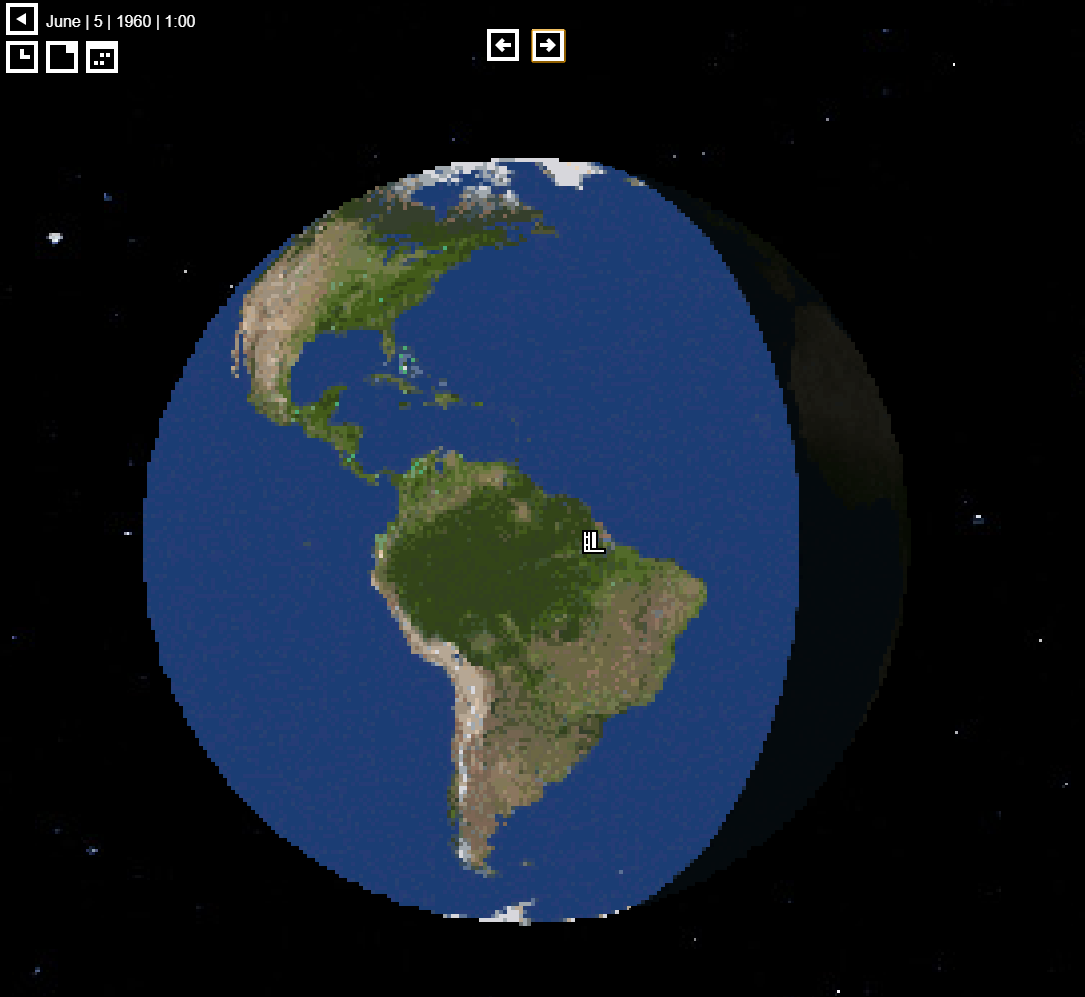
 umbral snow
What information do you store about the orientation of the globe? How does the game know where it is looking?
@sleek moat
sleek moat
There is a variable that goes from 0-35, which is the amount of rotation the planet has in the current scene, 360 degrees in increments of 10.
umbral snow
North pole is always up, south pole is always down?
sleek moat
my current idea is X=cos(long)-something Y=sin(-lat)
Always up, the view is prerendered, its not a 3d model.
umbral snow
Close.
x = cos(long - current rotation)
Check to see if that goes the right direction though lel
sleek moat
But if Lat is not on the equator, then the X needs to be smaller, or the point is off in space somewhere.
So the X coord needs to be calculated based on lat and long, while the Y can come from just lat
umbral snow
Sorry! You're right. Time to check my spherical coordinates
sleek moat
and since the edge of the image is perfect circle, i think the "-something" needs to include a cos and sin. I've been playing around with it and not getting any closer to a solution.
umbral snow
Spherical coordinates are as such,
x = ρcosφcosθ
y = ρcosφsinθ
z = ρsinφ
 marsh beacon
hey how to find the tan^-1 (1/sqrt(3)) wtih the unit circle?
umbral snow
Where φ is latitude and θ is longitude, considering where the camera to be facing as (0,0,0)
But we don't want to calculate that in 3D lol
Actually it's just a forward projection so we can forget about either x or y I'm not sure which yet
sleek moat
i think i follow
umbral snow
x is the one facing us so that one can just be forgotten about.
x = ρcosφcosθ
y = psinφ
Where p is the radius of your circle
And the very center of where we're looking is lat = long = 0
sleek moat
I got it to work, thank you so much.
My graphic for the globe is not a perfect ortho projection, so it gets a little misaligned as it turns, but I should be able to come up with a way to compensate for that.
umbral snow
Cool cool! Happy to hear it. Let me know if you need anything else!
 sinful grail
hey any good channels for learning the basics? im in calc 2 and need a refresher
 jaunty rover
 spiral bear
It's a circle
somber coyoteBOT
Autistic Hoodie:
 exotic meteor
We can say that their z position is equivalent
I would like to find the line that connect those two points
I am using the formula
$\frac{x - x_1}{x_2 - x_1} = \frac{y - y_1}{y_2 - y_1} = \frac{z - z_1}{z_2 - z_1}$
somber coyoteBOT
Autistic Hoodie:
somber coyoteBOT
Autistic Hoodie:
exotic meteor
Now I am trying to convert that into parametric form
gritty siren
dividing by 0 
exotic meteor
But the 0 in the fraction is giving me problem
Yeah...
If I define z as t
$\frac{y+1}{4} = \frac{t-1}{0}$
somber coyoteBOT
Autistic Hoodie:
hard gale
z is a constant for that line as you mentioned, so it's veri weird to parameterise it
hard gale
yea or from x, whatever you want
exotic meteor
Alright, thanks
hard gale

exotic meteor
Are three points always coplanar?
jaunty plume
yes
exotic meteor
$T_1 \ne T_2 \ne T_3$
somber coyoteBOT
Autistic Hoodie:
jaunty plume
as long as distinct and non collinear
exotic meteor
I'm learning about planes right now 😃
Ah yeah, makes sense
You can't draw a plane if they're collinear**
exotic meteor
Using 3d graphing is making math just so fun
I love how I can pick 3 random points and use math to find the plane that connect those three points 😄
clear haven
wym
it should be the same
maybe ur fractions are being weird?
okay
im surprised u have a csc function on ur calculator
lol
hard gale

thorn talon
That's not the same thing
hard gale
i luv conflicting notations
hard gale
taht's why i write arcsin :/
thorn talon
Don't worry
clear haven
arcsin is best notation
thorn talon
It's common error
clear haven
but yeah its not the same as csc
thorn talon
Cause confusing notation
clear haven
yeah
hard gale
{}
thorn talon
sin^-1(x) =/= 1/sin(x)
somber coyoteBOT
MetalNinja27:
clear haven
wat
it aint givin me the arcsin
but you know wat i mean
it's dumb
using exponents to notate anything but exponentiation (in cases where it's not repeated) is idiotic
and we should emphasize something else
thorn talon
Wrap the whole thing in parenthesis just in case tbh
hard gale
^_v
upper karma
hi
thorn talon
?
thorn talon
if m is the slope of the first line
then what must be the slope of the line perpendicular to it?
thorn talon
no
upper karma
so you cant have a slope of 0
but what happens if its just x=9
or y=1
bc thats just a straight line
parallel to the axis
upper karma
that doesnt have a slope?
upper karma
yeah
thorn talon
vertical lines have undefined slope
upper karma
um?
upper karma
do you mean the negative respicable?
upper karma
yeah i know that
thorn talon
use it
upper karma
yeah but i dont have the y=mc+c equation
thorn talon
you have m
upper karma
i mean i have the y int
thorn talon
it is enough
upper karma
oh wait yeah i have a point too
thorn talon
if m is the slope of line 1
then the slope of the line perpendicular must be the negative reciprocal then right?
upper karma
yeah
thorn talon
-1/m?
upper karma
but m=0
thorn talon
it very specifically states m =/= 0
upper karma
does a = with a / between it mean it doesnt equal 0
thorn talon
yes
thorn talon
do you know how to go from here?
upper karma
not really
thorn talon
do you know point slope form?
upper karma
like i dont actually have the slope
upper karma
i know slope interecpt
thorn talon
slope intercept is fine
upper karma
like y=mx+c
upper karma
yeah
upper karma
so it would be
thorn talon
plug that into x and y
upper karma
3=-1/m(0)+c
thorn talon
yep
upper karma
so c=3
upper karma
oh so i dont need to work out what m is?
upper karma
okay thats good
upper karma
its finer
fine
what about 3b
it says find m
if the line passes through (1,-4)
oh wait i have two points
so its just y2-y1/x2-x1
thorn talon
go from the equation you found in part a
upper karma
wdym?
thorn talon
y = (-1/m)x + 3
upper karma
yeah?
thorn talon
flip both sides
upper karma
would i go -7x-1
thorn talon
no
upper karma
wdym flip
upper karma
yeah
thorn talon
basically flipping top and bottom
taking reciprocal of both sides of an equation
is a valid manipulation
that preserves equality
generally
upper karma
hmmm
thorn talon
you know how you need to do the same thing to both sides?
upper karma
yeah
thorn talon
just like how you can multiply both sides by the same number
or add the same number to both sides
upper karma
yeah
thorn talon
you can take the reciprocal of both sides
thorn talon
yep
upper karma
and then cancel each other
thorn talon
yeah
upper karma
so its 1/7=m
thorn talon
essentially dividing both sides by -1
upper karma
oh yeahhhh