#geometry-and-trigonometry
1 messages · Page 190 of 1
 upper karma
 keen tangle
expand the fraction inside the sqrt by 2
keen tangle
$\frac{a}{b}=\frac{2a}{2b}$
 somber coyoteBOT
Gonzo17:
keen tangle
glad to help 😁
upper karma
latex is really useful lol
I should learn how to use it better
or else I always get : $}$
somber coyoteBOT
luka:
Compile Error! Click the  reaction for details. (You may edit your message)
 cold plaza
@sick veldt the answer is (a), and the way I checked it was by using the distance formula from (6.5,8.5) to (4,8), and verifying that that was indeed a third of the distance from (6.5,8.5) to (14,10)
i dont think repeatedly finding the midpoint works
cold plaza
what is the section formula
 sick veldt
so
the ratios
lets say 2:3
2 would be m
3 would be n
and the formula is
mx2 + nx1/ m + n
cold plaza
so when u say 2:3, it means that AC = 2/5 AB?
sick veldt
oo lol
somber coyoteBOT
luka:
upper karma
Random words: I'd start with sum and difference formulas
ok, what are these formulas?
$cos(3x)+cos(x) = 0$
somber coyoteBOT
luka:
somber coyoteBOT
luka:
upper karma
<@&286206848099549185> any ideas?
 steady sleet
$$\cos(x+x+x)=~?$$
somber coyoteBOT
Simple_Art:
somber coyoteBOT
luka:
Compile Error! Click the reaction for details. (You may edit your message)
 timber hinge
cos(x+2x)
steady sleet
Also:
#❓how-to-get-help, rule #4: If your question has not been answered for a minimum of 15 minutes, you may use the Helpers tag once.
Please read the rules: #❓how-to-get-help!
upper karma
right
steady sleet
And you have all the formulas above
steady sleet
yes, the image you posted to be precise...
 timber hinge
rewrite it as
$4\cos\left(x\right)\sin\left(\frac{\pi}{4}-x\right)\sin\left(\frac{\pi}{4}+x\right)$
somber coyoteBOT
Colen:
timber hinge
Then its trivial to solve for = 0
upper karma
ok
@timber hinge how do you rewrite it like that?
I tried using the formula from the image but it doesn't give me your equation
<@&286206848099549185> any ideas?
timber hinge
$ \cos\left(3x\right)+\cos\left(x\right) = 2\cos\left(x\right)\cos\left(2x\right) \ \cos\left(2x\right)=\left(\cos\left(x\right)-\sin\left(x\right)\right)\left(\cos\left(x\right)+\sin\left(x\right)\right) \ \cos\left(x\right)-\sin\left(x\right)=\sqrt{2}\sin\left(\frac{\pi}{4}-x\right) \ \cos\left(x\right)+\sin\left(x\right)=\sqrt{2}\sin\left(\frac{\pi}{4}+x\right) \ \cos\left(2x\right)=2\sin\left(\frac{\pi}{4}-x\right)\sin\left(\frac{\pi}{4}+x\right) \ \therefore 4\cos\left(x\right)\sin\left(\frac{\pi}{4}-x\right)\sin\left(\frac{\pi}{4}+x\right)=\cos\left(3x\right)+\cos\left(x\right) $
somber coyoteBOT
Colen:
timber hinge
You can probably deduce that first bit on your own
$ \cos\left(3x\right)+\cos\left(x\right) \ \cos\left(x+2x\right)=\cos\left(x\right)\cos\left(2x\right)-\sin\left(x\right)\sin\left(2x\right)+\cos\left(x\right) \ \cos\left(x\right)\left(\cos\left(x\right)^2-\sin\left(x\right)^2\right)-2\sin\left(x\right)\sin\left(x\right)\cos\left(x\right)+\cos\left(x\right) \ \cos\left(x\right)\left(2\cos\left(x\right)^2-1\right)-2\sin\left(x\right)^2\cos\left(x\right)+\cos\left(x\right) \ \cos\left(x\right)\left(2\cos\left(x\right)^2-1\right)-2\left(1-\cos\left(x\right)^2\right)\cos\left(x\right)+\cos\left(x\right) \ \cos\left(x\right)\left(\left(2\cos\left(x\right)^2-1\right)-2\left(1-\cos\left(x\right)^2\right)+1\right) \ \cos\left(x\right)\left(4\cos\left(x\right)^2-2\right) \ 2\cos\left(x\right)\left(2\cos\left(x\right)^2-1\right) \ 2\cos\left(x\right)\cos\left(2x\right) $
somber coyoteBOT
Colen:
timber hinge
I feel like i'm overkilling this problem but it would technically work 
keen tangle
yeah Colen there's a pretty easy way
keen tangle
wait how do you break lines here?
timber hinge
double backslash
upper karma
ok thanks
I've never learned these formulas (cos(3x))
(this is school homework I don't get)
I've only learned the duplication one with cos(2x) or sin(2x)
is there a method in which we can use these?
keen tangle
$\cos(3x)=\cos(2x)(\cos x)-\sin x\sin(2x)=\cos^3 x-\sin^2 x \cos x-2\sin^2 x\cos x=\=\cos^3 x-3(1-\cos^2 x)(\cos x)=4\cos^3 x-3\cos x$
somber coyoteBOT
Gonzo17:
keen tangle
so $0=\cos^3 x +\cos x=\cos x(4\cos^2 x-2)=4\cos x(\cos x-\frac{\sqrt 2}{2})(\cos x+\frac{\sqrt 2}{2})$
somber coyoteBOT
Gonzo17:
upper karma
ok get it now
 oblique plank
It's a double angle formula derived from cos (2x).
oblique plank
I mean that follows from this.
@nova jewel
 nova jewel
I don’t get the point , How can you only find cos^2(x/2) with ^2 meaning square
oblique plank
Replace sin^2 (x) with (1 - cos^2 (x)).
nova jewel
Wait... it give me cos(2x)=cos^2(x)-(1-cos^2))
So cos(2x)=2cos^2(x)-1
That doesn’t help me
Or i’m juste the dummest person on earth
Pls @oblique plank help
oblique plank
You're almost there. Just transpose the 1 and the 2 to the RHS and make the squared term the subject.
Then substitute x/2 for x throughout.
nova jewel
Srry i’m not english what does rhs mean??
oblique plank
Also, don't @ everyone. People don't like it. Some severs will even warn or ban you for it.
RHS = Right Hand Side of the equation.
nova jewel
Ok understood
oblique plank
Is your pfp Discord chan?
oblique plank
Profile picture. You new to the internet or something @nova jewel?
nova jewel
I’m not english so all of this is new for me and i dunno who is she i just found her funny
oblique plank
👌
 eager plume
what is pythagoras' theorem
 astral hornet
In a right triangle, The square of the hypotenuse length equals the sum of the squares of the 2 legs lengths
eager plume
ok thanks
 serene field
Any of the trigonometric ratios, or the law of sines.
 limpid basin
do you know what identity comes from 1 + tan^2 x?
 hot flax
sec^2 x
sick veldt
limpid basin
k so sec^2x/csc^2x =?
 chrome fiber
you need to square both terms
 real sparrow
No they're squared
chrome fiber
oof
real sparrow
Jinxed.
real sparrow
Yep.
chrome fiber
$\tan^2\theta = (\tan\theta)^2$
somber coyoteBOT
june:
real sparrow
tan ^2 x= (sinx/cosx) ^2
chrome fiber
same for the other one too
 silent sparrow
Can I see a visual
real sparrow
cosec^2x = (1/sinx)^2
silent sparrow
I forgot the squares
silent sparrow
I don’t cancel anything
real sparrow
Well.
silent sparrow
So it’s sin^2/cos^2 times 1/sin^2
chrome fiber
yep
real sparrow
^
real sparrow
Lol what ?
chrome fiber
you have this
real sparrow
@silent sparrow https://socratic.org/questions/how-do-you-simplify-tan-2x-csc-2x

Socratic.org
According to the following rules: tanx = sinx/(cosx) cscx= 1/sinx I found sec^2 x tan^2x . csc^2x sin^2x/(cos^2x) . 1/ (sin^2x) = 1/cos^2x = sec^2x Or using the rule : sin^2x + cos^2x = 1 you can rearrange it like: 1/(sin^2x) = (sin^2x + cos^2x) / sin^2x = sin^2x/sin^2x +cos^...
Go live your life now.
chrome fiber
$\frac{\sin^2\theta}{\cos^2\theta}\cdot\frac1{\sin^2\theta}$
somber coyoteBOT
june:
chrome fiber
simplify it
silent sparrow
Yes that’s what I have
chrome fiber
simplify it?
real sparrow
LOL
silent sparrow
Lol I’m not good at math
Or this section
I’ve been on this prob for like 30 mins
Its sad
Nvm
I found out how to do it
Lol
Ty
Sorry for the fuss
Not cool to lol either
 tawdry monolith
Hi could anyone help me with a trigonometry question
serene field

upper karma
Not really
upper karma
As in, take a better picture
upper karma
🆗
upper karma
CED = CBD right?
tawdry monolith
right
upper karma
CBD = CEA
tawdry monolith
true
upper karma
There ya go
tawdry monolith
I have to find it in pure numbers
upper karma
Are you given the angle?
tawdry monolith
to find the angle CEA
real sparrow
Well in the question it says angle CAD is twice of angle DBC but in the figer angle CAB is twice that of angle DBC
Is the correct or a typo ?
real sparrow
Well
tawdry monolith
I'll try to solve it now
real sparrow
Yeah its done
The Essence is just use the fact sum of the internal angles of a traingle is 180 and follow the route till you get angle BCE and then you'll get angle AEC
Thanks.
tawdry monolith
its been a long time since i've solved trigo
is Sin(a)=1.8Sin(0.5a) solvable?
dont think so
real sparrow
Ya it is
tawdry monolith
how so
real sparrow
sin(a) = 2sin(a/2)cos(a/2)
tawdry monolith
I dont think we've learned that yet
real sparrow
Well its an identity ?
tawdry monolith
aha
real sparrow
Still sloving that will give your the value of cos(a/2)
and you can continue with whatever you're doing
tawdry monolith
Thnx for ur help
real sparrow
Welcome.
upper karma
hi could anyone help me with my analytical geometry
 rugged moat
What property says that AH²=GH×HE
I guess similar triangles?
$\frac{AH}{GH}=\frac{HE}{AH}$
somber coyoteBOT
rugged moat
Eh
I will remember this
Fuck however one derives that, should be easy if I tried
Thanks anwyay
 wild hamlet
np
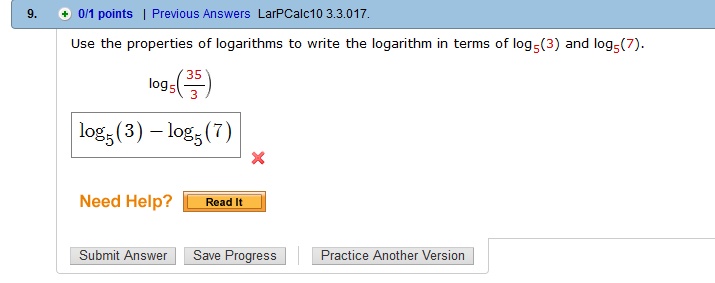
 keen aspen
Split the log as $ \log_{5}(35)-\log_{5}(3) $ first..
somber coyoteBOT
PJS:
keen aspen
Nope right idea though
log_5(7*5)
-> log_5(7)+log_5(5)
log_5(5) is 1
so just 1+log_5(7)
keen aspen
Np
 bitter viper
Hi guys just wondering if "-1" is the right answer here. Just want to double check because i am on my possible entry for this question
 bitter viper
Hi yall, sorry to bother just wondering if this is the right answer before i submit
 keen aspen
$ \left(\frac{f}{g}\right)(x))=\frac{x+3}{x^2-2} $
somber coyoteBOT
PJS:
bitter viper
ooo ok thank you that will help with my next questions
 jaunty plume
yup
 meager acorn
whats the arc on the circle of radius formula
1/2 pi r^2?
S= r theta
A = 1/2 r^2 theta
i m guessing S = R theta >.>
meager acorn
cot^2(x/2)
= 1/tan^2(x/2)
= cos x/ 1-cos x
upper karma
w
meager acorn
how can 1+cos x can become cscx+cotx
i tried with cscx + cotx/cscx-cotx didnt work out well so i went for cot^2(x/2)
 dire rampart
multiply the top and bottom of the rhs by sinx
then use double angle formula for cos> cos(x)=cos(x/2+x/2)
dire rampart
same question?
dire rampart
its way easier to start from the rhs imo
dire rampart
always start with the more complicated side, cuz you have more to work with
meager acorn
somthin like that right
1+cosx/1-cosx
@dire rampart
do i still have to use double angle formula
dire rampart
ya you do
 tulip yarrow
Question Guys!
Not sure if I did this correctly.
tulip yarrow
Alright! Thank you!
 languid pecan
Hello can someone help me get started on solving a triangle given 2 medians and a vertex?
 pseudo pecan
@languid pecan
What do you mean solving?
 chilly flower

steady sleet
#❓how-to-get-help, rule #4: If your question has not been answered for a minimum of 15 minutes, you may use the Helpers tag once.
Please read the rules: #❓how-to-get-help!
upper karma
At least he posted question before pinging  that's really the worst type of pings
half the time I ping helpers 15 minutes later no one still helps me reeeeeeee
chilly flower
Well just to double check with myself, that symbol means they're congruent right? @upper karma
upper karma
I already answered it thank though, sorry for pinging early.
 lofty scaffold
chilly flower
lofty scaffold
chilly flower
To verify that two triangles are congruent, both triangles have to share certain traits
In this case, both of them have equal sides (lines JS and JF are marked, lines SK and KF are both 3, and the line JK is shared)
Because all the sides are congruent, there is no way for the angles to not be congruent as well, so the two triangles are congruent
I think it's like
SSS, SAS, and ASA
Dunno
chilly flower
Yeah, just a roundabout way of showing all those legs' lengths are equal lol
tawdry monolith
Guys real quick is there any website that has all of the geometry (circle related) "sentences"
Or rules idk what do u call it in english
 left ginkgo
postulates and theorems?
 vocal minnow
circles as in unit circle or
 cursive spire
Is it viable to find the distance between two points without y?
(y equating to 0 here)
 glass fjord
Hi! I need help answering these four questions and also, can someone explain the congruency tests to me please?
 outer aspen
Hi can someone help me with this problem
So the question was finding the measure of angle X and I thought it was 140 until my friend said it was 130
I’ve gtg @ me if you can help
Thanks!!
 paper glacier
outer aspen
paper glacier
outer aspen
@paper glacier Awesome thanks!
 lament bay
<@&286206848099549185>
 supple haven
whats pi/pi/4
lament bay
1/4
lament bay
@supple haven what about B?
lament bay
Ok
supple haven
is it 37?
lament bay
I don’t know
lament bay
Nah I just don’t know how to do it
 plucky marlin
it's 34
supple haven
can you explain it?
plucky marlin
yeah sure

ADC = 180 - (71 + 90)
= 19
so in the triangle BDC
BCD = 180 - (127 + 19)
supple haven
damn I'm hella dumb, I should've seen that
plucky marlin

 sacred cradle
ty
 winged fulcrum
yo can someone help me with trig plz?
simplifying trig expressions
i dont get how it got thAt
and when i use an online calculator it says the original cant be simplified
plucky marlin
online calculator has the dumb
$\frac{\cos x}{\frac{1}{\cos x} + \frac{\sin x}{\cos x}}$
somber coyoteBOT
Salty Boi:
plucky marlin
$\frac{\cos x}{\frac{1 + \sin x}{\cos x}} $
somber coyoteBOT
Salty Boi:
winged fulcrum
then i got cos(x)/(1+sin(x))/(cos(x)
plucky marlin
$\frac{\cos^2 x}{1 + \sin x} $
somber coyoteBOT
Salty Boi:
plucky marlin
$\frac{1 - \sin^2 x}{1 + \sin x} $
somber coyoteBOT
Salty Boi:
plucky marlin
$\frac{(1+ \sin x)(1 - \sin x)}{1 + \sin x}$
somber coyoteBOT
Salty Boi:
plucky marlin
$1 - \sin x$
somber coyoteBOT
Salty Boi:
plucky marlin
DONE
plucky marlin

plucky marlin

 long sapphire
i felt that mic drop
 shut swift
hey guys, whats a good resource to practice proofs?
 little osprey
What kind of proofs
little osprey
AAA as in Angle Angle Angle?
shut swift
yeah
plucky marlin
what in the world ???
if all the angles of a triangle is the same that doesn't mean they are congruent
they would be similar triangle @shut swift
shut swift
so any good resources?
 winged arch
I am pretty confused on how to do number 1 on this study guide
can any one show me the method to solve this problem?
upper karma
Its just proofs
little osprey
@plucky marlin Yeah, thanks for clearing the point
plucky marlin
wut point ?
little osprey
Scroll up a bit
real sparrow
Ooof
keen tangle
geometry-trigonometry?
 void osprey
 oblique ibex
show that the equation sin^2x + 3 sinxcosx = 4cos^2x can be written as a quadratic equation in tanx
so basically i should make the sin and cos in tan form?
plucky marlin
$\sin^2 x + 3 \sin x \cos x - 4 \cos^2 x = 0$
somber coyoteBOT
Salty Boi:
plucky marlin
i would divide by cos^2(x)
$\frac{\sin^2 x}{\cos^2 x} + \frac{3 \sin x \cos x}{\cos^2 x} - \frac{4 \cos^2 x}{\cos^2 x} = 0$
somber coyoteBOT
Salty Boi:
plucky marlin
$\tan^2 x + 3 \tan x - 4 = 0$
somber coyoteBOT
Salty Boi:
oblique ibex
oh thanks lol
plucky marlin
 exotic plover
i'm really stuck on this equation, i know i can use compound angle formulae to change it but i end up overcomplicating questions like these... could somebody help me?
exotic plover
I just don’t know where to take it to get it to look like that
I got up to there
plucky marlin
damn ur smart
upper karma
no you are mom
exotic plover
So where the sinx is, could I write cos20 then?
exotic plover
I'm just super confused by all the sins and cos bc I'm not good at trigonometry
plucky marlin
uwu
plucky marlin
yes i do
upper karma
ok
plucky marlin
but wait
upper karma
stfu
plucky marlin
dats wrong tho
upper karma
what?
upper karma
what?
plucky marlin
wut ?
upper karma
wtf is this a game
exotic plover
Okay, so cos70 then where the sin20 is
upper karma
@exotic plover why though..
plucky marlin
it seems like i have to take matters into my hands
upper karma
@plucky marlin go ahead
plucky marlin
😤
upper karma
i exit
exotic plover
Because at first I thought you could collect all the terms together or something, I just don't really see it
upper karma
no use collecting if there is no possibiliy of having common terms
using sinx= cos(-x) gives you that
use it and come back
exotic plover
Okay, thanks
exotic plover
Thank you I appreciate the help
 uneven ruin
cos(x^2-2x)=0
How can I solve this trigo function ? I need to find points with the X line (Y=0)
 gritty siren
You need to use the known characterisation of zeroes of the cos function
 umbral snow
Could you solve cos(u) = 0?
uneven ruin
I know how to solve things like
cos(u)=0
...
u=1 obviously
gritty siren
=pup cos(1)
 charred spear
gritty siren
charred spear
gritty siren
cos(1) doesn't look like it's 0
uneven ruin
It is in my calculator, at least I think it is but nvm that.
This is the function right ?
cos(x^2-2x)=0
I know that no matter what, 90 degrees should be inside the cos ( ) to make it equal zero
But how do I solve it, I don’t know how to get rid of the cosine, can I just write it over like this and claim it’s supposed to be equal to 0.5Pi (cuz half pi is 90 degrees right)? ==> x^2-2x=0.5π
gritty siren
π/2 isn't the only solution to cos(u)=0
anything of the form π/2 + kπ with k in Z also work
uneven ruin
cos(u) = 0
So there’s 2 possible solutions for this ?
u = 1/2π +2πκ
u = -1/2π +2πκ
I can just write it as:
u = πκ
right ?
gritty siren
there are infinitely many solutions to the equation of unknown u: cos(u) = 0
 sinful isle
5x=a what is a
uneven ruin
Mb I missed that π/2
uneven ruin
Is the same principle works for higher degrees ?
Say that I have something like
Cos(X^9-8X^5)=0
To solve this I just realized I need to use cos^-1 on the right side in order to convert it into π
And one time the solution will be +1/2π and one time -1/2π ?
So a general solution will be like this ?
X^9-8X^5=1/2π + 2πκ
X^9-8X^5=-1/2π + 2πκ
gritty siren
the exercise is about finding the set of all Xs that work
uneven ruin
Well in those kind of exercises I will have to solve X between a certain set of values by going over all the K’s so it shouldn’t be a problem.
But is my assumption right about the general solution (doing what I did there) ?
Ofc it needs some more algebra into it to make it in a form of X = something but I will do that later.
 queen socket
So for the graph of tanx, pie/2 is essentially 1/0 which makes it undefined? Because tan = sin/cos
And the coords for 90 degrees is (0,1) on the unit circle
 dawn stone
@lament bay Since I is centroid, BI/IF=2/1. Solve for y from there.
 rare ravine
k so i got no help in #geometry-and-manifolds so i'll ask here i think :/
can u plz go take a look ? i've to do it before Monday
that's important
upper karma
guys
can someone show me the incenter theorem pls?
i mean, a demostration. I dont know why this is true

why m/n is proporcional to a+c / b
upper karma
The ratio of the sides BF:FC will be equal to AE:EC which is 2:3 @upper karma
Yeah I got it right.
I did it already, haha.
That's great!
I'm struggling with something else though.
upper karma
ty for answering
keen tangle
do you still care for that answer?
upper karma
what makes u think i dont??
upper karma
no
keen tangle
basically it's about putting some mass at certain points and seeing where the center of that mass is
like if you put equal masses at the vertices A, B, C you'd get that the center of them is the centroid of ABC
i guess you could just read sth about here
Mass point geometry, colloquially known as mass points, is a geometry problem-solving technique which applies the physical principle of the center of mass to geometry problems involving triangles and intersecting cevians. All problems that can be solved using mass point geom...
it's the easiest way I know of to solve stuff like this
upper karma
i wanna know why that is proportional
keen tangle
yeah I can tell you when you understand what that is about
upper karma
i know what those mass points are
upper karma
nop, i know what bisectors are but not a theorem
keen tangle
it basically says that in your pic AD/DC is equal to c/a
because the altitudes from D to AB and CB are equal
upper karma
ah okey
upper karma
i think (?)
keen tangle
[X] - area of X
$\frac{[ADB]}{[DCB]}=\frac{c}{a}$
when you take sides AB and BC and altitudes dropped on them
but $\frac{[ADB]}{[DCB]}=\frac{AD}{CD}$
when you take sides AD and CD and the altitude (it's one line) dropped on them

 left folio
How do i graph y=5sin(pix/2)-4

 bitter stratus
how do i prove this
dire rampart
you see the second line?
divide top and bottom by cos^2
then use the identity $\tan^{2}(x)+1=\sec^{2}(x)$
somber coyoteBOT
lemon catto:
bitter stratus
i can just divide the top and bottom by cos^2?
is that allowed?
actually i have a question
where did the 2sinxcosx go?
dire rampart
ye you can do that since its just dividing by 1 over all
what they did is much quicker
(cosx+sinx)=cos^2+sin^2+2sinxcosx
now cancel a factor of cosx+sinx from the top and bottom
and divide top and bottom by cosx
bitter stratus
i dont get it, they just took out the 2sinxcosx?
bitter stratus
ohhh (cos^2+2sinxcosx+sin^2) ?
bitter stratus
so the 1 the used Pythagorean identities?
and for the sin2x they used the double angle formula?
dire rampart
yea
bitter stratus
can i simplify sin4x to sin 2(2x) ?
upper karma
yes
it becomes 2sin2xcos2x
which becomes 4(sinxcosx)cos2x
though idk howll that help you
bitter stratus
okay thank you
and another question
is this possible "1 - cos(4x) = 2sin^2 (2x) "
gritty siren
Yes
gritty siren
tbh I plotted the two and the curves were the same, there's nothing too deep backing up my reply
gritty siren
It's surely doable using the identities you Know
bitter stratus
does this even equal tanx?
gritty siren
by plotting the thing, it looks like it works
gritty siren
$\sin 4x=2\sin 2x\cos 2x$\
$1-\cos 2x=1-\cos^2x+\sin^2x=2\sin^2x$\
$1-\cos 4x = 2\sin^22x$
somber coyoteBOT
Tuong:
gritty siren
$\frac {2\sin 2x\cos 2x ×2\sin^2x}{2\sin^22x×\cos 2x}$
somber coyoteBOT
Tuong:
gritty siren
$\frac{2\sin^2x}{\sin 2x}$
somber coyoteBOT
Tuong:
gritty siren
$\frac{2\sin^2x}{2\sin x\cos x}$
somber coyoteBOT
Tuong:
bitter stratus
hmmm okayy thank you!
 old warren
kinda need a tutor. I live in Hawaii, my school offers no math help, our "teacher" assigns trig work from chiacago, essentially we're doing an online trig course. We have a permanent sub unqaulified to teach math. So if anyone wants to help me, that'd be greatly appriciated. Half the grades in my school dropped trig for that reason. I'm still enrolled in the course to learn the subject, for college, and to recieve an honors certificate for completing highschool with 5 credits of math, 5 creds of english, & 5 creds for science. If anyone can assist me on the work I've been given or reccomend me tutor sites/helpful math stuff, I'd greatly appriciate it for me and for my fellow clasmates that strugle.
upper karma
Hello there, I am struggling with is this inequality, cos(sin(x)) =< sin(cos(x)), any hint please ?
upper karma
not sure
but probably along the lines of sin(90-sin(x))<= sin(cos(x))
now you can eliminate the sin since sin is an increasing function from [0,π/2]
90-sin(x) <= cosx
dire rampart
are you trying to solve for x?
 smoky violet
cos(sin(x)) doesn't equal sin(cos(x)) for any real x
also sin(cos(x)) is not greater than cos(sin(x)), it's always less
upper karma
dire rampart
roses are red, violets are blue, cos(sinx)>sin(cosx) for all real x, that much is true
upper karma
violets are violet
 surreal patrol
Violets are cyan
 warm pine
Violets are violet
Because violet is a strong independent colour who don't need no blue
 clear haven
violets at least are
 opal blaze
@bitter stratus you need to make it into a sine function (if you don't know how, I can show you), then find the amplitude, "line of symetry", frequancy and the "shift".
opal blaze
@bitter stratus Ok, just let me write it out
bitter stratus
okayy thank you so much
 cinder brook
Somebody help me as well plz
opal blaze
@bitter stratus and btw, the reason for me multiplying with sqrt(3^2 + 4^2) is so that cos^2(phi) + sin^2(phi) = 1
such that phi is the same number in both sine and cosine
bitter stratus
ohh that calrifies things a bit more, thank you again!
cinder brook
Any1 had a go at my problema
opal blaze
I am looking at it now
@cinder brook idk, it is quite complex
I do not know how to solve it
Im looking at power of a point theorem, angle bisector theorem and isosceles triangles. But there is nothing that really jumps out at me
cinder brook
Ur choice full solution if possible
cinder brook
Did you make one circle or 2
keen tangle
wdym make circles?
cinder brook
For tangents
keen tangle
yeah the picture's correct
cinder brook
How's atdb cyclic
cinder brook
Still don't get it
keen tangle
do you get why BDT=ACB?
cinder brook
Tangent triangle property
 fallow edge
Olympic geometry?
keen tangle
yeah what?
fallow edge
Never heard that term
keen tangle
idk I'm not native english
cinder brook
So what next @keen tangle
keen tangle
so BDT=BAT
cinder brook
How
keen tangle
BDT=ACB=BAT
cinder brook
Ok
keen tangle
Do you see it?
cinder brook
No
keen tangle
We want to prove AD=CD
cinder brook
Ya
keen tangle
so we just want to prove that ADC is iscosceles
cinder brook
Ya
keen tangle
we know that ADB=180-ATB right?
cinder brook
Thts wht I'm not getting
keen tangle
cause ATBD is cyclic
cinder brook
T and D are not on circumference
keen tangle
the opposite angles sum up to 180 in a cyclic quadrilateral
cinder brook
So howr they cyclic
keen tangle
and we know that ATBD is cyclic
cinder brook
For cyclic all points must be on circumference
cinder brook
Yes
keen tangle
which proves that the quadrilateral ATDB is cyclic
the points ATDB all lie on some circle
 halcyon hollow
Can i run a proof by someone real quick? I need to write a paper essentially based off it and i need to make sure it's right
umbral snow
Go for it!
halcyon hollow
Given 3 circles, a large circle with a radius R and two identical small circles inside, with a radius r. All circles are tangent to each other, find the arclength of the large circle between the two points of tangency to the small circles.
I got 2R*arcsin(r/(R-r))
somber coyoteBOT
Zoomin in the foreign:
 normal elbow
meh good enough 😂
normal elbow
yea that ❤
somber coyoteBOT
emeric75:
gritty siren
Good bot
 hard gale
so yeah first you could multiply your two fracs $$\frac{\sin(x)-1}{\cos(x)}\cdot\frac{1}{1-\sin(x)} = \frac{\sin(x)-1}{(1-\sin(x))\cos(x)}$$
somber coyoteBOT
emeric75:
hard gale
now notice that $\sin(x)-1 = -(1-\sin(x)$)
somber coyoteBOT
emeric75:
normal elbow
yup
hard gale
hence we get $$\frac{\sin(x)-1}{\cos(x)}\cdot\frac{1}{1-\sin(x)} = \frac{-(1-\sin(x))}{(1-\sin(x))\cos(x)}$$
somber coyoteBOT
emeric75:
normal elbow
ahhh
hard gale
good bot ^^
normal elbow
beautiful, thankyou so much
hard gale
👌
hard gale
waht what? the sec thing?
gritty siren
1/cos
warm pine
Is this an A Level paper?
normal elbow
I mean, how do you prove it using the triangle
normal elbow
its maths a level yeah
hard gale
ik
gritty siren
Rewrite 1 as cos²/cos² and tan² as sin²/cos² and it all goes smoothly
warm pine
You can just do it from the identity
I assume they want you to show to geometrically
Yeah just label AD as cos(t) + BD as sin(t) and BC as tan(t)
Then use Pythagoras
Although using the identity for sin and cos is faster
 feral fractal
Hey guys. I have an impossible exercise I'd need some help with. A cube and a ball have the same surface area. What's the coefficient between their the volumes of the objects? Let it be V1/V2 where V1 is the cube volume and V2 is the ball volume
chrome fiber
if the radius of the sphere is r, and the side length of the cube is a and their surface areas are equal, then whats the r/a?
dire rampart
yea now whats r/a
feral fractal
could you give me a hand? I think I messed it up.
normal elbow
ey bois
I've found both the x-values for the intersects
but idk where to substitute the x values for y
excuse the retardation
nvm
im a stinky nonce
I just thought it through
I forgot to minus 4 cause I was just looking at mod[2x+3]
got the right answer
dire rampart
@feral fractal so 6a^2=4pi r^2, meaning a^2/r^2=2/(3pi) meaning $\frac{a}{r}=\sqrt{\frac{2}{3\pi}}$
somber coyoteBOT
lemon catto:
Compile Error! Click the reaction for details. (You may edit your message)
somber coyoteBOT
lemon catto:
dire rampart
now you want volume of cube/volume of sphere right?
so $\frac{a^{3}}{4/3 \pi r^{3}}$
somber coyoteBOT
lemon catto:
dire rampart
or $\frac{3a^{3}}{4\pi r^{3}}$
somber coyoteBOT
lemon catto:
dire rampart
so $\frac{3}{4\pi} \cdot \bigg(\frac{a}{r}\bigg)^{3}$
somber coyoteBOT
lemon catto:
 vague pier
is anyone available to help with geometry?
hard gale
just post your things someone will answer
serene field
Recall the midpoint formula.
vague pier
M= x1+x2/2 and y1+y2/2 right?
somber coyoteBOT
Yue:
vague pier
so -1/2, 0/2?
serene field
0/2 is the same as 0
vague pier
@serene field are you still there?
vague pier
where did i go wrong
halcyon hollow
@vague pier you when you add -2.5+(-8) you get -10.5 not -5.5
which is where i assumed you messed up
vague pier
oh! yeah
 kind mist
https://cdn.discordapp.com/attachments/367528357614845952/523970434614558730/IMG_20181216_131106.jpg

Can some1 help me on #7
dire rampart
factor out a cosx
kind mist
yeah got that, confused on whats after that
dire rampart
$\cos(x)(2\sin^{2}(x)-1)=0$ $\cos(x)=0$ or $2\sin^{2}(x)-1=0$
somber coyoteBOT
lemon catto:
kind mist
Ah thanks I see it now
 wraith pumice
I'm not understanding the special right triangles: is the 45-45-45 sqrt2 for the two legs, and 2 for the hyp. or is it 1/sqrt2 for the two legs and 1 for the hyp?
which one should I use when looking for exact values of all 6 trig funtions?
serene field
Both are valid for isosceles right triangles.
If you apply the Pythagorean Theorem, you'll see that the legs:hypotenuse ratio of sqrt(2):2 and 1/sqrt(2):1 is true.
 hollow token
Do I plug y=f(-1). ?
left ginkgo
the line on the graph represents the function f(x)
the x axis is where you want to look.
Particularly at where x = -1
at that point, you determine the y value based off of the y axis
and that is your f(-1)
hollow token
I don’t understand that lol.
left ginkgo
uhhh
keen aspen
no
cosine is positive
so either I or IV
tangent is negative
so either II or IV
so that limits to IV
hollow token
Btw #27 is in 4 quardrent right?
keen aspen
Correct
 tardy plinth
I have 12 pages of geometry idk how to do due by tomorrow for a final study guide
Thought you guys could have a bit of a chuckle with that
dire rampart
oof
sick veldt
I think this is right
also for the last one it has to be CPCTC since HL theroem is only for right triagnles


 sick veldt
Looks good