#geometry-and-trigonometry
1 messages · Page 184 of 1
 shut swift
 chrome fiber
since they're congruent, x^2 - 10 = 5x + 4
solve for x
then use pythagoras theorem in any one of those to find the height
then area is 1/2 * 15 * height
times 2
shut swift
thanks
chrome fiber
np
 upper karma
If no one offers help in 5 minutes, feel free to PM me
 timber hinge
@latent canopy still need help?
 latent canopy
yhea
 languid lodge
Looks like a problem that I solved from a math competition.
I will have the solution within 30 minutes if that not too late.
languid lodge
Oh wait, nvm. I can find the small circle radius if I were given the distance between the bottom centers of circle A and B.
Then I would be able to solve it using systems of equations when connecting the radii to the centers of B to smaller circle and centers of A to smaller circle.
upper karma
@latent canopy You might want to give people that super helpful link you showed me yesterday
 serene field
Label the points of tangency. Find the relation between each point of tangency (will involve each radius), and create the general formula.
 frigid wasp
@limpid basin ik it was a few days ago but what did u mean by law of cosines?
or about the question i asked in general
 umbral snow
@gilded needle
Doesn't seem like enough info
 gilded needle
umbral snow
gilded needle
umbral snow
You're still missing an important part. I see now that you are breaking a vector into its components, and whenever you do that, the angle opposite the original vector is 90°
As such
Gy = 9.81cos(55)
Gx = 9.81sin(55)
This is a general pattern. Whenever you break a vector into its components:
The opposite side is hsin(θ)
The adjacent is hcos(θ)
 marble perch
upper karma
marble perch
upper karma
EDC is a right angle, so that should help you solve for x
 errant ether
DE bisects AC so AD = DC = AC/2
 surreal cipher
Guys, quick question. What regular prism has the best V:SA ratio?
 rain tulip
icosahedron?
@surreal cipher
icosahedron has lowest SA : V ratio so therefore it must have highest V: SA ratio
 nova pine
What is the area of an iscosceles triangle with a hypotenus of 20cm?
 meager lantern
Do you mean like this?
surreal cipher
@rain tulip
This is my problem.
I need a regular polygon to use as a face for a prism that extends 22 feet. What regular polygon is the best face choice?
 grim sorrel
Yeah $$\sqrt{2x^{2}}=\sqrt{2}x$$ and not 2x
 charred spearBOT
 hard gale
Yus
 sick veldt
thanks
upper karma
inverse tangent is defined as:
 somber coyoteBOT
Kylixir:
upper karma
is there a way to define a variation of arctan such that
somber coyoteBOT
Kylixir:
upper karma
Or should I just define my own function as
somber coyoteBOT
Kylixir:
 valid agate
If you really need it I would say define your own function
It's somewhat unusual tho
upper karma
$arctan(\frac{Qx}{P})$
somber coyoteBOT
Kylixir:
upper karma
Looks like I don't need to make my own function after all
 fresh axle
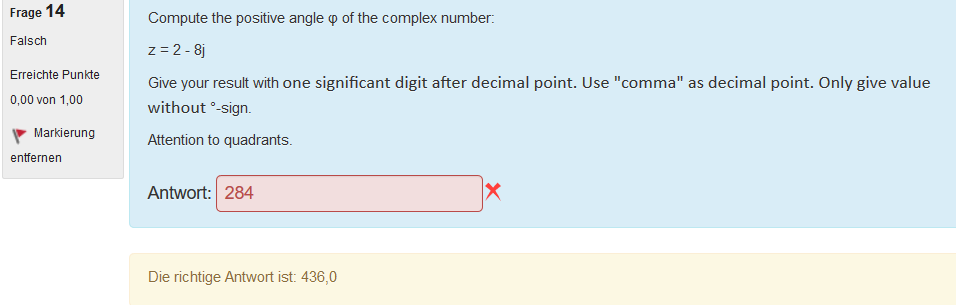
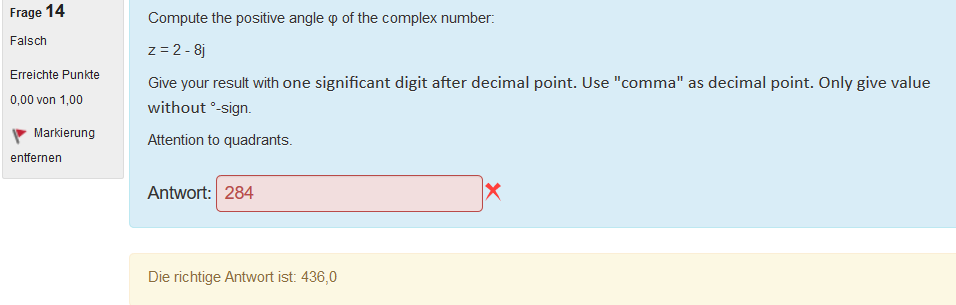
why is using arctan((-8) / 2) followed by adding 360 not the correct answer?
i'm confused over this
upper karma
One significant digit after the decimal point
fresh axle
no, the problem is that the correct answer is 436.0
upper karma
Like 284.1 (or whatever)
fresh axle
the german part at the bottom states: "the right answer is 436.0"
upper karma
Well, that can never be right for degrees. And I don't know of another unit that goes that high. Even gradians only go to 400
upper karma
Sure
 thorny solar
Can someone help me with this? My teacher didn't explain it at all
Sorry about that white thing, it's my dogs tail
upper karma
This is pretty much vertical and corresponding angles stuff. Unfortunately, the whole picture is a bit fuzzy. If no one else offers to help in 5 minutes, feel free to PM me
upper karma
Better. Remember vertical angles or PM me if no one else helps
 jaunty plume
because 2sinx(1-sin^2x) expands to 2sinx - 2sin^3x
 limpid basin
First let $$x = (1 + i \tan\theta)^n + (1- i\tan\theta)^n$$. Notice that multiplying x by $$\cos^n\theta$$ yields $$x(\cos^n\theta) = (\cos\theta + i\sin\theta)^n + (\cos\theta - i\sin\theta)^n$$
somber coyoteBOT
Plum:
 steady sleet

 heavy escarp
I'm still a bit confused
limpid basin
About what
 mellow scroll
I've been stuck on this problem for the past hour, I feel like the solution is literally in my face but I can't see it.
Could someone give me a little help?
😃
limpid basin
Seems like it
 peak talon
Hey guys, I'm a little confused about trig on the Cartesian plane. When calculating theta, it's always between the x axis and the hypotenuse right? But in my book it says something about "180-theta" when it's in the second quadrant. What does that mean / when do you use it?
mellow scroll
Could you take a picture @peak talon ?
peak talon
Uhh my phones camera is broken but I'll try find an example online and screenshot
mellow scroll
Alright
And by calculating theta, I presume it is to solve for the possible values of theta given that some trigonometric function, when applied to theta, equals <insert arbitrary ratio>.
peak talon
mellow scroll
AH yes
peak talon
It's just confusing when to use theta and when to use 180-theta or whatever
mellow scroll
Alright
The 180 - theta stuff
is to calculate for something known as the "basic angle"
do you know what the basic angle is?
peak talon
Nope
peak talon
Yea
mellow scroll
Try putting in tan(135 degrees)
peak talon
-1
peak talon
Yeah
mellow scroll
Now try tan(45)
peak talon
1
mellow scroll
What is common between the 2 values?
mellow scroll
In other words, the have the same magnitude
The basic angle is the acute angle that when put through the same trigonometric function, will spit out a value of the same magnitude as the theta.
peak talon
So it's like the interior angle?
mellow scroll
Not quite
peak talon
Cause what confuses me is that like in my book there's an example thats a triangle in the second quadrant and theta goes from the x axis to the hypotenuse and it says theta is between 90 and 180 but then when you work out theta with shift sin or whatever it returns something like 22 degrees
mellow scroll
It basically means the value of your inverse sin (arcsine) will only give you an angle between 90 degrees and -90 degrees.
pi/2 to -pi/2 in radians
?
peak talon
Okay I don't wanna get too ahead 😂 I just wanna know, why does it say theta is between 90 and 180 but then when you work out theta it's 22 in my example? When you work out that are you working out the interior angle so to get the whole angle it's 180 - 22?
peak talon
Why is this so confusing to me ffs
Okay so the question sentence is: if 13sinTheta - 5 = 0, and then some questions
peak talon
And in the beginning it says "Theta E[90, 180]"
charred spearBOT
Command disabled
The sever owner has disabled that command in this location.
peak talon
Yeah I know it's in the second quadrant. But what confuses me is that in the drawing it says theta goes from x axis to hypotenuse. But then if you work it out its 22👀
Yea it is
Shift sin
I sin^-1 both sides
Which gave 22 or something degrees
peak talon
How does that work?
You've just hit the nail, that's what confuses me
Why does the exterior angle (theta) have the same ratios as the interior one?
So when you're working with sides you use theta but if they ask you for the size of theta then you work out the angle using shift whatever and then - 180 or however much you need to get it?
Yeah that's what I meant
But for the second quadrant it's 180 -
peak talon
In the example theta goes from the x axis to the hypotenuse
I wish my phones camera worked so I could show
It just confuses me how theta is clearly more than 90 degrees in the drawing but when you work it out its "Theta = 22"
mellow scroll
'
basic angle also known as reference angle
since the triangles are just reflections, the basic angles are equal
In this case, the arcsine will give you alpha (basic angle), so you have to use that to find theta
since theta was specified in the question to be in the second quadrant.
mellow scroll
If the question gave another range
😃
for example
0 <= theta <= 360
then you would have to give both arcsine(theta) and 180 - arcsine(theta) as answers. Since both are possible values
peak talon
So I can't go from "sinTheta = 5/13" to "Theta = sin^-1 * 5/13" cause that doesn't give theta it gives the basic angle?
mellow scroll
kek
if a question asked that
I would give the general forms for theta
(arcsine(theta) + 360n) and (180 - arcsine(theta) + 360)
n E z
yea
you're right
we have to use Tau Radians
hueheuheuhue
 inland karma
somber coyoteBOT
inland karma
somber coyoteBOT
omar23:
 astral hornet
which problem?
 meager acorn
i have a few way to simplify but i dont know what i should do next
sin^4x-cos^4x+cos^2x
1-cos^2x+1-cos^2x-cos^4x+cos^2x is this how you simplify or do you make everything to sin?
 wild hamlet
I guess thats fine for simplifying
wild hamlet
sin(x)^4 + sin(x)^2
wild hamlet
2sin(x)^4 - cos(x)^4 + cos(x)^2 = 2sin(x)^4 - cos(x)^2 * (cos(x)^2 - 1)
cos(x)^2 = 1 - sin(x)^2
cos(x)^2 - 1 = -sin(x)^2
sub it in
errant ether
no, the sin^4(x) cancels out
wild hamlet
you forgot the 2
wild hamlet
problem 2 then
meager acorn
bit confused
wild hamlet
anyway
errant ether
sin^4(x) - cos^4(x) + cos^2(x) = sin^4(x) - (1 - 2sin^2(x) + sin^4(x)) + cos^2(x)
 teal dragon
when you bring a binomial to a power
you cant distribute the power
have you learned foil?
wild hamlet
sin(x)^2 + cos(x)^2 = 1, not subtract
teal dragon
it wouldnt be 1 either way
 tawdry spoke
Oo trig identities
wild hamlet
no, make everything to sin
meager acorn
whats the identies for cos to sin
tawdry spoke
Wats the prolem
wild hamlet
cos(x)^2 = 1 - sin(x)^2
meager acorn
teal dragon
=tex cos^2 x = 1 - sin^2 x
charred spearBOT
Command disabled
The sever owner has disabled that command in this location.
 somber coyoteBOT
fishcat:
tawdry spoke
Lol
 teal dragon
well, you know that $cos^2 x + sin^2 x = 1$
somber coyoteBOT
fishcat:
meager acorn
yes
teal dragon
subtract sin^2 on both sides
meager acorn
so its same thing than
teal dragon
yep
teal dragon
correct
tawdry spoke
The answer is sinx^2
meager acorn
that opens the door to next equation
yes that whats the practice exam answer says
thank you everyone!
let me get this straight
sin^4x-cos^4x+cos^2
sin^4x-cos^4x+1-sin^2?
wild hamlet
yes
meager acorn
hm....
chrome fiber
you can just use difference of squares for the first two terms
$\sin^4x - \cos^4x = (\sin^2x)^2 - (\cos^2x)^2\(\sin^2x + \cos^2x)(\sin^2x - \cos^2x)$
$$\sin^4x - \cos^4x = (\sin^2x)^2 - (\cos^2x)^2$$$$(\sin^2x + \cos^2x)(\sin^2x - \cos^2x)$$
somber coyoteBOT
june:
upper karma
which part doesnt make sense to you?
meager acorn
upper karma
bc i think its right
meager acorn
let me get mic
upper karma
lol its ok
meager acorn
so do i foil that [1-sin^2x]^2
 tropic shard
Yes.
meager acorn
if you foil than is it going to be
[1-sin^2x] x [1-sin^2x]?
or [1-sin^2x] x [1+sin^2x]
tropic shard
The same sign,
The second line you wrote was the conjugate of [1-sin²(x)] which is something else entirely
So you'd have to do [1-sin²(x)]·[1-sin²(x)] to get,
I'll let you do the honors
meager acorn
1-2sinx^2+sinx^4?
tropic shard
(a+b)²=a²+2ab+b²
Yes,
So I'd reorder it to sin⁴(x)-2·sin²(x)+1, then plug that in to the original problem for cos⁴(x)
meager acorn
let me re-order or write it one moment
tell me if i wrote this wrong
sin^4x-sin^2x+sin^4x
tropic shard
Shouldn't be two sin⁴(x)'s
tropic shard
Oh I see
meager acorn
tropic shard
But you plugged in the thing we did for cos⁴(x),
You also need to distribute the negative to all those terms
So you'd have one positive sin⁴(x), and one negative sin⁴(x), and so on.
meager acorn
frustrated right now
i understand till
sin^4x-[cos^2x]^2+1-sin^2x
after we foil
Sin^4x-2sin^2x+sin^4x
what am i misssing?
tropic shard
Okay, write for me what we had for cos⁴(x)=?
We got it so that cos⁴(x)=sin⁴(x)-2sin²(x)+1, or no?
meager acorn
i got it @tropic shard
tropic shard
Nice
tropic shard
I got lost on the second line of #2, but I agree with your final answer, good job!
 static river
@meager acorn its 1-(cos(x))^2 = sin(x)^2, not 1-cosx = sinx
static river
i wanna say square both sides but then you'd get extraneous solutions
i dont think im comfortable enough with my trig identities to help you solve it, i can only point out the mistakes i see
tropic shard
sinx/cosx=1-1/cosx
sinx/cosx+1/cosx=1
secx(sinx+1)=1
sinx+1=cosx
Uhh lemme refine that
teal dragon
sinx+1 is not equal to cos x
teal dragon
whats it solving for
tropic shard
When tan(x)=1-sec(x)
tropic shard
xD
teal dragon
i thought it was just stating the identity tan(x)=sec(x)-1
tropic shard
It threw me off too, until I realized halfway.
teal dragon
i always get the order mixed lol
tropic shard
Could you translate what I said to Tex? My Unicode way makes it look too messy with Paratheses and Brackets.
somber coyoteBOT
fishcat:
teal dragon
$\frac{\sin x}{\cos x}+\frac{1}{\cos x}=1$
somber coyoteBOT
fishcat:
teal dragon
$\sec x (\sin x + 1)=1$
somber coyoteBOT
fishcat:
somber coyoteBOT
fishcat:
tropic shard
Alrighty thanks!
Y'know if there's a way to make it more obvious the answer would be 0∧π?
somber coyoteBOT
fishcat:
teal dragon
$(\sin x + 1)^2 = 1-\sin^2 x$
somber coyoteBOT
fishcat:
teal dragon
$\sin^2 x + 2 \sin x + 1 = 1 - \sin^2 x$
somber coyoteBOT
fishcat:
meager acorn
one sec
meager acorn
teal dragon
i deleted it for nothing
tropic shard
Yup we're doing that xD
meager acorn
😮
tropic shard
professional $
teal dragon
$\tan^2 x = (1-\sec x)^2$
somber coyoteBOT
fishcat:
somber coyoteBOT
fishcat:
teal dragon
subtract sec^2 on both sides
tropic shard
Lost me there
teal dragon
$-2 = - 2 \sec x$
somber coyoteBOT
fishcat:
tropic shard
Nope
teal dragon
its true at 0 and pi
tropic shard
It's right
tropic shard
oh that's odd...
Yeah.. That's wrong somewhere..
Are we sure tan²(x)=sec²(x)-1?
I believe that is..
tropic shard
Yeah, everything checks out..
teal dragon
theres no intersection between the two initial equations at pi
umbral snow
Take sin²(x) + cos²(x) = 1
Divide both sides by cos²(x)
tan²(x) + 1 = sec²(x)
So that's the right identity
tropic shard
Now I have to see my earlier one as to why I was wrong, smh.
So the answer would be x=arccos(1)?
teal dragon
yup
tropic shard
So I was right??
teal dragon
well you were right about 0
i dont know how you got pi in there
it seemed right to me
tropic shard
Oh, cause I'm dumb for thinking cos(π)=1?
umbral snow
When is sec(x) = 1?
0, 2π, 4π...
tropic shard
So that's a yes.
umbral snow
And negative
teal dragon
the interval was [0,2pi)
umbral snow
So 0 is the only answer they want
tropic shard
0 and 2π
meager acorn
i m so screwed next week test;;;
tropic shard
But did they take 2π for you Yup?
meager acorn
i dont think so
tropic shard
Idk why I saw that paratheses as a bracket, sorry..
rain tulip
sum to product
meager acorn
only i see is
sin a+sinb
sin a - sin b
cos a + cos b
cos a - cos b
which one do i need to use
i want to punch a wall beacuse frustration
tropic shard
Well sin(x+π/2)=cos(x)
12·sin(x)+16·sin(x+½·π)
Hm.. Now how to deal with the coefficients.
12·sin(x)+12·sin(x+½·π)+4·sin(x+½·π)
24·sin(2x+½·π)·cos(2x+½·π)+4·sin(x+½·π)
Ahh I thought I was unto something, sorry man.
meager acorn
<@&286206848099549185>

@umbral snow
i understand i have to use sum to product
but which formulas i have to use
 river forge
there's some different formula's
do you want to like derive them or just get hit with them
meager acorn
this is pre-calc
umbral snow
Start with the form you want:
Asin(x + θ)
= Asin(x)cos(θ) + Acos(x)sin(θ)
This shows you that
Acosθ = 12
Asinθ = 16
meager acorn
i dont know derive
river forge
derive != derivative
it means to show where they originate from
so take something you know, and turn it into the formula
im guessing that's what kaynex is gonna do so
ill step out
umbral snow
So you want to solve for both of those. Any guesses?
umbral snow
If you only want θ, then just divide bottom by top:
tanθ = 16/12
A divides out, and θ is findable
meager acorn
how did you or where did tan theta = 16/12 come from
umbral snow
Start with the form you want:
Asin(x + θ)
= Asin(x)cos(θ) + Acos(x)sin(θ)
This shows you that
Acosθ = 12
Asinθ = 16
Dividing one line by the other:
(Asinθ) / (Acosθ) = 16/12
tanθ = 16/12
meager acorn
where did = Asin(x)cos(θ) + Acos(x)sin(θ)
come from
umbral snow
I expanded Asin(x + θ)
Using a sum identity
I've never used a product identity for anything before, lel. Sums are worth remembering though
umbral snow
I could have divided the other way I guess? Got cotθ = 12/16
umbral snow
Do you understand how we got to
Acosθ = 12
Asinθ = 16
umbral snow
Compare the form we WANT, vs the form we HAVE
WANT: Acosθsin(x) + Asinθcos(x)
HAVE: 12sin(x) + 16cos(x)
meager acorn
12sin x = A
16sin x = theta?
umbral snow
We can make those two things the same, if
Acosθ = 12
Asinθ = 16
So let them be the same thing
Note we have no control over x, and can't freely set that.
charred spearBOT
atan(4/3) = 0.927295218001612
umbral snow
In radians. Maybe you want degrees?
umbral snow
== atand(16/12)
charred spearBOT
180×atan(4/3)/π = 53.130102354156
umbral snow
tanθ = 16/12
θ = tan¯¹(16/12)
Or θ = arctan(16/12), since you are comfortable with the notation
umbral snow
Np. Feel free to ask if you have anything else!
 loud cedarBOT
🆙 | Yupki has given @umbral snow a reputation point!
umbral snow
Yay.
tropic shard
?
meager acorn
where do i start
tropic shard
So this is without a calculator?
meager acorn
yep
tropic shard
Okay well we know 165° is 15° from 180
teal dragon
i would go for 210 - 45
meager acorn
can we use 165 is 15
tropic shard
So sin(165°)/cos(165°)=sin(15°)/-cos(15°)
meager acorn
why -cos 15
tropic shard
Imagine the unit circle, if it passed the 90° point, the x-value is negative
But the y-value is still positive, because the angle is less than 180°
 graceful hull
heya
Ive got a homework sheet i dont fully understand
Would anyone help me complete it?
teal dragon
yep
tropic shard
Here would be nice, so I can help too >:)
tropic shard
Wait, so you don't know about translation via vectors?
graceful hull
Not really
I just find it so hard to make it accurate
And so I end up getting it wrong
tropic shard
I'm rusty, but I believe the -7 on top means move a point to the left by 7, and the -2 means move that same point down 2
Do that for all 4 points, then connect the dots and label 'B'
graceful hull
Right
tropic shard
Have you done that already?
tropic shard
Alright, now focusing back on image 'A'
graceful hull
Rotate your shape A 180 degrees about (1,0) and label the image C
graceful hull
Is that the one on the bottom or left?
tropic shard
Very bottom.
graceful hull
yup
tropic shard
So that means that will be stationary throughout the rotation.
The other points will move the 180°, but in this case that simply means their y-value changes sign.
So for ex. move a point from (2,2) to (2,-2) in this case.
graceful hull
So where do i move the bottom one to?
tropic shard
The one at (1,0) stays in place.
tropic shard
The point at (2,2) goes to (0,-2)
graceful hull
i think ive got it
tropic shard
Just imagine rotating that shape to the other side, while holding the (0,1) point down with your thumb.
graceful hull
lemme check with you in a sec ill snap a pic when finished
tropic shard
Ye
tropic shard
That looks right.
graceful hull
great
tropic shard
Yea, you're good.
graceful hull
Reflect A in line M label the image D
tropic shard
So since it's like a secondary y-axis
since it goes up and down
The Y values will stay the same
graceful hull
So it stays as -2 for the Y?
tropic shard
Well I believe they want you to focus back on image 'A,' where none of the points are -2
so (1,0) will still be ( ,0) in the end
graceful hull
Dont forget line M
tropic shard
wait um
graceful hull
If you look up theres that bold line
tropic shard
So pick a point, any point
graceful hull
Bottom one
tropic shard
So technically the boxes are ½, so it'd be -3 but you get it
graceful hull
The teacher says either or
tropic shard
Now, continue going that same direction the same amount of boxes you counted
graceful hull
You can use 1/2 or 1
Im using halfs because its easier to count, for me anyways
so another -6?
-12?
tropic shard
That's okay for these purposes, just make sure to stay consistent
Yea
So it'd be -12 away from it's original position
tropic shard
Place the dot
graceful hull
done
tropic shard
Yes
graceful hull
Then another -4?
tropic shard
Yeap
graceful hull
done
graceful hull
finished it
graceful hull
yeah
ty
ok
next is enlargement
Enlarge by sf 2 at point X
Centred at the point x*
Reflect in line M and Rotate 90* clockwise at the point x
tropic shard
Oh so for enlargement,
So basically count the dots x and y values from the X and double it
tropic shard
It's scaled in reference to reference point X, yes.
tropic shard
So like that for each point
(the lines are to be erased, leaving behind only the dot.
teal dragon
shouldn't it be more like
tropic shard
yes, yes it should
I was still scaling it by 2, mb
But same concept
Well
You see how horizontally you go to the right 2 squares?
Then go down by that amount.
tropic shard
teal dragon
^
tropic shard
For each point it'd be different. Hopefully this picture could be worth a thousand words
teal dragon
the blue line is the horizontal distance
graceful hull
but what do i do to work it out
teal dragon
then the red line is that same distance downwarss
graceful hull
How do i know where to move it
tropic shard
Either way works
tropic shard
You can do all of them Horizontal to Vertical, or Vertical to Horizontal, you'll get the same result
That's Vertical to Horizontal, but again, no need to do both Vert. to Hori. and Hori. to Vert. for the same point.
(but it's a good technique to check your work)
graceful hull
Ok im going to restart it and draw in the lines
brb
failed miserably
wait
got it
I dont think it is meant to go over the line tho?
lol
tropic shard
What do you mean?
graceful hull
The top left of my shape goes over the line
tropic shard
Let's see
graceful hull
tropic shard
Almost,
 tropic shard
That one I use imagination, lol.
serene field
X is your center of rotation.
graceful hull
So i rotate off that and not around the shape?
 austere prairie
Yep
graceful hull
Could someone draw how that would look? I just want to make sure im right
so would i draw the bottom 4 squares onto the x position?
austere prairie
The point right below x would be just to the left of it after the rotation
graceful hull
left of what?
austere prairie
Of x
tropic shard
I drew mine, show me how yours looks 
graceful hull
im still working it out
hold up
I’d rule over it but it’s gonna get rubbed out Ik it xd
tropic shard
serene field
The distance from x to the closest point on the triangle should not change, as it's rotation.
graceful hull
ohhh


 austere prairie
Clockwise, not counterclockwise castle
tropic shard
Oh
I didn't read that part, I just read 90°, so I was thinking like the unit circle xD
serene field
It happens to the best of us 👍
graceful hull
austere prairie
I thought the same thing at first as well lol
serene field
Check all vertices of the triangle.
graceful hull
wait
serene field
Make sure the angle subtended by the arc from initial to final is 90 degrees.
graceful hull
did i do it backwards?
tropic shard
Not quite there yet, you seem to have 2 points correct.
graceful hull
Is it backwards?
austere prairie
Not really
graceful hull
Whats to correct? I dont get where i went wrong
austere prairie
That top-most point needs to be below the horizontal line
tropic shard
Think of the rotation in your head
austere prairie
Directly below the leftmost vertex
To better visualize it, take your paper, hold your finger on x, and spin the paper 90 degrees
Such that the top of the paper is facing to the right
tropic shard
Yea, just don't lose your original position lol.
(have it visualized the whole time)
tropic shard
@serene field Sorry about that random FR, I won't feel bad if you declined that xD
austere prairie
serene field
A hint: Check the right-most vertex of the original.
tropic shard
Let's see
graceful hull
I dont think thats right tho
tropic shard
rip
graceful hull
tropic shard
You see Jythro's rotation?
tropic shard
You did, but it was misplaced.
serene field
Try imagining the triangle were a flag of sorts attached to X
And you were moving the flag around X
austere prairie
Literally take your paper, hold the tip of your pencil on X, and rotate your paper such that the top of the paper faces 3 o'clock
See where the original triangle moves to relative to it's original position
graceful hull
austere prairie
Stop and do exactly what I said, then take a picture of what you see
serene field
Rotation should not change the distance between points to the axis of rotation.
graceful hull
i feel so incredibly dumb rn
serene field
For example, if you were to paint a dot on a car tire
And you were to spin the tire 90 degrees
The distance to that dot from the axis of rotation, the center, is still the same.
graceful hull
tropic shard
In rotations, the points must reserve the same distance away from the point of rotation.
austere prairie
What you need to do is stop and take a step back
Literally take the time to rotate something irl
serene field
Get a piece of cheese from your fridge, cut it into a triangle shape
And spin it around
*a triangle piece of paper works too.
 hazy granite
or just cut out something the same shape
and put it on the figire
add a circle to it
 sharp fox
Lol
hazy granite
radius is 1 gridline
austere prairie
Yes
serene field
👍
austere prairie
That's it
graceful hull
Finallyyyy
austere prairie
Do you see why?
hazy granite
take the point closest to X
graceful hull
Gotcha
graceful hull
uhh ok
hazy granite
now, move the point 90° while still keeping the distance of 1 gridline
graceful hull
How’s this so far?
Yeah i get what you mean big
Thanks for the help on a quick note
Means so much
serene field
A is transformed to B by a [ ] through [ ]
Yeah, that'd be right. It's one in both the x and y directions.
A to C looks right as well.
graceful hull
Is it a vector I’m looking for on the 2nd part of B?
austere prairie
Not the grammar of the prompting sentence tho lol (ignore this, side comment)
serene field
That first sentence threw me way off lmao
Doesn't sound right, but it works
What do you need to do to A to get it to B?
Try looking at one vertex of A and its corresponding vertex in B.
graceful hull
D is a reflection of A draw the mirror line to reflect the diagram
serene field
Think of it as a mirror line.
graceful hull
serene field
👍
hazy granite
its dilation
or scaling
whatever you want to call it
ok to find it
take any line in the smaller figure
and take the corresponding line in the larger figure
graceful hull
For B?
hazy granite
yeah
graceful hull
Is it by sf 2?
hazy granite
yeah
graceful hull
C now
hazy granite
so keep the basic figure of c in your head
now rotate figure a
actually nevermind
it's reflection
hazy granite
yeah
graceful hull
What way does it face?
serene field
Could be answered as reflection or rotation + reflection 🤔
Try imagining a mirror between A and C
hazy granite
the closest point to each other is the right angle
graceful hull
serene field
It's diagonal, yeah, but that does look slightly off
hazy granite
yep
serene field
Your professor might dock points if they're stingy
hazy granite
it should be directly in between the 2 right angle points
graceful hull
Reflection (Mirrored line drawn above)?
Ill redraw
done
I’ve done the next part, and semi completed the part after
Then just geometric reasoning after
graceful hull
Ok
serene field
x = -2 for all y
hazy granite
on the opposite axis
serene field
Likewise, y = 1 for all x
hazy granite
take point -2 on the x axis
hazy granite
yeah
now draw a line perpendicular to the black line
connecting x -2 and the dges
hazy granite
yea
serene field
The horizontal line is y = 0.
hazy granite
wait
serene field
Once you redraw it, you may want to extend it to the right.
hazy granite
yeah that should be
graceful hull
extend what to the right?
serene field
The line supposedly extends infinitely in both directions
You'll be reflecting the image, which will likely end up on the right
serene field
Reflect the triangle across the axes
Remember that the distance from the original's vertices and the mirror is the same as the distance from the mirror to the image's vertices.
graceful hull
so to the right of the line?
hazy granite
yes
graceful hull
ok
hazy granite
you just have to reflect all 3 points
then you can construct the triangle from there
graceful hull
Slightly off the bottom, but my teacher isn’t picky
I’ll redraw the bottom anyways
Ok so now do the same thing underneath the X axis?
hazy granite
perfect except you have to reflect the image
actually
the mirror is not placed correctly
serene field
The second mirror is still along y = 0
graceful hull
^
graceful hull
So I’m just redrawing it again?
serene field
Extend it to the right
hazy granite
extend the mirror
hazy granite
yeah
hazy granite
reflect the image
graceful hull
was i doing it right before?
hazy granite
yeah