#geometry-and-trigonometry
1 messages · Page 180 of 1
 wild mirage
 upper karma
can anyone teach me how to find the perimeter of a composite figure
i dont know if i should use distance formula to find the length of the sides and then multiply that or add it or what
 hard gale
@wild mirage yep it's good (I was sleeping)
 tiny grail
@upper karma send me the q
 upbeat trail
 rugged moat
$$sin(90-(\phi-\alpha)=cos(\phi-\alpha)$$
 charred spearBOT
upbeat trail
charred spearBOT
upbeat trail
Thanks alot
 alpine marlin
Anyone know about a parabola directrix and focus?
my equation is y=-6x^2
Vertex is (0,0)
 keen aspen
Rip
alpine marlin
dude
keen aspen
4p?
keen aspen
Damn lol
alpine marlin
picky computer system
keen aspen
Yeah that's what I hate about computerized bullshit
alpine marlin
ikr
its not the first time its happened to me either
spent a solid 15 min trying to see wat was wrong xd
 calm meteor
Does anyone know the relationship of the radii for the inner circle inscribing the inner vertices and the outer circle inscribing the outer vertices ?
or if one even exists
 vapid jasper

 amber raven
@calm meteor that's a good question
Basically boils down to
Ratio of line segment from the center to the midpoint of a side of the regular polygon, to the line segment from the center to one of the verticies of the star
If we take the length from the center to one of the verticies of the star to be 1
We only need to measure the length of the line segment from the center to the midpoint of one of the edges of the regular polygon
And how do we do that?
Well if we know the side length of one of the outer triangles, then we can figure out it's height and from that deduce the length of the line segment from the center to the midpoint of the base of the triangle
 timber lily
I have to find the area of a parallelogram, but the vectors I have are in 3D, so how can I do it? I can't find the determinant since two vectors in 3D would not result in a quadratic matrix. I have the 4 points and the vectors that connect the points.
timber lily
Nevermind, found lenght(a)*lenght(b)*sin(v) 😃
 restive crown
Are these two expressions equivalent? I solved for an integral using Maple and it spewed out that first thing.. whereas on paper [and with symbolab] I got the second.
Maple's verify function is garbage, otherwise I'd use it.
 gritty siren
sin² = 1 - cos² should do the trick
restive crown
have you done the proof? I started it while I was waiting
Think i might of taken the scenic route though
gritty siren
In the left one, replace sin² by 1-cos² and it gives what you want immediately
restive crown
lol
I tried to prove the other was equal to it
silly me
I just got to the end too
gritty siren
that must've been hard
restive crown
not really hard, just took 7 times as long
upper karma
Hello all
 tough jay
 little osprey
@tough jay Wots your question.
tiny grail
The question is on there lol
tiny grail
I know
I was answering @little osprey
And the thing is too small for me @upper karma
little osprey
What?
 summer mason
If I want to upload a geomotry/shape question, do I upload it here?
hard gale
@summer mason yas you may
summer mason
I took a problem from my math test I had a few days ago, added some lines and made it harder than the actual problem in the test. Using a bit of Pythagoras's theorem and similarities triangle (if two triangles are similar then their sides' ratio will be the same) I was able to "solve" it and got an answer of approximately 21.28cm. Could anyone try it and tell me if I'm wrong or not?Thank you.
 fringe bear
Someone can help me please, it's for a questions
 marble zinc
can you find the force applied on each rope?
to*
you know A will give a pull of m_A * 9.8
upper karma
can anyone help me with this question and questions like these
marble zinc
then you can compute how it is distributed among the two other ropes, and using the coefficient of friction you can compute the max for m_A
@upper karma have you computed the volume of the cylinder?
upper karma
pi r^2 h
marble zinc
can you post your picture again it disappeared
ok then you have the formula for the cube: 88h
8x8xh
you want to find h
so 8x8xh = volume of the cylinder
just solve for h
 regal swift
@marble zinc thk youu
upper karma
guys i need some help
so i have on a program an array of acceleration values
i want to know the position of my moving object
how do i do that,
keen aspen
You want to know the position of an object based off of its acceleration?
marble zinc
interpolate to a continuous function
and integrate twice
using numerical estimations obviously
 lusty sluice
how do i find the angle measure of sin B= 0.4848
upper karma
lusty sluice
yes because of vertical angle theorem
 static river
@lusty sluice B = arcsin(.4848)
im assuming you're gonna use a calculator, arcsin is equal to sin^-1 or inverse sine. not all things write it the same
lusty sluice
thanks @static river
static river
np
 fair wigeon
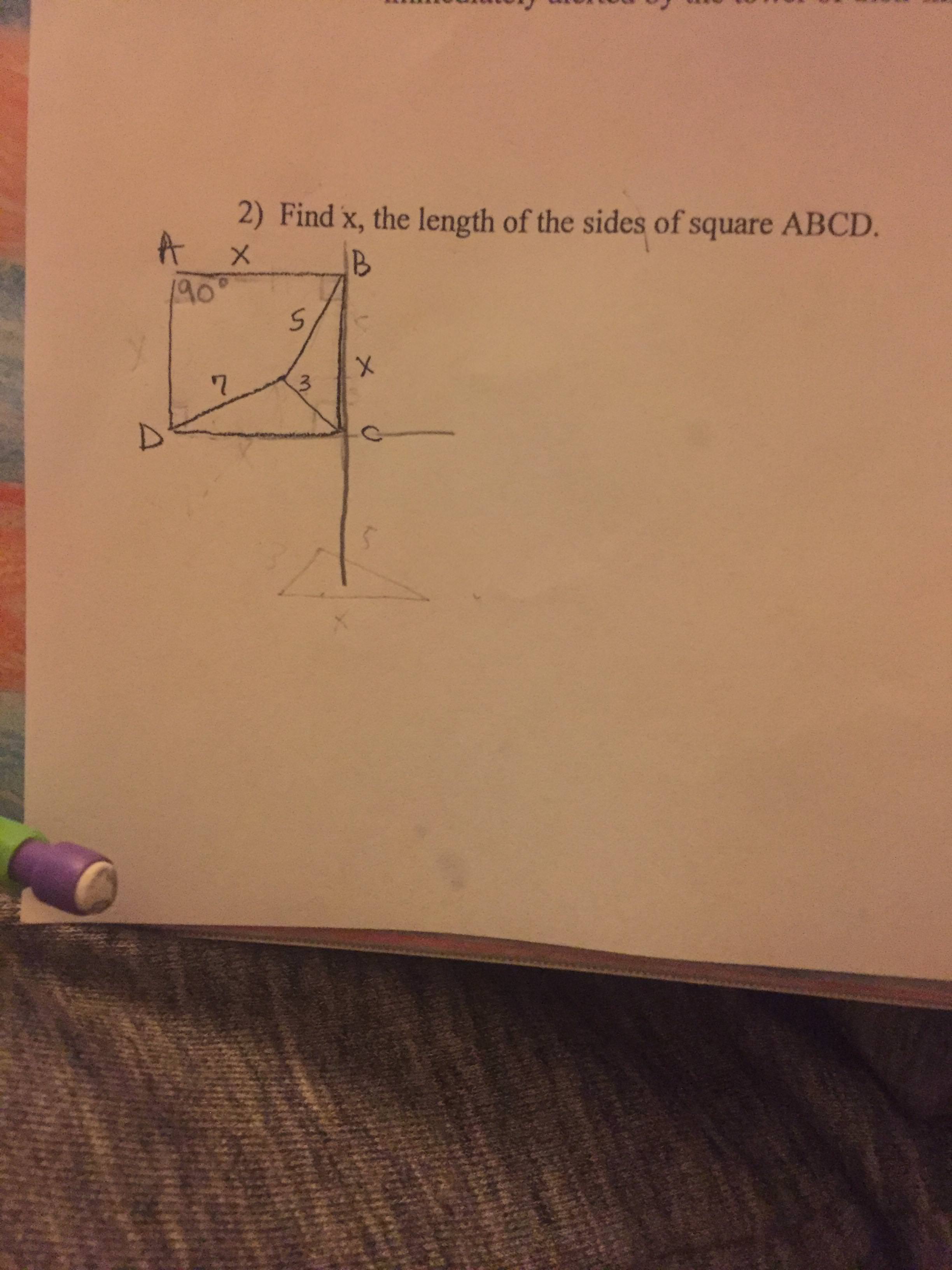
Is there any more info about the angles within the triangles, like, are the triangles right triangles or do they have other angles?
@upper karma
little osprey
I doubt it would be that easy.
 copper valve
use cosine law probably.
x²=3²+5²+15cos(α)
x²=3²+7²+21cos(β)
2x²=5²+7²+35cos(γ)
where α+β+γ=360°
rearrange: γ=360°- (α+β)
then form a system of equations
using trig sum identities
cos(γ) = cos(-γ) = cos(-γ+360°) = cos(α+β)
so the last one turns into
2x²=5²+7²-35cos(α+β)
upper karma
Don't answer the question I just want to know what relationship does a have with c
upper karma
@marble zinc thanks i'll try that
upper karma
@marble zinc why a cumulative sum not work in this case?
marble zinc
@upper karma well I'm missing a few details about your sample, but the sum would give you the speed, not the position, hence why you need to integrate (or sum) twice
 sick veldt
someone prove my answers are right
This questions gonna count a lot towards my grade
and I hate proofs with a passion so please.
<@&286206848099549185>
 steady sleet
#❓how-to-get-help
0) Wait a minimum of 15 minutes after posting your questions before pinging helpers.
- Give context e.g. what are you given, what can you use, etc.
sick veldt
Im being given proofs for constructs section of geometry
copper valve
we're not doing your work
sick veldt
?
I have the answers filled in
I just need the work to be check
@copper valve
my answers are in the reason section, #3-7
scroll up
upper karma
i used the trapezoid rule instead

In numerical analysis, numerical integration constitutes a broad family of algorithms for calculating the numerical value of a definite integral, and by extension, the term is also sometimes used to describe the numerical solution of differential equations. This article focus...
from here
 south pewter
Silly question but, this definition explained an obtuse triangle as having one obtuse angle. It can have more than one obtuse triangle, right?
upper karma
I believe so but it's been a long time
south pewter
If it has, say an acute angle
Along with an obtuse angle
Would it be acute and obtuse?
static river
@south pewter a triangle cannot have more than one obtuse angle. an obtuse angle is anything above 90 degrees, and you cant 2 angles above 90 degrees in a real triangle.
south pewter
Oh yeah silly me
upper karma
Well damn it been a long time
static river
for an acute triangle, i think it has to have all 3 angles below 90 degrees but dont quote me on that
static river
an obtuse triangle will always have an acute angle, so no its not both acute and obtuse. the specific angle can be either or but the triangle itself falls under the obtuse angle
upper karma
Just because people are here can someone tell me where quantum mechanics would be
static river
np man, feel free to ping me if you have anymore questions
static river
@upper karma my bad i didnt see it. to solve it you just need to find the circle angle
wait its not a right triangle one sec
static river
could you make a box based around the line with a length of 3 and the C?
then you could assign the sides some variable, im gonna use y for this
y^2 + y^2 = 9
y^2 = 9/2
y= (4.5)^1/2
then you'd have both sides of the created triangle
@upper karma unless i did the stuff in the image wrong, you could find that angle then subtract 90 from it to find the angle on the other side. then you could use law of sines since you have the 5 and 3 to find the rest of it and eventually X
@upper karma you can ask me
are you asking for me to explain the stuff under reasons?
so the statements column?
because the entire thing combined is the proof
i mean yeah i guess you could leave it without but the QED is just there to say you finished the proof. if your teacher wants that you should do it
id heavily recommend adding it if its the teachers standard, no point in losing marks just because you didnt write an extra line. @upper karma
yeah then dont do it
 soft panther
nevermind i understand
little osprey
wdym real triangle
upper karma
Help pls
 valid pike
Could anyone help me
I'm working with triangles and have a test next period
I'm having trouble understanding how with one given angle and a ratio how I can solve for the other two base angles
 ruby swallow
jamal
keen aspen
Well it would be something along the lines of same side interior angles
fair wigeon
Wouldn't it just be vertical angles
keen aspen
They arent vertical
static river
square root of 18 is equal to square root of 9 times square root of 2
square root of 9 is 3
oh this uses the fact that something that the square root of xy is equal to the square root of x times the square root of y
@sick veldt
works with division too
sick veldt
Hmm
but how can the square root if 18 equal 9?
only 9*2 can equal 18
If you square 18 you get an ongoing decimal
 mystic shadow
=tex \sqrt{a\cdot b}=\sqrt a\cdot \sqrt b\\sqrt{18}=\sqrt{2\cdot 9}
charred spearBOT
static river
@sick veldt the top half is the theorem i poorly explained and the second half is how it turns into a 3
static river
what?
charred spearBOT
static river
i think you pinged the wrong person
charred spearBOT
 spring apex
also why is this in geometry-trig lol
 wise halo
 woven matrix
For starters, for √3/2 = 400/c you would multiply each side by 2, not divide, so you'd get √3= 800/c
Then I guess isolate c so c=800/√3 and plug into the Pythagorean theorem?
keen aspen
Yeah you divided by 2 not multiplied
 ashen forge
can anyone help me with the steps to reach this?
gritty siren
The area of a disc is πr² (r being the radius)
Since you've already got the area, you can directly calculate the radius
Then, you can get the perimeter with 2πr
gritty siren
Oshit I didn't read the whole thing xd
upper karma
"Lemme sum stuff up because I think that my writing was a bit confusing.
Now, a square is inscribed within a circle. Your question asks you to find the diagonal length of the square. So, now since it is inscribed, it's safe to say that diagonal length is 2 times the radius of the circle. Find the radius using area formula.
Since square is symmetrical, by pythagoras theorem, (diagonal acts as hypotenuse, sides act as base and height) diagonal^2 = 2 x side^2.
Perimeter of the square is 4 x side."
I even wrote that up
How else can one explain this?
gritty siren
¯_(ツ)_/¯
upper karma
Even I got the same lmao
ashen forge
i have the answer
the problem is not the answer
there is an error in the reasoning
upper karma
uhh
Can you say where I made a mistake in my reasoning?
🤦 I should've not bothered a lot.
steady sleet
@ashen forge #❓how-to-get-help #rules
0) Do not post the same question in multiple channels. This can and will result in being forcefully removed from speaking in certain channels.
- Do not be offensive and say things like "you're dumb". This can and will result in being removed from the server.
- Be constructive. This includes explaining why you think someone else's explanation/answer is wrong instead of just blatantly arguing that they are wrong. Simply saying "the answer is not what you got" isn't helpful. For example, your book could be wrong instead.
.-. i see you prefer leaving then dealing with consequences.
upper karma
@steady sleet He moved on to the advanced mathematics server, I'll deal with him there
 icy venture
hellooo
I'm not really sure but I think this is about trigo
There are three snails A, B and C are at first located in equilateral triangle form with length of 1m ( with bird eye view).Each of snail has speed of 5cm/min.
A goes towards B
B goes towards C
C goes towards A
Q1) find the time taken for all the snails to meet at particular point at the same time.
Q2) find the distance moved by each snail to go tht point.
how do u solve this??
icy venture
Pls ping meh thanks!
 sterile mason
if I want to find the x for y = 0 values of the function f(x) = sin(x^2) would it be 0° + pi * k or 0° + (pi * k) ^ (1/2)?
steady sleet
@upper karma you seem to have handled it well
 clear haven
how did he get into the advanced maths server anyway
arent the invites for that like super hidden
actually hold on how did I get in to begin with??
steady sleet
🤦
steady sleet

clear haven
t!purge 7
 umbral snow
No, the invite is open. Check out #old-network
icy venture
Guyss can anyone help meh?
umbral snow
Yet another casualty of nobody saying "yes".
icy venture

umbral snow
Lel, feel free to post your question, many can help
In the future, just post. No need to ask about help
icy venture
I already posted it. Should I post it again?
umbral snow
This one?
There are three snails A, B and C are at first located in equilateral triangle form with length of 1m ( with bird eye view).Each of snail has speed of 5cm/min.
A goes towards B
B goes towards C
C goes towards A
Q1) find the time taken for all the snails to meet at particular point at the same time.
Q2) find the distance moved by each snail to go tht point.
Interesting problem. They'd take a spiral thingy
Do you know any calculus?
umbral snow
Only observation that may help is that the snails always form an equilateral triangle
 foggy oxide
if we think about the segment that represent the distance between two lines in R^3 this segment it's perpendicular to both right ?
(99% sure about this but yeah)
icy venture
Soooo how do u solve it?
foggy oxide
@icy venture what do you think about what i said ?

 normal vault
=wolf sin 45
normal vault
yikes
that's long
is that irrational?
wait no
its described as a fraction
🤔
 buoyant oasis
If you have an irrational number over a rational number ≠ 0, do you get a rational number or an irrational number?
upper karma
Irrational number
The thing is: consider that irrational number represented by it's own definition (c != p/q, c belongs to R, p&q belongs to rational number set); Rational number = a/b
c/(a/b)
Let's write that as [c(b/a)] / 1 Let b/a be X.
cX/1 = irrational number * any rational number will provide irrational value.
buoyant oasis
Thanks.
upper karma
Actually, this was a bit of clumpsy explanation. To be firm and exact, I would rather go with proof by contradiction.
hard gale
this is not a problem, it's just an expression
 stable tusk
to simplify the expression
hard gale
:/
 cobalt sonnet
id expand the brackets next
stable tusk
wat u mean
hard gale
(a-b)(a+b) = what?
stable tusk
1 - cot^2x - (1/sin^2x) ?
cobalt sonnet
theres an identity u could sub into the csc^2x
 chrome fiber
or convert everything to sin, cos then simplify
chrome fiber
give it a try
cobalt sonnet
wouldnt putting cosec^2 = 1+ cot^2 make it easier?
the question was just to simplify?
does it give an answer?
cobalt sonnet
1- cot^2x -(1+cot^2x)
gives u that answer
using the expansion then the identity that cosec^2x = 1 + cot^2x
gtg food shopping, if u havent been shown that identity then maybe thats not how they want you to do it
chrome fiber
$$\frac1{\sin^2x} = \csc^2x$$\$$\csc^2x = 1 + \cot^2x$$
charred spearBOT
chrome fiber
this is what the other person was talking about
stable tusk
ya but how am i supposed to get -2cot^2x
stable tusk
1+(cos^2x/sin^2x)-(1/sin^2x)
chrome fiber
1 - cot^2x - (1/sin^2x)
you can change that to
1 - cot^2x - csc^2x
which you can change to
1 - cot^2x - (1 + cot^2x)
which becomes
-2cot^2x
stable tusk
how do u solve this 1 - cot^2x - (1 + cot^2x)
do i just multiply?
holy im so dumb
i dont even know how to do this stuff
rugged moat
You open the brackets
stable tusk
wat u mean
how does this -cot^2x - cot^2x = -2cot^2x
im done
i need to sleep
i just figured it out
rofl
stable tusk
can some1 show me steps on how to do this
 turbid axle
I need help with a density word problem
About 70% of earth is covered in water, making 30% of earth potentially habitable by humans. Earth can be modeled as a sphere with diameter 12,700 km. There are 7.1 billion people in the world. What is the population density of potentially habitable earth?
whoops
wrong server
upper karma
. . .
gritty siren
Only one "=" I guess
upper karma
oh ok
stable tusk
how can i solve this. tan(2x) - tan x = 0
interval 0 <= x < 2pi
cobalt sonnet
first id sub in the tan double angle formula, tan2x= (2tan(x))/(1-tan^2(x))
stable tusk
can u set both of them equal to 0?
cobalt sonnet
is that question right ?
there is no real solution to that
u will get to tanx = i
stable tusk
the answer is 0
cobalt sonnet
hang on let me check again maybe i made a mistake
stable tusk
ya u get , 0, i, -i
cobalt sonnet
ok first sub in the tan2x = (2tan(x))/(1-tan^2(x))
stable tusk
do i multiply the top by -tan?
gritty siren
multiply the whole thing by 1-tan²x
 elfin moon
How do I turn a problem into a linear program problem? I have a dividing line that is the median of the x's and it splits my set of points into two sets, L and R. I wish to compute the upper convex hull. I can't see the connection between convex hulls and LP clearly other than the constraints are the dual of a point
stable tusk
sec x = 4, 0 < x < pi/2
find cos x/2
 queen hawk
Oh wait is this wrong channel
Whoops
OK I'm not sure if this is the right channel but I need help in a question
idk what to say lol
Forgot to add cm,*
Any help would be appreciated
charred spearBOT
cobalt sonnet
i guess thats how u would? ill try it like that and see if it works, maybe theres an easier way cus that way would be a bit messy
upper karma
Yeah Pythagorean theorem sounds right to me.
keen aspen
Anyways yeah, (2x+3)^2=(x+2)^2+y^2
Solve for y to get everything in terms of x
Now you can perform any trig sub you want
Well tan preferably
Or cosine
 frosty flame
ok
hard gale
well $$\sin(x) = \frac12$$
charred spearBOT
stable tusk
ya
stable tusk
they get the inverse, xd
frosty flame
ye it works the 'inverse way ' around
xsd
sin(x) = y
arcsin(y) = x
do u understand this?
stable tusk
i've been doing this problems wrong i think,. but im finding the answer i think
frosty flame
sin(x) = y
arcsin(y) = x
stable tusk
i use the calculator and it finds me one answer
then i use reference angles for the rest
idk
ya i get that
frosty flame
ok so csc(x) = 2
jusut like emeric said
cant i say sin(x) = 1/2?
cuz csc is 1/sin(x)?
what do you think>?
stable tusk
um
stable tusk
where did that 2 come from
stable tusk
1/sin(x) = 2
frosty flame
? thats in the given
stable tusk
how u get that
stable tusk
oh u put it there?
stable tusk
ya, thats wat i found after solving the equation
stable tusk
csc is 2?
stable tusk
ya
stable tusk
yes ok i see it now
stable tusk
ya
stable tusk
ya
stable tusk
multiply by reciprocal?
stable tusk
u can just flip em?
stable tusk
ya
stable tusk
ya
stable tusk
yea
stable tusk
ya
frosty flame
thats ur x
stable tusk
ya
but
like some of the questions have multiple answers
7pi/6
etc..
i was finding the reference angle
depending if it was positive or neg
idk if thats right
 glacial cedar
I need help on a geometry problem about parallel lines
frosty flame
bacck
rambo
ye ur right if i understand u
ye ofc there will be multiple answers
sin(30) = 1/2
sin(30+360) = 1/2
frosty flame
how did i do what
stable tusk
so i got 30
stable tusk
how do i get the other answers
cobalt sonnet
x2=180-x1 for sin graph
frosty flame
depens on ur interval
cobalt sonnet
then +- 360 to ur solutions for where the graph repeats (depend on what interval they give u)
frosty flame
of solutions
stable tusk
interval is 0<=x<2pi
cobalt sonnet
oh ur in radians
stable tusk
ya
frosty flame
2pi is 360
stable tusk
ya
cobalt sonnet
is one the answer 5pi/6
stable tusk
ok so i got 150
cobalt sonnet
thats 150degree
cobalt sonnet
for 0<=x<=2pi, sinx=1/2 solutions are x=pi/6, 5pi/6
stable tusk
oh i see, so it cant be the other ones cuz it would be negative in the other quadrants?
so where is this from x2 = 180-x1?
and wat about when im given other things
like cos, tan, csc, etc..
stable tusk
so i use that for everything?
cobalt sonnet
no thats for sin graph
hang on im trying to find the comand to display the graph
=pup sinx
cobalt sonnet
look first graph
for sinx=0.5
there are 2 values in ur interval
for sin graph x2=pi-x1
is just to give that other value (srry dunno how to word this else)
cos graph x2=-x1, then u again would do +- 2pi to get further solutions
tanx graph is not same though
tanx graph repeats every 180, or every pi
so u would just +- pi to find other solution
cobalt sonnet
well depend what question ur looking at
stable tusk
ok so look
cobalt sonnet
if question says, solve trig equation for interval idk say -2pi < x < 2pi
stable tusk
for the other part of the problem csc(x) = -2/3
cobalt sonnet
u would show all solution for their interval
stable tusk
itd be the same thing?
cobalt sonnet
yh
cobalt sonnet
uh
stable tusk
thats wrong
stable tusk
so that one would have no solution?
stable tusk
so its just the 2 from the first question?
cobalt sonnet
there maybe a more advanced complex way to do it but at least for now take it as no solution
wait what was ur first question
stable tusk
ok so u said x2 = 180-x1 for sine only?
cobalt sonnet
yh in degrees
cobalt sonnet
yh for cos, x2= - x1
stable tusk
for the first question we got 30
so i did arcsin(1/2)
so thats my first answer?
then i would just add/subtract 180,360 etc.. to find other angles that would fit the interval and the neg or pos sign
cobalt sonnet
what is the question u were given
stable tusk
after i do the arc watever i find one answer, then im stuck after that idk
um
3cot^2x - 4cscx = 1
and i got csc(x) = -2/3, csc(x) = 2
cobalt sonnet
yeah so if it gave ur interval as 0 to 2pi then it wants the answer in radians
so u have pi/6 and 5pi/6
from the solutions to cscx=2
stable tusk
ya
but look
ok for this other question
i ended up with sin(x) = 1/2 and sin(x) = -1/2
so wat i did was do it in my calkculator
arcsin for 1/2 and -1/2
so i got 30, -30
then wat do i do after
this question has 4 different answers
cobalt sonnet
then u find the repeats on sine graph by doing x2=180-x1 for each of them
so 150 and 210
stable tusk
this one also has 330
cobalt sonnet
oh yea from the -30 u could add 360 too
stable tusk
i know is like 360-30 but idk why/when to do that or if i need to do it certain time idk
cobalt sonnet
the graph repeats every 360
stable tusk
i know that
cobalt sonnet
x1=arccos(1/2)
stable tusk
so 60, -60
cobalt sonnet
for cos graph u can do x2= -x1
then +- 360 to those to find the answers in the given interval
stable tusk
i dont get this x2= -x1
then +- 360 to those to find the answers in the given interval
cobalt sonnet
=pup cosx
cobalt sonnet
look first graph
say you have cosx=1/2
if u put to calculator in radians it will give u pi/3
stable tusk
ya
stable tusk
yes
is there a video i can watch for this
i couldnt find one
since idk specific name of topic or anything
stable tusk
@cobalt sonnet @frosty flame alright thx very much for all ur help ❤
cobalt sonnet
np bro 😃
stable tusk
i got test in 2 days
cobalt sonnet
😄 yea gl rambo
once u start to wrap ur head around the fundementals with trig the harder stuff starts to make much more sense
stable tusk
i did good on the 1st test
but for this one i was absent to the classes cuz something happened
so im basically learning everything on my own
through the study guide questions the prof gave us
glacial cedar
How would I go about this problem?
 fair wagon
set the measure of angle 1 equal to the measure of angle 3, and the measure of angle 2 equal to the measure of angle 4
then just solve it as you would any other system of equations
glacial cedar
@fair wagon Whats the reason though?
fair wagon
alternate interior angles would be congruent
glacial cedar
how about angle 1 and 3
fair wagon
shoot your right they wouldn't be congruent
angle three would just be 180 - (angle 1 + angle 4)
because the sum of three angles in a triangle is 180 degrees
glacial cedar
oh yea
fair wagon
sry about messing up
glacial cedar
why would it be angle 1 and 4?
fair wagon
because the angles 1, 3, and 4 are in the same triangle
and to find 3 you would have to do 180 - the other angles
glacial cedar
ahh ok
fair wagon
Does that make sense?
glacial cedar
yeah it does
thanks
so in the end
system of equations with 180 - (anle 1 + angle 4) and angle 2 = angle 4
fair wagon
yup
glacial cedar
@fair wagon
valid pike
Can anyone help me with creating a two way table
upper karma
i thought it would be 118 because of alternate exterior angles but that was wrong
can anyone explain
umbral snow
You can use the 118 to find the complementary angle on the other side of that line
== 180-118
charred spearBOT
62
umbral snow
@upper karma
The triangles are similar.
5/4 = 2.5/x
upper karma
oh
little osprey
 old topaz
In triangle TBY using trig make YB which is the height the subject and do the same thing with ABX where you make BX the subject which would give you YB = h/tan24 and BX = h/tan13
 flint citrus
 astral hornet
Use properties of isosceles triangles
astral hornet
@upper karma are you trying to prove CDA congruent CDB?
upper karma
yes
astral hornet
so you already proved that 2 is congruent to 3
and wrote that the legs DB and AD are congruent
which is shown in the diagram
and you cant use DC reflexive, as SSA isnt a thing
since you already have justified a pair of angles congruent and their corresponding opposite sides to be congruent, which postulate/theorem do you think would be easiest to find the 3rd congruence statement for?
astral hornet
yes, you can use hy-leg, which is a good idea if you dont know ur isosceles props
so you have justified 2 and 3 as right angles from perp lines, and hypotenuses AD and BD congruent. now you just need to prove a leg congruent.
in hy-leg case, it's ok to pull a SSA, so you can justify DC reflexive
astral hornet
wdym implied?
astral hornet
so, which method do you think is also suitable, now that you have a pair of angles and sides opposite them congruent?
astral hornet
all 3 is possible, but which one do you want to work with?
upper karma
i don’t see how we’d prove any
astral hornet
for example, using isosceles bisector, we can prove AC = CB and 5 = 6.
and using prop of isos tri, we can prove 1=4
you can end up with all/almost every pairs
upper karma
i don’t think i’m supposed to use properties
 astral hornet
which 2?
upper karma
ohhhh nvm
i see it
but for the hy leg one what would i put as the third congruency
astral hornet
you'll need 1) the 2=3 via perp making them rights 2) hypotenuses DA=DB 3) a leg DC via reflexive or AC = CB via isosceles bisector
astral hornet
np
 warped lance
Does anyone know if I can use the 180(n-2) for an irregular polygon?
So, basically the polygon to the right?
upper karma
Yea I guess.
 proper charm
What’s up I’m trouble with sum and difference formulas
upper karma
Triangle RST is congreuent to Triangle JKL. List three pairs of congruent corresponding sides and three pairs of congruent corresponding angles
proper charm
keen aspen
R and J, S and K, T and L, RS and JK, ST and KL, and TR and LJ @upper karma
Ok give me one sec
proper charm
No prob I’m gonna grab a snack
upper karma
Thank you my good sir.
proper charm
I was having trouble with #43 finding cos (a+tb) specifically and 45 overall
upper karma
PJS, when you get a second, I need some help understanding congruency
keen aspen
Oh okay I see your sin(A+B) is correct lemme check your cos
Okay I see
You did +(-15/65)
Where it was supposed to be -(-15/65)
Or +15/65
upper karma
I never thought I'd be saying this, but I miss algebra so much.
keen aspen
@upper karma go ahead
upper karma
I'll have to do it tomorrow, I got the answers for the worksheet I need.
I just miss algebra cause it wasn't as much logic, it was more just plugging in numbers to equations
Which are super satisfying to solve
proper charm
did i get a dent on #45?
proper charm
Thanks I guess its just my sohcahtoa being off
What do I do with the whole number 1 in the denominator
would it be 10rad5/10rad5?
so it could (-) with the other ones
keen aspen
Idk what you're referring to
proper charm
1 is part of the tan (a+b) formula
keen aspen
OkY
proper charm
you helped me with the numerator ya its in deno now
proper charm
Okei thanks!
little osprey
I don't see an E.
upper karma
360
upper karma
no
little osprey
Hmm so all the interior angles add up to 360 right?
So try 90+120+(2x+30)+x=360
All the information is given on the top right part ofc.
@upper karma Do you not understand?
upper karma
so what now
little osprey
So then angle DCE should be 180-40
The most important part is that you understand.
Cuz they are supplementary.
little osprey
No worries.
 red warren
when are 3 sides unfit to form a triangle?
one would be if one of them gets 0 or less
but other than that.... something with pythagoras?
if c² is unequal to a² plus b²?
 oblique ibex
hey i asked for help too
stable tusk
i have a question, for tangent and cotangent to find the period to graph is pi/b?
elfin moon
I'm told that if given a point p: (x,y), the dual of that is a line is `p* : (y=x_p*x - y_p). That line is also a halfplane in 3D. My professor mentioned that it could be represented like this instead:
He never explained why it's 1/d
And how do I compute that?
 cedar perch
upper karma
cedar perch
upper karma

 silent sparrow
helloo
anybody here ?
can someone help me
with graphing sin and cos phase shift functions ??
keen aspen
Sure
 leaden gale
 elfin mica
Help idk what to do even though it seems so obvious
I have to prove that if two angles of a triangle are congruent then the sides opposite these angles are also congruent
astral hornet
you can prove the tri an isos, and use prop of isos
elfin mica
I’ll have to look up the properties of ISOs thanks
Also do you understand what the hint is trying to lead me to
keen aspen
Law of sines
keen aspen
I dont think it's a sufficient way to prove it however
elfin mica
i still dont know what to do lol
 lean wigeon
I’ve been stuck on this for while, had many attempts but never got anywhere

 lethal cloak
the lines are said to be perpendicular, and the one of geometry's theorems says that a line that goes through them will have corresponding angles
Meaning 9x + 21 = 11x-1
And from there you solve
yea
lean wigeon
(5y-5) + (11x-1) = 180
 spiral shuttle
wait a second i can't find the assignment that this question is on
fuck
hold up
spiral shuttle
whats 11
lethal cloak
x
lethal cloak
yea
lethal cloak
Like konni said you'd substitute x into an equation where y is then you solve for y and you get both variables
lean wigeon

spiral shuttle
wait how do i solve it from 11x-1=9x+21
spiral shuttle
ok
why do u divide by 2
NVM GOT IT
its bc its 2x=22
ok
and it should be easy from there
thanks a lot guys
lean wigeon

lethal cloak

spiral shuttle
whats the command to solve an equation
charred spearBOT
Argument query required.
spiral shuttle
=pup 11x11-1
lethal cloak
Yeet'd
spiral shuttle
=pup 65/5
tiny grail
am i interrupting a question
apparently im supposed to do this with complex numbers
but i got stuck on the algebra
 pure cipher
Hi, could you please help me with this problem: The angle on the base of the equilateral trapezoid is 75 degrees, the base forms a ratio of 2:1 and the leg is 10cm long. How much is the trapezoid surface?
 vapid mica
Hey i have a Simple problem where i need to prove that a quad. is a trapezoid but iam not knowing how to prove the bases parrallel can someone help?
 noble cloak
=pup 8+2
noble cloak
=pup 123x=1
noble cloak
=pup 918231823961297317238120896380x01923712039=a876sduyiqaosZJL
charred spearBOT
Wolfram|Alpha didn't send a result back.
Maybe your query was malformed?
 celest pond
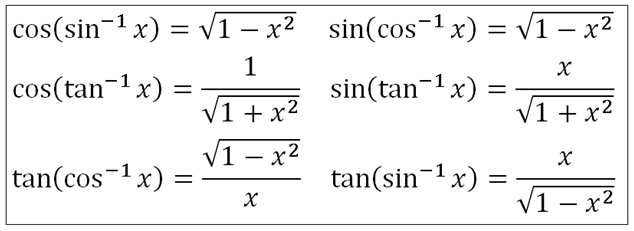
Im looking for a bit of help with inverse trig functions. The problem is cos(arcsin(15/17)+arccos(4/5))
I applied the cos sum formula, but i think i made a bigger mess. then im stuck with cos(arcsin(15/17)(4/5)-(15/17)sin(arccos(4/5))
umbral snow
sin²(x) + cos²(x) = 1
Letting x = arcsin(15/17)
(15/17)² + cos²(arcsin(15/17)) = 1
cos(arcsin(15/17)) = ±√[1 - (15/17)²]
You have to keep track of the quadrants in which you're working though.
So that also can be the negative root
celest pond
I ended up figuring it out by drawing out the triangles and got cos(arcsin(15/17)) = 8/17. but i guess this wont always work because that triangle happened to play nice. I also dont get why you're using that formula when my problem doesnt have and raised powers in it?
celest pond
I've got another one im stuck on. cos(2arctan(-2))
Im not sure where to start, i assume i need an identity or something to manipulate the 2 in front of the arctan?
 twin delta
good ol angle sum identities
celest pond
I keep coming back to this problem and i cant figure it out. Everytime i try something, it gets uglier and uglier
celest pond
I did, and then I applied the cos sum formula to it. cos(arctan(-2))cos(arctan(-2))-sin(arctan(-2))sin(arctan(-2))
twin delta
k hold up, i've been studying calc/stat all afternoon, gotta clear my head a tad


 twin delta
seems like a good way to go
celest pond
arctan(x) and tan^-1(x) are the same, right?
twin delta
right
spiral shuttle
=pup 9x+21=1
celest pond
cool, i got it. Thank you all
twin delta
trig can be annoying
but it also makes some things easier so i dunno, very bittersweet relationship
 median holly
Which angle in a 5 radius circle gets you the point (3,4)?
 wild hamlet
=pup calc arctan(4/3) in degrees